Hebrews 11:31

Greek (Tischendorf 8th ed.) Hebrews 11:31 appears in the Greek New Testament. The text above is from the Tischendorf 8th edition. Each word links to its Strong’s number and a concise gloss. Click any word for its full Thayer’s Greek Lexicon entry.
Download image
Cite this verse

Hebrews 11:31 (World English Bible). Public Domain. Lemma interlinear Bible study tool, https://lemma.gebible.app/v/hebrews/11/31.

Show BibTeX & RIS
BibTeX
RIS
English Translation
By faith, Rahab the prostitute, didn't perish with those who were disobedient, having received the spies in peace.
World English Bible · Public Domain
Highlights
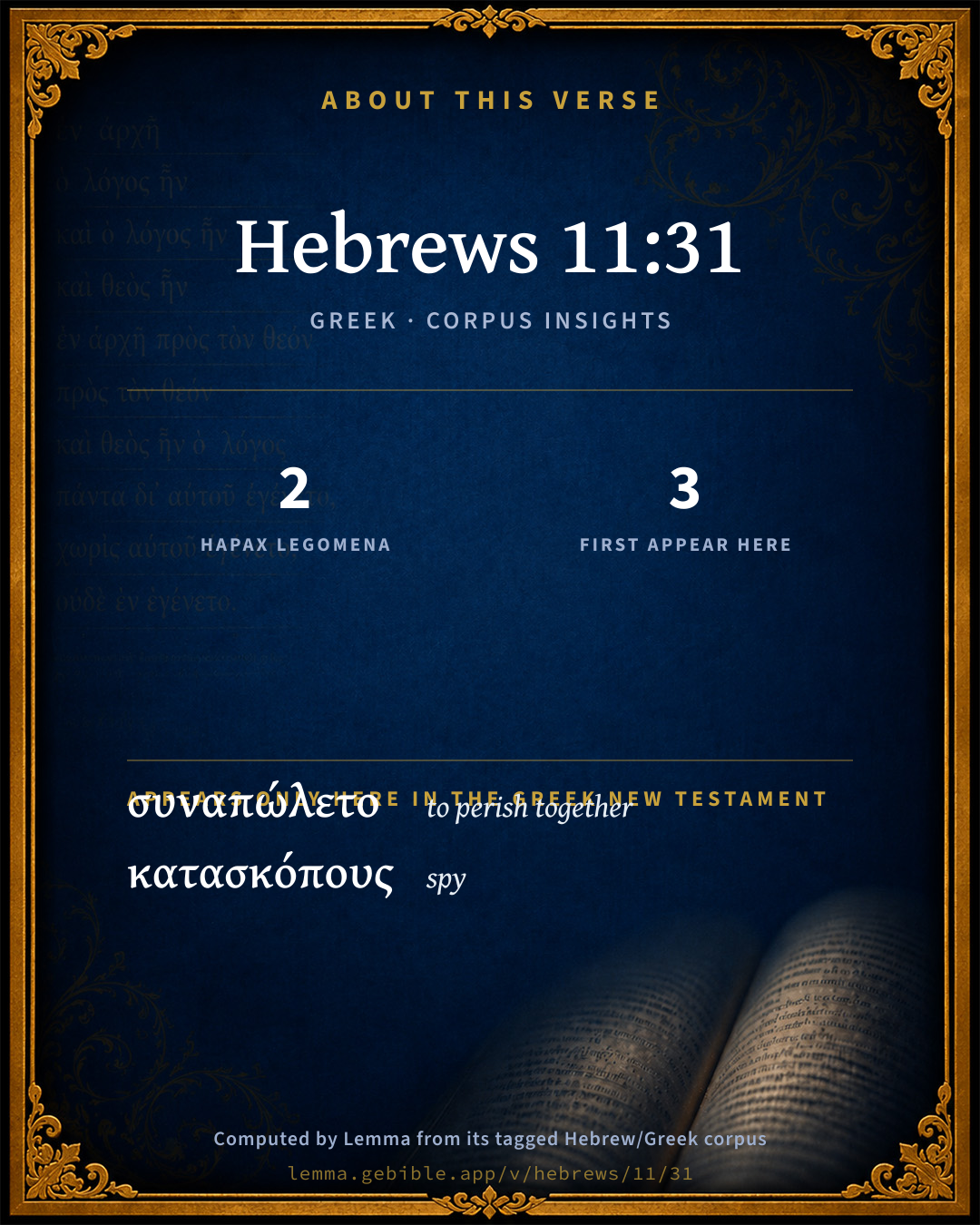
  • 2 hapax legomena — only here in the Greek New Testament
  • 3 first appearances in the Greek New Testament
Full analysis ↓
Download a study sheet

One document with this verse’s original text, its word-by-word gloss line, the meaning frame, cross-references with their text, attributed commentary, and full source and license credits — printable, and it pastes into notes with its structure intact.

This verse Autodidact and up

Study sheet (.html) Plain text (.txt)

A passage Seminary Student

Up to 50 verses in one chapter. A passage sheet keeps up to 6 commentary sources and 12 cross-references per verse, in the order this page ranks them, and says so on the sheet whenever that leaves anything out. Ask for a single verse and you get the Autodidact verse sheet above.

Everything on this page stays free to read, with no account — the sheet is a download of what is already on screen, not access to it.

Want to remove ads? Support Godless Engineer
Compare translations 3

The same verse in 3 English versions, stacked beneath the original-language interlinear above. Click any original word for its lexicon entry.

Each is an independent rendering of the whole verse — the interlinear is not word-aligned to these translations.

Highlighted words mark where these versions differ — a whole-verse word diff, not a word-by-word alignment.

  • World English Bible Public Domain
    By faith, Rahab the prostitute, didn't perish with those who were disobedient, having received the spies in peace.
  • King James Version Public Domain
    By faith the harlot Rahab perished not with them that believed not, when she had received the spies with peace.
  • unfoldingWord Literal Text CC BY-SA 4.0
    By faith Rahab the prostitute did not perish together with the ones having disobeyed, having welcomed the spies with peace.

unfoldingWord Literal Text — © unfoldingWord, licensed CC BY-SA 4.0. Word-aligned USFM3 via Door43 (git.door43.org/unfoldingWord/en_ult).

Versions to compare (up to 4)

3 of 4 selected

Show all 19 translations

Every available English version of this verse, each an independent rendering of the whole verse.

  • World English Bible Public Domain
    By faith, Rahab the prostitute, didn't perish with those who were disobedient, having received the spies in peace.
  • Berean Standard Bible Public Domain
    By faith the prostitute Rahab, because she welcomed the spies in peace, did not perish with those who were disobedient.
  • Majority Standard Bible Public Domain
    By faith the prostitute Rahab, because she welcomed the spies in peace, did not perish with those who were disobedient.
  • King James Version Public Domain
    By faith the harlot Rahab perished not with them that believed not, when she had received the spies with peace.
  • American Standard Version (1901) Public Domain
    By faith Rahab the harlot perished not with them that were disobedient, having received the spies with peace.
  • Revised Version (1885) Public Domain
    By faith Rahab the harlot perished not with them that were disobedient, having received the spies with peace.
  • Geneva Bible (1599) Public Domain
    By faith the harlot Rahab perished not with them which obeyed not, when she had receiued the spies peaceably.
  • Douay-Rheims (1899) Public Domain
    By faith Rahab the harlot perished not with the unbelievers, receiving the spies with peace.
  • Young's Literal Translation Public Domain
    by faith Rahab the harlot did not perish with those who disbelieved, having received the spies with peace.
  • Literal Standard Version CC BY-SA 4.0
    By faith Rahab the prostitute did not perish with those who disbelieved, having received the spies with peace.
  • Unlocked Literal Bible CC BY-SA 4.0
    It was by faith that Rahab the prostitute did not die with those who were disobedient, because she had received the spies in peace.
  • unfoldingWord Literal Text CC BY-SA 4.0
    By faith Rahab the prostitute did not perish together with the ones having disobeyed, having welcomed the spies with peace.
  • Darby Bible Public Domain
    By faith Rahab the harlot did not perish along with the unbelieving, having received the spies in peace.
  • World Messianic Bible Public Domain
    By faith Rahab the prostitute didn’t perish with those who were disobedient, having received the spies in peace.
  • Webster's Bible Public Domain
    By faith the harlot Rahab perished not with them that believed not, as she had received the spies with peace.
  • Free Bible Version CC BY-SA 4.0
    Trusting in God, Rahab the prostitute didn't die with those who rejected God, because she had welcomed the Israelite spies in peace.
  • Bible in Basic English Public Domain
    By faith Rahab, the loose woman, was not put to death with those who had gone against God's orders, because she had taken into her house in peace those sent to see the land.
  • Text-Critical English NT CC BY 4.0
    By faith Rahab the prostitute did not perish with those who were disobedient, because she had welcomed the spies in peace.
  • Tyndale New Testament (1534) Public Domain
    By fayth the harlot Raab perisshed not with the vnbelevers when she had receaved the spyes to lodgynge peaseably.

Literal Standard Version (2020), Covenant Press — licensed CC BY-SA 4.0. Text via the HelloAO Bible API (eBible.org). Unlocked Literal Bible (unfoldingWord) — licensed CC BY-SA 4.0. Text via the HelloAO Bible API (eBible.org). unfoldingWord Literal Text — © unfoldingWord, licensed CC BY-SA 4.0. Word-aligned USFM3 via Door43 (git.door43.org/unfoldingWord/en_ult). Free Bible Version, Dr. Jonathan Gallagher — licensed CC BY-SA 4.0. Text via the HelloAO Bible API (eBible.org).

Word by word

More ways to search: Search by grammar → Find every occurrence → Compare this word →

Practice this passage: Drill this verse → Learn its vocabulary →

συναπώλετο
synapóllymi
G4881
“to perish together”
Verb, Aorist, Middle, Indicative, 3rd person, Singular
Part of Speech
Verb
Tense
Aorist
Voice
Middle
Mood
Indicative
Person
3rd person
Number
Singular
Full Thayer's Definition

Origin: from G4862 and G622

TDNT: None

1. to destroy together 2. to perish together (to be slain along with)
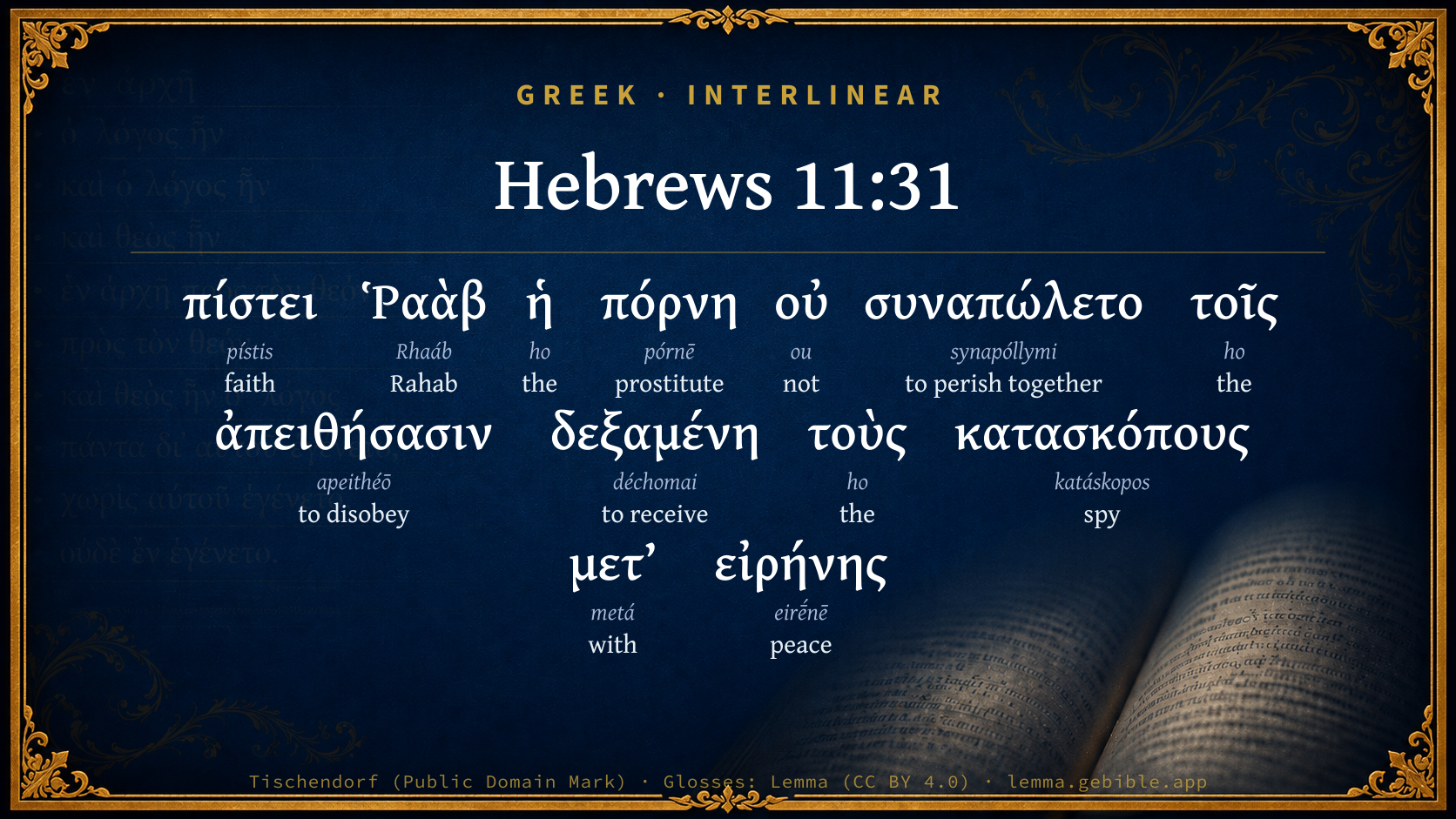
  1. πίστει pístis G4102 “faith” Noun, Dative, Singular, Feminine
  2. Ῥαὰβ Rhaáb G4460 “Rahab” Noun, Proper, indeclinable
  3. ἡ ho G3588 “the” Article, Nominative, Singular, Feminine
  4. πόρνη pórnē G4204 “prostitute” Noun, Nominative, Singular, Feminine
  5. οὐ ou G3756 “not” Particle, Negative
  6. τοῖς ho G3588 “the” Article, Dative, Plural, Masculine
  7. ἀπειθήσασιν apeithéō G544 “to disobey” Verb, Aorist, Active, Participle, Dative, Plural, Masculine
  8. δεξαμένη déchomai G1209 “to receive” Verb, Aorist, Middle deponent, Participle, Nominative, Singular, Feminine
  9. τοὺς ho G3588 “the” Article, Accusative, Plural, Masculine
  10. κατασκόπους katáskopos G2685 “spy” Noun, Accusative, Plural, Masculine
  11. μετ’ metá G3326 “with” Preposition
  12. εἰρήνης eirḗnē G1515 “peace” Noun, Genitive, Singular, Feminine

About this verse

These counts appear in no published source. They are computed here, from the morphology-tagged text and Lemma’s own curated glosses. What Lemma adds →

13
words
11
distinct lemmas
General Epistles
section

Notable vocabulary

2 hapax legomena — words that appear only here in the entire Greek New Testament:

  • συναπώλετο to perish together G4881
  • κατασκόπους spy G2685

First appearance in Scripture

These words make their first canonical appearance in the Greek New Testament here:

  • Ῥαὰβ Rahab G4460
  • συναπώλετο to perish together G4881
  • κατασκόπους spy G2685

Shared distinctive vocabulary

Ῥαὰβ Rahab G4460 occurs in 2 verses of the Greek New Testament. Also found in:

Repetition

A word recurs within this verse:

Cross-references

9

Topical passages linked to Hebrews 11:31 in the Treasury of Scripture Knowledge — connected by theme and wording, ordered by reader-vote popularity; previews shown in the World English Bible.

  • James 2:25 In like manner wasn't Rahab the prostitute also justified by works, in that she received the messengers, and sent them out another way?
  • Joshua 6:22–25 Joshua said to the two men who had spied out the land, Go into the prostitute's house, and bring out there the woman, and all that she has, as you swore to her.
  • Matthew 1:5 Salmon became the father of Boaz by Rahab. Boaz became the father of Obed by Ruth. Obed became the father of Jesse.
  • Joshua 2:1–24 Joshua the son of Nun sent out of Shittim two men as spies secretly, saying, Go, view the land, and Jericho. They went and came into the house of a prostitute whose name was Rahab, and lay there.
  • Matthew 1:1 The book of the generation of Jesus Christ, the son of David, the son of Abraham.
  • Joshua 1:1 Now it happened after the death of Moses the servant of Yahweh, that Yahweh spoke to Joshua the son of Nun, Moses' minister, saying,
  • Hebrews 3:18 To whom did he swear that they wouldn't enter into his rest, but to those who were disobedient?
  • 1 Peter 2:8 and, "A stone of stumbling, and a rock of offense." For they stumble at the word, being disobedient, whereunto also they were appointed.
  • 1 Peter 3:20 who before were disobedient, when God waited patiently in the days of Noah, while the ark was being built. In it, few, that is, eight souls, were saved through water.

Cross-references courtesy of OpenBible.info (CC BY 4.0).

Commentary

Notes on Hebrews 11:31 from classic Christian and Jewish commentators (each source and its license shown beneath its notes). The classic Christian expositions comment on the surrounding passage and are grouped to its opening verse, so a note may address several verses; the Jewish commentaries on the Tanakh (Rashi and others) are per-verse, so they appear only where the commentator wrote on this verse.

Lemma curates 59 commentaries, every one of them public domain or Creative Commons licensed, each selected and text-cleaned for this edition rather than reprinted as found. About our sources →

Jamieson, Fausset & Brown

Robert Jamieson, A. R. Fausset & David Brown

Rahab showed her "faith" in her confession, Jos 2:9, Jos 2:11, "I know that Jehovah hath given you the land; Jehovah your God, is God in heaven above, and in earth beneath."

the harlot--Her former life adds to the marvel of her repentance, faith, and preservation (Mat 21:31-32).

believed not--Greek, "were disobedient," namely, to the will of God manifested by the miracles wrought in behalf of Israel (Jos 2:8-11).

received--in her house (Jos 2:1, Jos 2:4, Jos 2:6).

with peace--peaceably; so that they had nothing to fear in her house. Thus Paul, quoting the same examples (Heb 11:17, Heb 11:31) for the power of faith, as James (Jam 2:21, Jam 2:25; see on Jam 2:21; Jam 2:25) does for justification by works evidentially, shows that in maintaining justification by faith alone, he means not a dead faith, but "faith which worketh by love" (Gal 5:6).

Jamieson, Fausset & Brown — Commentary Critical and Explanatory on the Whole Bible (1871) — public domain (CC PDM 1.0). Text via the HelloAO Bible API.

The Biblical Illustrator

Joseph S. Exell

Heb_11:31

Rahab

Rahab

1.

Think what a moral mixture the human heart may hold, what a mass of contradictions it is! Rahab, loyal lover to her kindred, traitor to her king, gifted with insight above her fellow-citizens, yet exposing herself to the scorn of man, possessed of a crude faith, yet selling her honour for gain l Surely the warp of heaven and the woof of hell were never woven together more strangely. Surely there never was such a peculiar character thrown off from the loom of life. But no, such contradictions are common, and that may be one of the reasons why her name is left on record. How many men do you know who are of perfectly simple moral character, who act from one motive, who are dominated by a single passion, whose conduct, under given circumstances, you can infallibly calculate? How many saints do you know who bear on them no traces of sin? How many sinners who show signs of nothing else? The best have their weak points: the worst retain some features of good.

2. Observe how independent religion may be of morality, how strong a hold faith in God may have in those on whom righteousness have a most imperfect grasp. Rahabs faith still held; while of her morals the less said the better. This is the perplexity of the present time, that so many men are honestly and ardently in love with goodness, and are yet able to do without God; and the converse, that a man may have faith in God and yet be wicked. Religion and righteousness are two different things, though ultimately one. They satisfy different needs of our nature. We may seek God for shelter. A man finds the world crumbling beneath his feet and he hides himself in the Eternal; or he is oppressed by the meagreness of his range of vision, and he flees to Him in whom there is no darkness at all; or he is crushed by pain, or he seeks help from Him who bears the cares of the world, and who can bring peace in the midst of sorrows. But morality! That is the souls working day and loins must be girded. Rest here means idleness, apathy, death, Moral progress must be struggled for; advance in purity implies a hotly-contested race. Religion brings rest; morality means toil. The noble, impassive soul, strong in affection but weak of will, makes much of religious help and consolation. He is not dishonest, but the ideal has never dawned on him of religion and morality clothed in double raiment, offering at the altar, body, soul and spirit.

3. Notice the power of even a rudimentary faith. In Rahabs case, a little religion went a long way. As some one says, faith is the one before the ciphers on the cheque presented at the bank of heaven. It is the beginning of all virtues. It may be crude at first, but it cannot continue so; for it brings the Spirit of God into the heart. The harlot Rahab, by her crude faith, stepped forth from the ranks of heathendom; and so the most disgraced child of man can be rescued from his sin, through faith in God. (A. Martin, M. A.)

Rahabs faith:

Some lessons of the story lie on its surface. How the publicans and the harlots may enter the kingdom of God before Sadducee and Pharisee--not in their sins, but washed from them, and inclined towards the possibilities of grace by the very fact that at least self-satisfaction is impossible--that at least boasting is excluded. Also we find here the recognition of a very imperfect knowledge and a very elementary faith, as having in it the root of the matter if it will but work. What was Rahabs knowledge, what was Rahabs faith, when she received the two Hebrew spies, hid them from discovery, and sent them out by another way? What Rahab knew was only this--that the God of Israel had wrought a great deliverance for His people, first in the exodus from Egypt, then in the wars of the march, and that evidently no power could stand against Him--she and her nation were foredoomed to discomfiture before this mighty God and this favoured race. Upon this small and elementary foundation of dogmatic truth was reared the superstructure of a changed and transformed life. She received with peace, with friendliness and hospitality, the emissaries of the invading people, protected them with ready inventiveness from the instant search and pursuit of her king--and was herself, in the terrible slaughter of her countrymen, incorporated, with all her house, into the conquering race, to become the ancestress, as St. Matthew teaches, of king David, and of the Messiah Himself. It would be a mistake, at anachronism, to apply to a dweller in one of the old Canaanite cities, amidst the worshippers of false and cruel deities, destitute of one ray either of law or gospel light, principles of conduct and character which we owe to the revelation of all truth and all duty by our Lord Jesus Christ. The Epistle is contented to say only this, Behold in the example of this woman the working of that faith which grasps the unseen. Behold the action of faith upon evidence presented and upon an alternative of conduct. Behold the inference of truth honestly drawn, and the preference, on the strength of it, of the future to the present. Behold, St. James adds, how faith differs from opinion, and evidences its existence by the sign of work. The hearts of other inhabitants of Jericho were melting, she tells us, with the terror of Israel--she alone acted upon the conviction and added another element to the great cloud of witnesses. We all see why the apostle should have singled out for mention the faith of this woman of Canaan. She was an instance of faith lifting a life out of the prejudices and partialities of birth and companionship, and making it willing, at the call of duty, to seek a new kindred and a new citizenship, amongst strangers, amongst aliens--if need be, amongst enemies. Her example is like that of Abraham leaving his birthplace, of Moses forsaking his palace--like these, yet, in degree, rising above them. For Abraham pitched his tent not amongst foes--and Moses, in renouncing the land of his adoption, returned to the citizenship of his birth and of his ancestry. She cast herself upon a hostile race, and had to unlearn every association, every habit, every feeling of the past. Thus might it be, at no distant day, with these Christians of Palestine. They were to suffer the sword of Rome to fall upon apostate Jerusalem--they were to raise no arm in her defence--on the contrary, when they saw her compassed with armies, when they saw the abomination of desolation stand in her holy place, they were to recognise the predicted token, and themselves to flee to the mountains. Christ must be more than country to those who would be worthy of Him. (Dean Vaughan.)

Rahabs faith

I. SAVING FAITH.

II. A SINGULAR FAITH.

III. A STABLE FAITH, which stood firm in the midst of trouble.

IV. A SELF-DENYING FAITH.

V. A SYMPATHISING FAITH. Desired mercy for her relations.

VI. A SANCTIFYING FAITH. (C. H. Spurgeon.)

Rahab

I. SHE POSSESSED SINGULAR FAITH.

1. She received no instruction from her parents.

2. She was not in a believing country.

3. Her means of knowledge were very slender; and therefore, the food of her faith was comparatively scant.

4. Perhaps the most wonderful thing about her faith was that she should be a woman of such a character. She was apparently the most unlikely person to become a believer in Jehovah. She was a harlot, a woman that was a sinner, and universally known to be such.

5. The subject of her faith was difficult.

II. HER FAITH WAS ACTIVE.

1. It was active mentally. When she believed, she began to think.

2. Her faith was active in her own sphere. Home duties are one of the very best forms of the activity of faith, especially in Christian women.

3. She did all this to the best of her ability, and she used her common sense.

4. She was also active at great risk.

III. RAHABS FAITH WAS MARRED WITH GROSS WEAKNESS. She lied unto the men who came to the door to seize the spies. There were, no doubt, in her conscience indistinct glimmerings of an idea that to lie was an evil thing, but, nevertheless, her surroundings prevented her clearly knowing it as we know it. To this very day among many orientals it is far more usual to lie than to speak the truth. You must judge individuals from their own standpoint, and consider their circumstances, or you may do them an injustice. I am not going to excuse Rahabs lie. A lie in Rahab, or in Abraham, is as bad as in any one else; but in this case there is this to be said, she had not been taught, as most of us have been, that a lie is a degrading sin. Her fault was by no means one which we can afford to throw stones at; avoid it carefully, but do not censure it self-complacently.

IV. Rahabs was A FAITH THAT WAS NOT ABOVE THE USE OF OUTWARD SIGNS AND SEALS. There are persons in the world who altogether despise the outward ordinances; they may be good, but they are not wise. Rahab first of all required from these spies an oath that they would preserve her, and next they gave her a token, a scarlet line, which was to be hung up in her window. This was the blood red flag of Israel. Was it not hoisted on the Passover night, so that the angel might pass by and deliver the people?

She felt great comfort when she had placed the token in her window. She was not superstitious; she did not believe that anything mystical was in the red cord, but she put it there, because she had been told to do so. Now, the highest faith in Christ is perfectly consistent with the obedient use of Christian ordinances.

V. HER FAITH WAS SAVING FAITH. I have shown how it was grievously marred, but it was effectual notwithstanding. So, true faith in Christ, despite its weakness, will save us, separate us from the world, join us unto Gods Israel, give us kinship with the Lord Jesus Christ; and what higher dignity is it possible to receive?

VI. HER FAITH BECAME WITH GOD ACCEPTABLE, SO THAT SHE WAS THE MEANS OF THE SALVATION OF OTHERS. Oh, I like this in Rahab, that she did not bargain for her own safety alone. Her sin had not hardened her heart as sin does in many cases. She thought of her father, and her mother, and her brothers, and her sisters. Now, wherever there is a real child of God there will be anxiety for his family. If you do not want to have)our children saved, you are not saved yourself. (C. H. Spurgeon.)

Sovereign grace:

Observe here

1. The person spoke of, Rahab, a Gentile, an Amorite, an harlot, who kept a victualling house in Jericho, and so was both harlot and hostess, defiled both in body and mind with idolatry and adultery.

2. What is spoken of her: she believed. Behold here a blessed instance

(1) Of the sovereignty and freedom of Gods grace.

(2) Of the power and efficacy of Divine grace, in calling and converting a person given up by her own choice to the vilest of sins; but no sinner nor sin is to be despaired of, in whose cure sovereign grace is engaged.

3. The effect and fruit of her faith, she received the spies with peace; that is, entertained them safely.

4. The benefit and advantage she received by her faith, she perished not; that is, when the credulous and idolatrous people of Jericho were destroyed, she and her family were preserved.

From the whole learn

1. That God is ready to show wonderful mercy to penitent sinners, if they return to Him and believe in Him, how great soever their sins have formerly been.

2. That true faith, wherever it is, will show itself by some eminent effect, and notable fruits of it.

3. That the rewards of faith are excellent and truly glorious; as she was preserved from the common ruin at Jericho, so shall all believers be saved from the wrath and destruction which shall come ere long upon the impenitent and unbelieving world. (W. Burkitt, M. A.)

Faith recognised and rewarded in the unworthy

I. AN ILLUSTRATION OF THE NATURE OF FAITH.

1. The character and circumstances of Rahab show that faith is not necessarily a Christian grace.

2. Her faith was but the reasonable acting of a thoughtful mind.

3. Its reality proved itself by works.

II. AN ILLUSTRATION OF GODS FAITHFULNESS.

1. Gods ready response to true faith, though it be characterised by ignorance and unworthiness.

2. This is seen in the remarkable preservation of Rahab.

3. And in her abundant reward for all her faith had hazarded in His cause.

III. AN ILLUSTRATION OF THE CONVERTING POWER OF FAITH IN GOD.

1. It separated her in character and doom from all her surroundings.

2. It made her the means of preserving all her kindred.

3. It allied her, an outcast Gentile, with the people of God. (C. New.)

The Biblical Illustrator, edited by Joseph S. Exell (c. 1880s–1900s) — public domain. Text from a community e-Sword module.

Joseph Benson's Commentary

Heb 11:31. By faith — Expressed in her words, recorded Jos 2:9-11, I know that the Lord hath given you the land, &c.; the harlot Rahab — That is, who had once been a harlot; but after she believed in the true God, it is reasonable to think she amended her manners, as well as repented of the lie by which she deceived the king of Jericho’s messengers. For that faith in the true God, which made her hazard her life in receiving and concealing the spies, must, when she attained to more knowledge, have wrought in her a thorough reformation; perished not with them that believed not — With the rest of the Canaanites in that city, among whom she dwelt; when she had received the spies — Hospitably, and dismissed them in peace, when an alarm was taken by her fellow-citizens, and they searched for them to destroy them.

Joseph Benson's Commentary on the Old and New Testaments (1811–1818) — public domain. Text from a community e-Sword module.

Tyndale Open Study Notes

Tyndale Open Resources

11:31 Rahab the prostitute (Josh 2; 6:25) showed faith in the power of the God of Israel by protecting the spies who came to her home (cp. Jas 2:25). As a result, she and her family were not destroyed but joined the community of Israel. In fact, Rahab was an ancestor of Jesus (Matt 1:5).

Tyndale Open Study Notes — © Tyndale Open Resources, licensed CC BY-SA 4.0. Text via the HelloAO Bible API.

Bengel's Gnomon

Johann Albrecht Bengel

Heb 11:31. Ἡ πόρνη, the harlot) אשה זונה, LXX. γυνὴ πορνὴ, a woman a harlot, Jos 2:1. This ground, on which Rahab was accustomed to receive strangers, even adds to our wonder that she was afterwards preserved.

Bengel's Gnomon of the New Testament — English translation (T&T Clark, Edinburgh, 1860) — public domain. Text from a community e-Sword module.

Meyer's Critical & Exegetical Commentary

Heinrich August Wilhelm Meyer

Heb_11:31. The example of the Gentile woman Rahab, Joshua 2; Jos_6:17; Jos_6:22 ff. Her conduct had proceeded from the recognition that the God of the Israelites is a God in heaven and upon earth, and from the confidence thereon based, that this God would lead them to victory. Comp. Jos_2:9 ff.

Ῥαὰβ ἡ πόρνη] Comp. Jam_2:25; Clem. Rom. ad Cor. c. 12. The epithet ἡ πόρνη is to be left in its literal sense. To interpret it, with Jac. Cappellus, Valckenaer, Heinrichs, and others, after the precedent of the Chaldee paraphrase and the Arabian version, by the hostess, or, with Hofmann, the harlots hostess, or, with Braun and others, the heathen woman, or finally, with Koppe (in Heinrichs) and others, the idolatress, is arbitrary. The designation of Rahab as ἡ πόρνη is an historic characterization, in accordance with Jos_2:2; Jos_6:17 ff., and without any ground of offence. For it has already been rightly observed by Calvin: hoc (epitheton) ad anteactam vitam referri certum est; resipiscentiae enim testis est fides. Comp. further, Mat_21:31-32.

τοῖς ἀπειθήσασιν] the inhabitants of Jericho. They had shown themselves disobedient, because they had resisted the people of God (Jos_6:1), although not to them either had the mighty deeds of this God remained unknown (Jos_2:10).

δεξαμένη τοὺς κατασκόπους μετʼ εἰρήνης] seeing she had received the spies with peace, i.e. without practising acts of hostility towards them, to which she might have been incited by reason of their nationality.

Meyer — Critical and Exegetical Commentary on the New Testament — English translation by Peter Christie, edited by Frederick Crombie (T&T Clark, 1880) — public domain. Text from a community e-Sword module.

Geneva Bible (1599)

Geneva Bible translators

Courteously and friendly, so that she did not only not hurt them, but also kept them safe.

A notable example of God’s goodness.

Rahab.

Geneva Bible (1599) marginal notes — public domain. Text via Bolls.life.

Adam Clarke's Commentary

Verse 31. The harlot Rahab perished not] See this account Jos 2:1; Jos 2:9; Jos 2:11, and Jos 6:23, where it is rendered exceedingly probable that the word זונה zonah in Hebrew, and πορνη in Greek, which we translate harlot, should be rendered innkeeper or tavernkeeper, as there is no proper evidence that the person in question was such a woman as our translation represents her. As to her having been a harlot before and converted afterwards, it is a figment of an idle fancy. She was afterwards married to Salmon, a Jewish prince; see Mt 1:5. And it is extremely incredible that, had she been what we represent her, he would have sought for such an alliance.

Received the spies with peace.] Μετ' ειρηνης· The same as בשלום beshalom, giving them a kind welcome, good fare, and protection. After these words the Slavonic adds: Και ἑτερᾳ ὁδῳ εκβαλουσα, and sent them out another way.

Adam Clarke's Commentary on the Bible (1810–1826) — public domain. Text from a community e-Sword/MySword module.

John Calvin's Commentaries

31. By faith the harlot Rahab, etc. Though at the first view, this example may seem, on account of the meanness of the person, hardly entitled to notice, and even unworthy of being recorded, yet it was not unsuitably, nor without reason, adduced by the Apostle. He has hitherto shown that the Patriarchs, whom the Jews most honored and venerated, did nothing worthy of praise except through faith; and that all the benefits conferred on us by God, even the most remarkable, have been the fruits of the same faith: but he now teaches us, that an alien woman, not only of a humble condition among her own people, but also a harlot, had been adopted into the body of the Church through faith.

It hence follows, that those who are most exalted, are of no account before God, unless they have faith; and that, on the other hand, those who are hardly allowed a place among the profane and the reprobate, are by faith introduced into the company of angels.

Moreover, James also bears testimony to the faith of Rahab, (James 2:25,) and it may be easily concluded from sacred history, that she was endued with true faith; for she professed her full persuasion of what God had promised to the Israelites; and of those whom fear kept from entering the land, she asked pardon for herself and her friends, as though they were already conquerors; and in all this, she did not consider men, but God himself. The evidence of her faith was, that she received the spies at the peril of her life: then, by means of faith, she escaped safe from the ruin of her own city. She is mentioned as a harlot, in order to amplify the grace of God.

Some, indeed, render זונה a hostess, as though she kept a public house, or an inn; but as the word means a harlot everywhere in Scripture, there is no reason why we should explain it otherwise in this place. The Rabbis, thinking it strange and disgraceful to their nation, were it said, that the spies entered into the house of a harlot; have invented this forced meaning. But such a fear was groundless; for in the history of Joshua, this word, harlot, is expressly added, in order that we may know that the spies came into the city Jericho clandestinely, and concealed themselves in a harlot’s house. At the same time this must be understood of her past life; for faith is an evidence of repentance.

John Calvin's Commentaries (1540-1563) — public domain. Text from the Calvin Translation Society English edition (1840s-50s) via the Christian Classics Ethereal Library (ccel.org). Calvin's coverage is partial (roughly two-thirds of the Bible); uncommented books and verses are honest gaps, never fabricated. The 19th-century editor's footnotes and remarks are omitted so the notes are faithfully Calvin's own voice.

Ellicott's Commentary for English Readers

(31) That believed not.—Bather, that were disobedient (see Heb_3:18; Heb_4:6; Heb_4:11). To her and to her countrymen alike had come the knowledge of what the Lord had done for Israel (Jos_2:10). She recognised from these signs, and acknowledged, the supremacy of Jehovah (Heb_11:11), and she cast in her lot with His servants; the men of Jericho continued in their disobedience, and perished (Jos_6:21). Through faith, therefore, a despised heathen woman became united with the people of God. With such an example these more detailed histories may fitly close.

A Bible Commentary for English Readers, edited by Charles John Ellicott (1878–1897) — public domain. Text from a community e-Sword module.

The Cambridge Bible for Schools and Colleges

gen. ed. J. J. S. Perowne

31. By faith] Jos_2:9-11, “The Lord your God, He is God.”

the harlot Rahab] So she is called in Jos_2:1; Jas_2:25, and it shews the faithfulness of the sacred narrative that her name is even introduced as well as that of Ruth, a Moabitess, in the genealogy of our Lord (Mat_1:5). The Targum softens it down into “innkeeper” and others render it “idolatress.” Her name was highly honoured by the Jews, who said that eight prophets—among them Baruch, Jeremiah, and Shallum—were descended from her, and the prophetess Huldah. Megillah f. 14. 2.

that believed not] Rather, “that were disobedient.”

The Cambridge Bible for Schools and Colleges (gen. ed. J. J. S. Perowne; Cambridge University Press, 1878–1918) — public domain. Text from a community e-Sword module.

John Gill's Exposition

Who through faith subdued kingdoms,.... As David did particularly; who subdued Syria, Moab, Ammon, Amalek, Edom, and the Philistines, Sa2 8:12. War, in some cases, is lawful; and kingdoms may be subdued; and faith makes use of means to do it: these kingdoms, though subdued by faith, yet not without fighting. Believers have no reason to be afraid of kings, or kingdoms; and this should encourage the saints, in their combats with the powers of darkness.

Wrought righteousness; exercised vindictive justice, in taking vengeance on the enemies of God, and his people; civil righteousness, in the discharge of their offices; and moral righteousness, in their conversation before God and men; which, being imperfect, was not justifying: wherefore they stood in need of another, and better righteousness, which is perfect and durable; and, in consequence of which being known, embraced, and received, men work righteousness: it may be observed, that to do works of righteousness in faith, and by it, is something very considerable; it is reckoned here among actions of the greatest fame; and that true faith is an operative grace, it works by love, and is always attended with works of righteousness; and that righteousness is a fruit and evidence of faith; and that faith is not the believer's righteousness; and that the righteousness of faith is not that which faith works, but which it receives.

Obtained promises; the promise of the land of Canaan; particular promises of victory over their enemies; promises concerning the Messiah, and of everlasting life and happiness: their faith was not the cause of promises being made, nor of their being fulfilled; but was the grace by which these believers received them, believed them, and waited for the accomplishment of them; and, in some sense, enjoyed the things promised before hand; their faith realizing things future and invisible to them: to obtain a promise from God is a great and marvellous thing; it is an instance of rich grace; and there is never a promise, but what is great in itself, and precious to the saints: all God's promises are obtained; they are sure, and are certainly fulfilled; and it is the work and business of faith to receive, and enjoy them.

Stopped the mouths of lions: a lion was slain by Samson, and another by David; but the most remarkable instance of stopping the mouths of lions, was in the den, into which Daniel was cast; and this may encourage the faith of God's people, when they are in the midst of men, comparable to lions; and may animate them not to fear the devouring lion, Satan.

John Gill's Exposition of the Whole Bible (1746–1763) — public domain (CC PDM 1.0). Text via the HelloAO Bible API.

Trapp's Complete Commentary

John Trapp

31 By faith the harlot Rahab perished not with them that believed not, when she had received the spies with peace.

Ver. 31. With them that believed not] To wit, that gave not credit to those common reports of God and his great works, but despised them as light news, and refused to be at the pains of further inquiry.

When she had received the spies] Whom to secure she told a lie, which was ill done. The apostle commends her faith in God, but not her deceit toward her neighbour, as Hugo well observeth.

John Trapp, A Commentary or Exposition upon All the Books of the Old and New Testament (1647–1656) — public domain. Text from a community e-Sword module.

Albert Barnes' Notes on the Bible

By faith the harlot Rahab - She resided in Jericho; Jos 2:1. When Joshua crossed the Jordan, he sent two men as spies to her house, and she saved them by concealment from the enemies that would have destroyed their lives. For this act of hospitality and kindness, they assured her of safety when the city should be destroyed, and directed her to give an indication of her place of abode to the invading Israelites, that her house might be spared; Jos 2:18-19. In the destruction of the city, she was accordingly preserved; Josh. 6. The apostle seems to have selected this case as illustrating the nature of faith, partly because it occurred at Jericho, of which he had just made mention, and partly to show that strong faith had been exercised not only by the patriarchs, and by those who were confessed to be great and good, but by those in humble life, and whose earlier conduct had been far from the ways of virtue. “Calvin.”

Much perplexity has been felt in reference to this case, and many attempts have been made to remove the difficulty. The main difficulty has been that a woman of this character should be enumerated among those who were eminent for piety, and many expositors have endeavored to show that the word rendered “harlot” does not necessarily denote a woman of abandoned character, but may be used to denote a hostess. This definition is given by Schleusner, who says that the word may mean one who prepares and sells food and who receives strangers to entertain them. Others have supposed that the word means “an idolatress,” because those devoted to idolatry were frequently of abandoned character. But there are no clear instances in which the Greek word, and the corresponding Hebrew word - זונה zownah - is used in this sense. The usual and the fair meaning of the word is what is given in our translation, and there is no good reason why that signification should not be retained here. It is not implied by the use of the word here, however, that Rahab was an harlot at the time to which the apostle refers; but the meaning is, that this had been her character, so that it was proper to designate her by this appellation. In regard to this case, therefore, and in explanation of the difficulties which have been felt in reference to it, we may remark:

(1) That the obvious meaning of this word here and of the corresponding place in Jos 2:6 is, that she had been a woman of abandoned character, and that she was known as such. That she might have been also a hostess, or one who kept a house of entertainment for strangers, is at the same time by no means improbable, since it not unfrequently happened in ancient as well as modern times, that females of this character kept such houses. It might have been the fact that her house was “known” merely as a house of entertainment that led the spies who went to Jericho to seek a lodging there. It would be natural that strangers coming into a place should act in this respect as all other travelers did, and should apply for entertainment at what was known as a public house.

(2) There is no improbability in supposing that her course of life had been changed either before their arrival, or in consequence of it. They were doubtless wise and holy men. Men would not be selected for an enterprise like this, in whom the leader of the Hebrew army could not put entire confidence. It is not unfair then to suppose that they were men of eminent piety, as well as sagacity. Nor is there any improbability in supposing that they would acquaint this female with the history of their people, with their remarkable deliverance from Egypt, and with the design for which they were about to invade the land of Canaan. There is evidence that some such representations made a deep impression on her mind, and led to a change in her views and feelings, for she not only received them with the usual proofs of hospitality, but jeoparded her own life in their defense, when she might easily have betrayed them. This fact showed that she had a firm belief that they were what they professed to be - the people of God, and that she was willing to identify her interests with theirs.

(3) This case - supposing that she had been a woman of bad character, but now was truly converted - does not stand alone. Other females of a similar character have been converted, and have subsequently led lives of piety; and though the number is not comparatively great, yet the truth of God has shown its power in renewing and sanctifying some at least of this, the most abandoned and degraded class of human beings. “Publicans and harlots,” said the Saviour, “go into the kingdom of God;” Mat 21:31. Rahab seems to have been one of them; and her case shows that such instances of depravity are not hopeless. This record, therefore, is one of encouragement for the most abandoned sinners; and one too which shows that strangers, even in a public house, may do good to those who have wandered far from God and virtue, and that we should never despair of saving the most abandoned of our race.

(4) There is no need of supposing that the apostle in commending this woman approved of all that she did. That she was not perfect is true. That she did some things which cannot be vindicated is true also - and who does not? But admitting all that may be said about any imperfection in her character, (compare Jos 2:4), it was still true that she had strong faith - and that is all that the apostle commends. We are under no more necessity of vindicating all that she did, than we are all that David or Peter did - or all that is now done by those who have the highest claims to virtue.

(5) She had strong faith. It was only a strong belief that Yahweh was the true God, and that the children of Israel were his people, which would have led her to screen the strangers at the peril of her own life; and when the city was encompassed, and the walls fell, and the tumult of battle raged she showed her steady confidence in their fidelity, and in God, by using the simple means on which she was told the safety of herself and her family depended; Jos 6:22-23.

With them that believed not - The inhabitants of the idolatrous city of Jericho. The margin is, “were disobedient.” The more correct rendering, however, is, as in the text, believed not. They evinced no such faith as Rahab had, and they were therefore destroyed.

Received the spies with peace - With friendliness and kindness; Jos 2:1 ff.

Albert Barnes' Notes on the Bible (1834–1885) — public domain. Text from a community e-Sword/MySword module.

Matthew Poole's English Annotations

By faith the harlot Rahab perished not with them that believed not; by the same gospel faith Rahab, who, as the Jews read the word, Jos 2:1, זונה; was an hostess, and kept a house of entertainment, and so came to lodge the spies; or, as the Septuagint read it, and the Holy Ghost confirms it here, and Jam 2:25, was a public harlot, who gat her livelihood by the prostitution of her body, as well as the sale of meat and drink: so notorious a sinner as she, and a Canaanite too, was preserved from the destruction that was inflicted by the Israelites on the unbelieving and disobedient inhabitants of Jericho, being, after her exclusion out of the camp, in order to a legal purifying, admitted into God’s church, and honoured by him to be a mother in Israel, from whom the Messiah should descend, Jos 6:23,25.

When she had received the spies with peace: the full proof of her being a believer, was her entertaining of the spies sent from Joshua to Jericho, preserving them when sought for, and dismissing them, advising them what they were to do in order to their safety, Jos 2:3,10, to the end. The ground of all this, was her faith in God’s promise of giving Canaan to Israel, confirmed by the great works she heard God had done for them, and her own expectation of good only in the portion of God’s people, to whom she desired to be united, which was afterwards accomplished. Neither doth Paul and James contradict each other concerning her faith and works, Jam 2:25; for she was empted from destruction by the same faith by which she was justified; and her faith was justified to be sound and true, by her carriage to the spies, for it was a full demonstration of her faith in God.

Matthew Poole's English Annotations on the Holy Bible (1683–1685) — public domain. Text from a community e-Sword/MySword module.

Whedon's Commentary on the Bible

Daniel D. Whedon

31. Harlot—Styled an innkeeper in the Chaldee paraphrase, and in the Arabic translation. And this interpretation has been followed by some commentators, including Adam Clarke. But both the Hebrew word and this Greek term, used also by St. James, (as also abundantly by Clement of Rome in his epistle,) are unequivocally harlot. There is no reasonable doubt that she belonged to a class of courtezans consecrated to Ashtaroth, the goddess of impure love. This obscene idolatry had its centre in Phoenician Sidon, and spread itself through Canaan during the residence of Israel in Egypt. It took its origin in adoration of the generative power of nature, implying a worship of the sun as source of generation, and of his queen, the moon. It had its stately houses of abode, where licentiousness was consecrated as a religious rite. It induced the wandering traveller to enter, furnishing both refuge and license. Hence, doubtless, Rahab was both hostess and harlot. Hers was a repentant faith in Jehovah, according to her own words, (Jos_2:11,) “Jehovah your God, he is God in heaven above, and in earth beneath.” She perished not in the terrible destruction of Jericho; she married a Hebrew, became mother of Boaz, and ancestress of Jesus. Note on Mat_1:2.

With peace—Perhaps by a welcoming salam preparatory to her forsaking the base rites of Ashtaroth and becoming a pure worshipper of Jehovah.

Daniel D. Whedon (gen. ed.), Commentary on the Old and New Testaments (1874–1909) — public domain. Text from a community e-Sword module.

The Pulpit Commentary

By faith Rahab the harlot perished not with them that were disobedient, when she had received the spies with peace. Rahab is instanced also by St. James (Jam_2:25) as having shown her faith by works. Such special notice of her is accounted for by her being so remarkable an instance of a heathen, an alien, one of the very doomed Canaanite race, being through faith adopted into the commonwealth of Israel, so as even to become an ancestress of the Messiah. (Mat_1:5) Faith is thus exhibited as the acceptable principle of religious action, not in Israel only, but in all races, as in all times. Rahab"s faith was in the omnipotence and supremacy of the God of Israel, induced by evidence of which she could not resist the force. (Jos_2:9-12) Her consequent action was to protect the spies, of course with great risk to herself, lest she should oppose the Divine will as she believed it. Her fellow-countrymen had the same evidence before them; but it caused them only to lose courage and faint, not to act on faith at all, either in their own gods or in the LORD; hence they are hero called "those who were disobedient (toiv apeiyhsasi)," i.e. resisted God"s will the same expression as is used of the Israelites who fell in the wilderness, (Heb_3:18) and of the contemporaries of Noah. (1Pe_3:20; cf. Act_19:9) That Rahab was, at the time when she thus evinced her faith, a harlot (such is certainly the meaning of pornh); that she lied to the King of Jericho"s messengers; (Jos_2:4, Jos_2:5) and that she treacherously aided the invaders of her country; have been felt as difficulties with regard to the position assigned her among the faithful. In reply to such aspersions on her character, it is usual to allege as follows: As to her harlotry, there is no reason to suppose that her profession was held in any disrepute among the Canaanites, or that she was aware of there being any harm in it; and that, at any rate after her conversion, she became the honorable wife of a chief in Israel. As to her lying, strict truthfulness in all circumstances was not likely to be known to her as a necessary virtue; Michal, not to mention others, lied to Saul"s messengers in order to save David"s live, and even some Christian casuists allow falsehood in such cases. As to her treachery, what she held to be her religious duty properly took precedence of any sentiment of hopeless patriotism; and, after all, what she did was only to save the spies from a cruel death, not to correspond with the enemy or open the gates of her city to them. Such excuses for what might seem amiss in her are valid. But the main point to be observed is this that, whatever her enlightenment, as a heathen, in principles of morality familiar to us Christians, she stands out in the sacred record as having been saved and admitted into Israel on account of her faith in the one true God, and action in accordance with her faith. What is said of Jael (Dr. Arnold"s "Sermons on Interpretation of Scripture") may be still more said of her: "They who serve him honestly up to the measure of their knowledge are according to the general course of his providence encouraged and blessed; they whose eyes and hearts are still fixed upwards, on duty, not on self, are precisely that smoking flax which he will not quench, but cherish rather, till the smoke be blown into a flame." Be it observed, however, that Jael"s murderous deed much less easily defensible than Rahab"s conduct is nowhere adduced in the New Testament as an instance of faith. Among the names that follow here Barak is mentioned, but not Jael. The only ground for supposing her to be approved in Scripture is her being called "blessed" in Deborah"s triumphal song, uttered in the flush of victory. But we are not bound to accept that "prophetess," however inspired for her peculiar mission, as an oracle on questions of morality.

The faith of a heathen woman. "By faith the harlot Rahab perished not, etc. What did Rahab believe? What does the Bible teach us concerning her faith? She exercised:

1. Faith in Jehovah as the true and supreme God. She believed in him not simply as a superior and powerful local or national deity, but as supreme over all beings universally. This is her confession, "Jehovah your God, he is God in heaven above, and in earth beneath". (Jos_2:11)

2. Faith in the fidelity and power of Jehovah to fulfill his purposes in relation to his people. "She said unto the men, I know that Jehovah hath given you the land"; (Jos_2:9) and therefore she was confident that they would actually come into possession of it.

a. Faith in the fidelity of the worshippers of Jehovah. She showed kindness to the spies, entered into an important agreement with them, and fulfilled her part of the agreement, evidently expecting them to fulfill their. (Jos_2:12, Jos_2:13, Jos_2:21) Three aspects of the faith of Rahab are suggested by our text.

b. FAITH IN AN UNLIKELY PERSON.

1. Rahab was an idolatrous Canaanite. She had not been blessed with parental instructions and home influences inclining her heart to faith in the true and holy God; but the reverse. She was the daughter of heathen parents, instructed in a loathsome and degrading idolatry, and belonged to a people whose "abominations and iniquities had become full, so that the land spued out its inhabitants, and the Lord could deal with them only in sheer destruction." Yet she believed sincerely and strongly in the living and true God.

2. Rahab was a known harlot. Whether she was such at the time she received the spies we know not, probably she was not; but if not then, she had been formerly, and was still known by the disgraceful title of "Rahab the harlot." But, as Bishop Hervey remarks, "it is very possible that to a woman of her country and religion such a calling may have implied a far less deviation from the standard of morality than it does with us; and, moreover, with a purer faith she seems to have entered upon a pure life."We should not have expected true religious faith in such a woman, much less conspicuous faith; but such faith she exemplified. Learn that the outwardly moral and respectable may be further from the kingdom of God than the openly disreputable. "A woman which was in the city, a sinner," was accepted by the blessed Savior much more than the prosperous, respectable Pharisee, Simon. (Luk_7:36-50) Jesus said unto "the chief priests and the elders of the people... Verily I say unto you, that the publicans and the harlots go into the kingdom of God before you," etc. (Mat_21:23, Mat_21:31, Mat_21:32)

II FAITH CLEARLY ENVINCED. Rahab manifested the reality of her faith:

1. In receiving the spies. She would not have shown courteous hospitality to any of the Israelites, who were dreaded and detested by her countrymen, but for her faith. "By faith Rahab received the spies with peace.

2. In concealing and delivering the imperiled spies at her own risk. (Jos_2:2-7, Jos_2:15, Jos_2:16, Jos_2:22) Grave objection has been raised to the conduct of Rahab in telling a lie in order to conceal and protect the spies. We have no wish to apologize for falsehood; but the objection is not a reasonable one. "Strict truth," says Bishop Hervey, "either in Jew or heathen, was a virtue so utterly unknown before the promulgation of the gospel, that, as far as Rahab is concerned, the discussion" of her conduct in deceiving the King of Jericho"s messengers with a false tale is quite superfluous. The objection also overlooks a very precious truth as to the relations and dealings of God with man. "God demands not of the feeble at the beginning the great works of consummate faith; he beholds even in the imperfect act the faith which prompts it, if faith is actually operating in its performance." St. James inquires, "Was not Rahab the harlot justified by works, in that she received the messengers, and sent them out another. (Jam_2:25)

3. In entering into a solemn contract with the spies and carrying out the terms of that contract. The compact she agreed to was a thing of life or death to her; and she kept her part of the compact, and exhibited even to the end steady confidence in the fidelity of the two spies to their engagement. Her actions proved the reality and strength of her faith.

III FAITH RICHLY REWARDED.

1. In the preservation of herself and her kindred when her fellow-citizens were destroyed. (Jos_6:22, Jos_6:23, Jos_6:25) "By faith Rahab the harlot perished not with them that were disobedient." Her fellow-citizens had heard the reports of what God had done for Israel, and of the remarkable victories which the Israelites had achieved, but they believed not in the God of Israel. They believed not that Israel"s God was the true God, and that Israel was the peculiar people of God, though they had evidence sufficient of it." Or, as Alford expresses it, "The inhabitants of Jericho were disobedient to the will of God manifested by the signs and wonders which he had wrought for Israel; as is implied by Rahab"s speech." (Jos_2:9-12) And they perished. But Rahab and her family were saved.

2. In the honorable distinction to which she attained. She is exhibited in this Epistle as an example of distinguished faith, and by St. James (Jam_2:25) as an example of conduct consistent with her faith. And, far higher than these commendations, as the wife of Salmon and the mother of Boaz she became an ancestress of our Lord and Savior Jesus Christ.

Our subject is full of encouragement for sinners to turn to God by faith in Jesus Christ. "Let the wicked forsake his way, and the unrighteous man his thoughts; and let him return unto the Lord," etc.. W.J. (Isa_55:6, Isa_55:7)

The Pulpit Commentary (1880–1919), ed. H.D.M. Spence-Jones & Joseph S. Exell — public domain. Text from a community e-Sword module.

John Wesley's Explanatory Notes

Rahab - Though formerly one not of the fairest character.

John Wesley, Explanatory Notes Upon the Whole Bible (1754–1765) — public domain. Text via the GEBible commentary corpus.

Burkitt's Expository Notes on the New Testament

William Burkitt

Observe here, 1. The person spoken of, Rahab, a Gentile, an Amorite, an harlot, who kept a victualling house in Jericho, and so was both harlot and hostess, defiled both in body and mind, with idolatry and adultery.

2. What is spoken of her; she believed: By faith Rahab, &,c. She was converted to God before the spies came to her, by what she had heard of him and his mighty works.

Behold here a blessed instance!

1. Of the sovereignty and freedom of God’s grace.

2. Of the power and efficacy of divine grace, in calling and converting a person given up by her own choice to the vilest of sins, even to the ravings of lust; but no sinner nor sin is to be despaired of, in whose cure sovereign grace is engaged.

Observe, 3. The effect and fruit of her faith, She received the spies with peace; that is, entertained them safely, concealed them, gave them intelligence, exposed herself to danger in the converance of them; an eminent fruit, a special evidence, and an high demonstration of her faith: indeed she told an officious lie; but God pardoned it, and the apostle here makes no mention of it; the Holy Ghost lays, as it were, the finger upon the scar, and covers it out of sight, contrary to the practice of the malignant world, who overlook all the good, and reflect only upon the evil of an action; whereas God takes notice of the good, but passes by the evil.

Observe, 4. The benefit and advantage she received by her faith, she perished not; that is, when the credulous and idolatrous people of Jericho were destroyed, she and her family were preserved.

From the whole learn, 1. That God is ready to show wonderful mercy to penitent sinners, if they return to him, and believe in him, how great soever their sins have formerly been.

Learn, 2. That true faith, wherever it is, will show itself by some eminent effect, and notable fruits of it.

Learn, 3. That the rewards of faith are excellent and truly glorious; as she was preserved from the common ruin at Jericho, so shall all believers be saved from that wrath and destruction which shall come ere long upon the impenitent and unbelieving world.

William Burkitt's Expository Notes on the New Testament (1700–1703) — public domain. Text from a community e-Sword module.

The People's New Testament

B. W. Johnson

31. By faith the harlot Rahab. See Josh. 2:1–22.

B. W. Johnson's The People's New Testament with Notes (1889–1891) — public domain. Electronic text from the Christian Classics Ethereal Library (CCEL) ThML edition.

Cambridge Greek Testament for Schools and Colleges

31. πίστει. Jos 2:9-11, “The Lord your God, He is God.”

ἡ πόρνη. So she is called in Jos 2:1; Jas 2:25; and it shews the faithfulness of the sacred narrative that her name is even introduced as well as that of Ruth, a Moabitess, in the genealogy of our Lord (Mat 1:5). The Targum softens it down into “innkeeper” and others render it “idolatress.” Her name was highly honoured by the Jews, who said that eight prophets—among them Baruch, Jeremiah, and Shallum, and the prophetess Huldah—were descended from her. Megillah, f. 14. 2.

τοῖς ἀπειθήσασιν. “That were disobedient.”

Cambridge Greek Testament for Schools and Colleges (Cambridge University Press, 1896; 21 vols, various authors incl. Carr, Maclear, Plummer, Farrar, Lumby, Moule, M. R. James, Simcox) — public domain. Text from a community e-Sword module.

Alford’s Greek Testament

Henry Alford

31.] The last example is one connected with the taking of Jericho, just mentioned. By faith (shewn in her confession Jos 2:9, “I know that Jehovah hath given you the land:” and ib. ver. 11, “Jehovah your God, He is God in heaven above and in earth beneath”) Rahab the harlot (not to be softened into “cauponaria,” as Valcknaer, al. Clement of Rome devotes to her a whole chapter of his Epistle to the Corinthians, and has no idea of her other than as an harlot. Calvin says well, “Hoc (epitheton) ad anteactam vitam referri certum est: resipiscentiæ enim testis est fides.” See note, Mat 1:5) did not perish with them who were disobedient (on the word ἀπειθέω, see note ch. 3:18. The inhabitants of Jericho were disobedient to the will of God manifested by the signs and wonders which he had wrought for Israel: as is implied by Rahab’s speech, Jos 2:9-12), having received (viz. to her house: κατέλυσαν ἐκεῖ, Jos 2:1) the spies (sent by Joshua to Jericho: ἀπέστειλεν Ἰησοῦς δύο νεανίσκους κατασκοπεῦσαι, Jos 2:1) with peace (reff.: so that they had nothing hostile to fear from her). On the introduction of Rahab in Jas 2:25, as an example of justification by works, see note there.

Henry Alford, The Greek Testament (1849–1861) — public domain. Text from a community e-Sword module.

Westcott on Hebrews & the Epistles of John

Brooke Foss Westcott

31. πίστει Ῥαάβ...] The record of the separation of the poople of God from Egypt is closed by the incorporation of a stranger.

Rahab at once looked forward with confidence to the triumph of Israel: Josh, ii. 9. Comp. James ii 25; Clem. R. i. 12 (διὰ πίστιν καὶ φιλοξενίαν ἐσώθη. Midr. Bemidbar R. 8 (on Num. vy. 9; Wtinsche, p. 136), (the ancestress of priests and prophets).

The addition of the title ἡ πόρνη places in a fuller light the triumph of Faith.

The liat of the champions of Faith whose victorics are specially noticed is closed by a woman and a gentile and an outcast. In this thero is a significant foreshadowing of its esscntial univorsality. So Theodoret: θαυμάσαι δὲ ἄξιον τὴν ἀποστολικὴν σοφίαν, μᾶλλον δὲ ὑμνῆσαι προσήκει τοῦ θείου πνεύματος τὴν ἐνέργειαν, ὅτι τῷ Μωύῦσεϊ.. καὶ τοῖς ἄλλοις ἁγίοις ἀλλόφυλον γυναῖκα καὶ πόρνην συνέταξεν, ἵνα καὶ τῆς πίστεως ἐπιδείξῃ τὴν δύναμιν καὶ καταστείλῃ τὴν ᾿Ιουδαίων ὀφρύν.

οὐ συναπ. τ. ἀπειθ.)} perished not with them that were disobedient, Vulg. non poriit cum incredulis. The form of expression places in relief the punishment of the disobedient; and the ground of their destruction. They too had heard of the wonders which God had wrought for His people and were not moved by them tosubmission.

For ἀπειθεῖν (of which the force is lost by the Latin Vulgate) see John fit. 36; Rom. ii. 8; c. ill, 18 note.

᾿ 5 ?¢ σασιν, δεξαμένη τοὺς κατασκόπους μετ᾽ εἰρήνης.

(5) 32-38. Faith in national life. tion of the chief types of victory (33— The entrance to Oanaan and tho 35 4). representative victory at Jericho (a) Representative herocs of the forma a close to a complete cycle of theocracy and the kingdom (32).

divine discipline. The history of Israel from the Call of Abraham to the occupation of the Promised Land offers a type of the religious history of man. So far then the writer of the Epistle has given examples of faith in detail. From this point he simply recites in a summary form the names and exploits of later heroes of Faith. In part (a) they wrought great things (32—35 a): in part (ὃ) they suffered great things (35 b— 38).

The enumeration extends to the time of the Maccabees, the last decisive national struggle of the Jews before the coming of Christ.

(a) The victorious successes of Faith : the great things which it has wrought (32—35 a).

¥ And what can I (why do I) say moref For the time will fatl me as 1 tell of Gideon, Barak, Sameun, Jephthah ; of David and Samuel and of the prophets: ™who through Jatth subdued kingdoms, wrought righteousness, obtained promises, stopped the mouths of lions, + quenchod the power of fire, escaped the edge GU the sword, from weakness were made strong, proved mighty in war, turned to flight armies of aliens. 35 Women received their dead by a resurrection.

The summary recital of these outward successes of Faith consists first (a) of two groups of names, which represent the th and the kingdom (9. 32); and then (8) of a descrip-

Brooke Foss Westcott (1825–1901), The Epistle to the Hebrews (1889) and The Epistles of St John (1883) — public domain (pre-1929). Text recovered from Internet Archive / Google Books OCR scans. Westcott’s Gospel of John commentary is not included (its OCR lost the chapter running-heads required for reliable verse-keying). Some Greek quoted in the Hebrews volume is imperfectly rendered by the OCR.

Lesson kit

Teaching starters — assembled from the data on this page, not authored interpretation. Every prompt links to the verse data it draws on. Edit before teaching.

Hebrews, in the General Epistles, opens this verse with 13 words (11 distinct Greek lemmas). Its most distinctive word is synapóllymi (“to perish together”). A historical commentator’s framing appears above. Read the whole chapter for the surrounding context.

Discussion questions

  1. How does “to perish together” (synapóllymi) shape what this verse is saying?
  2. This verse holds 2 words here found nowhere else in the Greek New Testament. What might the rare words draw attention to?
  3. 3 words here appear for the first time in Scripture. What is being introduced at this debut?
  4. James 2:25 shares the word «Rahab» with this verse. How do the two illuminate each other?
  5. “the” occurs 3× in this one verse. What is the effect of the repetition?
  6. The translations on this page render this verse differently — a whole-verse word diff, not a word-by-word alignment. What might account for the different wordings?
  7. Reading how Jamieson, Fausset & Brown and The Biblical Illustrator read this verse, where do the two commentators agree and where do they part?

Things to notice

  • 2 words in this verse appear nowhere else in the Greek New Testament.
  • 3 words make their first canonical appearance in Scripture here.
  • These translations choose different wording for 17 words in this verse.
  • “the” occurs 3× in this single verse.
  • 11 distinct Greek lemmas span 13 words in this verse.

Reading settings

Reading text

Shown beneath each verse's original-language words.

Old Testament
Old Testament edition

Read the OT as the Masoretic Hebrew (MT) or the Greek Septuagint (LXX).

English shown for the Greek Septuagint (in the Hebrew ↔ Greek comparison).

Comparing translations? Open the Compare panel on any verse page to stack up to four side by side.