
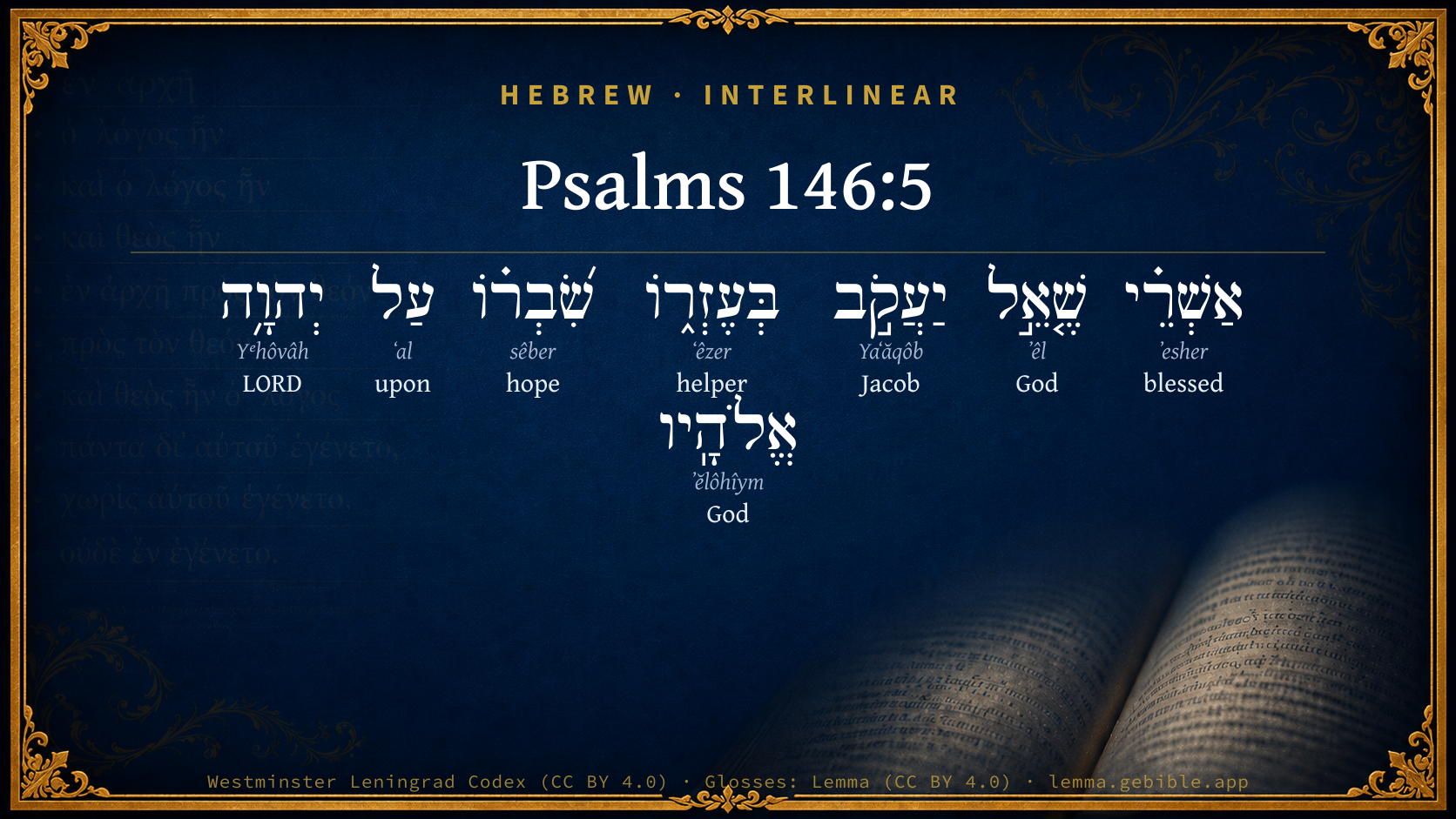
Psalms 146:5

Hebrew (Westminster Leningrad Codex) Psalms 146:5 appears in the Hebrew Old Testament. The text above is from the Westminster Leningrad Codex. Each word links to its Strong’s number, a concise gloss, and parsing drawn from the Open Scriptures Hebrew Bible morphology. Click any word for its full Brown-Driver-Briggs (BDB) entry.
Download image
Cite this verse

Psalms 146:5 (World English Bible). Public Domain. Lemma interlinear Bible study tool, https://lemma.gebible.app/v/psalms/146/5.

Show BibTeX & RIS
BibTeX
RIS
English Translation
Happy is he who has the God of Jacob for his help, Whose hope is in Yahweh, his God:
World English Bible · Public Domain
Download a study sheet

One document with this verse’s original text, its word-by-word gloss line, the meaning frame, cross-references with their text, attributed commentary, and full source and license credits — printable, and it pastes into notes with its structure intact.

This verse Autodidact and up

Study sheet (.html) Plain text (.txt)

A passage Seminary Student

Up to 50 verses in one chapter. A passage sheet keeps up to 6 commentary sources and 12 cross-references per verse, in the order this page ranks them, and says so on the sheet whenever that leaves anything out. Ask for a single verse and you get the Autodidact verse sheet above.

Everything on this page stays free to read, with no account — the sheet is a download of what is already on screen, not access to it.

Want to remove ads? Support Godless Engineer
Compare translations 3

The same verse in 3 English versions, stacked beneath the original-language interlinear above. Click any original word for its lexicon entry.

Each is an independent rendering of the whole verse — the interlinear is not word-aligned to these translations.

Highlighted words mark where these versions differ — a whole-verse word diff, not a word-by-word alignment.

  • World English Bible Public Domain
    Happy is he who has the God of Jacob for his help, Whose hope is in Yahweh, his God:
  • King James Version Public Domain
    Happy is he that hath the God of Jacob for his help, whose hope is in the LORD his God:
  • unfoldingWord Literal Text CC BY-SA 4.0
    The happinesses of who the God of Jacob for his help; his hope in Yahweh his God,

unfoldingWord Literal Text — © unfoldingWord, licensed CC BY-SA 4.0. Word-aligned USFM3 via Door43 (git.door43.org/unfoldingWord/en_ult).

Versions to compare (up to 4)

3 of 4 selected

Show all 18 translations

Every available English version of this verse, each an independent rendering of the whole verse.

  • World English Bible Public Domain
    Happy is he who has the God of Jacob for his help, Whose hope is in Yahweh, his God:
  • Berean Standard Bible Public Domain
    Blessed is he whose help is the God of Jacob, whose hope is in the LORD his God,
  • Majority Standard Bible Public Domain
    Blessed is he whose help is the God of Jacob, whose hope is in the LORD his God,
  • King James Version Public Domain
    Happy is he that hath the God of Jacob for his help, whose hope is in the LORD his God:
  • American Standard Version (1901) Public Domain
    Happy is he that hath the God of Jacob for his help, Whose hope is in Jehovah his God:
  • Revised Version (1885) Public Domain
    Happy is he that hath the God of Jacob for his help, whose hope is in the LORD his God:
  • Geneva Bible (1599) Public Domain
    Blessed is he, that hath the God of Iaakob for his helpe, whose hope is in the Lord his God.
  • Douay-Rheims (1899) Public Domain
    They shall speak of the magnificence of the glory of thy holiness: and shall tell thy wondrous works.
  • Young's Literal Translation Public Domain
    O the happiness of him Who hath the God of Jacob for his help, His hope `is' on Jehovah his God,
  • Literal Standard Version CC BY-SA 4.0
    O the blessedness of him || Who has the God of Jacob for his help, || His hope [is] on his God YHWH,
  • Unlocked Literal Bible CC BY-SA 4.0
    Blessed is he who has the God of Jacob for his help, whose hope is in Yahweh his God.
  • unfoldingWord Literal Text CC BY-SA 4.0
    The happinesses of who the God of Jacob for his help; his hope in Yahweh his God,
  • Darby Bible Public Domain
    Blessed is he who hath the ùGod of Jacob for his help, whose hope is in Jehovah his God,
  • World Messianic Bible Public Domain
    Happy is he who has the God of Jacob for his help, whose hope is in the LORD, his God,
  • Webster's Bible Public Domain
    Happy is he that hath the God of Jacob for his help, whose hope is in the LORD his God:
  • Free Bible Version CC BY-SA 4.0
    Happy are those who have the God of Jacob to help them—their hope is in the Lord their God—
  • Bible in Basic English Public Domain
    Happy is the man who has the God of Jacob for his help, whose hope is in the Lord his God:
  • JPS Tanakh (1917) Public Domain
    Happy is he whose help is the God of Jacob, whose hope is in the LORD his God,

Literal Standard Version (2020), Covenant Press — licensed CC BY-SA 4.0. Text via the HelloAO Bible API (eBible.org). Unlocked Literal Bible (unfoldingWord) — licensed CC BY-SA 4.0. Text via the HelloAO Bible API (eBible.org). unfoldingWord Literal Text — © unfoldingWord, licensed CC BY-SA 4.0. Word-aligned USFM3 via Door43 (git.door43.org/unfoldingWord/en_ult). Free Bible Version, Dr. Jonathan Gallagher — licensed CC BY-SA 4.0. Text via the HelloAO Bible API (eBible.org).

Word by word

More ways to search: Search by grammar → Find every occurrence → Compare this word →

Practice this passage: Drill this verse → Learn its vocabulary →

About this verse

These counts appear in no published source. They are computed here, from the morphology-tagged text and Lemma’s own curated glosses. What Lemma adds →

8
words
8
distinct lemmas
Wisdom
section

Notable vocabulary

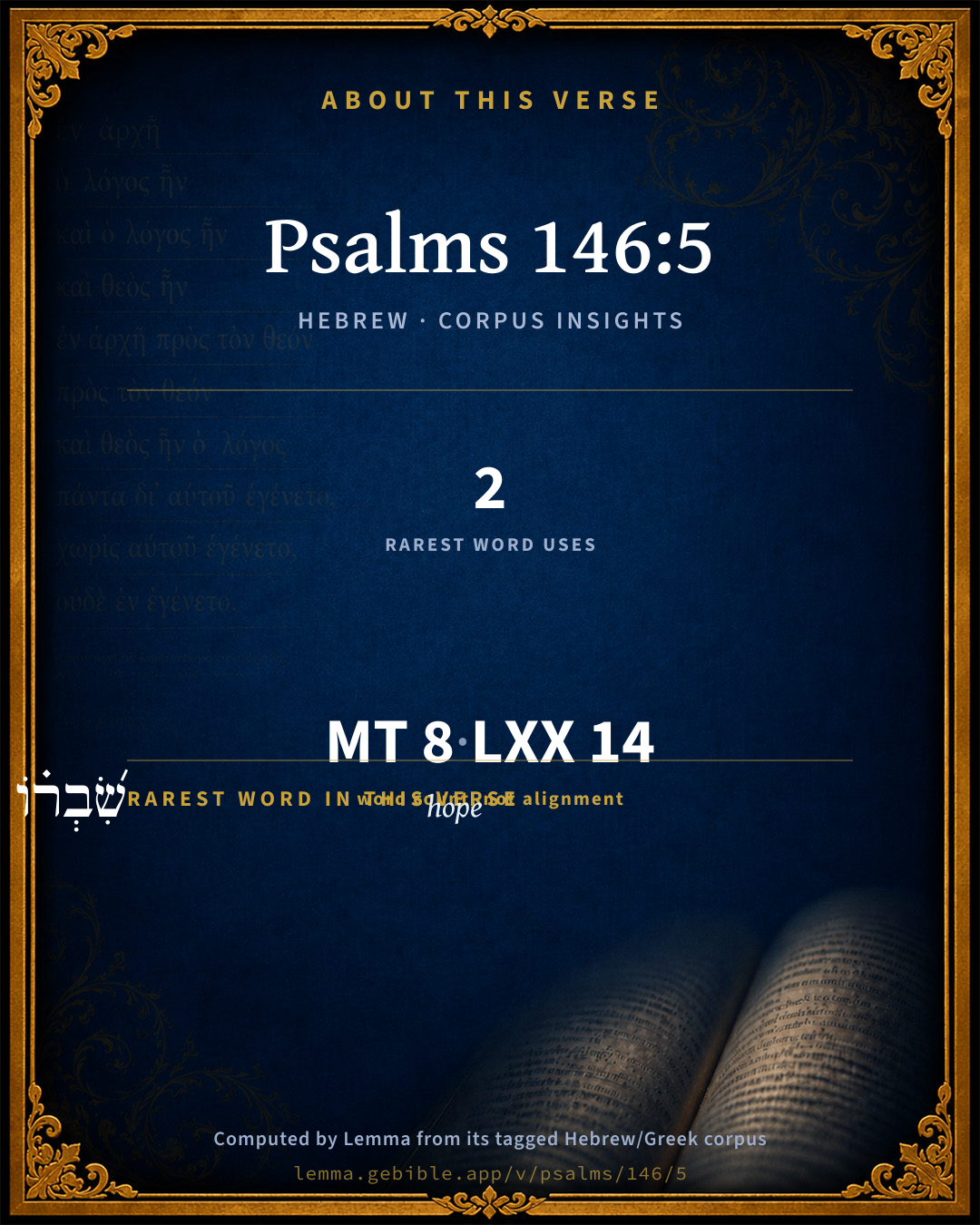
The rarest word here is שִׂ֝בְר֗וֹ hope H7664 — appearing just 2 times in the whole Hebrew Bible.

Shared distinctive vocabulary

שִׂ֝בְר֗וֹ hope H7664 occurs in 2 verses of the Hebrew Bible. Also found in:

Grammatical profile

  • 7 nouns
  • 1 preposition

Hebrew & Septuagint length

In English translation the verse runs 19 words from the Hebrew and 18 from the Septuagint (LXX English) — closely comparable.

A rough comparison of the two English renderings, which tokenize alike — not a word-level alignment.

Word counts can differ between the Hebrew and the Greek without any difference in meaning — e.g. the Hebrew direct-object marker אֵת has no separate Greek word, and Greek often adds the article ὁ.

In the original languages it is 8 Hebrew tokens and 14 Greek tokens — but the two are counted differently (Hebrew bundles its prefixes and suffixes into one token; the Greek is in lemma form), so that isn’t a like-for-like length.

Cross-references

14

Topical passages linked to Psalms 146:5 in the Treasury of Scripture Knowledge — connected by theme and wording, ordered by reader-vote popularity; previews shown in the World English Bible.

  • Jeremiah 17:7–8 Blessed is the man who trusts in Yahweh, and whose trust Yahweh is.
  • Psalms 144:15 Happy are the people who are in such a situation. Happy are the people whose God is Yahweh.
  • Psalms 71:5 For you are my hope, Lord Yahweh; My confidence from my youth.
  • Psalms 33:12 Blessed is the nation whose God is Yahweh, The people whom he has chosen for his own inheritance.
  • Psalms 46:11 Yahweh of Hosts is with us. The God of Jacob is our refuge. Selah.
  • Psalms 84:12 Yahweh of Hosts, Blessed is the man who trusts in you.
  • Genesis 32:24–29 Jacob was left alone, and wrestled with a man there until the breaking of the day.
  • Exodus 3:6 Moreover he said, "I am the God of your father, the God of Abraham, the God of Isaac, and the God of Jacob." Moses hid his face; for he was afraid to look at God.
  • Psalms 39:7 Now, Lord, what do I wait for? My hope is in you.
  • Psalms 46:7 Yahweh of Hosts is with us. The God of Jacob is our refuge. Selah.
  • Psalms 84:8 Yahweh, God of hosts, hear my prayer. Listen, God of Jacob. Selah.
  • 1 Peter 1:21 who through him are believers in God, who raised him from the dead, and gave him glory; so that your faith and hope might be in God.
  • Genesis 50:17 "So you shall tell Joseph, 'Now please forgive the disobedience of your brothers, and their sin, because they did evil to you.' Now, please forgive the disobedience of the servants of the God of your father." Joseph wept when they spoke to him.
  • Deuteronomy 33:29 Happy are you, Israel: Who is like you, a people saved by Yahweh, The shield of your help, The sword of your excellency! Your enemies shall submit themselves to you; You shall tread on their high places.

Cross-references courtesy of OpenBible.info (CC BY 4.0).

Hebrew and Greek witnesses Masoretic Hebrew ↔ Greek Septuagint

The same verse in the two great witnesses to the Old Testament, shown verse-for-verse.

You’re reading Greek Psalm 145 (Hebrew Psalm 146). The Septuagint counts the superscription, so verse numbers can differ from the Hebrew — chapter-level alignment, not verse-by-verse. Numbering follows Rahlfs.

These are two independent witnesses, not word-aligned to each other, and the Septuagint is shown in lemma (dictionary) form.

Hebrew Psalms 146:5 Masoretic · Westminster Leningrad Codex

אַשְׁרֵ֗י שֶׁ֤אֵ֣ל יַעֲקֹ֣ב בְּעֶזְר֑וֹ שִׂ֝בְר֗וֹ עַל יְהוָ֥ה אֱלֹהָֽיו

Happy is he who has the God of Jacob for his help, Whose hope is in Yahweh, his God:

World English Bible · Public Domain

Greek LXX Greek Psalm 145:5 Septuagint · lemma form

μακάριος ὅς ὁ θεός ἰακώβ βοηθός ὁ ἐλπίς αὐτός ἐπί κύριος ὁ θεός αὐτός

Blessed is he whose helper is the God of Jacob, whose hope is in the Lord his God:

LXX2012 (modern English Septuagint) · Public Domain

On this verse, The Treasury of David discusses the Septuagint’s reading. Read the note in Commentary ↓

Hebrew: Westminster Leningrad Codex (CC BY 4.0). Greek: Septuagint (public domain); English from LXX2012 (modern English Septuagint) (Public Domain). How the Septuagint differs from the Hebrew →

Commentary

Notes on Psalms 146:5 from classic Christian and Jewish commentators (each source and its license shown beneath its notes). The classic Christian expositions comment on the surrounding passage and are grouped to its opening verse, so a note may address several verses; the Jewish commentaries on the Tanakh (Rashi and others) are per-verse, so they appear only where the commentator wrote on this verse.

Lemma curates 59 commentaries, every one of them public domain or Creative Commons licensed, each selected and text-cleaned for this edition rather than reprinted as found. About our sources →

Matthew Henry's Commentary

The psalmist, having cautioned us not to trust in princes (because, if we do, we shall be miserably disappointed), here encourages us to put our confidence in God, because, if we do so, we shall be happily secured: Happy is he that has the God of Jacob for his help, that has an interest in his attributes and promises, and has them engaged for him, and whose hope is in the Lord his God.

I. Let us take a view of the character here given of those whom God will uphold. Those shall have God for their help, 1. Who take him for their God, and serve and worship him accordingly. 2. Who have their hope in him, and live a life of dependence upon him, who have good thoughts of him, and encourage themselves in him, when all other supports fail. Every believer may look upon him as the God of Jacob, of the church in general, and therefore may expect relief from him, in reference to public distresses, and as his God in particular, and therefore may depend upon him in all personal wants and straits. We must hope, (1.) In the providence of God for all the good things we need, which relate to the life that now is. (2.) In the grace of Christ for all the good things which relate to the life that is to come. To this especially the learned Dr. Hammond refers this and the following verses, looking upon the latter part of this psalm to have a most visible remarkable aspect towards the eternal Son of God in his incarnation. He quotes one of the rabbies, who says of Psa 146:10 that it belongs to the days of the Messiah. And that it does so he thinks will appear by comparing Psa 146:7, Psa 146:8, with the characters Christ gives of the Messiah (Mat 11:5, Mat 11:6), The blind receive their sight, the lame walk; and the closing words there, Blessed is he whosoever shall not be offended in me, he thinks may very well be supposed to refer to Psa 146:5. Happy is the man that hopes in the Lord his God, and who is not offended in him.

II. Let us take a view of the great encouragements here given us to hope in the Lord our God. 1. He is the Maker of the world, and therefore has all power in himself, and the command of the powers of all the creatures, which, being derived from him, depend upon him (Psa 146:6): He made heaven and earth, the sea, and all that in them is, and therefore his arm is not shortened, that it cannot save. It is very applicable to Christ, by whom God made the world, and without whom was not any thing made that was made. It is a great support to faith that the Redeemer of the world is the same that was the Creator of it, and therefore has a good-will to it, a perfect knowledge of its case, and power to help it. 2. He is a God of inviolable fidelity. We may venture to take God's word, for he keepeth truth for ever, and therefore no word of his shall fall to the ground; it is true from the beginning, and therefore true to the end. Our Lord Jesus is the Amen, the faithful witness, as well as the beginning, the author and principle, of the creation of God, Rev 3:14. The keeping of God's truth for ever is committed to him, for all the promises are in him yea and amen. 3. He is the patron of injured innocency: He pleads the cause of the oppressed, and (as we read it) he executes judgment for them. He often does it in his providence, giving redress to those that suffer wrong and clearing up their integrity. He will do it in the judgment of the great day. The Messiah came to rescue the children of men out of the hands of Satan the great oppressor, and, all judgment being committed to him, the executing of judgment upon persecutors is so among the rest, Jde 1:15. 4. He is a bountiful benefactor to the necessitous: He gives food to the hungry; so God does in an ordinary way for the answering of the cravings of nature; so he has done sometimes in an extraordinary way, as when ravens fed Elijah; so Christ did more than once when he fed thousands miraculously with that which was intended but for one meal or two for his own family. This encourages us to hope in him as the nourisher of our souls with the bread of life. 5. He is the author of liberty to those that were bound: The Lord looseth the prisoners. He brought Israel out of the house of bondage in Egypt and afterwards in Babylon. The miracles Christ wrought, in making the dumb to speak and the deaf to hear with that one word, Ephphatha - Be opened, his cleansing lepers, and so discharging them from their confinements, and his raising the dead out of their graves, may all be included in this one of loosing the prisoners; and we may take encouragement from those to hope in him for that spiritual liberty which he came to proclaim, Isa 61:1, Isa 61:2. 6. He gives sight to those that have been long deprived of it; The Lord can open the eyes of the blind, and has often given to his afflicted people to see that comfort which before they were not aware of; witness Gen 21:19, and the prophet's servant, Kg2 6:17. But this has special reference to Christ; for since the world began was it not heard that any man opened the eyes of one that was born blind till Christ did it (Joh 9:32) and thereby encouraged us to hope in him for spiritual illumination. 7. He sets that straight which was crooked, and makes those easy that were pained and ready to sink: He raises those that are bowed down, by comforting and supporting them under their burdens, and, in due time, removing their burdens. This was literally performed by Christ when he made a poor woman straight that had been bowed together, and could in no wise lift up herself (Luk 13:12); and he still does it by his grace, giving rest to those that were weary and heavily laden, and raising up with his comforts those that were humbled and cast down by convictions. 8. He has a constant kindness for all good people: The Lord loveth the righteous, and they may with the more confidence depend upon his power when they are sure of his good-will. Our Lord Jesus showed his love to the righteous by fulfilling all righteousness. 9. He has a tender concern for those that stand in special need of his care: The Lord preserves the strangers. It ought not to pass without remark that the name of Jehovah is repeated here five times in five lines, to intimate that it is an almighty power (that of Jehovah) that is engaged and exerted for the relief of the oppressed, and that it is as much the glory of God to succour those that are in misery as it is to ride on the heavens by his name Jah, Psa 68:4. (1.) Strangers are exposed, and are commonly destitute of friends, but the Lord preserves them, that they be not run down and ruined. Many a poor stranger has found the benefit of the divine protection and been kept alive by it. (2.) Widows and fatherless children, that have lost the head of the family, who took care of the affairs of it, often fall into the hands of those that make a prey of them, that will not do them justice, nay, that will do them injustice; but the Lord relieveth them, and raiseth up friends for them. See Exo 22:22, Exo 22:23. Our Lord Jesus came into the world to help the helpless, to receive Gentiles, strangers, into his kingdom, and that with him poor sinners, that are as fatherless, may find mercy, Hos 14:3. 10. He will appear for the destruction of all those that oppose his kingdom and oppress the faithful subjects of it: The way of the wicked he turns upside down, and therefore let us hope in him, and not be afraid of the fury of the oppressor, as though he were ready to destroy. It is the glory of the Messiah that he will subvert all the counsels of hell and earth that militate against his church, so that, having him for us, we need not fear any thing that can be done against us. 11. His kingdom shall continue through all the revolutions of time, to the utmost ages of eternity, v. 10. Let this encourage us to trust in God at all times that the Lord shall reign for ever, in spite of all the malignity of the powers of darkness, even thy God, O Zion! unto all generations. Christ is set King on the holy hill of Zion, and his kingdom shall continue in an endless glory. It cannot be destroyed by an invader; it shall not be left to a successor, either to a succeeding monarch or a succeeding monarchy, but it shall stand for ever. It is matter of unspeakable comfort that the Lord reigns as Zion's God, as Zion's king, that the Messiah is head over all things to the church, and will be so while the world stands.

Matthew Henry's Commentary on the Whole Bible (1708–1710) — public domain (CC PDM 1.0). Text via the HelloAO Bible API.

Trapp's Complete Commentary

John Trapp

Psa 146:5 Happy [is he] that [hath] the God of Jacob for his help, whose hope [is] in the LORD his God:

Ver. 5. Happy is he that hath the God of Jacob for his help] Since he is the King immortal, all powerful, as Psa 146:6, and no less willing, since he is a God in covenant.

Whose hope is in the Lord his God] This is a well grounded hope indeed, and such as will not drag after a man. The leper believed Christ’s power, "Lord, if thou wilt, thou canst make me clean." Martha believed his will to raise her dead brother, but doubted of his power; since he had now been four days in the grave. He that is confident of both is upon sure ground, and happy indeed.

John Trapp, A Commentary or Exposition upon All the Books of the Old and New Testament (1647–1656) — public domain. Text from a community e-Sword module.

The Biblical Illustrator

Joseph S. Exell

Psa_146:5

Happy is he that hath the God of Jacob for his help.

The God of Jacob

Few of Gods names are more suggestive than the one in the verse before us--the God of Jacob. It is very instructive, for example, and very comforting too, to find that God is willing to have His name so closely associated with that of a human being. The vastness of the material universe, with all its myriad hosts of suns and stars, sometimes staggers our faith, and makes us wonder if human life can really be the object of the Almighty care and love. To all such questionings we find an answer in this beautiful name. The God of unfathomable Space and immeasurable time is not unmindful of the life of man, The Lord of all those starry hosts--He also is the God of Jacob. And then this name shows, still further, that God cares not only for human beings, but for individual souls. The God of Jacob must be--

I. One who loves great sinners and pardons great transgressions. Sometimes a man feels as if he were too far gone in trespasses and sins to lift up his head in the presence of God, too full of utter selfishness and worldliness to dream of ever becoming a child of God at all. To such a man I would say, Just look at Jacob. If God became that mans God, surely He may become your God also. And sometimes one who has begun the Christian life, but has been overtaken in a fault, or in some other way has been backsliding in the path on which he started, loses heart and cries, Its useless for me to try to begin afresh; my nature is so weak, and the world around me is so strong. Again I would say, Look at Jacob! Bethel was Jacobs trysting-place with God; but long after Bethel was past Jacob sinned, and sinned again. And yet God did not forsake him or cast him away, but kept His hand upon him and carried him through, until, at last, He set his feet upon a rock and established his goings.

II. One who hears a sinners prayer. It is these prayers of Jacob which form the great redeeming feature of his character, and which, eventually, work out the mans salvation. With all his earthliness and selfishness he was a man who believed in God, and who believed also in prayer. The fact that he had a very sinful heart is no proof that his prayers were hypocritical. It teaches us, rather, that we must not wait untill we are saints before we begin to pray, for it is only by praying that we shall ever rise to any kind of sainthood.

III. One who purifies His sons by painful trial. Jacob has been called a Janus, with two faces, one turned upwards to heaven, the other downwards to hell. But Jacob was more than a Janus, for Janus only had two faces, while Jacob had two hearts. His two names point to his two natures--Jacob and Israel, the natural man and the spiritual man, the supplanter of his brother and the prince of God. Now, here was the problem of Jacobs life: How is the natural man to be spiritualized; how is the sinner to become a saint; how is the Jacob nature to be cast out, and the Israel nature to prevail? And this was the answer which God gave on every page of Jacobs history, It can only be done by sore and bitter trial. As a refiner of silver or gold deals with the impure but precious metal, so did God deal with this wayward child of His love. He sent him sorrow upon sorrow, until all the earthiness and dross was purged out of his heart, and Jacob became, not only in name, but in very nature, Israel, the Prince of God. (J. C,. Lambert, B. D.)

Happiness

I. Happiness in a worldly sense is an impossible attainment. This is proved--

1. By the wants, calamities, passions, and weaknesses of human nature. Each of these would prevent the attainment of happiness.

2. By the changing, transitory nature of the world and its contents. That pleasure which can be dashed away in a moment cannot be happiness.

3. By the fact that all here are under the dominion of sin. Sin blights all things, sin embitters all things, sin brings a curse on all things.

II. Happiness in a spiritual sense is a possible and a blessed reality. The reasons for this, given in our text, are two-fold--assistance in the present and hope in the future.

1. Assistance in the present. The God of Jacob is his help. Notice that a man may have difficulties and yet be happy. God is his help. Oh, what a help! His power, greatness, goodness, all exercised on the Christians behalf.

2. Hope for the future--Whose hope is in the Lord. Hope, even in the present, can give happiness. But this hope will one day be realized and its fruition will be perfect joy. It is in the Lord our God that perfect happiness is only to be found. May we seek Him for our help and make Him our hope. (Homilist.)

The Biblical Illustrator, edited by Joseph S. Exell (c. 1880s–1900s) — public domain. Text from a community e-Sword module.

J. A. Alexander on Psalms

Joseph Addison Alexander

5. (Psa 146:5) Happy lie whose help is the God of Jacob, (and) his reliance on Jehovah his God. Whose help, literally in whose help, i.e. engaged, employed in it, or more probably among whose helpers. Compare Psa 45:9; Psa 54:4; Psa 99:6; Psa 118:7. The divine name here used suggests the idea of almighty power, as opposed to that of human weakness. Reliance, literally expectation, hope; but the first idea is necessarily suggested by the preposition on.

Joseph Addison Alexander, The Psalms Translated and Explained (1850) — public domain. Text from a community e-Sword module.

Adam Clarke's Commentary

Verse 5. Happy is he that hath the God of Jacob for his help] While he that trusts in man is miserable, he that trusts in God is happy. In the son of man, בן אדם ben Adam, there is no help, תשועה teshuah, no saving principle. Every son of Adam naturally comes into the world without this, and must continue so till the Lord open the eyes of the blind, Ps 146:8; but a measure of light is given from that true Light which lighteth every man that cometh into the world. This son of Adam returns to his earth, לאדמתו leadmatho, to the ground, from which he was taken; this refers directly to Ge 2:7; Ge 3:19. But he that has the God for his help who helped Jacob in his distress, and was with him, and sustained him in and through all adversities, can never be destitute; for this God changes not; he lives for ever, and his projects cannot perish. He has purposed that Israel shall be delivered from this captivity. Cyrus may change, but God will not; trust therefore in HIM. He has all power; he made heaven and earth; he has them under his government and at his disposal; and should earth itself fail, heaven endures. And he keeps his truth for ever; and therefore his promises must be fulfilled to them that trust in him. Fear not.

Adam Clarke's Commentary on the Bible (1810–1826) — public domain. Text from a community e-Sword/MySword module.

John Calvin's Commentaries

5. Blessed is he, etc. As it would not have been enough to reprove the sin, he submits the remedy upon which the proper correction of it depends; and this is, that the hopes of men are only stable and well-founded when they rest entirely upon God. For even the wicked sometimes come the length of acknowledging the folly of trust in man. Accordingly they are often angry with themselves for being so inconsiderate as to expect deliverance from men; but by neglecting the remedy, they are not extricated from their error. The Psalmist having condemned the infatuation, which we have seen to be natural to us all, wisely subjoins that they are blessed who trust in God. Jeremiah observes the same order. (Jeremiah 17:5, 7.)

“Cursed is he that trusteth in man, and maketh flesh his arm,” etc.;

and then — “Blessed is the man whose hope the Lord is.” When David pronounces those blessed whose help is the Lord, he does not restrict the happiness of believers to present sense, as if they were only happy when God openly and in outward acts appeared as their helper, but he places their happiness in this — that they are truly persuaded of its being entirely by the grace of God they stand. He calls him the God of Jacob, to distinguish him from the multitude of false gods in which unbelievers gloried at that time; and there was good reason for this; for while all propose to themselves to seek God, few take the right way. In designating the true God by his proper mark, he intimates that it is only by an assured faith of adoption that any of us can rest upon him; for he must show himself favorable to us before we can look for help from him.

John Calvin's Commentaries (1540-1563) — public domain. Text from the Calvin Translation Society English edition (1840s-50s) via the Christian Classics Ethereal Library (ccel.org). Calvin's coverage is partial (roughly two-thirds of the Bible); uncommented books and verses are honest gaps, never fabricated. The 19th-century editor's footnotes and remarks are omitted so the notes are faithfully Calvin's own voice.

Ellicott's Commentary for English Readers

(5) For the different aspects of the Divine nature and character inspiring trust see Introduction. With this verse comp. Psa_33:12; Psa_144:15.

Hope.—The Hebrew word is rare in the psalter, expressing earnest” looking for,” or “waiting for.” (See Psa_104:27; Psa_119:166.)

A Bible Commentary for English Readers, edited by Charles John Ellicott (1878–1897) — public domain. Text from a community e-Sword module.

The Cambridge Bible for Schools and Colleges

gen. ed. J. J. S. Perowne

5. Happy is he, whose help is the God of Jacob;

Whose hope resteth upon Jehovah his God.

Cp. Psa_33:12; Psa_144:15; Psa_20:1. The word for hope is Aramaic, and is found elsewhere only in Psa_119:116 : the cognate verb is used in Psa_145:15 (A.V. wait).

The Cambridge Bible for Schools and Colleges (gen. ed. J. J. S. Perowne; Cambridge University Press, 1878–1918) — public domain. Text from a community e-Sword module.

John Gill's Exposition

Happy is he that hath the God of Jacob for his help,.... The God of the patriarch Jacob, the Messiah, who is that God that fed him all his life, the Angel that redeemed him from all evil, with whom in the form of a man he wrestled, when he had power over God, and saw him face to face; the God of the posterity of Jacob, the Angel of Jehovah's presence, who went before them by day and night in the wilderness, and saved and carried them all the days of old; the God of spiritual Jacob, or Israel, the church of the chosen, redeemed, and called ones; the God of every Israelite indeed, of every true believer, as he was Thomas's Lord and God: now happy is that man that has him for his help, who helps his servant Israel, all his people out of the sad estate of sin and misery into which they are brought; helps them to all the blessings of grace, and to all the supplies of it in their time of need; helps them under all their infirmities, temptations, and afflictions; helps them in all their way to heaven, and against every enemy of their souls; and at last helps them to everlasting glory and happiness;

whose hope is in the Lord his God; in Immanuel, God with us, God manifest in the flesh; Christ the hope of Israel, and the Saviour thereof; who is our hope, and in all his people the hope of glory; not only the author and giver of the grace of hope, but the object, ground, and foundation of it: now happy is that man whose hope alone is in him; who hopes for salvation, pardon, righteousness, and eternal life, through him, and him only; such are safe and secure, who, as prisoners of hope, turn to him their strong hold; those shall want no good thing that hope and trust in him; they have peace now through his blood and righteousness, and shall be saved with an everlasting salvation; see Jer 17:7.

John Gill's Exposition of the Whole Bible (1746–1763) — public domain (CC PDM 1.0). Text via the HelloAO Bible API.

Albert Barnes' Notes on the Bible

Happy is he that hath the God of Jacob for his help - Who may rely for protection on the God who defended Jacob in his travels and dangers. Or, perhaps the word Jacob is used here collectively to denote Israel - the Jewish people: the God whom they adore and worship, rather than the gods of the pagan. Compare Psa 144:15, note; Psa 54:4, note.

Whose hope is in the Lord his God - In Yahweh, worshipped as his God. That is, who truly worships Yahweh, or makes Yahweh his God.

Albert Barnes' Notes on the Bible (1834–1885) — public domain. Text from a community e-Sword/MySword module.

The Treasury of David

Charles H. Spurgeon

Ver. 5. Happy is he that hath the God of Jacob for his help. Heaped up is his happiness. He has happiness indeed: the true and the real delight is with him. The God of Jacob is the God of the covenant, the God of wrestling prayer, the God of the tried believer; he is the only living and true God. The God of Jacob is Jehovah, who appeared unto Moses, and led the tribes of Jacob out of Egypt, and through the wilderness. Those are happy who trust him, for they shall never be ashamed or confounded. The Lord never dies, neither do his thoughts perish: his purpose of mercy, like himself, endures throughout all generations. Hallelujah!

Whose hope is in the LORD his God. He is happy in help for the present and in hope for the future, who has placed all his confidence in Jehovah, who is his God by a covenant of salt. Happy is he when others are despairing! Happiest shall he be in that very hour when others are discovering the depths of agony. We have here a statement which we have personally tried and proved: resting in the Lord, we know a happiness which is beyond description, beyond comparison, beyond conception. O how blessed a thing it is to know that God is our present help, and our eternal hope. Full assurance is more than heaven in the bud, the flower has begun to open. We would not exchange with Caesar; his sceptre is a bauble, but our bliss is true treasure.

In each of the two titles here given, namely, "the God of Jacob", and "Jehovah his God", there is a peculiar sweetness. Either one of them has a fountain of joy in it; but the first will not cheer us without the second. Unless Jehovah be his God no man can find confidence in the fact that he was Jacob's God. But when by faith we know the Lord to be ours, then we are "rich to all the intents of bliss."

Ver. 5. Happy is he. This is the last of the twenty-five places (or twenty-six, if Ps 128:2 be included) in which the word ashre, with which the psalter begins, is found. Speaker's Commentary.

Ver. 5. Alas, how often do we trust when we should be afraid, and become afraid when we should trust! Lange's Commentary.

Ver. 5. The God of Jacob. A famous and significant description of God; and that, First, in respect of his nature, or the verity and reality of his being and excellence. He is styled here by way of elegancy or emphasis, "The God of Jacob", saith Mollerus, to discern and distinguish the true God of Israel from all Heathenish deities, and to explode all fictitious gods and all worships thereof. As the true God is the God of Jacob, so the God of Jacob is the true God. He is God alone, and there is no other besides him...Secondly. This title or appellation serves also to describe him in his special relation to his people. We find him called by our Psalmist, "The mighty God of Jacob": Ps 132:5. He is indeed the God of the whole earth, but in a peculiar manner "the God of Israel": Mt 15:31...It is observable in Scripture that he styles not himself so frequently, in his revelations of himself to them, "the God of heaven and earth" (though that also is a title full of encouragement), but "the God of Abraham, Isaac, and Jacob"; as if he had borne such choice goodwill, and had such a peculiar care for these three men, as to overlook all the world besides them. So near and intimate relation have God's people to him, that their interests are mutually involved, and twisted in a reciprocal and covenant bond. They are his, he is their portion; their Beloved is theirs and they are his: they are called by his name, the saints are styled his "holy ones", and the Church is termed expressly "Christ." Yea, he condescends to be called by their name; he assumes the name of Jacob, Ps 24:6: "This is the generation of them that seek him, that seek thy face, O Jacob:" From "The Saints' Ebenezer", by F.E., 1667.

Ver. 5. The God of Jacob. This verse aptly warrants us to apply to all believers all the illustrations of help and hope furnished by Jacob in his exile when none but God could help him. Simon de Muis.

Ver. 5-6. The God of Jacob...which wade heaven and earth, the sea, and all that therein is. It is a characteristic of these Psalms, to proclaim to all nations which worshipped idols, that "the God of Jacob", "the God of Zion", is the Creator and Governor of all things; and to make an appeal to all nations to turn to him. All these Psalms have a missionary character and an evangelical function. We may compare here the apostolic prayer at Jerusalem, after the descent of the Holy Ghost at Pentecost: "They lifted up their voices to God with one accord, and said, Lord, thou art God, that made heaven and earth, and the sea, and all that in them is" (where the words are the same as in the Septuagint in this place): "Who by the mouth of thy servant David hast said. Why do the heathen rage?" Ac 4:24-25 The office of these Psalms is to declare to the universe, that Jehovah, and he alone, is Elohim; and to invite all to worship him as such, by their oft repeated Hallelujah. Christopher Wordsworth.

Ver. 5. The secret of true happiness.

1. What it is not. The man here mentioned has his work and warfare, for he needs help; and he has not all he desires, for he is a man of hope.

2. What it is. It lies in the hath, the help, and the hope, and these are all in God.

Psalms 146:6*

Charles H. Spurgeon's The Treasury of David (1869–1885) — public domain. Psalms only. Text from a community e-Sword/MySword module.

Whedon's Commentary on the Bible

Daniel D. Whedon

5. Happy—The first word of the Psalms occurs here for the twenty-fifth and last time. It is a word of great force, always exclamatory. “O the blessednesses!”

Daniel D. Whedon (gen. ed.), Commentary on the Old and New Testaments (1874–1909) — public domain. Text from a community e-Sword module.

The Pulpit Commentary

Happy is he that hath the God of Jacob for his Help. "God of Jacob" is a favorite expression in the later psalms, where it almost supersedes the phrase, "God of Israel". (see Psa_76:6 Psa_81:1, 4 84:8 94:7 114:7 132:2, 5; and the present passage) It is rare in the historical books and in the prophets. Whose hope is in the Lord his God. (comp. Psa_22:9 Psa_39:7 Psa_62:5 Psa_71:5, etc.)

Vers. 5-10. The happiness of him that hath the God of Jacob for his Help and Hope.

These verses are a statement of the solid reasons of that happiness.

I THE LORD"S INFINITE POWER. (Ver. 6) He is the Creator of the heavens and the earth, "the sea, and all that therein is." He is the mighty God, and infinite in power.

II HIS ETERNAL TRUTH. He is faithful to his Word; he "keepeth truth for ever." None ever trusted in him and found his Word to fail. Contrast this with human help.

III HIS BOUNDLESS COMPASSION. See what an array of poor, helpless, and miserable ones are here enumerated as the special objects of his goodness.

1. The oppressed. (Ver. 7) For them, when none else can or will, he executeth judgment, and avenges them of their adversaries.

2. The hungry, the starving poor; to them he giveth food.

3. The prisoner; those immured in the tyrant"s dungeon, or shut up in rigid captivity.

4. The blind. In all ages, in the lands of the Bible, blindness was a calamity as common as it was terrible; to give them sight was, therefore, one of the chiefest mercies of God, and declared his bounty and goodness as great indeed.

5. The bowed down. What a vast company of these human experience has ever furnished! The burden of care, the weight of responsibility, the crushing power of sorrow, these are ever at work to recruit the ranks of the bowed down. But it is the Lord"s special office an office to the fulfillment of which not only the psalmist here, but myriads of God"s people in all ages, bear their testimony, to raise up them that be bowed down. (Luk_13:10-17)

6. The strangers. In our day, in Christian lands, the stranger is not so forlorn a being as he undoubtedly was in the days of the psalmist. Then, to live on the other side of a river flowing between one territory and another, made a man a rival, a foe, as the very etymology of the word "rival" tells, and bound you to treat him as your deadly enemy. Hence, for a man to be a stranger in a strange land was to be exposed to all manner of insult and wrong, and to be in continual peril of life itself. Israel had been such a stranger, and knew all the miseries of such a lot; but he here bears his testimony that "the Lord preserveth the strangers.

7. The desolate by bereavement. The fatherless and the widow are selected as types of the most desolate of all. Remember the parable of the importunate widow as showing the peril of oppression on the part of cruel adversaries, and of neglect and injustice on the part of a corrupt and unscrupulous judge. If God did not interfere for these desolate ones, none other would. But "he relieveth," etc. Such is the compassion of the Lord our God; and when a man knows this, not merely by hearing of it, but by actual experience, how can he keep from rendering praise to the Lord? The very stones would cry out if he were silent.

IV HIS PERFECT RIGHTEOUSNESS. Hence it is that he executeth judgment for the oppressed, He will not suffer wrong to prevail; but" the way of the wicked he turneth upside down," for "the Lord loveth the righteous." It is delightful to think of the compassion of God; but even that would not so stir our hearts were it not that it is all based on righteousness. Man"s great longing is for justice right between man and man but as yet he has never fully attained to it; and he never will until the righteous Lord, who loveth the righteous, is recognized and rejoiced in as our Lord and King. But even here and now God gives us to see his righteousness; for have we not read and heard of and seen, and that again and again, "the way of the wicked" turned "upside down"? Here, again, is another full-flowing fountain of praise.

V HIS PERPETUAL REIGN. (Ver. 10) Even could we attain, as one day we shall, to the joy of witnessing the Lord"s righteous, loving, and holy rule thoroughly and universally established, his kingdom actually come, and his "will done on earth, even as," etc.; yet, if it were but a passing and temporary dominion, destined after a while to come to an end, how that would sadden all our hearts, and silence the praise that would otherwise rise perennially towards God the Lord! But "the Lord shall reign for ever... unto all generations." Well, therefore, may we, and will we, praise the Lord. S.C.

"The God of Jacob.

There is true blessedness in the service of God. Listen to the oft-repeated declaration of joy in God with which these psalms are full. "As the hart panteth," etc. such is the constant theme. And the like declaration is found throughout the Old Testament. And in the New Testament likewise. If we had a Book of Psalms in this, as in the former part of the Scriptures, we should find that the joy of God"s people in him was realized in no less degree, and sung of in no less exalted strains. For we have the record of Christ"s servants, who, though mournful, were yet always rejoicing. We see SS. Paul and Silas in their dark prison cell at Philippi, and we hear the psalms in which they sang aloud their praises unto God at that midnight hour, amid all the pain and outward misery of their lot. And we read St. Paul"s letters, written during his imprisonment at Rome such as that to the Church at Philippi, the key-note of which is joy. And we clearly gather from all this that the service of God was no less blessed in the days of the New Testament than it was in those of the Old. And we find our Lord beginning his first great sermon with the eight-times repeated declaration of blessedness for his followers. And when in the depths of his own sorrow, when the shadow of the cross enshrouded him, and its darkness was such as could be felt, even then he told of his joy, and prayed that his disciples might share therein. And the universal consciousness of men attests that God is the soul"s true Solace and Strength; the widespread profession of religion in our day is but the confession of the human heart of its need of God; man"s weak, wayward will too often hinders from full obedience to what conscience declares, but it has not hindered nor destroyed the declaration itself. The young ruler went away sorrowful, but his sorrow was the confession of the blessedness he had lost. But his conduct, and that of those numerous ones who cannot bring themselves altogether to reject God"s call, alike show the conviction within them that, as our text declares, "happy is he that hath the God of Jacob for his Help," etc. But if those who never heartily act upon it nevertheless have this conviction, how much more deeply is it felt by those who yield to it, and who seek and find that God whose service is ever blessed! But here the happiness of God"s service is especially connected with the fact that God is the God of Jacob, and that the Lord was his God. The reason of this was because

I THE GOD OF JACOB IS ONE WHO COMES NEAR TO US, SO THAT WE MAY KNOW HIM. It was so with Jacob. See in his history how often God came near to him at Bethel, when serving with Laban; at Peniel; and at yet other times and places; so that there is left upon our minds the conviction that it was the continual privilege of Jacob to enjoy this communion with God. God was Jacob"s God because he was thus willing to come near to Jacob, and to be known by him as his God. Now, such knowledge of God as this must minister to the happiness of a man. Where should we be, in the midst of all the bewildering confusion of affairs, as it seems to us, unless we had the faith of God? What a cage of wild beasts this world would quickly become were the faith of God to disappear from men"s minds! In times of ease and prosperity, when men have more than heart can wish, and fare sumptuously every day, they may imagine that they can do without God; and, so far as any acknowledgment of him on their parts is concerned, they do deny him altogether. But in the dark hours of life, and when heart and flesh fail as sooner or later they will then the need of God is felt and confessed as it ought always to have been; then it is seen that "happy is he that hath the God," etc. And it is seen by him who hath such Help not in dark hours only, but at all times. Who can tell the quiet of mind, the holy strength, the calm patience, the unquenchable hope, the unfaltering trust, that are begotten of this most blessed Help? And as he was willing to reveal himself to Jacob, so will he to us; and in Jesus Christ our Lord he has revealed himself, and promised to be with us always. "God made us for himself, and our heart has no rest until it finds rest in him.

II NOT ONLY MAY WE KNOW HIM, BUT HE IS ONE WHO KNOWS US. "He knoweth the way that I take." With what constant interest does God appear to have watched over all the way along which Jacob had to go! When Jacob did not think God was near him, he was so, as at Bethel. And at the end of his life he tells of God as "the God who fed me all my life long... the Angel which redeemed me from all evil." He was not to Jacob, he need not be to us, any mere abstract, far-away Being, but one God. It is true of us who trust him that he interests himself in our concerns. In all that affects his people he takes a living and a loving interest not alone in their religious life, but in their secular, business, everyday life as well. Do let us believe this. We are very apt to forget it, if not question and almost deny it. But God is called the God of Jacob for this very reason, that we may joyfully know him as the God who careth for us at all times.

III AND BECAUSE JACOB SO REPRESENTS US ALL. God is often spoken of as the God of Abraham and of Isaac. And so he was; but they lived on so lofty a plane were, especially Abraham, such heroes of faith, that we, poor, feeble, imperfect, stumbling, falling people that we are, fail to get much consolation out of that name. But when we are told that he is the God of Jacob, then we come to see that he is just the God such as we all need. We want a God who will be gracious, and will not cast us off and throw us over because of our sins. He will punish us for them, as he did Jacob, and hold us down to the punishment until we will let the sin go; but he will not cast us off. No; he is the God of Jacob, and we are all of us far more Jacobs than we are Abrahams. And he will ever keep before us bright hope. All along through the weary way that the patriarch had to take he Was cheered by the promise of God which he had received at Bethel. He never forgot it; it shone like a beacon-light before him, and its good cheer never left him. The opened heavens, the throne of God, the ladder uniting earth and heaven, the angels ascending and descending, this vision, ratified with repeated promise, was the mainstay of his soul, and enabled him to go forward on the way God had appointed for him.

IV AND IT IS THUS GOD DEALS WITH US. We have "the hope set before us," and, "looking unto Jesus," we are strong to run the race set before us. And meanwhile we have given to us blessed installments of what hereafter we shall abundantly receive. We have, or may have, the sense of God"s forgiveness, the blessedness of the pure in heart, the joy of God"s presence, and the fellowship of the Holy Spirit; and each of there precious gifts serves but to confirm and intensify our hope. But the all-important question is Have we the God of Jacob for our Help? We may not have, but yet we may have, very much that is good and fair. God may fill your veins with health, your coffers with gold, your rooms with all things of beauty, and your whole life with comfort and outward ease. "But you are like in such case to those trees which in the winter-time are called Christmas-trees. One feels a kind of pang at the first sight of such a tree. No doubt it is beautiful in its way, with the little lights twinkling among the branches, and the sweet gifts of affection hanging from every spray. But the tree itself are you not sorry for it? Rooted no longer, growing no more. No more circulation of the living sap, no more sweet discoursing by its means between air and soil, between soil and air. The last waves of its life are sinking, and the more you hang upon it and the more you gather round it, the faster it will die" (Dr. A. Raleigh). And if our hope be not rooted in the God of Jacob, we are like one of those trees. Loaded, it may be, with all manner of pleasant things, and surrounded with affection, but dying all the while. Let it not be so with us, for it need not. S.C.

"The God of Jacob.

It is suggestive that Jacob should be thus singled out, and God should be presented in the special relations that he bore to that particular patriarch. God is the God of Abraham and of Isaac; but while there is much to be learned of God from his relations to them, there was and in an unusual sense there was for the returned exiles something special to learn about God from his relations with Jacob. The point of interest seems to lie in these contrasts.

I ABRAHAM AND ISAAC LIVED, ON THE WHOLE, RESTFUL, QUIET LIVES; JACOB LIVED A LIFE OF STRAIN AND CHANGE. The impression left on us by the lives of Abraham and Isaac is that of peaceful careers. Their movements were quiet tribal migrations, and the troubles they passed through were only family experiences and neighborly quarrellings. From them we learn what God is in relation to the usual and commonplace in human experience. But Jacob was a man who was tossed about from the beginning to the end of his days. A quiet, home-loving man, who was never permitted to be quiet. He had a life full of stern experiences; the strain was on him right up to life"s close. We cannot wonder that the returned exiles, who found they had entered upon a very hard experience, should think of Jacob, and comfort themselves by recalling what God had been to him. The "God of Jacob" is the God of the checkered life.

II ABRAHAM AND ISAAC HAD, ON THE WHOLE, GOOD NATURAL DISPOSITIONS; JACOB HAD A TAINT OF EVIL IN HIS NATURAL DISPOSITION. God is the God of those who are born amiable, as Samuel was; and the most beautiful flowers of character are those in which grace is triumphant in sanctified amiability. And yet most of us turn anxiously to inquire what God was to Jacob, who was not born amiable, who carried from his mother a guileful, grasping, and over self-reliant taint of evil. God could be the God of Jacob. True, a man with such a disposition will make for himself a hard, stern life. And it is well for him not to have that easy life which would only nourish his evil. But God is in full and direct relations with the man in whom principle is struggling for mastery over frailty. But that just describes Jacob, and may just describe us. R.T.

The Pulpit Commentary (1880–1919), ed. H.D.M. Spence-Jones & Joseph S. Exell — public domain. Text from a community e-Sword module.

Keil & Delitzsch

C. F. Keil & F. Delitzsch

Man's help is of no avail; blessed is he (this is the last of the twenty-five אשׁרי of the Psalter), on the contrary, who has the God of Jacob (שׁאל like שׁיהוה in Psa 144:15) as Him in whom is his succour (בּעזרו with Beth essentiae, vid., on Psa 35:2) - he, whose confidence (שׂבר as in Psa 119:116) rests on Jahve, whom he can by faith call his God. Men often are not able to give help although they might be willing to do so: He, however, is the Almighty, the Creator of the heavens, the earth, and the sea, and of all living things that fill these three (cf. Neh 9:6). Men easily change their mind and do not keep their word: He, however, is He who keepeth truth or faithfulness, inasmuch as He unchangeably adheres to the fulfilling of His promises. שׁמר אמת is in form equivalent substantially to שׁמר חסד and שׁמר הבּרית. And that which He is able to do as being the Almighty, and cannot as being the Truthful One leave undone, is also really His mode of active manifestation made evident in practical proofs: He obtains right for the oppressed, gives bread to the hungry, and consequently proves Himself to be the succour of those who suffer wrong without doing wrong, and as the provider for those who look for their daily bread from His gracious hand. With השּׁמר, the only determinate participle, the faithfulness of God to His promises is made especially prominent.

Keil & Delitzsch — Biblical Commentary on the Old Testament (1861–1891) — public domain (CC PDM 1.0). Text via the HelloAO Bible API. (Old Testament only.)

unfoldingWord translationNotes

Door43 World Missions Community

Yahweh made heaven and earth

The words "heaven" and "earth" represent everything that exists in the physical universe. (See: Merism)

observes trustworthiness

The abstract noun "trustworthiness" can be stated as an adjective. AT: "remains trustworthy" or "remains faithful" (See: Abstract Nouns)

translationWords

bless

Jacob

hope

heaven

trust

eternity

unfoldingWord translationNotes — © Distant Shores Media and the Door43 World Missions Community, licensed CC BY-SA 4.0. Source: git.door43.org/Door43/en_tn.

Rashi

Rabbi Shlomo Yitzchaki (Rashi)

Praiseworthy is he in whose help is the God of Jacob, for the Holy One, blessed be He, promised him (Gen. 28:15): “Behold I am with you, and I shall guard You, etc., and I shall return you.” Now why is He praiseworthy? Because He made heaven and earth and the sea, and since all is His, He has the power to guard him on the sea and on dry land; but a mortal king, although he watches him on dry land, cannot watch him on the sea.

Rashi on the Tanakh — English translations: “The Judaica Press complete Tanach with Rashi, translated by A. J. Rosenberg” (CC BY 4.0); “Pentateuch with Rashi's commentary by M. Rosenbaum and A.M. Silbermann, 1929-1934” (public domain); “The Metsudah Tanach series, Lakewood, N.J” (CC BY 4.0); and “The Book of Joshua, Metsudah Publications, 1997” (CC BY 4.0). Text via Sefaria.

Ibn Ezra

Rabbi Abraham ibn Ezra

"Fortunate" - The meaning is that [fortunate is one] that leans on none but God, and does not request help from man.

And the meaning of "...the God of Ya'akov as his aid" is [based on that which] he(Ya'akov) said [in Bereshit 28:21]: "and Hashem will be as God for me," as I explained [that verse] in its place.

Ibn Ezra on the Tanakh — English translations: “Sefaria Community Translation” (CC0 1.0 (public-domain dedication)); “Yalkut, Sifsei Chachomim Chumash, Metsudah Publications, 2009” (CC BY 4.0); and “Commentary of Ibn Ezra on Isaiah - trans. by M. Friedlander, 1873” (public domain). Text via Sefaria.

Lesson kit

Teaching starters — assembled from the data on this page, not authored interpretation. Every prompt links to the verse data it draws on. Edit before teaching.

Psalms, in the Wisdom, opens this verse with 8 words (8 distinct Hebrew lemmas). Its most distinctive word is sêber (“hope”). A historical commentator’s framing appears above. Read the whole chapter for the surrounding context.

Discussion questions

  1. How does “hope” (sêber) shape what this verse is saying?
  2. Psalms 119:116 shares the word «hope» with this verse. How do the two illuminate each other?
  3. The translations on this page render this verse differently — a whole-verse word diff, not a word-by-word alignment. What might account for the different wordings?
  4. Reading how Matthew Henry's Commentary and Trapp's Complete Commentary read this verse, where do the two commentators agree and where do they part?

Things to notice

Reading settings

Reading text

Shown beneath each verse's original-language words.

Old Testament
Old Testament edition

Read the OT as the Masoretic Hebrew (MT) or the Greek Septuagint (LXX).

English shown for the Greek Septuagint (in the Hebrew ↔ Greek comparison).

Comparing translations? Open the Compare panel on any verse page to stack up to four side by side.