
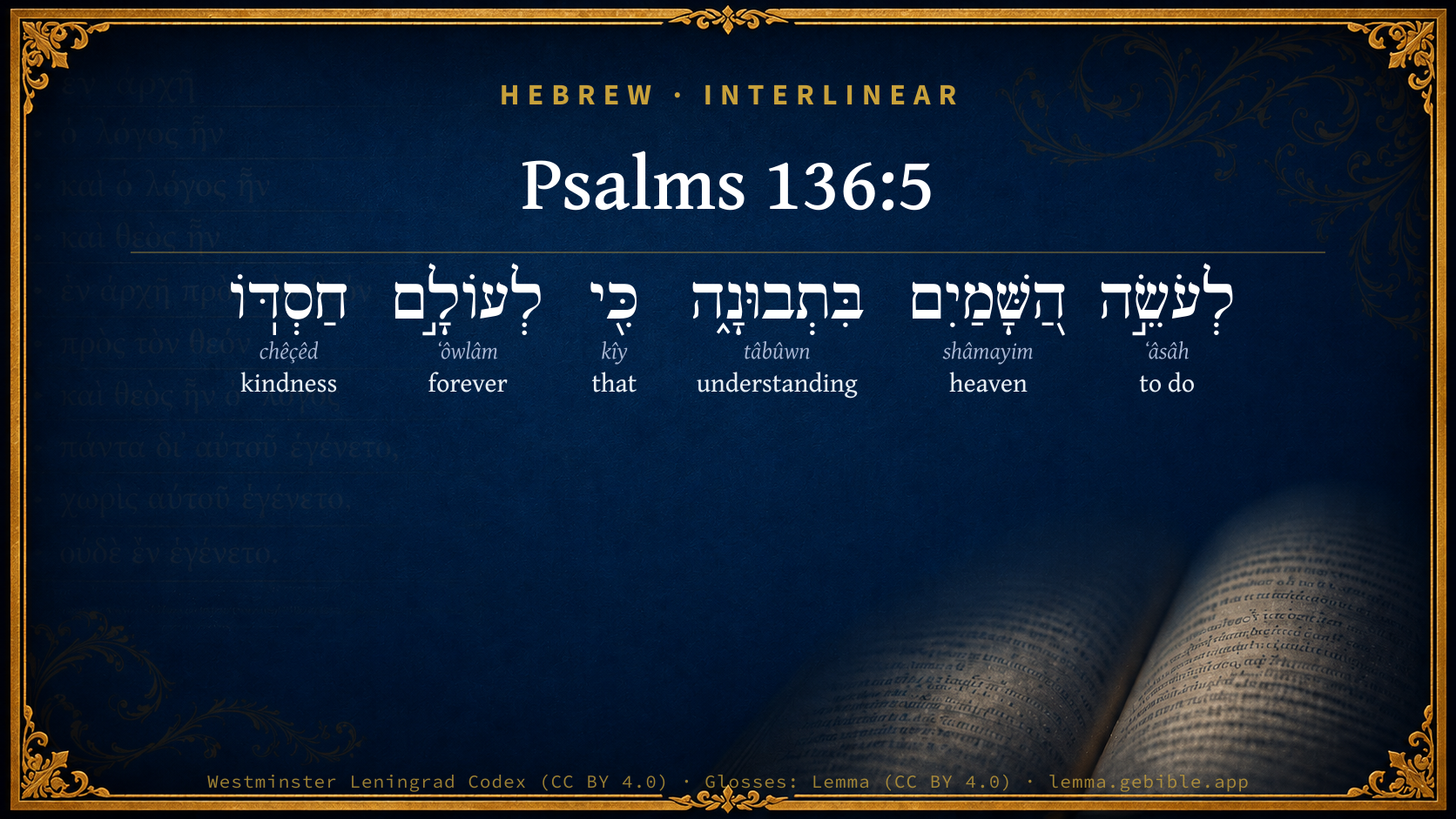
Psalms 136:5

Hebrew (Westminster Leningrad Codex) Psalms 136:5 appears in the Hebrew Old Testament. The text above is from the Westminster Leningrad Codex. Each word links to its Strong’s number, a concise gloss, and parsing drawn from the Open Scriptures Hebrew Bible morphology. Click any word for its full Brown-Driver-Briggs (BDB) entry.
Download image
Cite this verse

Psalms 136:5 (World English Bible). Public Domain. Lemma interlinear Bible study tool, https://lemma.gebible.app/v/psalms/136/5.

Show BibTeX & RIS
BibTeX
RIS
English Translation
To him who by understanding made the heavens; For his loving kindness endures forever:
World English Bible · Public Domain
Download a study sheet

One document with this verse’s original text, its word-by-word gloss line, the meaning frame, cross-references with their text, attributed commentary, and full source and license credits — printable, and it pastes into notes with its structure intact.

This verse Autodidact and up

Study sheet (.html) Plain text (.txt)

A passage Seminary Student

Up to 50 verses in one chapter. A passage sheet keeps up to 6 commentary sources and 12 cross-references per verse, in the order this page ranks them, and says so on the sheet whenever that leaves anything out. Ask for a single verse and you get the Autodidact verse sheet above.

Everything on this page stays free to read, with no account — the sheet is a download of what is already on screen, not access to it.

Want to remove ads? Support Godless Engineer
Compare translations 3

The same verse in 3 English versions, stacked beneath the original-language interlinear above. Click any original word for its lexicon entry.

Each is an independent rendering of the whole verse — the interlinear is not word-aligned to these translations.

Highlighted words mark where these versions differ — a whole-verse word diff, not a word-by-word alignment.

  • World English Bible Public Domain
    To him who by understanding made the heavens; For his loving kindness endures forever:
  • King James Version Public Domain
    To him that by wisdom made the heavens: for his mercy endureth for ever.
  • unfoldingWord Literal Text CC BY-SA 4.0
    To the maker of the heavens by understanding, for his covenant faithfulness to forever.

unfoldingWord Literal Text — © unfoldingWord, licensed CC BY-SA 4.0. Word-aligned USFM3 via Door43 (git.door43.org/unfoldingWord/en_ult).

Versions to compare (up to 4)

3 of 4 selected

Show all 18 translations

Every available English version of this verse, each an independent rendering of the whole verse.

  • World English Bible Public Domain
    To him who by understanding made the heavens; For his loving kindness endures forever:
  • Berean Standard Bible Public Domain
    By His insight He made the heavens. His loving devotion endures forever.
  • Majority Standard Bible Public Domain
    By His insight He made the heavens. His loving devotion endures forever.
  • King James Version Public Domain
    To him that by wisdom made the heavens: for his mercy endureth for ever.
  • American Standard Version (1901) Public Domain
    To him that by understanding made the heavens; For his lovingkindness `endureth' for ever:
  • Revised Version (1885) Public Domain
    To him that by understanding made the heavens: for his mercy endureth for ever.
  • Geneva Bible (1599) Public Domain
    Which by his wisedome made the heauens: for his mercie endureth for euer:
  • Douay-Rheims (1899) Public Domain
    For I have known that the Lord is great, and our God is above all gods.
  • Young's Literal Translation Public Domain
    To Him making the heavens by understanding, For to the age `is' His kindness.
  • Literal Standard Version CC BY-SA 4.0
    To Him making the heavens by understanding, || For His kindness [is] for all time.
  • Unlocked Literal Bible CC BY-SA 4.0
    to him who by wisdom made the heavens, for his covenant faithfulness endures forever.
  • unfoldingWord Literal Text CC BY-SA 4.0
    To the maker of the heavens by understanding, for his covenant faithfulness to forever.
  • Darby Bible Public Domain
    To him that by understanding made the heavens, for his loving-kindness [endureth] for ever;
  • World Messianic Bible Public Domain
    to him who by understanding made the heavens, for his loving kindness endures forever;
  • Webster's Bible Public Domain
    To him that by wisdom made the heavens: for his mercy endureth for ever.
  • Free Bible Version CC BY-SA 4.0
    To him who knew how to make the heavens. For his trustworthy love lasts forever.
  • Bible in Basic English Public Domain
    To him who by wisdom made the heavens: for his mercy is unchanging for ever.
  • JPS Tanakh (1917) Public Domain
    To Him that by understanding made the heavens, for His mercy endureth for ever.

Literal Standard Version (2020), Covenant Press — licensed CC BY-SA 4.0. Text via the HelloAO Bible API (eBible.org). Unlocked Literal Bible (unfoldingWord) — licensed CC BY-SA 4.0. Text via the HelloAO Bible API (eBible.org). unfoldingWord Literal Text — © unfoldingWord, licensed CC BY-SA 4.0. Word-aligned USFM3 via Door43 (git.door43.org/unfoldingWord/en_ult). Free Bible Version, Dr. Jonathan Gallagher — licensed CC BY-SA 4.0. Text via the HelloAO Bible API (eBible.org).

Word by word

More ways to search: Search by grammar → Find every occurrence → Compare this word →

Practice this passage: Drill this verse → Learn its vocabulary →

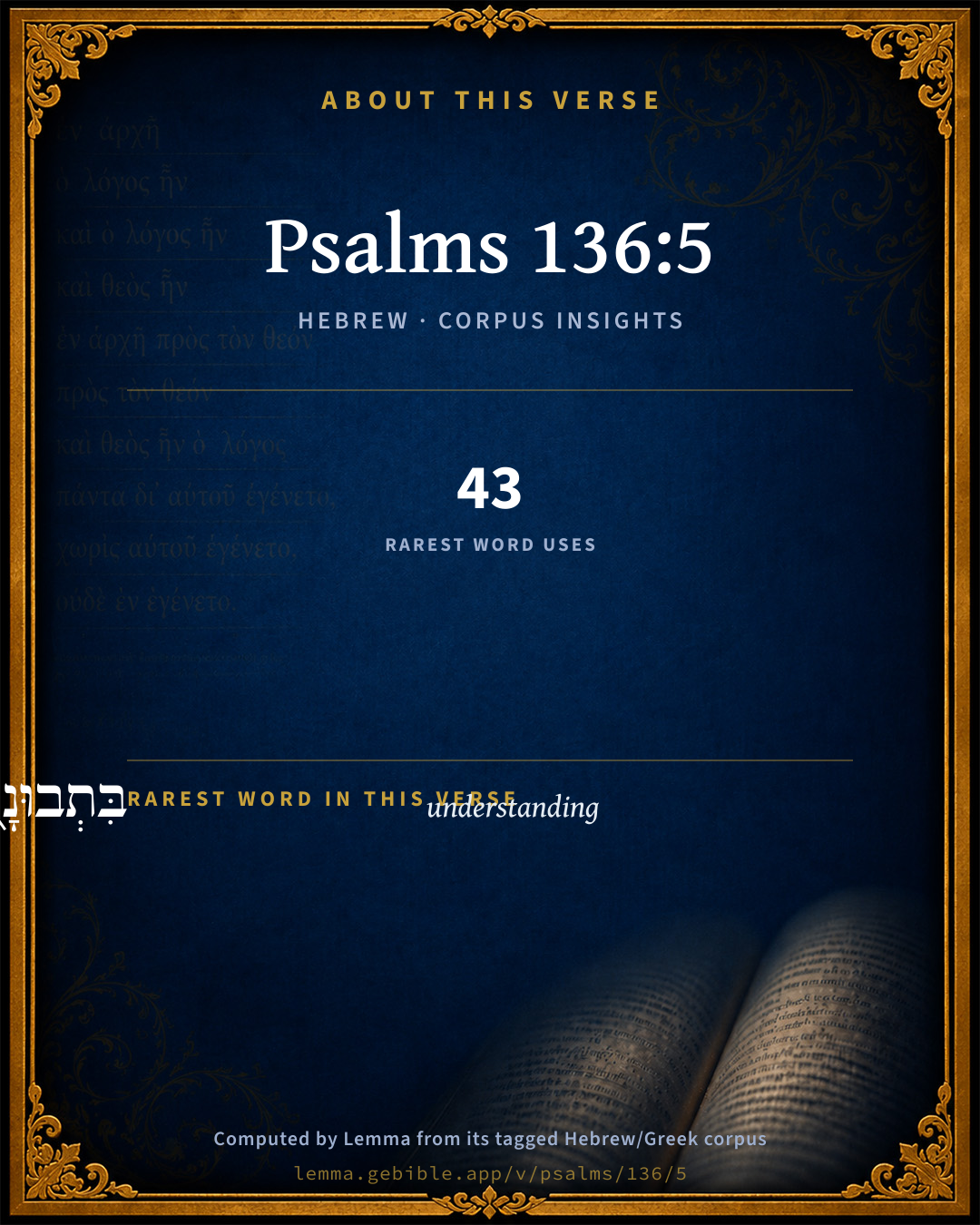
About this verse

These counts appear in no published source. They are computed here, from the morphology-tagged text and Lemma’s own curated glosses. What Lemma adds →

6
words
6
distinct lemmas
Wisdom
section

Shared distinctive vocabulary

בִּתְבוּנָ֑ה understanding H8394 occurs in 42 verses of the Hebrew Bible. Also found in:

Grammatical profile

  • 1 verb
  • 4 nouns
  • 1 conjunction

Verb forms

  • לְעֹשֵׂ֣ה Qal · Participle Active

Hebrew & Septuagint length

In English translation the verse runs 14 words from the Hebrew and 14 from the Septuagint (LXX English) — the same length.

A rough comparison of the two English renderings, which tokenize alike — not a word-level alignment.

Word counts can differ between the Hebrew and the Greek without any difference in meaning — e.g. the Hebrew direct-object marker אֵת has no separate Greek word, and Greek often adds the article ὁ.

Cross-references

7

Topical passages linked to Psalms 136:5 in the Treasury of Scripture Knowledge — connected by theme and wording, ordered by reader-vote popularity; previews shown in the World English Bible.

  • Genesis 1:1 In the beginning God created the heavens and the earth.
  • Psalms 104:24 Yahweh, how many are your works! In wisdom have you made them all. The earth is full of your riches.
  • Psalms 33:6 By Yahweh's word the heavens were made; All their host by the breath of his mouth.
  • Jeremiah 51:15 He has made the earth by his power, he has established the world by his wisdom, and by his understanding has he stretched out the heavens:
  • Proverbs 3:19–20 By wisdom Yahweh founded the earth. By understanding, he established the heavens.
  • Proverbs 8:22–29 "Yahweh possessed me in the beginning of his work, Before his deeds of old.
  • Jeremiah 10:12 He has made the earth by his power, he has established the world by his wisdom, and by his understanding has he stretched out the heavens:

Cross-references courtesy of OpenBible.info (CC BY 4.0).

Hebrew and Greek witnesses Masoretic Hebrew ↔ Greek Septuagint

The same verse in the two great witnesses to the Old Testament, shown verse-for-verse.

You’re reading Greek Psalm 135 (Hebrew Psalm 136). The Septuagint counts the superscription, so verse numbers can differ from the Hebrew — chapter-level alignment, not verse-by-verse. Numbering follows Rahlfs.

These are two independent witnesses, not word-aligned to each other, and the Septuagint is shown in lemma (dictionary) form.

Hebrew Psalms 136:5 Masoretic · Westminster Leningrad Codex

לְעֹשֵׂ֣ה הַ֭שָּׁמַיִם בִּתְבוּנָ֑ה כִּ֖י לְעוֹלָ֣ם חַסְדּֽוֹ

To him who by understanding made the heavens; For his loving kindness endures forever:

World English Bible · Public Domain

Greek LXX Greek Psalm 135:5 Septuagint · lemma form

ὁ ποιέω ὁ οὐρανός ἐν σύνεσις ὅτι εἰς ὁ αἰών ὁ ἔλεος αὐτός

To him who made the heavens by understanding; for his mercy endures for ever.

LXX2012 (modern English Septuagint) · Public Domain

Hebrew: Westminster Leningrad Codex (CC BY 4.0). Greek: Septuagint (public domain); English from LXX2012 (modern English Septuagint) (Public Domain). How the Septuagint differs from the Hebrew →

Commentary

Notes on Psalms 136:5 from classic Christian and Jewish commentators (each source and its license shown beneath its notes). The classic Christian expositions comment on the surrounding passage and are grouped to its opening verse, so a note may address several verses; the Jewish commentaries on the Tanakh (Rashi and others) are per-verse, so they appear only where the commentator wrote on this verse.

Lemma curates 59 commentaries, every one of them public domain or Creative Commons licensed, each selected and text-cleaned for this edition rather than reprinted as found. About our sources →

Trapp's Complete Commentary

John Trapp

Psa 136:5 To him that by wisdom made the heavens: for his mercy [endureth] for ever.

Ver. 5. To him that by wisdom, &c.] Singulari ingenio et summa industria, yet without tool or toil. See Heb 11:10. {See Trapp on "Heb 11:10"}

John Trapp, A Commentary or Exposition upon All the Books of the Old and New Testament (1647–1656) — public domain. Text from a community e-Sword module.

Joseph Benson's Commentary

Psa 136:5-6. To him that by wisdom — Namely, by eminent and admirable wisdom, far exceeding the capacity of all creatures, whether human or angelical; made the heavens, that stretched out the earth — “The heavens above, and the earth beneath, declare the wisdom of their great Maker, and proclaim aloud, to an intelligent ear, the divinity of the hand that formed them. The heavens display the love of God to man; the earth teaches the duty of man to God. Heaven is glorious and gracious, earth verdant and fruitful. The bright and ample circumference of heaven, the variegated surface of the earth, and the profusion of good things that distinguish the seasons, contaminated as they all have been by man’s transgression, even now yield a prospect which annihilates all human grandeur. What idea, then, are we to frame of those new heavens and earth from which sin and corruption are excluded, and where righteousness hath fixed her eternal throne.” — Horne.

Joseph Benson's Commentary on the Old and New Testaments (1811–1818) — public domain. Text from a community e-Sword module.

J. A. Alexander on Psalms

Joseph Addison Alexander

5. (Psa 136:5) To him that made the heavens in wisdom--for unto eternity (is) his mercy. That made, literally making, perhaps in reference to the continued exercise of God's creative power. In wisdom, or with understanding. See above, on Psa 104:24, and compare Pro 3:19.

Joseph Addison Alexander, The Psalms Translated and Explained (1850) — public domain. Text from a community e-Sword module.

Adam Clarke's Commentary

Verse 5. By wisdom made the heavens] In the contrivance of the celestial bodies, in their relations, connexions, influences on each other, revolutions, &c., the wisdom of God particularly appears.

Adam Clarke's Commentary on the Bible (1810–1826) — public domain. Text from a community e-Sword/MySword module.

Ellicott's Commentary for English Readers

(5) By wisdom.—From Psa_104:24, Pro_3:19, or Jer_10:12.

A Bible Commentary for English Readers, edited by Charles John Ellicott (1878–1897) — public domain. Text from a community e-Sword module.

The Cambridge Bible for Schools and Colleges

gen. ed. J. J. S. Perowne

5. O give thanks unto the redeemer of Israel (Isa_49:7), for &c.

5. by wisdom] By understanding, as Pro_3:19; Jer_10:12.

The Cambridge Bible for Schools and Colleges (gen. ed. J. J. S. Perowne; Cambridge University Press, 1878–1918) — public domain. Text from a community e-Sword module.

John Gill's Exposition

To him that by wisdom made the heavens,.... In such a curious manner, in such a proper and delightful situation, with such furniture, and for such uses, Pro 3:19;

for his mercy endureth for ever; which appears in the continued influences of the heaven; the dew, rain, and snow, that descend from it on the earth to water and make it fruitful, and to produce those rich and valuable blessings called the "precious things of heaven", Deu 33:13; and which are of the utmost importance for the service of man and beast: and, besides, God has of his infinite mercy, which continues, provided an inheritance in the heavens, a house eternal in the heavens, mansions of bliss and glory there, which Christ is now preparing for his saints, that they may dwell with him in them for evermore.

John Gill's Exposition of the Whole Bible (1746–1763) — public domain (CC PDM 1.0). Text via the HelloAO Bible API.

Albert Barnes' Notes on the Bible

To him that by wisdom made the heavens - Made them in so wise a manner; where so much wisdom was manifested. See Pro 3:19; Pro 8:24-31.

For his mercy ... - The making of the heavens was a manifestation of mercy and goodness as furnishing an abode for unfallen and holy beings; as a dwelling-place for redeemed sinners when they shall be removed there from the earth; and as, by their order, their beauty, their harmony, and their happy influences, tending to promote the happiness of man on earth.

Albert Barnes' Notes on the Bible (1834–1885) — public domain. Text from a community e-Sword/MySword module.

Matthew Poole's English Annotations

By wisdom, to wit, by eminent and admirable wisdom, far exceeding the capacity of all human or angelical creatures.

Matthew Poole's English Annotations on the Holy Bible (1683–1685) — public domain. Text from a community e-Sword/MySword module.

The Treasury of David

Charles H. Spurgeon

Ver. 5. To him that by wisdom made the heavens. His goodness appears in creating the upper regions. He set his wisdom to the task of fashioning a firmament, or an atmosphere suitable for a world upon which mortal men should dwell. What a mass of wisdom lies hidden in this one creating act! The discoveries of our keenest observers have never searched out all the evidences of design which are crowded together in this work of God's hands. The lives of plants, animals, and men are dependent upon the fashioning of our heavens: had the skies been other than they are we had not been here to praise God. Divine foresight planned the air and the clouds, with a view to the human race.

For his mercy endureth for ever. The Psalmist's details of mercy begin in the loftiest regions, and gradually descend from the heavens to "our low estate" (Ps 134:23); and this is an ascent, for mercy becomes greater as its objects become less worthy. Mercy is far reaching, long enduring, all encompassing. Nothing is too high for its reach, as nothing is beneath its stoop.

High as heaven his wisdom reigns,

Mercy on the throne remains.

Ver. 5. To him that by wisdom made the heavens. We find that God has built the heavens in wisdom, to declare his glory, and to show forth his handiwork. There are no iron tracks, with bars and bolts, to hold the planets in their orbits. Freely in space they move, ever changing, but never changed; poised and balancing; swaying and swayed; disturbing and disturbed, onward they fly, fulfilling with unerring certainty their mighty cycles. The entire system forms one grand complicated piece of celestial machinery; circle within circle, wheel within wheel, cycle within cycle; revolutions go swift as to be completed in a few hours; movements so slow, that their mighty periods are only counted by millions of years. From "The Orbs of Heaven", 1859.

Ver. 5. To him that by wisdom made the heavens. Not only the firmament, but the third heavens, too, where all is felicity, where is the throne of glory. Then, I infer, that if the mercy which visits earth is from the same Jehovah who built that heaven and filled it with glory, there must be in his mercy something of the same "understanding" or "wisdom." It is wise, prudent mercy; not rashly given forth; and it is the mercy of him whose love has filled that heaven with bliss. The same architect, the same skill, the same love! Andrew A. Bonar.

Psalms 136:6*

Charles H. Spurgeon's The Treasury of David (1869–1885) — public domain. Psalms only. Text from a community e-Sword/MySword module.

The Pulpit Commentary

To him that by wisdom made the heavens. Creation is the work, not only of God"s power, bat of his wisdom also. Things were made as they are by the exertion of his forethought and understanding. (comp. Pro_3:19 Eph_1:11) For his mercy, etc.

The Pulpit Commentary (1880–1919), ed. H.D.M. Spence-Jones & Joseph S. Exell — public domain. Text from a community e-Sword module.

Lesson kit

Teaching starters — assembled from the data on this page, not authored interpretation. Every prompt links to the verse data it draws on. Edit before teaching.

Psalms, in the Wisdom, opens this verse with 6 words (6 distinct Hebrew lemmas). Its most distinctive word is tâbûwn (“understanding”). A historical commentator’s framing appears above. Read the whole chapter for the surrounding context.

Discussion questions

  1. How does “understanding” (tâbûwn) shape what this verse is saying?
  2. How does Exodus 31:3, which shares the word «understanding», read alongside this verse?
  3. These translations render this verse differently; the difference is in the English rendering, not the original. What questions does that raise?
  4. «לְעֹשֵׂ֣ה» is a Qal Participle Active verb. How does that grammatical form shape the action described?
  5. Compare how Trapp's Complete Commentary and Joseph Benson's Commentary read this verse. Where do they agree or differ?

Things to notice

Reading settings

Reading text

Shown beneath each verse's original-language words.

Old Testament
Old Testament edition

Read the OT as the Masoretic Hebrew (MT) or the Greek Septuagint (LXX).

English shown for the Greek Septuagint (in the Hebrew ↔ Greek comparison).

Comparing translations? Open the Compare panel on any verse page to stack up to four side by side.