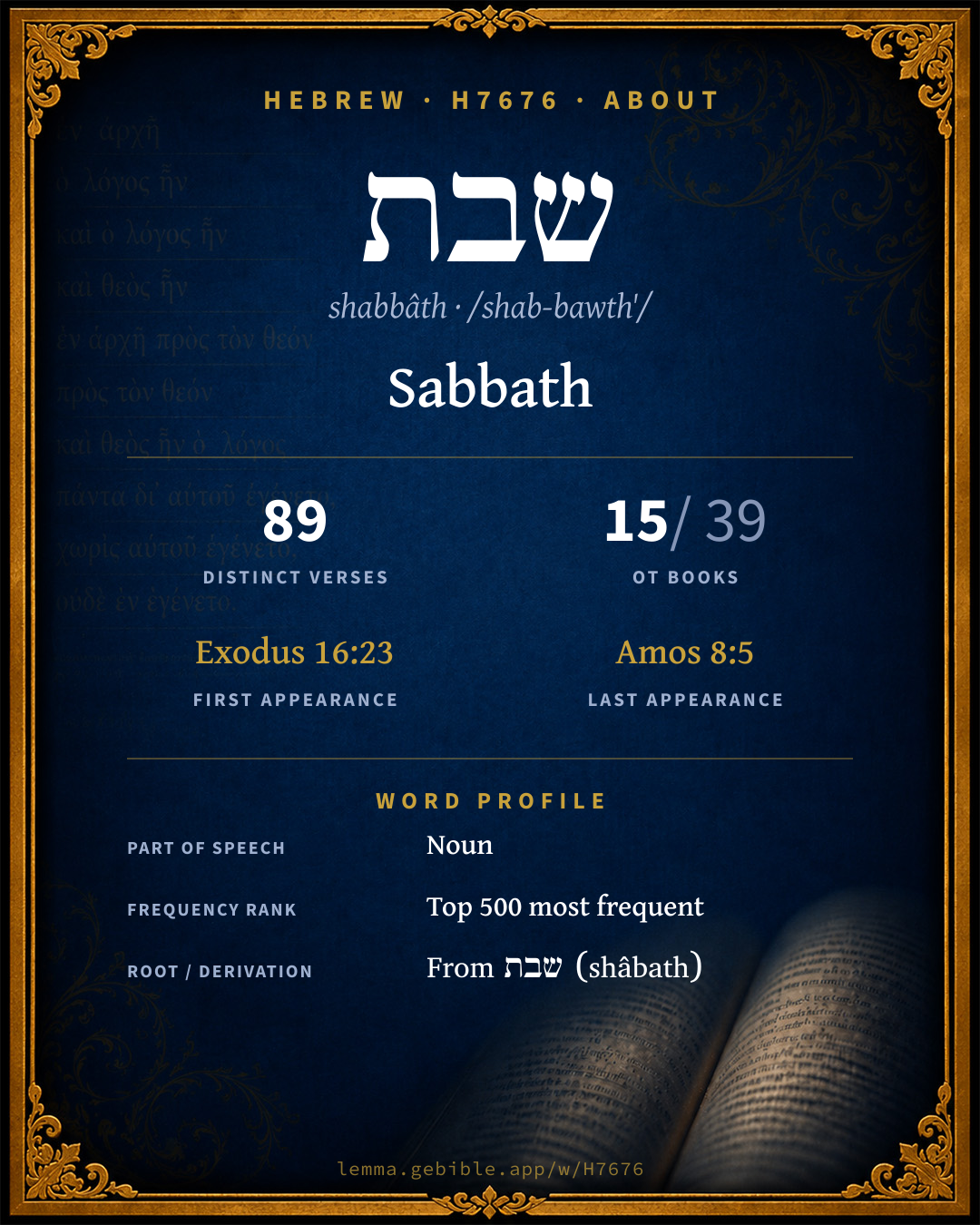
שַׁבָּת
Sabbath
BDB lists 5 entries for ‘Sabbath’ fuller range ↓
Full lexicon entry — Brown-Driver-Briggs (BDB)
From Brown-Driver-Briggs (BDB)
Where this word appears
Grammar key — what these labels mean
Part of speech
- Noun
- A naming word — a person, place, thing, or idea.
Noun type
- Common
- A common noun — a general class of person, place, or thing (“king,” “city,” “water”), not a specific name.
State
- Absolute
- The independent form of a noun, not bound to a following word.
- Construct
- A noun bound to a following noun in a possessive / “of” relationship (the construct chain).
Gender
- Both
- Attested as both masculine and feminine.
Number
- Singular
- One.
- Plural
- More than one (in Hebrew, generally three or more).
Every verse where H7676 appears in the Book of Lamentations — 1 distinct verse. Click any verse to open its interlinear word-by-word view. Verse text shown in the World English Bible for context — . Each verse’s Hebrew form is shown with its reference; the English is not keyword-highlighted, since the data carries no word-level English alignment. Use “Compare translations” on any verse to read it across multiple English versions. This concordance covers the Hebrew Bible; Septuagint (Greek Old Testament) occurrences are not indexed here.
Lamentations
About this entry
At a glance — auto-summarized from this page’s data, not written by a person. Every figure links to its source below. This summary describes the numbers; it doesn’t interpret them.
At its core, שבת (shabbâth) means “Sabbath.” Scripture first uses it in Exodus 16:23. It turns up in 89 verses across 15 books, a moderately common footprint. Dig into 89-verse concordance and the renderings breakdown below.
Gloss history
Strong's 1890 vs modern scholarship
About this word
Strong's H7676 catalogs a Hebrew word from the Hebrew Old Testament.
These counts are not copied from any lexicon or concordance. They are computed here, from the morphology-tagged Hebrew Old Testament. What Lemma adds →
- 89
- distinct verses
- The word appears in 89 distinct verses.
- 15 / 39
- OT books
- The word appears in 15 of 39 Old Testament books.
- #390
- by frequency
- Top 500 most frequent Hebrew words (rank 390 of 8,640 Hebrew words by occurrence).
View all 89 occurrences in the concordance →
By section of the Old Testament
By traditional corpus
Conventional, traditional groupings — biblical authorship is debated, so this is a traditional corpus grouping, not an authorship claim. Each share is this word’s portion of its verses in that division of the Hebrew canon. Each figure is a share of the word’s 89 distinct verses.
- Torah (Pentateuch) 37 verses · 42%
- Prophets (Nevi'im) 32 verses · 36%
- Writings (Ketuvim) 20 verses · 22%
How translations render this word
Counts come from each version’s own published word-to-Strong’s tagging or interlinear alignment — an approximate guide to how each version renders this word, not a word-level alignment the data otherwise carries. Because each total is that version’s own tagged count, the per-version totals vary from one another and need not match the appearance or distinct-verse counts above. These counts may also differ from a printed concordance because Lemma counts each distinctly tagged rendering and does not collapse phrase taggings into a single head-word total. This is a fixed set of word-tagged versions (KJV, ASV, BSB, ULT) and does not change with the reading translation you choose elsewhere. Each version’s license is shown beside its name below (and on Sources).
- King James Version: Sabbath 54×, Sabbaths 33×, Is the sabbath 5×
- American Standard Version: Sabbath 47×, Sabbaths 27×, Is a sabbath 6×
- Berean Standard Bible: Sabbath 56×, Sabbaths 27×, Is a sabbath 7×
- unfoldingWord Literal Text: Sabbath 67×, Sabbaths 25×, Is a sabbath of 4×
King James Version Public Domain
Renders H7676 across 108 tagged occurrences — most commonly:
Plus 9 renderings that appear only once — usually multi-word phrases or single function words the recovered tagging swept in, not distinct renderings.
American Standard Version Public Domain
Renders H7676 across 107 tagged occurrences — most commonly:
Plus 22 renderings that appear only once — usually multi-word phrases or single function words the recovered tagging swept in, not distinct renderings.
Berean Standard Bible Public Domain
Renders H7676 across 105 tagged occurrences — most commonly:
Plus 13 renderings that appear only once — usually multi-word phrases or single function words the recovered tagging swept in, not distinct renderings. Not rendered by a distinct English word in 6 further occurrences.
unfoldingWord Literal Text CC BY-SA 4.0
Renders H7676 across 111 tagged occurrences — most commonly:
Plus 6 renderings that appear only once — usually multi-word phrases or single function words the recovered tagging swept in, not distinct renderings.
9 senses and sub-senses in the full BDB
What do BDB’s symbols mean?
BDB uses these scholarly abbreviations:
| Symbol | Meaning |
|---|---|
| 𝔊 | the Septuagint (the ancient Greek translation, LXX) |
| 𝔙 | the Vulgate (the Latin translation) |
| 𝔖 | the Syriac version (the Peshitta) |
| 𝔗 | the Targum (the Aramaic translation) |
| ψ | the Psalms |
| √ | root (the underlying root or stem) |
| ‖ | parallel passage (a synonymous or contrasted parallel) |
| † | the dagger: every passage where the word occurs is cited |
The 9 senses and sub-senses the full Brown-Driver-Briggs lexicon distinguishes for this word, in lexicon order (not ranked by frequency), with BDB’s own verbatim wording and sub-sense lettering. Shown in Hebrew script with BDB’s own scholarly abbreviations. The condensed entry is in the Lexicon Entry tab. See also the Forms in the corpus table below.
- 1. sabbath:
- a. primitive שׁ׳ ליהוה Ex 16:25 (J), 20:10 = Dt 5:14 (ten words) Lv 23:3 (P); הַשּׁ׳ Ex 16:29 (J); בַּיּוֹם הַשְּׁבִיעִי שׁ׳ Ex 16:26 (J); on seventh day יוֹם הַשַּׁבָּת 20:8, 11 = Dt 5:12, 15 (ten words), so throughout; Ex 31:15 + 3 times P, Je 17:21; Ez 46:4; Ne 10:32 + 9 times, + (‖ new moon) Is 1:13; Ez 46:1; 2 K 4:23; Am 8:5, cf. Is 66:23(×2), also חג and מועד Ho 2:13; time of change of watch in temple 2 K 11:5, 7, 9(×2) = 2 Ch 23:4, 8(×2); מיסך הַשּׁ׳ (in temple) 2 K 16:18; orig. observed simply by abstinence from labour Ex 20:9, 10 = Dt 5:12–14; Ex 23:12 (E), 34:21 (J; Br Hex. 181–195). e.g. Exodus 16:25
- b. Deut. reason for day is deliverance from Egypt Dt 5:15, hence its consecration, לְקַדְּשׁוֹ v 12 = Ex 20:8; קדּשׁ יום השׁ׳ Je 17:22, 24, 27 (especially no load carried), Ez 20:20; 44:24. e.g. Deuteronomy 5:15
- c. intensified by antith. חלּל שׁ׳ Ez 20:13 + 5 times Ez, cf. Ne 13:18. Phrases in H: שׁמר (ה)שׁ׳ Lv 19:3, 30; 26:2, then P Ex 31:13, 14, 16; cf. Is 56:2, 4, 6; יוֹם קָדְשִׁי, קדושׁ י׳: 58:13(×2) (c. כבּד). H also שַׁבְּתֹתֵיכֶם Lv 26:35; סִמָּחְֽרַת הַשּׁ׳ 23:11, 15, 16; שַׁבְּתוֹתַי 19:3, 30; 26:2; Is 56:4; Ez 20:12; 22:26, + 8 times Ez; ‖ מוֹעֵד La 2:6. e.g. Ezekiel 20:13
- d. P gives as basis God’s resting Ex 20:11; 31:17; שׁבתות י׳ Lv 23:38; קדשׁ ליהוה שׁ׳ Ex 16:23, cf. Ne 9:14, שׁ׳ שׁבתון Ex 31:15; 35:2; Lv 23:3; עשׂה השׁ׳ Ex 31:16, עֹלַת שׁ׳ בְּשַׁבַּתּוֹ Nu 28:10, cf. Is 66:23; בְּיוֹם הַשּׁ׳ בְּיוֹם הַשּׁ׳ Lv 24:8 on every sabbath, abbr. שַׁבַּת שַׁבָּת 1 Ch 9:32; לַשַּׁבָּתוֹת, ‖ חֳדָשִׁים + מועדים 23:31 + 3 times Chr, Ne 10:34 (ל om. by error); work punished by stoning Nu 15:32; trade prohib. Ne 10:32; 13:15–21. e.g. Exodus 20:11
- 2. day of atonement is a שַׁבַּת שַׁבָּתוֹן Lv 16:31; 23:32 (P), cf. שָׁבַת שַׁבָּת v 32 (P). e.g. Leviticus 16:31
- 3. sabbath year, שַׁבַּת שַׁבָּתוֹן Lv 25:4 (H); שַׁבָּת ליהוה v 2, 4 (H); (הארץ) רצה שַׁבְּתוֹתֶיהָ 26:34(×2), 43 (H), 2 Ch 36:21. e.g. Leviticus 25:4
- 4. = week (?): שֶׁבַע שַׁבָּתוֹת Lv 23:15 (H), seven sabbaths or weeks; שֶׁבַע שַׁבְּתֹת (ה)שָּׁנִים 25:8(×2) (H) seven sabbaths or weeks (of years), uncertain (v. Mk 16:2, 9; Lk 18:12; Mt 28:1, cf. J.Aram. usage); poss. שַׁבָּת Is 66:23 = week (Du). e.g. Leviticus 23:15
- 5. שַׁבַּת הָאָ֫רֶץ Lv 25:6 (H) = produce in sabbath year (growing of itself). e.g. Leviticus 25:6
Senses from the full Brown-Driver-Briggs lexicon (Brown, Driver, Briggs; Oxford 1906 — public domain), digitized via Sefaria, supplemented by the OpenScriptures HebrewLexicon (CC BY 4.0). Full attribution on Sources.
Word origin
n.f. Ex 31:14 + m. Is 56:2, 6; 66:23, (under infl. of יוֹם in freq. יוֹם הַשּׁ׳, AlbrZAW xvi (1896), 47) Sabbath (= ת + שׁבת; NH שַׁבָּת, Aramaic שַׁבְּתָא, ܫܰܒܬܳܐ; perhaps Assyrian šabattum (‖ ûm nûḫ libbi, day of rest of heart (i.e. propitiation) [of deity]: only in lex. tablets); cf. Lotz Quaest. de hist. Sabbati, 1883 Jen ZA iv (1869), 274 ff. (doubts connexion of Assyrian word with Heb. Sabbath) Id S. S. Times, Jan. 16, 1892, 35 f. Muss-Arn JBL xi (1892), 93 Schwally Idiot. 127; v. (more recently) JastrAm. J. Theol. ii (1898), 312 ff. Toy TBL xviii (1899), 190 ff. Dr Hast DB Sabbath (1902) Zim KAT3. 592 ff.; ZMG 1904, 199 ff. [15th day of month so called] 458 ff.);—abs. שׁ׳ Ex 16:25 + 64 times; cstr. שַׁבַּת v 23 + 10 times; sf. שַׁבַּתּוֹ Nu 28:10 + 3 times sf.; pl. שַׁבָּתוֹת Lv 23:15 + 7 times; cstr. שַׁבְּתֹת v 38 25:8(×2); sf. שַׁבְּתוֹתַי Is 56:4 +, etc.;—
— Brown-Driver-Briggs (Oxford 1906, public domain), digitized via Sefaria, supplemented by the OpenScriptures HebrewLexicon (CC BY 4.0). See Sources.
Derived from שבת (shâbath) (H7673) — to cease.
Jastrow Dictionary
A second Hebrew/Aramaic lexicon for comparison, covering Aramaic and post-biblical (Talmudic, Targumic, Midrashic) usage that the biblical-Hebrew BDB does not. Matched by lemma rather than by Strong’s number, so a lemma may carry more than one Jastrow headword (shown separately below), and the entries cover usage well beyond the Bible.
שֶׁבֶת I
- c. (v. Löw Pfl., p. 373) dill. Ukts. III, 4 הש׳ משנתן טעמו וכ׳ (Ar. משנתנה טעמה) the dill stalk after having given its taste to a dish; Ber. 39ᵃ. Maasr. IV, 5 הש׳ מתעשרת וכ׳ dill must be tithed as seed &c., v. עָשַׂר; a. fr.
שֶׁבֶת II
- 1. seat. Esth. R. to I, 2 מקום הש׳ the place of the throne. Ib. כדי שיהא המלך יושב בש׳ וכ׳ so that the king might be seated in the chair with the crown &c. Nidd. 16ᵇ, v. מָרוֹם; a. e.
- 2. sitting idle, indemnity for loss of time (Ex. XXI, 19). B. Kam. VIII, 1 ש׳ רואין אותו וכ׳ to estimate indemnity for loss of time, we consider the person concerned, as if he were a watchman in a cucumber field. Ib. 85ᵃ דמי שִׁבְתּוֹ indemnity for his enforced idleness. Ib. שבתו ורפואתו כל שחייב בש׳ וכ׳ the text places on parallel lines indemnity for loss of time and healing expenses: whenever one is bound to pay for loss of time, one is bound to pay for healing. Ib. 86ᵃ ש׳ גדולה וש׳ קטנה the larger indemnity (for the permanent incapacitation, e.g. the value of the earning capacity of a maimed hand), and the smaller indemnity (for the time of sickness); Gitt. 42ᵃ; a. fr.—Pl. (ch.) שִׁבְּתִּין. Y. B. Kam. VIII, 6ᵇ bot. תרין ש׳ אינון there are two kinds of indemnity for incapacitation (the larger and the smaller, v. supra). e.g. Exodus 21:19
שָׁבַת
- (b. h.)
- 1. to rest, cease; esp. to observe the Sabbath, Lam. R. to V, 14 (expl. מנגינתם, ib.) מזמריהון שָׁבְתוּ they ceased from their songs. Ib. to I, 7 (ref. to משבתיה, ib.) זה … שש׳ מתוכה this refers to R. J. b. Z. who ceased from staying within her (who left Jerusalem during the siege). Snh. 58ᵇ נכרי שש׳ וכ׳ a gentile that rests from work (on any day) deserves death. Y. Ber. IV, 7ᶜ bot. כבר ש׳ וכ׳ R. Ḥ. has already begun the Sabbath observance in his town. Y. Sabb. XV, 15ᵃ bot. שבת לה׳ שְׁבוֹת כה׳ מה הקב"ה ש׳ ממאמר אף את שבות ממאמר ‘a Sabbath unto the Lord’ (Ex. XX, 10), rest like the Lord, as God rested from speech, so do thou rest from speech (planning work). Ned. III, 10 הנודר משׁוֹבְתֵי שבת וכ׳ he who forswears benefit at the hands of those who rest on the Sabbath, is forbidden to receive benefits from Jews and from Samaritans; a. fr.—Pes. 54ᵃ אור שש׳ a light which burned during the entire Sabbath (having been kindled on the Sabbath eve). Men. 21ᵃ (ref. to תשבית, Lev. II, 13) מלח שאינה שׁוֹבֶתֶת וכ׳ Ms. M. (ed. שובתה) a kind of salt which has no Sabbath (is generated at all times), which is Sodom salt (v. מֶלַח). e.g. Exodus 20:10
- 2. to stay over the Sabbath; (of scholars) to deliver the Sabbath lecture. Peah VIII, 7 ש׳ נותנין לו מזון וכ׳ where the transient poor makes his Sabbath station, you must give him food for three meals; Sabb. 118ᵃ; B. Bath. 9ᵃ. Mekh. Bo, s. 16 כבר שָׂבְתוּ … ולא ש׳ וכ׳ once the disciples made their Sabbath station at Jabneh, but R. J. did not stay there. Ib. ומי ש׳ שם and who lectured there?; אפשר שש׳ ר׳ וכ׳ is it possible that R. El. b. Az. lectured without sayîng something novel?; Y. Ḥag. I, beg. 75ᵈ; Y. Sot. III, 18ᵈ bot.; a. fr.
- 3. (v. שְׁבִיתָה) to appoint a Sabbath camp as the center for Sabbath movements. Pes. III, 7 (49ᵃ) ההולך … לִשְׁבּוֹת שביתת הרשות if a person goes away from home … in order to transfer his Sabbath camp for some secular (social) purpose. Erub. 51ᵃ לשׁוֹבְתֵי שבת for those who appoint a Sabbath camp (when on the road near the beginning of the Sabbath), v. פֵּאָה; a. fr.—Part. pass. שָׁבוּת allowed to rest, abandoned. Sifra B’har, Par. 1, ch. I (ref. to שבת הארץ, Lev. XXV, 6) מן הש׳ בארץ … מן השמור thou mayest (in the Sabbatical year) eat of what is abandoned in the earth (that which grows without special cultivation, manuring &c.), but not of what is watched in the earth (of a field more than ordinarily ploughed); Yalk. Lev. 659. e.g. Leviticus 25:6
- to cause to cease, remove. Y. Ber. IV, 7ᵈ bot. שתשבור ותַשְׁבִּית עולו וכ׳ that thou mayest break and remove the yoke of the evil inclination &c.; ib. שתַּשְׁבִּיתֵהוּ מעלינו וכ׳ that thou mayest remove it (the leaven of evil) from within us &c.—V. הַשְׁבָּתָה.
שְׁבַת
- , to rest; to observe the Sabbath. Targ. Ex. XXXI, 17. Targ. O. ib. XVI, 30 ed. Berl. (oth. ed. נחו). Targ. Y. Lev. XXIII, 32.—Y. Maas. Sh. V, 56ᵃ top ונחית שָׁבֵית בבייתיה and went down to observe the Sabbath in his own house; ib. הוו סלקון שַׁבְתוּן וכ׳ went up and celebrated the Sabbath at the Temple; Lam. R. to III, 9 ושבחן (read: ושַׁבְתָן).—[Y. Maas. Sh. l. c. סליק ש׳, read: שבח, v. שְׁבַח I.]
שַׁבָּת
- preced.)
- 1. day of rest, Sabbath.—שַׁבַּת בראשית, v. בְּרֵאשִׁית. Sabb. I, 1 יציאות הש׳ the laws concerning the carrying of objects from one territory (רָשׁוּת) to another on the Sabbath, v. הוֹצָאָה. Ib. 2ᵇ הכא דעיקר ש׳ הוא here where the Sabbath law is the main subject. Ib. 10ᵇ מתנה … וש׳ שמה I have a precious gift in my treasury, its name is Sabbath. Ib. 119ᵃ תבלין … וש׳ שמו וכ׳ we (Jews) have a certain spice, its name is Sabbath, which we put into it (the Sabbath dish), and its flavor spreads, Ib. 117ᵇ בש׳ חייב אדם לבצוע וכ׳ on the Sabbath one must break bread (say the blessing) over two loaves. Ib. לעולם … להוצאת ש׳ one should always be early in making the purchases for the Sabbath. Ib. 118ᵃ עשה שַׁבַּתְּךָ וכ׳, v. צָרַךְ. Ib. 119ᵃ בואו … ש׳ המלכה come ye, and let us go forth to meet queen Sabbath. Ib.ᵇ שני … בערב ש׳ מבית וכ׳ two ministering angels escort man on the Sabbath eve from the synagogue to his house; מלאך … שתהא לש׳ אחרת כך וכ׳ the good angel says, may it be thus the next Sabbath, and the evil angel says Amen against his will. Ib. לא חרבה … את הש׳ Jerusalem was destroyed for no other reason than because they desecrated the Sabbath there. Mekh. Ki Thissa לכם ש׳ מסורה וכ׳, v. מָסַר. R. Hash. IV, 1 שחל להיות בש׳ which falls on a Sabbath day; a. v. fr.—Ber. 28ᵃ, a. e. ש׳ של מי היתה whose Sabbath was it, i.e. whose turn to preach was it?—Pl. שַׁבָּתוֹת. Sabb. l. c. אילמלי … שתי ש׳ וכ׳ if Israel were to observe two Sabbaths properly, they would at once be redeemed. Yeb. 93ᵃ ש׳ וימים טובים Sabbaths and festivals; Keth. 110ᵇ; a. v. fr.
- 2. week. Ned. VIII, 1 ש׳ זו אסור בכל הש׳ וש׳ שעברה (if one says on a Sabbath day, ‘I vow abstinence from wine) this Sabbath’, he is forbidden to drink wine the whole (incoming) week and the week just expiring. Men. 65ᵇ באמצע ש׳ during the week, opp. בשבת on the Sabbath day; a. fr.—Pl. as ab. Is. 66ᵃ אימתי … שבע ש׳ תמימות וכ׳ when do you find seven complete weeks (between Passover and Shabuoth)? When you begin to count from the evening. Pesik. Haʿom., p. 69ᵇ באלו שבע ש׳ וכ׳ during those seven weeks between Passover &c.; a. fr.—שַׁבָּת Sabbath, name of a treatise, of the Order of Moʿed, of the Mishnah, Tosefta, Talmud Babli and Y’rushalmi.
A Dictionary of the Targumim, the Talmud Babli and Yerushalmi, and the Midrashic Literature (Marcus Jastrow; London, Luzac, 1903) — Public Domain. Digitized via Sefaria. Digitized via Sefaria. Full attribution on Sources.
Forms in the corpus
The 52 distinct written forms H7676 takes in the Hebrew Bible, most frequent first — each parse links to that state’s occurrences in the concordance. Hebrew forms include their vowel points and cantillation, so a single lemma takes many written forms.
Same root — word family
Other BDB entries built from the same root as H7676, grouped by Strong’s listed origin. These share a root / origin per the lexicon — not necessarily a shared meaning. Each links to that word’s own entry.
Derives from
Shares the same root
Proper names from this root
People and places named from this root — a name, not an additional meaning of the word.
- σαββατον sábbaton G4521 Sabbath
- שבתון shabbâthôwn H7677 Sabbath observance
- שבתי Shabbᵉthay H7678 Shabbethai
Compare all same-root words → Showing 4 of 7 — not the complete family. 3 of the same-root words are proper names (people or places). They share a root, not necessarily a meaning.
Bible dictionary
Public-domain dictionary articles matched to this entry by name (Sabbath). A biblical name can be shared by more than one person or place, so an article may treat several.
Easton's Bible Dictionary · M. G. Easton, 1897
(Heb. verb shabbath, meaning "to rest from labour"), the day of rest. It is first mentioned as having been instituted in Paradise, when man was in innocence (Gen. 2:2). "The sabbath was made for man," as a day of rest and refreshment for the body and of blessing to the soul.
It is next referred to in connection with the gift of manna to the children of Israel in the wilderness (Ex. 16:23); and afterwards, when the law was given from Sinai (20:11), the people were solemnly charged to "remember the sabbath day, to keep it holy." Thus it is spoken of as an institution already existing.
In the Mosaic law strict regulations were laid down regarding its observance (Ex. 35:2, 3; Lev. 23:3; 26:34). These were peculiar to that dispensation.
In the subsequent history of the Jews frequent references are made to the sanctity of the Sabbath (Isa. 56:2, 4, 6, 7; 58:13, 14; Jer. 17:20-22; Neh. 13:19). In later times they perverted the Sabbath by their traditions. Our Lord rescued it from their perversions, and recalled to them its true nature and intent (Matt. 12:10-13; Mark 2:27; Luke 13:10-17).
The Sabbath, originally instituted for man at his creation, is of permanent and universal obligation. The physical necessities of man require a Sabbath of rest. He is so constituted that his bodily welfare needs at least one day in seven for rest from ordinary labour. Experience also proves that the moral and spiritual necessities of men also demand a Sabbath of rest. "I am more and more sure by experience that the reason for the observance of the Sabbath lies deep in the everlasting necessities of human nature, and that as long as man is man the blessedness of keeping it, not as a day of rest only, but as a day of spiritual rest, will never be annulled. I certainly do feel by experience the eternal obligation, because of the eternal necessity, of the Sabbath. The soul withers without it. It thrives in proportion to its observance. The Sabbath was made for man. God made it for men in a certain spiritual state because they needed it. The need, therefore, is deeply hidden in human nature. He who can dispense with it must be holy and spiritual indeed. And he who, still unholy and unspiritual, would yet dispense with it is a man that would fain be wiser than his Maker" (F. W. Robertson).
The ancient Babylonian calendar, as seen from recently recovered inscriptions on the bricks among the ruins of the royal palace, was based on the division of time into weeks of seven days. The Sabbath is in these inscriptions designated Sabattu, and defined as "a day of rest for the heart" and "a day of completion of labour."
The change of the day. Originally at creation the seventh day of the week was set apart and consecrated as the Sabbath. The first day of the week is now observed as the Sabbath. Has God authorized this change? There is an obvious distinction between the Sabbath as an institution and the particular day set apart for its observance. The question, therefore, as to the change of the day in no way affects the perpetual obligation of the Sabbath as an institution. Change of the day or no change, the Sabbath remains as a sacred institution the same. It cannot be abrogated.
If any change of the day has been made, it must have been by Christ or by his authority. Christ has a right to make such a change (Mark 2:23-28). As Creator, Christ was the original Lord of the Sabbath (John 1:3; Heb. 1:10). It was originally a memorial of creation. A work vastly greater than that of creation has now been accomplished by him, the work of redemption. We would naturally expect just such a change as would make the Sabbath a memorial of that greater work.
True, we can give no text authorizing the change in so many words. We have no express law declaring the change. But there are evidences of another kind. We know for a fact that the first day of the week has been observed from apostolic times, and the necessary conclusion is, that it was observed by the apostles and their immediate disciples. This, we may be sure, they never would have done without the permission or the authority of their Lord.
After his resurrection, which took place on the first day of the week (Matt. 28:1; Mark 16:2; Luke 24:1; John 20:1), we never find Christ meeting with his disciples on the seventh day. But he specially honoured the first day by manifesting himself to them on four separate occasions (Matt. 28:9; Luke 24:34, 18-33; John 20:19-23). Again, on the next first day of the week, Jesus appeared to his disciples (John 20:26).
Some have calculated that Christ's ascension took place on the first day of the week. And there can be no doubt that the descent of the Holy Ghost at Pentecost was on that day (Acts 2:1). Thus Christ appears as instituting a new day to be observed by his people as the Sabbath, a day to be henceforth known amongst them as the "Lord's day." The observance of this "Lord's day" as the Sabbath was the general custom of the primitive churches, and must have had apostolic sanction (comp. Acts 20:3-7; 1 Cor. 16:1, 2) and authority, and so the sanction and authority of Jesus Christ.
The words "at her sabbaths" (Lam. 1:7, A.V.) ought probably to be, as in the Revised Version, "at her desolations."
Smith's Bible Dictionary · William Smith, 1863
(shabbath), "a day of rest," from shabath "to cease to do to," "to rest"). The name is applied to divers great festivals, but principally and usually to the seventh day of the week, the strict observance of which is enforced not merely in the general Mosaic code, but in the Decalogue itself. The consecration of the Sabbath was coeval with the creation. The first scriptural notice of it, though it is not mentioned by name, is to be found in (Genesis 2:3) at the close of the record of the six-days creation. There are not wanting indirect evidences of its observance, as the intervals between Noah's sending forth the birds out of the ark, an act naturally associated with the weekly service, (Genesis 8:7-12) and in the week of a wedding celebration, (Genesis 29:27,28) but when a special occasion arises, in connection with the prohibition against gathering manna on the Sabbath, the institution is mentioned as one already known. (Exodus 16:22-30) And that this (All this is confirmed by the great antiquity of the division of time into weeks, and the naming the days after the sun, moon and planets.) was especially one of the institutions adopted by Moses from the ancient patriarchal usage is implied in the very words of the law "Remember the Sabbath day, to keep it holy." But even if such evidence were wanting, the reason of the institution would be a sufficient proof. It was to be a joyful celebration of God's completion of his creation. It has indeed been said that Moses gives quite a different reason for the institution of the Sabbath, as a memorial of the deliverance front Egyptian bondage. (5:15) The words added in Deuteronomy are a special motive for the joy with which the Sabbath should be celebrated and for the kindness which extended its blessings to the slave and the beast of burden as well as to the master: "that thy man servant and thy maidservant may rest as well as thought. (5:14) These attempts to limit the ordinance proceed from an entire misconception of its spirit, as if it were a season of stern privation rather than of special privilege. But in truth, the prohibition of work is only subsidiary to the positive idea of joyful rest and recreation in communion with Jehovah, who himself "rested and was refreshed." (Exodus 31:17) comp. (Exodus 23:12) It is in (Exodus 16:23-29) that we find the first incontrovertible institution of the day, as one given to and to be kept by the children of Israel. Shortly afterward it was re-enacted in the Fourth Commandment. This beneficent character of the Fourth Commandment is very apparent in the version of it which we find in Deuteronomy. (5:12-15) The law and the Sabbath are placed upon the same ground, and to give rights to classes that would otherwise have been without such--to the bondman and bondmaid may, to the beast of the field-is viewed here as their main end. "The stranger," too is comprehended in the benefit. But the original proclamation of it in Exodus places it on a ground which, closely connected no doubt with these others is yet higher and more comprehensive. The divine method of working and rest is there propose to work and to rest. Time then to man as the model after which presented a perfect whole it is most important to remember that the Fourth Commandment is not limited to a mere enactment respecting one day, but prescribes the due distribution of a week, and enforces the six days' work as much as the seventh day's rest. This higher ground of observance was felt to invest the Sabbath with a theological character, and rendered if the great witness for faith in a personal and creating God. It was to be a sacred pause in the ordinary labor which man earns his bread the curse the fall was to be suspended for one and, having spent that day in joyful remembrance of God's mercies, man had a fresh start in his course of labor. A great snare, too, has always been hidden in the word work, as if the commandment forbade occupation and imposed idleness. The terms in the commandment show plainly enough the sort of work which is contemplated-servile work and business. The Pentateuch presents us with but three applications of the general principle-- (Exodus 16:29; 35:3; Numbers 15:32-36) The reference of Isaiah to the Sabbath gives us no details. The references in Jeremiah and Nehemiah show that carrying goods for sale, and buying such, were equally profanations of the day. A consideration of the spirit of the law and of Christ's comments on it will show that it is work for worldly gain that was to be suspended; and hence the restrictive clause is prefaced with the restrictive command. "Six days shalt thou labor, and do all thy work;" for so only could the sabbatic rest be fairly earned. Hence, too, the stress constantly laid on permitting the servant and beast of burden to share the rest which selfishness would grudge to them. Thus the spirit of the Sabbath was joy, refreshment and mercy, arising from remembrance of God's goodness as Creator and as the Deliverer from bondage. The Sabbath was a perpetual sign and covenant, and the holiness of the day is collected with the holiness of the people; "that ye may know that I am Jehovah that doth sanctify you." (Exodus 31:12-17; Ezekiel 20:12) Joy was the key-note Of their service. Nehemiah commanded the people, on a day holy to Jehovah "Mourn not, nor weep: eat the fat, and drink: the sweet, and send portions to them for whom nothing is prepared." (Nehemiah 8:9-13) The Sabbath is named as a day of special worship in the sanctuary. (Leviticus 19:30; 26:2) It was proclaimed as a holy convocation. (Leviticus 23:3) In later times the worship of the sanctuary was enlivened by sacred music. (Psalms 68:25-27; 150:1)... etc. On this day the people were accustomed to consult their prophets, (2 Kings 4:23) and to give to their children that instruction in the truths recalled to memory by the day which is so repeatedly enjoined as the duty of parents; it was "the Sabbath of Jehovah" not only in the sanctuary, but "in all their dwellings." (Leviticus 23:3) When we come to the New Testament we find the most marked stress laid on the Sabbath. In whatever ways the Jew might err respecting it, he had altogether ceased to neglect it. On the contrary wherever he went its observance became the most visible badge of his nationality. Our Lord's mode of observing the Sabbath was one of the main features of his life, which his Pharisaic adversaries meet eagerly watched and criticized. They had invented many prohibitions respecting the Sabbath of which we find nothing in the original institution. Some of these prohibitions were fantastic and arbitrary, in the number of those "heavy burdens and grievous to be borne" while the latter expounders of the law "laid on men's shoulders." Comp. (Matthew 12:1-13; John 5:10) That this perversion of the Sabbath had become very general in our Saviour's time is apparent both from the recorded objections to acts of his on that day and from his marked conduct on occasions to which those objections were sure to be urged. (Matthew 12:1-16; Mark 3:2; Luke 6:1-5; 13:10-17; John 6:2-18; 7:23; 9:1-34) Christ's words do not remit the duty of keeping the Sabbath, but only deliver it from the false methods of keeping which prevented it from bestowing upon men the spiritual blessings it was ordained to confer.
Classic public-domain reference works; full attribution on Sources.
Septuagint verse parallels
This word appears in 79 verses that also exist in the Greek Old Testament (Septuagint), out of the 89 Hebrew verses it occurs in. You can read those verses in Greek by switching the Old Testament edition to the Septuagint.
Read these verses in the Septuagint
- Exodus 16:23
- Leviticus 16:31
- Numbers 15:32
- Deuteronomy 5:12
- 2 Kings 4:23
- 1 Chronicles 9:32
- 2 Chronicles 2:4
- Psalms 92:1
- Isaiah 1:13
- Jeremiah 17:21
- Lamentations 2:6
- Ezekiel 20:12
This is a verse-level parallel only — the same verses exist in both the Hebrew and Greek Old Testaments. No word-level Hebrew↔Greek correspondence is claimed: the data carries no such alignment, so no Greek word is shown as this Hebrew word’s translation. Coverage is not total — the Septuagint omits the deuterocanon and renumbers the Psalms, so some Hebrew verses have no direct Greek parallel.