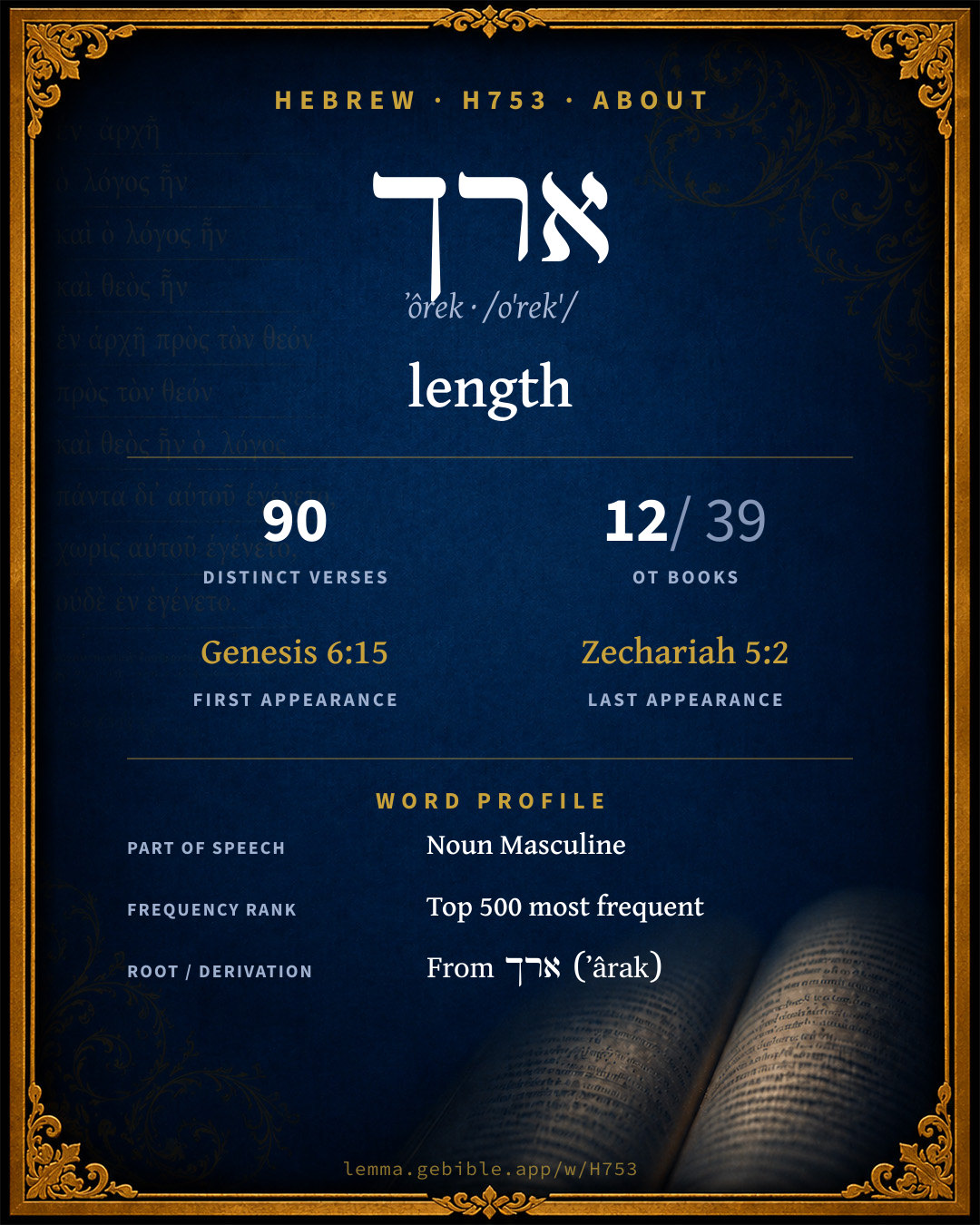
אֹ֫רֶךְ
length
‘length’ is one of 2 main senses fuller range ↓
Full lexicon entry — Brown-Driver-Briggs (BDB)
From Brown-Driver-Briggs (BDB)
Where this word appears
See every Construct-state word in the Hebrew Bible →
Grammar key — what these labels mean
Part of speech
- Noun
- A naming word — a person, place, thing, or idea.
Noun type
- Common
- A common noun — a general class of person, place, or thing (“king,” “city,” “water”), not a specific name.
State
- Absolute
- The independent form of a noun, not bound to a following word.
- Construct
- A noun bound to a following noun in a possessive / “of” relationship (the construct chain).
Gender
- Masculine
- Grammatically masculine.
Number
- Singular
- One.
Grammatical forms
- Noun, Common, Masculine, Singular, Construct 63 times (66%)
- Noun, Common, Masculine, Singular, Absolute 32 times (34%)
Parsed forms decoded from the imported morphology (morphhb / Westminster Leningrad Codex — WLC text public domain, morphhb tagging CC BY 4.0), counted across 95 parsed occurrences — not distinct verses.
Every verse where H753 appears — 90 distinct verses across 12 books. Click any verse to open its interlinear word-by-word view. Verse text shown in the World English Bible for context — . Each verse’s Hebrew form is shown with its reference; the English is not keyword-highlighted, since the data carries no word-level English alignment. Use “Compare translations” on any verse to read it across multiple English versions. This concordance covers the Hebrew Bible; Septuagint (Greek Old Testament) occurrences are not indexed here.
Genesis 2 verses
- Genesis 6:15 אֹ֚רֶךְ n c ms cs This is how you shall make it. The length of the ark will be three hundred cubits, the breadth of it fifty cubits, and the height of it thirty cubits.
- Genesis 13:17 לְ/אָרְכָּ֖/הּ prep + n c ms cs + sfx pers 3fs Arise, walk through the land in the length of it and in the breadth of it; for I will give it to you."
Exodus 23 verses
- Exodus 25:10 אָרְכּ֗/וֹ n c ms cs + sfx pers 3ms "They shall make an ark of acacia wood. Its length shall be two and a half cubits, its breadth a cubit and a half, and a cubit and a half its height.
- Exodus 25:17 אָרְכָּ֔/הּ n c ms cs + sfx pers 3fs You shall make a mercy seat of pure gold. Two and a half cubits shall be its length, and a cubit and a half its breadth.
- Exodus 25:23 אָרְכּ/וֹ֙ n c ms cs + sfx pers 3ms "You shall make a table of acacia wood. Two cubits shall be its length, and a cubit its breadth, and one and a half cubits its height.
- Exodus 26:2 אֹ֣רֶךְ n c ms cs The length of each curtain shall be twenty-eight cubits, and the breadth of each curtain four cubits: all the curtains shall have one measure.
- Exodus 26:8 אֹ֣רֶךְ n c ms cs The length of each curtain shall be thirty cubits, and the breadth of each curtain four cubits: the eleven curtains shall have one measure.
- Exodus 26:13 בְּ/אֹ֖רֶךְ prep + n c ms cs The cubit on the one side, and the cubit on the other side, of that which remains in the length of the curtains of the tent, shall hang over the sides of the tent on this side and on that side, to cover it.
- Exodus 26:16 אֹ֣רֶךְ n c ms cs Ten cubits shall be the length of a board, and one and a half cubits the breadth of each board.
- Exodus 27:1 אֹ֜רֶךְ n c ms "You shall make the altar of acacia wood, five cubits long, and five cubits broad; the altar shall be foursquare: and its height shall be three cubits.
- Exodus 27:9 אֹ֔רֶךְ n c ms "You shall make the court of the tent: for the south side southward there shall be hangings for the court of fine twined linen one hundred cubits long for one side:
- Exodus 27:11 בָּ/אֹ֔רֶךְ אֹ֑רֶךְ prep det + n c ms n c ms Likewise for the north side in length there shall be hangings one hundred cubits long, and the pillars of it twenty, and their sockets twenty, of brass; the hooks of the pillars, and their fillets, of silver.
- Exodus 27:18 אֹ֣רֶךְ n c ms cs The length of the court shall be one hundred cubits, and the breadth fifty every where, and the height five cubits, of fine twined linen, and their sockets of brass.
- Exodus 28:16 אָרְכּ֖/וֹ n c ms cs + sfx pers 3ms It shall be square and folded double; a span shall be its length of it, and a span its breadth.
- Exodus 30:2 אָרְכּ֜/וֹ n c ms cs + sfx pers 3ms Its length shall be a cubit, and its breadth a cubit. It shall be square, and its height shall be two cubits. Its horns shall be of one piece with it.
- Exodus 36:9 אֹ֜רֶךְ n c ms cs The length of each curtain was twenty-eight cubits, and the breadth of each curtain four cubits. All the curtains had one measure.
- Exodus 36:15 אֹ֜רֶךְ n c ms cs The length of each curtain was thirty cubits, and four cubits the breadth of each curtain. The eleven curtains had one measure.
- Exodus 36:21 אֹ֣רֶךְ n c ms cs Ten cubits was the length of a board, and a cubit and a half the breadth of each board.
- Exodus 37:1 אָרְכּ֗/וֹ n c ms cs + sfx pers 3ms Bezalel made the ark of acacia wood. Its length was two and a half cubits, and its breadth a cubit and a half, and a cubit and a half its height.
- Exodus 37:6 אָרְכָּ֔/הּ n c ms cs + sfx pers 3fs He made a mercy seat of pure gold. Its length was two and a half cubits, and a cubit and a half its breadth.
- Exodus 37:10 אָרְכּ/וֹ֙ n c ms cs + sfx pers 3ms He made the table of acacia wood. Its length was two cubits, and its breadth was a cubit, and its height was a cubit and a half.
- Exodus 37:25 אָרְכּ/וֹ֩ n c ms cs + sfx pers 3ms He made the altar of incense of acacia wood. It was square: its length was a cubit, and its breadth a cubit. Its height was two cubits. Its horns were of one piece with it.
- Exodus 38:1 אָרְכּ֜/וֹ n c ms cs + sfx pers 3ms He made the altar of burnt offering of acacia wood. It was square. Its length was five cubits, its breadth was five cubits, and its height was three cubits.
- Exodus 38:18 אֹ֔רֶךְ n c ms The screen for the gate of the court was the work of the embroiderer, of blue, purple, scarlet, and fine twined linen. Twenty cubits was the length, and the height in the breadth was five cubits, like to the hangings of the court.
- Exodus 39:9 אָרְכּ֛/וֹ n c ms cs + sfx pers 3ms It was square. They made the breastplate double. Its length was a span, and its breadth a span, being double.
Deuteronomy 2 verses
- Deuteronomy 3:11 אָרְכָּ֗/הּ n c ms cs + sfx pers 3fs (For only Og king of Bashan remained of the remnant of the Rephaim; behold, his bedstead was a bedstead of iron; isn't it in Rabbah of the children of Ammon? nine cubits was the length of it, and four cubits the breadth of it, after the cubit of a man.)
- Deuteronomy 30:20 וְ/אֹ֣רֶךְ conj + n c ms cs to love Yahweh your God, to obey his voice, and to cleave to him; for he is your life, and the length of your days; that you may dwell in the land which Yahweh swore to your fathers, to Abraham, to Isaac, and to Jacob, to give them.
Judges 1 verse
1 Kings 6 verses
- 1 Kings 6:2 אָרְכּ֖/וֹ n c ms cs + sfx pers 3ms The house which king Solomon built for Yahweh, the length of it was sixty cubits, and the breadth of it twenty [cubits], and the height of it thirty cubits.
- 1 Kings 6:3 אָרְכּ֔/וֹ n c ms cs + sfx pers 3ms The porch before the temple of the house, twenty cubits was the length of it, according to the breadth of the house; [and] ten cubits was the breadth of it before the house.
- 1 Kings 6:20 אֹ֜רֶךְ n c ms Within the oracle was [a space of] twenty cubits in length, and twenty cubits in breadth, and twenty cubits in the height of it; and he overlaid it with pure gold: and he covered the altar with cedar.
- 1 Kings 7:2 אָרְכּ/וֹ֙ n c ms cs + sfx pers 3ms For he built the house of the forest of Lebanon; the length of it was one hundred cubits, and the breadth of it fifty cubits, and the height of it thirty cubits, on four rows of cedar pillars, with cedar beams on the pillars.
- 1 Kings 7:6 אָרְכּ֔/וֹ n c ms cs + sfx pers 3ms He made the porch of pillars; the length of it was fifty cubits, and the breadth of it thirty cubits; and a porch before them; and pillars and a threshold before them.
- 1 Kings 7:27 אֹ֚רֶךְ n c ms cs He made the ten bases of brass; four cubits was the length of one base, and four cubits the breadth of it, and three cubits the height of it.
2 Chronicles 7 verses
- 2 Chronicles 3:3 הָ/אֹ֡רֶךְ ptcl def.art + n c ms Now these are the foundations which Solomon laid for the building of the house of God. The length by cubits after the first measure was sixty cubits, and the breadth twenty cubits.
- 2 Chronicles 3:4 הָ/אֹ֜רֶךְ ptcl def.art + n c ms The porch that was before [the house], the length of it, according to the breadth of the house, was twenty cubits, and the height one hundred twenty; and he overlaid it within with pure gold.
- 2 Chronicles 3:8 אָרְכּ֞/וֹ n c ms cs + sfx pers 3ms He made the most holy house: the length of it, according to the breadth of the house, was twenty cubits, and the breadth of it twenty cubits; and he overlaid it with fine gold, amounting to six hundred talents.
- 2 Chronicles 3:11 אָרְכָּ֖/ם n c ms cs + sfx pers 3mp The wings of the cherubim were twenty cubits long: the wing of the one [cherub] was five cubits, reaching to the wall of the house; and the other wing was [likewise] five cubits, reaching to the wing of the other cherub.
- 2 Chronicles 3:15 אֹ֑רֶךְ n c ms Also he made before the house two pillars of thirty-five cubits high, and the capital that was on the top of each of them was five cubits.
- 2 Chronicles 4:1 אָרְכּ֔/וֹ n c ms cs + sfx pers 3ms Moreover he made an altar of brass, twenty cubits the length of it, and twenty cubits the breadth of it, and ten cubits the height of it.
- 2 Chronicles 6:13 אָרְכּ֗/וֹ n c ms cs + sfx pers 3ms (for Solomon had made a brazen scaffold, five cubits long, and five cubits broad, and three cubits high, and had set it in the midst of the court; and on it he stood, and kneeled down on his knees before all the assembly of Israel, and spread forth his hands toward heaven;)
Job 1 verse
Psalms 4 verses
- Psalms 21:4 אֹ֥רֶךְ n c ms cs He asked life of you, you gave it to him, Even length of days forever and ever.
- Psalms 23:6 לְ/אֹ֣רֶךְ prep + n c ms cs Surely goodness and loving kindness shall follow me all the days of my life, And I shall dwell in Yahweh's house forever.
- Psalms 91:16 אֹ֣רֶךְ n c ms cs I will satisfy him with long life, And show him my salvation."
- Psalms 93:5 לְ/אֹ֣רֶךְ prep + n c ms cs Your statutes stand firm. Holiness adorns your house, Yahweh, forevermore.
Proverbs 3 verses
- Proverbs 3:2 אֹ֣רֶךְ n c ms cs For length of days, and years of life, And peace, will they add to you.
- Proverbs 3:16 אֹ֣רֶךְ n c ms cs Length of days is in her right hand. In her left hand are riches and honor.
- Proverbs 25:15 בְּ/אֹ֣רֶךְ prep + n c ms cs By patience a ruler is persuaded. A soft tongue breaks the bone.
Lamentations 1 verse
Ezekiel 38 verses
- Ezekiel 31:7 בְּ/אֹ֖רֶךְ prep + n c ms cs Thus was it beautiful in its greatness, in the length of its branches; for its root was by many waters.
- Ezekiel 40:7 אֹ֨רֶךְ֙ n c ms Every lodge was one reed long, and one reed broad; and [the space] between the lodges was five cubits; and the threshold of the gate by the porch of the gate toward the house was one reed.
- Ezekiel 40:11 אֹ֣רֶךְ n c ms cs He measured the breadth of the opening of the gate, ten cubits; and the length of the gate, thirteen cubits;
- Ezekiel 40:18 אֹ֣רֶךְ n c ms cs The pavement was by the side of the gates, answerable to the length of the gates, even the lower pavement.
- Ezekiel 40:20 אָרְכּ֖/וֹ n c ms cs + sfx pers 3ms The gate of the outer court whose prospect is toward the north, he measured the length of it and the breadth of it.
- Ezekiel 40:21 אָרְכּ֔/וֹ n c ms cs + sfx pers 3ms The lodges of it were three on this side and three on that side; and the posts of it and the arches of it were after the measure of the first gate: the length of it was fifty cubits, and the breadth twenty-five cubits.
- Ezekiel 40:25 אֹ֔רֶךְ n c ms There were windows in it and in the arches of it round about, like those windows: the length was fifty cubits, and the breadth twenty-five cubits.
- Ezekiel 40:29 אֹ֔רֶךְ n c ms and the lodges of it, and the posts of it, and the arches of it, according to these measures: and there were windows in it and in the arches of it round about; it was fifty cubits long, and twenty-five cubits broad.
- Ezekiel 40:30 אֹ֗רֶךְ n c ms There were arches round about, twenty-five cubits long, and five cubits broad.
- Ezekiel 40:33 אֹ֚רֶךְ n c ms and the lodges of it, and the posts of it, and the arches of it, according to these measures: and there were windows therein and in the arches of it round about; it was fifty cubits long, and twenty-five cubits broad.
- Ezekiel 40:36 אֹ֚רֶךְ n c ms the lodges of it, the posts of it, and the arches of it: and there were windows therein round about; the length was fifty cubits, and the breadth twenty-five cubits.
- Ezekiel 40:42 אֹרֶךְ֩ n c ms There were four tables for the burnt offering, of hewn stone, a cubit and a half long, and a cubit and a half broad, and one cubit high; whereupon they laid the instruments with which they killed the burnt offering and the sacrifice.
- Ezekiel 40:47 אֹ֣רֶךְ n c ms He measured the court, one hundred cubits long, and a hundred cubits broad, foursquare; and the altar was before the house.
- Ezekiel 40:49 אֹ֣רֶךְ n c ms cs The length of the porch was twenty cubits, and the breadth eleven cubits; even by the steps by which they went up to it: and there were pillars by the posts, one on this side, and another on that side.
- Ezekiel 41:2 אָרְכּ/וֹ֙ n c ms cs + sfx pers 3ms The breadth of the entrance was ten cubits; and the sides of the entrance were five cubits on the one side, and five cubits on the other side: and he measured the length of it, forty cubits, and the breadth, twenty cubits.
- Ezekiel 41:4 אָרְכּ֜/וֹ n c ms cs + sfx pers 3ms He measured the length of it, twenty cubits, and the breadth, twenty cubits, before the temple: and he said to me, This is the most holy place.
- Ezekiel 41:12 וְ/אָרְכּ֖/וֹ conj + n c ms cs + sfx pers 3ms The building that was before the separate place at the side toward the west was seventy cubits broad; and the wall of the building was five cubits thick round about, and the length of it ninety cubits.
- Ezekiel 41:13 אֹ֖רֶךְ אֹ֖רֶךְ n c ms n c ms So he measured the house, one hundred cubits long; and the separate place, and the building, with the walls of it, one hundred cubits long;
- Ezekiel 41:15 אֹֽרֶךְ n c ms cs He measured the length of the building before the separate place which was at the back of it, and the galleries of it on the one side and on the other side, one hundred cubits; and the inner temple, and the porches of the court;
- Ezekiel 41:22 וְ/אָרְכּ֣/וֹ וְ/אָרְכּ֥/וֹ conj + n c ms cs + sfx pers 3ms conj + n c ms cs + sfx pers 3ms The altar was of wood, three cubits high, and the length of it two cubits; and the corners of it, and the length of it, and the walls of it, were of wood: and he said to me, This is the table that is before Yahweh.
- Ezekiel 42:2 אֹ֨רֶךְ֙ n c ms Before the length of one hundred cubits was the north door, and the breadth was fifty cubits.
- Ezekiel 42:7 אָרְכּ֖/וֹ n c ms cs + sfx pers 3ms The wall that was outside by the side of the chambers, toward the outer court before the chambers, the length of it was fifty cubits.
- Ezekiel 42:8 אֹ֣רֶךְ n c ms cs For the length of the chambers that were in the outer court was fifty cubits: and, behold, before the temple were one hundred cubits.
- Ezekiel 42:11 כְּ/אָרְכָּ֖/ן prep + n c ms cs + sfx pers 3fp The way before them was like the appearance of [the way of] the chambers which were toward the north; according to their length so was their breadth: and all their exits were both according to their fashions, and according to their doors.
- Ezekiel 42:20 אֹ֚רֶךְ n c ms He measured it on the four sides: it had a wall round about, the length five hundred, and the breadth five hundred, to make a separation between that which was holy and that which was common.
- Ezekiel 43:16 אֹ֔רֶךְ n c ms The altar hearth shall be twelve [cubits] long by twelve broad, square in the four sides of it.
- Ezekiel 43:17 אֹ֗רֶךְ n c ms The ledge shall be fourteen [cubits] long by fourteen broad in the four sides of it; and the border about it shall be half a cubit; and the bottom of it shall be a cubit round about; and the steps of it shall look toward the east.
- Ezekiel 45:1 אֹ֗רֶךְ אֹ֔רֶךְ n c ms n c ms Moreover, when you shall divide by lot the land for inheritance, you shall offer an offering to Yahweh, a holy portion of the land; the length shall be the length of twenty-five thousand [reeds], and the breadth shall be ten thousand: it shall be holy in all the border of it round about.
- Ezekiel 45:3 אֹ֗רֶךְ n c ms cs Of this measure shall you measure a length of twenty-five thousand, and a breadth of ten thousand: and in it shall be the sanctuary, which is most holy.
- Ezekiel 45:5 אֹ֔רֶךְ n c ms Twenty-five thousand in length, and ten thousand in breadth, shall be to the Levites, the ministers of the house, for a possession to themselves, [for] twenty chambers.
- Ezekiel 45:6 וְ/אֹ֗רֶךְ conj + n c ms cs You shall appoint the possession of the city five thousand broad, and twenty-five thousand long, side by side with the offering of the holy portion: it shall be for the whole house of Israel.
- Ezekiel 45:7 וְ/אֹ֗רֶךְ conj + n c ms [Whatever is] for the prince [shall be] on the one side and on the other side of the holy offering and of the possession of the city, in front of the holy offering and in front of the possession of the city, on the west side westward, and on the east side eastward; and in length answerable to one of the portions, from the west border to the east border.
- Ezekiel 46:22 אֹ֔רֶךְ n c ms In the four corners of the court there were courts enclosed, forty [cubits] long and thirty broad: these four in the corners were of one measure.
- Ezekiel 48:8 וְ/אֹ֜רֶךְ conj + n c ms By the border of Judah, from the east side to the west side, shall be the offering which you shall offer, twenty-five thousand [reeds] in breadth, and in length as one of the portions, from the east side to the west side: and the sanctuary shall be in the midst of it.
- Ezekiel 48:9 אֹ֗רֶךְ n c ms cs The offering that you shall offer to Yahweh shall be twenty-five thousand [reeds] in length, and ten thousand in breadth.
- Ezekiel 48:10 אֹ֕רֶךְ n c ms cs For these, even for the priests, shall be the holy offering: toward the north twenty-five thousand [in length], and toward the west ten thousand in breadth, and toward the east ten thousand in breadth, and toward the south twenty-five thousand in length: and the sanctuary of Yahweh shall be in the midst of it.
- Ezekiel 48:13 אֹ֔רֶךְ אֹ֗רֶךְ n c ms n c ms Answerable to the border of the priests, the Levites shall have twenty-five thousand in length, and ten thousand in breadth: all the length shall be twenty-five thousand, and the breadth ten thousand.
- Ezekiel 48:18 בָּ/אֹ֜רֶךְ prep det + n c ms The remainder in the length, answerable to the holy offering, shall be ten thousand eastward, and ten thousand westward; and it shall be answerable to the holy offering; and the increase of it shall be for food to those who labor in the city.
Zechariah 2 verses
- Zechariah 2:2 אָרְכָּֽ/הּ n c ms cs + sfx pers 3fs Then I asked, "Where are you going?" He said to me, "To measure Jerusalem, to see what is its breadth and what is its length."
- Zechariah 5:2 אָרְכָּ/הּ֙ n c ms cs + sfx pers 3fs He said to me, "What do you see?" I answered, "I see a flying scroll; its length is twenty cubits, and its breadth ten cubits."
About this entry
At a glance — auto-summarized from this page’s data, not written by a person. Every figure links to its source below. This summary describes the numbers; it doesn’t interpret them.
ארך — transliterated ʼôrek — is a Hebrew noun carrying the sense “length.” It first appears in Genesis 6:15. With 90 verses in 12 books, it is a moderately common word in the Hebrew Bible. Its uses concentrate in Ezekiel (42% of all occurrences). It is not a single-sense word — see its full sense range. See the sense tree, 90-verse concordance, and the renderings breakdown below.
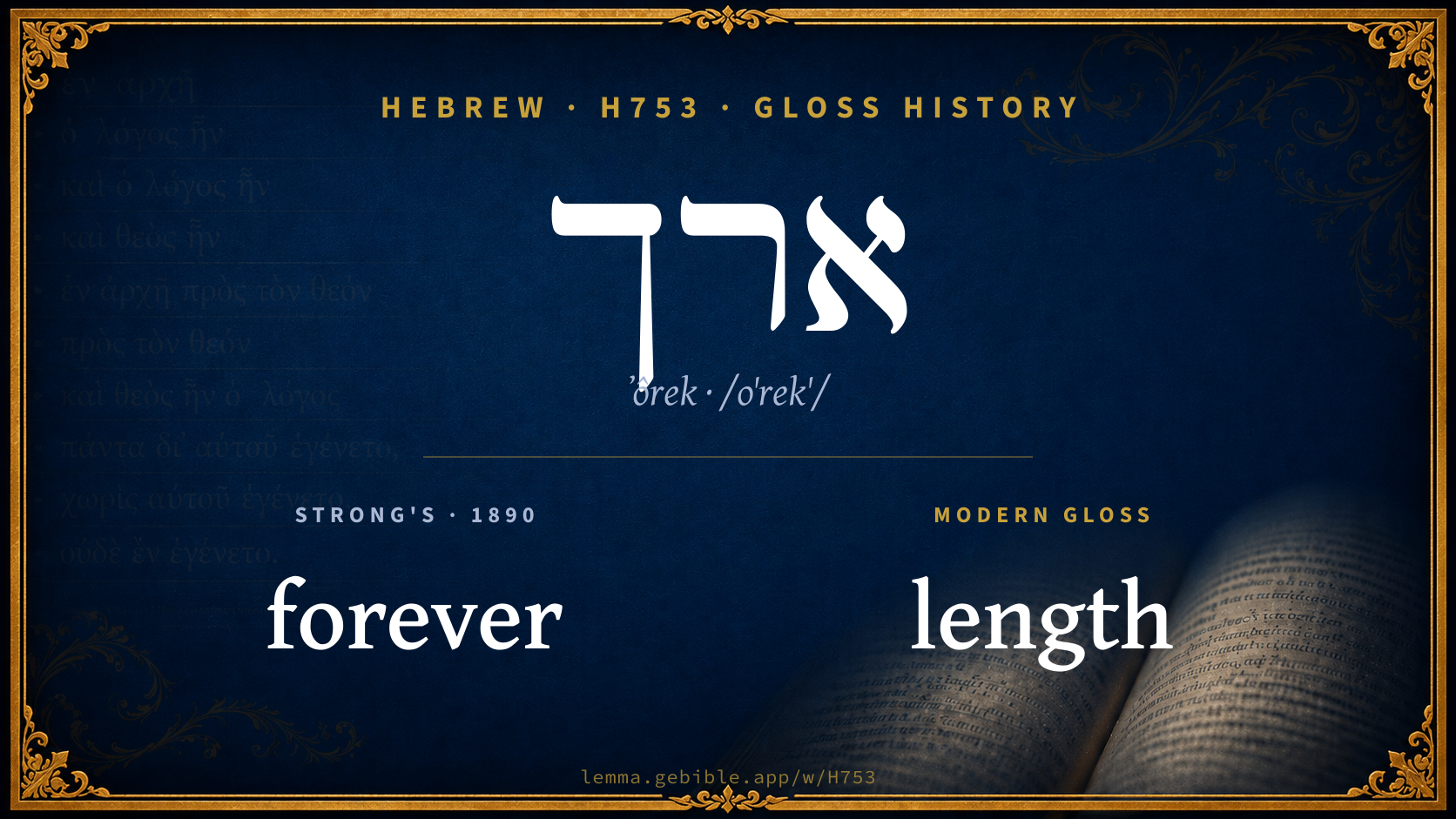
Gloss history
Strong's 1890 vs modern scholarship
About this word
Strong's H753 catalogs a Hebrew word from the Hebrew Old Testament.
These counts are not copied from any lexicon or concordance. They are computed here, from the morphology-tagged Hebrew Old Testament. What Lemma adds →
- 90
- distinct verses
- The word appears in 90 distinct verses.
- 12 / 39
- OT books
- The word appears in 12 of 39 Old Testament books.
- #437
- by frequency
- Top 500 most frequent Hebrew words (rank 437 of 8,640 Hebrew words by occurrence).
View all 90 occurrences in the concordance →
Most concentrated in
- Ezekiel 38 verses 42%
- Exodus 23 verses 26%
- 2 Chronicles 7 verses 8%
By section of the Old Testament
By traditional corpus
Conventional, traditional groupings — biblical authorship is debated, so this is a traditional corpus grouping, not an authorship claim. Each share is this word’s portion of its verses in that division of the Hebrew canon. Each figure is a share of the word’s 90 distinct verses.
- Prophets (Nevi'im) 47 verses · 52%
- Torah (Pentateuch) 27 verses · 30%
- Writings (Ketuvim) 16 verses · 18%
How translations render this word
Counts come from each version’s own published word-to-Strong’s tagging or interlinear alignment — an approximate guide to how each version renders this word, not a word-level alignment the data otherwise carries. Because each total is that version’s own tagged count, the per-version totals vary from one another and need not match the appearance or distinct-verse counts above. These counts may also differ from a printed concordance because Lemma counts each distinctly tagged rendering and does not collapse phrase taggings into a single head-word total. This is a fixed set of word-tagged versions (KJV, ASV, BSB, ULT) and does not change with the reading translation you choose elsewhere. Each version’s license is shown beside its name below (and on Sources).
- King James Version: Length 50×, Long 16×, Was the length 9×
- American Standard Version: Length 43×, Long 15×, Was the length 11×
- Berean Standard Bible: Long 62×, Length 15×
- unfoldingWord Literal Text: Length 58×, Length of 17×, Was 6×
King James Version Public Domain
Renders H753 across 95 tagged occurrences — most commonly:
Plus 7 renderings that appear only once — usually multi-word phrases or single function words the recovered tagging swept in, not distinct renderings.
American Standard Version Public Domain
Renders H753 across 94 tagged occurrences — most commonly:
Plus 12 renderings that appear only once — usually multi-word phrases or single function words the recovered tagging swept in, not distinct renderings.
Berean Standard Bible Public Domain
Renders H753 across 91 tagged occurrences — most commonly:
Plus 14 renderings that appear only once — usually multi-word phrases or single function words the recovered tagging swept in, not distinct renderings. Not rendered by a distinct English word in 4 further occurrences.
unfoldingWord Literal Text CC BY-SA 4.0
Renders H753 across 104 tagged occurrences — most commonly:
Plus 10 renderings that appear only once — usually multi-word phrases or single function words the recovered tagging swept in, not distinct renderings.
Senses in the full BDB
What do BDB’s symbols mean?
BDB uses these scholarly abbreviations:
| Symbol | Meaning |
|---|---|
| 𝔊 | the Septuagint (the ancient Greek translation, LXX) |
| 𝔙 | the Vulgate (the Latin translation) |
| 𝔖 | the Syriac version (the Peshitta) |
| 𝔗 | the Targum (the Aramaic translation) |
| ψ | the Psalms |
| √ | root (the underlying root or stem) |
| ‖ | parallel passage (a synonymous or contrasted parallel) |
| † | the dagger: every passage where the word occurs is cited |
The 3 senses and sub-senses the full Brown-Driver-Briggs lexicon distinguishes for this word, in lexicon order (not ranked by frequency), with BDB’s own verbatim wording and sub-sense lettering. Shown in Hebrew script with BDB’s own scholarly abbreviations. The condensed entry is in the Lexicon Entry tab. See also the Forms in the corpus table below.
- a. length of ark Gn 6:15 (P), of land of Canaan 13:17 (J); most often of ark & other measurements in tabernacle & temple Ex 25:10, 17; 26:2, 8; 27:1, 9 + (22 times Ex, P), 1 K 6:2, 3, 20 + (13 times K & Ch), Ez 40:7, 11, 18 + (41 times Ez), etc. e.g. Genesis 6:15
- b. of time א׳ יָמִים Dt 30:20; Jb 12:12; ψ 21:5; 23:6; 91:16; 93:5 Pr 3:2, 16; La 5:20. e.g. Deuteronomy 30:20
- c. א׳ אַפַּיִם forbearance, self-restraint, Pr 25:15.—(Ez 31:7 𝔊 𝔖 Co read רֹב for אֹרֶךְ, cf. v 5 where Co del. vb. ארך; 41:22 read prob. אדנו 𝔊 Sm, or אדניו Co = base.) e.g. Proverbs 25:15
Senses from the full Brown-Driver-Briggs lexicon (Brown, Driver, Briggs; Oxford 1906 — public domain), digitized via Sefaria, supplemented by the OpenScriptures HebrewLexicon (CC BY 4.0). Full attribution on Sources.
Word origin
n.[m.] length—only sg., א׳ abs. Ex 27:1 +; cstr. Gn 6:15; אָרְכּוֹ Ex 25:10 +; אָרְכָּם 2 Ch 3:11; אָרְכָּן Ez 42:11, etc.—
— Brown-Driver-Briggs (Oxford 1906, public domain), digitized via Sefaria, supplemented by the OpenScriptures HebrewLexicon (CC BY 4.0). See Sources.
Derived from ארך (ʼârak) (H748) — to be long.
Jastrow Dictionary
A second Hebrew/Aramaic lexicon for comparison, covering Aramaic and post-biblical (Talmudic, Targumic, Midrashic) usage that the biblical-Hebrew BDB does not. Matched by lemma rather than by Strong’s number, so a lemma may carry more than one Jastrow headword (shown separately below), and the entries cover usage well beyond the Bible.
ארך
- (√אר, cmp. ארג) to join, weave; whence to arrange, plan; v. ערך.—V. אֲרִיךְ II, אֲרוּכָה &c.
אָרֵךְ
- , cmp. Schr. KAT p. 497 ארג; cmp. also גדל to plait,to be tall) to be [pointed, stretched,] long, tall.
- 1. to prolong, be long in doing. Ber. I, 4 אמרו להַאֲרִיךְ they commended a lengthy benediction. Ib. 34ᵃ; cmp. אַרְכָן. Yoma 35ᵇ הֶאֱ׳ בתפלתו staid long in prayer.—הא׳ ימים to live long. Meg. 27ᵇ; a. fr.—Ber. 8ᵇ, a. fr. מַאֲרִיכִין ימיו his life will be prolonged.—פנים, הא׳ רוח to be long-suffering, forbearing. Y. Shebu. IV, beg. 35ᵇ; a. fr.—Y. Taan. II, 65ᵇ bot. when collecting debts (punishing) מאריך וגובה he is slow in collecting (punishes in long intervals, gives extension).
- 2. to be long, last long. Num. R. s. 20, end הא׳ הברזל the point of the spear grew longer, v. infra; a. fr.
- 3. [to lengthen the carrying pole,] to make heavy. Nidd. 16ᵇ כמה הֶאֱרַכְתָּ עלינו how heavy thou hast made our burden (through restrictive laws)!
- to be prolonged, grow longer. Sifré Num. 131; Yalk. ib. 771; (Num. R. l. c. האריך).
אֲרַךְ
- , v. אֲרִיךְ I
אֶרֶךְ
- (b. h.) only with אַף, אֲפַּיִם long-suffering, forbearing. Y. Taan. II, 65ᵇ; a. fr.; v. אַף.
A Dictionary of the Targumim, the Talmud Babli and Yerushalmi, and the Midrashic Literature (Marcus Jastrow; London, Luzac, 1903) — Public Domain. Digitized via Sefaria. Digitized via Sefaria. Full attribution on Sources.
Forms in the corpus
The 43 distinct written forms H753 takes in the Hebrew Bible, most frequent first — each parse links to that state’s occurrences in the concordance. Hebrew forms include their vowel points and cantillation, so a single lemma takes many written forms.
Same root — word family
Other BDB entries built from the same root as H753, grouped by Strong’s listed origin. These share a root / origin per the lexicon — not necessarily a shared meaning. Each links to that word’s own entry.
Derives from
Shares the same root
Proper names from this root
People and places named from this root — a name, not an additional meaning of the word.
Compare all same-root words → Showing 4 of 7 — not the complete family. 1 of the same-root words is a proper name (a person or place). They share a root, not necessarily a meaning.
Septuagint verse parallels
This word appears in 88 verses that also exist in the Greek Old Testament (Septuagint), out of the 90 Hebrew verses it occurs in. You can read those verses in Greek by switching the Old Testament edition to the Septuagint.
Read these verses in the Septuagint
- Genesis 6:15
- Exodus 25:10
- Deuteronomy 3:11
- Judges 3:16
- 1 Kings 6:2
- 2 Chronicles 3:3
- Job 12:12
- Psalms 21:4
- Proverbs 3:2
- Lamentations 5:20
- Ezekiel 31:7
- Zechariah 2:2
This is a verse-level parallel only — the same verses exist in both the Hebrew and Greek Old Testaments. No word-level Hebrew↔Greek correspondence is claimed: the data carries no such alignment, so no Greek word is shown as this Hebrew word’s translation. Coverage is not total — the Septuagint omits the deuterocanon and renumbers the Psalms, so some Hebrew verses have no direct Greek parallel.