Ezekiel 40:20

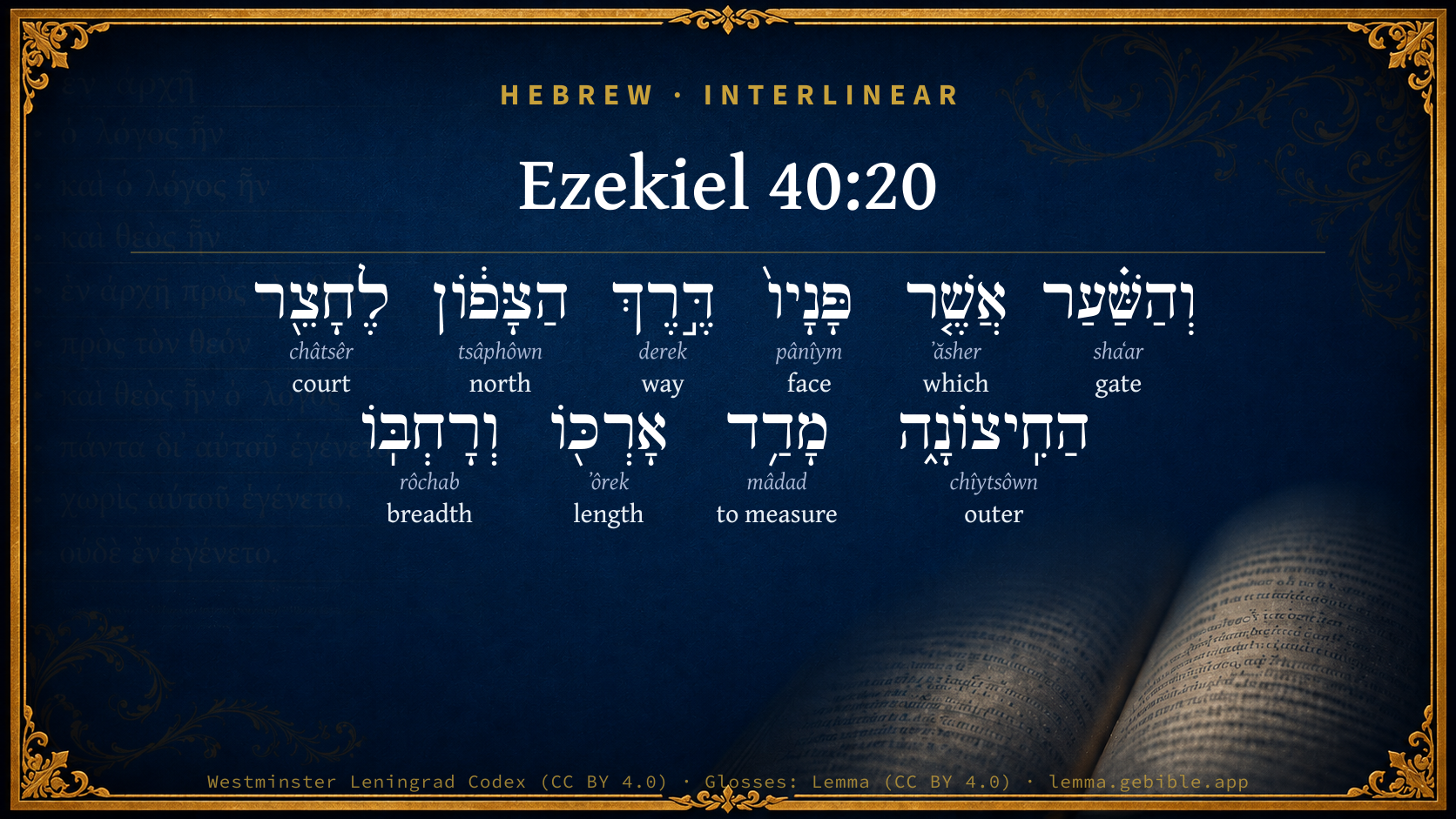
Hebrew (Westminster Leningrad Codex) Ezekiel 40:20 appears in the Hebrew Old Testament. The text above is from the Westminster Leningrad Codex. Each word links to its Strong’s number, a concise gloss, and parsing drawn from the Open Scriptures Hebrew Bible morphology. Click any word for its full Brown-Driver-Briggs (BDB) entry.
Download image
Cite this verse

Ezekiel 40:20 (World English Bible). Public Domain. Lemma interlinear Bible study tool, https://lemma.gebible.app/v/ezekiel/40/20.

Show BibTeX & RIS
BibTeX
RIS
English Translation
The gate of the outer court whose prospect is toward the north, he measured the length of it and the breadth of it.
World English Bible · Public Domain
Download a study sheet

One document with this verse’s original text, its word-by-word gloss line, the meaning frame, cross-references with their text, attributed commentary, and full source and license credits — printable, and it pastes into notes with its structure intact.

This verse Autodidact and up

Study sheet (.html) Plain text (.txt)

A passage Seminary Student

Up to 50 verses in one chapter. A passage sheet keeps up to 6 commentary sources and 12 cross-references per verse, in the order this page ranks them, and says so on the sheet whenever that leaves anything out. Ask for a single verse and you get the Autodidact verse sheet above.

Everything on this page stays free to read, with no account — the sheet is a download of what is already on screen, not access to it.

Want to remove ads? Support Godless Engineer
Compare translations 3

The same verse in 3 English versions, stacked beneath the original-language interlinear above. Click any original word for its lexicon entry.

Each is an independent rendering of the whole verse — the interlinear is not word-aligned to these translations.

Highlighted words mark where these versions differ — a whole-verse word diff, not a word-by-word alignment.

  • World English Bible Public Domain
    The gate of the outer court whose prospect is toward the north, he measured the length of it and the breadth of it.
  • King James Version Public Domain
    And the gate of the outward court that looked toward the north, he measured the length thereof, and the breadth thereof.
  • unfoldingWord Literal Text CC BY-SA 4.0
    Then he measured the length and width of the gate that was at the north of the outer court.

unfoldingWord Literal Text — © unfoldingWord, licensed CC BY-SA 4.0. Word-aligned USFM3 via Door43 (git.door43.org/unfoldingWord/en_ult).

Versions to compare (up to 4)

3 of 4 selected

Show all 18 translations

Every available English version of this verse, each an independent rendering of the whole verse.

  • World English Bible Public Domain
    The gate of the outer court whose prospect is toward the north, he measured the length of it and the breadth of it.
  • Berean Standard Bible Public Domain
    He also measured the length and width of the gateway of the outer court facing north.
  • Majority Standard Bible Public Domain
    He also measured the length and width of the gateway of the outer court facing north.
  • King James Version Public Domain
    And the gate of the outward court that looked toward the north, he measured the length thereof, and the breadth thereof.
  • American Standard Version (1901) Public Domain
    And the gate of the outer court whose prospect is toward the north, he measured the length thereof and the breadth thereof.
  • Revised Version (1885) Public Domain
    And the gate of the outer court whose prospect is toward the north, he measured the length thereof and the breadth thereof.
  • Geneva Bible (1599) Public Domain
    And the gate of the outwarde court, that looked toward the North, measured he after the length and breadth thereof.
  • Douay-Rheims (1899) Public Domain
    He measured also both the length and the breadth of the gate of the outward court, which looked northward.
  • Young's Literal Translation Public Domain
    As to the gate of the outer court whose front `is' northward, he hath measured its length and its breadth;
  • Literal Standard Version CC BY-SA 4.0
    As for the gate of the outer court whose front [is] northward, he has measured its length and its breadth;
  • Unlocked Literal Bible CC BY-SA 4.0
    Then he measured the length and width of the gate that was at the north of the outer court.
  • unfoldingWord Literal Text CC BY-SA 4.0
    Then he measured the length and width of the gate that was at the north of the outer court.
  • Darby Bible Public Domain
    And the gate of the outer court, that looked toward the north, he measured its length and its breadth.
  • World Messianic Bible Public Domain
    He measured the length and width of the gate of the outer court which faces toward the north.
  • Webster's Bible Public Domain
    And the gate of the outward court that looked towards the north, he measured its length, and its breadth.
  • Free Bible Version CC BY-SA 4.0
    He also measured the length and width of the gateway of the outer courtyard that faced north.
  • Bible in Basic English Public Domain
    And there was a doorway to the outer square, looking to the north; and he took the measure of it to see how wide and how long it was.
  • JPS Tanakh (1917) Public Domain
    And the gate of the outer court that looked toward the north, he measured the length thereof and the breadth thereof.

Literal Standard Version (2020), Covenant Press — licensed CC BY-SA 4.0. Text via the HelloAO Bible API (eBible.org). Unlocked Literal Bible (unfoldingWord) — licensed CC BY-SA 4.0. Text via the HelloAO Bible API (eBible.org). unfoldingWord Literal Text — © unfoldingWord, licensed CC BY-SA 4.0. Word-aligned USFM3 via Door43 (git.door43.org/unfoldingWord/en_ult). Free Bible Version, Dr. Jonathan Gallagher — licensed CC BY-SA 4.0. Text via the HelloAO Bible API (eBible.org).

Word by word

More ways to search: Search by grammar → Find every occurrence → Compare this word →

Practice this passage: Drill this verse → Learn its vocabulary →

הַחִֽיצוֹנָ֑ה
chîytsôwn
H2435
“the · outer”
Particle, Definite Article + Adjective, Adjective, Feminine, Singular, Absolute
Part of Speech
Particle + Adjective
Type
Adjective
Gender
Feminine
Number
Singular
State
Absolute
Full BDB Definition

Origin: from H2434

TWOT: 627b

outer, external, outward
  1. וְהַשַּׁ֗עַר shaʻar H8179 “and · the · gate” Conjunction + Particle, Definite Article + Noun, Common, Masculine, Singular, Absolute
  2. אֲשֶׁ֤ר ʼăsher H834 “which” Particle, Relative
  3. פָּנָיו֙ pânîym H6440 “face(s) · his” Noun, Common, Both, Plural, Construct + Suffix, Personal, 3rd Person, Masculine, Singular
  4. דֶּ֣רֶךְ derek H1870 “way of” Noun, Common, Both, Singular, Construct
  5. הַצָּפ֔וֹן tsâphôwn H6828 “the · north” Particle, Definite Article + Noun, Common, Feminine, Singular, Absolute
  6. לֶחָצֵ֖ר châtsêr H2691 “to/for the · court” Preposition, Determined + Noun, Common, Both, Singular, Absolute
  7. מָדַ֥ד mâdad H4058 “to measure” Verb, Qal, Perfect, 3rd Person, Masculine, Singular
  8. אָרְכּ֖וֹ ʼôrek H753 “length · his” Noun, Common, Masculine, Singular, Construct + Suffix, Personal, 3rd Person, Masculine, Singular
  9. וְרָחְבּֽוֹ rôchab H7341 “and · breadth · his” Conjunction + Noun, Common, Masculine, Singular, Construct + Suffix, Personal, 3rd Person, Masculine, Singular

About this verse

These counts appear in no published source. They are computed here, from the morphology-tagged text and Lemma’s own curated glosses. What Lemma adds →

10
words
10
distinct lemmas
Prophets
section

Notable vocabulary

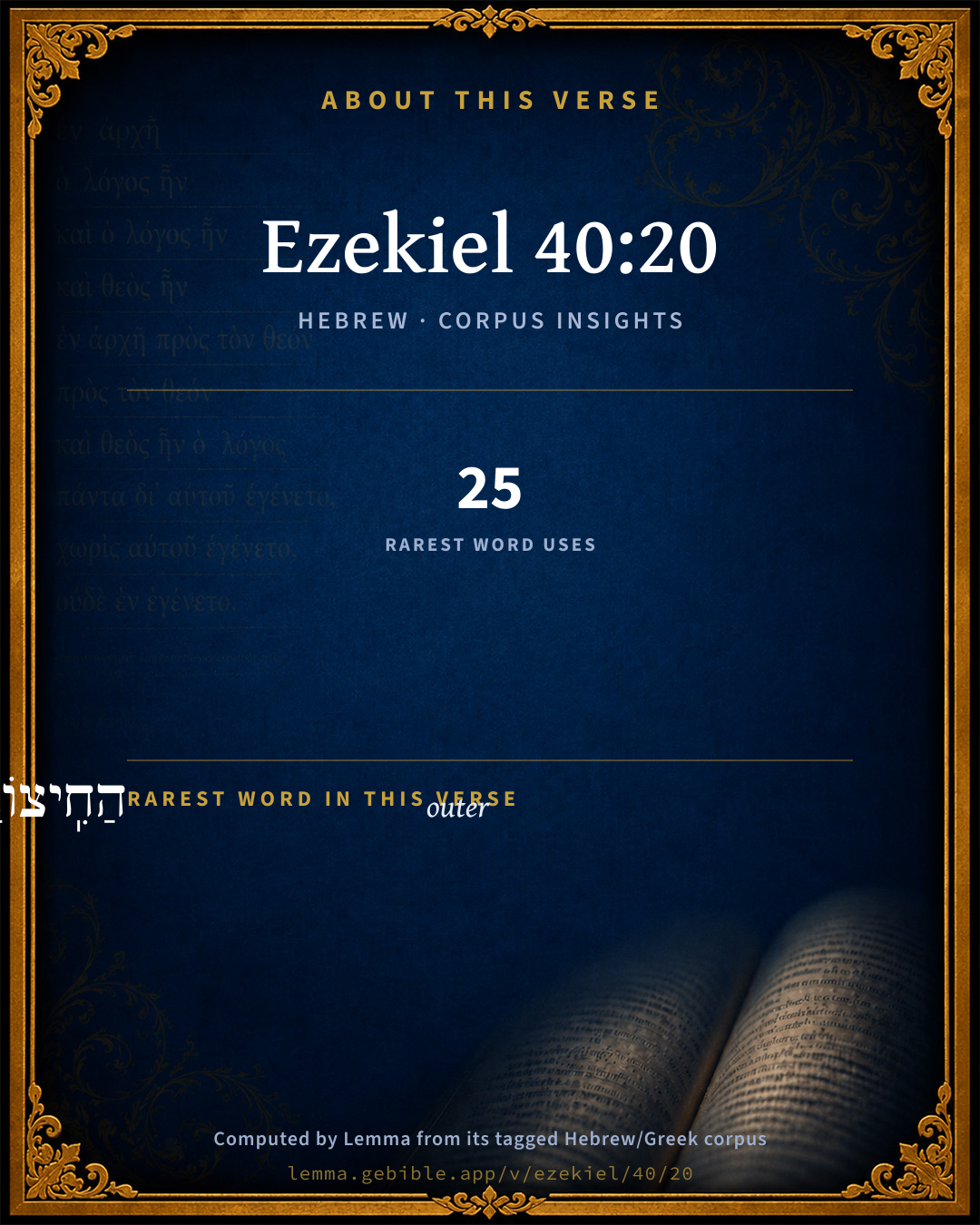
The rarest word here is הַחִֽיצוֹנָ֑ה outer H2435 — appearing just 25 times in the whole Hebrew Bible.

Shared distinctive vocabulary

הַחִֽיצוֹנָ֑ה outer H2435 occurs in 24 verses of the Hebrew Bible. Also found in:

Grammatical profile

  • 1 verb
  • 7 nouns
  • 1 adjective
  • 1 particle

Verb forms

  • מָדַ֥ד Qal · Perfect

Hebrew & Septuagint length

In English translation the verse runs 23 words from the Hebrew and 23 from the Septuagint (LXX English) — the same length.

A rough comparison of the two English renderings, which tokenize alike — not a word-level alignment.

Word counts can differ between the Hebrew and the Greek without any difference in meaning — e.g. the Hebrew direct-object marker אֵת has no separate Greek word, and Greek often adds the article ὁ.

Cross-references

1

Topical passages linked to Ezekiel 40:20 in the Treasury of Scripture Knowledge — connected by theme and wording, ordered by reader-vote popularity; previews shown in the World English Bible.

  • Ezekiel 40:6 Then came he to the gate which looks toward the east, and went up the steps of it: and he measured the threshold of the gate, one reed broad; and the other threshold, one reed broad.

Cross-references courtesy of OpenBible.info (CC BY 4.0).

Hebrew and Greek witnesses Masoretic Hebrew ↔ Greek Septuagint

The same verse in the two great witnesses to the Old Testament, shown verse-for-verse.

These are two independent witnesses, not word-aligned to each other, and the Septuagint is shown in lemma (dictionary) form.

Hebrew Ezekiel 40:20 Masoretic · Westminster Leningrad Codex

וְהַשַּׁ֗עַר אֲשֶׁ֤ר פָּנָיו֙ דֶּ֣רֶךְ הַצָּפ֔וֹן לֶחָצֵ֖ר הַחִֽיצוֹנָ֑ה מָדַ֥ד אָרְכּ֖וֹ וְרָחְבּֽוֹ

The gate of the outer court whose prospect is toward the north, he measured the length of it and the breadth of it.

World English Bible · Public Domain

Greek LXX Ezekiel 40:20 Septuagint · lemma form

καί ἰδού πύλη βλέπω πρός βορέας ὁ αὐλή ὁ ἐξώτερος καί διαμετρέω αὐτός ὁ τε μῆκος αὐτός καί ὁ πλάτος

and behold a gate looking northwards belonging to the outer court, and he measured it, both the length of it and the breadth;

LXX2012 (modern English Septuagint) · Public Domain

Hebrew: Westminster Leningrad Codex (CC BY 4.0). Greek: Septuagint (public domain); English from LXX2012 (modern English Septuagint) (Public Domain). How the Septuagint differs from the Hebrew →

Targum (Aramaic paraphrase)

1

The Targum is the ancient Jewish Aramaic paraphrase of the Hebrew Scriptures — an interpretive translation, not the Hebrew text itself. Onkelos (literal) and Pseudo-Jonathan (expansive) render the Torah, and Jonathan the Prophets. Coverage is partial: where no permissively-licensed English translation exists for a verse, only the Aramaic is shown. This is verse-level text, not a word-by-word alignment to the Hebrew.

  1. Targum Jonathan Prophets (Joshua–Malachi)
    וְתַרְעָא דְפְתִיחַ לְאוֹרַח צִפּוּנָא לְדַרְתָּא בָּרַיְתָא מְשַׁח אוּרְכֵּיהּ וּפוּתְיֵהּ:

    (no public-domain English translation for this verse)

    Targum Jonathan — Aramaic: “Mikraot Gedolot” (public domain). English: “Sefaria Community Translation” (CC0 1.0 (public-domain dedication)); “London "Chaldee Paraphrase," 1871” (public domain). Text via Sefaria.

Commentary

Notes on Ezekiel 40:20 from classic Christian and Jewish commentators (each source and its license shown beneath its notes). The classic Christian expositions comment on the surrounding passage and are grouped to its opening verse, so a note may address several verses; the Jewish commentaries on the Tanakh (Rashi and others) are per-verse, so they appear only where the commentator wrote on this verse.

Lemma curates 59 commentaries, every one of them public domain or Creative Commons licensed, each selected and text-cleaned for this edition rather than reprinted as found. About our sources →

Keil & Delitzsch

C. F. Keil & F. Delitzsch

The North Gate and the South Gate of the Outer Court (1 Plate I A)

The description of these two gate-buildings is very brief, only the principal portions being mentioned, coupled with the remark that they resembled those of the east gate. The following is the description of the north gate. - Eze 40:20. And the gate, whose direction was toward the north, touching the outer court, he measured its length and its breadth, Eze 40:21. And its guard-rooms, three on this side and three on that, and its pillars and its wall-projections. It was according to the measure of the first gate, fifty cubits its length, and the breadth five and twenty cubits. Eze 40:22. And its windows and its wall-projections and its palms were according to the measure of the gate, whose direction was toward the east; and by seven steps they went up, and its wall-projections were in front of it. Eze 40:23. And a gate to the inner court was opposite the gate to the north and to the east; and he measured from gate to gate a hundred cubits. - With the measuring of the breadth of the court the measuring man had reached the north gate, which he also proceeded to measure now. In Eze 40:20 the words והשּׁער to החיצונה are written absolutely; and in Eze 40:21 the verb היה does not belong to the objects previously enumerated, viz., guard-rooms, pillars, etc., but these objects are governed by ויּמד yb denrevog e, and היה points back to the principal subject of the two verses, השּׁער: it (the gate) was according to the measure... (cf. Eze 40:15 and Eze 40:13). For the use of ב in definitions of measurement, "25 בּאמּה" (by the cubit, sc. measured), as in Exo 27:18, etc., see Gesenius, 120. 4, Anm. 2. The "first gate" is the east gate, the one first measured and described. In Eze 40:23 the number of steps is given which the flight leading into the gateway had; and this of course applies to the flight of steps of the east gate also (Eze 40:6). In Eze 40:22, כּמדּת is not to be regarded as doubtful, as Hitzig supposes, or changed into כּ; for even if the windows of the east gate were not measured, they had at all events a definite measurement, so that it might be affirmed with regard to the windows of the north gate that their dimensions were the same. This also applies to the palm-decorations. With regard to the אלמּים (Eze 40:21), however, it is simply stated that they were measured; but the measurement is not given. לפּניהם (Eze 40:22, end) is not to be altered in an arbitrary and ungrammatical way into לפנימה, as Bttcher proposes. The suffix הם refers to the steps. Before the steps there were the אילמּים of the gate-building. This "before," however, is not equivalent to "outside the flight of steps," as Bttcher imagines; for the measuring man did not go out of the inside of the gate, or go down the steps into the court, but came from the court and ascended the steps, and as he was going up he saw in front (vis--vis) of the steps the אילמּים of the gate, i.e., the wall-projections on both sides of the threshold of the gate. In Eze 40:23 it is observed for the first time that there was a gate to the inner court opposite to the northern and the eastern gate of the outer court already described, so that the gates of the outer and inner court stood vis--vis. The distance between these outer and inner gates is then measured, viz., 100 cubits, in harmony with Eze 40:19.

In Eze 40:24-27 the south gate is described with the same brevity. Eze 40:24. And he led me toward the south, and behold there was a gate toward the south, and he measured its pillars and its wall-projections according to the same measures. Eze 40:25. And there were windows in it and its wall-projections round about like those windows; fifty cubits was the length, and the breadth five and twenty cubits. Eze 40:26. And seven steps were its ascent and its wall-projections in the front of them, and it had palm-work, one upon this side and one upon that on its pillars. Eze 40:27. And there was a gate to the inner court toward the south, and he measured from gate to gate toward the south a hundred cubits. - This gate also was built exactly like the two others. The description simply differs in form, and not in substance, from the description of the gate immediately preceding. כּמּדּות האלּ, "like those measures," is a concise expression for "like the measures of the pillars already described at the north and east gates." For Eze 40:25, compare Eze 40:16 and Eze 40:21; and for Eze 40:26, vid., Eze 40:22. Eze 40:26 is clearly explained from Eze 40:16, as compared with Eze 40:9. And lastly, Eze 40:27 answers to the 23rd verse, and completes the measuring of the breadth of the court, which was also a hundred cubits upon the south side, from the outer gate to the inner gate standing opposite, as was the case according to Eze 40:19 upon the eastern side. Hvernick has given a different explanation of Eze 40:27, and would take the measurement of a hundred cubits as referring to the distance between the gates of the inner court which stood opposite to each other, because in Eze 40:27 we have משּׁער in the text, and not מן השּׁער; so that we should have to render the passage thus, "he measured from a gate to the gate toward the south a hundred cubits," and not "from the gate (already described) of the outer court," but from another gate, which according to the context of the verse must also be a gate of the inner court. But it is precisely the context which speaks decidedly against this explanation. For since, according to Eze 40:18, the measuring man did not take the prophet into the inner court, for the purpose of measuring it before his eyes, till after he had measured from (a) gate to the south gate of the inner court, the distance which he had previously measured and found to be a hundred cubits is not to be sought for within the inner court, and therefore cannot give the distance between the gates of the inner court, which stood opposite to one another, but must be that from the south gate of the outer court to the south gate of the inner. This is the case not only here, but also in Eze 40:23, where the north gate is mentioned. We may see how little importance is to be attached to the omission of the article in משּׁער from the expression משּׁער אל שׁער in Eze 40:23, where neither the one gate nor the other is defined, because the context showed which gates were meant. Hvernick's explanation is therefore untenable, notwithstanding the fact that, according to Eze 40:47, the size of the inner court was a hundred cubits both in breadth and length. - From the distance between the gates of the outer court and the corresponding gates of the inner, as given in Eze 40:27, Eze 40:23, and Eze 40:19, we find that the outer court covered a space of two hundred cubits on every side, - namely, fifty cubits the distance which the outer court building projected into the court, and fifty cubits for the projection of the gate-building of the inner court into the outer court, and a hundred cubits from one gate-porch to the opposite one (50 + 50 + 100 = 200).

Consequently the full size of the building enclosed by the wall (Eze 40:5), i.e., of the temple with its two courts, may also be calculated, as it has been by many of the expositors. If we proceed, for example, from the outer north gate to the outer south gate upon the ground plan (Plate I), we have, to quote the words of Kliefoth, "first the northern breadth of the outer court (D) with its two hundred cubits; then the inner court, which measured a hundred cubits square according to Eze 40:47 (E), with its hundred cubits; and lastly, the south side of the outer court with two hundred cubits more (D); so that the sanctuary was five hundred cubits broad from north to south. And if we start from the entrance of the east gate of the court (A), we have first of all the eastern breadth of the outer court, viz., two hundred cubits; then the inner court (e) with its hundred cubits; after that the temple-buildings, which also covered a space of a hundred cubits square according to Eze 41:13-14, including the open space around them (G), with another hundred cubits; and lastly, the גּזרה (J), which was situated to the west of the temple-buildings, and also covered a space of a hundred cubits square according to Eze 41:13-14, with another hundred cubits; so that the sanctuary was also five hundred cubits long from east to west, or, in other words, formed a square of five hundred cubits."

Keil & Delitzsch — Biblical Commentary on the Old Testament (1861–1891) — public domain (CC PDM 1.0). Text via the HelloAO Bible API. (Old Testament only.)

Fairbairn on Ezekiel, Jonah & the Pastoral Epistles

Patrick Fairbairn

Now follows a brief description of the north and south gates:

Eze 40:20. And the gate of the outer court which looks toward the north he measured in its length and its breadth.

Eze 40:21. And its three chambers were on the one side, and three on the other; and its pillars and its porches were after the measure of the first gate: the length of it fifty cubits, and the breadth of it twenty-five cubits.

Eze 40:22. And its windows, and its porches, and its palm-trees, were after the measure of the gate which looks toward the east; and by seven steps they go up to it, and its porch before them.

Eze 40:23. And the gate of the inner court was over against the gate northward, and eastward (that is, apparently, the gate of the inner court here stood right opposite the outer gate, just as it had done on the east: so that the “and eastward” must be taken elliptically for: and as it was with the eastward; compare Eze 40:27, where the eastward is left out).

Eze 40:24. And he brought me toward the south, and lo, a gate toward the south; and he measured its pillars and its porches according to these measures.

Eze 40:25. And there were windows to it and to its porches entirely round about, according to those windows: fifty cubits long, and five-and-twenty cubits broad.

Eze 40:26. And its ascent is by seven steps, and its porch before them; and it had palm-trees, one on this side, and one on that side, upon its pillars.

Eze 40:27. And there was a gate for the inner court toward the south; and he measured from gate to gate an hundred cubits.

These directions regarding the north and south divisions merely intimate a correspondence in the plan between the different approaches, excepting that in the case of these two other gates no mention is made of the building with its thirty chambers, which was found on the eastern side. Probably because only one was needed, and it was assigned to the eastern quarter, as being the more peculiarly sacred; and being intended for the officiating priests, it might be most conveniently situated there.

Patrick Fairbairn — An Exposition of Ezekiel (1851), Jonah (1849), and The Pastoral Epistles (1874) — public domain. Text from a community e-Sword module.

Tyndale Open Study Notes

Tyndale Open Resources

40:20-27 The gateway on the north and the south gateway are described in similar terms, though in less detail than the east gateway. They were also a formidable defensive barrier against the intrusion of any defilement. There is no west gateway to the outer or the inner court because the area behind the Temple proper was blocked off to prevent access from the rear.

Tyndale Open Study Notes — © Tyndale Open Resources, licensed CC BY-SA 4.0. Text via the HelloAO Bible API.

Jamieson, Fausset & Brown

Robert Jamieson, A. R. Fausset & David Brown

The different approaches corresponded in plan. In the case of these two other gates, however, no mention is made of a building with thirty chambers such as was found on the east side. Only one was needed, and it was assigned to the east as being the sacred quarter, and that most conveniently situated for the officiating priests.

Jamieson, Fausset & Brown — Commentary Critical and Explanatory on the Whole Bible (1871) — public domain (CC PDM 1.0). Text via the HelloAO Bible API.

The Cambridge Bible for Schools and Colleges

gen. ed. J. J. S. Perowne

20. The dimensions of the N. gate were as those of the E. gate.

The Cambridge Bible for Schools and Colleges (gen. ed. J. J. S. Perowne; Cambridge University Press, 1878–1918) — public domain. Text from a community e-Sword module.

John Gill's Exposition

And the little chambers thereof were three on this side, and three on that side,.... As in the eastern gate, and the measures the same, Eze 40:7. Gospel churches in the latter day will be all on the same plan, and modelled according to the same pattern, and be in just the same order, one as another:

and the posts thereof, and the arches thereof, were after the same measure of the first gate; the eastern gate: believers will be all pillars in the church of God, and partakers of the same like precious faith:

the length thereof was fifty cubits, and the breadth five and twenty cubits; see Eze 40:13.

John Gill's Exposition of the Whole Bible (1746–1763) — public domain (CC PDM 1.0). Text via the HelloAO Bible API.

Albert Barnes' Notes on the Bible

The gates both of the outer and of the inner court. Compare Plan II.

Albert Barnes' Notes on the Bible (1834–1885) — public domain. Text from a community e-Sword/MySword module.

Matthew Poole's English Annotations

Now is this measurer giving account of the north gate of this outward court, in which is a most exact harmony with the measures, fashion, and ornaments of the east gate, so that nothing needs be here repeated; who would know all particulars of this gate may find them in the east gate.

Matthew Poole's English Annotations on the Holy Bible (1683–1685) — public domain. Text from a community e-Sword/MySword module.

Whedon's Commentary on the Bible

Daniel D. Whedon

20. The northern and southern gates are here seen to correspond exactly in dimensions, surroundings, and distance from the gate of the inner court, with the eastern or main entrance, which has been previously described.

Daniel D. Whedon (gen. ed.), Commentary on the Old and New Testaments (1874–1909) — public domain. Text from a community e-Sword module.

The Pulpit Commentary

Vers. 20-23The north gate. This was in all respects similar to that upon the east, though its description proceeds in the reverse order, beginning with the three "chambers," or lodges, on each side of the footway (ver. 21), going on to the "posts," "arches," and "windows," and ending with the outside steps, seven in number (ver. 22), which are here first mentioned in connection with the gates. Its dimensions were the same as those of the "first" gate, fifty cubits long and twenty-five cubits broad. It stood exactly in front of a corresponding gate into the inner court, and the distance between the two gates was, as before, a hundred cubits.

The Pulpit Commentary (1880–1919), ed. H.D.M. Spence-Jones & Joseph S. Exell — public domain. Text from a community e-Sword module.

unfoldingWord translationNotes

Door43 World Missions Community

chambers

See how you translated this in Ezekiel 40:7.

portico

See how you translated this in Ezekiel 8:16.

measured the same

"had the same measurement"

fifty cubits

about 27 meters. (See: Biblical Distance)

cubits

See how you translated these "long" cubits in Ezekiel 40:05.

twenty-five cubits

about 13.5 meters

the main gate

This refers to the gate on the eastern side of the outer courtyard. AT: "the main gate, which was on the eastern side of the outer wall"

translationWords

gate

court

unfoldingWord translationNotes — © Distant Shores Media and the Door43 World Missions Community, licensed CC BY-SA 4.0. Source: git.door43.org/Door43/en_tn.

Rashi

Rabbi Shlomo Yitzchaki (Rashi)

he measured its length and its width [to be] like the measurement of the eastern gate. This is delineated in the section.

Rashi on the Tanakh — English translations: “The Judaica Press complete Tanach with Rashi, translated by A. J. Rosenberg” (CC BY 4.0); “Pentateuch with Rashi's commentary by M. Rosenbaum and A.M. Silbermann, 1929-1934” (public domain); “The Metsudah Tanach series, Lakewood, N.J” (CC BY 4.0); and “The Book of Joshua, Metsudah Publications, 1997” (CC BY 4.0). Text via Sefaria.

Lesson kit

Teaching starters — assembled from the data on this page, not authored interpretation. Every prompt links to the verse data it draws on. Edit before teaching.

Ezekiel, in the Prophets, opens this verse with 10 words (10 distinct Hebrew lemmas). Its most distinctive word is chîytsôwn (“outer”). A historical commentator’s framing appears above. Read the whole chapter for the surrounding context.

Discussion questions

  1. How does “outer” (chîytsôwn) shape what this verse is saying?
  2. How does 1 Kings 6:29, which shares the word «outer», read alongside this verse?
  3. These translations render this verse differently; the difference is in the English rendering, not the original. What questions does that raise?
  4. «מָדַ֥ד» is a Qal Perfect verb. How does that grammatical form shape the action described?
  5. Compare how Keil & Delitzsch and Fairbairn on Ezekiel, Jonah & the Pastoral Epistles read this verse. Where do they agree or differ?

Things to notice

Reading settings

Reading text

Shown beneath each verse's original-language words.

Old Testament
Old Testament edition

Read the OT as the Masoretic Hebrew (MT) or the Greek Septuagint (LXX).

English shown for the Greek Septuagint (in the Hebrew ↔ Greek comparison).

Comparing translations? Open the Compare panel on any verse page to stack up to four side by side.