
1 Kings 7:27

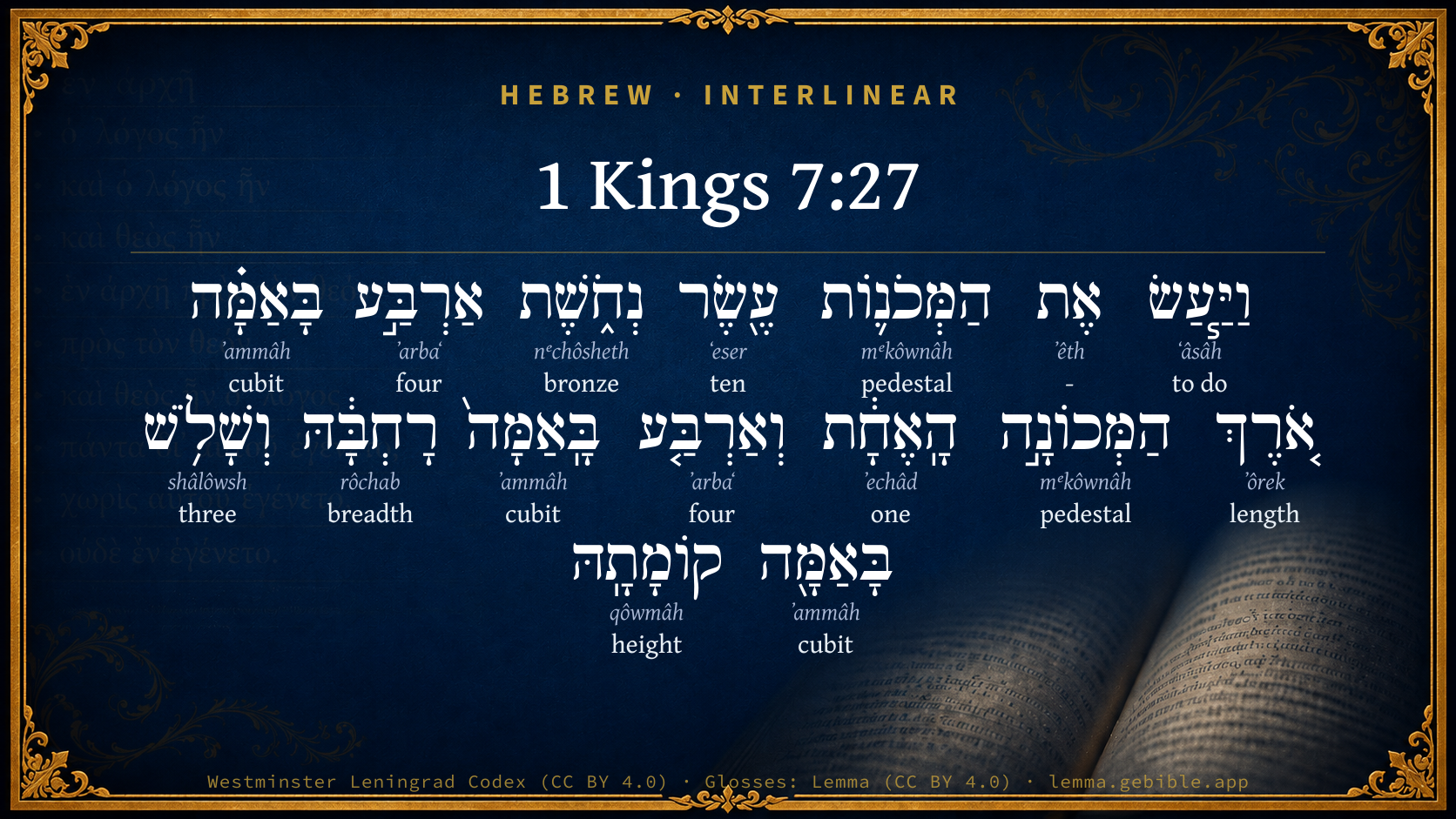
Hebrew (Westminster Leningrad Codex) 1 Kings 7:27 appears in the Hebrew Old Testament. The text above is from the Westminster Leningrad Codex. Each word links to its Strong’s number, a concise gloss, and parsing drawn from the Open Scriptures Hebrew Bible morphology. Click any word for its full Brown-Driver-Briggs (BDB) entry.
Download image
Cite this verse

1 Kings 7:27 (World English Bible). Public Domain. Lemma interlinear Bible study tool, https://lemma.gebible.app/v/1-kings/7/27.

Show BibTeX & RIS
BibTeX
RIS
English Translation
He made the ten bases of brass; four cubits was the length of one base, and four cubits the breadth of it, and three cubits the height of it.
World English Bible · Public Domain
Highlights
  • 1 first appearance in the Hebrew Bible
Full analysis ↓
Download a study sheet

One document with this verse’s original text, its word-by-word gloss line, the meaning frame, cross-references with their text, attributed commentary, and full source and license credits — printable, and it pastes into notes with its structure intact.

This verse Autodidact and up

Study sheet (.html) Plain text (.txt)

A passage Seminary Student

Up to 50 verses in one chapter. A passage sheet keeps up to 6 commentary sources and 12 cross-references per verse, in the order this page ranks them, and says so on the sheet whenever that leaves anything out. Ask for a single verse and you get the Autodidact verse sheet above.

Everything on this page stays free to read, with no account — the sheet is a download of what is already on screen, not access to it.

Want to remove ads? Support Godless Engineer
Compare translations 3

The same verse in 3 English versions, stacked beneath the original-language interlinear above. Click any original word for its lexicon entry.

Each is an independent rendering of the whole verse — the interlinear is not word-aligned to these translations.

Highlighted words mark where these versions differ — a whole-verse word diff, not a word-by-word alignment.

  • World English Bible Public Domain
    He made the ten bases of brass; four cubits was the length of one base, and four cubits the breadth of it, and three cubits the height of it.
  • King James Version Public Domain
    And he made ten bases of brass; four cubits was the length of one base, and four cubits the breadth thereof, and three cubits the height of it.
  • unfoldingWord Literal Text CC BY-SA 4.0
    And he made ten bronze stands. Four by the cubit the length of one stand, and four by the cubit its width, and three by the cubit its height.

unfoldingWord Literal Text — © unfoldingWord, licensed CC BY-SA 4.0. Word-aligned USFM3 via Door43 (git.door43.org/unfoldingWord/en_ult).

Versions to compare (up to 4)

3 of 4 selected

Show all 18 translations

Every available English version of this verse, each an independent rendering of the whole verse.

  • World English Bible Public Domain
    He made the ten bases of brass; four cubits was the length of one base, and four cubits the breadth of it, and three cubits the height of it.
  • Berean Standard Bible Public Domain
    In addition, he made ten movable stands of bronze, each four cubits long, four cubits wide, and three cubits high.
  • Majority Standard Bible Public Domain
    In addition, he made ten movable stands of bronze, each four cubits long, four cubits wide, and three cubits high.
  • King James Version Public Domain
    And he made ten bases of brass; four cubits was the length of one base, and four cubits the breadth thereof, and three cubits the height of it.
  • American Standard Version (1901) Public Domain
    And he made the ten bases of brass; four cubits was the length of one base, and four cubits the breadth thereof, and three cubits the height of it.
  • Revised Version (1885) Public Domain
    And he made the ten bases of brass; four cubits was the length of one base, and four cubits the breadth thereof, and three cubits the height of it.
  • Geneva Bible (1599) Public Domain
    And he made tenne bases of brasse, one base was foure cubites long, and foure cubites broad, and three cubites hie.
  • Douay-Rheims (1899) Public Domain
    And he made ten bases of brass, every base was four cubits in length, and four cubits in breadth, and three cubits high.
  • Young's Literal Translation Public Domain
    And he maketh the ten bases of brass; four by the cubit `is' the length of the one base, and four by the cubit its breadth, and three by the cubit its height.
  • Literal Standard Version CC BY-SA 4.0
    And he makes the ten bases of bronze; the length of the one base [is] four by the cubit, and its breadth [is] four by the cubit, and its height [is] three by the cubit.
  • Unlocked Literal Bible CC BY-SA 4.0
    Huram made the ten stands of bronze. Each stand was four cubits long and four cubits wide, and the height was three cubits.
  • unfoldingWord Literal Text CC BY-SA 4.0
    And he made ten bronze stands. Four by the cubit the length of one stand, and four by the cubit its width, and three by the cubit its height.
  • Darby Bible Public Domain
    And he made ten bases of brass: four cubits was the length of one base, and the breadth four cubits, and the height three cubits.
  • World Messianic Bible Public Domain
    He made the ten bases of bronze. The length of one base was four cubits, four cubits its width, and three cubits its height.
  • Webster's Bible Public Domain
    And he made ten bases of brass; four cubits was the length of one base, and four cubits the breadth of it, and three cubits the hight of it.
  • Free Bible Version CC BY-SA 4.0
    He also made ten carts to carry basins. The carts measured four cubits long, four cubits wide, and three cubits high.
  • Bible in Basic English Public Domain
    And he made ten wheeled bases of brass; every one four cubits long, four cubits wide, and three cubits high.
  • JPS Tanakh (1917) Public Domain
    And he made the ten bases of brass; four cubits was the length of one base, and four cubits the breadth thereof, and three cubits the height of it.

Literal Standard Version (2020), Covenant Press — licensed CC BY-SA 4.0. Text via the HelloAO Bible API (eBible.org). Unlocked Literal Bible (unfoldingWord) — licensed CC BY-SA 4.0. Text via the HelloAO Bible API (eBible.org). unfoldingWord Literal Text — © unfoldingWord, licensed CC BY-SA 4.0. Word-aligned USFM3 via Door43 (git.door43.org/unfoldingWord/en_ult). Free Bible Version, Dr. Jonathan Gallagher — licensed CC BY-SA 4.0. Text via the HelloAO Bible API (eBible.org).

Word by word

More ways to search: Search by grammar → Find every occurrence → Compare this word →

Practice this passage: Drill this verse → Learn its vocabulary →

הַמְּכֹנ֛וֹת
mᵉkôwnâh
H4350
“the · pedestals”
Particle, Definite Article + Noun, Common, Feminine, Plural, Absolute
Part of Speech
Particle + Noun
Type
Common
Gender
Feminine
Number
Plural
State
Absolute
Full BDB Definition

Origin: from H4349

TWOT: 964d

fixed resting place, base, pedestal
  1. וַיַּ֧עַשׂ ʻâsâh H6213 “and · to do” Conjunction + Verb, Qal, Sequential Imperfect, 3rd Person, Masculine, Singular
  2. אֶת ʼêth H853 “-” Particle, Direct Object
  3. עֶ֖שֶׂר ʻeser H6235 “ten” Adjective, Cardinal number, Feminine, Singular, Absolute
  4. נְחֹ֑שֶׁת nᵉchôsheth H5178 “bronze” Noun, Common, Feminine, Singular, Absolute
  5. אַרְבַּ֣ע ʼarbaʻ H702 “four” Adjective, Cardinal number, Feminine, Singular, Absolute
  6. בָּאַמָּ֗ה ʼammâh H520 “in/at the · cubit” Preposition, Determined + Noun, Common, Feminine, Singular, Absolute
  7. אֹ֚רֶךְ ʼôrek H753 “length of” Noun, Common, Masculine, Singular, Construct
  8. הַמְּכוֹנָ֣ה mᵉkôwnâh H4350 “the · pedestal” Particle, Definite Article + Noun, Common, Feminine, Singular, Absolute
  9. הָֽאֶחָ֔ת ʼechâd H259 “the · one” Particle, Definite Article + Adjective, Cardinal number, Feminine, Singular, Absolute
  10. וְאַרְבַּ֤ע ʼarbaʻ H702 “and · four” Conjunction + Adjective, Cardinal number, Feminine, Singular, Absolute
  11. בָּֽאַמָּה֙ ʼammâh H520 “in/at the · cubit” Preposition, Determined + Noun, Common, Feminine, Singular, Absolute
  12. רָחְבָּ֔הּ rôchab H7341 “breadth · her” Noun, Common, Masculine, Singular, Construct + Suffix, Personal, 3rd Person, Feminine, Singular
  13. וְשָׁלֹ֥שׁ shâlôwsh H7969 “and · three” Conjunction + Adjective, Cardinal number, Feminine, Singular, Absolute
  14. בָּאַמָּ֖ה ʼammâh H520 “in/at the · cubit” Preposition, Determined + Noun, Common, Feminine, Singular, Absolute
  15. קוֹמָתָֽהּ qôwmâh H6967 “height · her” Noun, Common, Feminine, Singular, Construct + Suffix, Personal, 3rd Person, Feminine, Singular

About this verse

These counts appear in no published source. They are computed here, from the morphology-tagged text and Lemma’s own curated glosses. What Lemma adds →

16
words
12
distinct lemmas
Historical
section

Notable vocabulary

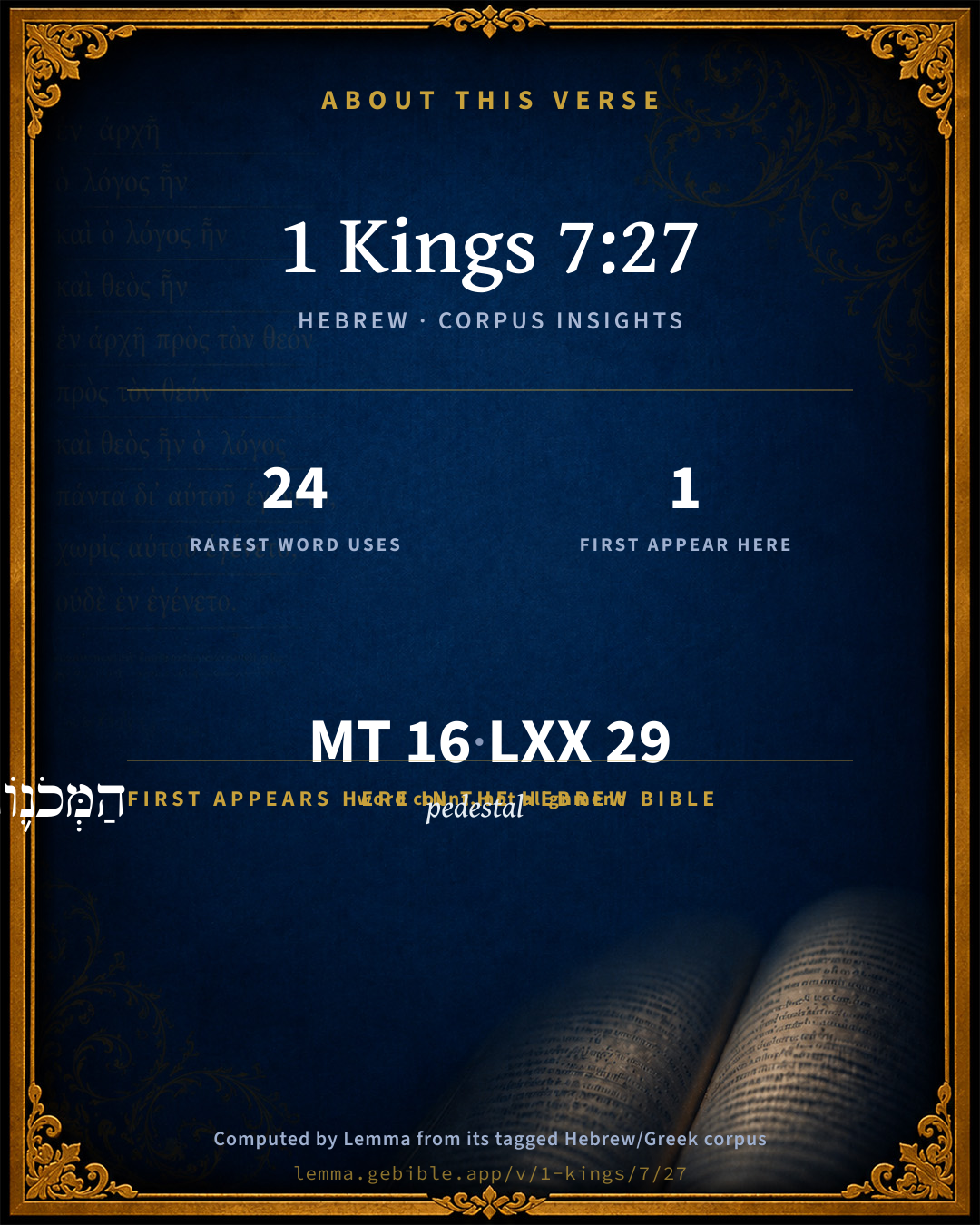
The rarest word here is הַמְּכֹנ֛וֹת pedestal H4350 — appearing just 24 times in the whole Hebrew Bible.

First appearance in Scripture

This word makes its first canonical appearance in the Hebrew Bible here:

  • הַמְּכֹנ֛וֹת pedestal H4350

Shared distinctive vocabulary

הַמְּכֹנ֛וֹת pedestal H4350 occurs in 18 verses of the Hebrew Bible. Also found in:

Grammatical profile

  • 1 verb
  • 9 nouns
  • 5 adjectives
  • 1 particle

Verb forms

  • וַיַּ֧עַשׂ Qal · Sequential Imperfect

Repetition

Words recur within this verse — often emphatic in Hebrew:

  • בָּאַמָּ֗ה cubit H520 ×3
  • הַמְּכֹנ֛וֹת pedestal H4350 ×2
  • אַרְבַּ֣ע four H702 ×2

Hebrew & Septuagint length

In English translation the verse runs 29 words from the Hebrew and 27 from the Septuagint (LXX English) — closely comparable.

A rough comparison of the two English renderings, which tokenize alike — not a word-level alignment.

Word counts can differ between the Hebrew and the Greek without any difference in meaning — e.g. the Hebrew direct-object marker אֵת has no separate Greek word, and Greek often adds the article ὁ.

In the original languages it is 16 Hebrew tokens and 29 Greek tokens — but the two are counted differently (Hebrew bundles its prefixes and suffixes into one token; the Greek is in lemma form), so that isn’t a like-for-like length.

Cross-references

6

Topical passages linked to 1 Kings 7:27 in the Treasury of Scripture Knowledge — connected by theme and wording, ordered by reader-vote popularity; previews shown in the World English Bible.

  • 2 Chronicles 4:14 He made also the bases, and the basins made he on the bases;
  • 2 Kings 25:13 The pillars of brass that were in the house of Yahweh, and the bases and the brazen sea that were in the house of Yahweh, did the Chaldeans break in pieces, and carried the brass of them to Babylon.
  • Jeremiah 52:17 The pillars of brass that were in the house of Yahweh, and the bases and the brazen sea that were in the house of Yahweh, did the Chaldeans break in pieces, and carried all the brass of them to Babylon.
  • 1 Kings 7:38 He made ten basins of brass: one basin contained forty baths; and every basin was four cubits; and on very one of the ten bases one basin.
  • 2 Kings 25:16 The two pillars, the one sea, and the bases, which Solomon had made for the house of Yahweh, the brass of all these vessels was without weight.
  • Jeremiah 52:20 The two pillars, the one sea, and the twelve brazen bulls that were under the bases, which king Solomon had made for the house of Yahweh. The brass of all these vessels was without weight.

Cross-references courtesy of OpenBible.info (CC BY 4.0).

Hebrew and Greek witnesses Masoretic Hebrew ↔ Greek Septuagint

The same verse in the two great witnesses to the Old Testament, shown verse-for-verse.

These are two independent witnesses, not word-aligned to each other, and the Septuagint is shown in lemma (dictionary) form.

Hebrew 1 Kings 7:27 Masoretic · Westminster Leningrad Codex

וַיַּ֧עַשׂ אֶת הַמְּכֹנ֛וֹת עֶ֖שֶׂר נְחֹ֑שֶׁת אַרְבַּ֣ע בָּאַמָּ֗ה אֹ֚רֶךְ הַמְּכוֹנָ֣ה הָֽאֶחָ֔ת וְאַרְבַּ֤ע בָּֽאַמָּה֙ רָחְבָּ֔הּ וְשָׁלֹ֥שׁ בָּאַמָּ֖ה קוֹמָתָֽהּ

He made the ten bases of brass; four cubits was the length of one base, and four cubits the breadth of it, and three cubits the height of it.

World English Bible · Public Domain

Greek LXX 1 Kings 7:27 Septuagint · lemma form

στῦλος δύο καί ὁ στρεπτός ὁ στῦλος ἐπί ὁ κεφαλή ὁ στῦλος δύο καί ὁ δίκτυον δύο ὁ καλύπτω ἀμφότεροι ὁ στρεπτός ὁ γλυφή ὁ εἰμί ἐπί ὁ στῦλος

And he made ten brazen bases: five cubits was the length of one base, and four cubits the breadth of it, and its height was six cubits.

LXX2012 (modern English Septuagint) · Public Domain

Hebrew: Westminster Leningrad Codex (CC BY 4.0). Greek: Septuagint (public domain); English from LXX2012 (modern English Septuagint) (Public Domain). How the Septuagint differs from the Hebrew →

Targum (Aramaic paraphrase)

1

The Targum is the ancient Jewish Aramaic paraphrase of the Hebrew Scriptures — an interpretive translation, not the Hebrew text itself. Onkelos (literal) and Pseudo-Jonathan (expansive) render the Torah, and Jonathan the Prophets. Coverage is partial: where no permissively-licensed English translation exists for a verse, only the Aramaic is shown. This is verse-level text, not a word-by-word alignment to the Hebrew.

  1. Targum Jonathan Prophets (Joshua–Malachi)
    וַעֲבַד יַת בְּסִיסַיָא עַסְרָא דִנְחָשָׁא אַרְבַּע אַמִין אוּרְכָּא דִבְסִיסָא חֲדָא וְאַרְבַּע אַמִין פּוּתְיָהּ וּתְלַת אַמִין רוּמָה:

    (no public-domain English translation for this verse)

    Targum Jonathan — Aramaic: “Mikraot Gedolot” (public domain). English: “Sefaria Community Translation” (CC0 1.0 (public-domain dedication)); “London "Chaldee Paraphrase," 1871” (public domain). Text via Sefaria.

Commentary

Notes on 1 Kings 7:27 from classic Christian and Jewish commentators (each source and its license shown beneath its notes). The classic Christian expositions comment on the surrounding passage and are grouped to its opening verse, so a note may address several verses; the Jewish commentaries on the Tanakh (Rashi and others) are per-verse, so they appear only where the commentator wrote on this verse.

Lemma curates 59 commentaries, every one of them public domain or Creative Commons licensed, each selected and text-cleaned for this edition rather than reprinted as found. About our sources →

Trapp's Complete Commentary

John Trapp

1Ki 7:27 And he made ten bases of brass; four cubits [was] the length of one base, and four cubits the breadth thereof, and three cubits the height of it.

Ver. 27. And he made ten bases of brass.] To bear up so many lesser layers. {1Ki 7:38}

John Trapp, A Commentary or Exposition upon All the Books of the Old and New Testament (1647–1656) — public domain. Text from a community e-Sword module.

Joseph Benson's Commentary

1Ki 7:27-29. He made ten bases of brass — Upon which stood ten lavers mentioned below, (1Ki 7:38,) in which they washed the parts of the sacrifices, 2Ch 4:6. They had borders — Broad brims, possibly for the more secure holding of the lavers. Upon the ledges there was a base above — This is very obscurely expressed; hut probably by the base above is meant the uppermost part of the base; which, though it was above, yet was a base to the laver, which stood upon it. Certain additions —

Either as bases for the feet of the said lions and oxen, or only as further ornaments.

Joseph Benson's Commentary on the Old and New Testaments (1811–1818) — public domain. Text from a community e-Sword module.

Whedon's Commentary on the Bible

Daniel D. Whedon

27. Ten bases — Square chest-shaped supports on which the brazen lavers mentioned in 1Ki_7:38 rested. The exact form of these bases and the lavers is, like that of the pillars Jachin and Boaz, difficult to define. The Scripture text itself is very obscure — the terms used are rare, and the versions all differ widely, and afford us no real aid. We may, however, by a careful study of the Hebrew text and the aid of the annexed cut, approximate a tolerably correct idea of the construction of these vessels. While the water in the brazen sea served for the priests to wash in, the lavers held the water in which they washed “such things as they offered for the burnt offering.” 2Ch_4:6. Hence they were set upon lofty bases to lift them near to the top of the great brazen altar of burnt offerings, which was ten cubits high. 2Ch_4:1. The bases were three cubits high, (1Ki_7:27,) the wheels a cubit and a half, (32,) the round compass half a cubit, (35,) the laver one cubit, and its base work a cubit and a half, (31,) and the corners or feet (30) were probably half a cubit, so that the height of the entire structure would be eight cubits, or about twelve feet. This would bring the top of the laver within three feet of the top of the great altar, and thus place it within convenient reach of the officiating priest.

Daniel D. Whedon (gen. ed.), Commentary on the Old and New Testaments (1874–1909) — public domain. Text from a community e-Sword module.

Tyndale Open Study Notes

Tyndale Open Resources

7:27-39 The ten bronze water carts each held a basin for rinsing burnt offerings (2 Chr 4:6). Five stood on either side of the Temple. Because they had wheels, they could be moved as needed.

Tyndale Open Study Notes — © Tyndale Open Resources, licensed CC BY-SA 4.0. Text via the HelloAO Bible API.

Jamieson, Fausset & Brown

Robert Jamieson, A. R. Fausset & David Brown

he made ten bases of brass--These were trucks or four-wheeled carriages, for the support and conveyance of the lavers. The description of their structure shows that they were elegantly fitted up and skilfully adapted to their purpose. They stood, not on the axles, but on four rests attached to the axles, so that the figured sides were considerably raised above the wheels. They were all exactly alike in form and size. The lavers which were borne upon them were vessels capable each of holding three hundred gallons of water, upwards of a ton weight. The whole, when full of water, would be no less than two tons [NAPIER].

Jamieson, Fausset & Brown — Commentary Critical and Explanatory on the Whole Bible (1871) — public domain (CC PDM 1.0). Text via the HelloAO Bible API.

Adam Clarke's Commentary

Verse 27. He made ten bases] That is, pedestals, for the ten lavers to rest on.

Adam Clarke's Commentary on the Bible (1810–1826) — public domain. Text from a community e-Sword/MySword module.

Ellicott's Commentary for English Readers

(27-29) The smaller lavers of brass for washing the sacrifices, and the movable bases on which they rested, are described still more elaborately. Some of the details of the description are obscure, and it is clear that our translators were very much at fault about them. Generally, however, it appears that each base was a kind of hollow chest, 6 feet square on plan, and 4½ feet high, having at the angles pilasters or fillets (“ledges” in 1Ki_7:28), with panels on each side (“borders” in 1Ki_7:28), ornamented with “lions, oxen, and cherubims,” below which hung festoons of thin metal-work—(“certain additions made of thin work,” in 1Ki_7:29). Each base was set on four brazen wheels with brazen axles (“plates” in 1Ki_7:30) only 27 inches high, and with naves, felloes, and spokes, all cast in brass. On each base was a convex circular stand (1Ki_7:35), with a “mouth,” or circular opening (apparently “the chapiter” of 1Ki_7:31), upon which, or over which, the laver stood. This was nine inches high, ornamented with carvings of “cherubims, lions, and palm-trees.” From the four corners of the upper surface of the base sprang “undersetters,” apparently brackets helping to support the laver, which rested above the “mouth” of the convex stand, and to keep it fast in its place (1Ki_7:30; 1Ki_7:34). The laver was 6 feet in diameter, and held 40 baths, or about 360 gallons. The whole stood high, no doubt to bring it nearly on a level with the brazen altar, which was 15 feet high. In form, perhaps, each laver was a smaller copy of the molten sea. Of the whole a conjectural description and sketch are given in the Dictionary of the Bible, art. LAVERS.

A Bible Commentary for English Readers, edited by Charles John Ellicott (1878–1897) — public domain. Text from a community e-Sword module.

The Cambridge Bible for Schools and Colleges

gen. ed. J. J. S. Perowne

27–39. Of the ten bases, and the lavers upon them (2Ch_4:6)

27. ten bases of brass] These were stands for the ten lavers mentioned below. See 1Ki_7:38.

The Cambridge Bible for Schools and Colleges (gen. ed. J. J. S. Perowne; Cambridge University Press, 1878–1918) — public domain. Text from a community e-Sword module.

John Gill's Exposition

And the work of the bases was on this manner,.... The following was the form in which they were made:

they had borders; plates of brass all around them, which enclosed them:

and the borders were between the ledges; which were short staves or bars of brass, that stood upright all around, like the staves of a cart on each side, or the rails of a balcony, only in double rows; and between these were the borders or plates of brass.

John Gill's Exposition of the Whole Bible (1746–1763) — public domain (CC PDM 1.0). Text via the HelloAO Bible API.

Albert Barnes' Notes on the Bible

Ten bases of brass - These were for the ten lavers (1Ki 7:38. See 2Ch 4:6). In general terms the bases were square stands, 6 feet each way, and 4 12 feet high, elaborately ornamented on their four sides, and resting upon four wheels, 2 14 feet in diameter. Each stand supported a laver 6 feet high, which contained 40 baths 1Ki 7:38, or about 340 gallons.

Albert Barnes' Notes on the Bible (1834–1885) — public domain. Text from a community e-Sword/MySword module.

Haydock's Catholic Bible Commentary

Bases. These were designed to wash the victims. (Pelletier)

George Leo Haydock (1774–1849), Haydock's Catholic Family Bible and Commentary, 1859 edition — public domain. Excludes Psalms (Douay-Rheims chapter numbering differs from Protestant) and Deuterocanonical books (Catholic canon only).

Matthew Poole's English Annotations

He made ten bases; upon which stood the ten lavers mentioned below, 1Ki 7:38, in which they washed the parts of the sacrifices, 2Ch 4:6.

Matthew Poole's English Annotations on the Holy Bible (1683–1685) — public domain. Text from a community e-Sword/MySword module.

The Pulpit Commentary

And he made ten bases or stands, twOnwOkm, from WK, erectus stetit. The description of both the bases and the layers which they supported (vers. 27-39) is extremely obscure. We know, however, that the bases (as the name implies) were simply stands or pediments for the lavers of brass; four cubits was the length of one base and four cubits the breadth thereof; and three cubits the height of it they were rectangular, or box shaped, six feet square and four and a half feet high.

The Pulpit Commentary (1880–1919), ed. H.D.M. Spence-Jones & Joseph S. Exell — public domain. Text from a community e-Sword module.

John Wesley's Explanatory Notes

Bases - Upon which stood the ten lavers mentioned below, ver. 38, in which they washed the parts of the sacrifices.

John Wesley, Explanatory Notes Upon the Whole Bible (1754–1765) — public domain. Text via the GEBible commentary corpus.

Keil & Delitzsch

C. F. Keil & F. Delitzsch

The Brazen Stands and Their Basins.

(Note: The description which follows will be more easily understood by comparing it with the sketch given in my biblische Archologie, Taf. iii. fig. 4.)

- He made ten stands of brass, each four cubits long, four cubits broad, and three cubits high. מכנות, stands or stools (Luther), is the name given to these vessels from their purpose, viz., to serve as supports to the basins which were used for washing the flesh of the sacrifices. They were square chests cast in brass, of the dimensions given.

Kg1 7:28-29

Their work (their construction) was the following: they had מסגּרות, lit., surroundings, i.e., panels of flat sides, and that between שׁלבּים, commissurae, i.e., frames or borders, which enclosed the sides, and were connected together at the angles; and upon the panels within the borders (there were figures of) lions, oxen, and cherubim. The statement in Josephus, that each centre was divided into three compartments, has nothing to support it in the biblical text, nor is it at all probable in itself, inasmuch as a division of this kind would have rendered the figures placed upon them insignificantly small. "And upon the borders was a base above." כּן is a noun, and has been rendered correctly by the Chaldee כנתא, basis. The meaning is, above, over the borders, there was a pedestal for the basin upon the chest, which is more fully described in Kg1 7:31. To take כּן as an adverb does not give a suitable sense. For if we adopt the rendering, and upon the corner borders (or ledges) likewise above (De Wette and Ewald), - i.e., there were also figures of lions, oxen, and cherubim upon the corner borders, - it is impossible to tell what the meaning of ממּעל can be, to say nothing of the fact that on the corner borders there could hardly be room for such figures as these. This last argument also tells against the rendering adopted by Thenius: "and upon the corner borders, above as well as below the lions and oxen, (there were) wreaths;" in which, moreover, it is impossible to attach any supportable meaning to the כּן. When, on the other hand, Thenius objects to our view that the pedestal in question is spoken of for the first time in Kg1 7:31, and that the expression "above the corner borders (ledges)" would be extremely unsuitable, since the pedestal in question was above the whole stand; the former remark is not quite correct, for Kg1 7:31 merely contains a more minute description of the character of the pedestal, and the latter is answered by the fact that the pedestal derived its strength from the corner borders or ledges. "And below the lions and oxen were wreaths, pendant work." ליות, here and at Kg1 7:36, is to be explained from לויה in Pro 1:9 and Pro 4:9, and signifies twists or wreaths. מורד מעשׂה is not "work of sinking," i.e., sunken work (Thenius), which never can be the meaning of מורד, but pendant work, festoons, by which, however, we cannot understand festoons hanging freely, or floating in the air.

Kg1 7:30

"Every stool had four brazen wheels and brazen axles, and the four feet thereof had shoulder-pieces; below the basin were the shoulder-pieces cast, beyond each one (were) wreaths." The meaning is that the square chests stood upon axles with wheels of brass, after the style of ordinary carriage wheels (Kg1 7:33), so that they could be driven or easily moved from one place to another; and that they did not rest directly upon the axles, but stood upon four feet, which were fastened upon the axles. This raised the chest above the rim of the wheels, so that not only were the sides of the chest which were ornamented with figures left uncovered, but, according to Kg1 7:32, the wheels stood below the panels, and not, as in ordinary carriages, at the side of the chest. With regard to the connection between the axles and the wheels, Gesenius (Thes. p. 972) and Thenius suppose that the axles were fastened to the wheels, as in the Roman plaustra and at the present day in Italy, so as to turn with them; and Thenius argues in support of this, that להם is to be connected not only with what immediately precedes, but also with נהשׁת סרני. But this latter is unfounded; and the idea is altogether irreconcilable with the fact that the wheels had naves (חשּׁקים, Kg1 7:33), from which we must infer that they revolved upon the axles. The words להם כּתפת פעמתיו וארבּעה are ambiguous.They may either be rendered, "and its four feet had shoulder-pieces," or, as Thenius supposes, "and its four feet served as shoulder-pieces." פּעמת means stepping feet, feet bent out as if for stepping (Exo 25:12). The suffix attached to פעמתיו refers to מכונה, the masculine being often used indefinitely instead of the feminine, as in להם in Kg1 7:28. Thenius compares these feet to the ἁμαξόποδες of the Greeks, and imagines that they were divided below, like fork-shaped upright contrivances, in which, as in forks, the wheels turned with the axles, so that the axle-peg, which projected outwards, had a special apparatus, instead of the usual pin, in the form of a stirrup-like and on the lower side hand-shaped holder (יד), which was fastened to the lower rim of the מכונה, and descended perpendicularly so as to cover the foot, and the general arrangement of the wheels themselves received greater strength in consequence. These feet, which were divided in the shape of forks, are supposed to be called כּתפת (shoulders), because they were not attached underneath at the edge of the stand, but being cast with the corner rims passed down in the inner angles, so that their uppermost portion was under the basin, and the lowest portion was under the stand, which we are to picture to ourselves as without a bottom, and projecting as a split foot, held the wheel, and so formed its shoulder-pieces. But we cannot regard this representation as either in accordance with the text, or as really correct. Even if להם כּתפת could in any case be grammatically rendered, "they served them (the wheels and axles) as shoulders," although it would be a very questionable course to take להם in a different sense here from that which it bears in the perfectly similar construction in Kg1 7:28, the feet which carried the stand could not possibly be called the shoulders of the wheels and their axles, since they did not carry the wheels, but the מכונה. Moreover, this idea is irreconcilable with the following words: "below the basin were the shoulder-pieces cast." If, for example, as Thenius assumes, the mechonah head a cover which was arched like a dome, and had a neck in the centre into which the basin was inserted by its lower rim, the shoulder-pieces, supposing that they were cast upon the inner borders of the chest, would not be below the basin, but simply below the corners of the lid of the chest, so that they would stand in no direct relation whatever to the basin. We must therefore give the preference to the rendering, which is grammatically the most natural one, "and its feet had shoulder-pieces," and understand the words as signifying that from the feet, which descended of course from the four corner borders of the chest down to the axles, there ascended shoulder-pieces, which ran along the outside of the chest and reached to the lower part of the basin which was upon the lid of the chest, and as shoulders either supported or helped to support it. According to Kg1 7:34, these shoulder-pieces were so cast upon the four corners of the chest, that they sprang out of it as it were. ליות אישׁ מעבר, opposite to each one were wreaths. Where these festoons were attached, the various senses in which מעבר is used prevent our deciding with certainty. At any rate, we must reject the alternation proposed by Thenius, of ליות into לאחת, for the simple reason that לאחת אישׁ in the sense of "one to the other" would not be Hebraic.

Kg1 7:31-34

In Kg1 7:31 we have a description of the upper portion of the mechonah, which formed the pedestal for the basin, and therewith an explanation of לכּיּר מתּחת. "And the mouth of it (the basin) was within the crown and upwards with a cubit, and the mouth of it (the crown) was rounded, stand-work, a cubit and a half (wide), and on its mouth also there was engraved work, and its panels were square, not round." To understand this verse, we must observe that, according to Kg1 7:35, the mechonah chest was provided at the top with a dome-shaped covering, in the centre of which there was an elevation resembling the capital of a pillar (הכּתרת, the crown), supporting the basin, which was inserted into it by its lower rim. The suffix in פּיהוּ (its mouth) is supposed by Thenius to refer to the mechonah chest, and he questions the allusion to the basin, on the ground that this was so flat that a mouth-like opening could not possibly be spoken of, and the basins were never within the mechonah. But however correct these two remarks may be in themselves, they by no means demonstrate the necessity of taking פּיהוּ as referring to the mechonah chest. For פּה (the mouth) is not necessarily to be understood as denoting a mouth-like opening to the basin; but just as ראשׁ פּי in Exo 28:32 signifies the opening of the clothes for the head, i.e., for putting the head through when putting on the clothes, so may פּיהוּ (its mouth) be the opening or mouth for the basin, i.e., the opening into which the basin fitted and was emptied, the water in the basin being let off into the mechonah chest through the head-shaped neck by means of a tap or plug. The mouth was really the lower or contracted portion of the shell-shaped basin, which was about a cubit in height within the neck and upwards, that is to say, in all, inasmuch as it went partly into the neck and rose in part above it. The פּיה (the mouth thereof) which follows is the (upper) opening of the crown-like neck of the lid of the mechonah. This was rounded, מעשׂה־כן, stand-work, i.e., according to De Wette's correct paraphrase, formed after the style of the foot of a pillar, a cubit and a half in diameter. "And also upon the mouth of it (the mechonah) was carved work." The גּם (also) refers to the fact that the sides of the mechonah were already ornamented with carving. מסגּרתיהם, the panels of the crown-like neck (כּתרת) and its mouth (פּיה) were square, like the panels of the sides of the mechonah chest. The fact that panels are spoken of in connection with this neck, may be explained on the assumption that with its height of one cubit and its circumference of almost five cubits (which follows from its having a diameter of a cubit and a half) it had stronger borders of brass to strengthen its bearing power, while between them it consisted of thinner plates, which are called fillings or panels. - In Kg1 7:32, Kg1 7:33, the wheels are more minutely described. Every stool had four wheels under the panels, i.e., not against the sides of the chest, but under them, and ידות, hands or holders of the wheels, i.e., special contrivances for fastening the wheels to the axles, probably larger and more artistically worked than the linch-pins of ordinary carriages. These ידות were only required when the wheels turned upon the axles, and not when they were fastened to them. The height of the wheel was a cubit and a half, i.e., not half the height, but the whole. For with a half height of a cubit and a half the wheels would have been three cubits in diameter; and as the chest was only four cubits long, the hinder wheels and front wheels would almost have touched one another. The work (construction) of the wheels resembled that of (ordinary) carriage wheels; but everything about them (holders, felloes, spokes, and naves) was cast in brass. - In Kg1 7:34 the description passes to the upper portion of the mechonah. "And he made four shoulder-pieces at the four corners of one (i.e., of every) stand; out of the stand were its shoulder-pieces." כּתפות are the shoulder-pieces already mentioned in Kg1 7:30, which were attached to the feet below, or which terminated in feet. They were fastened to the corners in such a way that they seemed to come out of them; and they rose above the corners with a slight inclination (curve) towards the middle of the neck or capital, till they came under the outer rim of the basin which rested upon the capital of the lid of the chest, so as to support the basin, which turned considerably outwards at the top.

Kg1 7:35-36

"And on the upper part of the stand (the mechonah chest) half a cubit high was rounded all round, and on the upper part were its holders, and its panels out of it. המּכונה ראשׁ is the upper portion of the square chest. This was not flat, but rounded, i.e., arched, so that the arching rose half a cubit high above the height of the sides. This arched covering (or lid) had ידות, holders, and panels, which were therefore upon the upper part of the מכונה. The holders we take to be strong broad borders of brass, which gave the lid the necessary firmness; and the fillings or panels are the thinner plates of brass between them. They were both ממּנּה, "out of it," out of the upper part of the mechonah, i.e., cast along with it. With regard to the decoration of it, Kg1 7:36 states that "he cut out (engraved) upon the plates of its holders, and upon its panels, cherubim, lions, and palms, according to the empty space of every one, and wreaths all round." We cannot determine anything further with regard to the distribution of these figures.

Kg1 7:37-38

"Thus he made the ten stools of one kind of casting, measure, and form, and also ten brazen basins (כּיּרות), each holding forty baths, and each basin four cubits." In a round vessel this can only be understood of the diameter, not of the height or depth, as the basins were set upon (על) the stands. על־המּכונה אחד כּיּור is dependent upon ויּעשׂ: he made ten basins, ... one basin upon a stand for the ten stands, i.e., one basin for each stand. If then the basins were a cubit in diameter at the top, and therefore their size corresponded almost exactly to the length and breadth of the stand, whilst the crown-like neck, into which they were inserted, was only a cubit and a half in diameter (Kg1 7:31), their shape must have resembled that of widespreading shells. And the form thus given to them required the shoulder-pieces described in Kg1 7:30 and Kg1 7:34 as supports beneath the outer rim of the basins, to prevent their upsetting when the carriage was wheeled about.

(Note: The description which Ewald has given of these stands in his Geschichte, iii. pp. 311,312, and still more elaborately in an article in the Gttingen Gelehrten Nachr. 1859, pp. 131-146, is not only obscure, but almost entirely erroneous, since he proposes in the most arbitrary way to make several alterations in the biblical text, on the assumption that the Solomonian stands were constructed just like the small bronze four-wheeled kettle-carriages (hardly a foot in size) which have been discovered in Mecklenburg, Steyermark, and other places of Europe. See on this subject G. C. F. Lisch, "ber die ehernen Wagenbecken der Bronzezeit," in the Jahrbb. des Vereinsf. Mecklenb. Geschichte, ix. pp. 373,374, where a sketch of a small carriage of this kind is given.)

Kg1 7:39

And he put the stands five on the right side of the house and five on the left; and the (brazen) sea he put upon the right side eastwards, opposite to the south. The right side is the south side, and the left the north side. Consequently the stands were not placed on the right and left, i.e., on each side of the altar of burnt-offering, but on each side of the house, i.e., of the temple-hall; while the brazen sea stood farther forward between the hall and the altar, only more towards the south, i.e., to the south-east of the hall and the south-west of the altar of burnt-offering. The basins upon the stands were for washing (according to Ch2 4:6), namely, "the work of the burnt-offering," that is to say, for cleansing the flesh and fat, which were to be consumed upon the altar of burnt-offering. By means of the stands on wheels they could not only easily bring the water required near to the priests who were engaged in preparing the sacrifices, but could also let down the dirty water into the chest of the stand by means of a special contrivance introduced for the purpose, and afterwards take it away. As the introduction of carriages for the basins arose from the necessities of the altar-service, so the preparation of ten such stands, and the size of the basins, was occasioned by the greater extension of the sacrificial worship, in which it often happened that a considerable number of sacrifices had to be made ready for the altar at the same time. The artistic work of these stands and their decoration with figures were intended to show that these vessels were set apart for the service of the sanctuary. The emblems are to some extent the same as those on the walls of the sanctuary, viz., cherubim, palms, and flowers, which had therefore naturally the same meaning here as they had there; the only difference being that they were executed there in gold, whereas here they were in brass, to correspond to the character of the court. Moreover, there were also figures of lions and oxen, pointing no doubt to the royal and priestly characters, which were combined, according to Exo 19:6, in the nation worshipping the Lord in this place.

Keil & Delitzsch — Biblical Commentary on the Old Testament (1861–1891) — public domain (CC PDM 1.0). Text via the HelloAO Bible API. (Old Testament only.)

unfoldingWord translationNotes

Door43 World Missions Community

Huram made

Huram would have commanded his workers to do this work. AT: "Huram also commanded them to make" or "They also made" (See: Metonymy)

four cubits ... three cubits

A cubit is 46 centimeters. AT: "about 1.8 meters ... about 1.4 meters" (See: Biblical Distance)

The work of the stands was like this

This means the author will describe the stands in the words that follow.

on the panels and on the frames were lions, oxen, and cherubim

There were decorative pieces in the shapes of lions, oxen, and cherubim fastened to the sides of the stands.

wreaths of hammered work

Here the word "wreaths" refers to spiral-shaped pieces of bronze.

translationWords

bronze

lions

cherub

unfoldingWord translationNotes — © Distant Shores Media and the Door43 World Missions Community, licensed CC BY-SA 4.0. Source: git.door43.org/Door43/en_tn.

Rashi

Rabbi Shlomo Yitzchaki (Rashi)

And three amohs was its height. The height of the base excluding the height of the wheel (meaning: excluding the base [=כן] itself; יד האופן is the wheel) upon which it rests was an amoh and a half, and the height of the base was an amoh and a half. (Four amohs was the length, etc.) The amoh of the height was square but the half amoh was round, as it is stated, “At the top of the base [was a frame] half an amoh high circular all around.”

Rashi on the Tanakh — English translations: “The Judaica Press complete Tanach with Rashi, translated by A. J. Rosenberg” (CC BY 4.0); “Pentateuch with Rashi's commentary by M. Rosenbaum and A.M. Silbermann, 1929-1934” (public domain); “The Metsudah Tanach series, Lakewood, N.J” (CC BY 4.0); and “The Book of Joshua, Metsudah Publications, 1997” (CC BY 4.0). Text via Sefaria.

Lesson kit

Teaching starters — assembled from the data on this page, not authored interpretation. Every prompt links to the verse data it draws on. Edit before teaching.

1 Kings, in the Historical, opens this verse with 16 words (12 distinct Hebrew lemmas). Its most distinctive word is mᵉkôwnâh (“pedestal”). A historical commentator’s framing appears above. Read the whole chapter for the surrounding context.

Discussion questions

  1. The word mᵉkôwnâh carries the sense “pedestal.” How does it shape the verse?
  2. This is the first place “pedestal” appears in Scripture (first appears here). What does its debut here establish?
  3. How does 1 Kings 7:28, which shares the word «pedestal», read alongside this verse?
  4. What does the repetition of “cubit” (3× in this one verse) do in this verse?
  5. These translations render this verse differently. What is at stake in choosing one wording over another?
  6. «וַיַּ֧עַשׂ» is a Qal Sequential Imperfect verb. How does that grammatical form shape the action described?
  7. Compare how Trapp's Complete Commentary and Joseph Benson's Commentary read this verse. Where do they agree or differ?

Things to notice

Reading settings

Reading text

Shown beneath each verse's original-language words.

Old Testament
Old Testament edition

Read the OT as the Masoretic Hebrew (MT) or the Greek Septuagint (LXX).

English shown for the Greek Septuagint (in the Hebrew ↔ Greek comparison).

Comparing translations? Open the Compare panel on any verse page to stack up to four side by side.