
1 Kings 7:6

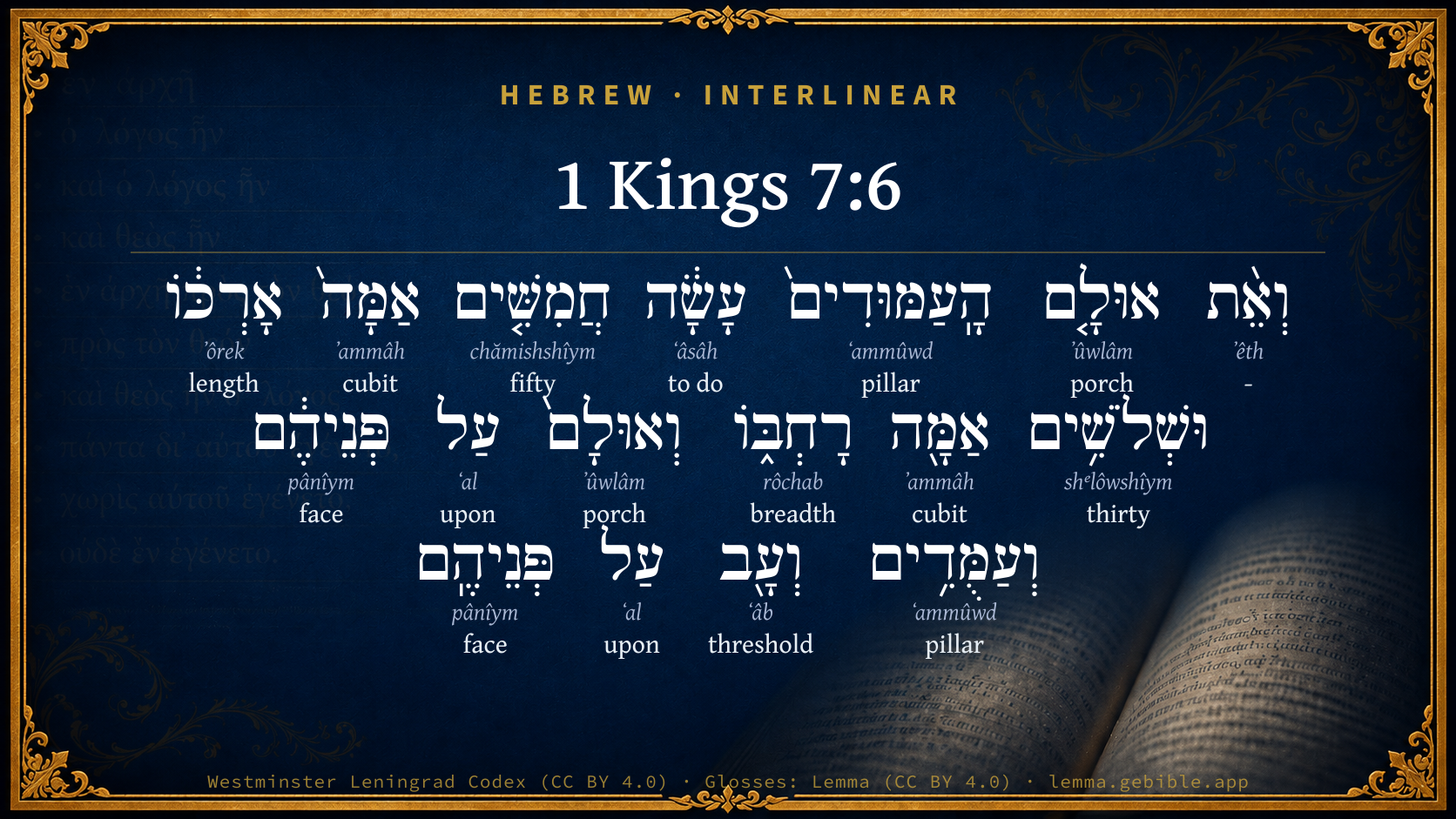
Hebrew (Westminster Leningrad Codex) 1 Kings 7:6 appears in the Hebrew Old Testament. The text above is from the Westminster Leningrad Codex. Each word links to its Strong’s number, a concise gloss, and parsing drawn from the Open Scriptures Hebrew Bible morphology. Click any word for its full Brown-Driver-Briggs (BDB) entry.
Download image
Cite this verse

1 Kings 7:6 (World English Bible). Public Domain. Lemma interlinear Bible study tool, https://lemma.gebible.app/v/1-kings/7/6.

Show BibTeX & RIS
BibTeX
RIS
English Translation
He made the porch of pillars; the length of it was fifty cubits, and the breadth of it thirty cubits; and a porch before them; and pillars and a threshold before them.
World English Bible · Public Domain
Highlights
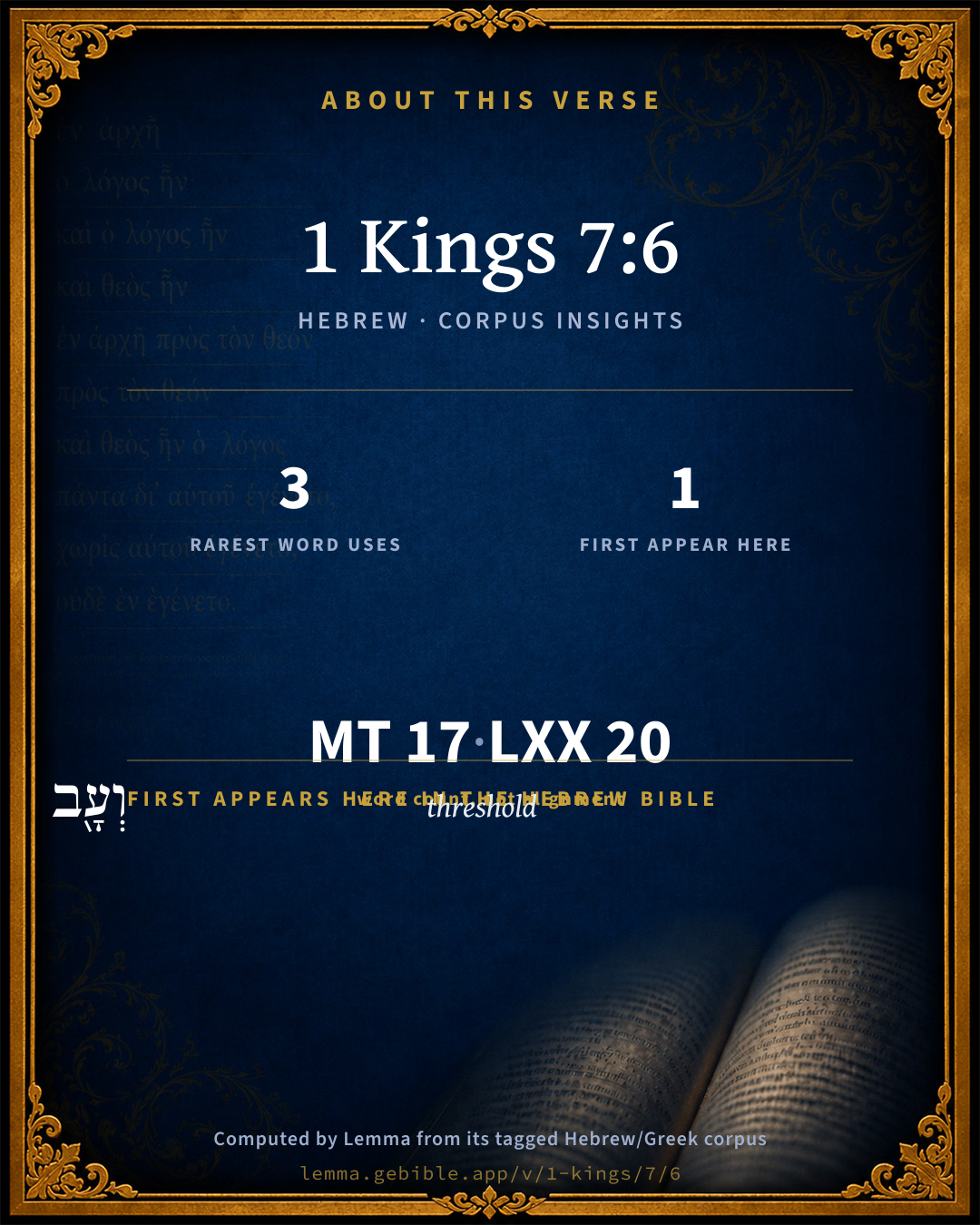
  • 1 first appearance in the Hebrew Bible
Full analysis ↓
Download a study sheet

One document with this verse’s original text, its word-by-word gloss line, the meaning frame, cross-references with their text, attributed commentary, and full source and license credits — printable, and it pastes into notes with its structure intact.

This verse Autodidact and up

Study sheet (.html) Plain text (.txt)

A passage Seminary Student

Up to 50 verses in one chapter. A passage sheet keeps up to 6 commentary sources and 12 cross-references per verse, in the order this page ranks them, and says so on the sheet whenever that leaves anything out. Ask for a single verse and you get the Autodidact verse sheet above.

Everything on this page stays free to read, with no account — the sheet is a download of what is already on screen, not access to it.

Want to remove ads? Support Godless Engineer
Compare translations 3

The same verse in 3 English versions, stacked beneath the original-language interlinear above. Click any original word for its lexicon entry.

Each is an independent rendering of the whole verse — the interlinear is not word-aligned to these translations.

Highlighted words mark where these versions differ — a whole-verse word diff, not a word-by-word alignment.

  • World English Bible Public Domain
    He made the porch of pillars; the length of it was fifty cubits, and the breadth of it thirty cubits; and a porch before them; and pillars and a threshold before them.
  • King James Version Public Domain
    And he made a porch of pillars; the length thereof was fifty cubits, and the breadth thereof thirty cubits: and the porch was before them: and the other pillars and the thick beam were before them.
  • unfoldingWord Literal Text CC BY-SA 4.0
    And he made the Porch of Pillars. 50 cubits its length and 30 cubits its width. And a porch on their face, and pillars and a roof on their face.

unfoldingWord Literal Text — © unfoldingWord, licensed CC BY-SA 4.0. Word-aligned USFM3 via Door43 (git.door43.org/unfoldingWord/en_ult).

Versions to compare (up to 4)

3 of 4 selected

Show all 18 translations

Every available English version of this verse, each an independent rendering of the whole verse.

  • World English Bible Public Domain
    He made the porch of pillars; the length of it was fifty cubits, and the breadth of it thirty cubits; and a porch before them; and pillars and a threshold before them.
  • Berean Standard Bible Public Domain
    Solomon made his colonnade fifty cubits long and thirty cubits wide, with a portico in front of it and a canopy with pillars in front of the portico.
  • Majority Standard Bible Public Domain
    Solomon made his colonnade fifty cubits long and thirty cubits wide, with a portico in front of it and a canopy with pillars in front of the portico.
  • King James Version Public Domain
    And he made a porch of pillars; the length thereof was fifty cubits, and the breadth thereof thirty cubits: and the porch was before them: and the other pillars and the thick beam were before them.
  • American Standard Version (1901) Public Domain
    And he made the porch of pillars; the length thereof was fifty cubits, and the breadth thereof thirty cubits; and a porch before them; and pillars and a threshold before them.
  • Revised Version (1885) Public Domain
    And he made the porch of pillars; the length thereof was fifty cubits, and the breadth thereof thirty cubits; and a porch before them; and pillars and thick beams before them.
  • Geneva Bible (1599) Public Domain
    And he made a porche of pillars fiftie cubites long, and thirtie cubites broade, and the porch was before them, euen before them were thirtie pillars.
  • Douay-Rheims (1899) Public Domain
    And he made a porch of pillars of fifty cubits in length, and thirty cubits in breadth: and another porch before the greater porch: and pillars, and chapiters upon the pillars.
  • Young's Literal Translation Public Domain
    And the porch of the pillars he hath made; fifty cubits its length, and thirty cubits its breadth, and the porch `is' before them, and pillars and a thick place `are' before them.
  • Literal Standard Version CC BY-SA 4.0
    And he has made the porch of the pillars; its length fifty cubits, and its breadth thirty cubits, and the porch [is] before them, and pillars and a thick place [are] before them.
  • Unlocked Literal Bible CC BY-SA 4.0
    There was a colonnade fifty cubits long and thirty cubits wide, with a portico in front and pillars and a roof.
  • unfoldingWord Literal Text CC BY-SA 4.0
    And he made the Porch of Pillars. 50 cubits its length and 30 cubits its width. And a porch on their face, and pillars and a roof on their face.
  • Darby Bible Public Domain
    And he made the porch of pillars; its length was fifty cubits, and its breadth thirty cubits; and there was a porch in front of them; and there were pillars, and steps in front of them.
  • World Messianic Bible Public Domain
    He made the hall of pillars. Its length was fifty cubits and its width thirty cubits, with a porch before them, and pillars and a threshold before them.
  • Webster's Bible Public Domain
    And he made a porch of pillars; its length was fifty cubits, and its breadth thirty cubits: and the porch was before them: and the other pillars and the thick beams were before them.
  • Free Bible Version CC BY-SA 4.0
    He also had the Hall of Columns made—forty cubits long and thirty cubits wide. It had a porch in front, its canopy also supported by columns.
  • Bible in Basic English Public Domain
    And he made a covered room of pillars, fifty cubits long and thirty cubits wide, and... with steps before it.
  • JPS Tanakh (1917) Public Domain
    And he made the porch of pillars: the length thereof was fifty cubits, and the breadth thereof thirty cubits; and a porch before them; and pillars and thick beams before them.

Literal Standard Version (2020), Covenant Press — licensed CC BY-SA 4.0. Text via the HelloAO Bible API (eBible.org). Unlocked Literal Bible (unfoldingWord) — licensed CC BY-SA 4.0. Text via the HelloAO Bible API (eBible.org). unfoldingWord Literal Text — © unfoldingWord, licensed CC BY-SA 4.0. Word-aligned USFM3 via Door43 (git.door43.org/unfoldingWord/en_ult). Free Bible Version, Dr. Jonathan Gallagher — licensed CC BY-SA 4.0. Text via the HelloAO Bible API (eBible.org).

Word by word

More ways to search: Search by grammar → Find every occurrence → Compare this word →

Practice this passage: Drill this verse → Learn its vocabulary →

וְעָ֖ב
ʻâb
H5646
“and · threshold”
Conjunction + Noun, Common, Masculine, Singular, Absolute
Part of Speech
Conjunction + Noun
Type
Common
Gender
Masculine
Number
Singular
State
Absolute
Full BDB Definition

Origin: from an unused root meaning to cover

TWOT: 1552a

an architectural term - meaning dubious; perhaps projecting roof, landing, thick beam, plank, threshold
  1. וְאֵ֨ת ʼêth H853 “and · -” Conjunction + Particle, Direct Object
  2. אוּלָ֤ם ʼûwlâm H197 “porch of” Noun, Common, Masculine, Singular, Construct
  3. הָֽעַמּוּדִים֙ ʻammûwd H5982 “the · pillars” Particle, Definite Article + Noun, Common, Masculine, Plural, Absolute
  4. עָשָׂ֔ה ʻâsâh H6213 “to do” Verb, Qal, Perfect, 3rd Person, Masculine, Singular
  5. חֲמִשִּׁ֤ים chămishshîym H2572 “fifty” Adjective, Cardinal number, Both, Plural, Absolute
  6. אַמָּה֙ ʼammâh H520 “cubit” Noun, Common, Feminine, Singular, Absolute
  7. אָרְכּ֔וֹ ʼôrek H753 “length · his” Noun, Common, Masculine, Singular, Construct + Suffix, Personal, 3rd Person, Masculine, Singular
  8. וּשְׁלֹשִׁ֥ים shᵉlôwshîym H7970 “and · thirty” Conjunction + Adjective, Cardinal number, Both, Plural, Absolute
  9. אַמָּ֖ה ʼammâh H520 “cubit” Noun, Common, Feminine, Singular, Absolute
  10. רָחְבּ֑וֹ rôchab H7341 “breadth · his” Noun, Common, Masculine, Singular, Construct + Suffix, Personal, 3rd Person, Masculine, Singular
  11. וְאוּלָם֙ ʼûwlâm H197 “and · porch” Conjunction + Noun, Common, Masculine, Singular, Absolute
  12. עַל ʻal H5921 “upon” Preposition
  13. פְּנֵיהֶ֔ם pânîym H6440 “face(s) · their” Noun, Common, Both, Plural, Construct + Suffix, Personal, 3rd Person, Masculine, Plural
  14. וְעַמֻּדִ֥ים ʻammûwd H5982 “and · pillars” Conjunction + Noun, Common, Masculine, Plural, Absolute
  15. עַל ʻal H5921 “upon” Preposition
  16. פְּנֵיהֶֽם pânîym H6440 “face(s) · their” Noun, Common, Both, Plural, Construct + Suffix, Personal, 3rd Person, Masculine, Plural

About this verse

These counts appear in no published source. They are computed here, from the morphology-tagged text and Lemma’s own curated glosses. What Lemma adds →

17
words
12
distinct lemmas
Historical
section

Notable vocabulary

The rarest word here is וְעָ֖ב threshold H5646 — appearing just 3 times in the whole Hebrew Bible.

First appearance in Scripture

This word makes its first canonical appearance in the Hebrew Bible here:

  • וְעָ֖ב threshold H5646

Shared distinctive vocabulary

וְעָ֖ב threshold H5646 occurs in 3 verses of the Hebrew Bible. Also found in:

Grammatical profile

  • 1 verb
  • 11 nouns
  • 2 adjectives
  • 2 prepositions
  • 1 particle

Verb forms

  • עָשָׂ֔ה Qal · Perfect

Repetition

Words recur within this verse — often emphatic in Hebrew:

  • אוּלָ֤ם porch H197 ×2
  • הָֽעַמּוּדִים֙ pillar H5982 ×2
  • אַמָּה֙ cubit H520 ×2
  • עַל upon H5921 ×2
  • פְּנֵיהֶ֔ם face H6440 ×2

Hebrew & Septuagint length

In the original languages it is 17 Hebrew tokens and 20 Greek tokens — but the two are counted differently (Hebrew bundles its prefixes and suffixes into one token; the Greek is in lemma form), so that isn’t a like-for-like length.

Cross-references

2

Topical passages linked to 1 Kings 7:6 in the Treasury of Scripture Knowledge — connected by theme and wording, ordered by reader-vote popularity; previews shown in the World English Bible.

  • 1 Kings 7:12 The great court round about had three courses of hewn stone, and a course of cedar beams; like as the inner court of the house of Yahweh, and the porch of the house.
  • Ezekiel 41:25–26 There were made on them, on the doors of the temple, cherubim and palm trees, like as were made on the walls; and there was a threshold of wood on the face of the porch outside.

Cross-references courtesy of OpenBible.info (CC BY 4.0).

Hebrew and Greek witnesses Masoretic Hebrew ↔ Greek Septuagint

The same verse in the two great witnesses to the Old Testament, shown verse-for-verse.

These are two independent witnesses, not word-aligned to each other, and the Septuagint is shown in lemma (dictionary) form.

Hebrew 1 Kings 7:6 Masoretic · Westminster Leningrad Codex

וְאֵ֨ת אוּלָ֤ם הָֽעַמּוּדִים֙ עָשָׂ֔ה חֲמִשִּׁ֤ים אַמָּה֙ אָרְכּ֔וֹ וּשְׁלֹשִׁ֥ים אַמָּ֖ה רָחְבּ֑וֹ וְאוּלָם֙ עַל פְּנֵיהֶ֔ם וְעַמֻּדִ֥ים וְעָ֖ב עַל פְּנֵיהֶֽם

He made the porch of pillars; the length of it was fifty cubits, and the breadth of it thirty cubits; and a porch before them; and pillars and a threshold before them.

World English Bible · Public Domain

Greek LXX 1 Kings 7:6 Septuagint · lemma form

καί ἔργον κρεμαστός δύο στίχος ῥοά χαλκοῦς δικτυόω ἔργον κρεμαστός στίχος ἐπί στίχος καί οὕτως ποιέω ὁ ἐπίθεμα ὁ δεύτερος

No English rendering of this Greek verse — the small residue in the structurally divergent books.

On this verse, Haydock's Catholic Bible Commentary discusses the Septuagint’s reading. Read the note in Commentary ↓

Hebrew: Westminster Leningrad Codex (CC BY 4.0). Greek: Septuagint (public domain); English from a public-domain English Septuagint. How the Septuagint differs from the Hebrew →

Targum (Aramaic paraphrase)

1

The Targum is the ancient Jewish Aramaic paraphrase of the Hebrew Scriptures — an interpretive translation, not the Hebrew text itself. Onkelos (literal) and Pseudo-Jonathan (expansive) render the Torah, and Jonathan the Prophets. Coverage is partial: where no permissively-licensed English translation exists for a verse, only the Aramaic is shown. This is verse-level text, not a word-by-word alignment to the Hebrew.

  1. Targum Jonathan Prophets (Joshua–Malachi)
    וְיַת אוּלַמָא דְעַמוּדַיָא עֲבַד חַמְשִׁין אַמִין אוּרְכֵּיהּ וּתְלָתִין אַמִין פּוּתְיֵהּ וְאוּלַמָא עַל אַפֵּיהוֹן וְעַמוּדַיָא וּסְקוֹפָתָא עַל אַפֵּיהוֹן:

    (no public-domain English translation for this verse)

    Targum Jonathan — Aramaic: “Mikraot Gedolot” (public domain). English: “Sefaria Community Translation” (CC0 1.0 (public-domain dedication)); “London "Chaldee Paraphrase," 1871” (public domain). Text via Sefaria.

Commentary

Notes on 1 Kings 7:6 from classic Christian and Jewish commentators (each source and its license shown beneath its notes). The classic Christian expositions comment on the surrounding passage and are grouped to its opening verse, so a note may address several verses; the Jewish commentaries on the Tanakh (Rashi and others) are per-verse, so they appear only where the commentator wrote on this verse.

Lemma curates 59 commentaries, every one of them public domain or Creative Commons licensed, each selected and text-cleaned for this edition rather than reprinted as found. About our sources →

Trapp's Complete Commentary

John Trapp

1Ki 7:6 And he made a porch of pillars; the length thereof [was] fifty cubits, and the breadth thereof thirty cubits: and the porch [was] before them: and the [other] pillars and the thick beam [were] before them.

Ver. 6. Were before them.] Or, According to them: all was suitable, and sightly.

John Trapp, A Commentary or Exposition upon All the Books of the Old and New Testament (1647–1656) — public domain. Text from a community e-Sword module.

The Biblical Illustrator

Joseph S. Exell

1Ki_7:6

And he made a porch of pillars.

The porch

Since this porch was the common place of reception for all worshippers, and the place also where they laid the beggars, it looks as if it were to be a type of the churchs bosom for charity. Here the proselytes were entertained, here the beggars were relieved, and received alms. These gates were seldom shut; and the houses of Christian compassion should be always open. This therefore beautified this gate, as charity beautifies any of the churches. Largeness of heart, and tender compassion at the church door, is excellent; it is the bond of perfectness (1Co_12:31; 1Co_13:1-4; Joh_5:5; Joh_5:7; Col_3:14). (John Bunyan.)

The pillars of the house of Lebanon

(1Ki_7:6-22):--These pillars were sweet-scented pillars, for they were made of cedar; but what cared the enemy for that, they were offensive to him, for that they were placed for a fortification against him. Nor is it any allurement to Satan to favour the mighty ones in the church in the wilderness for the fragrant smell of their sweet graces; nay, both he and his angels are the more beset to oppose them because they are so sweet scented. The cedars, therefore, got nothing because they were cedars at the hands of the barbarous Gentiles--for they would burn the cedars--as the angels or pillars get nothing of favour at the hands of Antichrist, because they are pillars and angels for the truth, yea, they so much the more by her are abhorred. Well, but they are pillars for all that, yea, pillars to the church in the wilderness, as the others were in the house of the forest of Lebanon. The glory of the temple lay in one thing, and the glory of this house lay in another; the glory of the temple lay in that she contained the true form and modes of worship, and the glory of the house of Lebanon lay in her many pillars and thick beams, by which she was made capable, through good management, to give check to those of Damascus when they should attempt to throw down her worship. (John Bunyan.)

The Biblical Illustrator, edited by Joseph S. Exell (c. 1880s–1900s) — public domain. Text from a community e-Sword module.

Joseph Benson's Commentary

1Ki 7:6. And he made a porch of pillars — That is, supported by divers pillars: this was for his guard, and for people to walk in who came upon business, as well as for the more magnificent entrance into the house. Upon this also it is probable there were other rooms built as in the house. The porch was before them — That is, before the pillars of the great house before spoken of. And the other pillars, &c. — Or, and pillars, that is, fewer and lesser pillars for the support of the porch. Were before them — Or, according to them; (see the margin;) that is, they were directly opposite one to another.

Joseph Benson's Commentary on the Old and New Testaments (1811–1818) — public domain. Text from a community e-Sword module.

Tyndale Open Study Notes

Tyndale Open Resources

7:6-8 The Hall of Pillars was apparently a colonnaded entry to the Hall of Justice, where Solomon sat to hear legal matters (see also 10:18-20). Similar throne rooms have been found in Syria and Mesopotamia. • Solomon erected separate living quarters for Pharaoh’s daughter (see 3:1; 9:24; 2 Chr 8:11).

Tyndale Open Study Notes — © Tyndale Open Resources, licensed CC BY-SA 4.0. Text via the HelloAO Bible API.

Geneva Bible (1599)

Geneva Bible translators

Before the pillars of the house.

Geneva Bible (1599) marginal notes — public domain. Text via Bolls.life.

Ellicott's Commentary for English Readers

(6) A porch of pillars, although by some authorities it is held to be a separate building, seems by the exact agreement of dimensions—its “length” being just the breadth of the hall—to have been a propylæon, or entrance vestibule, to the hall of state (like the porch, or vestibule, of the Temple), probably corresponding in the general arrangement of its pillars, and perhaps also in height. It had also a porch of its own, with a threshold (for the last clause of the verse should be rendered, “and a porch before it with pillars, and a threshold before them,”) forming a kind of plinth, or, possibly, a flight of steps.

A Bible Commentary for English Readers, edited by Charles John Ellicott (1878–1897) — public domain. Text from a community e-Sword module.

The Cambridge Bible for Schools and Colleges

gen. ed. J. J. S. Perowne

6. And he made a (R.V. the) porch of pillars] This would seem to have been a separate building not connected with the house of the forest. In the same manner the porch for the throne in the next verse was unconnected with any other building. What was the purpose of the porch of pillars is not stated.

and the porch was before them] It is better to make this clause dependent on the first verb. Thus ‘he made the porch of pillars … and a porch before them,’ i.e. before the pillars.

and the other pillars and the thick beam were before them] The word translated ‘thick beam’ seems most likely to have been a threshold or step work by which the porch was entered. The twice repeated ‘before them’ must refer to the same thing, viz. to the pillars of the first named porch, of which they formed the striking feature. So the sense of the verse would be ‘he made the porch of pillars and in front of them also another porch with its pillars and a staircase or set of steps to approach it by.’

The Cambridge Bible for Schools and Colleges (gen. ed. J. J. S. Perowne; Cambridge University Press, 1878–1918) — public domain. Text from a community e-Sword module.

John Gill's Exposition

Then he made a porch for the throne,.... The ivory throne on which he sat to hear and try causes, Kg1 10:18,

where he might judge, even the porch of judgment: which had its name from thence; this was either in his house in the forest of Lebanon, or in his palace at Jerusalem; the former seems best:

and it was covered with cedar from one side of the floor unto the other; that is, the whole floor.

John Gill's Exposition of the Whole Bible (1746–1763) — public domain (CC PDM 1.0). Text via the HelloAO Bible API.

Albert Barnes' Notes on the Bible

Probably the porch of the “House of the Forest.” Porches of columns immediately in front of columnar chambers were a favorite feature of Persian architecture. The whole verse should be translated, “And he made the porch of the pillars in length 50 cubits, and in breadth 30 cubits, and a porch before them (i. e., the pillars), and pillars, and a base (or step) before them.” Most of the Persepolitan porches had small pillared chambers at some little distance in front of them.

Albert Barnes' Notes on the Bible (1834–1885) — public domain. Text from a community e-Sword/MySword module.

Haydock's Catholic Bible Commentary

Porch. Septuagint seem to retain the original word ulam, as they read Greek: ailam; whence our hall, and the Latin aula, may be derived. (Haydock) --- It was a court surrounded by pillars and galleries, in from of the palace. (Calmet) --- Another. Hebrew, "the porch before them, (pillars) and the pillars, and the thick beam before them."

George Leo Haydock (1774–1849), Haydock's Catholic Family Bible and Commentary, 1859 edition — public domain. Excludes Psalms (Douay-Rheims chapter numbering differs from Protestant) and Deuterocanonical books (Catholic canon only).

Matthew Poole's English Annotations

A porch of pillars, i.e. supported by divers pillars, for the more magnificent entrance into the house; upon which also it is thought there were other rooms built, as in the house.

The porch, now mentioned, which is said to be

before them, i.e. before the pillars on which the house of Lebanon stood, or before the doors and posts mentioned 1Ki 7:5; or, a porch, i.e. another and a lesser porch, which was before them, i.e. before the pillars of the greater porch now mentioned.

And the other pillars, or, and pillars, i.e. fewer and lesser pillars for the support of the lesser porch.

The thick beam; which was laid upon these pillars, as the others were, 1Ki 7:2.

Matthew Poole's English Annotations on the Holy Bible (1683–1685) — public domain. Text from a community e-Sword/MySword module.

Whedon's Commentary on the Bible

Daniel D. Whedon

6. A porch of pillars — The exact position of this porch is not stated, but as the description of the palace began with the house of the forest of Lebanon, we naturally suppose, in the absence of any thing that appears to the contrary, that it follows the order of the successive buildings, and accordingly this porch was situated between the house of the forest of Lebanon and the porch of judgment described in the next verse. (B in plan.) It served as a majestic colonnade leading to the throne-chamber.

The porch was before them — Rather, a porch. A portico of lesser dimensions was built before the pillars. (a in plan.)

Pillars and the thick beam — The pillars here mentioned were probably a sort of peristyle to the great porch of pillars; that is, a range of noticeable pillars running round the outside of the porch. The עב, thick beam, is to be understood of the threshold, or rather the ascent by steps into the porch, which was, of course, before or in front of the pillars, and probably ran around the entire porch.

Daniel D. Whedon (gen. ed.), Commentary on the Old and New Testaments (1874–1909) — public domain. Text from a community e-Sword module.

The Pulpit Commentary

And he made a porch of pillars Heb. the porch of pillars. This was no doubt a covered colonnade, i.e., it had a roof but no sides. The pillars were its only walls. But here the question presents itself, Was this porch the vestibule of the house of the forest of Lebanon, just described? From the correspondence between its width and that of this palace, Rawlinson infers that it was (cf. 1Ki_6:2, 1Ki_6:3) Bahr believes it to have been the porch or entrance to the hall of judgment mentioned in the next verse, while Fergusson again assigns it an independent position, separate from either. The term porch ( the meaning of which is surely determined by its use in ch. 6., almost implies that it must have served as the entrance or vestibule to some building. But the size, and the fact that it had itself a porch (see below), favour the idea that it was an independent structure, though Rawlinson shows that "most of the Persepolitan porches had small pillared chambers at some little distance in front of them," and refers to the Egyptian propylaea. Keil argues that this pillar hall, as he calls it, stood between the house of the forest of Lebanon and the judgment hall. Bahr, as remarked above, sees in it the anterior part of the judgment hall, which latter, he adds, bore to it the same relation that the oracle did to the temple house. He observes that as the ark was in the oracle, so the throne (1Ki_10:18) found a place in the hall of judgment. This structure, therefore, with its porch, mentioned presently, would reproduce the main features of the temple arrangement. We see, consequently, that both the house of the forest of Lebanon and the porch of pillars followed in their outline the ground plan of the temple. Nor is this at all surprising, considering that all these edifices probably had the same architect or designer; the length thereof was fifty cubits the length, i.e., according to the view last advanced of the two divisions of the building, viz., the porch of pillars and the porch of judgment. But the correspondence of the length or width the same word is used of the width of the temple porch (1Ki_6:3) of this porch with the width of the house of the forest of Lebanon is, to say the least, remarkable, and suggests that after all it may have been the porch of that building. If so, the resemblance to the temple would be still more striking, and the breadth depth? thereof thirty cubits: and the porch Heb. a porch was before them i.e., the pillars. The words can only mean that a smaller porch stood before the porch of pillars, or colonnade): and the other omit pillars i.e. , the pillars of the minor vestibule or fore porch and the thick beam Heb. threshold were before them. The broad threshold, approached by steps, and the pillars which it supported, together with the roof which covered them, formed the front part and approach to the larger porch or colonnade.

The Pulpit Commentary (1880–1919), ed. H.D.M. Spence-Jones & Joseph S. Exell — public domain. Text from a community e-Sword module.

John Wesley's Explanatory Notes

A porch - Supported by divers pillars, for the more magnificent entrance into the house; upon which also it is thought there were other rooms built, as in the house. The porch - Now mentioned which is said to be before them; before the pillars on which the house of Lebanon stood. Pillars - Or, and pillars; That is, fewer and lesser pillars for the support of the lesser porch. Beam - Which was laid upon these pillars, as the others were ver. 2.

John Wesley, Explanatory Notes Upon the Whole Bible (1754–1765) — public domain. Text via the GEBible commentary corpus.

unfoldingWord translationNotes

Door43 World Missions Community

General Information:

The author writes about the structure of the Hall of Pillars.

colonnade

a series of columns, all the same distance apart

fifty cubits ... thirty cubits

A cubit is 46 centimeters. AT: "23 meters ... 13.8 meters" (See: Biblical Distance)

portico

an area of a building made of columns and a roof that leads to and connects with the building's entrance door. See how you translated this in 1 Kings 6:3

translationWords

column

unfoldingWord translationNotes — © Distant Shores Media and the Door43 World Missions Community, licensed CC BY-SA 4.0. Source: git.door43.org/Door43/en_tn.

Rashi

Rabbi Shlomo Yitzchaki (Rashi)

An entrance hall of columns. He made an entrance before these columns as an entrance to the house. Its length was fifty amohs along the width of the house, which was fifty amohs, and thirty amohs its width before the extent of the length of the house, only that the longer measurement is always called the length and the shorter one is called the width.

There was [another] entrance hall above them. He made a high entrance [around] the entire house.

And columns and support beams upon them. And on the cut beams of cedar which were on the lower columns he erected on (should read “additional”) columns and beams from column to column, the columns to connect boards from one to another, and the beams for the ceiling. “עב” is a beam [=מריש], as we learned, “And the עבים, these are the beams.”

Rashi on the Tanakh — English translations: “The Judaica Press complete Tanach with Rashi, translated by A. J. Rosenberg” (CC BY 4.0); “Pentateuch with Rashi's commentary by M. Rosenbaum and A.M. Silbermann, 1929-1934” (public domain); “The Metsudah Tanach series, Lakewood, N.J” (CC BY 4.0); and “The Book of Joshua, Metsudah Publications, 1997” (CC BY 4.0). Text via Sefaria.

Lesson kit

Teaching starters — assembled from the data on this page, not authored interpretation. Every prompt links to the verse data it draws on. Edit before teaching.

1 Kings, in the Historical, opens this verse with 17 words (12 distinct Hebrew lemmas). Its most distinctive word is ʻâb (“threshold”). A historical commentator’s framing appears above. Read the whole chapter for the surrounding context.

Discussion questions

  1. How does “threshold” (ʻâb) shape what this verse is saying?
  2. The word “threshold” first appears here in Scripture. What is being introduced at this debut?
  3. Ezekiel 41:25 shares the word «threshold» with this verse. How do the two illuminate each other?
  4. “porch” occurs 2× in this one verse. What is the effect of the repetition?
  5. These translations render this verse differently; the difference is in the English rendering, not the original. What questions does that raise?
  6. The verb «עָשָׂ֔ה» is Qal Perfect. How does its form color the action?
  7. Reading how Trapp's Complete Commentary and The Biblical Illustrator read this verse, where do the two commentators agree and where do they part?

Things to notice

Reading settings

Reading text

Shown beneath each verse's original-language words.

Old Testament
Old Testament edition

Read the OT as the Masoretic Hebrew (MT) or the Greek Septuagint (LXX).

English shown for the Greek Septuagint (in the Hebrew ↔ Greek comparison).

Comparing translations? Open the Compare panel on any verse page to stack up to four side by side.