Ezekiel 31:7

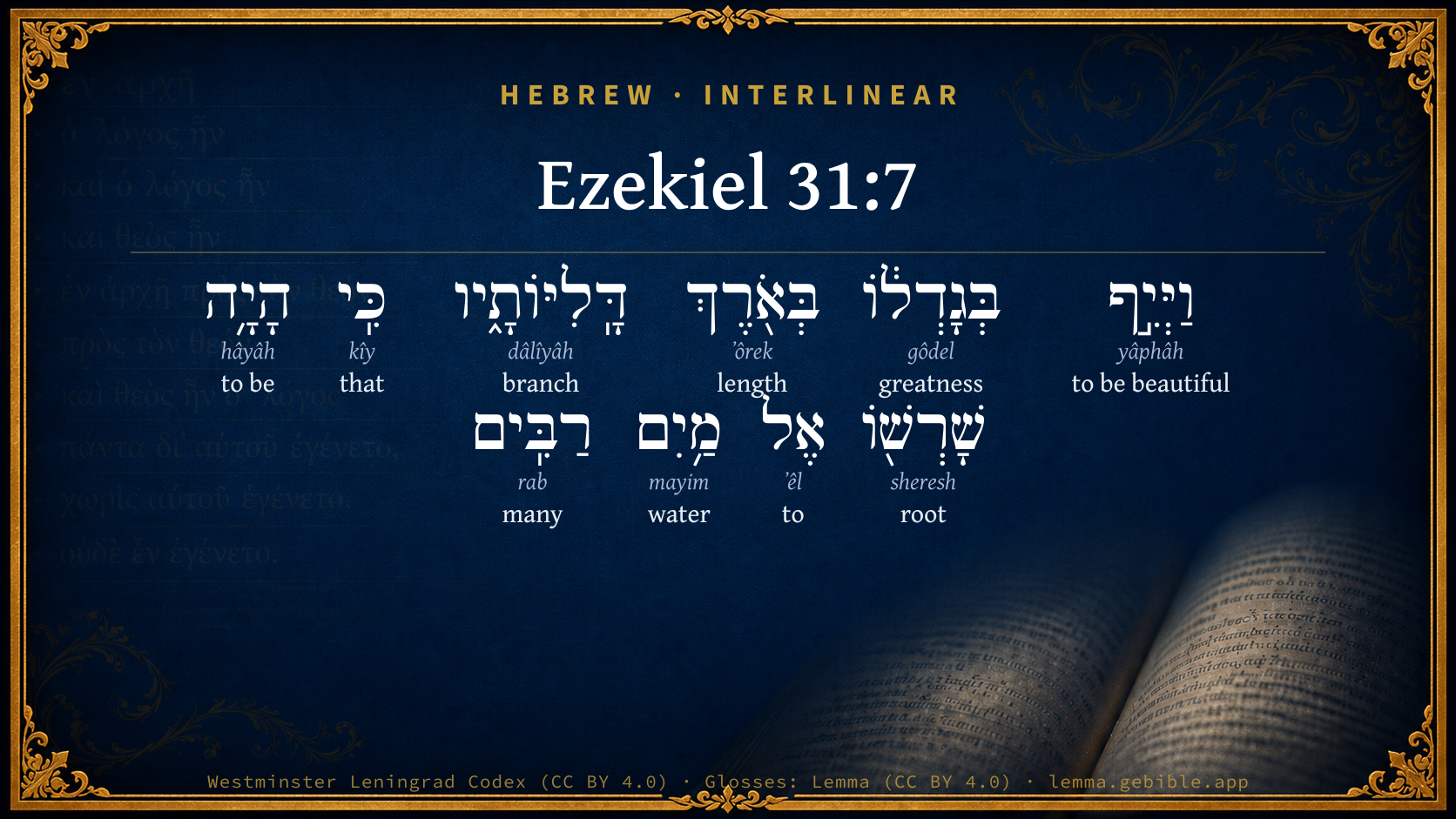
Hebrew (Westminster Leningrad Codex) Ezekiel 31:7 appears in the Hebrew Old Testament. The text above is from the Westminster Leningrad Codex. Each word links to its Strong’s number, a concise gloss, and parsing drawn from the Open Scriptures Hebrew Bible morphology. Click any word for its full Brown-Driver-Briggs (BDB) entry.
Download image
Cite this verse

Ezekiel 31:7 (World English Bible). Public Domain. Lemma interlinear Bible study tool, https://lemma.gebible.app/v/ezekiel/31/7.

Show BibTeX & RIS
BibTeX
RIS
English Translation
Thus was it beautiful in its greatness, in the length of its branches; for its root was by many waters.
World English Bible · Public Domain
Download a study sheet

One document with this verse’s original text, its word-by-word gloss line, the meaning frame, cross-references with their text, attributed commentary, and full source and license credits — printable, and it pastes into notes with its structure intact.

This verse Autodidact and up

Study sheet (.html) Plain text (.txt)

A passage Seminary Student

Up to 50 verses in one chapter. A passage sheet keeps up to 6 commentary sources and 12 cross-references per verse, in the order this page ranks them, and says so on the sheet whenever that leaves anything out. Ask for a single verse and you get the Autodidact verse sheet above.

Everything on this page stays free to read, with no account — the sheet is a download of what is already on screen, not access to it.

Want to remove ads? Support Godless Engineer
Compare translations 3

The same verse in 3 English versions, stacked beneath the original-language interlinear above. Click any original word for its lexicon entry.

Each is an independent rendering of the whole verse — the interlinear is not word-aligned to these translations.

Highlighted words mark where these versions differ — a whole-verse word diff, not a word-by-word alignment.

  • World English Bible Public Domain
    Thus was it beautiful in its greatness, in the length of its branches; for its root was by many waters.
  • King James Version Public Domain
    Thus was he fair in his greatness, in the length of his branches: for his root was by great waters.
  • unfoldingWord Literal Text CC BY-SA 4.0
    For it was beautiful in its greatness and the length of its branches, for its roots were in many waters.

unfoldingWord Literal Text — © unfoldingWord, licensed CC BY-SA 4.0. Word-aligned USFM3 via Door43 (git.door43.org/unfoldingWord/en_ult).

Versions to compare (up to 4)

3 of 4 selected

Show all 18 translations

Every available English version of this verse, each an independent rendering of the whole verse.

  • World English Bible Public Domain
    Thus was it beautiful in its greatness, in the length of its branches; for its root was by many waters.
  • Berean Standard Bible Public Domain
    It was beautiful in its greatness, in the length of its limbs, for its roots extended to abundant waters.
  • Majority Standard Bible Public Domain
    It was beautiful in its greatness, in the length of its limbs, for its roots extended to abundant waters.
  • King James Version Public Domain
    Thus was he fair in his greatness, in the length of his branches: for his root was by great waters.
  • American Standard Version (1901) Public Domain
    Thus was it fair in its greatness, in the length of its branches; for its root was by many waters.
  • Revised Version (1885) Public Domain
    Thus was he fair in his greatness, in the length of his branches: for his root was by many waters.
  • Geneva Bible (1599) Public Domain
    Thus was he faire in his greatnesse, and in the length of his branches: for his roote was neere great waters.
  • Douay-Rheims (1899) Public Domain
    And he was most beautiful for his greatness, and for the spreading of his branches: for his root was near great waters.
  • Young's Literal Translation Public Domain
    And he is fair in his greatness, In the length of his thin shoots, For his root hath been by great waters.
  • Literal Standard Version CC BY-SA 4.0
    And he is beautiful in his greatness, || In the length of his thin shoots, || For his root has been by great waters.
  • Unlocked Literal Bible CC BY-SA 4.0
    For it was beautiful in its greatness and the length of its branches, for its roots were in many waters.
  • unfoldingWord Literal Text CC BY-SA 4.0
    For it was beautiful in its greatness and the length of its branches, for its roots were in many waters.
  • Darby Bible Public Domain
    Thus was he fair in his greatness, in the length of his branches: because his root was by great waters.
  • World Messianic Bible Public Domain
    Thus it was beautiful in its greatness, in the length of its branches; for its root was by many waters.
  • Webster's Bible Public Domain
    Thus was he fair in his greatness, in the length of his branches: for his root was by great waters.
  • Free Bible Version CC BY-SA 4.0
    It was beautiful and majestic with its long branches, because its roots reached down to the plentiful water.
  • Bible in Basic English Public Domain
    So it was beautiful, being so tall and its branches so long, for its root was by great waters.
  • JPS Tanakh (1917) Public Domain
    Thus was it fair in its greatness, in the length of its branches; for its root was by many waters.

Literal Standard Version (2020), Covenant Press — licensed CC BY-SA 4.0. Text via the HelloAO Bible API (eBible.org). Unlocked Literal Bible (unfoldingWord) — licensed CC BY-SA 4.0. Text via the HelloAO Bible API (eBible.org). unfoldingWord Literal Text — © unfoldingWord, licensed CC BY-SA 4.0. Word-aligned USFM3 via Door43 (git.door43.org/unfoldingWord/en_ult). Free Bible Version, Dr. Jonathan Gallagher — licensed CC BY-SA 4.0. Text via the HelloAO Bible API (eBible.org).

Word by word

More ways to search: Search by grammar → Find every occurrence → Compare this word →

Practice this passage: Drill this verse → Learn its vocabulary →

וַיְּיִ֣ף
yâphâh
H3302
“and · to be beautiful”
Conjunction + Verb, Qal, Sequential Imperfect, 3rd Person, Masculine, Singular
Part of Speech
Conjunction + Verb
Stem
Qal
Form
Sequential Imperfect
Person
3rd Person
Gender
Masculine
Number
Singular
Full BDB Definition

Origin: a primitive root

TWOT: 890

to be bright, be beautiful, be handsome, be fair - (Qal) to be beautiful - (Piel) to beautify - (Pual) to be beautiful - (Hithpael) to beautify oneself
  1. בְּגָדְל֔וֹ gôdel H1433 “in/at · greatness · his” Preposition + Noun, Common, Masculine, Singular, Construct + Suffix, Personal, 3rd Person, Masculine, Singular
  2. בְּאֹ֖רֶךְ ʼôrek H753 “in/at · length of” Preposition + Noun, Common, Masculine, Singular, Construct
  3. דָּֽלִיּוֹתָ֑יו dâlîyâh H1808 “branches · his” Noun, Common, Feminine, Plural, Construct + Suffix, Personal, 3rd Person, Masculine, Singular
  4. כִּֽי kîy H3588 “that” Conjunction
  5. הָיָ֥ה hâyâh H1961 “to be” Verb, Qal, Perfect, 3rd Person, Masculine, Singular
  6. שָׁרְשׁ֖וֹ sheresh H8328 “root · his” Noun, Common, Masculine, Singular, Construct + Suffix, Personal, 3rd Person, Masculine, Singular
  7. אֶל ʼêl H413 “to” Preposition
  8. מַ֥יִם mayim H4325 “water(s)” Noun, Common, Masculine, Plural, Absolute
  9. רַבִּֽים rab H7227 “many” Adjective, Adjective, Masculine, Plural, Absolute

About this verse

These counts appear in no published source. They are computed here, from the morphology-tagged text and Lemma’s own curated glosses. What Lemma adds →

10
words
10
distinct lemmas
Prophets
section

Notable vocabulary

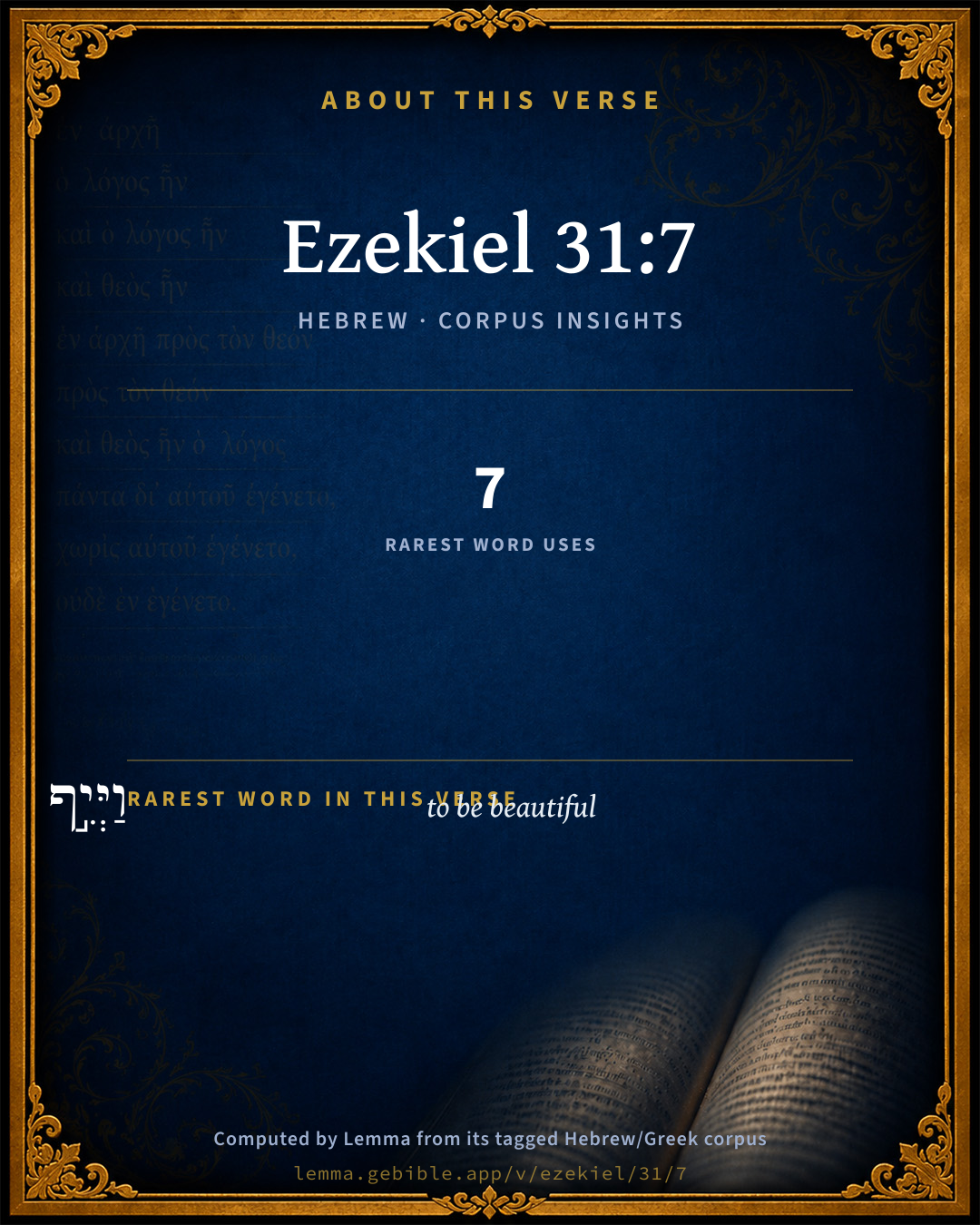
The rarest word here is וַיְּיִ֣ף to be beautiful H3302 — appearing just 7 times in the whole Hebrew Bible.

Shared distinctive vocabulary

וַיְּיִ֣ף to be beautiful H3302 occurs in 7 verses of the Hebrew Bible. Also found in:

Grammatical profile

  • 2 verbs
  • 5 nouns
  • 1 adjective
  • 1 preposition
  • 1 conjunction

Verb forms

  • וַיְּיִ֣ף Qal · Sequential Imperfect
  • הָיָ֥ה Qal · Perfect

Hebrew & Septuagint length

In English translation the verse runs 20 words from the Hebrew and 22 from the Septuagint (LXX English) — closely comparable.

A rough comparison of the two English renderings, which tokenize alike — not a word-level alignment.

Word counts can differ between the Hebrew and the Greek without any difference in meaning — e.g. the Hebrew direct-object marker אֵת has no separate Greek word, and Greek often adds the article ὁ.

Hebrew and Greek witnesses Masoretic Hebrew ↔ Greek Septuagint

The same verse in the two great witnesses to the Old Testament, shown verse-for-verse.

These are two independent witnesses, not word-aligned to each other, and the Septuagint is shown in lemma (dictionary) form.

Hebrew Ezekiel 31:7 Masoretic · Westminster Leningrad Codex

וַיְּיִ֣ף בְּגָדְל֔וֹ בְּאֹ֖רֶךְ דָּֽלִיּוֹתָ֑יו כִּֽי הָיָ֥ה שָׁרְשׁ֖וֹ אֶל מַ֥יִם רַבִּֽים

Thus was it beautiful in its greatness, in the length of its branches; for its root was by many waters.

World English Bible · Public Domain

Greek LXX Ezekiel 31:7 Septuagint · lemma form

καί γίγνομαι καλός ἐν ὁ ὕψος αὐτός διά ὁ πλῆθος ὁ κλάδος αὐτός ὅτι γίγνομαι ὁ ῥίζα αὐτός εἰς ὕδωρ πολύς

And he was fair in his height by reason of the multitude of his branches: for his roots were amidst much water.

LXX2012 (modern English Septuagint) · Public Domain

Hebrew: Westminster Leningrad Codex (CC BY 4.0). Greek: Septuagint (public domain); English from LXX2012 (modern English Septuagint) (Public Domain). How the Septuagint differs from the Hebrew →

Targum (Aramaic paraphrase)

1

The Targum is the ancient Jewish Aramaic paraphrase of the Hebrew Scriptures — an interpretive translation, not the Hebrew text itself. Onkelos (literal) and Pseudo-Jonathan (expansive) render the Torah, and Jonathan the Prophets. Coverage is partial: where no permissively-licensed English translation exists for a verse, only the Aramaic is shown. This is verse-level text, not a word-by-word alignment to the Hebrew.

  1. Targum Jonathan Prophets (Joshua–Malachi)
    וְאִתְנְצַח בְּסוּמְכְוָתֵיהּ בִּסְגֵי גִבָּרוֹהִי אֲרֵי הֲוַת אֵימְתֵיהּ עַל עַמְמִין סַגִיאִין:

    (no public-domain English translation for this verse)

    Targum Jonathan — Aramaic: “Mikraot Gedolot” (public domain). English: “Sefaria Community Translation” (CC0 1.0 (public-domain dedication)); “London "Chaldee Paraphrase," 1871” (public domain). Text via Sefaria.

Commentary

Notes on Ezekiel 31:7 from classic Christian and Jewish commentators (each source and its license shown beneath its notes). The classic Christian expositions comment on the surrounding passage and are grouped to its opening verse, so a note may address several verses; the Jewish commentaries on the Tanakh (Rashi and others) are per-verse, so they appear only where the commentator wrote on this verse.

Lemma curates 59 commentaries, every one of them public domain or Creative Commons licensed, each selected and text-cleaned for this edition rather than reprinted as found. About our sources →

Trapp's Complete Commentary

John Trapp

Eze 31:7 Thus was he fair in his greatness, in the length of his branches: for his root was by great waters.

Ver. 7. Thus was he fair in his greatness] Once again he setteth forth with how great power and glory God had adorned this first monarchy.

John Trapp, A Commentary or Exposition upon All the Books of the Old and New Testament (1647–1656) — public domain. Text from a community e-Sword module.

John Gill's Exposition

Thus was he fair in his greatness,.... Amiable, lovely, delightful to look upon in the greatness of his majesty, in his royal glory and dignity:

in the length of his branches; in the extent of his empire, and the provinces of it:

for his root was by great waters; his kingdom was well established, firmly rooted among a multitude of people; from whom he had a large revenue to support his throne and government, and the dignity of it; by tribute, taxes, customs, and presents; and through the large trade and traffic of his subjects in different parts, from whence he received great profit and advantage. The Targum is,

"and he became victorious by his auxiliaries, by the multitude of his mighty ones, so that his terror was upon many people.''

John Gill's Exposition of the Whole Bible (1746–1763) — public domain (CC PDM 1.0). Text via the HelloAO Bible API.

Matthew Poole's English Annotations

Fair; beautiful, lovely, and desirable. In his greatness; not exerted in tyranny and oppression, but exercised in the royal art of imitating the greatest and best being who is King over all, for he doth good to all.

In the length of his branches; how far soever remote, yet the justice and goodness of the government appeared the beauty of those provinces, as well as of the whole kingdom.

His root, whence he sprung, which supported and supplied the kingdom, was right, the laws, punishments, rewards, and encouragements neither founded in cruelty, nor maintained by violence.

By great waters; not by blood, which is no proper kindly nourishment for such cedars, but by waters, which are kindly and proper, and these great enough for his own growth and to nourish others too.

Matthew Poole's English Annotations on the Holy Bible (1683–1685) — public domain. Text from a community e-Sword/MySword module.

The Pulpit Commentary

The root and the waters.

I THE TREE FLOURISHES THROUGH ITS ROOT.

1. The root supports the tree. It is the foundation. Unless the root is deep and strong the tree will fall, blown over by the hurricane or swept away by the flood. Our life needs a root, a foundation.

2. The root brings nourishment to the tree. It sucks in moisture from the earth and draws the rich juices of the soil up into the plant. When the roots are cut the tree must wither and die. The child"s Christmas-tree looks green for the short season of festivities, but according to a common custom, being cut off without a proper root, it cannot live. There are souls that have no root in themselves. (Mat_13:21) They can only endure for a while. We must find supplies of spiritual nourishment if we are to persevere unto everlasting life.

3. The root lies low. The lordly branches of the cedar wave in the air and toss themselves proudly against the sky, but they could not thus thrive without the lowly root. Souls thrive on their humbler experiences. They grow strong in humility and trust.

4. The root is unseen. It lies in dark underground regions. He is but a shallow being whose every experience lies on the surface. "The secret of the Lord is with them that fear him". (Psa_25:14) The tree will die if the root be laid bare to the sun. Spiritual experience should be decently covered, not dragged to the light and made a matter of common talk. Let the leaves and fruit be seen; keep the root in the dark.

5. The root must press down to deep sources of supply. If the water be far from the surface, the root must go after it. "The well is deep"; (Joh_4:11) then the water will be all the more cool and refreshing. It is good to press down to the deeper experiences of the Christian life.

II THE ROOT NEEDS GOOD SUPPLIES OF WATER.

1. It needs water. Trees will not grow on the Sahara Desert. But a little moisture will bring vegetation. On the rare occasion of rain falling in the desert a sudden greenness appears on the sand; but the minute vegetable growth disappears as quickly as it comes, for the moisture rapidly evaporates in the heated air. Souls need the living waters. They need these waters because, like trees, they are alive. The statue does not droop in the noonday sun, because it is of stone, dead stone. There are statuesque souls that seem to thrive without any spiritual supplies, but they have no vitality in them. They are too stolid to faint. Fiery souls pine and wither when deprived of living water.

2. It must be within reach of water. It is nearly useless for the water to fall on the leaves if the root is not reached, but when the root is in moisture, though the leaves are covered with dust and sadly need cleansing showers, the tree will still live. We can bear heat and drought in the world if the soul"s hidden roots are supplied by Divine grace. But we do not merely require superficial refreshment; we need such deep soul-supplies as shall penetrate to the roots of our being. For this purpose the roots must be near the water. Cattle can go down to the brooks and drink, but trees must be planted in moist soil. It is customary in the East to cut channels for water deflected from larger streams, that this may run among the roots of trees. The best trees grow by rivers of water. (Psa_1:3) Souls must be within reach of Divine supplies. It is not sufficient that God is gracious and that Christ can give of the water of life. We must be near the water ourselves. There must be personal appropriation. This is only possible by means of that spiritual neighborhood which is sympathy. The use of "means of grace prayers, Christian fellowship, meditation on Scripture, etc. helps to rouse that sympathy, and so to bring the roots near to the great waters.

HOMILIES BY W. CLARKSON Ver. 7. The source of strength and beauty.

The "great power" of Assyria is likened in this parable to a noble cedar planted in (or transferred to) the garden of Eden, raising its head high above all the other trees in that "garden of God;" its eminence and its beauty being largely due to the fact that it was so well watered at its roots, that "the waters nourished him, the deep made him to grow; her rivers ran about her plantations" (Ver. 4, Revised Version); and that "his root was by many waters" (Revised Version). Here we have a picture of strength showing itself beautiful, extending its influence far and wide, owing everything to the hidden source below.

I GREAT STRENGTH. The greatness of Assyria was the greatness of national power. We are accustomed to speak of the greater nations of the earth as the "great powers." As history has shown us, such "powers" have often proved to be little better than weakness when the hour of trial came; still, in appearance, in size, in equipment, in eminence, or in reputation, they have been comparatively great and strong. Greatness, as we recognize it, is seen in national position, in physical strength and skill, in mental grasp and literary accomplishment, in art and science, in social rank, in statesmanship, in character and moral weight. In any one of these spheres a community or a man may be "great" in the sight of its (his) contemporaries.

II GREATNESS SHOWING ITSELF FAIN. "He was fair or, "beautiful" in his greatness." Greatness may be either

(1) imposing, compelling the homage of all who behold it, instantly commanding their regard and their tribute; or it may be

(2) admirable, such that the longer it is watched by observant and critical eyes the more it is esteemed and the higher it is prized; or it may be

(3) attractive, of such gracious and winning mien that every one is drawn towards it and desires to come into closer association with it. There is much "greatness," or what commonly passes for such, that is distinctly unbeautiful. Possibly, indeed, it may be imposing or attractive to minds that are easily imposed upon or readily captivated; but it is devoid of all that is really excellent, and no true eye, that can distinguish the good from the pretentious, would call it fair. All beauty that is worthy of the name, and the only excellency that will last, is that which commends itself to the mind of the heart-searching Truth beauty on which purity can look with pleasure, and which love can regard with genuine delight.

III EXTENDING ITS INFLUENCE. One of its characteristics is "the length of its branches." It is the province of greatness to make itself felt on every hand, just as a noble tree throws out its branches far around its stem. This it may do deliberately and determinately; or it may do this unconsciously, as the simple and inevitable result of its own nature and life. The extension of our influence should be regarded by us, not as a right, but as a duty and a privilege. So far as we can make ourselves felt, and inasmuch as we believe ourselves to be the possessors and exponents of what is right and true, we should seek, even diligently, to "spread the branches" of our power as far as they will go. We should therefore shun all acts and extirpate all habits that tend to dwarf these branches, to diminish the influence we might be and should be exerting.

IV THE SOURCE OF STRENGTH AND BEAUTY. This great cedar was what it was because "its root was by great many waters." It was always nourished from below. It drew its strength from its roots, and its roots found their resources in the abundant streams that never failed to water and to refresh them. Strength and beauty grow out of character, moral and spiritual, as the leaves and the branches and the stem grow out of the roots of the tree. And character must be fed by the living streams of truth that flow in the garden of God; not any one truth, nor yet one set or class of truths, but "all the truth" (Joh_16:13) which we are able to receive: our root is to be "by many waters." We must, if we would be the symmetrical and fruit-bearing tree we should aspire to become, take care that mind and heart are well nourished by all the truth we can gather from the great Teacher, or glean from those who spoke in his Name. Nor must we forget that, beside the root drinking in the moisture below, there are the myriad leaves drinking in the air and sunshine above. We must open all the leaves of our nature to receive the warm sunshine of the love of God, and to admit all the direct Divine influences which the Spirit of God will breathe upon us. C.

The Pulpit Commentary (1880–1919), ed. H.D.M. Spence-Jones & Joseph S. Exell — public domain. Text from a community e-Sword module.

Rashi

Rabbi Shlomo Yitzchaki (Rashi)

And it became beautiful [Heb. וַיִיף,] an expression of beauty (יֹפִי).

its tendrils [Heb. דָּלִיוֹתָיו.] They too are an expression used for branches: [those] that extend lengthwise in every direction, like the tendrils of a vineyard, ses treilles in French, its climbing vines.

Rashi on the Tanakh — English translations: “The Judaica Press complete Tanach with Rashi, translated by A. J. Rosenberg” (CC BY 4.0); “Pentateuch with Rashi's commentary by M. Rosenbaum and A.M. Silbermann, 1929-1934” (public domain); “The Metsudah Tanach series, Lakewood, N.J” (CC BY 4.0); and “The Book of Joshua, Metsudah Publications, 1997” (CC BY 4.0). Text via Sefaria.

Lesson kit

Teaching starters — assembled from the data on this page, not authored interpretation. Every prompt links to the verse data it draws on. Edit before teaching.

Ezekiel, in the Prophets, opens this verse with 10 words (10 distinct Hebrew lemmas). Its most distinctive word is yâphâh (“to be beautiful”). A historical commentator’s framing appears above. Read the whole chapter for the surrounding context.

Discussion questions

  1. How does “to be beautiful” (yâphâh) shape what this verse is saying?
  2. Psalms 45:2 shares the word «to be beautiful» with this verse. How do the two illuminate each other?
  3. The translations on this page render this verse differently — a whole-verse word diff, not a word-by-word alignment. What might account for the different wordings?
  4. The verb «וַיְּיִ֣ף» is Qal Sequential Imperfect. How does its form color the action?
  5. Reading how Trapp's Complete Commentary and John Gill's Exposition read this verse, where do the two commentators agree and where do they part?

Things to notice

Reading settings

Reading text

Shown beneath each verse's original-language words.

Old Testament
Old Testament edition

Read the OT as the Masoretic Hebrew (MT) or the Greek Septuagint (LXX).

English shown for the Greek Septuagint (in the Hebrew ↔ Greek comparison).

Comparing translations? Open the Compare panel on any verse page to stack up to four side by side.