
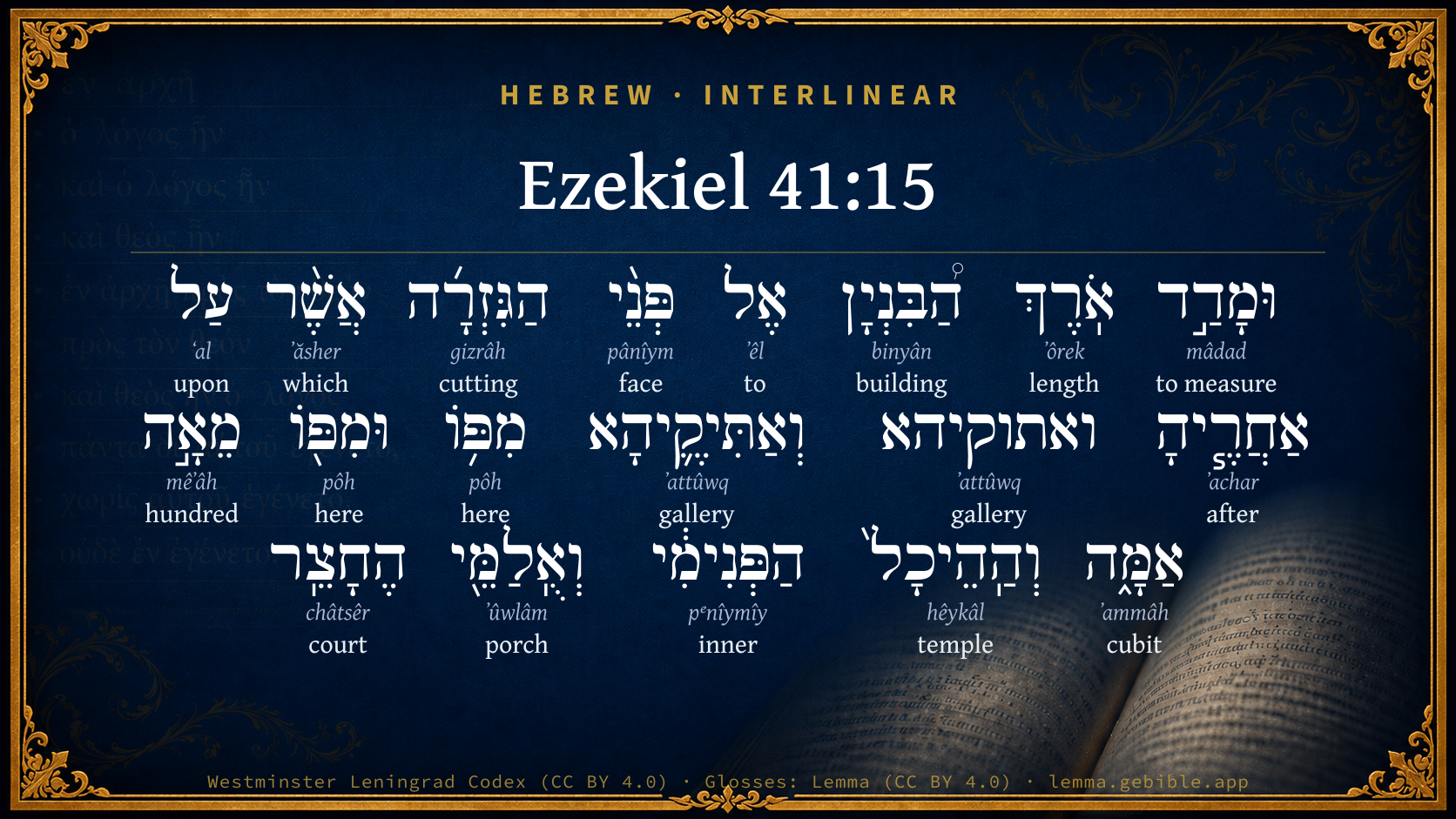
Ezekiel 41:15

Hebrew (Westminster Leningrad Codex) Ezekiel 41:15 appears in the Hebrew Old Testament. The text above is from the Westminster Leningrad Codex. Each word links to its Strong’s number, a concise gloss, and parsing drawn from the Open Scriptures Hebrew Bible morphology. Click any word for its full Brown-Driver-Briggs (BDB) entry.
Download image
Cite this verse

Ezekiel 41:15 (World English Bible). Public Domain. Lemma interlinear Bible study tool, https://lemma.gebible.app/v/ezekiel/41/15.

Show BibTeX & RIS
BibTeX
RIS
English Translation
He measured the length of the building before the separate place which was at the back of it, and the galleries of it on the one side and on the other side, one hundred cubits; and the inner temple, and the porches of the court;
World English Bible · Public Domain
Highlights
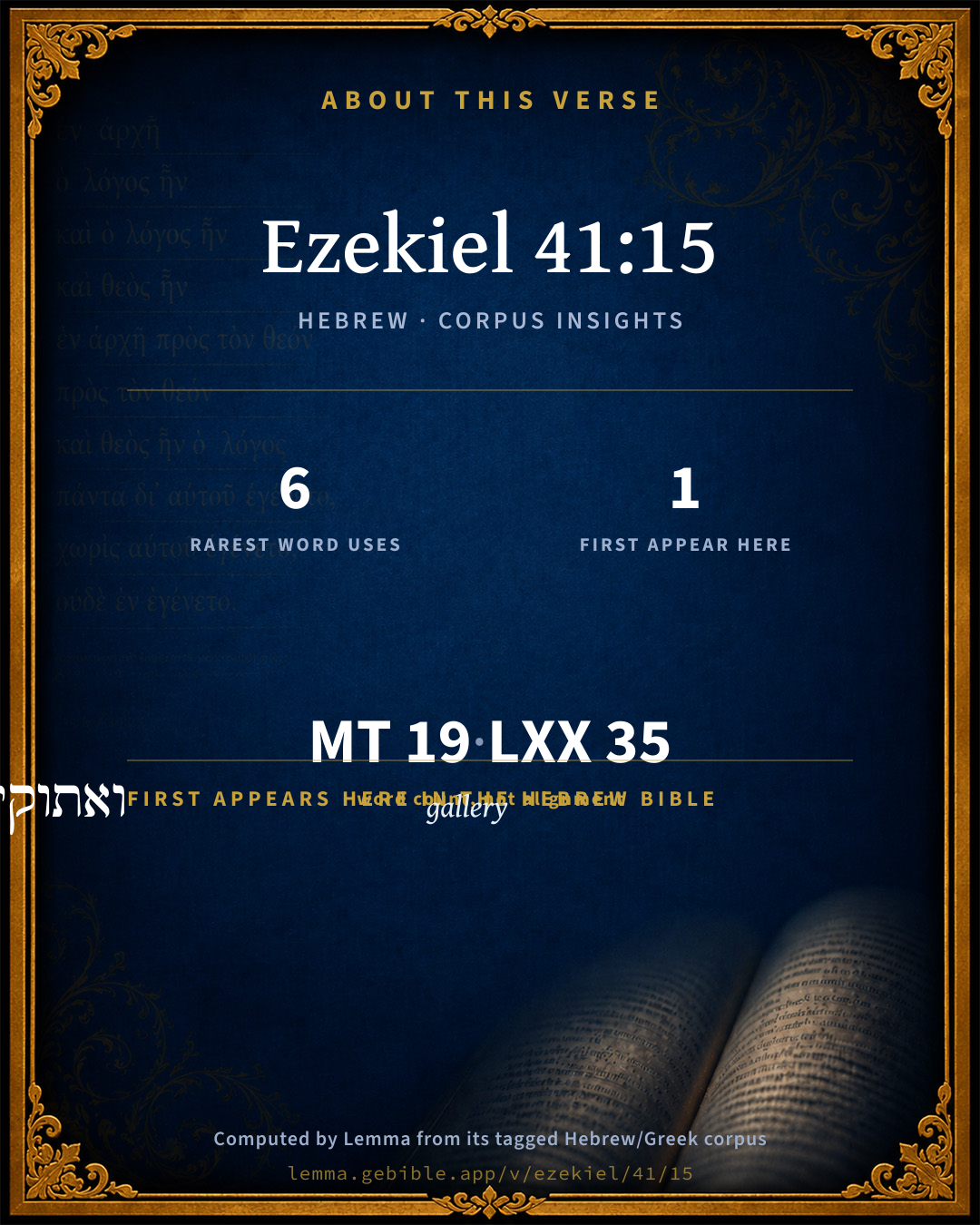
  • 1 first appearance in the Hebrew Bible
Full analysis ↓
Download a study sheet

One document with this verse’s original text, its word-by-word gloss line, the meaning frame, cross-references with their text, attributed commentary, and full source and license credits — printable, and it pastes into notes with its structure intact.

This verse Autodidact and up

Study sheet (.html) Plain text (.txt)

A passage Seminary Student

Up to 50 verses in one chapter. A passage sheet keeps up to 6 commentary sources and 12 cross-references per verse, in the order this page ranks them, and says so on the sheet whenever that leaves anything out. Ask for a single verse and you get the Autodidact verse sheet above.

Everything on this page stays free to read, with no account — the sheet is a download of what is already on screen, not access to it.

Want to remove ads? Support Godless Engineer
Compare translations 3

The same verse in 3 English versions, stacked beneath the original-language interlinear above. Click any original word for its lexicon entry.

Each is an independent rendering of the whole verse — the interlinear is not word-aligned to these translations.

Highlighted words mark where these versions differ — a whole-verse word diff, not a word-by-word alignment.

  • World English Bible Public Domain
    He measured the length of the building before the separate place which was at the back of it, and the galleries of it on the one side and on the other side, one hundred cubits; and the inner temple, and the porches of the court;
  • King James Version Public Domain
    And he measured the length of the building over against the separate place which was behind it, and the galleries thereof on the one side and on the other side, an hundred cubits, with the inner temple, and the porches of the court;
  • unfoldingWord Literal Text CC BY-SA 4.0
    Then the man measured the length of the building behind the sanctuary, to its west, and the galleries on either side—one hundred cubits. The holy place and the portico,

unfoldingWord Literal Text — © unfoldingWord, licensed CC BY-SA 4.0. Word-aligned USFM3 via Door43 (git.door43.org/unfoldingWord/en_ult).

Versions to compare (up to 4)

3 of 4 selected

Show all 18 translations

Every available English version of this verse, each an independent rendering of the whole verse.

  • World English Bible Public Domain
    He measured the length of the building before the separate place which was at the back of it, and the galleries of it on the one side and on the other side, one hundred cubits; and the inner temple, and the porches of the court;
  • Berean Standard Bible Public Domain
    Next he measured the length of the building facing the temple courtyard at the rear of the temple, including its galleries on each side; it was a hundred cubits. The outer sanctuary, the inner sanctuary, and the porticoes facing the court,
  • Majority Standard Bible Public Domain
    Next he measured the length of the building facing the temple courtyard at the rear of the temple, including its galleries on each side; it was a hundred cubits. The outer sanctuary, the inner sanctuary, and the porticoes facing the court,
  • King James Version Public Domain
    And he measured the length of the building over against the separate place which was behind it, and the galleries thereof on the one side and on the other side, an hundred cubits, with the inner temple, and the porches of the court;
  • American Standard Version (1901) Public Domain
    And he measured the length of the building before the separate place which was at the back thereof, and the galleries thereof on the one side and on the other side, a hundred cubits; and the inner temple, and the porches of the court;
  • Revised Version (1885) Public Domain
    And he measured the length of the building before the separate place which was at the back thereof, and the galleries thereof on the one side and on the other side, an hundred cubits; and the inner temple, and the porches of the court;
  • Geneva Bible (1599) Public Domain
    And hee measured the length of the building, ouer against the separate place, which was behinde it, and the chambers on the one side and on the other side an hundreth cubites with the Temple within, and the arches of the court.
  • Douay-Rheims (1899) Public Domain
    And he measured the length of the building over against it, which was separated at the back of it: and the galleries on both sides a hundred cubits: and the inner temple, and the porches of the court.
  • Young's Literal Translation Public Domain
    And he hath measured the length of the building unto the front of the separate place that `is' at its hinder part, and its galleries on this side and on that side, a hundred cubits, and the inner temple and the porches of the court,
  • Literal Standard Version CC BY-SA 4.0
    And he has measured the length of the building to the front of the separate place that [is] at its back part, and its galleries on this side and on that side—one hundred cubits. And the inner temple and the porches of the court,
  • Unlocked Literal Bible CC BY-SA 4.0
    Then the man measured the length of the building behind the sanctuary, to its west, and the galleries on either side—one hundred cubits. The holy place and the portico,
  • unfoldingWord Literal Text CC BY-SA 4.0
    Then the man measured the length of the building behind the sanctuary, to its west, and the galleries on either side—one hundred cubits. The holy place and the portico,
  • Darby Bible Public Domain
    And he measured the length of the building before the separate place, which was at the back of it, with its galleries on the one side and on the other side, a hundred cubits; and the inner temple, and the porches of the court.
  • World Messianic Bible Public Domain
    He measured the length of the building before the separate place which was at its back, and its galleries on the one side and on the other side, one hundred cubits from the inner temple, and the porches of the court,
  • Webster's Bible Public Domain
    And he measured the length of the building over against the separate place which was behind it, and its galleries on the one side and on the other side, a hundred cubits, with the inner temple, and the porches of the court;
  • Free Bible Version CC BY-SA 4.0
    He measured the length of the building that faced the Temple courtyard towards the rear of the Temple, including its open halls on each side. It was one hundred cubits long. The outer sanctuary, the inner sanctuary, and the porches facing the courtyard,
  • Bible in Basic English Public Domain
    And he took the measure of the building in front of the separate place which was at the back of it, and the pillared walks on one side and on the other side; they were a hundred cubits long; and the Temple and the inner part and its outer covered way were covered in;
  • JPS Tanakh (1917) Public Domain
    And he measured the length of the building before the separate place which was at the back thereof, and the galleries thereof on the one side and on the other side, a hundred cubits. Now the temple, and the inner place, and the porches of the court,

Literal Standard Version (2020), Covenant Press — licensed CC BY-SA 4.0. Text via the HelloAO Bible API (eBible.org). Unlocked Literal Bible (unfoldingWord) — licensed CC BY-SA 4.0. Text via the HelloAO Bible API (eBible.org). unfoldingWord Literal Text — © unfoldingWord, licensed CC BY-SA 4.0. Word-aligned USFM3 via Door43 (git.door43.org/unfoldingWord/en_ult). Free Bible Version, Dr. Jonathan Gallagher — licensed CC BY-SA 4.0. Text via the HelloAO Bible API (eBible.org).

Word by word

More ways to search: Search by grammar → Find every occurrence → Compare this word →

Practice this passage: Drill this verse → Learn its vocabulary →

ואתוקיהא
ʼattûwq
H862
“and · galleries · her”
Conjunction + Noun, Common, Masculine, Plural, Construct + Suffix, Personal, 3rd Person, Feminine, Singular
Part of Speech
Conjunction + Noun
Type
Common
Gender
Masculine
Number
Plural
State
Construct
Full BDB Definition

Origin: from H5423 in the sense of decreasing

TWOT: 191a

gallery, porch
  1. וּמָדַ֣ד mâdad H4058 “and · to measure” Conjunction + Verb, Qal, Sequential Perfect, 3rd Person, Masculine, Singular
  2. אֹֽרֶךְ ʼôrek H753 “length of” Noun, Common, Masculine, Singular, Construct
  3. הַ֠בִּנְיָן binyân H1146 “the · building” Particle, Definite Article + Noun, Common, Masculine, Singular, Absolute
  4. אֶל ʼêl H413 “to” Preposition
  5. פְּנֵ֨י pânîym H6440 “face(s) of” Noun, Common, Both, Plural, Construct
  6. הַגִּזְרָ֜ה gizrâh H1508 “the · cutting” Particle, Definite Article + Noun, Common, Feminine, Singular, Absolute
  7. אֲשֶׁ֨ר ʼăsher H834 “which” Particle, Relative
  8. עַל ʻal H5921 “upon” Preposition
  9. אַחֲרֶ֧יהָ ʼachar H310 “after · her” Preposition + Suffix, Personal, 3rd Person, Feminine, Singular
  10. וְאַתִּיקֶ֛יהָא ʼattûwq H862 “and · galleries · her” Conjunction + Noun, Common, Masculine, Plural, Construct + Suffix, Personal, 3rd Person, Feminine, Singular
  11. מִפּ֥וֹ pôh H6311 “from · here” Preposition + Adverb
  12. וּמִפּ֖וֹ pôh H6311 “and · from · here” Conjunction + Preposition + Adverb
  13. מֵאָ֣ה mêʼâh H3967 “hundred” Adjective, Cardinal number, Both, Singular, Absolute
  14. אַמָּ֑ה ʼammâh H520 “cubit” Noun, Common, Feminine, Singular, Absolute
  15. וְהַֽהֵיכָל֙ hêykâl H1964 “and · the · temple” Conjunction + Particle, Definite Article + Noun, Common, Masculine, Singular, Absolute
  16. הַפְּנִימִ֔י pᵉnîymîy H6442 “the · inner” Particle, Definite Article + Adjective, Adjective, Masculine, Singular, Absolute
  17. וְאֻֽלַמֵּ֖י ʼûwlâm H197 “and · porches of” Conjunction + Noun, Common, Masculine, Plural, Construct
  18. הֶחָצֵֽר châtsêr H2691 “the · court” Particle, Definite Article + Noun, Common, Both, Singular, Absolute

About this verse

These counts appear in no published source. They are computed here, from the morphology-tagged text and Lemma’s own curated glosses. What Lemma adds →

19
words
17
distinct lemmas
Prophets
section

Notable vocabulary

The rarest word here is ואתוקיהא gallery H862 — appearing just 6 times in the whole Hebrew Bible.

First appearance in Scripture

This word makes its first canonical appearance in the Hebrew Bible here:

  • ואתוקיהא gallery H862

Shared distinctive vocabulary

ואתוקיהא gallery H862 occurs in 4 verses of the Hebrew Bible. Also found in:

Grammatical profile

  • 1 verb
  • 10 nouns
  • 2 adjectives
  • 3 prepositions
  • 2 adverbs
  • 1 particle

Verb forms

  • וּמָדַ֣ד Qal · Sequential Perfect

Repetition

Words recur within this verse — often emphatic in Hebrew:

  • ואתוקיהא gallery H862 ×2
  • מִפּ֥וֹ here H6311 ×2

Hebrew & Septuagint length

In English translation the verse runs 45 words from the Hebrew and 50 from the Septuagint (LXX English) — closely comparable.

A rough comparison of the two English renderings, which tokenize alike — not a word-level alignment.

Word counts can differ between the Hebrew and the Greek without any difference in meaning — e.g. the Hebrew direct-object marker אֵת has no separate Greek word, and Greek often adds the article ὁ.

In the original languages it is 19 Hebrew tokens and 35 Greek tokens — but the two are counted differently (Hebrew bundles its prefixes and suffixes into one token; the Greek is in lemma form), so that isn’t a like-for-like length.

Cross-references

9

Topical passages linked to Ezekiel 41:15 in the Treasury of Scripture Knowledge — connected by theme and wording, ordered by reader-vote popularity; previews shown in the World English Bible.

  • Ezekiel 42:3 Over against the twenty [cubits] which belonged to the inner court, and over against the pavement which belonged to the outer court, was gallery against gallery in the third story.
  • Ezekiel 42:1 Then he brought me forth into the outer court, the way toward the north: and he brought me into the chamber that was over against the separate place, and which was over against the building toward the north.
  • Song of Solomon 1:17 The beams of our house are cedars. Our rafters are firs. Beloved
  • Song of Solomon 7:5 Your head on you is like Carmel, The hair of your head like purple; The king is held captive in its tresses.
  • Ezekiel 41:12 The building that was before the separate place at the side toward the west was seventy cubits broad; and the wall of the building was five cubits thick round about, and the length of it ninety cubits.
  • Ezekiel 41:17 to [the space] above the door, even to the inner house, and outside, and by all the wall round about inside and outside, by measure.
  • Ezekiel 42:5 Now the upper chambers were shorter; for the galleries took away from these, more than from the lower and the middle, in the building.
  • Ezekiel 42:15 Now when he had made an end of measuring the inner house, he brought me forth by the way of the gate whose prospect is toward the east, and measured it round about.
  • Zechariah 3:7 "Thus says Yahweh of hosts: 'If you will walk in my ways, and if you will keep my charge, then you also shall judge my house, and shall also keep my courts, and I will give you a place of access among these who stand by.

Cross-references courtesy of OpenBible.info (CC BY 4.0).

Hebrew and Greek witnesses Masoretic Hebrew ↔ Greek Septuagint

The same verse in the two great witnesses to the Old Testament, shown verse-for-verse.

These are two independent witnesses, not word-aligned to each other, and the Septuagint is shown in lemma (dictionary) form.

Hebrew Ezekiel 41:15 Masoretic · Westminster Leningrad Codex

וּמָדַ֣ד אֹֽרֶךְ הַ֠בִּנְיָן אֶל פְּנֵ֨י הַגִּזְרָ֜ה אֲשֶׁ֨ר עַל אַחֲרֶ֧יהָ ואתוקיהא וְאַתִּיקֶ֛יהָא מִפּ֥וֹ וּמִפּ֖וֹ מֵאָ֣ה אַמָּ֑ה וְהַֽהֵיכָל֙ הַפְּנִימִ֔י וְאֻֽלַמֵּ֖י הֶחָצֵֽר

He measured the length of the building before the separate place which was at the back of it, and the galleries of it on the one side and on the other side, one hundred cubits; and the inner temple, and the porches of the court;

World English Bible · Public Domain

Greek LXX Ezekiel 41:15 Septuagint · lemma form

καί διαμετρέω μῆκος ὁ διαὁρίζω κατά πρόσωπον ὁ ἀπόλοιπος ὁ κατόπισθεν ὁ οἶκος ἐκεῖνος καί ὁ ἀπόλοιπος ἔνθεν καί ἔνθεν πῆχυς ἑκατόν ὁ μῆκος καί ὁ ναός καί ὁ γωνία καί ὁ αιλαμ ὁ ἐξώτερος

And he measured the length of the partition in front of the space left by the back parts of that house; and the spaces left on this side and on that side were in length one hundred cubits: and the temple and the corners and the outer porch were ceiled.

LXX2012 (modern English Septuagint) · Public Domain

On this verse, The Cambridge Bible for Schools and Colleges discusses the Septuagint’s reading. Read the note in Commentary ↓

Hebrew: Westminster Leningrad Codex (CC BY 4.0). Greek: Septuagint (public domain); English from LXX2012 (modern English Septuagint) (Public Domain). How the Septuagint differs from the Hebrew →

Targum (Aramaic paraphrase)

1

The Targum is the ancient Jewish Aramaic paraphrase of the Hebrew Scriptures — an interpretive translation, not the Hebrew text itself. Onkelos (literal) and Pseudo-Jonathan (expansive) render the Torah, and Jonathan the Prophets. Coverage is partial: where no permissively-licensed English translation exists for a verse, only the Aramaic is shown. This is verse-level text, not a word-by-word alignment to the Hebrew.

  1. Targum Jonathan Prophets (Joshua–Malachi)
    וּמְשַׁח אוּרְכָּא דְבִנְיָנָא דִקֳדָם בְּצוּרְתָא דְלַאֲחוֹרָאָה וְזִיוְיָתָהָא מִכָּא וּמִכָּא מְאָה אַמִין וְהֵיכְלָא גַוָאָה וְאוּלַמֵי דַרְתָּא:

    (no public-domain English translation for this verse)

    Targum Jonathan — Aramaic: “Mikraot Gedolot” (public domain). English: “Sefaria Community Translation” (CC0 1.0 (public-domain dedication)); “London "Chaldee Paraphrase," 1871” (public domain). Text via Sefaria.

Commentary

Notes on Ezekiel 41:15 from classic Christian and Jewish commentators (each source and its license shown beneath its notes). The classic Christian expositions comment on the surrounding passage and are grouped to its opening verse, so a note may address several verses; the Jewish commentaries on the Tanakh (Rashi and others) are per-verse, so they appear only where the commentator wrote on this verse.

Lemma curates 59 commentaries, every one of them public domain or Creative Commons licensed, each selected and text-cleaned for this edition rather than reprinted as found. About our sources →

The Cambridge Bible for Schools and Colleges

gen. ed. J. J. S. Perowne

15. The “length” here is reckoned from N. to S.

which was behind it] Rather: behind which it was. The building, while lying “over against” the “separate place,” was behind it, i.e. to the W. of it. If this construction be not adopted the meaning is, which (building) was behind it (the separate place)—an independent clause. The length of the building as it lay along the “separate place” N. to S. was 100 cubits, i.e. 90 (interior, Eze_41:12) + 5 + 5 (side walls, Eze_41:12) = 100, Fig. 3, rs. The term rendered “galleries” is of uncertain meaning. It occurs only Eze_41:15-16 and Eze_42:3; Eze_42:5. If the reading be right here it can mean nothing else but walls, or something equivalent to walls and occupying the same space, according to Eze_41:12. Syriac uses a term by which it also renders the “walls” of the altar, Eze_41:22.—The verse should end at the word cubits.

15 b seq. Description of the inside of the house, with its ornamentation

The details of measurement were exhausted in Eze_41:15 a. The prophet proceeds now to describe the interior of the house in two particular points: (1) the woodwork with which the house in its walls, &c., was covered, 15b–16 a; and (2) the ornamentation of this woodwork, 16 b seq. The text is in some disorder, and the unknown term rendered “galleries” causes perplexity, though two general statements are plainly made, viz. that the whole interior of the house was covered with wood, and that this woodwork from floor to roof was ornamented in the holy place and in the holiest with cherubs and palms (in the porch perhaps with palms only). With no more changes than are absolutely necessary Eze_41:15 b–16 a might read: “and the temple (i.e. holy place), and the inner house (holiest), and the porch of the court (more probably, and its outer porch), 16 and the thresholds, and the closed windows and the galleries round about the three of them, opposite the threshold (i.e. towards the interior) were veneered with wood (or, were polished wood) round about.” This would state generally that the whole interior was wainscotted. But the jump from “thresholds” (A.V. door-posts) to “closed windows” in Eze_41:16 is unnatural. It is probable that “thresholds” should be read with LXX. cieled (or, wainscotted). It is certainly probable that the roofing is described; the word read by LXX. (saphan) is always used of the roof-work in the description of Solomon’s temple (1Ki_6:7., unless Eze_7:7 be an exception, a clause wanting in LXX.); and LXX. understood it so here (Eze_41:20). Further the mention of the closed windows, which must have been toward the roof, in immediate connexion, is in favour of the roof-work. What the “galleries” were is obscure. LXX. either did not read the word or rendered it “narrow openings” (slit windows). A.V. “on their three stories” should be to the three of them (the holy place, holiest and porch, Eze_41:15). Pointed thus the reading is: and the temple and the inner house (holiest) and the porch of the court (or, and its outer porch) were covered with a roof-work, and they three had their closed windows and their galleries round about.

The Cambridge Bible for Schools and Colleges (gen. ed. J. J. S. Perowne; Cambridge University Press, 1878–1918) — public domain. Text from a community e-Sword module.

John Gill's Exposition

And he measured the length of the building over against the separate place,.... Which was ninety cubits, as appears from Eze 41:12, when measured by itself:

which was behind it; that is, behind the separate place, or holiest of all, at the back of it, at the west end. Noldius (g) renders the words, "he measured the length of the building before the separate place, and behind it"; or its back part, as the Syriac, and interprets it thus; that he measured the building or the porch which was before the temple, that is to the north; and the porch opposite to it, that is to the south: this "building" behind it, with the Jews (h), is the same with Bethchaliphoth (i), or the house of knives, which the priests used in sacrificing:

and the galleries thereof on the one side, and on the other side, an hundred cubits; as the above is the length of this building from east to west, this is the breadth of it from north to south; the breadth of the building itself was seventy cubits, Eze 41:12, and the galleries on the north and south sides of it, and the thickness of the walls, which were five cubits each, made thirty more; in all a hundred cubits; which is equal to the breadth of the temple, as in the preceding verse: these galleries, or balconies, or porticos, supported by pilasters, design places for the saints to walk in, converse, and commune with one another; and where Christ the King of saints is held forth, and seen in his beauty and glory; see Zac 3:7,

with the inner temple, and the porches of the court; or, "and the inner temple" (k), &c. that is, and he also measured the inner temple or holy of holies, with all the porches, chambers, and their walls, and with all the spaces and appendages to it, which were of the same measure; see Eze 41:15.

(g) Concord. Ebr. Part. p. 104. No. 521. (h) Lipman. Tzurath Beth Hamikdash, sect. 50. (i) Misn. Middot, c. 4. sect. 7. (k) "et templum interius", V. L. Pagninus, Montanus, Cocceius, Starckius.

John Gill's Exposition of the Whole Bible (1746–1763) — public domain (CC PDM 1.0). Text via the HelloAO Bible API.

Trapp's Complete Commentary

John Trapp

Eze 41:15 And he measured the length of the building over against the separate place which [was] behind it, and the galleries thereof on the one side and on the other side, an hundred cubits, with the inner temple, and the porches of the court;

Ver. 15. An hundred cubits.] See on Eze 41:13.

With the inner temple and the porches thereof.] Summa et infima iuxta curat, nihil aspernatur. {a}

{a} Oecolamp.

John Trapp, A Commentary or Exposition upon All the Books of the Old and New Testament (1647–1656) — public domain. Text from a community e-Sword module.

Joseph Benson's Commentary

Eze 41:15-17. And he measured the length, &c. — Noldius translates this sentence more clearly thus: And he measured the length of the building which was before the separate place, [and] that which was behind it, or opposite to it; by which he understands the north and south porch, the east and west sides having been measured before, Eze 41:12; Eze 41:14. And the galleries thereof on one side, &c., a hundred cubits, with [or and] the inner temple, and the porches thereof — As the temple, and the area wherein it stood, made a square of a hundred cubits; so the courts and buildings thereto belonging were of the same dimensions. By the galleries are meant the side-chambers, described Eze 41:6-7. Within the inner temple — Called the inner house, Eze 41:17, Eze 42:15, to distinguish it from the courts and buildings which were about it. The door- posts and the narrow windows, &c. — He measured also the thickness of the walls on each side of the porch, and the thickness of the door-cases at the entrance into the temple; as also the narrow windows belonging to the three stories of chambers, which were placed on the outside of the temple. From the ground up to the windows — He measured from the ground up to the windows which were placed above the side-chambers. And the windows were covered — With lattices or curtains, or both. To that above the door — It seems this verse is connected with the preceding, and signifies that the windows were made in exact proportion, both over the porch, and through every part of the temple and the buildings adjoining to it.

Joseph Benson's Commentary on the Old and New Testaments (1811–1818) — public domain. Text from a community e-Sword module.

Keil & Delitzsch

C. F. Keil & F. Delitzsch

Summary Account of the Measurement, the Character, and the Significant Ornaments of the Projecting Portions of the Temple Building. - Eze 41:15. And thus he measured the length of the building in the front of the separate place which was at the back thereof, and its galleries on this side and that side, a hundred cubits, and the inner sanctuary, and the porches of the court; Eze 41:16. The thresholds, and the closed windows, and the galleries round about all three - opposite to the thresholds was wainscoting wood round about, and the ground up to the windows; but the windows were covered - Eze 41:17. (The space) above the doors, both to the inner temple and outside, and on all the wall round about, within and without, had its measures. Eze 41:18. And cherubs and palms were made, a palm between every two cherubs; and the cherub had two faces; Eze 41:19. A man's face toward the palm on this side, and a lion's face toward the palm on that side: thus was it made round about the whole house. Eze 41:20. From the floor to above the doors were the cherubs and palms made, and that on the wall of the sanctuary. Eze 41:21. The sanctuary had square door-posts, and the front of the holy of holies had the same form. Eze 41:22. The altar was of wood, three cubits high, and its length two cubits; and it had its corner-pieces and its stand, and its walls were of wood: and he said to me, This is the table which stands before Jehovah. Eze 41:23. And the holy place and the holy of holies had two doors. Eze 41:24. And the doors had two wings, two turning leaves; the one door two, and the other two leaves. Eze 41:25. And there were made upon them, upon the doors of the sanctuary, cherubs and palms, as they were made upon the walls; and a moulding of wood was on the front of the porch outside. Eze 41:26. And there were closed windows and palms on this side and on that, on the side-walls of the porch, and the side-rooms of the house, and the beams. - Eze 41:15 is the commencement of a comprehensive enumeration of particular features in the building, the greater part of which have not been mentioned before; so that וּמדד (for ויּמד) is to be rendered, "and thus he measured." The circumstance that another measurement follows in Eze 41:15, whereas no further numbers are given from Eze 41:15 onwards, does not warrant us in assuming that Eze 41:15 is to be joined on to Eze 41:14, and Eze 41:15 to be taken in connection with Eze 41:16. The absence of the cop. ו before הסּפּים in Eze 41:16 is sufficient to preclude the latter, showing as it does that הסּפּים commences a fresh statement; and the words 'וההיכל וגו in Eze 41:15 are still governed by the verb וּמדד in Eze 41:15. The contents of Eze 41:15 are also decisive against the separation mentioned. If, for instance, we connect Eze 41:15 with Eze 41:14, the first clause contains a pure tautology, as the length of the building has been already measured, and the result is given in Eze 41:13. The tautology does not exist, if the summary statements of the measurement of different portions of the whole temple building commence with Eze 41:15; and in connection with these a supplementary account is given of various details not mentioned before.

The contents of the second clause, namely, what is stated concerning the אתּיקים, belong directly to the latter. The building in front of the separate place, which was measured by the man, is more precisely defined, so far as its situation is concerned, by the words אשׁר על־אחריה. The feminine suffix in אחריה points back to הגּזרה; consequently אשׁר can only refer to הבּנין: "the building...which was at the back of the gizrah." This is not at variance with the situation indicated in אל־פּני הגּזרה, but serves as a more exact definition of this statement, showing that the building which stood at the front of the gizrah occupied the hinder part of it, i.e., extended in length from the front of the gizrah to the back. - The meaning of אתּוּקים or אתּיקים, here (Keri) and in Eze 41:16; Eze 42:3 and Eze 42:5, the only other passages in which it occurs, is involved in obscurity. Even Raschi confesses that he does not know what it means, and the older translators have simply resorted to vague conjectures for their renderings; the lxx here, ἀπόλοιπα, in Eze 42:3 and Eze 42:5 περίστυλον and στοαί; the Vulgate, here, ethecas (the Hebrew word Latinized), in Ezekiel 42 porticus; Targum, in the London Polyglot, Eze 41:15, זיויתהא; Eze 41:16, אתּיקיּא; Eze 42:3, זוי; and Eze 42:5, זיזיּא. There is no root אתק in Hebrew; and the derivation of the word from עתק is not only uncertain, but furnishes us with nothing that can be used for tracing the architectural signification of the word. Even the context in Eze 41:15 and Eze 41:16 of this chapter supplies nothing, for in both verses the meaning of the clauses in which אתיקים stands is a matter of dispute. It is only in Eze 42:3 and Eze 42:5 that we find any clue. According to Eze 42:3, in the three-storied cell-building there was אתּיק אל־פּני on the third storey; and according to Eze 41:5 the cells of the upper storey in this building were shorter than those of the lower and central storey, because אתּיקים took space away from them; and the reason for this, again, was, that the three-storied cells had no pillars. From this we may infer with certainty that the אתּיקים were galleries or passages running along the outer walls of the building, which were not supported by pillars, and therefore necessarily rested upon ledges obtained by the receding of the rooms of the upper storey. This meaning also suits the present chapter. The suffix in אתּוּקיהא (an Aramaic form for אתּיקיה) points back, not to בּנין, but to הבּניה in Eze 41:13; for the words, "and its galleries on this side and on that," i.e., on the north and south sides of the building, are not dependent upon ארך הבּנין, in the sense of "the length of the building, with its galleries on this side and on that," as ואתוקיהא is too widely separated from 'ארך הב for this. ואתוקיהא is rather a second object to מדד: he measured (1) the length of the building; (2) its galleries on this side and that - a hundred cubits; (3) the inner temple, etc. The hundred cubits do not refer to the length of the building, but to the galleries on both sides, which were of the same length as the building, and therefore ran along its entire length, - a fact which it was not superfluous to mention, as they might possibly have been shorter. ההיכל הפּנימי is the temple house, with the buildings against it, within the inner court. In addition to these, there are also mentioned the porches of the court, i.e., at the gate-buildings of the inner and outer courts, as the projecting portions of these buildings. These three works mentioned in Eze 41:15 comprise the whole of the buildings, the measurements of which have been mentioned in the previous description - viz. the building to the west of the temple, in Eze 41:12-14; the inner temple, in Eze 41:1-11; the porches of the courts, to which the temple porch in front of the holy place is to be added, as having been reckoned in the measurement as belonging to the inner court, in Ezekiel 41. - Thus the contents of our verse (Eze 41:15) plainly show that it not only is an indivisible whole, but forms a conclusion in which the foregoing measurements are all summed up, and which serves as an introduction, in accordance with this, to the following summary of various additional features in the temple buildings which are also worthy of mention.

In this summary there are five points noticed: (a) the fact that all parts of the buildings had their measurements (Eze 41:16 and Eze 41:17); (b) the significant ornamentation of the inner walls of the sanctuary (Eze 41:18-21); (c) the altar in the holy place (Eze 41:22); (d) the character and decoration of the doors of the sanctuary (Eze 41:23-25); (e) the style of the porch and of the side-buildings against the temple (Eze 41:25, Eze 41:26). - Eze 41:16 and Eze 41:17 form one period, enlarged by the parenthetical insertion of explanatory statements, similar to the construction in Eze 41:18 and Eze 41:19. The predicate to the three subjects - the thresholds, the closed windows, and the galleries - is not to be sought for either in סביב or in 'הסּף שׁחיף וגו. The latter construction, adopted by Bttcher and Hvernick, yields the unmeaning assertion that the thresholds lay across in front of the threshold. The former gives the apparently bald thought, that thresholds, windows, and galleries were round about; in which the use of the article, the thresholds, the windows, is exceedingly strange. The predicate to 'הסּפּים וגו is מדּות at the end of Eze 41:17 : the thresholds, etc., had measurements; and the construction is so far anakolouthistic, that the predicate מדּות, strictly speaking, belongs to the things mentioned in Eze 41:17 alone, and the subjects mentioned in Eze 41:16 are to be regarded as absolute nominatives. The words סביב לשׁלשׁתּם belong to the three preceding subjects, as a further definition, the thresholds, windows, and galleries (which were) against these three round about. The suffix to שׁלשׁתּם, "their triad," refers to the three buildings mentioned in Eze 41:15 : the one upon the separate place, the temple building, and the porches of the court; and the appositional סביב is not to be so pressed as to lead to the conclusion that all three buildings, and therefore the porches of the court also, had אתּיקים round about. As the סביב לשׁלשׁתם is affirmed of the thresholds, and the windows, and the galleries, and these three objects are introduced by the article, as well known, i.e., as already mentioned and described in the preceding verses, the more precise definition (resp. limitation) of the apposition, "round about these three," is to be taken from the preceding description of these three buildings, and we are simply to assume the existence of thresholds, windows, and galleries in these buildings in those cases in which they have been mentioned in that description; so that the only place in which there were galleries was the building upon the separate place. But before the intended information is given concerning the thresholds, etc., a remark is introduced, with the words from נגד הסּף to סביב, as to the construction of the thresholds: viz., that opposite to the threshold (הסּף being used in a general sense for every threshold) there was שׁחיף עץ, a thin covering of wood, or wainscoting. נגד does not mean across the front (Bttcher), but "opposite;" and the part opposite to the threshold of a door is, strictly speaking, the lintel. Here, however, the word is probably used in the broader sense for the framework of the door, above and on the two sides, as is shown by סביב סביב which follows. With הארץ a fresh object is introduced. הארץ is a nominative, like הסּפּים, etc.; and the thought of supplying מן gniylppus, "from the ground," has originated in a faulty interpretation of the words. The idea is this: as the thresholds, the windows, etc., so also the ground up to the windows, i.e., the space between the ground and the windows, had measurements. The allusion to the windows is followed by the remark, in the form of a circumstantial clause, that "the windows were covered." מכסּות is apparently only a substantial explanation of אטמות (see the comm. on Eze 40:16).

In Eze 41:17 two further objects are mentioned as having measurements; not, however, in the logical position of subjects, but with prepositions על and אל: upon that which was above the opening of the door...and (what was) on all the walls, i.e., the space above the doors and on all the walls. To this periphrasis of the subject, through על and אל, there is attached the predicate מדּות, which belongs to all the subjects of Eze 41:16 and Eze 41:17, in the sense of, "on all the walls there were measures." The meaning is, that all the parts of the building which have been named had their definite measurements, were carefully measured off. In order to express this thought in as general and comprehensive a manner as possible, the ideas contained in the subjects in Eze 41:17 are expanded by means of appositions: that of the space above, over the entrance door, by ולחוּץ 'ועד הבּית הף (both ו-ו = et-et) into the inner temple, i.e., both the inside of the temple throughout, and also to the outside. The idea of the whole wall is expressed by "round about, in the inside and on the outside." - Thus everything in Eze 41:16 and Eze 41:17 is clear, and in accordance with fact; and there is no necessity either for the critical scissors of Ewald and Hitzig, who cut out all that they do not understand as glosses, or for the mal-emendation of Bttcher, who changes מדּות into מקלעות (Kg1 6:18), and thus finds it good to ornament the temple with sculptures, even on the outsides of all the walls.

Eze 41:18-21 treat of the ornamenting of the inside of the sanctuary, i.e., of the holy place and the holy of holies. Eze 41:18 and Eze 41:19 form, like Eze 41:16 and Eze 41:17, a period extended by parentheses. The predicate עשׂוּי, standing at the beginning of Eze 41:18, is resumed in Eze 41:19, and completed by ס' 'אל־כּל־הבּית ס. That the cherubim and palms were executed in sculpture or carving, is evident from the resemblance to Solomon's temple. They were so distributed that a cherub was followed by a palm, and this by a cherub again, so that the palm stood between the two cherubim, and the cherub turned one of its two faces to the palm on this side, and the other to the palm upon that side. In sculpture only two faces could be shown, and consequently these cherubic figures had only two faces, and not four, like those in the vision. This sculpture was placed round about the whole house, and that, as is added in Eze 41:20 by way of explanation, from the ground even to up above the door, namely, on the inner wall of the sanctuary (ההיכל). כּל־הבּית is hereby limited to the היכל, the holy place and the holy of holies. וקיר is a local accusative. To this there is appended the further notice in Eze 41:21, that the sanctuary had door-posts in a square form. The loose arrangement of the words, "the sanctuary post work of square form," is a concise form of expression after the manner of brief topographical notices. מזוּזה invariably signifies, wherever it occurs, the door-posts, i.e., the projecting framework of the entrances. רבוּע, "foured," does not mean four-cornered merely, but really square (Exo 27:1 and Exo 28:16). Consequently the words, "the door-posts of the holy place were of a square shape," might be understood as signifying not merely that the door-posts were beams cut square, but, as Kliefoth supposes, that the post work surrounding the door was made of a square form, that is to say, was of the same height as breadth, which would be quite in keeping with the predominance of the square shape, with its symbolical significance, in this picture of a temple. But the statement in the second half of the verse can hardly be reconciled with this; for whatever diversity there may be in the interpretation of this verse in particular points, it is certain that it does contain the general assertion that the doorway of the holy of holies was also shaped in the same way. But the door of the holy of holies, instead of being square, was (according to Eze 41:3) six cubits high and seven cubits broad. הקּודשׁ, as distinguished from ההיכל, is the holy of holies, which Eze 41:23 places beyond all doubt (for this use of הקּדשׁ, see Lev 16:2-3, Lev 16:16). פּני־הקּדשׁ, the face of the holy of holies, the front which met the eye of a person entering the holy place. המּראה כּמּראה is the predicate, which is attached as loosely as in the first hemistich. The front of the holy of holies had the appearance like the appearance (just described), i.e., like the appearance of the היכל; in fact, it had also a doorway with four-cornered posts. J. F. Starch has already given this explanation of the words: Eadem facies et aspectus erat utriusque portae templi et adyti, utraque quadrata et quadratis postibus conspicua erat. The proposal of Ewald, on the other hand, to connect כּמּראה with the following word המּזבּח, "in front of the holy of holies there was something to be seen like the shape of the altar" (lxx, Syr.), has the article in המּראה against it (Bttcher).

Keil & Delitzsch — Biblical Commentary on the Old Testament (1861–1891) — public domain (CC PDM 1.0). Text via the HelloAO Bible API. (Old Testament only.)

Tyndale Open Study Notes

Tyndale Open Resources

41:15-20 The Temple building was all paneled with wood and decorated with palm trees and cherubim. The cherubim were like those described in Ezekiel’s earlier visions of judgment (see 1:5-12; 10:2-14). But where those real-life cherubim had four faces, the carved two-dimensional models are depicted with only two faces—that of a lion, the highest of the wild animals, and a human, the pinnacle of the created order. Cherubim also adorned Solomon’s Temple (1 Kgs 6:32); they were traditional symbols of judgment that complemented the palm trees, traditional symbols of blessing.

Tyndale Open Study Notes — © Tyndale Open Resources, licensed CC BY-SA 4.0. Text via the HelloAO Bible API.

Jamieson, Fausset & Brown

Robert Jamieson, A. R. Fausset & David Brown

galleries--terrace buildings. On the west or back of the temple, there was a separate place occupied by buildings of the same external dimensions as the temple, that is, one hundred cubits square in the entire compass [FAIRBAIRN].

Jamieson, Fausset & Brown — Commentary Critical and Explanatory on the Whole Bible (1871) — public domain (CC PDM 1.0). Text via the HelloAO Bible API.

Ellicott's Commentary for English Readers

(15) And he measured.—The rest of the chapter consists of an enumeration of various details, for the most part not before mentioned, and this is introduced by a summary of the measurements already made. This clause is therefore to be understood as equivalent to “So he measured,” or, “And he had measured.” The dimensions of each of the principal parts is then repeated: the building to the west of the Temple, the Temple itself, and the porches of the court. The only new point introduced is “the galleries thereof.” It seems certain that this must refer to the building beyond “the separate place;” but the word for galleries occurs only here and in Eze_41:16, and Eze_42:3; Eze_42:5, and its derivation is quite unknown. The translation, galleries, is probably correct; and as there was a space of 10 cubits on each side of the building in question, there may very well have been galleries covering and protecting its entrances, although they are not located with sufficient definiteness to be drawn on the plan.

A Bible Commentary for English Readers, edited by Charles John Ellicott (1878–1897) — public domain. Text from a community e-Sword module.

Albert Barnes' Notes on the Bible

The description of certain details is introduced by a summary statement of what had been already done.

Galleries - On either side of the eastern front of the building on the separate place was a gallery of ten feet, under which was an approach to the building, by which the refuse was to be carried in by openings in the north and south, and then carried out by a western postern.

Albert Barnes' Notes on the Bible (1834–1885) — public domain. Text from a community e-Sword/MySword module.

Haydock's Catholic Bible Commentary

Galleries; Ethecas, or as the more correct manuscripts of St. Jerome read, Ecthetas, seems to be formed from (Calmet) Hebrew athikim, (Haydock) which St. Jerome explains a balcony, portico, or gallery.

George Leo Haydock (1774–1849), Haydock's Catholic Family Bible and Commentary, 1859 edition — public domain. Excludes Psalms (Douay-Rheims chapter numbering differs from Protestant) and Deuterocanonical books (Catholic canon only).

Matthew Poole's English Annotations

The building, possibly that of Eze 41:12,13, or else the buildings of this court next to the temple, or else the west buildings behind the oracle, or the buildings of the utter court, of which in Eze 42:1,3,7,8.

The separate place: see Eze 41:12.

Which was behind it; the buildings that were behind on the west side of that supposed range, of buildings, or else behind the temple.

Galleries; either chambers, or porches, or balconies, places supported by pilasters, made for beauty and delight.

With the inner temple; according to the measures of the temple, and its appendant buildings.

Matthew Poole's English Annotations on the Holy Bible (1683–1685) — public domain. Text from a community e-Sword/MySword module.

Whedon's Commentary on the Bible

Daniel D. Whedon

15. Over against — R.V., “before the separate place which was at the back thereof,” etc. 1. The breadth of the area from west to east: (1) The separate place (including walls), 100 cubits; (2) the “house” (with free space behind), 100 cubits; (3) the inner court, 100 cubits; (4) the outer court (the two gates with space between them), 200 cubits; total, 500 cubits. 2. The length of the area from north to south: (1) The outer court (the two northern gates with spaces between them), 200 cubits; (2) the “house” (with free space on both sides), 100 cubits; (3) the outer court (the two southern gates with distance between them), 200 cubits; total, 500 cubits. (See Plumptre.)

Daniel D. Whedon (gen. ed.), Commentary on the Old and New Testaments (1874–1909) — public domain. Text from a community e-Sword module.

The Pulpit Commentary

Vers. 15-26The projecting portions of the temple building.

With this verse begins a summary of measurements of which some have been already given, while others are new. Starting from the gizrah, or separate place, this summary mentions that the "man" measured

(1) the whole length of the erection;

(2) the length of its "galleries" on the north and south sides; and

(3) the inner temple with the porches of the court.

The length of the separate place is not stated, that having been already done (ver. 13). The length of the galleries is specified as a hundred cubits, which shows they extended along the whole side of the building. As for the nature of these "galleries," or nothing can be ascertained from the derivation of the word. The LXX renders it in this verse by ajpoloipa ("things left over"), in Eze_42:3 and 5 by perisula and stoai: the Vulgate has hero ethecas, the Hebrew Latinized, and in Eze 42 portions. The ethekim were most likely passages or perches running along both (north and south) sides of the building, and supported either by pillars or ledges in the wall. The inner temple, which was measured, was the "house" which stood between the gizrah and the inner court; the porches of the court were the gate buildings in the inner and outer courts. Of all these the dimensions have already been reported, and are not again rehearsed.

The Pulpit Commentary (1880–1919), ed. H.D.M. Spence-Jones & Joseph S. Exell — public domain. Text from a community e-Sword module.

unfoldingWord translationNotes

Door43 World Missions Community

the galleries

"the balconies." The balconies were places that were built higher up than the rest of the building. People could go into balconies and look down on the main floor of the building.

one hundred cubits

Each long cubit was about 54 centimeters. See how you translated this in Ezekiel 40:5. "100 cubits" or "about 54 meters" (See: Biblical Distance)

the portico

See how you translated this in Ezekiel 8:16.

translationWords

sanctuary

holy place

unfoldingWord translationNotes — © Distant Shores Media and the Door43 World Missions Community, licensed CC BY-SA 4.0. Source: git.door43.org/Door43/en_tn.

Rashi

Rabbi Shlomo Yitzchaki (Rashi)

And he measured the length of the structure before the fortress, which was behind it [Heb. אֲשֶׁר עַל אַחֲרֶיהָ, lit. that was on its back.] Now he returns and measures the length of the House on the south, as he measured it on the north. (I found:) And that is the meaning of “behind it,” i.e., backwards, for he returned and measured by turning around, turning on his heels, toward the west.

and its corners [Heb. וְאַתִּקֶיהָא, and its extremities.] Jonathan renders: its corners; i.e., with the extended section making up the depository for the knives, which was at the corners of the house.

and the Inner Sanctum and the Halls of the Court The end of this verse is not related to its beginning, but is connected to the following verse, and this is its explanation: And the Heichal as well as the Inner Sanctum - which is the Holy of Holies - as well as the Halls of the Court delineated above -(30: 40) “and the Halls round about” - all these had posts, narrowing windows, and “attikim” surrounding the three of them, including the “gizrah,” which is the Heichal, (the Halls), and the Holy of Holies. The three of them had the “sippim,” posts for their entrances, and the three of them had narrowing windows, and the three of them had “attikim.” I do not know what they are. I say, however, that they are a sort of square column protruding into the wall for reinforcement, they are called piliers in French, pillars.

Rashi on the Tanakh — English translations: “The Judaica Press complete Tanach with Rashi, translated by A. J. Rosenberg” (CC BY 4.0); “Pentateuch with Rashi's commentary by M. Rosenbaum and A.M. Silbermann, 1929-1934” (public domain); “The Metsudah Tanach series, Lakewood, N.J” (CC BY 4.0); and “The Book of Joshua, Metsudah Publications, 1997” (CC BY 4.0). Text via Sefaria.

Lesson kit

Teaching starters — assembled from the data on this page, not authored interpretation. Every prompt links to the verse data it draws on. Edit before teaching.

Ezekiel, in the Prophets, opens this verse with 19 words (17 distinct Hebrew lemmas). Its most distinctive word is ʼattûwq (“gallery”). A historical commentator’s framing appears above. Read the whole chapter for the surrounding context.

Discussion questions

  1. The word ʼattûwq carries the sense “gallery.” How does it shape the verse?
  2. The word “gallery” first appears here in Scripture. What is being introduced at this debut?
  3. Ezekiel 41:16 shares the word «gallery» with this verse. How do the two illuminate each other?
  4. “gallery” occurs 2× in this one verse. What is the effect of the repetition?
  5. These translations render this verse differently; the difference is in the English rendering, not the original. What questions does that raise?
  6. The verb «וּמָדַ֣ד» is Qal Sequential Perfect. How does its form color the action?
  7. Reading how The Cambridge Bible for Schools and Colleges and John Gill's Exposition read this verse, where do the two commentators agree and where do they part?

Things to notice

Reading settings

Reading text

Shown beneath each verse's original-language words.

Old Testament
Old Testament edition

Read the OT as the Masoretic Hebrew (MT) or the Greek Septuagint (LXX).

English shown for the Greek Septuagint (in the Hebrew ↔ Greek comparison).

Comparing translations? Open the Compare panel on any verse page to stack up to four side by side.