Ezekiel 42:8

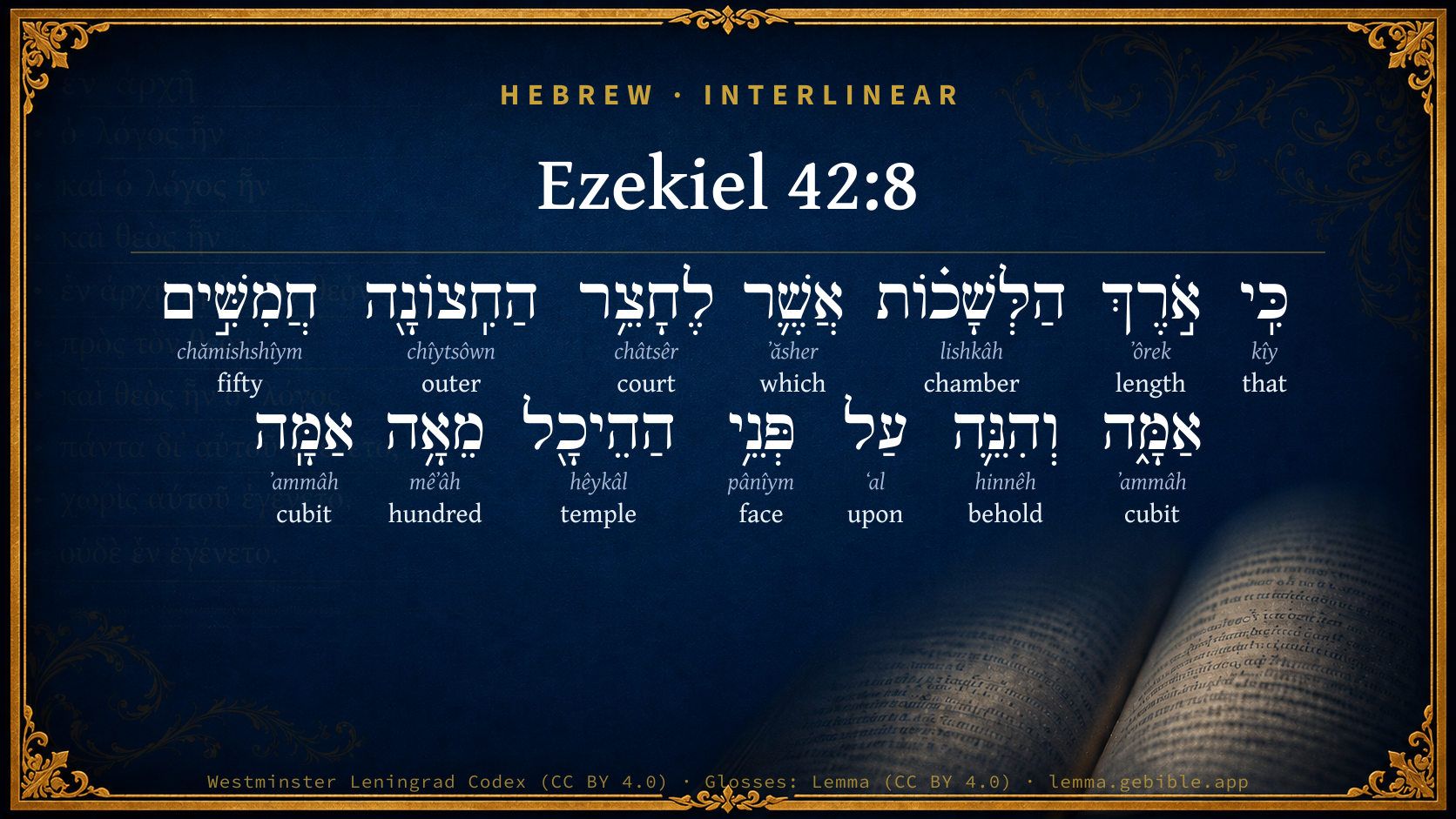
Hebrew (Westminster Leningrad Codex) Ezekiel 42:8 appears in the Hebrew Old Testament. The text above is from the Westminster Leningrad Codex. Each word links to its Strong’s number, a concise gloss, and parsing drawn from the Open Scriptures Hebrew Bible morphology. Click any word for its full Brown-Driver-Briggs (BDB) entry.
Download image
Cite this verse

Ezekiel 42:8 (World English Bible). Public Domain. Lemma interlinear Bible study tool, https://lemma.gebible.app/v/ezekiel/42/8.

Show BibTeX & RIS
BibTeX
RIS
English Translation
For the length of the chambers that were in the outer court was fifty cubits: and, behold, before the temple were one hundred cubits.
World English Bible · Public Domain
Download a study sheet

One document with this verse’s original text, its word-by-word gloss line, the meaning frame, cross-references with their text, attributed commentary, and full source and license credits — printable, and it pastes into notes with its structure intact.

This verse Autodidact and up

Study sheet (.html) Plain text (.txt)

A passage Seminary Student

Up to 50 verses in one chapter. A passage sheet keeps up to 6 commentary sources and 12 cross-references per verse, in the order this page ranks them, and says so on the sheet whenever that leaves anything out. Ask for a single verse and you get the Autodidact verse sheet above.

Everything on this page stays free to read, with no account — the sheet is a download of what is already on screen, not access to it.

Want to remove ads? Support Godless Engineer
Compare translations 3

The same verse in 3 English versions, stacked beneath the original-language interlinear above. Click any original word for its lexicon entry.

Each is an independent rendering of the whole verse — the interlinear is not word-aligned to these translations.

Highlighted words mark where these versions differ — a whole-verse word diff, not a word-by-word alignment.

  • World English Bible Public Domain
    For the length of the chambers that were in the outer court was fifty cubits: and, behold, before the temple were one hundred cubits.
  • King James Version Public Domain
    For the length of the chambers that were in the utter court was fifty cubits: and, lo, before the temple were an hundred cubits.
  • unfoldingWord Literal Text CC BY-SA 4.0
    The length of the rooms of the outer courtyard was fifty cubits, and the rooms facing the sanctuary were one hundred cubits in length.

unfoldingWord Literal Text — © unfoldingWord, licensed CC BY-SA 4.0. Word-aligned USFM3 via Door43 (git.door43.org/unfoldingWord/en_ult).

Versions to compare (up to 4)

3 of 4 selected

Show all 18 translations

Every available English version of this verse, each an independent rendering of the whole verse.

  • World English Bible Public Domain
    For the length of the chambers that were in the outer court was fifty cubits: and, behold, before the temple were one hundred cubits.
  • Berean Standard Bible Public Domain
    For the chambers on the outer court were fifty cubits long, while those facing the temple were a hundred cubits long.
  • Majority Standard Bible Public Domain
    For the chambers on the outer court were fifty cubits long, while those facing the temple were a hundred cubits long.
  • King James Version Public Domain
    For the length of the chambers that were in the utter court was fifty cubits: and, lo, before the temple were an hundred cubits.
  • American Standard Version (1901) Public Domain
    For the length of the chambers that were in the outer court was fifty cubits: and, lo, before the temple were a hundred cubits.
  • Revised Version (1885) Public Domain
    For the length of the chambers that were in the outer court was fifty cubits: and, lo, before the temple were an hundred cubits.
  • Geneva Bible (1599) Public Domain
    For the length of the chambers that were in the vtter court, was fiftie cubites: and loe, before the Temple were an hundreth cubites.
  • Douay-Rheims (1899) Public Domain
    For the length of the chambers of the outward court was fifty cubits: and the length before the face of the temple, a hundred cubits.
  • Young's Literal Translation Public Domain
    for the length of the chambers that `are' to the outer court `is' fifty cubits, and of those on the front of the temple a hundred cubits.
  • Literal Standard Version CC BY-SA 4.0
    for the length of the chambers that [are] in the outer court [is] fifty cubits, and of those on the front of the temple—one hundred cubits.
  • Unlocked Literal Bible CC BY-SA 4.0
    The length of the rooms of the outer courtyard was fifty cubits, and the rooms facing the sanctuary were one hundred cubits in length.
  • unfoldingWord Literal Text CC BY-SA 4.0
    The length of the rooms of the outer courtyard was fifty cubits, and the rooms facing the sanctuary were one hundred cubits in length.
  • Darby Bible Public Domain
    for the length of the cells that were against the outer court was fifty cubits; but behold, before the temple it was a hundred cubits.
  • World Messianic Bible Public Domain
    For the length of the rooms that were in the outer court was fifty cubits. Behold, those facing the temple were one hundred cubits.
  • Webster's Bible Public Domain
    For the length of the chambers that were in the outer court was fifty cubits: and lo, before the temple were a hundred cubits.
  • Free Bible Version CC BY-SA 4.0
    The rooms on the outer courtyard extended for fifty cubits, but those that faced the Temple were a hundred cubits long.
  • Bible in Basic English Public Domain
    For the rooms in the outer square were fifty cubits long: and in front of the Temple was a space of a hundred cubits.
  • JPS Tanakh (1917) Public Domain
    For the length of the chambers that were toward the outer court was fifty cubits; and, lo, before the temple were a hundred cubits.

Literal Standard Version (2020), Covenant Press — licensed CC BY-SA 4.0. Text via the HelloAO Bible API (eBible.org). Unlocked Literal Bible (unfoldingWord) — licensed CC BY-SA 4.0. Text via the HelloAO Bible API (eBible.org). unfoldingWord Literal Text — © unfoldingWord, licensed CC BY-SA 4.0. Word-aligned USFM3 via Door43 (git.door43.org/unfoldingWord/en_ult). Free Bible Version, Dr. Jonathan Gallagher — licensed CC BY-SA 4.0. Text via the HelloAO Bible API (eBible.org).

Word by word

More ways to search: Search by grammar → Find every occurrence → Compare this word →

Practice this passage: Drill this verse → Learn its vocabulary →

הַחִֽצוֹנָ֖ה
chîytsôwn
H2435
“the · outer”
Particle, Definite Article + Adjective, Adjective, Feminine, Singular, Absolute
Part of Speech
Particle + Adjective
Type
Adjective
Gender
Feminine
Number
Singular
State
Absolute
Full BDB Definition

Origin: from H2434

TWOT: 627b

outer, external, outward
  1. כִּֽי kîy H3588 “that” Conjunction
  2. אֹ֣רֶךְ ʼôrek H753 “length of” Noun, Common, Masculine, Singular, Construct
  3. הַלְּשָׁכ֗וֹת lishkâh H3957 “the · chambers” Particle, Definite Article + Noun, Common, Feminine, Plural, Absolute
  4. אֲשֶׁ֛ר ʼăsher H834 “which” Particle, Relative
  5. לֶחָצֵ֥ר châtsêr H2691 “to/for the · court” Preposition, Determined + Noun, Common, Both, Singular, Absolute
  6. חֲמִשִּׁ֣ים chămishshîym H2572 “fifty” Adjective, Cardinal number, Both, Plural, Absolute
  7. אַמָּ֑ה ʼammâh H520 “cubit” Noun, Common, Feminine, Singular, Absolute
  8. וְהִנֵּ֛ה hinnêh H2009 “and · behold” Conjunction + Particle, Demonstrative
  9. עַל ʻal H5921 “upon” Preposition
  10. פְּנֵ֥י pânîym H6440 “face(s) of” Noun, Common, Both, Plural, Construct
  11. הַהֵיכָ֖ל hêykâl H1964 “the · temple” Particle, Definite Article + Noun, Common, Masculine, Singular, Absolute
  12. מֵאָ֥ה mêʼâh H3967 “hundred” Adjective, Cardinal number, Both, Singular, Absolute
  13. אַמָּֽה ʼammâh H520 “cubit” Noun, Common, Feminine, Singular, Absolute

About this verse

These counts appear in no published source. They are computed here, from the morphology-tagged text and Lemma’s own curated glosses. What Lemma adds →

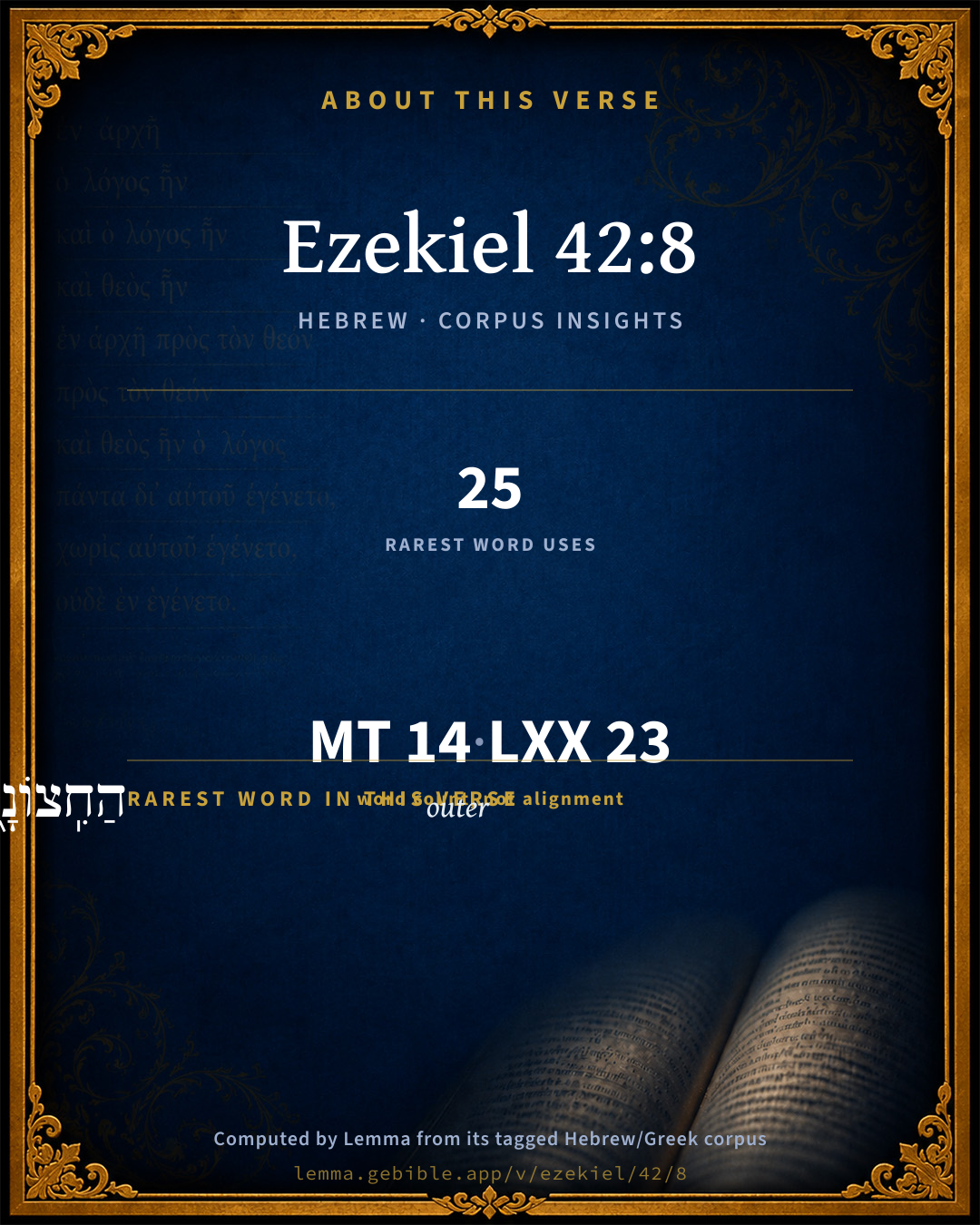
14
words
13
distinct lemmas
Prophets
section

Notable vocabulary

The rarest word here is הַחִֽצוֹנָ֖ה outer H2435 — appearing just 25 times in the whole Hebrew Bible.

Shared distinctive vocabulary

הַחִֽצוֹנָ֖ה outer H2435 occurs in 24 verses of the Hebrew Bible. Also found in:

Grammatical profile

  • 7 nouns
  • 3 adjectives
  • 1 preposition
  • 1 conjunction
  • 2 particles

Repetition

A word recurs within this verse — often emphatic in Hebrew:

  • אַמָּ֑ה cubit H520 ×2

Hebrew & Septuagint length

In English translation the verse runs 24 words from the Hebrew and 29 from the Septuagint (LXX English) — closely comparable.

A rough comparison of the two English renderings, which tokenize alike — not a word-level alignment.

Word counts can differ between the Hebrew and the Greek without any difference in meaning — e.g. the Hebrew direct-object marker אֵת has no separate Greek word, and Greek often adds the article ὁ.

In the original languages it is 14 Hebrew tokens and 23 Greek tokens — but the two are counted differently (Hebrew bundles its prefixes and suffixes into one token; the Greek is in lemma form), so that isn’t a like-for-like length.

Cross-references

1

Topical passages linked to Ezekiel 42:8 in the Treasury of Scripture Knowledge — connected by theme and wording, ordered by reader-vote popularity; previews shown in the World English Bible.

  • Ezekiel 41:13–14 So he measured the house, one hundred cubits long; and the separate place, and the building, with the walls of it, one hundred cubits long;

Cross-references courtesy of OpenBible.info (CC BY 4.0).

Hebrew and Greek witnesses Masoretic Hebrew ↔ Greek Septuagint

The same verse in the two great witnesses to the Old Testament, shown verse-for-verse.

These are two independent witnesses, not word-aligned to each other, and the Septuagint is shown in lemma (dictionary) form.

Hebrew Ezekiel 42:8 Masoretic · Westminster Leningrad Codex

כִּֽי אֹ֣רֶךְ הַלְּשָׁכ֗וֹת אֲשֶׁ֛ר לֶחָצֵ֥ר הַחִֽצוֹנָ֖ה חֲמִשִּׁ֣ים אַמָּ֑ה וְהִנֵּ֛ה עַל פְּנֵ֥י הַהֵיכָ֖ל מֵאָ֥ה אַמָּֽה

For the length of the chambers that were in the outer court was fifty cubits: and, behold, before the temple were one hundred cubits.

World English Bible · Public Domain

Greek LXX Ezekiel 42:8 Septuagint · lemma form

ὅτι ὁ μῆκος ὁ ἐξέδρα ὁ βλέπω εἰς ὁ αὐλή ὁ ἐξώτερος πηχύς πεντήκοντα καί οὗτος εἰμί ἀντιπροσώπος οὗτος ὁ πᾶς πηχύς ἑκατόν

For the length of the chambers looking toward the inner court was fifty cubits, and these are the ones that front the others; the whole was one hundred cubits.

LXX2012 (modern English Septuagint) · Public Domain

On this verse, The Cambridge Bible for Schools and Colleges discusses the Septuagint’s reading. Read the note in Commentary ↓

Hebrew: Westminster Leningrad Codex (CC BY 4.0). Greek: Septuagint (public domain); English from LXX2012 (modern English Septuagint) (Public Domain). How the Septuagint differs from the Hebrew →

Targum (Aramaic paraphrase)

1

The Targum is the ancient Jewish Aramaic paraphrase of the Hebrew Scriptures — an interpretive translation, not the Hebrew text itself. Onkelos (literal) and Pseudo-Jonathan (expansive) render the Torah, and Jonathan the Prophets. Coverage is partial: where no permissively-licensed English translation exists for a verse, only the Aramaic is shown. This is verse-level text, not a word-by-word alignment to the Hebrew.

  1. Targum Jonathan Prophets (Joshua–Malachi)
    אֲרֵי אוּרְכָּא דְלִשְׁכָּתָא דִלְדַרְתָּא בָרַיְתָא חַמְשִׁין אַמִין וְהַוְיָן עַל אַפֵּי הֵיכְלָא מְאָה אַמִין:

    (no public-domain English translation for this verse)

    Targum Jonathan — Aramaic: “Mikraot Gedolot” (public domain). English: “Sefaria Community Translation” (CC0 1.0 (public-domain dedication)); “London "Chaldee Paraphrase," 1871” (public domain). Text via Sefaria.

Commentary

Notes on Ezekiel 42:8 from classic Christian and Jewish commentators (each source and its license shown beneath its notes). The classic Christian expositions comment on the surrounding passage and are grouped to its opening verse, so a note may address several verses; the Jewish commentaries on the Tanakh (Rashi and others) are per-verse, so they appear only where the commentator wrote on this verse.

Lemma curates 59 commentaries, every one of them public domain or Creative Commons licensed, each selected and text-cleaned for this edition rather than reprinted as found. About our sources →

Trapp's Complete Commentary

John Trapp

Eze 42:8 For the length of the chambers that [were] in the utter court [was] fifty cubits: and, lo, before the temple [were] an hundred cubits.

Ver. 8. Here the Rabbis call again for the help of their Elias. See on Eze 40:6.

John Trapp, A Commentary or Exposition upon All the Books of the Old and New Testament (1647–1656) — public domain. Text from a community e-Sword module.

Joseph Benson's Commentary

Eze 42:8-12. For the length of the chambers, &c. — The chambers that were built over the cloisters were in length fifty cubits. And lo, before the temple were a hundred cubits — In passing from the north to the south side of the temple, Eze 42:11-12, over the space of ground that fronted the east side of it, the prophet was shown that it measured a hundred cubits, Eze 41:14. And from under these chambers was the entry, &c. — The entry into these south chambers was by a pair of stairs at the east corner of the outer court: see Eze 46:19. The chambers were in the thickness — Or rather, in the breadth of the wall — That is, of the ground which that wall enclosed. Over against, or before, the separate place, and before the building — These expressions denote that these south chambers had the same situation with respect to the temple, as the north chambers had, spoken of Eze 42:1. And the way before them, &c. — Such a way led to these chambers, as did to the chambers on the north side. As long as they, and as broad as they — The proportions of both were the same; and the windows, doors, and passages belonging to these, were exactly uniform with those on the north side. The sense of the twelfth verse would be plainer, if the words were thus translated, And such were the doors of the chambers toward the south; namely, as those toward the north. There was a door in the head of the way, &c. — Namely, like that described Eze 42:9.

Joseph Benson's Commentary on the Old and New Testaments (1811–1818) — public domain. Text from a community e-Sword module.

Ellicott's Commentary for English Readers

(8) The length of the chambers.—We should say the breadth, since a longer measurement the other way immediately follows; but the word is used in connection with, and as a reason for, the length of the wall mentioned in Eze_42:7, as if it were said, “The wall was fifty cubits long, because this side of the building was fifty cubits long.” To prevent any possible misunderstanding it is immediately added, “Before (literally, upon the face of) the Temple an hundred cubits;” i.e., the length east and west was 100 cubits.

A Bible Commentary for English Readers, edited by Charles John Ellicott (1878–1897) — public domain. Text from a community e-Sword module.

The Cambridge Bible for Schools and Colleges

gen. ed. J. J. S. Perowne

8. The shorter wing of chambers lying toward the outer court was 50 cubits long. Fig. 3, uv.

and lo, … the temple] The exclamation and lo! is rather unnatural, a slight change of punctuation gives, but those. The expression “before the temple” is difficult. Usually “temple” means merely the holy place. The phrase “before” the temple makes no difficulty, “before” means merely “facing,” and does not imply the “front” of the temple in the technical sense. The LXX. (so Ew. Corn.) reads differently: and these (the shorter wing, Fig. 3, G´) faced the others (the longer, Fig. 3, G), together 100 cubits—“together” referring to the shorter wing and wall (Fig. 3, uv + vw).

The Cambridge Bible for Schools and Colleges (gen. ed. J. J. S. Perowne; Cambridge University Press, 1878–1918) — public domain. Text from a community e-Sword module.

John Gill's Exposition

For the length of the chambers that were in the utter court was fifty cubits,.... Which was the reason why the wall was of the same length, that it might be answerable to them; here length is put for breadth; see Eze 42:2, this measure was from the north to south, as Lipman (x) observes:

and lo, before the temple were an hundred cubits; as the breadth of the wall and chambers was fifty, so in length, as they were over against the temple, they were an hundred cubits, as in Eze 42:2, unless the account is to be taken thus; that the row of chambers towards the north were fifty cubits long, and the row towards the south over against the other was fifty cubits, and so both made a hundred; to which sense is the Septuagint version,

"for the length of the chambers that look to the outward court was fifty cubits, and those (that is, those that looked to the temple, or were before that) answered to them, the whole a hundred cubits;''

that is, both rows made a hundred cubits; but rather, as Lipman (y) says, the chambers contained from east to west a hundred cubits.

(x) Tzurath Beth Hamikdash, sect. 71. (y) Ibid.

John Gill's Exposition of the Whole Bible (1746–1763) — public domain (CC PDM 1.0). Text via the HelloAO Bible API.

Albert Barnes' Notes on the Bible

The length - From north to south.

Before the temple - This describes their position in a general way; more precisely they lay over against partly the “separate place” and partly the “temple-court” Eze 42:1.

Albert Barnes' Notes on the Bible (1834–1885) — public domain. Text from a community e-Sword/MySword module.

Matthew Poole's English Annotations

This verse gives us a reason why the wall over against the chambers was but fifty cubits, it might not be more or less because it was to hold exact symmetry with these buildings, which it confronted: possibly this verse may give some light to the second verse, latter part.

The utter court: see Eze 42:1,7.

And, lo, before the temple were an hundred cubits: some say the angel, conducting the prophet from these north chambers to the south, hath occasion given him to take notice of, and to measure a second time, this space before the temple; but what if the angel and the prophet were now on the roof of this fifty cubits’ building, as they seem to be Eze 42:5, measuring it, and thence the angel might point to the hundred cubits’ space before the temple, and bid the prophet to mind it? The former, most received, suits best with the 11th and 12th verses.

Matthew Poole's English Annotations on the Holy Bible (1683–1685) — public domain. Text from a community e-Sword/MySword module.

The Pulpit Commentary

According to the statement contained in this verse, the chambers that were in the outer court, i.e. the chambers whose windows looked into the outer court, projected fifty cubits into the outer court; i.e. this was their breadth or depth from north to south; whereas those before the temple were a hundred cubits; i.e. the chambers whose windows fronted the temple, were a hundred cubits from east to west.

The Pulpit Commentary (1880–1919), ed. H.D.M. Spence-Jones & Joseph S. Exell — public domain. Text from a community e-Sword module.

Rashi

Rabbi Shlomo Yitzchaki (Rashi)

For the length of the chambers from north to south, was fifty cubits.

and behold, before the Temple from east to west, paralleling the Hall and the Temple and House of the Ark Cover, [i.e., the Holy of Holies] and the cells, were one hundred cubits.

Rashi on the Tanakh — English translations: “The Judaica Press complete Tanach with Rashi, translated by A. J. Rosenberg” (CC BY 4.0); “Pentateuch with Rashi's commentary by M. Rosenbaum and A.M. Silbermann, 1929-1934” (public domain); “The Metsudah Tanach series, Lakewood, N.J” (CC BY 4.0); and “The Book of Joshua, Metsudah Publications, 1997” (CC BY 4.0). Text via Sefaria.

Lesson kit

Teaching starters — assembled from the data on this page, not authored interpretation. Every prompt links to the verse data it draws on. Edit before teaching.

Ezekiel, in the Prophets, opens this verse with 14 words (13 distinct Hebrew lemmas). Its most distinctive word is chîytsôwn (“outer”). A historical commentator’s framing appears above. Read the whole chapter for the surrounding context.

Discussion questions

  1. What does “outer” (chîytsôwn) contribute to the verse as a whole?
  2. How does 1 Kings 6:29, which shares the word «outer», read alongside this verse?
  3. What does the repetition of “cubit” (2× in this one verse) do in this verse?
  4. These translations render this verse differently. What is at stake in choosing one wording over another?
  5. Compare how Trapp's Complete Commentary and Joseph Benson's Commentary read this verse. Where do they agree or differ?

Things to notice

Reading settings

Reading text

Shown beneath each verse's original-language words.

Old Testament
Old Testament edition

Read the OT as the Masoretic Hebrew (MT) or the Greek Septuagint (LXX).

English shown for the Greek Septuagint (in the Hebrew ↔ Greek comparison).

Comparing translations? Open the Compare panel on any verse page to stack up to four side by side.