2 Chronicles 3:15

Hebrew (Westminster Leningrad Codex) 2 Chronicles 3:15 appears in the Hebrew Old Testament. The text above is from the Westminster Leningrad Codex. Each word links to its Strong’s number, a concise gloss, and parsing drawn from the Open Scriptures Hebrew Bible morphology. Click any word for its full Brown-Driver-Briggs (BDB) entry.
Download image
Cite this verse

2 Chronicles 3:15 (World English Bible). Public Domain. Lemma interlinear Bible study tool, https://lemma.gebible.app/v/2-chronicles/3/15.

Show BibTeX & RIS
BibTeX
RIS
English Translation
Also he made before the house two pillars of thirty-five cubits high, and the capital that was on the top of each of them was five cubits.
World English Bible · Public Domain
Highlights
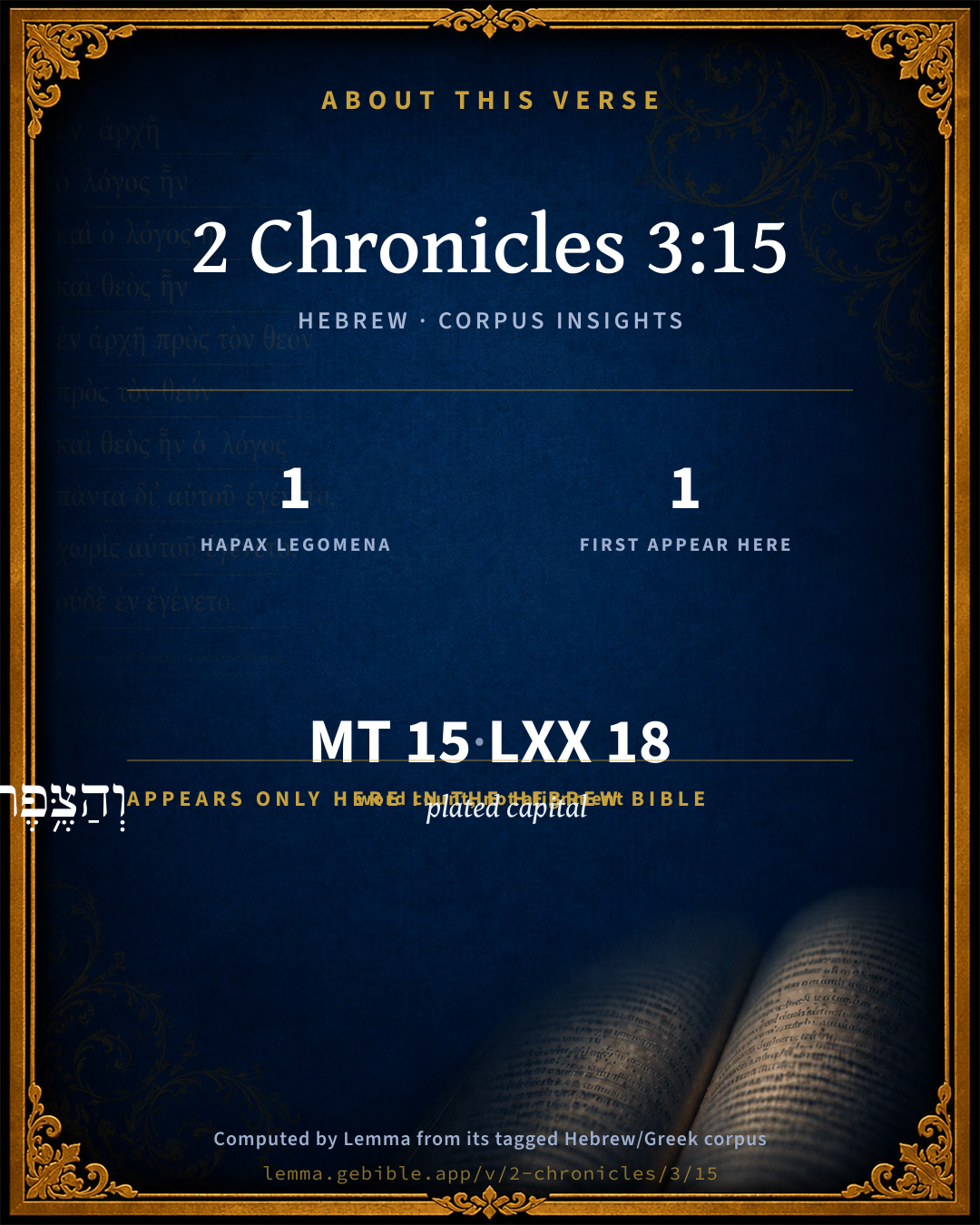
  • 1 hapax legomenon — only here in the Hebrew Bible
  • 1 first appearance in the Hebrew Bible
Full analysis ↓
Download a study sheet

One document with this verse’s original text, its word-by-word gloss line, the meaning frame, cross-references with their text, attributed commentary, and full source and license credits — printable, and it pastes into notes with its structure intact.

This verse Autodidact and up

Study sheet (.html) Plain text (.txt)

A passage Seminary Student

Up to 50 verses in one chapter. A passage sheet keeps up to 6 commentary sources and 12 cross-references per verse, in the order this page ranks them, and says so on the sheet whenever that leaves anything out. Ask for a single verse and you get the Autodidact verse sheet above.

Everything on this page stays free to read, with no account — the sheet is a download of what is already on screen, not access to it.

Want to remove ads? Support Godless Engineer
Compare translations 3

The same verse in 3 English versions, stacked beneath the original-language interlinear above. Click any original word for its lexicon entry.

Each is an independent rendering of the whole verse — the interlinear is not word-aligned to these translations.

Highlighted words mark where these versions differ — a whole-verse word diff, not a word-by-word alignment.

  • World English Bible Public Domain
    Also he made before the house two pillars of thirty-five cubits high, and the capital that was on the top of each of them was five cubits.
  • King James Version Public Domain
    Also he made before the house two pillars of thirty and five cubits high, and the chapiter that was on the top of each of them was five cubits.
  • unfoldingWord Literal Text CC BY-SA 4.0
    And he made before the house two pillars, 35 cubits in length; and the capital which was on its head, five cubits.

unfoldingWord Literal Text — © unfoldingWord, licensed CC BY-SA 4.0. Word-aligned USFM3 via Door43 (git.door43.org/unfoldingWord/en_ult).

Versions to compare (up to 4)

3 of 4 selected

Show all 18 translations

Every available English version of this verse, each an independent rendering of the whole verse.

  • World English Bible Public Domain
    Also he made before the house two pillars of thirty-five cubits high, and the capital that was on the top of each of them was five cubits.
  • Berean Standard Bible Public Domain
    In front of the temple he made two pillars, which together were thirty-five cubits high, each with a capital on top measuring five cubits.
  • Majority Standard Bible Public Domain
    In front of the temple he made two pillars, which together were thirty-five cubits high, each with a capital on top measuring five cubits.
  • King James Version Public Domain
    Also he made before the house two pillars of thirty and five cubits high, and the chapiter that was on the top of each of them was five cubits.
  • American Standard Version (1901) Public Domain
    Also he made before the house two pillars of thirty and five cubits high, and the capital that was on the top of each of them was five cubits.
  • Revised Version (1885) Public Domain
    Also he made before the house two pillars, of thirty and five cubits high, and the chapiter that was on the top of each of them was five cubits.
  • Geneva Bible (1599) Public Domain
    And he made before the house two pillars of fiue and thirtie cubites hie: and the chapiter that was vpon the top of eche of them, was fiue cubites.
  • Douay-Rheims (1899) Public Domain
    He made also before the doors of the temple two pillars, which were five and thirty cubits high: and their chapiters were five cubits.
  • Young's Literal Translation Public Domain
    And he maketh at the front of the house two pillars, thirty and five cubits in length, and the ornament that `is' on their heads five cubits.
  • Literal Standard Version CC BY-SA 4.0
    And he makes two pillars at the front of the house, thirty-five cubits in length, and the ornament that [is] on their heads [is] five cubits.
  • Unlocked Literal Bible CC BY-SA 4.0
    Solomon also made two pillars, each thirty-five cubits high, for in front of the house; the capitals that were on the top of them were five cubits high.
  • unfoldingWord Literal Text CC BY-SA 4.0
    And he made before the house two pillars, 35 cubits in length; and the capital which was on its head, five cubits.
  • Darby Bible Public Domain
    And before the house he made two pillars thirty-five cubits long; and the capital that was on the top of each of them was five cubits.
  • World Messianic Bible Public Domain
    Also he made before the house two pillars thirty-five cubits high, and the capital that was on the top of each of them was five cubits.
  • Webster's Bible Public Domain
    Also he made before the house two pillars of thirty and five cubits high, and the capital that was on the top of each of them was five cubits.
  • Free Bible Version CC BY-SA 4.0
    He made two columns for the front of the Temple, thirty-five cubits high, each having a capital five cubits high.
  • Bible in Basic English Public Domain
    And in front of the house he made two pillars, thirty-five cubits high, with crowns on the tops of them, five cubits high.
  • JPS Tanakh (1917) Public Domain
    Also he made before the house two pillars of thirty and five cubits high, and the capital that was on the top of each of them was five cubits.

Literal Standard Version (2020), Covenant Press — licensed CC BY-SA 4.0. Text via the HelloAO Bible API (eBible.org). Unlocked Literal Bible (unfoldingWord) — licensed CC BY-SA 4.0. Text via the HelloAO Bible API (eBible.org). unfoldingWord Literal Text — © unfoldingWord, licensed CC BY-SA 4.0. Word-aligned USFM3 via Door43 (git.door43.org/unfoldingWord/en_ult). Free Bible Version, Dr. Jonathan Gallagher — licensed CC BY-SA 4.0. Text via the HelloAO Bible API (eBible.org).

Word by word

More ways to search: Search by grammar → Find every occurrence → Compare this word →

Practice this passage: Drill this verse → Learn its vocabulary →

וְהַצֶּ֥פֶת
tsepheth
H6858
“and · the · plated capital”
Conjunction + Particle, Definite Article + Noun, Common, Masculine, Singular, Absolute
Part of Speech
Conjunction + Particle + Noun
Type
Common
Gender
Masculine
Number
Singular
State
Absolute
Full BDB Definition

Origin: from an unused root meaning to encircle

TWOT: 1951c

plated capital (of pillar)
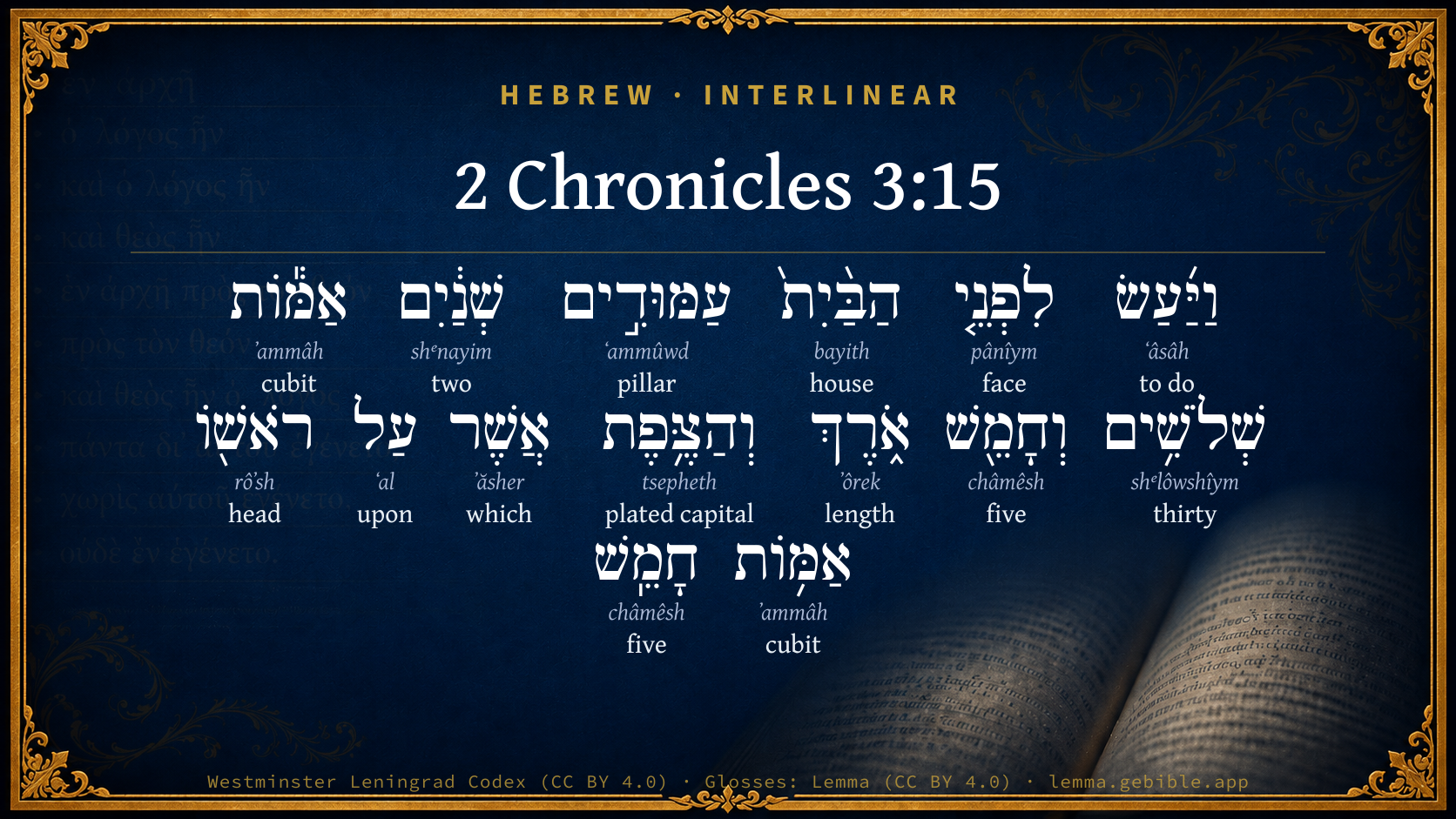
  1. וַיַּ֜עַשׂ ʻâsâh H6213 “and · to do” Conjunction + Verb, Qal, Sequential Imperfect, 3rd Person, Masculine, Singular
  2. לִפְנֵ֤י pânîym H6440 “to/for · face(s) of” Preposition + Noun, Common, Both, Plural, Construct
  3. הַבַּ֨יִת֙ bayith H1004 “the · house” Particle, Definite Article + Noun, Common, Masculine, Singular, Absolute
  4. עַמּוּדִ֣ים ʻammûwd H5982 “pillars” Noun, Common, Masculine, Plural, Absolute
  5. שְׁנַ֔יִם shᵉnayim H8147 “two” Adjective, Cardinal number, Masculine, Dual, Absolute
  6. אַמּ֕וֹת ʼammâh H520 “cubits” Noun, Common, Feminine, Plural, Absolute
  7. שְׁלֹשִׁ֥ים shᵉlôwshîym H7970 “thirty” Adjective, Cardinal number, Both, Plural, Absolute
  8. וְחָמֵ֖שׁ châmêsh H2568 “and · five” Conjunction + Adjective, Cardinal number, Feminine, Singular, Absolute
  9. אֹ֑רֶךְ ʼôrek H753 “length” Noun, Common, Masculine, Singular, Absolute
  10. אֲשֶׁר ʼăsher H834 “which” Particle, Relative
  11. עַל ʻal H5921 “upon” Preposition
  12. רֹאשׁ֖וֹ rôʼsh H7218 “head · his” Noun, Common, Masculine, Singular, Construct + Suffix, Personal, 3rd Person, Masculine, Singular
  13. אַמּ֥וֹת ʼammâh H520 “cubits” Noun, Common, Feminine, Plural, Absolute
  14. חָמֵֽשׁ châmêsh H2568 “five” Adjective, Cardinal number, Feminine, Singular, Absolute

About this verse

These counts appear in no published source. They are computed here, from the morphology-tagged text and Lemma’s own curated glosses. What Lemma adds →

15
words
13
distinct lemmas
Historical
section

Notable vocabulary

1 hapax legomenon — a word that appears only here in the entire Hebrew Bible:

  • וְהַצֶּ֥פֶת plated capital H6858

First appearance in Scripture

This word makes its first canonical appearance in the Hebrew Bible here:

  • וְהַצֶּ֥פֶת plated capital H6858

Grammatical profile

  • 1 verb
  • 8 nouns
  • 4 adjectives
  • 1 preposition
  • 1 particle

Verb forms

  • וַיַּ֜עַשׂ Qal · Sequential Imperfect

Repetition

Words recur within this verse — often emphatic in Hebrew:

  • אַמּ֕וֹת cubit H520 ×2
  • וְחָמֵ֖שׁ five H2568 ×2

Hebrew & Septuagint length

In English translation the verse runs 27 words from the Hebrew and 20 from the Septuagint (LXX English) — closely comparable.

A rough comparison of the two English renderings, which tokenize alike — not a word-level alignment.

Word counts can differ between the Hebrew and the Greek without any difference in meaning — e.g. the Hebrew direct-object marker אֵת has no separate Greek word, and Greek often adds the article ὁ.

In the original languages it is 15 Hebrew tokens and 18 Greek tokens — but the two are counted differently (Hebrew bundles its prefixes and suffixes into one token; the Greek is in lemma form), so that isn’t a like-for-like length.

Cross-references

2

Topical passages linked to 2 Chronicles 3:15 in the Treasury of Scripture Knowledge — connected by theme and wording, ordered by reader-vote popularity; previews shown in the World English Bible.

  • 1 Kings 7:15–24 For he fashioned the two pillars of brass, eighteen cubits high apiece: and a line of twelve cubits compassed either of them about.
  • Jeremiah 52:20–23 The two pillars, the one sea, and the twelve brazen bulls that were under the bases, which king Solomon had made for the house of Yahweh. The brass of all these vessels was without weight.

Cross-references courtesy of OpenBible.info (CC BY 4.0).

Hebrew and Greek witnesses Masoretic Hebrew ↔ Greek Septuagint

The same verse in the two great witnesses to the Old Testament, shown verse-for-verse.

These are two independent witnesses, not word-aligned to each other, and the Septuagint is shown in lemma (dictionary) form.

Hebrew 2 Chronicles 3:15 Masoretic · Westminster Leningrad Codex

וַיַּ֜עַשׂ לִפְנֵ֤י הַבַּ֨יִת֙ עַמּוּדִ֣ים שְׁנַ֔יִם אַמּ֕וֹת שְׁלֹשִׁ֥ים וְחָמֵ֖שׁ אֹ֑רֶךְ וְהַצֶּ֥פֶת אֲשֶׁר עַל רֹאשׁ֖וֹ אַמּ֥וֹת חָמֵֽשׁ

Also he made before the house two pillars of thirty-five cubits high, and the capital that was on the top of each of them was five cubits.

World English Bible · Public Domain

Greek LXX 2 Chronicles 3:15 Septuagint · lemma form

καί ποιέω ἔμπροσθεν ὁ οἶκος στῦλος δύο πῆχυς τριάκοντα πέντε ὁ ὕψος καί ὁ κεφαλή αὐτός πῆχυς πέντε

Also he made in front of the house two pillars, in height thirty-five cubits, and their chapters of five cubits.

LXX2012 (modern English Septuagint) · Public Domain

On this verse, Ellicott's Commentary for English Readers discusses the Septuagint’s reading. Read the note in Commentary ↓

Hebrew: Westminster Leningrad Codex (CC BY 4.0). Greek: Septuagint (public domain); English from LXX2012 (modern English Septuagint) (Public Domain). How the Septuagint differs from the Hebrew →

Commentary

Notes on 2 Chronicles 3:15 from classic Christian and Jewish commentators (each source and its license shown beneath its notes). The classic Christian expositions comment on the surrounding passage and are grouped to its opening verse, so a note may address several verses; the Jewish commentaries on the Tanakh (Rashi and others) are per-verse, so they appear only where the commentator wrote on this verse.

Lemma curates 59 commentaries, every one of them public domain or Creative Commons licensed, each selected and text-cleaned for this edition rather than reprinted as found. About our sources →

Ellicott's Commentary for English Readers

(d) THE TWO BRONZE PILLARS IN THE PORCH

(2Ch_3:15-17). Comp. 1Ki_7:15-22.

(15) Before the house.—Before the holy place, in the porch.

Two pillars of thirty and five cubits high.—Two pillars thirty and five cubits in length. 1Ki_7:15 says “eighteen cubits,” so also 2Ki_25:17; Jer_52:21; and no doubt correctly. Of the versions, the LXX. and Vulg. have “thirty-five;” the Syriac and Arabic, “eighteen.”

The chapiter—i.e., the capital. French, chapitre. Literally, the ornament. 1Ki_7:16 has “the crown; “so 2Ch_4:12.

A Bible Commentary for English Readers, edited by Charles John Ellicott (1878–1897) — public domain. Text from a community e-Sword module.

The Cambridge Bible for Schools and Colleges

gen. ed. J. J. S. Perowne

15–17 (= 1Ki_7:15-22). The Pillars Jachin and Boaz

15. before the house two pillars] Cp. 1Ki_7:21, he set up the pillars at the porch of the temple, and Jer_52:17 (translate, the pillars … that belonged to the house). These pillars were immediately in front of the porch, but (it seems) detached from it. They were cast in brass (2Ch_4:11-17), were hollow (Jer_52:21), and were crowned with “chapiters” (capitals) in shape like bowls (1Ki_7:41). The dimensions of the pillars (without the chapiters) are variously given thus:—

2Ch_3:15

(Heb.)

length

35 cubits.

2Ch_3:15

(LXX.)

height (ὕψος)

35 cubits.

Jer_52:21

(Heb.)

height (ὕψος)

18 cubits.

Jer_52:21

(LXX.)

height (ὕψος)

35 cubits.

1Ki_7:15

(Heb. and LXX.)

height (ὕψος)

18 cubits.

Jer_52:21

(Heb. and LXX.)

circumference

12 cubits.

1Ki_7:15

(Heb.)

circumference

12 cubits.

1Ki_7:15

(LXX.)

circumference

14 cubits.

The purpose for which the pillars were erected is not certainly known. The fact that names were given them (2Ch_3:17) suggests that they were symbols, perhaps of the presence of Jehovah; cp. Isa_19:19, where a pillar, maçççbâh, is regarded (equally with an altar) as “a sign and witness unto the Lord.” Such a pillar might sometimes be used as an altar; cp. 1Ch_11:22 (note) and Gen_28:18; and the “bowls” of the chapiters of Solomon’s two pillars may have been meant to contain something to be burnt in sacrifice. See Robertson Smith, Religion of the Semites, p. 191, note 1, and Additional Note L, where there is an illustration of a coin shewing two detached pillars standing in front of the temple of Aphrodite at Paphos. The two pillars in the temple of Heracles at Tyre, of which Herodotus (2:44) speaks, were perhaps simply votive offerings.

The Cambridge Bible for Schools and Colleges (gen. ed. J. J. S. Perowne; Cambridge University Press, 1878–1918) — public domain. Text from a community e-Sword module.

Trapp's Complete Commentary

John Trapp

2Ch 3:15 Also he made before the house two pillars of thirty and five cubits high, and the chapiter that [was] on the top of each of them [was] five cubits.

Ver. 15. Also he made before the house two pillars.] These were cast by Hiram, as great ordnance are now-a-days, round and hollow. See on 1Ki 7:15.

John Trapp, A Commentary or Exposition upon All the Books of the Old and New Testament (1647–1656) — public domain. Text from a community e-Sword module.

Joseph Benson's Commentary

2Ch 3:15-16. He also made before the house — That is, before the holy house, or temple, as it is explained 2Ch 3:17; two pillars of thirty and five cubits high — Namely, both taken together, being each near eighteen cubits, 1Ki 7:15. He made chains as in the oracle — Like unto those which he made in the oracle, of which see 1Ki 6:21. And made a hundred pomegranates — In each row, or two hundred in all, as it is said 1Ki 7:20. These pillars, according to the signification of their names, Jachin and Boaz, mean establishment and strength. See the margin.

Joseph Benson's Commentary on the Old and New Testaments (1811–1818) — public domain. Text from a community e-Sword module.

Tyndale Open Study Notes

Tyndale Open Resources

3:15-16 The two pillars set in the porch of the Temple were made of bronze and were ornately decorated (cp. 1 Kgs 7:15-22).

Tyndale Open Study Notes — © Tyndale Open Resources, licensed CC BY-SA 4.0. Text via the HelloAO Bible API.

Geneva Bible (1599)

Geneva Bible translators

Every one was eighteen cubits long, but the half cubit could not be seen, for it was hid in the roundness of the chapiter, and therefore he giveth to every one but 17 and an half.

Geneva Bible (1599) marginal notes — public domain. Text via Bolls.life.

Albert Barnes' Notes on the Bible

Of thirty and five cubits - See 1Ki 7:15 note. Some suppose that there has been a corruption of the number in the present passage.

Albert Barnes' Notes on the Bible (1834–1885) — public domain. Text from a community e-Sword/MySword module.

Haydock's Catholic Bible Commentary

Five. 3 Kings vii. 15., we read each was eighteen cubits. It is probable that each was 17½ and the other half was for the crown, (Calmet) or cornice. (Haydock)

George Leo Haydock (1774–1849), Haydock's Catholic Family Bible and Commentary, 1859 edition — public domain. Excludes Psalms (Douay-Rheims chapter numbering differs from Protestant) and Deuterocanonical books (Catholic canon only).

Matthew Poole's English Annotations

Before the house, i.e. before the holy house, or before the temple as this is explained, 1Ch 3:17, lest it should be understood of the most holy house, of which he had spoken before.

Thirty and five cubits high, to wit, both of them; of which See Poole "1Ki 7:15".

Matthew Poole's English Annotations on the Holy Bible (1683–1685) — public domain. Text from a community e-Sword/MySword module.

The Pulpit Commentary

Thirty and five cubits. The height of these pillars is attested in three places to have been 18 cubits (1Ki_7:15; 2Ki_25:17; Jer_52:21) Some therefore think that the height given in our text describes rather the distance of the one pillar from the other, which would be just 35 cubits, if they stood at the extreme points of the line of the porch front; since the wings on each side (5 cubits for the lowest chamber, and 2.5 cubits for the thickness of the walls) would make up this amount. It isfurther noticed with this explanation that their height (18 cubits) with the chapiters (5 cubits) added, would bring them to the same height as the porch, and that their ornamentation agrees with that of the porch. (1Ki_7:19) All this may be the ease. Yet considering other indications of uncertainty about our text, and the fact that the characters yod kheth (18) are easily superseded by lamed he (35), it is perhaps likelier that we have here simply a clerical error. The parallel place tells us that these pillars and the chapiters were cast of brass; that "a line (1Ki_7:15; Jer 52) of twelve cubits not seven did compass either of them about;" that the ornamentation of each chapiter was "a net of checker-work, and a wreath of chain-work;" that upon the five cubits of chapiter there was another "four cubits of lily-work," etc. If this last feature apply to the two pillars, and not (as some think) to the porch only, the pillars would reach a height of 27 cubits, and if it be supposed that they stood on some stone or other superstructure, it may still be that our "thirty-five cubits" has its meaning. Meantime the passage in Jeremiah (Jer 52) tells us that the pillars were hollow, and that the thickness of the metal was "four fingers.

Vers. 15-17.

Our strength and beauty.

The dimensions of these pillars are still unsettled and uncertain. But there can be no question as to their main characteristics, and very little doubt as to their spiritual significance. Their obvious size and their names speak of strength; the decorations which they bore speak of beauty. Standing where they stood, in or at the porch of the house of the Lord, they were standing monuments of the two closely related truths

I THAT WE SHOULD RECOGNIZE IN GOD HIMSELF STRENGTH AND BEAUTY.

1. Strength. Our temptation is to trust in the strong barrier of sea or mountain range; in the powerful army and navy with all their equipments; in the vigorous and sagacious policy of our statesmanship; in the amplitude of pecuniary resources, etc. But the strength of a country, as also of a man, is in God. If his favour is turned away, all our material advantages will fail us. Rabshakeh"s multitudes of armed Assyrians disappear at the stroke of the God of Israel; the rich man, with his full barns and his cherished plans, leaves his wealth behind him when God says, "Thy soul is required of thee." But to the faithful Hezekiah the favour of Jehovah proves an ample shield against the threatening enemy. And they are blessed who "walk in the light of God"s countenance;" for he is "the glory of their strength: and in his favour shall their horn be exalted". (Psa_89:15, Psa_89:17) The wise nation and the wise man will not look complacently around them to find the secret and source of their strength; they will look up toward him that dwelleth in the heavens, and say, "Jachin; Boaz;" "he will establish;" "in him is strength.

2. Beauty. We are inclined to boast of the beauty of the landscape; or of the persons of our sons and daughters; or of our palaces and castles and cathedrals; or of our "pleasant pictures," and fair gems and jewels. But our delight should be, first and most, in him whose Divine character is perfect; who unites in himself, with completest symmetry, all possible attributes; who is as merciful as he is pure; who is as pitiful as he is righteous; who is as gentle as he is strong; whom we can not only adore and honour, but delight in and love. We go to the house of the Lord that we may behold "the beauty of the Lord"; (Psa_27:4) and especially that we may dwell upon the beauties and the glories of the character of that Son of man who was "holy, harmless, undefiled," in whose mouth no guile was found, but in whose life every grace that can adorn humanity was seen by those that knew him.

II THAT WE SHOULD SEEK FROM GOD OUR STRENGTH AND BEAUTY. The Israelites went up to the house of the Lord that by obedient sacrifice, by reverent worship, by believing prayer, they might secure the favour of the Most High. If we would gain from God the strength we need, and that spiritual excellency which is the true beauty of the nation and the individual, we must go to God to seek it. We must present ourselves before him from whom all strength and glory come. We must seek him

(1) in confession, and in Christ who is our Propitiation;

(2) in reverent worship;

(3) in earnest and believing prayer for his upholding power and for his shaping hand.

Then will he make us strong to overcome and to accomplish; beautiful to attract and to win. C.

The Pulpit Commentary (1880–1919), ed. H.D.M. Spence-Jones & Joseph S. Exell — public domain. Text from a community e-Sword module.

Keil & Delitzsch

C. F. Keil & F. Delitzsch

The two brazen pillars before the house, i.e., before the porch, whose form is more accurately described in Kg1 7:15-22. The height of it is here given at thirty-five cubits, while, according to Kg1 7:15; Kg2 25:17; Jer 52:21, it was only eighteen cubits. The number thirty-five has arisen by confounding יח = 18 with לה = 35; see on Kg1 7:16. הצּפת (ἁπ. λεγ.) from צפה, overlay, cover, is the hood of the pillar, i.e., the capital, called in Kg1 7:16. כּתרת, crown, capital, five cubits high, as in Kg1 7:16.

Ch2 3:16

"And he made little chains on the collar (Halsreife), and put it on the top of the pillars, and made 100 pomegranates, and put them on the chains." In the first clause of this verse, בּדּביר, "in (on) the most holy place," has no meaning, for the most holy place is not here being discussed, but the pillars before the porch, or rather an ornament on the capital of these pillars. We must not therefore think of chains in the most holy place, which extended thence out to the pillars, as the Syriac and Arabic seem to have done, paraphrasing as they do: chains of fifty cubits (i.e., the length of the holy place and the porch). According to Kg1 7:17-20 and Kg1 7:41., compared with Ch2 4:12-13, each capital consisted of two parts. The lower part was a circumvolution (Wulst) covered with chain-like net-work, one cubit high, with a setting of carved pomegranates one row above and one row below. The upper part, or that which formed the crown of the capital, was four cubits high, and carved in the form of an open lily-calyx. In our verse it is the lower part of the capital, the circumvolution, with the chain net-work and the pomegranates, which is spoken of. From this, Bertheau concludes that דּביר must signify the same as the more usual שׂבכה, viz., "the lattice-work which was set about the top of the pillars, and served to fasten the pomegranates," and that bdbyr has arisen out of בּרביד by a transposition of the letters. בּרביד (chains) should be read here. This conjecture so decidedly commends itself, that we regard it as certainly correct, since רביד denotes in Gen 41:42; Eze 16:11, a necklace, and so may easily denote also a ring or hoop; but we cannot adopt the translation "chains on a ring," nor the idea that the שׂבכה, since it surrounded the head of the pillars as a girdle or broad ring, is called the ring of the pillars. For this idea does not agree with the translation "chains in a ring," even when they are conceived of as "chain-like ornaments, which could scarcely otherwise be made visible on the ring than by open work." Then the chain-like decorations were not, as Bertheau thinks, on the upper and under border of the ring, but formed a net-work which surrounded the lower part of the capital of the pillar like a ring, as though a necklace had been drawn round it. רביד consequently is not the same as שׂבכה, but rather corresponds to that part of the capital which is called גּלּה (גּלּות) in Kg1 7:14; for the שׂבכות served to cover the גּלּות, and were consequently placed on or over the גּלּות, as the pomegranates were on the chains or woven work. הגּלּה denotes the curve, the circumvolution, which is in Kg1 7:20 called הבּטן, a broad-arched band, bulging towards the middle, which formed the lower part of the capital. This arched part of the capital the author of the Chronicle calls רביד, ring or collar, because it may be regarded as the neck ornament of the head of the pillar, in contrast to the upper part of the capital, that consisted in lily-work, i.e., the ball wrought into the form of an open lily-calyx (כּתרת( xylac-).

Ch2 3:17

As to the position of the pillars, and their names, see on Kg1 7:21.

Keil & Delitzsch — Biblical Commentary on the Old Testament (1861–1891) — public domain (CC PDM 1.0). Text via the HelloAO Bible API. (Old Testament only.)

unfoldingWord translationNotes

Door43 World Missions Community

Solomon also made ... He made ... he also made ... He set up

The readers should understand that Solomon probably commanded other people to do the actual work. AT: "Solomon's workers also made ... They made ... they also made ... They set up" (See: Metonymy)

thirty-five cubits ... five cubits

"35 cubits ... 5 cubits." A cubit is 46 centimeters. AT: "16.1 meters ... 2.3 meters" (See: Numbers and Biblical Distance)

the capitals

decorations on top of the pillars

one hundred pomegranates

"100 pomegranates" (See: Numbers)

on the right hand ... on the left

"on the right side ... on the left side" or "on the south side ... on the north side"

he named

"Solomon named"

Jakin

Possibly a name to describe God as "The One who establishes." (See: How to Translate Names)

Boaz

This name means "in strength" and is possibly used here to describe God because it means, "In Him is strength." (See: How to Translate Names)

translationWords

column

pomegranate

temple

right hand

unfoldingWord translationNotes — © Distant Shores Media and the Door43 World Missions Community, licensed CC BY-SA 4.0. Source: git.door43.org/Door43/en_tn.

Rashi

Rabbi Shlomo Yitzchaki (Rashi)

thirty-five cubits long i.e., the height. And in I Kings (7:15): “And he cast the two pillars of copper, eighteen cubits, etc.” Rabbi Solomon (Rashi to Kings) explained that he cast them both together and subsequently divided them in two, and the missing cubit is not counted because it is unlike the work of the rest of the pillar, as is written there in the section (7:22): “And upon the top of the pillars was lily work.” Rabbi Joseph [Kara] also explained it in this manner, but it is not acceptable to me, for what is the meaning of its height being eighteen, but this is how I heard it, that he surely cast them both together, and then divided them in two; so we find that each one was seventeen and a half cubits, and the capital, which was the chapiter, as is stated there, its thickness was half a cubit, making each one eighteen cubits.

and the capital - Heb. וְהַצֶּפֶת. That is the overlay (צִפּוּי) like (verse 10): “and he (sic) overlaid them (וַיְצַפֶּה) with gold.” I.e., it was made like a sort of hollow (conical) hat, whose thickness was half of a cubit from below, and when it is inverted and placed on the pillar, it is found to be eighteen cubits: in I Kings (7:16-20), it is called chapiters (כֹּתָרוֹת), an expression of a crown (כֶּתֶר), as it is written: “And two chapiters (כּתָרוֹת), etc.”

Rashi on the Tanakh — English translations: “The Judaica Press complete Tanach with Rashi, translated by A. J. Rosenberg” (CC BY 4.0); “Pentateuch with Rashi's commentary by M. Rosenbaum and A.M. Silbermann, 1929-1934” (public domain); “The Metsudah Tanach series, Lakewood, N.J” (CC BY 4.0); and “The Book of Joshua, Metsudah Publications, 1997” (CC BY 4.0). Text via Sefaria.

Lesson kit

Teaching starters — assembled from the data on this page, not authored interpretation. Every prompt links to the verse data it draws on. Edit before teaching.

2 Chronicles, in the Historical, opens this verse with 15 words (13 distinct Hebrew lemmas). Its most distinctive word is tsepheth (“plated capital”). A historical commentator’s framing appears above. Read the whole chapter for the surrounding context.

Discussion questions

  1. How does “plated capital” (tsepheth) shape what this verse is saying?
  2. 1 word here appears nowhere else in the Hebrew Bible. Why might the author reach for such rare wording?
  3. This is the first place “plated capital” appears in Scripture (first appears here). What does its debut here establish?
  4. How does 1 Kings 7:15–24, which shares this passage’s theme, read alongside this verse?
  5. What does the repetition of “cubit” (2× in this one verse) do in this verse?
  6. The translations on this page render this verse differently — a whole-verse word diff, not a word-by-word alignment. What might account for the different wordings?
  7. «וַיַּ֜עַשׂ» is a Qal Sequential Imperfect verb. How does that grammatical form shape the action described?
  8. Compare how Ellicott's Commentary for English Readers and The Cambridge Bible for Schools and Colleges read this verse. Where do they agree or differ?

Things to notice

  • 1 word in this verse appears nowhere else in the Hebrew Bible.
  • 1 word makes its first canonical appearance in Scripture here.
  • This verse counts 15 Hebrew ↔ 18 Greek words.
  • These translations choose different wording for 12 words in this verse.
  • “cubit” occurs 2× in this single verse.

Reading settings

Reading text

Shown beneath each verse's original-language words.

Old Testament
Old Testament edition

Read the OT as the Masoretic Hebrew (MT) or the Greek Septuagint (LXX).

English shown for the Greek Septuagint (in the Hebrew ↔ Greek comparison).

Comparing translations? Open the Compare panel on any verse page to stack up to four side by side.