
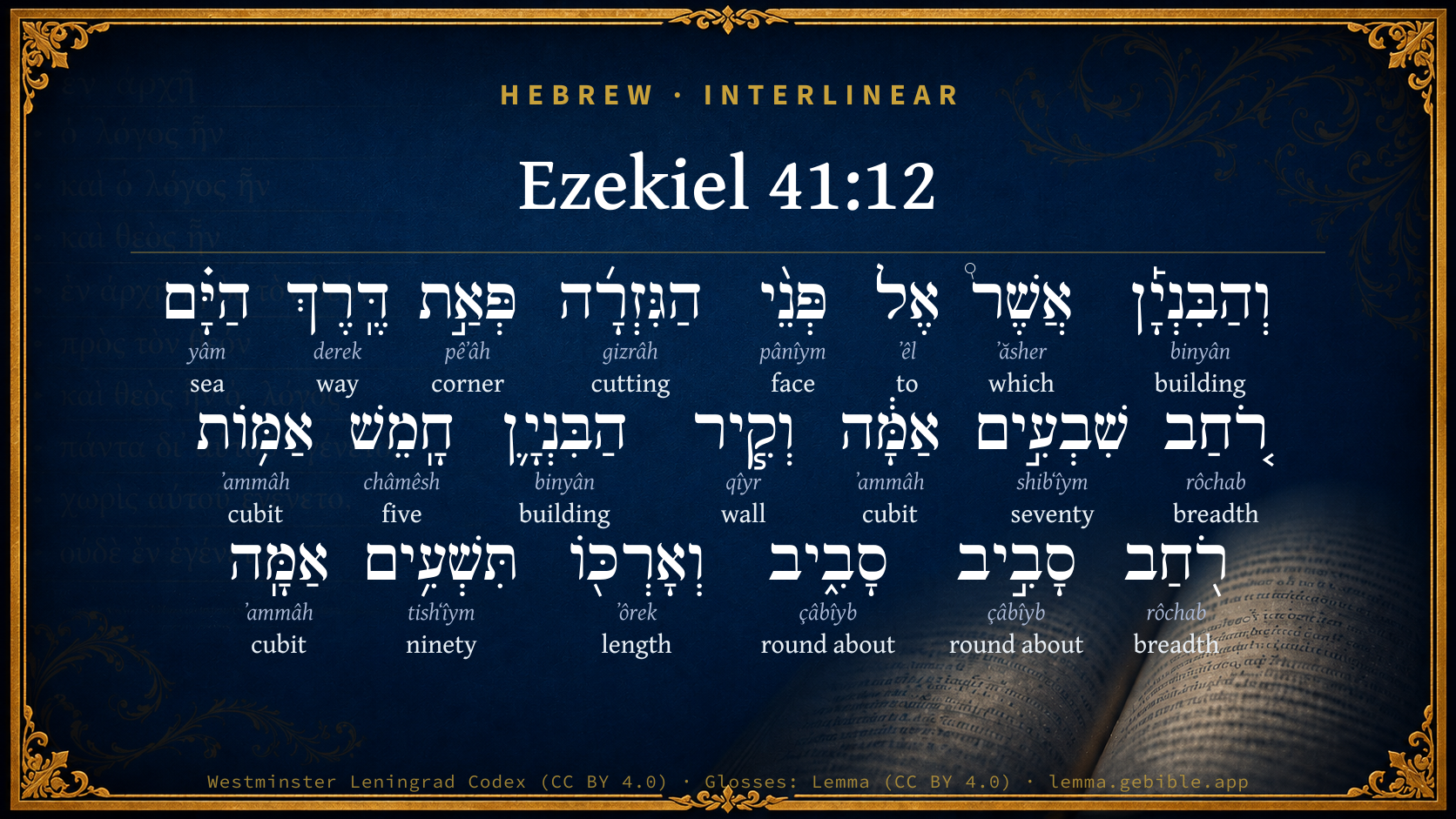
Ezekiel 41:12

Hebrew (Westminster Leningrad Codex) Ezekiel 41:12 appears in the Hebrew Old Testament. The text above is from the Westminster Leningrad Codex. Each word links to its Strong’s number, a concise gloss, and parsing drawn from the Open Scriptures Hebrew Bible morphology. Click any word for its full Brown-Driver-Briggs (BDB) entry.
Download image
Cite this verse

Ezekiel 41:12 (World English Bible). Public Domain. Lemma interlinear Bible study tool, https://lemma.gebible.app/v/ezekiel/41/12.

Show BibTeX & RIS
BibTeX
RIS
English Translation
The building that was before the separate place at the side toward the west was seventy cubits broad; and the wall of the building was five cubits thick round about, and the length of it ninety cubits.
World English Bible · Public Domain
Download a study sheet

One document with this verse’s original text, its word-by-word gloss line, the meaning frame, cross-references with their text, attributed commentary, and full source and license credits — printable, and it pastes into notes with its structure intact.

This verse Autodidact and up

Study sheet (.html) Plain text (.txt)

A passage Seminary Student

Up to 50 verses in one chapter. A passage sheet keeps up to 6 commentary sources and 12 cross-references per verse, in the order this page ranks them, and says so on the sheet whenever that leaves anything out. Ask for a single verse and you get the Autodidact verse sheet above.

Everything on this page stays free to read, with no account — the sheet is a download of what is already on screen, not access to it.

Want to remove ads? Support Godless Engineer
Compare translations 3

The same verse in 3 English versions, stacked beneath the original-language interlinear above. Click any original word for its lexicon entry.

Each is an independent rendering of the whole verse — the interlinear is not word-aligned to these translations.

Highlighted words mark where these versions differ — a whole-verse word diff, not a word-by-word alignment.

  • World English Bible Public Domain
    The building that was before the separate place at the side toward the west was seventy cubits broad; and the wall of the building was five cubits thick round about, and the length of it ninety cubits.
  • King James Version Public Domain
    Now the building that was before the separate place at the end toward the west was seventy cubits broad; and the wall of the building was five cubits thick round about, and the length thereof ninety cubits.
  • unfoldingWord Literal Text CC BY-SA 4.0
    The building that faced the courtyard on the west side was seventy cubits in width. Its wall measured five cubits thick all around, and it was ninety cubits in length.

unfoldingWord Literal Text — © unfoldingWord, licensed CC BY-SA 4.0. Word-aligned USFM3 via Door43 (git.door43.org/unfoldingWord/en_ult).

Versions to compare (up to 4)

3 of 4 selected

Show all 18 translations

Every available English version of this verse, each an independent rendering of the whole verse.

  • World English Bible Public Domain
    The building that was before the separate place at the side toward the west was seventy cubits broad; and the wall of the building was five cubits thick round about, and the length of it ninety cubits.
  • Berean Standard Bible Public Domain
    Now the building that faced the temple courtyard on the west was seventy cubits wide, and the wall of the building was five cubits thick all around, with a length of ninety cubits.
  • Majority Standard Bible Public Domain
    Now the building that faced the temple courtyard on the west was seventy cubits wide, and the wall of the building was five cubits thick all around, with a length of ninety cubits.
  • King James Version Public Domain
    Now the building that was before the separate place at the end toward the west was seventy cubits broad; and the wall of the building was five cubits thick round about, and the length thereof ninety cubits.
  • American Standard Version (1901) Public Domain
    And the building that was before the separate place at the side toward the west was seventy cubits broad; and the wall of the building was five cubits thick round about, and the length thereof ninety cubits.
  • Revised Version (1885) Public Domain
    And the building that was before the separate place at the side toward the west was seventy cubits broad; and the wall of the building was five cubits thick round about, and the length thereof ninety cubits.
  • Geneva Bible (1599) Public Domain
    Nowe the building that was before the separate place toward the West corner, was seuentie cubites broad, and the wall of the building was fiue cubites thick, round about, and ye length ninetie cubites.
  • Douay-Rheims (1899) Public Domain
    And the building that was separate, and turned to the way that looked toward the sea, was seventy cubits broad: and the wall of the building, five cubits thick round about: and ninety cubits long.
  • Young's Literal Translation Public Domain
    As to the building that `is' at the front of the separate place `at' the corner westward, the breadth `is' seventy cubits, and the wall of the building five cubits broad all round about, and its length ninety cubits.
  • Literal Standard Version CC BY-SA 4.0
    As for the building that [is] at the front of the separate place [at] the corner westward, the breadth [is] seventy cubits, and the wall of the building [is] five cubits broad all around, and its length—ninety cubits.
  • Unlocked Literal Bible CC BY-SA 4.0
    The building that faced the courtyard on the west side was seventy cubits in width. Its wall measured five cubits thick all around, and it was ninety cubits in length.
  • unfoldingWord Literal Text CC BY-SA 4.0
    The building that faced the courtyard on the west side was seventy cubits in width. Its wall measured five cubits thick all around, and it was ninety cubits in length.
  • Darby Bible Public Domain
    And the building that was before the separate place at the end toward the west was seventy cubits broad; and the wall of the building was five cubits thick round about; and its length ninety cubits.
  • World Messianic Bible Public Domain
    The building that was before the separate place at the side toward the west was seventy cubits wide; and the wall of the building was five cubits thick all around, and its length ninety cubits.
  • Webster's Bible Public Domain
    Now the building that was before the separate place at the end towards the west was seventy cubits broad; and the wall of the building was five cubits thick around, and its length ninety cubits.
  • Free Bible Version CC BY-SA 4.0
    Another building faced the Temple courtyard on the west side. It measured seventy cubits wide and ninety cubits long, with walls all the way round that were five cubits thick.
  • Bible in Basic English Public Domain
    And the building which was in front of the separate place at the side to the west was seventy cubits wide; the wall of the building was five cubits thick all round and ninety cubits long.
  • JPS Tanakh (1917) Public Domain
    And the building that was before the separate place at the side toward the west was seventy cubits broad; and the wall of the building was five cubits thick round about, and the length thereof ninety cubits.

Literal Standard Version (2020), Covenant Press — licensed CC BY-SA 4.0. Text via the HelloAO Bible API (eBible.org). Unlocked Literal Bible (unfoldingWord) — licensed CC BY-SA 4.0. Text via the HelloAO Bible API (eBible.org). unfoldingWord Literal Text — © unfoldingWord, licensed CC BY-SA 4.0. Word-aligned USFM3 via Door43 (git.door43.org/unfoldingWord/en_ult). Free Bible Version, Dr. Jonathan Gallagher — licensed CC BY-SA 4.0. Text via the HelloAO Bible API (eBible.org).

Word by word

More ways to search: Search by grammar → Find every occurrence → Compare this word →

Practice this passage: Drill this verse → Learn its vocabulary →

וְהַבִּנְיָ֡ן
binyân
H1146
“and · the · building”
Conjunction + Particle, Definite Article + Noun, Common, Masculine, Singular, Absolute
Part of Speech
Conjunction + Particle + Noun
Type
Common
Gender
Masculine
Number
Singular
State
Absolute
Full BDB Definition

Origin: from H1129

TWOT: 255a

structure, building
  1. אֲשֶׁר֩ ʼăsher H834 “which” Particle, Relative
  2. אֶל ʼêl H413 “to” Preposition
  3. פְּנֵ֨י pânîym H6440 “face(s) of” Noun, Common, Both, Plural, Construct
  4. הַגִּזְרָ֜ה gizrâh H1508 “the · cutting” Particle, Definite Article + Noun, Common, Feminine, Singular, Absolute
  5. פְּאַ֣ת pêʼâh H6285 “corner of” Noun, Common, Feminine, Singular, Construct
  6. דֶּֽרֶךְ derek H1870 “way of” Noun, Common, Both, Singular, Construct
  7. הַיָּ֗ם yâm H3220 “the · sea” Particle, Definite Article + Noun, Common, Masculine, Singular, Absolute
  8. רֹ֚חַב rôchab H7341 “breadth of” Noun, Common, Masculine, Singular, Construct
  9. שִׁבְעִ֣ים shibʻîym H7657 “seventy” Adjective, Cardinal number, Both, Plural, Absolute
  10. אַמָּ֔ה ʼammâh H520 “cubit” Noun, Common, Feminine, Singular, Absolute
  11. וְקִ֧יר qîyr H7023 “and · wall of” Conjunction + Noun, Common, Masculine, Singular, Construct
  12. הַבִּנְיָ֛ן binyân H1146 “the · building” Particle, Definite Article + Noun, Common, Masculine, Singular, Absolute
  13. חָֽמֵשׁ châmêsh H2568 “five” Adjective, Cardinal number, Feminine, Singular, Absolute
  14. אַמּ֥וֹת ʼammâh H520 “cubits” Noun, Common, Feminine, Plural, Absolute
  15. רֹ֖חַב rôchab H7341 “breadth” Noun, Common, Masculine, Singular, Absolute
  16. סָבִ֣יב çâbîyb H5439 “round about” Noun, Common, Both, Singular, Absolute
  17. סָבִ֑יב çâbîyb H5439 “round about” Noun, Common, Both, Singular, Absolute
  18. וְאָרְכּ֖וֹ ʼôrek H753 “and · length · his” Conjunction + Noun, Common, Masculine, Singular, Construct + Suffix, Personal, 3rd Person, Masculine, Singular
  19. תִּשְׁעִ֥ים tishʻîym H8673 “ninety” Adjective, Cardinal number, Both, Plural, Absolute
  20. אַמָּֽה ʼammâh H520 “cubit” Noun, Common, Feminine, Singular, Absolute

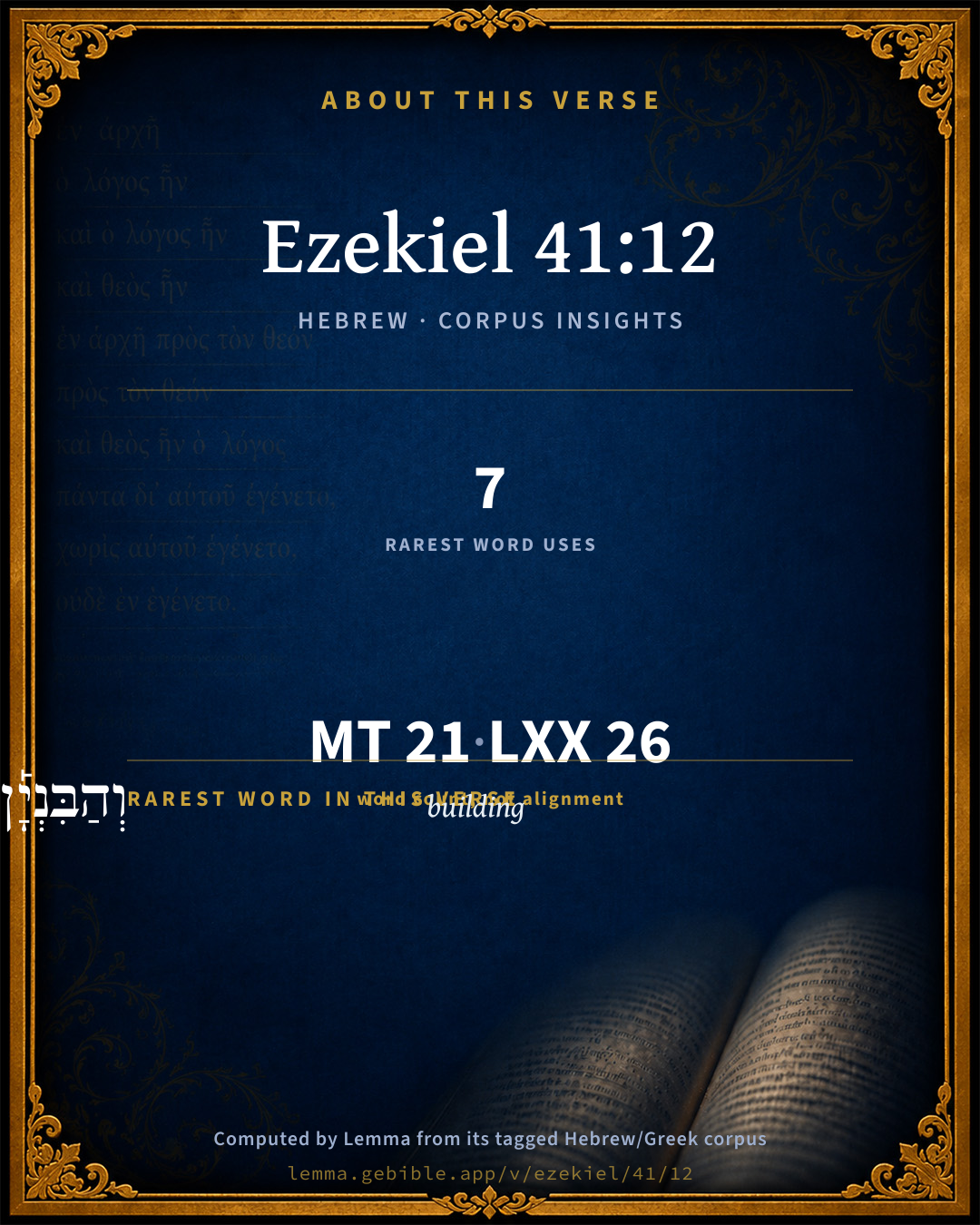
About this verse

These counts appear in no published source. They are computed here, from the morphology-tagged text and Lemma’s own curated glosses. What Lemma adds →

21
words
16
distinct lemmas
Prophets
section

Notable vocabulary

The rarest word here is וְהַבִּנְיָ֡ן building H1146 — appearing just 7 times in the whole Hebrew Bible.

Shared distinctive vocabulary

וְהַבִּנְיָ֡ן building H1146 occurs in 6 verses of the Hebrew Bible. Also found in:

Grammatical profile

  • 16 nouns
  • 3 adjectives
  • 1 preposition
  • 1 particle

Repetition

Words recur within this verse — often emphatic in Hebrew:

  • אַמָּ֔ה cubit H520 ×3
  • וְהַבִּנְיָ֡ן building H1146 ×2
  • רֹ֚חַב breadth H7341 ×2
  • סָבִ֣יב round about H5439 ×2

Hebrew & Septuagint length

In English translation the verse runs 37 words from the Hebrew and 36 from the Septuagint (LXX English) — closely comparable.

A rough comparison of the two English renderings, which tokenize alike — not a word-level alignment.

Word counts can differ between the Hebrew and the Greek without any difference in meaning — e.g. the Hebrew direct-object marker אֵת has no separate Greek word, and Greek often adds the article ὁ.

In the original languages it is 21 Hebrew tokens and 26 Greek tokens — but the two are counted differently (Hebrew bundles its prefixes and suffixes into one token; the Greek is in lemma form), so that isn’t a like-for-like length.

Cross-references

6

Topical passages linked to Ezekiel 41:12 in the Treasury of Scripture Knowledge — connected by theme and wording, ordered by reader-vote popularity; previews shown in the World English Bible.

  • Ezekiel 41:13–15 So he measured the house, one hundred cubits long; and the separate place, and the building, with the walls of it, one hundred cubits long;
  • Ezekiel 42:1 Then he brought me forth into the outer court, the way toward the north: and he brought me into the chamber that was over against the separate place, and which was over against the building toward the north.
  • Ezekiel 42:10 In the thickness of the wall of the court toward the east, before the separate place, and before the building, there were chambers.
  • Ezekiel 42:13 Then said he to me, The north chambers and the south chambers, which are before the separate place, they are the holy chambers, where the priests who are near to Yahweh shall eat the most holy things: there shall they lay the most holy things, and the meal-offering, and the sin-offering, and the trespass-offering; for the place is holy.
  • Revelation 21:27 There will in no way enter into it anything profane, or one who causes an abomination or a lie, but only those who are written in the Lamb's book of life.
  • Revelation 22:14–15 Blessed are those who do his commandments, that they may have the right to the tree of life, and may enter in by the gates into the city.

Cross-references courtesy of OpenBible.info (CC BY 4.0).

Hebrew and Greek witnesses Masoretic Hebrew ↔ Greek Septuagint

The same verse in the two great witnesses to the Old Testament, shown verse-for-verse.

These are two independent witnesses, not word-aligned to each other, and the Septuagint is shown in lemma (dictionary) form.

Hebrew Ezekiel 41:12 Masoretic · Westminster Leningrad Codex

וְהַבִּנְיָ֡ן אֲשֶׁר֩ אֶל פְּנֵ֨י הַגִּזְרָ֜ה פְּאַ֣ת דֶּֽרֶךְ הַיָּ֗ם רֹ֚חַב שִׁבְעִ֣ים אַמָּ֔ה וְקִ֧יר הַבִּנְיָ֛ן חָֽמֵשׁ אַמּ֥וֹת רֹ֖חַב סָבִ֣יב סָבִ֑יב וְאָרְכּ֖וֹ תִּשְׁעִ֥ים אַמָּֽה

The building that was before the separate place at the side toward the west was seventy cubits broad; and the wall of the building was five cubits thick round about, and the length of it ninety cubits.

World English Bible · Public Domain

Greek LXX Ezekiel 41:12 Septuagint · lemma form

καί ὁ διαὁρίζω κατά πρόσωπον ὁ ἀπόλοιπος ὡς πρός θάλασσα πηχύς ἑβδομήκοντα πλάτος ὁ τοῖχος ὁ διαὁρίζω πῆχυς πέντε εὖρος κυκλόθεν καί μῆκος αὐτός πῆχυς ἐνενήκοντα

And the partition wall in front of the remaining space, toward the west, was seventy cubits in breadth; the breadth of the partition wall was five cubits round about, and the length of it ninety cubits.

LXX2012 (modern English Septuagint) · Public Domain

Hebrew: Westminster Leningrad Codex (CC BY 4.0). Greek: Septuagint (public domain); English from LXX2012 (modern English Septuagint) (Public Domain). How the Septuagint differs from the Hebrew →

Targum (Aramaic paraphrase)

1

The Targum is the ancient Jewish Aramaic paraphrase of the Hebrew Scriptures — an interpretive translation, not the Hebrew text itself. Onkelos (literal) and Pseudo-Jonathan (expansive) render the Torah, and Jonathan the Prophets. Coverage is partial: where no permissively-licensed English translation exists for a verse, only the Aramaic is shown. This is verse-level text, not a word-by-word alignment to the Hebrew.

  1. Targum Jonathan Prophets (Joshua–Malachi)
    וּבִנְיָנָא דִקֳדָם בְּצוּרְתָּא רוּחַ אוֹרַח מַעַרְבָא פּוּתְיָא שַׁבְעִין אַמִין וְכָתְלָא דְבִנְיָנָא חֲמֵשׁ אַמִין פּוּתְיָא סְחוֹר סְחוֹר וְאוּרְכֵּהּ תִּשְׁעִין אַמִין:

    (no public-domain English translation for this verse)

    Targum Jonathan — Aramaic: “Mikraot Gedolot” (public domain). English: “Sefaria Community Translation” (CC0 1.0 (public-domain dedication)); “London "Chaldee Paraphrase," 1871” (public domain). Text via Sefaria.

Commentary

Notes on Ezekiel 41:12 from classic Christian and Jewish commentators (each source and its license shown beneath its notes). The classic Christian expositions comment on the surrounding passage and are grouped to its opening verse, so a note may address several verses; the Jewish commentaries on the Tanakh (Rashi and others) are per-verse, so they appear only where the commentator wrote on this verse.

Lemma curates 59 commentaries, every one of them public domain or Creative Commons licensed, each selected and text-cleaned for this edition rather than reprinted as found. About our sources →

Matthew Henry's Commentary

Here is, 1. An account of a building that was before the separate place (that is, before the temple), at the end towards the west (Eze 41:12), which is here measured, and compared (Eze 41:13) with the measure of the house, and appears to be of equal dimensions with it. This stood in a court by itself, which is measured (Eze 41:15) and its galleries, or chambers belonging to it, its posts and windows, and the ornaments of them, Eze 41:15-17. But what use was to be made of this other building we are not told; perhaps, in this vision, it signified the setting up of a church among the Gentiles not inferior to the Jewish temple, but of quite another nature, and which should soon supersede it. 2. A description of the ornaments of the temple, and the other building. The walls on the inside from top to bottom were adorned with cherubim and palm-trees, placed alternately, as in Solomon's temple, Kg1 6:29. Each cherub is here said to have two faces, the face of a man towards the palm tree on one side and the face of a young lion towards the palm-tree on the other side, Eze 41:19. These seem to represent the angels, who have more than the wisdom of a man and the courage of a lion; and in both they have an eye to the palms of victory and triumph which are set before them, and which they are sure of in all their conflicts with the powers of darkness. And in the assemblies of the saints angels are in a special manner present, Co1 11:10. 3. A description of the posts of the doors both of the temple and of the sanctuary; they were squared (Eze 41:21), not round like pillars; and the appearance of the one was as the appearance of the other. In the tabernacle, and in Solomon's temple, the door of the sanctuary, or most holy, was narrower than that of the temple, but here it was fully as broad; for in gospel-times the way into the holiest of all is made more manifest than it was under the Old Testament (Heb 9:8) and therefore the door is wider. These doors are described, Eze 41:23, Eze 41:24. The temple and the sanctuary had each of them its door, and they were two-leaved, folding doors. 4. We have here the description of the altar of incense, here said to be an altar of wood, Eze 41:22. No mention is made of its being over-laid with gold; but surely it was intended to be so, else it would not bear the fire with which the incense was to be burned, unless we will suppose that it served only to put the censers upon. Or else it intimates that the incense to be offered in the gospel-temple shall be purely spiritual, and the fire spiritual, which will not consume an altar of wood. Therefore this altar is called a table. This is the table that is before the Lord. Here, as before, we find the altar turned into a table; for, the great sacrifice being now offered, that which we have to do is to feast upon the sacrifice at the Lord's table. 5. Here is the adorning of the doors and windows with palm-trees, that they might be of a piece with the walls of the house, Eze 41:25, Eze 41:26. Thus the living temples are adorned, not with gold, or silver, or costly array, but with the hidden man of the heart, in that which is not corruptible.

Matthew Henry's Commentary on the Whole Bible (1708–1710) — public domain (CC PDM 1.0). Text via the HelloAO Bible API.

Trapp's Complete Commentary

John Trapp

Eze 41:12 Now the building that [was] before the separate place at the end toward the west [was] seventy cubits broad; and the wall of the building [was] five cubits thick round about, and the length thereof ninety cubits.

Ver. 12. The separate place.] The temple, or at least some part of it.

John Trapp, A Commentary or Exposition upon All the Books of the Old and New Testament (1647–1656) — public domain. Text from a community e-Sword module.

Joseph Benson's Commentary

Eze 41:12-14. Now the building, &c. — This seems to be another building not before mentioned, but now measured by itself. So he measured the house — The whole temple, oracle, sanctuary, and porch, with the walls, which were in length a hundred cubits from east to west, which may be thus computed:

CUBITS.

The thickness of the wall of the east porch

5

The passage through the porch

11

The wall between the porch and the temple

6

The outward sanctuary

40

The partition wall

2

The holy of holies

20

The thickness of the west wall

6

The side-chambers at the west end

5

The outer wall of those chambers

5

Also the breadth of the face of the house — The front of the temple eastward was a hundred cubits.

Joseph Benson's Commentary on the Old and New Testaments (1811–1818) — public domain. Text from a community e-Sword module.

Whedon's Commentary on the Bible

Daniel D. Whedon

THE “SEPARATE PLACE” DESCRIBED, Eze_41:12-15.

12. At the end — R.V., “at the side.”

Daniel D. Whedon (gen. ed.), Commentary on the Old and New Testaments (1874–1909) — public domain. Text from a community e-Sword module.

Keil & Delitzsch

C. F. Keil & F. Delitzsch

The Separate Place, and the External Dimensions of the Temple

Eze 41:12. And the building at the front of the separate place was seventy cubits broad on the side turned toward the west, and the wall of the building five cubits broad round about, and its length ninety cubits. Eze 41:13. And he measured the (temple) house: the length a hundred cubits; and the separate place, and its building, and its walls: the length a hundred cubits. Eze 41:14. And the breadth of the face of the (temple) house, and of the separate place toward the east, a hundred cubits. - The explanation of these verses depends upon the meaning of the word גּזרה. According to its derivation from גּזר, to cut, to separate, גּזרה means that which is cut off, or separated. Thus ארץ גּזרה is the land cut off, the desert, which is not connected by roads with the inhabited country. In the passage before us, גּזרה signifies a place on the western side of the temple, i.e., behind the temple, which was separated from the sanctuary (Plate I J), and on which a building stood, but concerning the purpose of which nothing more definite is stated than we are able to gather, partly from the name and situation of the place in question, and partly from such passages as Ch1 26:18 and Kg2 23:11, according to which, even in Solomon's temple, there was a similar space at the back of the temple house with buildings upon it, which had a separate way out, the gate שׁלּכת, namely, that "this space,with its buildings, was to be used for the reception of all refuse, sweepings, all kinds of rubbish, - in brief, of everything that was separated or rejected when the holy service was performed in the temple, - and that this was the reason why it received the name of the separate place" (Kliefoth). The building upon this space was situated אל־פּני־הגּזרה, in the front of the gizrah (that is to say, as one approached it from the temple); and that פּאת דּרך־היּם, on the side of the way to the sea, i.e., on the western side, sc. of the temple, and had a breadth of seventy cubits (from north to south), with a wall round about, which was five cubits broad (thick), and a length of ninety cubits. As the thickness of the wall is specially mentioned in connection with the breadth, we must add it both to the breadth and to the length of the building as given here; so that, when looked at from the outside, the building was eighty cubits broad and a hundred cubits long. In Eze 41:13 this length is expressly attributed to the separate place, and (i.e., along with) its building, and the walls thereof. But the length of the temple house has also been previously stated as a hundred cubits. In Eze 41:14 the breadth of both is also stated to have been a hundred cubits - namely, the breadth of the outer front, or front face of the temple, was a hundred cubits; and the breadth of the separate place לקּדים toward the east, i.e., the breadth which it showed to the person measuring on the eastern side, was the same. If, them, the building on the separate place was only eighty cubits broad, according to Eze 41:12, including the walls, whilst the separate place itself was a hundred cubits broad, there remains a space of twenty cubits in breadth not covered by the building; that is to say, as we need not hesitate to put the building in the centre, open spaces of ten cubits each on the northern and southern sides were left as approaches to the building on both sides (K), whereas the entire length of the separate place (from east to west) was covered by the building. - All these measurements are in perfect harmony. As the inner court formed a square of a hundred cubits in length (Eze 40:47), the temple house, which joined it on the west, extended with its appurtenances to a similar length; and the separate place behind the temple also covered a space of equal size. These three squares, therefore, had a length from east to west of three hundred cubits. If we add to this the length of the buildings of the east gates of the inner and outer courts, namely fifty cubits for each (Eze 40:15, Eze 40:21, Eze 40:25, Eze 40:29, Eze 40:33, Eze 40:36), and the length of the outer court from gate to gate a hundred cubits (Eze 40:19, Eze 40:23, Eze 40:27), we obtain for the whole of the temple building the length of five hundred cubits. If, again, we add to the breadth of the inner court or temple house, which was one hundred cubits, the breadths of the outer court, with the outer and inner gate-buildings, viz., two hundred cubits on both the north and south sides, we obtain a total breadth of 100 + 200 + 200 = 500 (say five hundred) cubits; so that the whole building covered a space of five hundred cubits square, in harmony with the calculation already made (at Eze 40:24-27) of the size of the surrounding wall.

Keil & Delitzsch — Biblical Commentary on the Old Testament (1861–1891) — public domain (CC PDM 1.0). Text via the HelloAO Bible API. (Old Testament only.)

Fairbairn on Ezekiel, Jonah & the Pastoral Epistles

Patrick Fairbairn

Eze 41:12. And the building which was in front of the separate place on the west end was seventy cubits broad; and the wall of the building five cubits broad round about, and its length ninety cubits, lo. And he measured the house an hundred cubits long, and the separate place, and the building and its walls, an hundred cubits long.

Eze 41:14. And the breadth of the front of the house, and of the separate place on the east, an hundred cubits.

Eze 41:15. And he measured the length of the building in front of the separate place, which was upon its back part, and its galleries upon the one side and the other side, an hundred cubits; (By the אַתִּוֶקִים, galleries, are supposed to be meant some sort of terrace building, but the word, being only found in this description of Ezekiel, cannot be defined exactly. Indeed in the account contained in these four verses there is considerable obscurity, so that some have even held, and Böttcher still holds, that it is only the temple that is spoken of. But I think this impossible. The prophet seems plainly to mean, that on the west, or to the back of the temple, there was a separate place occupied as to its greater part by buildings, which were much about the same external dimensions with the temple; both being in their entire compass an hundred cubits square. But in neither case is the description so full as to enable us to make up the different items with anything like certainty.) and (he measured) the inner temple in the porches of the court,

Eze 41:16. The thresholds, and the fixed windows, and the galleries roundabout, with their three (storeys) over against the threshold; of fine wood (or wainscoated with wood) round about, and from the ground up to the carved windows (probably the highest, and as such covered from the view below, though the expression is still peculiar);

Eze 41:17. Above the entrance, even to the interior of the house, and the outside, and to all the wall round about, within and without; measurements (were taken).

Eze 41:18. And there were made cherubim and palm-trees; and a palm-tree was between each cherub; and the cherub had two faces.

Eze 41:19. And the face of a man was toward the palm-tree on the one side, and the face of a lion toward the palm-tree on the other; they were made over all the house round about.

Eze 41:20. From the ground to above the entrance were the cherubim and palm- trees made, and the wall of the temple.

Eze 41:21. The door-posts of the temple were squared, and the face of the sanctuary was of the well-known appearance (literally, of the appearance according to the appearance, the appearance it was wont to present).

Eze 41:22. The altar of wood was three cubits high, and its length two cubits, and its corners, and its length, and its walls were of wood; and he said to me, “This is the table which is before the Lord.”

Eze 41:23. And there were two doors to the temple and the sanctuary.

Eze 41:24. And the two doors had two leaves, turning-leaves; two leaves for one door, and two for the other.

Eze 41:25. And there were made for them, for the doors of the temple, cherubim and palm-trees, like those made on the walls; and a wooden sill-piece (or plank) upon the front of the porch from without.

Eze 41:26. And there were fixed windows, and palm-trees on each hand on the sides of the porch, and the side-chambers of the house, and the sill-pieces (or planks).

The latter part of the description has reference chiefly to the ornamental work which was done upon the walls of the temple, and which is also mentioned in 1 Kings 6. The account here is fuller, though it makes no mention of the flowers and the overlaying with gold, which are found there. What is meant by the עב in Eze 41:25-26 is quite uncertain, but has been conjecturally understood to be some sort of sill-piece or plank about the threshold. Some later writers (Ewald, Hitzig) incline rather to understand it of some peculiar kind of carved work, or settings in the outer porch; but opinions may vary as much as the fancies of men. It will be observed, too, that the only article of sacred furniture mentioned, the altar of incense, is called the Lord’s table; and it is again also, at Eze 44:16, referred to under this name: “They shall enter into my sanctuary, and they shall come near to my table, to minister unto me.” It was at the incense altar, and not at the table of show-bread, that the daily and regular ministrations of the priesthood in the sanctuary proceeded; and it was of this also, which stood in immediate front of the veil, that it could with special propriety be said that it was “before the Lord.” Its being called a table probably referred to the satisfaction and delight with which the Lord was to regard the services, which were henceforth to be offered to him by his renewed people. And possibly on this account, too, the dimensions are given larger than of old—three cubits in height and two in breadth, instead of two and one. But the most peculiar part of the description is what relates to the buildings connected with the separate place, so closely adjoining to the temple, in the unoccupied ground on the west, and so much resembling it in size. Nothing is said of their exact intention, nor is there even any particular description of the internal construction. The account as to details is remarkably general and obscure; and why then given at all? To show, as it would seem, that there was now to be no place left, as of old, which might not be held to be sacred ground. It appears to have been there that in Manasseh’s time the horses were kept which were consecrated to the sun (2Ki 23:11), called “the suburbs of the temple.” But all excuse was henceforth to be taken away for such abominations; the Lord laid claim to all for his peculiar service, and had this also filled up with sacred erections.

Patrick Fairbairn — An Exposition of Ezekiel (1851), Jonah (1849), and The Pastoral Epistles (1874) — public domain. Text from a community e-Sword module.

Jamieson, Fausset & Brown

Robert Jamieson, A. R. Fausset & David Brown

Sum of the measures of the temple, and of the buildings behind and on the side of it.

Jamieson, Fausset & Brown — Commentary Critical and Explanatory on the Whole Bible (1871) — public domain (CC PDM 1.0). Text via the HelloAO Bible API.

Adam Clarke's Commentary

Verse 12. The length thereof ninety cubits.] The temple, with the buildings which surrounded it, was eighty-one cubits long; add ten cubits for the vestibule, or five for the breadth of the separate place, and five for its wall; in all, ninety cubits. See the plan, LHIL. See Clarke on Eze 48:35. By the separate place I suppose the temple itself is meant.

Adam Clarke's Commentary on the Bible (1810–1826) — public domain. Text from a community e-Sword/MySword module.

Ellicott's Commentary for English Readers

(12) The separate place.—This is the space at the west end of the Temple (20 cubits broad) before coming to another building. Nothing is here said of the purposes of this other building; but it is probably “the appointed place” (Eze_43:21) for the burning of the sin-offering, and also of any remains of other sacrifices which required to be consumed by fire, and of any other refuse from the Temple. Its total width of 80 cubits (70 cubits + 2 walls of 5 cubits each) leaves a passage-way of 10 cubits on each side; while its length (90 cubits + two walls of 5 cubits each—100 cubits) Just fills the space from “the separate place” to the wall of the court. (See plan II., G. [Eze_40:44-49]) The sum-total of the exterior measurements is given in Eze_41:13-14.

A Bible Commentary for English Readers, edited by Charles John Ellicott (1878–1897) — public domain. Text from a community e-Sword module.

The Cambridge Bible for Schools and Colleges

gen. ed. J. J. S. Perowne

12. The building behind the house on the west, Fig. 3, K

To the west of the house proper, but divided from it by the 20 cubits of the “separate place” (Fig. 3, H), was a large building, 70 cubits broad (E. to W. Fig. 3, rp, sq), and 90 long (N. to S. Fig. 3, rs, pq)—breadth being the smaller and length the larger dimension here. The wall of the building all round was 5 cubits thick. The measurements 70 and 90 are inside. The uses which this building served are not specified, they were probably general.

before the separate place] i.e. the court of 20 cubits broad (Fig. 3, H), which ran round the house. “Before” is opposite to or facing.

The Cambridge Bible for Schools and Colleges (gen. ed. J. J. S. Perowne; Cambridge University Press, 1878–1918) — public domain. Text from a community e-Sword module.

John Gill's Exposition

Now the building that was before the separate place,.... The "separate place" is the holy of holies, which was separated by a vail under the second temple, and by a wall as in this, and the first from the holy place: "before or over against" which was a building, as it is rendered, Eze 41:15, a new building, not before taken notice of: and it was situated

at the end toward the west: or "sea" (e), the Mediterranean sea, which lay west to the land of Canaan. The meaning is, that this building was to the west of the temple, at which end stood the holy of holies, and this near to that: what building is here meant is not easy to say, there being nothing in the first or second temple which answered to it: it seems to be a new building; and what the mystical sense of it is cannot be easily guessed at. Cocceius thinks, that as the holy of holies signifies the heavenly or more perfect state of the church on earth, this, being over against it, or behind it, as in Eze 41:15, may design heaven itself, the happiness and glory of the saints treasured up and reserved there:

it was seventy cubits broad; Jerom seems to have the same mystical sense in view; since he observes, that after labours and perils, and the floods and shipwrecks of this world for seventy years, we come to enjoy the eternal rest:

and the wall of the building was five cubits thick round about; which may answer to the vast gulf fixed between the godly in heaven, and the wicked in hell; so that there is no going the one to the other, Luk 16:26,

and the length thereof ninety cubits; there are no outgoings to this building, as Hafenrefferus (f), a German divine, observes; so that those that are brought into it shall ever remain in it, which is the case of the saints in heaven.

(e) "ad mare, Piscator; obversa mari", Cocceius, Starckius. (f) Apud Starckius in loc.

John Gill's Exposition of the Whole Bible (1746–1763) — public domain (CC PDM 1.0). Text via the HelloAO Bible API.

Albert Barnes' Notes on the Bible

The separate place - See F, Plan II. The word occurs only in this chapter. The name, which seems one of discredit, has led to the conjecture that the purpose of this place and its building was to receive the offal of the sacrifices and sweepings of the courts, to be carried thence by a postern gate (compare Eze 43:21). The building itself was, we are told, seventy cubits wide, with walls five cubits thick (eighty cubits in all), leaving ten cubits on each side to make up the 100 cubits from north to south. The length was ninety cubits, which, adding as before the thickness of the walls, gives 100 cubits in length. The whole temple-building was 500 cubits from west to east, and from north to south, 500 cubits.

Albert Barnes' Notes on the Bible (1834–1885) — public domain. Text from a community e-Sword/MySword module.

Matthew Poole's English Annotations

This is a new building not yet mentioned, but now measured by itself.

Before, or over against,

the separate place; either the temple, with all the appendant treasury chambers; or the oracle, which was in the west end of the temple, and separate from the rest of the temple; or that twenty cubits’ space which was cut off from the chambers, an& the five cubits’ space before them by a breast wall, as some think.

At the end of either temple, oracle, or foresaid space,

toward the west, was seventy cubits broad: as men are not agreed about the fabric, and its dimensions, here intended to be measured, so they are as little agreed how to compute the measures; every one however makes out his account, whether the thing he measures be the right or mistaken. First, suppose the temple and the west part of it from north to south, thus: Twenty cubits the oracle, each side wall six cubits, breadth of chambers on each side four, the thickness of the out-walls of these chambers on both sides five cubits each, a void space of five cubits compassing the whole, and then the low or breast wall that enclosed this space five cubits thick on each side, making up the third ten, produce the seventy cubits. But they that think of a distinct building on the west end of the temple, do also in their method make out the account.

The wall of the building was five cubits thick: this seems to countenance their opinion who conceive a distinct building meant.

The length thereof ninety cubits: these proportions are easily laid together, which will make up the total, and agree with the temple, thus: Temple and oracle with their walls seventy cubits, porch eleven, and chambers and walls nine cubits. And who will have such a new structure here measured (which is more than was in the first temple fabric) will make all correspond to their hypothesis, and you may more easily object against another’s than demonstrate your own guess. The best is, the error is not great if a man do err here.

Matthew Poole's English Annotations on the Holy Bible (1683–1685) — public domain. Text from a community e-Sword/MySword module.

The Pulpit Commentary

Vers. 12-14. The separate place.

The building that was before the separate place. The word hrzGh, occurring only in this chapter, and translated "separate place," is derived from a root signifying to "cut off," and here denotes a space behind the temple on the west, which was marked off from the rest of the ground on which the temple with its courts and chambers stood, and devoted most likely to less sacred purposes. Behind Solomon"s temple lay a similar space (2Ki_23:11; 1Ch_26:18) with buildings upon it and a separate way out; and as the name gizrah appears to convey the notion of something that required to be kept apart and removed from the sacred precincts, the opinion of Kliefoth is probably correct that "this space with its buildings was to be used for the reception of all refuse, sweepings, all kinds of rubbish in brief, of everything that was separated or rejected when the holy service was performed in the temple, and that this was the reason why it received the name of "the separate place." The dimensions of this building were

(1) the breadth, seventy cubits;

(2) the length, ninety cubits;

(3) the thickness of the wall, five cubits round about.

Solidity.

wall of the building was five cubits thick." This suggests a solid structure.

I THE STRUCTURE OF SALVATION IS SOLID. The temple was strong as a castle. Indeed, it was used as a fortress in the time of the Roman siege of Jerusalem, and was the last part of the city to yield to the foe. The Church of God is better than an ark on the waters; it is a mighty fortress, built upon a strong foundation, and strongly protected by the presence of God. We need not fear for our spiritual shelter. It will not be blown away with every wind of doctrine. What Christ has done for us will stand the hardest strain.

II THE STRUCTURE OF THE CHRISTIAN LIFE IS SOLID. There are, indeed, some Christian people whose faith seems to be no better than the flimsiest summer tent, quite unfit to stand against the least gale of doubt, temptation, or trouble. But he who is really and earnestly endeavoring to live the Christian life by the grace of God will find that, though he is weak, God can make him strong, and build up his spiritual life into a vigor at which the man himself may well be surprised.

III THE STRUCTURE OF TRUTH IS SOLID. There is a great deal in men"s opinions of religion that will need to be swept away by widening knowledge. But this is not truth. As soon as a real fact is reached, no granite from Aberdeen can be more hard and firm. When we reach truth our feet touch the rock, and when we build up our teachings out of truths they must stand. "Truth is great, and it must prevail.

IV THE STRUCTURE OF GOOD WORK IS SOLID. Here is the test by which to reveal showy, worthless work, and to distinguish it from that which is of real value. There are men who build on the right foundation, and yet only pile up wood, hay, and stubble. Their work will be burnt, though they themselves will be saved. (1Co_3:13-15) But when a man with an honest heart toils unpretentiously to build up what is real and true to better society, to spread the gospel by it all on the foundation of Christ, he may rest assured that his work will stand. Such work is solid.

V THE CHURCH OF CHRIST IS SOLID. The Church has stood many shocks and dangers temptations and persecutions. Still she endures. Philosophies, social systems, and political movements have risen and fallen. But the Church of Christ has outlived them all. She outlived the Roman empire and the ancient civilization. She will outlive her rivals in thought and social movements in the present day.

VI HEAVEN IS SOLID. It is no vague cloudland. Christ spoke of his Father"s house. (Joh_14:1) St. Paul contrasted the house not made with hands, eternal in the heavens, with the present temporary tabernacle of the earthly body. (2Co_5:1) The writer to the Hebrews shows us Abraham looking "for a city which hath foundations, whose Builder and Maker is God". (Heb_11:10)

The Pulpit Commentary (1880–1919), ed. H.D.M. Spence-Jones & Joseph S. Exell — public domain. Text from a community e-Sword module.

John Wesley's Explanatory Notes

The building - This is a new building not yet mentioned, but now measured by itself.

John Wesley, Explanatory Notes Upon the Whole Bible (1754–1765) — public domain. Text via the GEBible commentary corpus.

Kretzmann's Popular Commentary

Paul E. Kretzmann

A Further Description of tile Temple

v. 12. Now, the building that was before the separate place, literally, "the off-place," apparently a building where the refuse and offal of the Temple-worship were deposited, at the end, toward the west, was seventy cubits broad; and the wall was seventy cubits broad, for at the great festival seasons the amount of waste material was very great; and the wall of the building was five cubits thick round about, or of the same thickness as the wall farther toward the front, and the length thereof ninety cubits.

v. 13. So He measured the house, an hundred cubits long, that is, the entire Temple edifice, and the separate place and the building, with the walls thereof, an hundred cubits long, so that there was a passage of ten cubits each on both the north and the south sides of the Temple-building;

v. 14. also the breadth of the face of the house and of the separate place toward the east, another place for refuse, an hundred cubits.

v. 15. And He measured the length of the building over against the separate place which was behind it, and the galleries thereof, evidently cloistered walks, on the one side and on the other side, an hundred cubits, with the inner temple and the porches of the court, the pediments projecting into the court;

v. 16. the door-posts and the narrow windows and the galleries round about on their three stories, rather, "round about on all three,"—over against the door, ceiled with wood round about, literally, "over against the threshold a boarding of wood round and round," and from the ground up to the windows, and the windows were covered,

v. 17. to that above the door, even unto the inner house, and without, and by all the wall round about within and without, by measure, all the dimensions were carefully worked out and observed in the building.

v. 18. And it was made with cherubim and palm-trees, these Serving as ornaments, in the various parts of the structure, so that a palm-tree was between a cherub and a cherub, in artistic alternation; and every cherub had two faces,

v. 19. so that the face of a man, the one face of a cherub, was toward the palm-tree on the one side and the face of a young lion, the other face of a cherub, toward the palm-tree on the other side; it was made through all the house round about, from the floor to the roof, wherever the open wall was visible.

v. 20. From the ground unto above the door were cherubim and palm-trees made and on the wall of the Temple.

v. 21. The posts of the Temple were squared, in agreement with Egyptian architecture, and the face of the Sanctuary, so that the door-posts with the threshold formed a square; the appearance of the one as the appearance of the other, in the signature of the coming universality. "

v. 22. The altar of wood, the altar of incense in the Holy Place, was three cubits high and the length thereof two cubits, the plate of the altar being a square of this dimension; and the corners thereof, or, "and it had corners," namely, the horns, or projections, which characterized the Jewish altars, and the length thereof and the walls thereof were of wood. And He said unto me, This is the table that is before the Lord, the altar of the presence of Jehovah, immediately before the Ark of the Covenant which was just beyond the veil.

v. 23. And the Temple and the sanctuary had two doors.

v. 24. And the doors had two leaves apiece, two turning leaves, so that each leaf had two parts which could lie opened and shut, two leaves for the one door and two leaves for the other door.

v. 25. And there were made on them, on the doors of the Temple, cherubim and palm-trees like as were made upon the walls; and there were thick planks, or "a wooden pediment," upon the face of the porch without.

v. 26. And there were narrow windows, closed and latticed, and palm-trees on the one side and on the other side, on the sides of the porch, and upon the side-chambers of the house, and thick planks, heavy projecting portions of wood, probably like the open gables of old houses. Even insignificant details are not omitted in order to make the description of the Temple as complete as possible.

Paul E. Kretzmann, Popular Commentary of the Bible (1921–1924) — public domain. Text from a community e-Sword module.

unfoldingWord translationNotes

Door43 World Missions Community

The building that faced the courtyard on the west side was seventy cubits in width

This can be stated as a separate sentence. AT: "There was a building on the west side of the temple area, and its entrance was towards the courtyard. It was seventy cubits in width"

seventy cubits ... five cubits ... ninety cubits ... one hundred cubits

Each long cubit was about 54 centimeters. See how you translated this in Ezekiel 40:5. "70 cubits ... 5 cubits ... 90 cubits ... 100 cubits" or "about 38 meters ... about 2.7 meters ... about 49 meters ... about 54 meters" (See: Biblical Distance)

translationWords

court

sanctuary

unfoldingWord translationNotes — © Distant Shores Media and the Door43 World Missions Community, licensed CC BY-SA 4.0. Source: git.door43.org/Door43/en_tn.

Rashi

Rabbi Shlomo Yitzchaki (Rashi)

And the structure that was before the fortress, etc. The width of the entire structure on the western side - the width of the House and the thickness of the northern and southern wall, with the northern and southern cells, and the thickness of their walls on the north and on the south - equaled seventy cubits, and so too it was in the Second Temple. And so we learned in Tractate Middoth (4:7) about the western wall: “From north to south - seventy cubits,” and it computes the calculation.

the fortress [Heb. הַגִּזְרָה.] Jonathan renders: the fortress. And I say that the tall House was called [the fortress] and that the low cells that were around it were called “the structure.” Menahem, however, (page. 54) interpreted גִּזְרָה as a chamber.

the side that was toward the west. [Heb. דֶרֶךְ יָם, lit. the way of the (Mediterranean) Sea.] The western side.

the side that was toward the west was seventy cubits wide And the width of the structure on the western side, from north to south, was seventy cubits, and here you have the computation: The northern cell was 4 [cubits], and its walls 10, totaling 14. The clear area between the cell and the House was 5 [cubits], totaling 19. The width of the foundation of the walls was included in the interior of the cell and in the clear place. The wall of the Heichal was 6 [cubits], totaling 25, and its interior was 20 [cubits] wide, totaling 45 [cubits]. The southern wall of the Heichal was 6, adding up to 51, and with the 19 [cubits] of the southern cells, the grand total is 70 [cubits].

and the wall of the structure the walls of the cells.

and it was ninety cubits long The length of the structure of the cells and the clear place was ninety cubits [in] the north and [in] the south, not including the depository of the knives, which is not counted because it protruded outward to the north and to the south, and was not the same shape as the rest of the structure. The House was thirty cubits wider in the front than in the back, as we learned (Middoth 4:7): “The Hall exceeded the Heichal by fifteen cubits in the north and fifteen cubits in the south, and that [longer area] was called the Depository of the Knives, because there they stored the knives.” The length of that structure from east to west was ten cubits. This leaves 90 cubits of length with 70 cubits width, for the entire House was 100 cubits long on both sides, as is delineated in this section and in Tractate Middoth (4:6).

Rashi on the Tanakh — English translations: “The Judaica Press complete Tanach with Rashi, translated by A. J. Rosenberg” (CC BY 4.0); “Pentateuch with Rashi's commentary by M. Rosenbaum and A.M. Silbermann, 1929-1934” (public domain); “The Metsudah Tanach series, Lakewood, N.J” (CC BY 4.0); and “The Book of Joshua, Metsudah Publications, 1997” (CC BY 4.0). Text via Sefaria.

Lesson kit

Teaching starters — assembled from the data on this page, not authored interpretation. Every prompt links to the verse data it draws on. Edit before teaching.

Ezekiel, in the Prophets, opens this verse with 21 words (16 distinct Hebrew lemmas). Its most distinctive word is binyân (“building”). A historical commentator’s framing appears above. Read the whole chapter for the surrounding context.

Discussion questions

  1. The word binyân carries the sense “building.” How does it shape the verse?
  2. How does Ezekiel 40:5, which shares the word «building», read alongside this verse?
  3. What does the repetition of “cubit” (3× in this one verse) do in this verse?
  4. The translations on this page render this verse differently — a whole-verse word diff, not a word-by-word alignment. What might account for the different wordings?
  5. Compare how Matthew Henry's Commentary and Trapp's Complete Commentary read this verse. Where do they agree or differ?

Things to notice

Reading settings

Reading text

Shown beneath each verse's original-language words.

Old Testament
Old Testament edition

Read the OT as the Masoretic Hebrew (MT) or the Greek Septuagint (LXX).

English shown for the Greek Septuagint (in the Hebrew ↔ Greek comparison).

Comparing translations? Open the Compare panel on any verse page to stack up to four side by side.