Zechariah 5:2

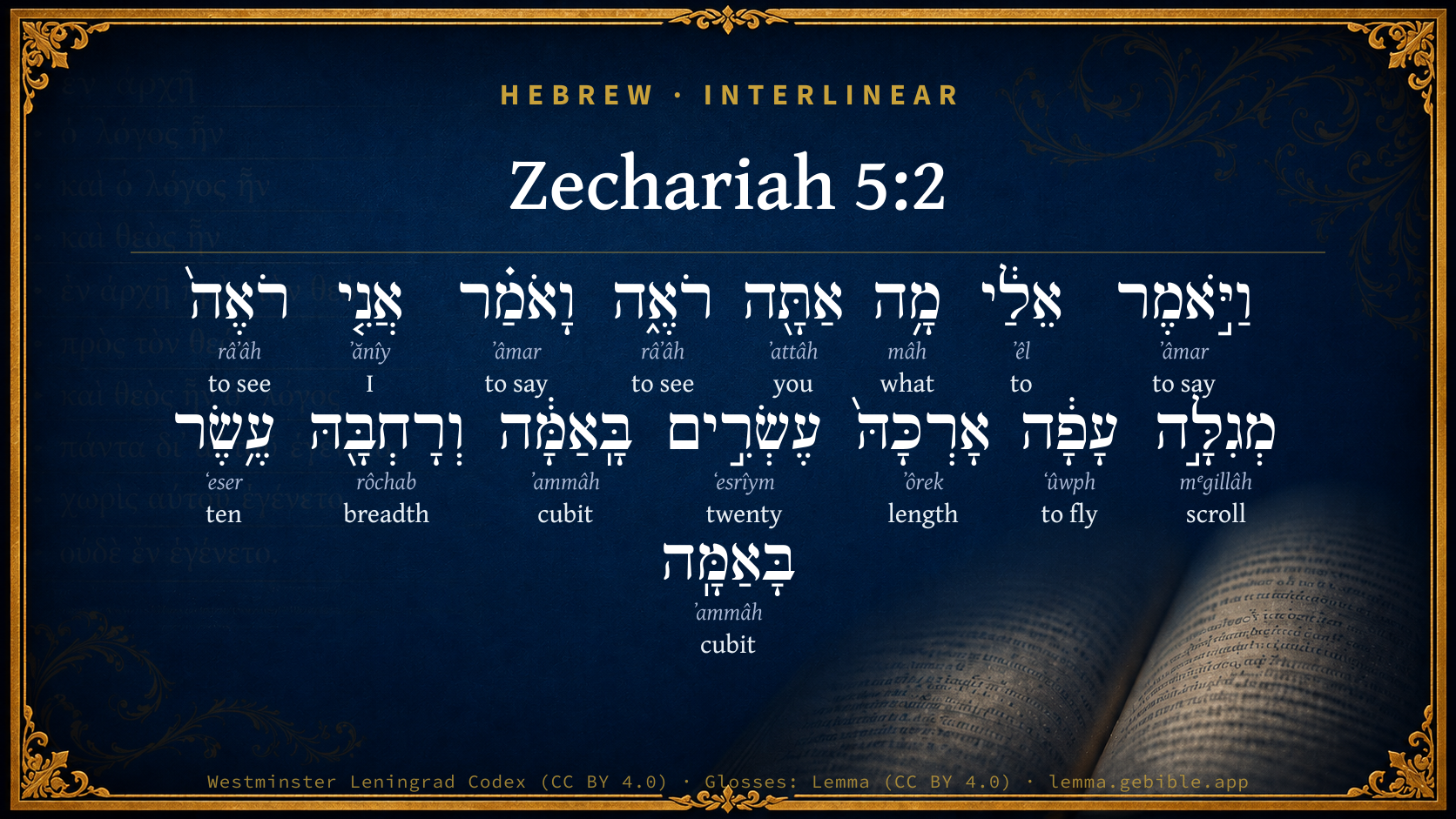
Hebrew (Westminster Leningrad Codex) Zechariah 5:2 appears in the Hebrew Old Testament. The text above is from the Westminster Leningrad Codex. Each word links to its Strong’s number, a concise gloss, and parsing drawn from the Open Scriptures Hebrew Bible morphology. Click any word for its full Brown-Driver-Briggs (BDB) entry.
Download image
Cite this verse

Zechariah 5:2 (World English Bible). Public Domain. Lemma interlinear Bible study tool, https://lemma.gebible.app/v/zechariah/5/2.

Show BibTeX & RIS
BibTeX
RIS
English Translation
He said to me, "What do you see?" I answered, "I see a flying scroll; its length is twenty cubits, and its breadth ten cubits."
World English Bible · Public Domain
Download a study sheet

One document with this verse’s original text, its word-by-word gloss line, the meaning frame, cross-references with their text, attributed commentary, and full source and license credits — printable, and it pastes into notes with its structure intact.

This verse Autodidact and up

Study sheet (.html) Plain text (.txt)

A passage Seminary Student

Up to 50 verses in one chapter. A passage sheet keeps up to 6 commentary sources and 12 cross-references per verse, in the order this page ranks them, and says so on the sheet whenever that leaves anything out. Ask for a single verse and you get the Autodidact verse sheet above.

Everything on this page stays free to read, with no account — the sheet is a download of what is already on screen, not access to it.

Want to remove ads? Support Godless Engineer
Compare translations 3

The same verse in 3 English versions, stacked beneath the original-language interlinear above. Click any original word for its lexicon entry.

Each is an independent rendering of the whole verse — the interlinear is not word-aligned to these translations.

Highlighted words mark where these versions differ — a whole-verse word diff, not a word-by-word alignment.

  • World English Bible Public Domain
    He said to me, "What do you see?" I answered, "I see a flying scroll; its length is twenty cubits, and its breadth ten cubits."
  • King James Version Public Domain
    And he said unto me, What seest thou? And I answered, I see a flying roll; the length thereof is twenty cubits, and the breadth thereof ten cubits.
  • unfoldingWord Literal Text CC BY-SA 4.0
    And he said to me, “What are you seeing?” And I said, “I am seeing a flying scroll. Its length is 20 cubits and its width is ten cubits.”

unfoldingWord Literal Text — © unfoldingWord, licensed CC BY-SA 4.0. Word-aligned USFM3 via Door43 (git.door43.org/unfoldingWord/en_ult).

Versions to compare (up to 4)

3 of 4 selected

Show all 18 translations

Every available English version of this verse, each an independent rendering of the whole verse.

  • World English Bible Public Domain
    He said to me, "What do you see?" I answered, "I see a flying scroll; its length is twenty cubits, and its breadth ten cubits."
  • Berean Standard Bible Public Domain
    “What do you see?” asked the angel. “I see a flying scroll,” I replied, “twenty cubits long and ten cubits wide.”
  • Majority Standard Bible Public Domain
    “What do you see?” asked the angel. “I see a flying scroll,” I replied, “twenty cubits long and ten cubits wide.”
  • King James Version Public Domain
    And he said unto me, What seest thou? And I answered, I see a flying roll; the length thereof is twenty cubits, and the breadth thereof ten cubits.
  • American Standard Version (1901) Public Domain
    And he said unto me, What seest thou? And I answered, I see a flying roll; the length thereof is twenty cubits, and the breadth thereof ten cubits.
  • Revised Version (1885) Public Domain
    And he said unto me, What seest thou? And I answered, I see a flying roll; the length thereof is twenty cubits, and the breadth thereof ten cubits.
  • Geneva Bible (1599) Public Domain
    And he said vnto me, What seest thou? And I answered, I see a flying booke: the length thereof is twentie cubites, and the breadth thereof tenne cubites.
  • Douay-Rheims (1899) Public Domain
    And he said to me: What seest thou? And I said: I see a volume flying: the length thereof is twenty cubits, and the breadth thereof ten cubits.
  • Young's Literal Translation Public Domain
    And he saith unto me, `What art thou seeing?' And I say, `I am seeing a flying roll, its length twenty by the cubit, and its breadth ten by the cubit.'
  • Literal Standard Version CC BY-SA 4.0
    And he says to me, “What are you seeing?” And I say, “I am seeing a flying scroll, its length [is] twenty by the cubit, and its breadth [is] ten by the cubit.”
  • Unlocked Literal Bible CC BY-SA 4.0
    The angel said to me, “What do you see?” I answered, “I see a flying scroll, twenty cubits long and ten cubits wide.”
  • unfoldingWord Literal Text CC BY-SA 4.0
    And he said to me, “What are you seeing?” And I said, “I am seeing a flying scroll. Its length is 20 cubits and its width is ten cubits.”
  • Darby Bible Public Domain
    And he said unto me, What seest thou? And I said, I see a flying roll: the length thereof is twenty cubits, and the breadth thereof ten cubits.
  • World Messianic Bible Public Domain
    He said to me, “What do you see?” I answered, “I see a flying scroll; its length is twenty cubits, and its width ten cubits.”
  • Webster's Bible Public Domain
    And he said to me, What seest thou? And I answered, I see a flying roll; its length is twenty cubits, and its breadth ten cubits.
  • Free Bible Version CC BY-SA 4.0
    “What do you see?” asked the angel. “I see a flying scroll,” I replied. “It's thirty feet long and fifteen feet wide.”
  • Bible in Basic English Public Domain
    And he said to me, What do you see? And I said, A roll going through the air; it is twenty cubits long and ten cubits wide.
  • JPS Tanakh (1917) Public Domain
    And he said unto me: 'What seest thou?' And I answered: 'I see a flying roll; the length thereof is twenty cubits, and the breadth thereof ten cubits.'

Literal Standard Version (2020), Covenant Press — licensed CC BY-SA 4.0. Text via the HelloAO Bible API (eBible.org). Unlocked Literal Bible (unfoldingWord) — licensed CC BY-SA 4.0. Text via the HelloAO Bible API (eBible.org). unfoldingWord Literal Text — © unfoldingWord, licensed CC BY-SA 4.0. Word-aligned USFM3 via Door43 (git.door43.org/unfoldingWord/en_ult). Free Bible Version, Dr. Jonathan Gallagher — licensed CC BY-SA 4.0. Text via the HelloAO Bible API (eBible.org).

Word by word

More ways to search: Search by grammar → Find every occurrence → Compare this word →

Practice this passage: Drill this verse → Learn its vocabulary →

מְגִלָּ֣ה
mᵉgillâh
H4039
“scroll”
Noun, Common, Feminine, Singular, Absolute
Part of Speech
Noun
Type
Common
Gender
Feminine
Number
Singular
State
Absolute
Full BDB Definition

Origin: from H1556

TWOT: 353m

roll, book, writing
  1. וַיֹּ֣אמֶר ʼâmar H559 “and · to say” Conjunction + Verb, Qal, Sequential Imperfect, 3rd Person, Masculine, Singular
  2. אֵלַ֔י ʼêl H413 “to · me” Preposition + Suffix, Personal, 1st Person, Common, Singular
  3. מָ֥ה mâh H4100 “what” Particle, Interrogative
  4. אַתָּ֖ה ʼattâh H859 “you” Pronoun, Personal, 2nd Person, Masculine, Singular
  5. רֹאֶ֑ה râʼâh H7200 “seeing” Verb, Qal, Participle Active, Masculine, Singular, Absolute
  6. וָאֹמַ֗ר ʼâmar H559 “and · to say” Conjunction + Verb, Qal, Sequential Imperfect, 1st Person, Common, Singular
  7. אֲנִ֤י ʼănîy H589 “I” Pronoun, Personal, 1st Person, Common, Singular
  8. רֹאֶה֙ râʼâh H7200 “seeing” Verb, Qal, Participle Active, Masculine, Singular, Absolute
  9. עָפָ֔ה ʻûwph H5774 “flying” Verb, Qal, Participle Active, Feminine, Singular, Absolute
  10. אָרְכָּהּ֙ ʼôrek H753 “length · her” Noun, Common, Masculine, Singular, Construct + Suffix, Personal, 3rd Person, Feminine, Singular
  11. עֶשְׂרִ֣ים ʻesrîym H6242 “twenty” Adjective, Cardinal number, Both, Plural, Absolute
  12. בָּֽאַמָּ֔ה ʼammâh H520 “in/at the · cubit” Preposition, Determined + Noun, Common, Feminine, Singular, Absolute
  13. וְרָחְבָּ֖הּ rôchab H7341 “and · breadth · her” Conjunction + Noun, Common, Masculine, Singular, Construct + Suffix, Personal, 3rd Person, Feminine, Singular
  14. עֶ֥שֶׂר ʻeser H6235 “ten” Adjective, Cardinal number, Feminine, Singular, Absolute
  15. בָּאַמָּֽה ʼammâh H520 “in/at the · cubit” Preposition, Determined + Noun, Common, Feminine, Singular, Absolute

About this verse

These counts appear in no published source. They are computed here, from the morphology-tagged text and Lemma’s own curated glosses. What Lemma adds →

16
words
13
distinct lemmas
Prophets
section

Notable vocabulary

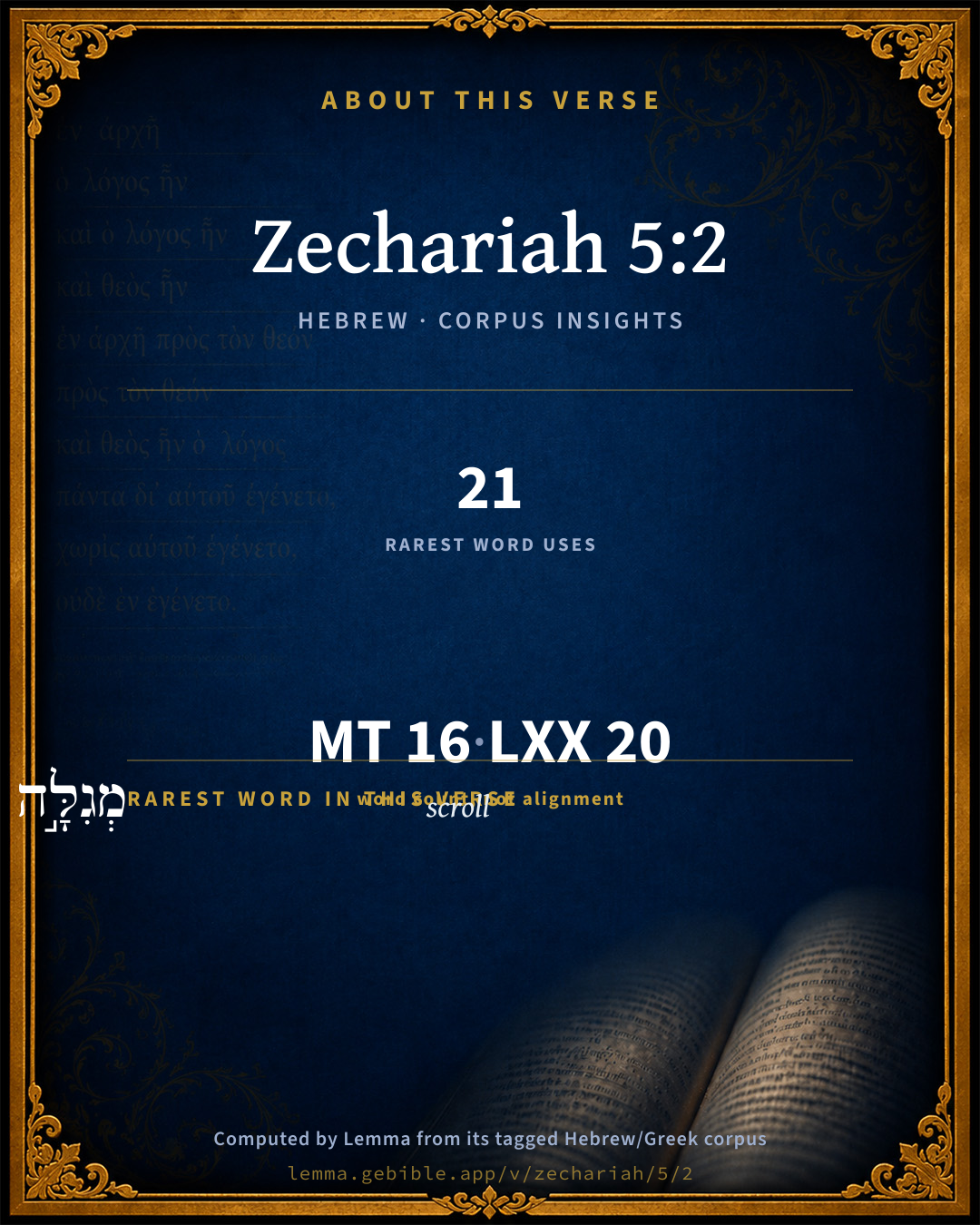
The rarest word here is מְגִלָּ֣ה scroll H4039 — appearing just 21 times in the whole Hebrew Bible.

Shared distinctive vocabulary

מְגִלָּ֣ה scroll H4039 occurs in 19 verses of the Hebrew Bible. Also found in:

Grammatical profile

  • 5 verbs
  • 5 nouns
  • 2 adjectives
  • 2 pronouns
  • 1 preposition
  • 1 particle

Verb forms

  • וַיֹּ֣אמֶר Qal · Sequential Imperfect
  • רֹאֶ֑ה Qal · Participle Active
  • וָאֹמַ֗ר Qal · Sequential Imperfect
  • רֹאֶה֙ Qal · Participle Active
  • עָפָ֔ה Qal · Participle Active

Repetition

Words recur within this verse — often emphatic in Hebrew:

  • וַיֹּ֣אמֶר to say H559 ×2
  • רֹאֶ֑ה to see H7200 ×2
  • בָּֽאַמָּ֔ה cubit H520 ×2

Hebrew & Septuagint length

In English translation the verse runs 25 words from the Hebrew and 29 from the Septuagint (LXX English) — closely comparable.

A rough comparison of the two English renderings, which tokenize alike — not a word-level alignment.

Word counts can differ between the Hebrew and the Greek without any difference in meaning — e.g. the Hebrew direct-object marker אֵת has no separate Greek word, and Greek often adds the article ὁ.

In the original languages it is 16 Hebrew tokens and 20 Greek tokens — but the two are counted differently (Hebrew bundles its prefixes and suffixes into one token; the Greek is in lemma form), so that isn’t a like-for-like length.

Cross-references

7

Topical passages linked to Zechariah 5:2 in the Treasury of Scripture Knowledge — connected by theme and wording, ordered by reader-vote popularity; previews shown in the World English Bible.

  • Genesis 6:11–13 The earth was corrupt before God, and the earth was filled with violence.
  • Jeremiah 1:11–14 Moreover the word of Yahweh came to me, saying, Jeremiah, what see you? I said, I see a rod of an almond tree.
  • Amos 7:8 Yahweh said to me, "Amos, what do you see?" I said, "A plumb line." Then the Lord said, "Behold, I will set a plumb line in the midst of my people Israel. I will not again pass by them any more.
  • Zephaniah 1:14 The great day of Yahweh is near. It is near, and hurries greatly, the voice of the day of Yahweh. The mighty man cries there bitterly.
  • Zechariah 4:2 He said to me, "What do you see?" I said, "I have seen, and, behold, a lampstand all of gold, with its bowl on the top of it, and its seven lamps thereon; there are seven pipes to each of the lamps, which are on the top of it;
  • 2 Peter 2:3 In covetousness they will exploit you with deceptive words: whose sentence now from of old doesn't linger, and their destruction will not slumber.
  • Revelation 18:5 for her sins have reached to the sky, and God has remembered her iniquities.

Cross-references courtesy of OpenBible.info (CC BY 4.0).

Hebrew and Greek witnesses Masoretic Hebrew ↔ Greek Septuagint

The same verse in the two great witnesses to the Old Testament, shown verse-for-verse.

These are two independent witnesses, not word-aligned to each other, and the Septuagint is shown in lemma (dictionary) form.

Hebrew Zechariah 5:2 Masoretic · Westminster Leningrad Codex

וַיֹּ֣אמֶר אֵלַ֔י מָ֥ה אַתָּ֖ה רֹאֶ֑ה וָאֹמַ֗ר אֲנִ֤י רֹאֶה֙ מְגִלָּ֣ה עָפָ֔ה אָרְכָּהּ֙ עֶשְׂרִ֣ים בָּֽאַמָּ֔ה וְרָחְבָּ֖הּ עֶ֥שֶׂר בָּאַמָּֽה

He said to me, "What do you see?" I answered, "I see a flying scroll; its length is twenty cubits, and its breadth ten cubits."

World English Bible · Public Domain

Greek LXX Zechariah 5:2 Septuagint · lemma form

καί εἶπον πρός ἐγώ τίς σύ βλέπω καί εἶπον ἐγώ ὁράω δρέπανον πέτομαι μῆκος πῆχυς εἴκοσι καί πλάτος πῆχυς δέκα

And he said to me, What see you? And I said, I see a flying sickle, of the length of twenty cubits, and of the breadth of ten cubits.

LXX2012 (modern English Septuagint) · Public Domain

On this verse, Trapp's Complete Commentary discusses the Septuagint’s reading. Read the note in Commentary ↓

Hebrew: Westminster Leningrad Codex (CC BY 4.0). Greek: Septuagint (public domain); English from LXX2012 (modern English Septuagint) (Public Domain). How the Septuagint differs from the Hebrew →

Targum (Aramaic paraphrase)

1

The Targum is the ancient Jewish Aramaic paraphrase of the Hebrew Scriptures — an interpretive translation, not the Hebrew text itself. Onkelos (literal) and Pseudo-Jonathan (expansive) render the Torah, and Jonathan the Prophets. Coverage is partial: where no permissively-licensed English translation exists for a verse, only the Aramaic is shown. This is verse-level text, not a word-by-word alignment to the Hebrew.

  1. Targum Jonathan Prophets (Joshua–Malachi)
    וַאֲמַר לִי מָה אַתְּ חָזֵי וַאֲמָרֵית אֲנָא חָזֵי מְגִלָה פָּרְחָא אוּרְכָּהּ עַשְׂרִין אַמִין וּפוּתְיָהּ עֲשַׂר אַמִין:

    (no public-domain English translation for this verse)

    Targum Jonathan — Aramaic: “Mikraot Gedolot” (public domain). English: “Sefaria Community Translation” (CC0 1.0 (public-domain dedication)); “London "Chaldee Paraphrase," 1871” (public domain). Text via Sefaria.

Commentary

Notes on Zechariah 5:2 from classic Christian and Jewish commentators (each source and its license shown beneath its notes). The classic Christian expositions comment on the surrounding passage and are grouped to its opening verse, so a note may address several verses; the Jewish commentaries on the Tanakh (Rashi and others) are per-verse, so they appear only where the commentator wrote on this verse.

Lemma curates 59 commentaries, every one of them public domain or Creative Commons licensed, each selected and text-cleaned for this edition rather than reprinted as found. About our sources →

Trapp's Complete Commentary

John Trapp

Zec 5:2 And he said unto me, What seest thou? And I answered, I see a flying roll; the length thereof [is] twenty cubits, and the breadth thereof ten cubits.

Ver. 2. What seest thou?] q.d. Mark it well, and let thine eye affect thine heart; let these things be oculis commissa fidelibus.

I see a flying book] {See Trapp on "Zec 5:1"} Some read it, A double book (according to the Chaldaic signification of the word), as containing double, that is, manifold, menaces and punishments of sin. But the Chaldee paraphrast, Septuagint, and others, render it flying; as hasting and hovering over the heads of wicked persons.

The length thereof is twenty cubits, &c.] Ten yards long, and five broad. Neither let men say that words are but wind, as they did, Jer 5:13. For, 1. Even wind, when gotten into the bowels of the earth, may cause an earthquake; as when into the bowels of the body a heartquake. 2. God threateneth those scoffers, Jer 5:14, that he will make that word, which they termed wind, to become fire, and themselves fuel to feed it. And as fire grows quickly upon fuel fully dried, Nah 1:10, and consumeth it in an instant, so God’s flying roll will lick up the evildoers, no otherwise than the fire from heaven after it had consumed the sacrifice, the wood, the stones, and the dust, licked up also the water that was in the trench, 1Ki 18:38. The threatenings of God’s law (the same with this roll) are (as Erasmus saith of Eze 3:18) fulmina non verba, lightbolts rather than words; or if words, yet they are (as one saith) verba non legenda sed vivenda, words not to be read only, but lived; at least, not to be read as men do the old stories of foreign wars, wherein they are nothing concerned (but as threatening themselves in every threat, cursing themselves in every curse, &c.), nor as they read the predictions of an almanack for wind and weather, which they think may come to pass, and it may be not; but be confident of this very thing, that God who hath denounced it will surely do it, and that he will execute the judgment written in this roll, Psa 149:9, yea, every sickness and every plague which is not written in the book of this law, them will the Lord cause to descend upon the disobedient, until they be destroyed, Deu 28:61.

John Trapp, A Commentary or Exposition upon All the Books of the Old and New Testament (1647–1656) — public domain. Text from a community e-Sword module.

Joseph Benson's Commentary

Zec 5:2-4. The length thereof is twenty cubits, &c. — Such scrolls for writing were usually longer than they were broad; so this was represented as ten yards in length, and five in breadth. The roll was very large, to show what a number of curses would come upon the wicked. Then said he, This is the curse, &c. — This roll, or book, contains the curses, or judgments, due to sinners, particularly sinners of the Jews, who have been favoured with greater light and privileges than other people, and whose sins, therefore, are the more inexcusable. That goeth over the face of the whole earth — Or rather, of the whole land; for the land of Judea only seems to be here meant. Every one that stealeth shall be cut off as on this side, &c. — The roll was written on both sides, as that mentioned Eze 2:10 : and on one side were contained the judgments against stealing, and on the other against false swearing. These two sins are joined together, because in the Jewish courts men were compelled to purge themselves by oath, in case they were accused of theft; and they often would forswear themselves rather than discover the truth. Considering the time when Zechariah prophesied, it seems probable, that those who made use of fraud with respect to what had been dedicated to the rebuilding of the temple, and restoring the service of God, are here particularly referred to. According to Calmet, under the two names of theft and false swearing, the Hebrews and Chaldeans included all other crimes; theft denoting every injustice and violence executed against men, and perjury all crimes committed against God. Instead of on this side, and on that side, Newcome reads, from hence, namely, from the land. And instead of shall be cut off, the Vulgate reads, judicabitur, shall be judged; and Houbigant, shall be punished. It must be acknowledged, however, that the Hebrew word נקה, so rendered, rather means, carries himself as innocent, or, asserts himself to be innocent; or, is declared innocent, or, left unpunished, namely, by the magistrate. Blayney therefore translates the clause, Because, on the one hand, every one that stealeth is as he that is guiltless; and, on the other hand, every one that sweareth is as he that is guiltless. On which he observes, “The reason assigned for the curse going forth through the whole land is, that the good and the bad, the innocent and the guilty, were in every part of it looked upon and treated alike; so that it was time for the divine justice to interpose, and make the proper distinction between them.” And it shall enter, &c. — This curse shall come with commission from me; into the house of the thief — Where he had laid up that which he got by theft, thinking to enjoy it to his satisfaction. Or, by his house may be understood his family, estate, and goods: it shall take hold of him, and all that belong to him, and shall never leave them till their are utterly destroyed. And it shall remain in the midst of the house — It shall stick close to them and theirs, as Gehazi’s leprosy did to him and his posterity; or, like the leprosy that infects a house, and cannot be purged till the house itself be pulled down.

Joseph Benson's Commentary on the Old and New Testaments (1811–1818) — public domain. Text from a community e-Sword module.

Geneva Bible (1599)

Geneva Bible translators

Because the Jews had provoked God’s plagues by contemning his word, and casting off all judgment and equity, he showeth that God’s curses written in this book had justly light both on them and their fathers: but now if they would repent, God would send the same among the Chaldeans their former enemies.

Geneva Bible (1599) marginal notes — public domain. Text via Bolls.life.

Jamieson, Fausset & Brown

Robert Jamieson, A. R. Fausset & David Brown

length . . . twenty cubits . . . breadth . . . ten cubits--thirty feet by fifteen, the dimensions of the temple porch (Kg1 6:3), where the law was usually read, showing that it was divinely authoritative in the theocracy. Its large size implies the great number of the curses contained. The Hebrew for "roll" or "volume" is used of the law (Psa 40:7).

Jamieson, Fausset & Brown — Commentary Critical and Explanatory on the Whole Bible (1871) — public domain (CC PDM 1.0). Text via the HelloAO Bible API.

John Calvin's Commentaries

He afterwards adds, that he was asked by the angel what he saw. He might indeed have said, that a roll flying in the air appeared to him, but he did not as yet understand what it meant; hence the angel performed the office of an interpreter. But he says, that the roll was twenty cubits long, and ten broad. The Rabbis think that the figure of the court of the temple is here represented, for the length of the court was twenty cubits and its breadth was ten; and hence they suppose, that the roll had come forth from the temple, that there might be fuller reason to believe that God had sent forth the roll. And this allusion, though not sufficiently grounded, is yet more probable than the allegory of the puerile Jerome, who thinks that this ought to be applied to Christ, because he began to preach the gospel in his thirtieth year. Thus he meant to apply this number to the age of Christ, when he commenced his office as a teacher. But this is extreme trifling. I do not feel anxious to know why the length or the breadth is mentioned; for it seems not to be much connected with the main subject. But if it be proper to follow a probable conjecture, what I have already referred to is more admissible — that the length and breadth of the roll are stated, that the Jews might fully understand that nothing was set before them but what God himself sanctioned, as they clearly perceived a figure of the court of the temple.

John Calvin's Commentaries (1540-1563) — public domain. Text from the Calvin Translation Society English edition (1840s-50s) via the Christian Classics Ethereal Library (ccel.org). Calvin's coverage is partial (roughly two-thirds of the Bible); uncommented books and verses are honest gaps, never fabricated. The 19th-century editor's footnotes and remarks are omitted so the notes are faithfully Calvin's own voice.

Ellicott's Commentary for English Readers

(2) He.—The angel-interpreter. (Comp. Zec_5:5.)

The length . . . and the breadth . . .—These were the dimensions of the holy place of the Mosaic Tabernacle, also of the porch of Solomon’s Temple. If, then, we are to consider the measurement of the scroll as symbolical, we may regard it as indicating that the measure of the sanctuary is the measure of sin: that is, the sinner must not say, “I am not worse than my neighbour,” but should measure his conduct by the standard: “Become ye holy, for I am holy” (Lev_11:44; comp. Mat_5:48).

A Bible Commentary for English Readers, edited by Charles John Ellicott (1878–1897) — public domain. Text from a community e-Sword module.

The Cambridge Bible for Schools and Colleges

gen. ed. J. J. S. Perowne

2. the length thereof &c.] The roll was unfolded and opened out. The dimensions of the roll seem merely to be mentioned as an expression of the prophet’s wonder at its size. The beholder of such a strange apparition in the heavens would not unnaturally say how large he took it to be.

The Cambridge Bible for Schools and Colleges (gen. ed. J. J. S. Perowne; Cambridge University Press, 1878–1918) — public domain. Text from a community e-Sword module.

John Gill's Exposition

And he said unto me,.... That is, the angel:

What seest thou? and I answered, I see a flying roll, the length whereof is twenty cubits, and the breadth thereof ten cubits; so that it was a very large one, a volume of a very uncommon size, especially it may so seem to us; but in other nations they have very long rolls or volumes, even longer than this: the Russians write their acts, protests, and other court matters, on long rolls of paper, some twenty ells, some thirty, and some sixty, and more (x): and this being the length and breadth of the porch before the temple, Kg1 6:3 hence the Jewish writers conclude that this flying roll came from thence: it may design either the roll or book in which the sins of men are written; which is very large, and will quickly be brought into judgment, when it will be opened, and men will be judged according to it; which shows the notice God takes of the sins of men; the exact knowledge he has of them; his strict remembrance of them; and the certain account men must give of them another day: or, the book of God's judgments upon sinners, such as was Ezekiel's roll, Eze 2:9 which are many and great; are rolled up, and not at present to be searched into; but are flying, coming on, and will be speedily executed: or rather the book of the law, called a roll or volume, Psa 40:7 and which will be a swift witness against the breakers of it, as more fully appears from the explanation of it in the next verse Zac 5:3. It is a mere fancy and conceit of some that the Talmud is meant by this roll, the body of the Jewish traditions, which make void the commands of God, take away the blessing, and leave a curse in the land, as they did in the land of Judea.

(x) Eskuche apud Burkium in loc.

John Gill's Exposition of the Whole Bible (1746–1763) — public domain (CC PDM 1.0). Text via the HelloAO Bible API.

Albert Barnes' Notes on the Bible

And he - (the interpreting angel) said unto me It cannot be without meaning, that the dimensions of the roll should be those of the tabernacle , as the last vision was that of the candlestick, after the likeness of the candlestick therein. The explanations of this correspondence do not exclude each other. It may be that “judgment shall begin at the house of God” 1Pe 4:17; that the punishment on sin is proportioned to the nearness of God and the knowledge of Him; that the presence of God, which was for life, might also be to death, as Paul says; “God maketh manifest the savor of this knowledge by us in every place; for we are unto God a sweet savor of Christ in them that are saved and in them that perish; to the one we are the savor of death unto death, and to the other the savor of life unto life” 2Co 2:14-16; and Simeon said, “This child is set for the fall and rising again of many in Israel” Luk 2:34.

Albert Barnes' Notes on the Bible (1834–1885) — public domain. Text from a community e-Sword/MySword module.

Haydock's Catholic Bible Commentary

Cubits, alluding to Judea, which was twice as long as it was broad. (Menochius) --- Many explain this vision and that of the woman, (ver. 7) of the Jews, (Calmet) after St. Jerome. (Haydock) --- But is seems rather to denote the Chaldeans, whose sentence had been long pronounced, and who were punished by the Persians, and by the Greeks, as by two women. If we understand the Jews, their iniquity was chastised by the Assyrians and Chaldeans. (Calmet)

George Leo Haydock (1774–1849), Haydock's Catholic Family Bible and Commentary, 1859 edition — public domain. Excludes Psalms (Douay-Rheims chapter numbering differs from Protestant) and Deuterocanonical books (Catholic canon only).

Matthew Poole's English Annotations

And he; the angel, Zec 4:1,5.

What seest thou, O Zechariah?

The length thereof is twenty cubits; that is, ten yards long; by this it appears the roll was spread out, for had it been rolled up he could not have seen the length, though he did the breadth, five yards.

Matthew Poole's English Annotations on the Holy Bible (1683–1685) — public domain. Text from a community e-Sword/MySword module.

Whedon's Commentary on the Bible

Daniel D. Whedon

2. The interpreting angel calls the attention of the prophet to the new vision by means of a question (compare Zec_4:2, and see references there). The roll was unfolded, so that its immense size could be recognized.

Length… twenty cubits… the breadth… ten cubits — The measurements of the porch of Solomon’s temple (1Ki_6:3) and of the holy place in the tabernacle, as it may be determined from Exodus 26, and as it is given by Josephus (Antiquities, iii, Zec_6:4). The exact figures may have been suggested by one or the other of these places, but it is not probable that they possess any special symbolic meaning; all they are intended to do is to indicate the great size of the roll. The Hebrews appear to have used two cubits, one a little longer than the other, but the data are insufficient to determine the exact length of either; the length of the common cubit is estimated at approximately eighteen inches (see Hastings’s Dictionary of the Bible, article “Weights and Measures”).

The interpretation is given in Zec_5:3-4.

This is the curse — We must think of the roll as inscribed, perhaps upon both sides, with a curse or curses, similar to those in Deu_27:15-26; Deu_28:15-68, though there is no reason to suppose that the prophet has in mind these curses.

The whole earth — Better, R.V., “land.” Zec_5:6 and especially Zec_5:11 clearly show that the reference is to Palestine or Judah, or at the most to the extended Judah (Zec_2:11). Two classes of criminals are singled out.

Shall be cut off — The Hebrew verb is used ordinarily in the sense of acquit, free from guilt; in this passage most commentators take it in a physical sense, clear away — cut off, or destroy (Isa_3:26).

On this side — R.V., “on the one side”; better, margin, “from hence,” that is, from the land.

According to it — According to the curses inscribed upon the roll. Some commentators insist that the more common meaning of the verb should be retained; if that is done the text of the rest of the verse must be changed. Wellhausen reads, “For everyone that stealeth hath for long remained unpunished, and everyone that sweareth hath for long remained unpunished”; therefore Jehovah is sending his judgment.

Everyone that sweareth — Must be interpreted in the light of Zec_5:4 as equivalent to “everyone that sweareth falsely by my name.” The Old Testament does not condemn swearing per se; it condemns only false swearing (compare Hos_4:2); Mat_5:34 ff., is on the New Testament level.

I will bring it forth — Better and literally, I have caused it to go forth: it has already started on its mission of judgment. Its destination is the houses of the evil doers.

Shall remain — Literally, lodge over night; but it will not sleep.

Shall consume — Not only will it announce the judgment, it will execute it.

It — The house, including the inhabitants.

With the timber thereof and the stones thereof — That is, utterly.

Only two forms of wickedness are specified, stealing and false swearing. It is hardly likely, however, that these were the only sins recognized or prevalent in the days of Zechariah; it seems better to regard these as types of two classes of wickedness, stealing as representing all sins committed against man, false swearing by the name of Jehovah as representing all sins committed against Jehovah. Under these two heads all forms of sin may be grouped, as in the Decalogue. If this is done the vision symbolizes the destruction of sinners of every sort.

Daniel D. Whedon (gen. ed.), Commentary on the Old and New Testaments (1874–1909) — public domain. Text from a community e-Sword module.

The Pulpit Commentary

He said. The angel-interpreter spoke. (Zec_4:2) The length thereof, etc. Taking the cubit at a foot and a half, the size of the roll is enormous, and may well have aroused the prophet"s wonder. The dimensions given correspond to those of the porch of Solomon"s temple, (1Ki_6:3) twenty cubits long by ten broad. These are also the dimensions of the holy place in the tabernacle, and of Solomon"s brazen altar. (2Ch_4:1) The careful statement of the size of the roll indicates that some special meaning is attached to these measurements. We do not know that any symbolical signification was recognized in the porch of the temple; but these dimensions may well contain a reference to the sanctuary and the altar, as Knabenbauer explains, "The curse is of the same measure as that altar which was the instrument of expiation and reconciliation, and as that sanctuary which was the entrance to the holy of holies." Others consider that the curse is pronounced according to the measure of the sanctuary, i.e. according to the Divine Law; or that all might thus know that it came from God, and that the possession of the temple did not secure the people from vengeance unless they were pure and obedient.

The Pulpit Commentary (1880–1919), ed. H.D.M. Spence-Jones & Joseph S. Exell — public domain. Text from a community e-Sword module.

Lesson kit

Teaching starters — assembled from the data on this page, not authored interpretation. Every prompt links to the verse data it draws on. Edit before teaching.

Zechariah, in the Prophets, opens this verse with 16 words (13 distinct Hebrew lemmas). Its most distinctive word is mᵉgillâh (“scroll”). A historical commentator’s framing appears above. Read the whole chapter for the surrounding context.

Discussion questions

  1. What does “scroll” (mᵉgillâh) contribute to the verse as a whole?
  2. Psalms 40:7 shares the word «scroll» with this verse. How do the two illuminate each other?
  3. “to say” occurs 2× in this one verse. What is the effect of the repetition?
  4. The translations on this page render this verse differently — a whole-verse word diff, not a word-by-word alignment. What might account for the different wordings?
  5. The verb «וַיֹּ֣אמֶר» is Qal Sequential Imperfect. How does its form color the action?
  6. Reading how Trapp's Complete Commentary and Joseph Benson's Commentary read this verse, where do the two commentators agree and where do they part?

Things to notice

Reading settings

Reading text

Shown beneath each verse's original-language words.

Old Testament
Old Testament edition

Read the OT as the Masoretic Hebrew (MT) or the Greek Septuagint (LXX).

English shown for the Greek Septuagint (in the Hebrew ↔ Greek comparison).

Comparing translations? Open the Compare panel on any verse page to stack up to four side by side.