
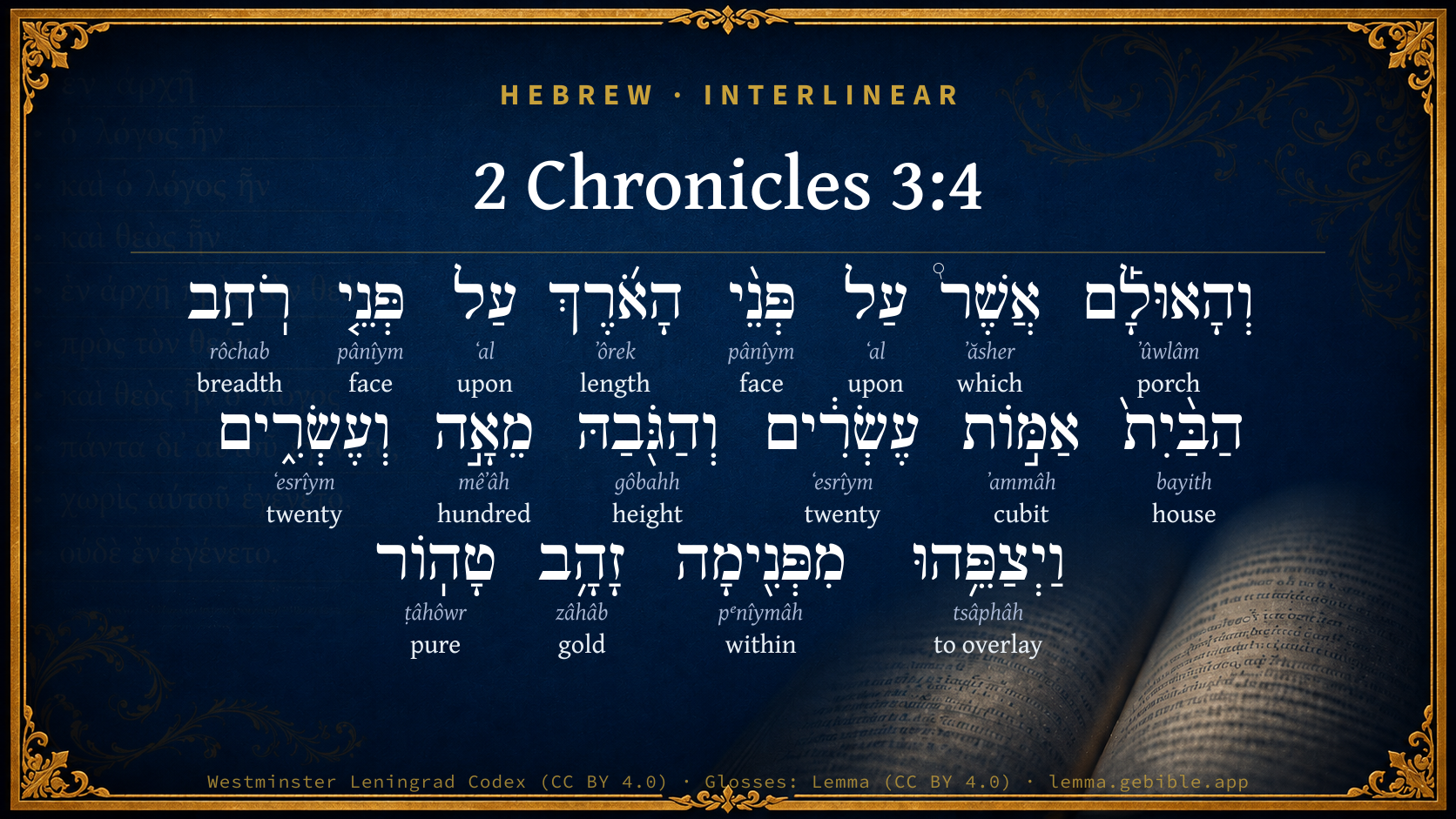
2 Chronicles 3:4

Hebrew (Westminster Leningrad Codex) 2 Chronicles 3:4 appears in the Hebrew Old Testament. The text above is from the Westminster Leningrad Codex. Each word links to its Strong’s number, a concise gloss, and parsing drawn from the Open Scriptures Hebrew Bible morphology. Click any word for its full Brown-Driver-Briggs (BDB) entry.
Download image
Cite this verse

2 Chronicles 3:4 (World English Bible). Public Domain. Lemma interlinear Bible study tool, https://lemma.gebible.app/v/2-chronicles/3/4.

Show BibTeX & RIS
BibTeX
RIS
English Translation
The porch that was before [the house], the length of it, according to the breadth of the house, was twenty cubits, and the height one hundred twenty; and he overlaid it within with pure gold.
World English Bible · Public Domain
Download a study sheet

One document with this verse’s original text, its word-by-word gloss line, the meaning frame, cross-references with their text, attributed commentary, and full source and license credits — printable, and it pastes into notes with its structure intact.

This verse Autodidact and up

Study sheet (.html) Plain text (.txt)

A passage Seminary Student

Up to 50 verses in one chapter. A passage sheet keeps up to 6 commentary sources and 12 cross-references per verse, in the order this page ranks them, and says so on the sheet whenever that leaves anything out. Ask for a single verse and you get the Autodidact verse sheet above.

Everything on this page stays free to read, with no account — the sheet is a download of what is already on screen, not access to it.

Want to remove ads? Support Godless Engineer
Compare translations 3

The same verse in 3 English versions, stacked beneath the original-language interlinear above. Click any original word for its lexicon entry.

Each is an independent rendering of the whole verse — the interlinear is not word-aligned to these translations.

Highlighted words mark where these versions differ — a whole-verse word diff, not a word-by-word alignment.

  • World English Bible Public Domain
    The porch that was before [the house], the length of it, according to the breadth of the house, was twenty cubits, and the height one hundred twenty; and he overlaid it within with pure gold.
  • King James Version Public Domain
    And the porch that was in the front of the house, the length of it was according to the breadth of the house, twenty cubits, and the height was an hundred and twenty: and he overlaid it within with pure gold.
  • unfoldingWord Literal Text CC BY-SA 4.0
    And the porch which is at the front, the length on the front of the width of the house, 20 cubits, and the height, 120. And he overlaid it from within with pure gold.

unfoldingWord Literal Text — © unfoldingWord, licensed CC BY-SA 4.0. Word-aligned USFM3 via Door43 (git.door43.org/unfoldingWord/en_ult).

Versions to compare (up to 4)

3 of 4 selected

Show all 18 translations

Every available English version of this verse, each an independent rendering of the whole verse.

  • World English Bible Public Domain
    The porch that was before [the house], the length of it, according to the breadth of the house, was twenty cubits, and the height one hundred twenty; and he overlaid it within with pure gold.
  • Berean Standard Bible Public Domain
    The portico at the front, extending across the width of the temple, was twenty cubits long and twenty cubits high. He overlaid the inside with pure gold.
  • Majority Standard Bible Public Domain
    The portico at the front, extending across the width of the temple, was twenty cubits long and twenty cubits high. He overlaid the inside with pure gold.
  • King James Version Public Domain
    And the porch that was in the front of the house, the length of it was according to the breadth of the house, twenty cubits, and the height was an hundred and twenty: and he overlaid it within with pure gold.
  • American Standard Version (1901) Public Domain
    And the porch that was before `the house', the length of it, according to the breadth of the house, was twenty cubits, and the height a hundred and twenty; and he overlaid it within with pure gold.
  • Revised Version (1885) Public Domain
    And the porch that was before the house, the length of it, according to the breadth of the house, was twenty cubits, and the height an hundred and twenty: and he overlaid it within with pure gold.
  • Geneva Bible (1599) Public Domain
    And the porch, that was before the length in the front of the breadth was twentie cubits, and the height was an hundreth and twentie, and he ouerlayd it within with pure golde.
  • Douay-Rheims (1899) Public Domain
    And the porch in the front, which was extended in length according to the measure of the breadth of the house, twenty cubits: and the height was a hundred and twenty cubits: and he overlaid it within with pure gold.
  • Young's Literal Translation Public Domain
    As to the porch that `is' on the front, the length `is' by the front of the breadth of the house, twenty cubits, and the height a hundred and twenty, and he overlayeth it within with pure gold.
  • Literal Standard Version CC BY-SA 4.0
    As for the porch that [is] on the front, the length [is] by the front of the breadth of the house—twenty cubits, and the height one hundred and twenty [[or twenty]], and he overlays it within with pure gold.
  • Unlocked Literal Bible CC BY-SA 4.0
    The length of the portico at the front of the house was twenty cubits, matching the building's width. Its height was also twenty cubits, and Solomon overlaid its interior with pure gold.
  • unfoldingWord Literal Text CC BY-SA 4.0
    And the porch which is at the front, the length on the front of the width of the house, 20 cubits, and the height, 120. And he overlaid it from within with pure gold.
  • Darby Bible Public Domain
    And the porch which was in front was twenty cubits in length, in front of the house broadways, and the height was a hundred and twenty; and he overlaid it within with pure gold.
  • World Messianic Bible Public Domain
    The porch that was in front, its length, across the width of the house, was twenty cubits, and the height one hundred twenty; and he overlaid it within with pure gold.
  • Webster's Bible Public Domain
    And the porch that was in the front of the house, the length of it was according to the breadth of the house, twenty cubits, and the hight was a hundred and twenty: and he overlaid it within with pure gold.
  • Free Bible Version CC BY-SA 4.0
    The front porch that ran across the width of the Temple was twenty cubits long and twenty cubits high. He covered the inside of the porch with pure gold.
  • Bible in Basic English Public Domain
    And the covered way in front of the house was twenty cubits long, as wide as the house, and a hundred and twenty cubits high, all plated inside with the best gold.
  • JPS Tanakh (1917) Public Domain
    And the porch that was before the house, the length of it, according to the breadth of the house, was twenty cubits, and the height a hundred and twenty; and he overlaid it within with pure gold.

Literal Standard Version (2020), Covenant Press — licensed CC BY-SA 4.0. Text via the HelloAO Bible API (eBible.org). Unlocked Literal Bible (unfoldingWord) — licensed CC BY-SA 4.0. Text via the HelloAO Bible API (eBible.org). unfoldingWord Literal Text — © unfoldingWord, licensed CC BY-SA 4.0. Word-aligned USFM3 via Door43 (git.door43.org/unfoldingWord/en_ult). Free Bible Version, Dr. Jonathan Gallagher — licensed CC BY-SA 4.0. Text via the HelloAO Bible API (eBible.org).

Word by word

More ways to search: Search by grammar → Find every occurrence → Compare this word →

Practice this passage: Drill this verse → Learn its vocabulary →

מִפְּנִ֖ימָה
pᵉnîymâh
H6441
“from · within”
Preposition + Adverb
Part of Speech
Preposition + Adverb
Full BDB Definition

Origin: from H6440 with directive enclitic

TWOT: 1782c

toward the inside, within, faceward
  1. וְהָאוּלָ֡ם ʼûwlâm H197 “and · the · porch” Conjunction + Particle, Definite Article + Noun, Common, Masculine, Singular, Absolute
  2. אֲשֶׁר֩ ʼăsher H834 “which” Particle, Relative
  3. עַל ʻal H5921 “upon” Preposition
  4. פְּנֵ֨י pânîym H6440 “face(s) of” Noun, Common, Both, Plural, Construct
  5. הָאֹ֜רֶךְ ʼôrek H753 “the · length” Particle, Definite Article + Noun, Common, Masculine, Singular, Absolute
  6. עַל ʻal H5921 “upon” Preposition
  7. פְּנֵ֤י pânîym H6440 “face(s) of” Noun, Common, Both, Plural, Construct
  8. רֹֽחַב rôchab H7341 “breadth of” Noun, Common, Masculine, Singular, Construct
  9. הַבַּ֨יִת֙ bayith H1004 “the · house” Particle, Definite Article + Noun, Common, Masculine, Singular, Absolute
  10. אַמּ֣וֹת ʼammâh H520 “cubits” Noun, Common, Feminine, Plural, Absolute
  11. עֶשְׂרִ֔ים ʻesrîym H6242 “twenty” Adjective, Cardinal number, Both, Plural, Absolute
  12. וְהַגֹּ֖בַהּ gôbahh H1363 “and · the · height” Conjunction + Particle, Definite Article + Noun, Common, Masculine, Singular, Absolute
  13. מֵאָ֣ה mêʼâh H3967 “hundred” Adjective, Cardinal number, Both, Singular, Absolute
  14. וְעֶשְׂרִ֑ים ʻesrîym H6242 “and · twenty” Conjunction + Adjective, Cardinal number, Both, Plural, Absolute
  15. וַיְצַפֵּ֥הוּ tsâphâh H6823 “and · to overlay · him” Conjunction + Verb, Piel, Sequential Imperfect, 3rd Person, Masculine, Singular + Suffix, Personal, 3rd Person, Masculine, Singular
  16. זָהָ֥ב zâhâb H2091 “gold” Noun, Common, Masculine, Singular, Absolute
  17. טָהֽוֹר ṭâhôwr H2889 “pure” Adjective, Adjective, Masculine, Singular, Absolute

About this verse

These counts appear in no published source. They are computed here, from the morphology-tagged text and Lemma’s own curated glosses. What Lemma adds →

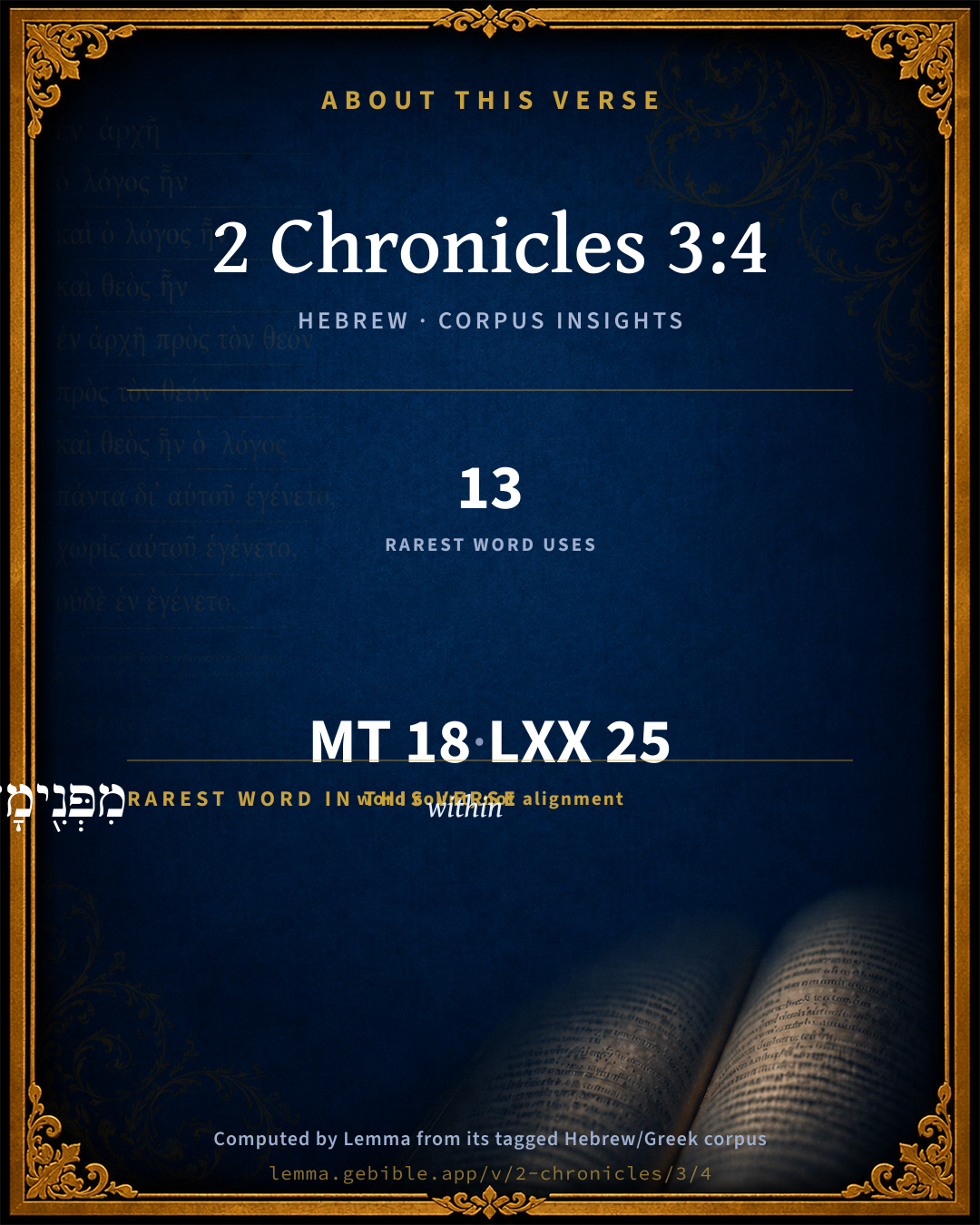
18
words
15
distinct lemmas
Historical
section

Notable vocabulary

The rarest word here is מִפְּנִ֖ימָה within H6441 — appearing just 13 times in the whole Hebrew Bible.

Shared distinctive vocabulary

מִפְּנִ֖ימָה within H6441 occurs in 12 verses of the Hebrew Bible. Also found in:

Grammatical profile

  • 1 verb
  • 9 nouns
  • 4 adjectives
  • 2 prepositions
  • 1 adverb
  • 1 particle

Verb forms

  • וַיְצַפֵּ֥הוּ Piel · Sequential Imperfect

Repetition

Words recur within this verse — often emphatic in Hebrew:

  • עַל upon H5921 ×2
  • פְּנֵ֨י face H6440 ×2
  • עֶשְׂרִ֔ים twenty H6242 ×2

Hebrew & Septuagint length

In English translation the verse runs 35 words from the Hebrew and 37 from the Septuagint (LXX English) — closely comparable.

A rough comparison of the two English renderings, which tokenize alike — not a word-level alignment.

Word counts can differ between the Hebrew and the Greek without any difference in meaning — e.g. the Hebrew direct-object marker אֵת has no separate Greek word, and Greek often adds the article ὁ.

In the original languages it is 18 Hebrew tokens and 25 Greek tokens — but the two are counted differently (Hebrew bundles its prefixes and suffixes into one token; the Greek is in lemma form), so that isn’t a like-for-like length.

Cross-references

3

Topical passages linked to 2 Chronicles 3:4 in the Treasury of Scripture Knowledge — connected by theme and wording, ordered by reader-vote popularity; previews shown in the World English Bible.

  • John 10:23 It was winter, and Jesus was walking in the temple, in Solomon's porch.
  • Acts 3:11 As the lame man who was healed held on to Peter and John, all the people ran together to them in the porch that is called Solomon's, greatly wondering.
  • Acts 5:12 By the hands of the apostles many signs and wonders were done among the people. They were all with one accord in Solomon's porch.

Cross-references courtesy of OpenBible.info (CC BY 4.0).

Hebrew and Greek witnesses Masoretic Hebrew ↔ Greek Septuagint

The same verse in the two great witnesses to the Old Testament, shown verse-for-verse.

These are two independent witnesses, not word-aligned to each other, and the Septuagint is shown in lemma (dictionary) form.

Hebrew 2 Chronicles 3:4 Masoretic · Westminster Leningrad Codex

וְהָאוּלָ֡ם אֲשֶׁר֩ עַל פְּנֵ֨י הָאֹ֜רֶךְ עַל פְּנֵ֤י רֹֽחַב הַבַּ֨יִת֙ אַמּ֣וֹת עֶשְׂרִ֔ים וְהַגֹּ֖בַהּ מֵאָ֣ה וְעֶשְׂרִ֑ים וַיְצַפֵּ֥הוּ מִפְּנִ֖ימָה זָהָ֥ב טָהֽוֹר

The porch that was before [the house], the length of it, according to the breadth of the house, was twenty cubits, and the height one hundred twenty; and he overlaid it within with pure gold.

World English Bible · Public Domain

Greek LXX 2 Chronicles 3:4 Septuagint · lemma form

καί αιλαμ κατά πρόσωπον ὁ οἶκος μῆκος ἐπί πρόσωπον πλάτος ὁ οἶκος πῆχυς εἴκοσι καί ὕψος πῆχυς ἑκατόν εἴκοσι καί καταχρυσόω αὐτός ἔσωθεν χρυσίον καθαρός

And the portico in front of the house, its length in front of the breadth of the house was twenty cubits, and its height one hundred and twenty cubits: and he gilded it within with pure gold.

LXX2012 (modern English Septuagint) · Public Domain

On this verse, Adam Clarke's Commentary discusses the Septuagint’s reading. Read the note in Commentary ↓

Hebrew: Westminster Leningrad Codex (CC BY 4.0). Greek: Septuagint (public domain); English from LXX2012 (modern English Septuagint) (Public Domain). How the Septuagint differs from the Hebrew →

Commentary

Notes on 2 Chronicles 3:4 from classic Christian and Jewish commentators (each source and its license shown beneath its notes). The classic Christian expositions comment on the surrounding passage and are grouped to its opening verse, so a note may address several verses; the Jewish commentaries on the Tanakh (Rashi and others) are per-verse, so they appear only where the commentator wrote on this verse.

Lemma curates 59 commentaries, every one of them public domain or Creative Commons licensed, each selected and text-cleaned for this edition rather than reprinted as found. About our sources →

Trapp's Complete Commentary

John Trapp

2Ch 3:4 And the porch that [was] in the front [of the house], the length [of it was] according to the breadth of the house, twenty cubits, and the height [was] an hundred and twenty: and he overlaid it within with pure gold.

Ver. 4. And the porch.] See on 1Ki 6:3.

And he overlaid it within with pure gold.] Such was Christ’s inside; {Col 2:9} in his outside was no such desirable beauty; so {Isa 53:2} the Church’s glory is inward, {Psa 45:13} in the hidden man of the heart. {1Pe 3:4}

John Trapp, A Commentary or Exposition upon All the Books of the Old and New Testament (1647–1656) — public domain. Text from a community e-Sword module.

Keil & Delitzsch

C. F. Keil & F. Delitzsch

The porch and the interior of the holy place. - Ch2 3:4. The porch which was before (i.e., in front of) the length (of the house), was twenty cubits before the breadth of the house, i.e., was as broad as the house. So understood, the words give an intelligible sense. הארך with the article refers back to הארך in Ch2 3:3 (the length of the house), and על־פּני in the two defining clauses means "in front;" but in the first clause it is "lying in front of the house," i.e., built in front; in the second it is "measured across the front of the breadth of the house."

(Note: There is consequently no need to alter the text according to Kg1 6:3, from which passage Berth. would interpolate the words פּניו על רחבּו בּאמּה ר עשׂר הבּית between על־פּני and הארך, and thereby get the signification: "and the porch which is before the house, ten cubits is its breadth before the same, and the length which is before the breadth twenty cubits." But this conjecture is neither necessary nor probable. It is not necessary, for (1) the present text gives an intelligible sense; (2) the assertion that the length and breadth of the porch must be stated cannot be justified, if for no other reason, for this, that even of the main buildings all three dimensions are not given, only two being stated, and that it was not the purpose of the author of the Chronicle to give an architecturally complete statement, his main anxiety being to supply a general idea of the splendour of the temple. It is not probable; because the chronicler, if he had followed Kg1 6:3, would not have written על־פּניו, but הבּית על־פּני, and instead of הארך would have written וערכּי, to correspond with רחבּו.)

There is certainly either a corruption of the text, or a wrong number in the statement of the height of the porch, 120 cubits; for a front 120 cubits high to a house only thirty cubits high could not be called אוּלם; it would have been a מגדּל, a tower. It cannot with certainty be determined whether we should read twenty or thirty cubits; see in Kg1 6:3. He overlaid it (the porch) with pure gold; cf. Kg1 6:21.

Ch2 3:5-7

The interior of the holy place. - Ch2 3:5. The "great house," i.e., the large apartment of the house, the holy place, he wainscotted with cypresses, and overlaid it with good gold, and carved thereon palms and garlands. חפּה from חפה, to cover, cover over, alternates with the synonymous צפּה in the signification to coat or overlay with wood and gold. תּמּרים .dlo as in Eze 41:18, for תּמּרות, Kg1 6:29, Kg1 6:35, are artificial palms as wall ornaments. שׁרשׁרות are in Exo 28:14 small scroll-formed chains of gold wire, here spiral chain-like decorations on the walls, garlands of flowers carved on the wainscot, as we learn from Kg1 6:18.

Ch2 3:6-7

And he garnished the house with precious stones for ornament (of the inner sides of the walls); cf. Ch1 29:2, on which Bhr on Kg1 6:7 appositely remarks, that the ornamenting of the walls with precious stones is very easily credible, since among the things which Solomon brought in quantity from Ophir they are expressly mentioned (Kg1 10:11), and it was a common custom in the East so to employ them in buildings and in vessels; cf. Symbolik des mos. Cult. i. S. 280, 294, 297. The gold was from פּרוים. This, the name of a place rich in gold, does not elsewhere occur, and has not as yet been satisfactorily explained. Gesen. with Wilson compares the Sanscrit parvam, the first, foremost, and takes it to be the name of the foremost, i.e., eastern regions; others hold the word to be the name of some city in southern or eastern Arabia, whence Indian gold was brought to Palestine. - In Ch2 3:7 the garnishing of the house with gold is more exactly and completely described. He garnished the house, the beams (of the roof), the thresholds (of the doors), and its walls and its doors with gold, and carved cherubs on the walls. For details as to the internal garnishing, decoration, and gilding of the house, see Kg1 6:18, Kg1 6:29, and Kg1 6:30, and for the doors, Kg1 6:32-35.

Keil & Delitzsch — Biblical Commentary on the Old Testament (1861–1891) — public domain (CC PDM 1.0). Text via the HelloAO Bible API. (Old Testament only.)

Geneva Bible (1599)

Geneva Bible translators

From the foundation to the top: for in the book of the kings mention is made from the foundation to the first stage.

It contained as much as did the breadth of the Temple, 1 Kings 6:3.

Geneva Bible (1599) marginal notes — public domain. Text via Bolls.life.

Jamieson, Fausset & Brown

Robert Jamieson, A. R. Fausset & David Brown

the porch--The breadth of the house, whose length ran from east to west, is here given as the measure of the length of the piazza. The portico would thus be from thirty to thirty-five feet long, and from fifteen to seventeen and a half feet broad.

the height was an hundred and twenty cubits--This, taking the cubit at eighteen inches, would be one hundred eighty feet; at twenty-one inches, two hundred ten feet; so that the porch would rise in the form of a tower, or two pyramidal towers, whose united height was one hundred twenty cubits, and each of them about ninety or one hundred five feet high [STIEGLITZ]. This porch would thus be like the propylæum or gateway of the palace of Khorsabad [LAYARD], or at the temple of Edfou.

Jamieson, Fausset & Brown — Commentary Critical and Explanatory on the Whole Bible (1871) — public domain (CC PDM 1.0). Text via the HelloAO Bible API.

Adam Clarke's Commentary

Verse 4. The height was a hundred and twenty] Some think this should be twenty only; but if the same building is spoken of as in 1Kg 6:2, the height was only thirty cubits. Twenty is the reading of the Syriac, the Arabic, and the Septuagint in the Codex Alexandrinus. The MSS. give us no help. There is probably a mistake here, which, from the similarity of the letters, might easily occur. The words, as they now stand in the Hebrew text, are מאה ואשרים meah veesrim, one hundred and twenty. But probably the letters in מאה meah, a hundred, are transposed for אמה ammah, a cubit, if, therefore, the א aleph be placed after the מ mem, then the word will be מאה meah one hundred; if before it the word will be אמה ammah, a cubit; therefore אמה עשרים ammah esrim will be twenty cubits; and thus the Syriac, Arabic, and Septuagint appear to have read. This will bring it within the proportion of the other measures, but a hundred and twenty seems too great a height.

Adam Clarke's Commentary on the Bible (1810–1826) — public domain. Text from a community e-Sword/MySword module.

Ellicott's Commentary for English Readers

(4) And the porch . . . twenty cubits.—Heb., and the porch that was before the length (i.e., that lay in front of the oblong main building), before the breadth of the house, was twenty cubits (i.e., the porch was as. long as the house was broad). This curious statement answers to what we read in 1Ki_6:3 : “And the porch before the hall of the house, twenty cubits was its length, before the breadth of the house.” But the Hebrew is too singular to pass without challenge, and comparison of the versions suggests that we ought to read here: “And the porch which was before it (Syriac), or before the house (LXX.), its length before the breadth of the house was twenty cubits.” This would involve but slight alteration of the Hebrew text. (Comp. 2Ch_3:8.)

And the height was an hundred and twenty. This would make the porch four times the height of the main building, which was thirty cubits. The Alexandrine MS. of the LXX., and the Arabic version, read “twenty cubits;” the Syriac omits the whole clause,, which has no parallel in Kings, and is further suspicious as wanting the word “cubits,” usually expressed after the number (see 2Ch_3:3). The Hebrew may be a corruption of the clause, “and its breadth ten cubits.” (Comp. 1Ki_6:3.)

And he overlaid it within with pure gold.—See 1Ki_6:21.

A Bible Commentary for English Readers, edited by Charles John Ellicott (1878–1897) — public domain. Text from a community e-Sword module.

The Cambridge Bible for Schools and Colleges

gen. ed. J. J. S. Perowne

4 (= 1Ki_6:3). The Porch

4. And the porch that was in the front of the house] The Hebrew text is faulty, but the sense is probably correctly given in A.V.

the length of it was according to the breadth of the house, twenty cubits] R.V. the length of it, according to the breadth of the house, was twenty cubits.

the height was an hundred and twenty] So LXX. If the measurement is correctly given, this building was rather a tower than a porch. In 1 Kings nothing is said about height.

The Cambridge Bible for Schools and Colleges (gen. ed. J. J. S. Perowne; Cambridge University Press, 1878–1918) — public domain. Text from a community e-Sword module.

Albert Barnes' Notes on the Bible

The height was an hundred and twenty cubits - This height, which so much exceeds that of the main building 1Ki 6:2, is probably to be corrected by the reading of the Arabic Version and the Alexandrian Septuagint, “twenty cubits.” But see 2Ch 3:9.

Albert Barnes' Notes on the Bible (1834–1885) — public domain. Text from a community e-Sword/MySword module.

Haydock's Catholic Bible Commentary

A hundred. The Arabic and some copies of the Septuagint read only twenty. Capellus and Toinard would substitute, ten cubits. A small change in the Hebrew might occasion these variations. (Calmet) --- In 3 Kings vi. 2., we find the height was thirty cubits: but that might be only to the first floor. Many think that the temple was 120 cubits high: but Salien (the year of the world 3024) explains it of the four-square tower, (Menochius) in the front. (Calmet)

George Leo Haydock (1774–1849), Haydock's Catholic Family Bible and Commentary, 1859 edition — public domain. Excludes Psalms (Douay-Rheims chapter numbering differs from Protestant) and Deuterocanonical books (Catholic canon only).

Matthew Poole's English Annotations

The height was an hundred and twenty; this being a kind of turret to the building. The breadth of it here omitted is expressed to be ten cubits, 1Ki 6:3.

Matthew Poole's English Annotations on the Holy Bible (1683–1685) — public domain. Text from a community e-Sword/MySword module.

The Pulpit Commentary

The porch a hundred and twenty. The "porch" ( Greek, oJ pronaov). It is out of the question that the porch should be of this height in itself. And almost as much out of the question that, if it could be so, this should be the only place to mention it by word or. description. There can be no doubt that the text is here slightly corrupt, and perhaps it is a further indication of this that, while the parallel contains nothing of the height, this place fails (but comp. our ver. 8) to give the breadth ("ten cubits"), which the parallel does give. The words for" hundred" and for "cubit" easily confuse with one another. And our present Hebrew text, ha; me, read twOm, will make good Hebrew syntax, and be in harmony with the Septuagint (Alexandrian), and with the Syriac and Arabic Versions. This gives the height of the porch as 20 cubits, which will be in harmony with the general height of the building, which was 30 cubits. Thus far, then, the plan of the temple is plain. The house is 60 cubits long, i.e. 20 for the holy of holies (rybiD or q; vd,qo); 40 for the holy place (lk; yhe); and for breadth 20 cubits. The porch was in length the same as the breadth of the house, viz. 20 cubits, but in breadth it was 10 cubits (1Ki_6:3) only, while its height was 20 cubits, against a height of 30 cubits for the "house". (1Ki_6:2) Overlaid it within with pure gold; i.e. covered the planks with gold leaf, or sometimes with plates of gold (Ovid., "L Epp. ex. Pont," 1:37, 38, 41, 42; Herod., 1:98; Polyb., 10:27. The appreciation, as well as bare knowledge, of goldbelonged to a very early date. (Gen_2:12) The days when it was used in ring or lump (though not in coin) for sign of wealth and for purposes of exchange, and also for ornament, (Gen_13:2 Gen_24:22 Gen_42:21) indicate how early were the beginnings of metallurgy as regards it, though much more developed afterwards (Jud_1:17:4; Isa_40:19 Isa_46:9) and show it in the time of David andSolomon no rare art, even though foreign workmen, for obvious reasons, were the most skilful workers with it. There are four verbs used to express the idea of overlaying, viz.

(a) hpj in hiph. This occurs only in this chapter, vers. 5, 7, 8, 9; but in Psa_68:13 may be compared.

(b) hl in hiph. This occurs in the present sense, though not necessarily staying very closely by it; in 2Ch_9:15, 2Ch_9:16, and its parallel; (1Ki_10:16, 1Ki_10:17) and perhaps in 2Sa_1:24. The meaning of the word, however, is evidently so generic that it scarcely postulates the rendering "overlay.

(c) hpx in piel. This occurs in our present verse, as also in a multitude of other places in Chronicles, Kings, Samuel, and Exodus. The radical idea of the verb (kal) is "to be bright.

(d) in hiph. This occurs only once. (1Ki_6:32) No one of these verbs in itself bespeaks certainly of which or what kind the overlaying might be, unless it be the last, the analogy of which certainly points to the sense of a thin spreading.

The Pulpit Commentary (1880–1919), ed. H.D.M. Spence-Jones & Joseph S. Exell — public domain. Text from a community e-Sword module.

John Wesley's Explanatory Notes

The height - This being a kind of turret to the building.

John Wesley, Explanatory Notes Upon the Whole Bible (1754–1765) — public domain. Text via the GEBible commentary corpus.

unfoldingWord translationNotes

Door43 World Missions Community

portico

an area of a building made of columns and a roof that leads to and connects with the building's entrance door. This portico was probably attached to the front part of the wall that surrounded the temple.

twenty cubits

A cubit is 46 centimeters. AT: "9.2 meters" (See: Biblical Distance)

Solomon overlaid ... He fashioned ... which he carved

The readers should understand that Solomon probably commanded other people to do the actual work. AT: "Solomon's workers overlaid ... They fashioned ... which they carved" (See: Metonymy)

the main hall

This is a reference to a large room, not a hallway.

translationWords

pure

gold

palm

unfoldingWord translationNotes — © Distant Shores Media and the Door43 World Missions Community, licensed CC BY-SA 4.0. Source: git.door43.org/Door43/en_tn.

Rashi

Rabbi Shlomo Yitzchaki (Rashi)

And the vestibule, the length of which was The length of the vestibule, opposite the breadth of the House, was twenty, for the length of the vestibule, which was opposite the breadth of the House, was twenty cubits from north to south, and every larger dimension is called length, and the smaller one is called breadth, and since in the Heichal, its measurement from east to west is larger and from north to south is smaller, it is called the breadth, but in the vestibule, whose measurement from north to south is larger, it is called the length, and its measurement from east to west, which is smaller, is called the breadth, and the breadth of the vestibule was ten cubits, as is delineated in I Kings (6:3): “ten cubits was the breadth thereof before the House.”

and the height was one hundred and twenty But in I Kings (6:2), it is written: “and thirty cubits the height thereof.” How so? The height of the [first] floor from the floor of the house to the ceiling of the first upper story was thirty cubits, and from upper story to upper story up to the highest roof was ninety cubits, as is written: (I Chron. 28:11): “And David gave his son Solomon the pattern of the vestibule and its houses and its treasures and its upper stories.” From there it can be deduced that there were upper stories there.

and he overlaid it from within with pure gold The inside of the Heichal, which was the greater house, he overlaid with gold, but not the vestibule, and he proceeds and delineates further how he did it. And the greater House He overlaid the entire House with pure gold. he overlaid with juniper wood - Heb. עֲצֵי בְרוֹשִּׁים. [This translation follows Yehuda Feliks, Nature & Man in the Bible, pp.110f.] For the entire House, the Debir and the Heichal, he first overlaid with juniper wood, and afterwards, “he overlaid it with fine gold” over the walls of juniper, and because of the overlaying of gold, with which he wished to overlay the House, he overlaid it first with wood in order that the gold would adhere firmly, for he would reinforce the gold with nails, with the decorations of the wood, for he made decorations in the wood. palm trees - Heb. תִּמּרִים. They are trees like a sort of palm trees and cherubim, and in I Kings (6:32) it is written: “and he carved upon them carvings of cherubim and palm trees and open flowers (וּפְטוּרֵי צִצִּים),” like (Num. 17:23) “and it sprouted fruit (וַיָּצֵץ צִיץ)”. And פְטוּרֵי is like “A man frees (פּוֹטֵר) his wife (entwerfen in Middle High German). (From Rabbi Eliezer the son of Rabbi Meshullam of blessed memory.)

Rashi on the Tanakh — English translations: “The Judaica Press complete Tanach with Rashi, translated by A. J. Rosenberg” (CC BY 4.0); “Pentateuch with Rashi's commentary by M. Rosenbaum and A.M. Silbermann, 1929-1934” (public domain); “The Metsudah Tanach series, Lakewood, N.J” (CC BY 4.0); and “The Book of Joshua, Metsudah Publications, 1997” (CC BY 4.0). Text via Sefaria.

Lesson kit

Teaching starters — assembled from the data on this page, not authored interpretation. Every prompt links to the verse data it draws on. Edit before teaching.

2 Chronicles, in the Historical, opens this verse with 18 words (15 distinct Hebrew lemmas). Its most distinctive word is pᵉnîymâh (“within”). A historical commentator’s framing appears above. Read the whole chapter for the surrounding context.

Discussion questions

  1. What does “within” (pᵉnîymâh) contribute to the verse as a whole?
  2. How does Leviticus 10:18, which shares the word «within», read alongside this verse?
  3. What does the repetition of “upon” (2× in this one verse) do in this verse?
  4. These translations render this verse differently; the difference is in the English rendering, not the original. What questions does that raise?
  5. «וַיְצַפֵּ֥הוּ» is a Piel Sequential Imperfect verb. How does that grammatical form shape the action described?
  6. Compare how Trapp's Complete Commentary and Keil & Delitzsch read this verse. Where do they agree or differ?

Things to notice

Reading settings

Reading text

Shown beneath each verse's original-language words.

Old Testament
Old Testament edition

Read the OT as the Masoretic Hebrew (MT) or the Greek Septuagint (LXX).

English shown for the Greek Septuagint (in the Hebrew ↔ Greek comparison).

Comparing translations? Open the Compare panel on any verse page to stack up to four side by side.