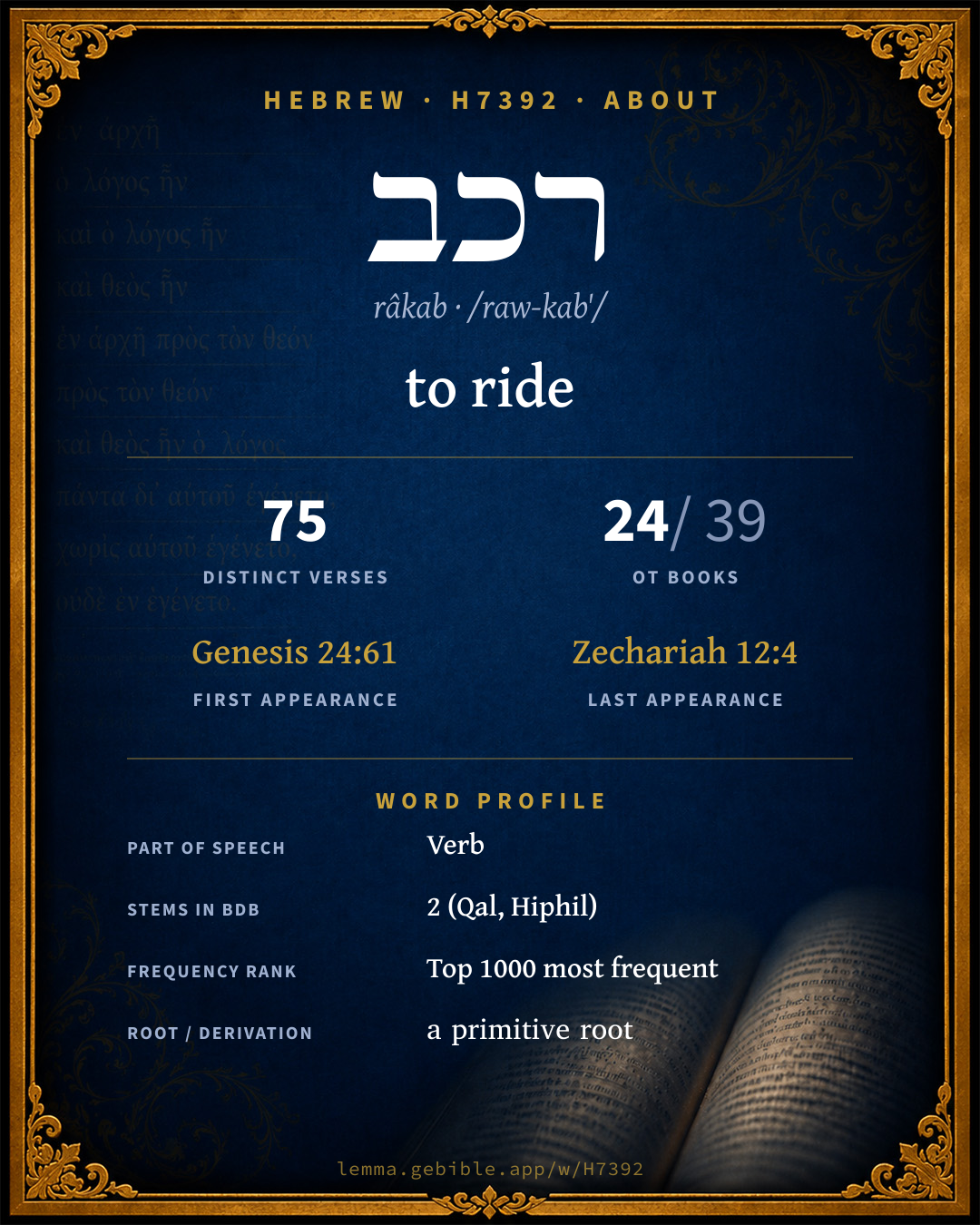
רָכַב
to ride
‘to ride’ is one of 7 main senses fuller range ↓
Full lexicon entry — Brown-Driver-Briggs (BDB)
From Brown-Driver-Briggs (BDB)
Where this word appears
See every Qal verb in the Hebrew Bible →
Grammar key — what these labels mean
Part of speech
- Verb
- An action or state-of-being word.
Stem
- Qal
- The basic, simple active stem — the plain form of the verb (“he wrote”). Here: ‘mount’
- Hiphil
- The causative active stem (“he caused / brought about”). Here: ‘cause to’
Form
- Participle Active
- A verbal adjective expressing ongoing or characteristic action (“writing / one who writes”).
- Sequential Imperfect
- An imperfect with prefixed waw — the standard past-narrative form (waw-consecutive imperfect).
- Infinitive Construct
- A bound verbal noun, frequently with prepositions (“to write / in writing”).
- Imperfect
- An incomplete, ongoing, or future action (“he will / would write”).
- Sequential Perfect
- A perfect with prefixed waw continuing a preceding imperfect or command (waw-consecutive perfect).
- Perfect
- A completed action or state — Hebrew marks aspect (completeness) more than strict tense (“he wrote”).
- Imperative
- A direct command (“write!”).
State
- Construct
- A noun bound to a following noun in a possessive / “of” relationship (the construct chain).
- Absolute
- The independent form of a noun, not bound to a following word.
Person
- 3rd Person
- The one spoken about (“he / she / it / they”).
- 1st Person
- The speaker (“I / we”).
- 2nd Person
- The one addressed (“you”).
Gender
- Masculine
- Grammatically masculine.
- Common
- Either gender — not distinguished for this form.
- Feminine
- Grammatically feminine.
Number
- Plural
- More than one (in Hebrew, generally three or more).
- Singular
- One.
6 verses where H7392 appears in the Qal stem in the Book of 2 Kings. Filtered view — show all forms. Click any verse to open its interlinear word-by-word view. Verse text shown in the World English Bible for context — . Each verse’s Hebrew form is shown with its reference; the English is not keyword-highlighted, since the data carries no word-level English alignment. Use “Compare translations” on any verse to read it across multiple English versions. This concordance covers the Hebrew Bible; Septuagint (Greek Old Testament) occurrences are not indexed here.
2 Kings
- 2 Kings 4:24 לִ/רְכֹּ֔ב prep + Qal inf.cs Then she saddled a donkey, and said to her servant, Drive, and go forward; don't slacken me the riding, except I bid you.
- 2 Kings 9:16 וַ/יִּרְכַּ֤ב conj + Qal wimpf 3ms So Jehu rode in a chariot, and went to Jezreel; for Joram lay there. Ahaziah king of Judah was come down to see Joram.
- 2 Kings 9:18 רֹכֵ֨ב Qal ptcp.act ms cs So there went one on horseback to meet him, and said, Thus says the king, Is it peace? Jehu said, What have you to do with peace? turn you behind me. The watchman told, saying, The messenger came to them, but he isn't coming back.
- 2 Kings 9:19 רֹכֵ֣ב Qal ptcp.act ms cs Then he sent out a second on horseback, who came to them, and said, Thus says the king, Is it peace? Jehu answered, What have you to do with peace? turn you behind me.
- 2 Kings 9:25 רֹכְבִ֤ים Qal ptcp.act mp Then said [Jehu] to Bidkar his captain, Take up, and cast him in the portion of the field of Naboth the Jezreelite; for remember how that, when I and you rode together after Ahab his father, Yahweh laid this burden on him:
- 2 Kings 18:23 רֹכְבִ֥ים Qal ptcp.act mp Now therefore, Please give pledges to my master the king of Assyria, and I will give you two thousand horses, if you are able on your part to set riders on them.
About this entry
At a glance — auto-summarized from this page’s data, not written by a person. Every figure links to its source below. This summary describes the numbers; it doesn’t interpret them.
רכב (râkab) is a Hebrew verb most often rendered “to ride.” Its English rendering has broadened — “rider” classically, “ride” (unfoldingWord Literal Text) in modern versions; see the renderings breakdown. Spanning 75 verses in 24 books, it ranks among the moderately common words of the Hebrew Bible. It first appears in Genesis 24:61. As a verb its force shifts by stem, across 2 stems (Qal, Hiphil, and more). The sections below give every sense, occurrence, and version rendering.
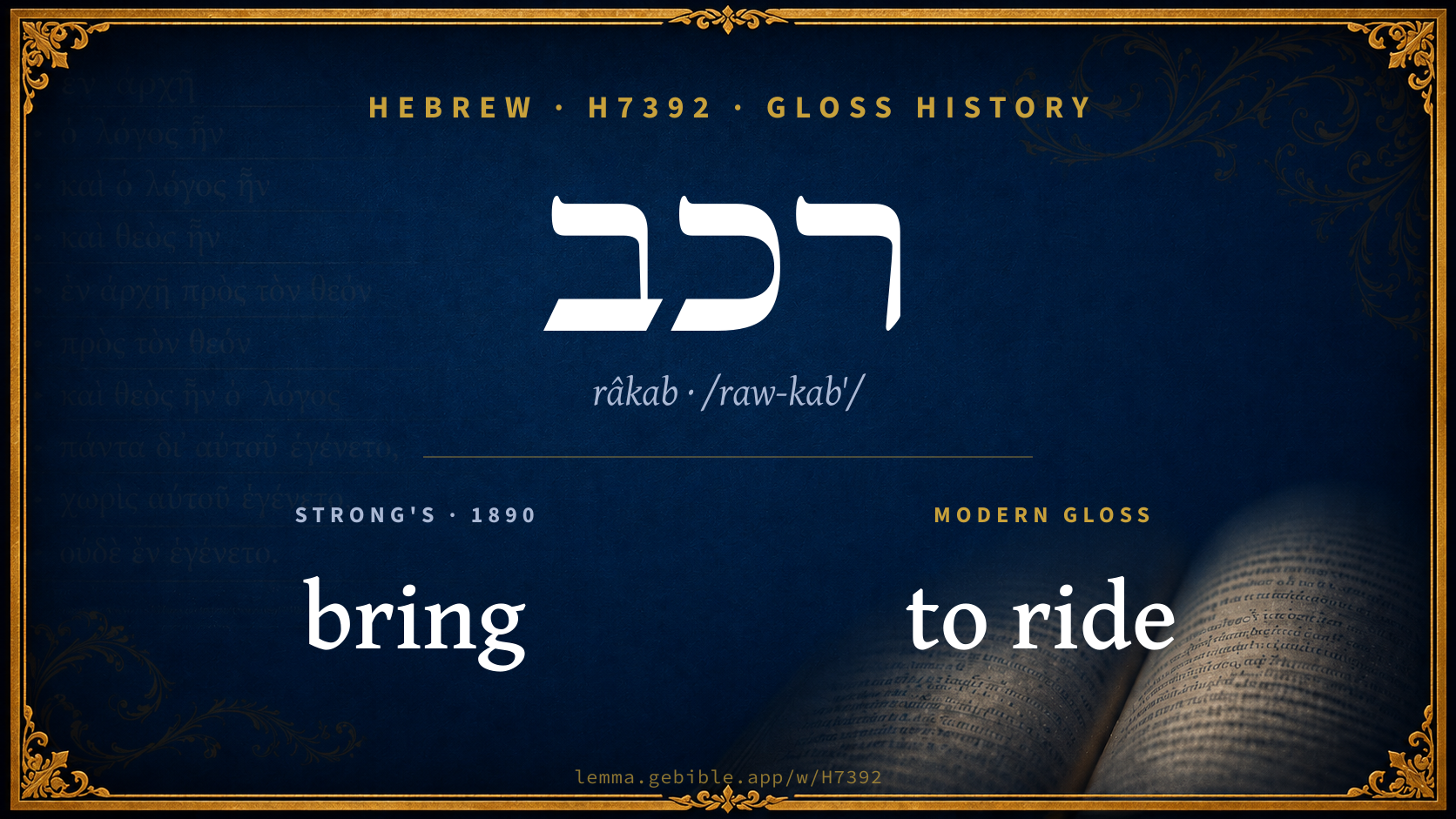
Gloss history
Strong's 1890 vs modern scholarship
About this word
Strong's H7392 catalogs a Hebrew word from the Hebrew Old Testament.
These counts are not copied from any lexicon or concordance. They are computed here, from the morphology-tagged Hebrew Old Testament. What Lemma adds →
- 75
- distinct verses
- The word appears in 75 distinct verses.
- 24 / 39
- OT books
- The word appears in 24 of 39 Old Testament books.
- #514
- by frequency
- Top 1000 most frequent Hebrew words (rank 514 of 8,640 Hebrew words by occurrence).
View all 75 occurrences in the concordance →
By section of the Old Testament
By traditional corpus
Conventional, traditional groupings — biblical authorship is debated, so this is a traditional corpus grouping, not an authorship claim. Each share is this word’s portion of its verses in that division of the Hebrew canon. Each figure is a share of the word’s 75 distinct verses.
- Prophets (Nevi'im) 49 verses · 65%
- Writings (Ketuvim) 15 verses · 20%
- Torah (Pentateuch) 11 verses · 15%
How translations render this word
Counts come from each version’s own published word-to-Strong’s tagging or interlinear alignment — an approximate guide to how each version renders this word, not a word-level alignment the data otherwise carries. Because each total is that version’s own tagged count, the per-version totals vary from one another and need not match the appearance or distinct-verse counts above. These counts may also differ from a printed concordance because Lemma counts each distinctly tagged rendering and does not collapse phrase taggings into a single head-word total. This is a fixed set of word-tagged versions (KJV, ASV, BSB, ULT) and does not change with the reading translation you choose elsewhere. Each version’s license is shown beside its name below (and on Sources).
- King James Version: Rider 7×, Riding 7×, Rode 7×
- American Standard Version: Riding 7×, Rider 6×, Rideth 6×
- Berean Standard Bible: Rider 6×, Rides 5×, Riding 5×
- unfoldingWord Literal Text: Ride 14×, Riding 9×, And 5×
King James Version Public Domain
Renders H7392 across 78 tagged occurrences — most commonly:
Plus 37 renderings that appear only once — usually multi-word phrases or single function words the recovered tagging swept in, not distinct renderings.
American Standard Version Public Domain
Renders H7392 across 78 tagged occurrences — most commonly:
Plus 41 renderings that appear only once — usually multi-word phrases or single function words the recovered tagging swept in, not distinct renderings.
Berean Standard Bible Public Domain
Renders H7392 across 77 tagged occurrences — most commonly:
Plus other, less common renderings. Plus 34 renderings that appear only once — usually multi-word phrases or single function words the recovered tagging swept in, not distinct renderings. Not rendered by a distinct English word in 1 further occurrence.
unfoldingWord Literal Text CC BY-SA 4.0
Renders H7392 across 92 tagged occurrences — most commonly:
Plus other, less common renderings. Plus 29 renderings that appear only once — usually multi-word phrases or single function words the recovered tagging swept in, not distinct renderings.
8 senses and sub-senses in the full BDB
Hebrew verbs can shift meaning by stem (binyan): Qal is the basic action, Niphal is often passive or reflexive, Piel often intensifies or makes it factitive, and Hiphil is typically causative. The senses below are grouped under the stem BDB assigns to each.
What do BDB’s symbols mean?
BDB uses these scholarly abbreviations:
| Symbol | Meaning |
|---|---|
| 𝔊 | the Septuagint (the ancient Greek translation, LXX) |
| 𝔙 | the Vulgate (the Latin translation) |
| 𝔖 | the Syriac version (the Peshitta) |
| 𝔗 | the Targum (the Aramaic translation) |
| ψ | the Psalms |
| √ | root (the underlying root or stem) |
| ‖ | parallel passage (a synonymous or contrasted parallel) |
| † | the dagger: every passage where the word occurs is cited |
The 8 senses and sub-senses the full Brown-Driver-Briggs lexicon distinguishes for this word, in lexicon order (not ranked by frequency), with BDB’s own verbatim wording and sub-sense lettering. Shown in Hebrew script with BDB’s own scholarly abbreviations. The condensed entry is in the Lexicon Entry tab. See also the Forms in the corpus table below.
Qal
- Pf. 3 ms. ר׳ Est 6:8; 2 ms. רָכַבְתָּ Nu 22:30; 3 pl. רָֽכְבוּ 1 S 30:17; Impf. 3 ms. יִרְכַּב Lv 15:9, etc.; Imv. ms. רְכַב ψ 45:5; Inf. cstr. לִרְכֹּב 2 S 16:2 2 K 4:24; Pt. act. רֹכֵב abs. Nu 22:22 +, cstr. Am 2:15; sf. רֹכְבוֹ Gn 49:17 +; fs. abs. רֹכֶ֫בֶת 1 S 25:30; mpl. רֹכְבִים 2 K 9:25 +, etc.;— e.g. Esther 6:8
- 1. mount, mount and sit, or ride, c. עַל of camel Gn 24:61 (J), 1 S 30:17, of ass (חֲמוֹר) 1 S 25:42; 25:20 2 S 16:2 (עַל obj. om.), 19:27 1 K 13:13, of mule (פֶּרֶד) 2 S 13:29; abs. of mounting (and riding in) chariot 1 K 18:45 2 K 9:16. e.g. Genesis 24:61
- 2. ride, be riding, c. עַל of mule (פֶּרֶד) 2 S 18:9, of ass, אָתוֹן Nu 22:22 (J), so (עַל obj. om.) 2 K 4:24, of חֲמוֹר Zc 9:9, of horse Zc 1:8; c. עַל־מֶרְכָּב (v מ׳) Lv 15:9; c. ב of animal (בְּהֵמָה) Ne 2:12; ב of chariotry and horses Je 17:25 = 22:4; abs. (perhaps in chariot) ψ 45:5 ride on! ride (habitually) c. עַל of אָתוֹן Nu 22:30 (J), of עֲיָרִים Ju 10:4; 12:14, of סוּם Ho 14:4 (fig. of alliance with Egypt), Je 6:23; 50:42 Est 6:8, Hb 3:8 (fig. of י׳; poss. add sf. ref. to יָם, cf. Dt 33:26), עַל־קַל (‖ סוּם) Is 30:16; of י׳, עַל־כְּרוּב 2 S 22:11 = ψ 18:11, עַל־עָב קַל Is 19:1, c. acc. שָׁמַיִם ride through Dt 33:26, but also c. ב loc. in, through, ψ 68:5, 34. e.g. 2 Samuel 18:9
- 3. pt. רֹכֵב etc., as subst., rider: רֹכְבֵי אֲתֹנוֹת Ju 5:10; ר׳ (ה)סוּם Am 2:15 2 K 9:18, 19 Ez 23:23; 38:15 Zc 10:5, so (appos. פָּרָשִׁים) Ez 23:6, 12; sf. of סוּם Gn 49:17 Ex 15:1, 21 Je 51:21a Zc 12:4 Jb 39:18 Hg 2:22b; עַל of סוּם 2 K 18:23 = Is 36:8; רֹכְבֵי רֶכֶשׁ Est 8:10, 14; sf. of chariot Je 51:21 b Hg 2:22. e.g. Judges 5:10
Hiphil
- Pf. 2 ms. הִרְכַּבְתָּ ψ 66:12, etc.; Impf. 3 ms. וַיַּרְכֵּב Gn 41:43 2 K 13:16, sf. יַרְכִּבֵהוּ Dt 32:13, etc.; Imv. ms. הַרְכֵּב 2 K 13:16;— e.g. Psalms 66:12
- 1. cause to (mount and) ride: c. acc. pers. + עַל of חֲמוֹר Ex 4:20 (J), of פִּרְדָּה 1 K 1:33, 38, 44, of סוּם Est 6:9, cf. (עַל־סוּם om.) v 11; c. acc. pers. + ב of chariot Gn 41:43 (E), 2 K 10:16; ב of chariot om. 2 K 9:28; 23:30 = (c. עֶל־רֶכֶב) 2 Ch 35:24; fig. Jb 30:22 (sc. on the wind); c. acc. rei + אֶל־עֲגָלָה 2 S 6:3 = 1 Ch 13:7; fig., c. acc. pers. + עַל loc. (על־במותי ארץ) Dt 32:13 so Is 58:14, + לְרֹאשֵׁנוּ ψ 66:12 over our heads. e.g. Exodus 4:20
- 2. cause to draw (plough, etc.) Ho 10:11, obj. Ephr. under fig. of heifer. e.g. Hosea 10:11
- 3. fig. (עַל־הַקֶשֶׁת) הַרְכֵּב יָֽדְךָ 2 K 13:16(×2) cause hand to ride upon (grasp) bow. e.g. 2 Kings 13:16
Senses from the full Brown-Driver-Briggs lexicon (Brown, Driver, Briggs; Oxford 1906 — public domain), digitized via Sefaria, supplemented by the OpenScriptures HebrewLexicon (CC BY 4.0). Full attribution on Sources.
Word origin
vb. mount and ride, ride (NH = BH; Assyrian rakâbu, Arabic رَكِبَ,, Aramaic רְכֵיב, ܪܟܶܒ, all id.; cf. Zinj. רכב war-chariot, n.pr. div. רכבאל (Cook108); Sab. רכבהו = his rider MordtmHim. Inschr. 25 (of horse; but his trappings CISiv. no. 306, 5); Ethiopic ረከበ: is attain, acquire);—
— Brown-Driver-Briggs (Oxford 1906, public domain), digitized via Sefaria, supplemented by the OpenScriptures HebrewLexicon (CC BY 4.0). See Sources.
Origin: a primitive root
Jastrow Dictionary
A second Hebrew/Aramaic lexicon for comparison, covering Aramaic and post-biblical (Talmudic, Targumic, Midrashic) usage that the biblical-Hebrew BDB does not. Matched by lemma rather than by Strong’s number, so a lemma may carry more than one Jastrow headword (shown separately below), and the entries cover usage well beyond the Bible.
רָכב
- (b. h.) [to be joined,] to ride. B. Mets. I, 2 היו רוֹכְבִין … אחד רוֹכֵב וכ׳ if two persons (each claiming to be the finder of an object) were riding …, or one was riding and one leading. Ḥag. I, 1; Y. ib. I, 76ᵃ top כל שאינו יכול לִרְכּוֹב וכ׳ a child too young to be carried on his father’s shoulder. Ber. 56ᵇ רְכָבוֹ if he dreamt that he rode on him. Gen. R. s. 75 רוֹכְבֵי סוסים riders on horses; a. fr.—Part. pass. רָכוּב; f. רְכוּבָה &c. riding. Ex. R. s. 26 תינוק שהיה ר׳ על וכ׳ a child that was riding on his father’s shoulder. Y. B. Mets. I, beg. 7ᵈ אשה … ר׳ וכ׳ if a woman rides on a beast led by two men; a. fr.—[Pesik. Vayhi, p. 4ᵃ רכובים, read דב׳, v. דָּבַב II.]
- 1. to cause to ride, put on. Snh. 91ᵇ, a. e. ה׳ חיגר על וכ׳ he made the lame ride on the blind man. Ib. בא והַרְכִּיבֵנִי come and carry me on thy back; a. fr.—Part. pass. מוּרְכָּב. Ib. 52ᵇ I remember when I was a child ומ׳ על כתיפו וכ׳ and rode on my father’s shoulder &c.; (Tosef. ib. IX, 11 רכוב); a. e.
- 2. to join, combine. Tosef. Sabb. XII (XIII), 14 המַרְכִּיב קנה וכ׳ if one inserts the branch of a candlestick; (Sabb. 47ᵃ המחזיר). Y. ib. XII, beg. 13ᶜ המרכיב מיטה וכ׳ he who sets up a folding couch; a. e.—Esp. to inoculate, engraft. Shebi. II, 6 אין … ואין מַרְכִּיבִין וכ׳ we must not plant, nor sink a vine, nor engraft before the Sabbatical year &c. Pes. IV, 8; a. fr.—Part. pass. as ab. Y. B. Bath. IV, end, 14ᵈ החרוב המ׳ a newly inoculated carob tree; a. e.
רְכַב
- Targ. O. Gen. XXIV, 61. Targ. Lev. XV, 9.—Part. רָכֵיב, רָכֵב; part. pass. רְכִיב, f. רְכִיבָא; pl. רְכִיבִין, רָכְבִּין; רְכִיבָן, רָכְבָּן. Targ. Y. Gen. l. c. Targ. Num. XXII, 22. Targ. I Sam. XXV, 20. Targ. Jud. X, 4; a. fr.—Koh. R. to I, 8 ועלון יתיה ר׳ חמרא וכ׳ and they brought him riding on an ass on the Sabbath. Gen. R. s. 65. Ber. 56ᵇ דר׳ הוא לתורא when he dreamt that he was riding on an ox; דר׳ תורא לדידיה that the ox was riding on him; a. fr.
- 1. to cause to ride. Targ. Gen. XLI, 43. Targ. Esth. VI, 9; a. fr.—Gen. R. l. c. חמי סוסא דאַרְכְּבִי … דאַרְכְּבָךְ מרך see the horse on which my master makes me ride, and see the horse (the gallows) on which thy master (the Lord) makes thee ride. Y. Kidd. I, 60ᶜ bot., a. e. אַרְכְּבֵיה וכ׳, v. בַּרְקָא II; a. fr.
- 2. to let gender; to inoculate. Targ. O. Lev. XIX, 19.—Y. Yeb. XV, 15ᵃ top אילין … דלא צריכין מַרְכְּבָא the Babylonian palms which require no inoculation.
רַכָּב
- preced.) rider. Mekh. B’shall., Shir., s. 2 (ref. to Ex. XV, 1) הסוס קשור ברַכָּבוֹ ורכבו בסוס וכ׳ the horse was tied to his rider, and the rider to his horse; Yalk. Ex. 243. e.g. Exodus 15:1
רֶכֶב
- preced.)
- 1. wagon, chariot; (collect. noun) chariots. Ex. R. s. 22 על רִכְבּוֹ ועל פרשיו over his (Pharaoh’s) chariots and over his horsemen; a. e.
- 2. upper millstone. B. Mets. IX, 13, v. רֵחַיִים. B. Bath. II, 1 מרחיקין … מן הר׳ you must keep the mill removed (from the neighbor’s wall) three handbreadths counting from the lower millstone, which makes four from the upper millstone; a. e.
- 3. branch for inoculation, set. Tosef. Kil. I, 10 אין מרכיבין זתים בר׳ תמרה you must not inoculate olive trees with a shoot of a palm; Y. ib. I, 27ᵇ
A Dictionary of the Targumim, the Talmud Babli and Yerushalmi, and the Midrashic Literature (Marcus Jastrow; London, Luzac, 1903) — Public Domain. Digitized via Sefaria. Digitized via Sefaria. Full attribution on Sources.
Forms in the corpus
The 64 distinct written forms H7392 takes in the Hebrew Bible, most frequent first — each parse links to that stem’s occurrences in the concordance. Hebrew forms include their vowel points and cantillation, so a single lemma takes many written forms.
The 60 most common forms are shown; 4 rarer forms follow in the full concordance.
Same root — word family
Other BDB entries built from the same root as H7392, grouped by Strong’s listed origin. These share a root / origin per the lexicon — not necessarily a shared meaning. Each links to that word’s own entry.
Derived from this word
- ארכבה ʼarkubâh H755 knee
- מרכב merkâb H4817 chariot
- רכב rekeb H7393 chariot
- רכב rakkâb H7395 horseman
- רכוב rᵉkûwb H7398 chariot
Proper names from this root
People and places named from this root — a name, not an additional meaning of the word.
Compare all same-root words → Showing 4 of 7 — not the complete family. 1 of the same-root words is a proper name (a person or place). They share a root, not necessarily a meaning.
Septuagint verse parallels
This word appears in 72 verses that also exist in the Greek Old Testament (Septuagint), out of the 75 Hebrew verses it occurs in. You can read those verses in Greek by switching the Old Testament edition to the Septuagint.
Read these verses in the Septuagint
- Genesis 24:61
- Exodus 4:20
- Leviticus 15:9
- Numbers 22:22
- Deuteronomy 32:13
- Judges 5:10
- 1 Samuel 25:20
- 2 Samuel 6:3
- 1 Kings 1:33
- 2 Kings 4:24
- 1 Chronicles 13:7
- 2 Chronicles 35:24
This is a verse-level parallel only — the same verses exist in both the Hebrew and Greek Old Testaments. No word-level Hebrew↔Greek correspondence is claimed: the data carries no such alignment, so no Greek word is shown as this Hebrew word’s translation. Coverage is not total — the Septuagint omits the deuterocanon and renumbers the Psalms, so some Hebrew verses have no direct Greek parallel.