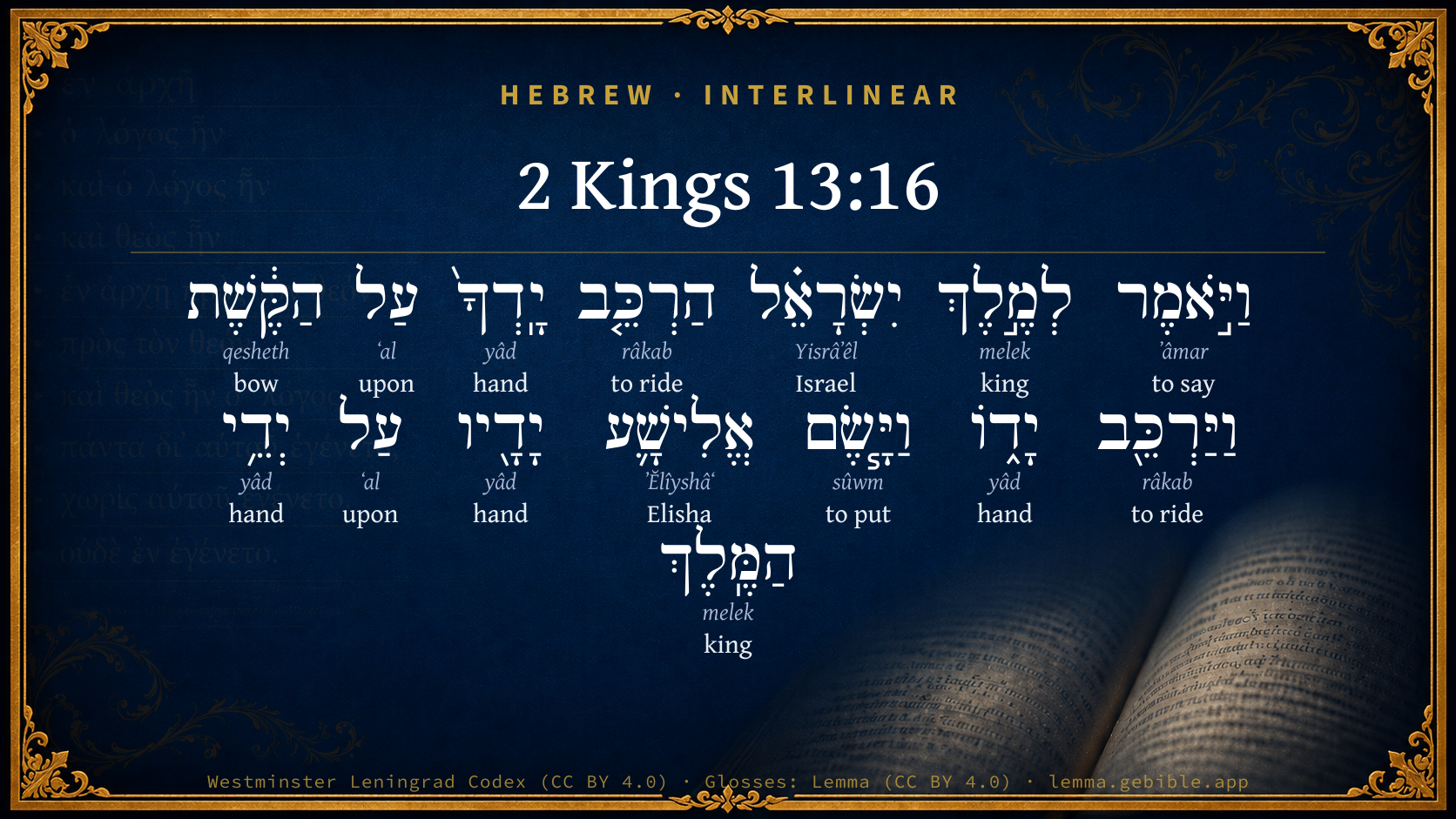
2 Kings 13:16

Hebrew (Westminster Leningrad Codex) 2 Kings 13:16 appears in the Hebrew Old Testament. The text above is from the Westminster Leningrad Codex. Each word links to its Strong’s number, a concise gloss, and parsing drawn from the Open Scriptures Hebrew Bible morphology. Click any word for its full Brown-Driver-Briggs (BDB) entry.
Download image
Cite this verse

2 Kings 13:16 (World English Bible). Public Domain. Lemma interlinear Bible study tool, https://lemma.gebible.app/v/2-kings/13/16.

Show BibTeX & RIS
BibTeX
RIS
English Translation
He said to the king of Israel, Put your hand on the bow; and he put his hand [on it]. Elisha laid his hands on the king's hands.
World English Bible · Public Domain
Download a study sheet

One document with this verse’s original text, its word-by-word gloss line, the meaning frame, cross-references with their text, attributed commentary, and full source and license credits — printable, and it pastes into notes with its structure intact.

This verse Autodidact and up

Study sheet (.html) Plain text (.txt)

A passage Seminary Student

Up to 50 verses in one chapter. A passage sheet keeps up to 6 commentary sources and 12 cross-references per verse, in the order this page ranks them, and says so on the sheet whenever that leaves anything out. Ask for a single verse and you get the Autodidact verse sheet above.

Everything on this page stays free to read, with no account — the sheet is a download of what is already on screen, not access to it.

Want to remove ads? Support Godless Engineer
Compare translations 3

The same verse in 3 English versions, stacked beneath the original-language interlinear above. Click any original word for its lexicon entry.

Each is an independent rendering of the whole verse — the interlinear is not word-aligned to these translations.

Highlighted words mark where these versions differ — a whole-verse word diff, not a word-by-word alignment.

  • World English Bible Public Domain
    He said to the king of Israel, Put your hand on the bow; and he put his hand [on it]. Elisha laid his hands on the king's hands.
  • King James Version Public Domain
    And he said to the king of Israel, Put thine hand upon the bow. And he put his hand upon it: and Elisha put his hands upon the king's hands.
  • unfoldingWord Literal Text CC BY-SA 4.0
    And he said to, the king of Israel, “Make your hand ride on the bow.” And he made his hand ride. And Elisha put his hands over the hands of the king.

unfoldingWord Literal Text — © unfoldingWord, licensed CC BY-SA 4.0. Word-aligned USFM3 via Door43 (git.door43.org/unfoldingWord/en_ult).

Versions to compare (up to 4)

3 of 4 selected

Show all 18 translations

Every available English version of this verse, each an independent rendering of the whole verse.

  • World English Bible Public Domain
    He said to the king of Israel, Put your hand on the bow; and he put his hand [on it]. Elisha laid his hands on the king's hands.
  • Berean Standard Bible Public Domain
    Then Elisha said to the king of Israel, “Put your hand on the bow.” So the king put his hand on the bow, and Elisha put his hands on the king’s hands.
  • Majority Standard Bible Public Domain
    Then Elisha said to the king of Israel, “Put your hand on the bow.” So the king put his hand on the bow, and Elisha put his hands on the king’s hands.
  • King James Version Public Domain
    And he said to the king of Israel, Put thine hand upon the bow. And he put his hand upon it: and Elisha put his hands upon the king's hands.
  • American Standard Version (1901) Public Domain
    And he said to the king of Israel, Put thy hand upon the bow; and he put his hand `upon it'. And Elisha laid his hands upon the king's hands.
  • Revised Version (1885) Public Domain
    And he said to the king of Israel, Put thine hand upon the bow: and he put his hand upon it. And Elisha laid his hands upon the king’s hands.
  • Geneva Bible (1599) Public Domain
    And he sayde to the King of Israel, Put thine hand vpon the bowe. And he put his hand vpon it. And Elisha put his hands vpon the Kings hands,
  • Douay-Rheims (1899) Public Domain
    He said to the king of Israel: Put thy hand upon the bow. And when he had put his hand, Eliseus put his hands over the king's hands,
  • Young's Literal Translation Public Domain
    And he saith to the king of Israel, `Place thy hand on the bow;' and he placeth his hand, and Elisha putteth his hands on the hands of the king,
  • Literal Standard Version CC BY-SA 4.0
    And he says to the king of Israel, “Place your hand on the bow”; and he places his hand, and Elisha puts his hands on the hands of the king,
  • Unlocked Literal Bible CC BY-SA 4.0
    Elisha said to the king of Israel, “Put your hand on the bow,” so he put his hand on it. Then Elisha laid his hands on the king's hands.
  • unfoldingWord Literal Text CC BY-SA 4.0
    And he said to, the king of Israel, “Make your hand ride on the bow.” And he made his hand ride. And Elisha put his hands over the hands of the king.
  • Darby Bible Public Domain
    And he said to the king of Israel, Put thy hand upon the bow. And he put his hand [upon it]; and Elisha put his hands upon the king's hands,
  • World Messianic Bible Public Domain
    He said to the king of Israel, “Put your hand on the bow;” and he put his hand on it. Elisha laid his hands on the king’s hands.
  • Webster's Bible Public Domain
    And he said to the king of Israel, Put thy hand upon the bow. And he put his hand upon it: and Elisha put his hands upon the king's hands.
  • Free Bible Version CC BY-SA 4.0
    Then Elisha said to the king of Israel, “Pick up the bow.” So the king picked up the bow. Elisha placed his hands on the king's hands.
  • Bible in Basic English Public Domain
    And he said to the king of Israel, Put your hand on the bow: and he put his hand on it; and Elisha put his hands on the king's hands.
  • JPS Tanakh (1917) Public Domain
    And he said to the king of Israel: 'Put thy hand upon the bow'; and he put his hand upon it. And Elisha laid his hands upon the king's hands.

Literal Standard Version (2020), Covenant Press — licensed CC BY-SA 4.0. Text via the HelloAO Bible API (eBible.org). Unlocked Literal Bible (unfoldingWord) — licensed CC BY-SA 4.0. Text via the HelloAO Bible API (eBible.org). unfoldingWord Literal Text — © unfoldingWord, licensed CC BY-SA 4.0. Word-aligned USFM3 via Door43 (git.door43.org/unfoldingWord/en_ult). Free Bible Version, Dr. Jonathan Gallagher — licensed CC BY-SA 4.0. Text via the HelloAO Bible API (eBible.org).

Word by word

More ways to search: Search by grammar → Find every occurrence → Compare this word →

Practice this passage: Drill this verse → Learn its vocabulary →

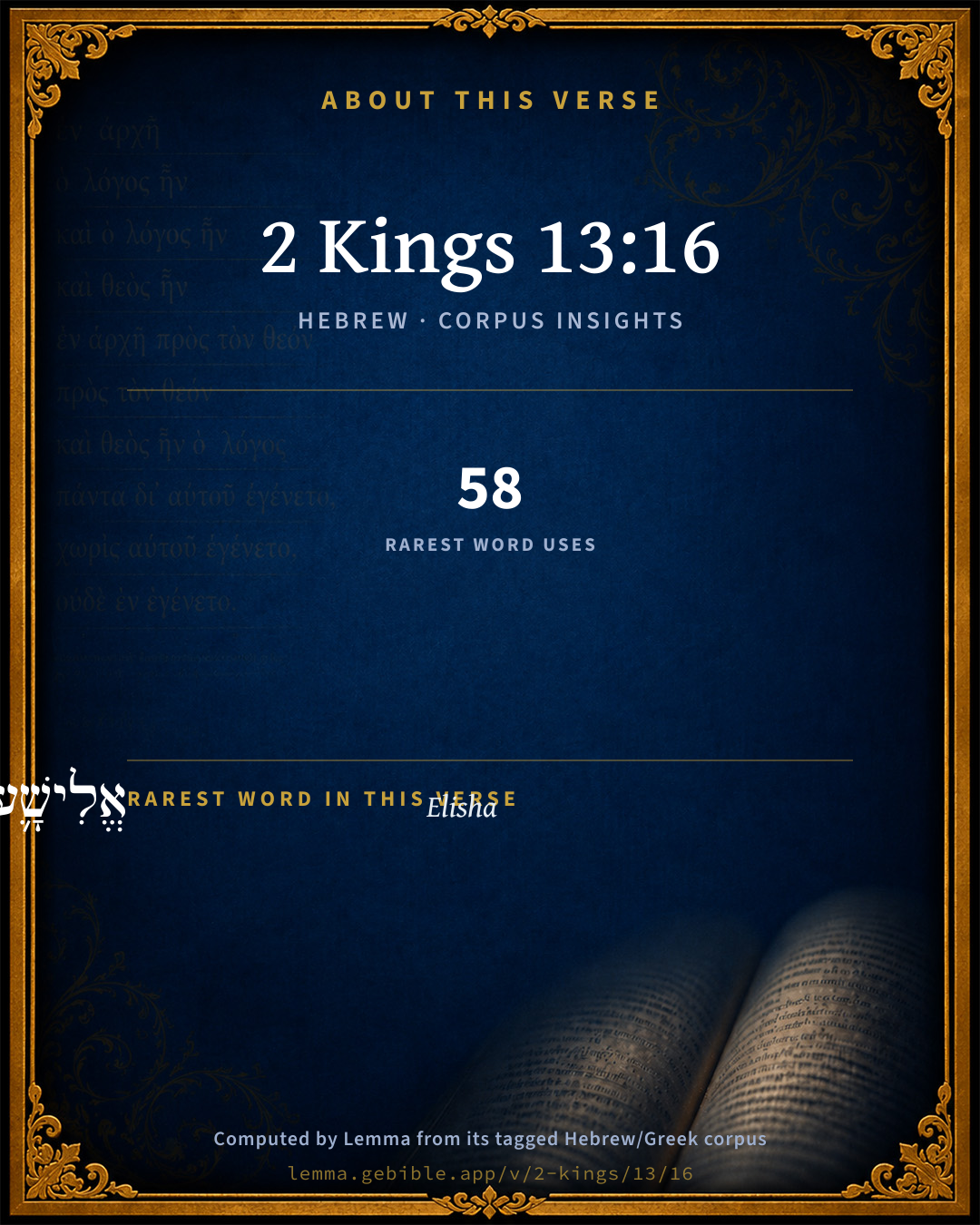
אֱלִישָׁ֛ע
ʼĔlîyshâʻ
H477
“Elisha”
Noun, Proper
Part of Speech
Noun
Type
Proper
Full BDB Definition

Origin: contracted for H474

TWOT: None

Elisha = "God is salvation" - the great prophet who succeeded Elijah
  1. וַיֹּ֣אמֶר ʼâmar H559 “and · to say” Conjunction + Verb, Qal, Sequential Imperfect, 3rd Person, Masculine, Singular
  2. לְמֶ֣לֶךְ melek H4428 “to/for · king of” Preposition + Noun, Common, Masculine, Singular, Construct
  3. יִשְׂרָאֵ֗ל Yisrâʼêl H3478 “Israel” Noun, Proper
  4. הַרְכֵּ֤ב râkab H7392 “ride” Verb, Hiphil, Imperative, 2nd Person, Masculine, Singular
  5. יָֽדְךָ֙ yâd H3027 “hand · your” Noun, Common, Both, Singular, Construct + Suffix, Personal, 2nd Person, Masculine, Singular
  6. עַל ʻal H5921 “upon” Preposition
  7. הַקֶּ֔שֶׁת qesheth H7198 “the · bow” Particle, Definite Article + Noun, Common, Feminine, Singular, Absolute
  8. וַיַּרְכֵּ֖ב râkab H7392 “and · to ride” Conjunction + Verb, Hiphil, Sequential Imperfect, 3rd Person, Masculine, Singular
  9. יָד֑וֹ yâd H3027 “hand · his” Noun, Common, Both, Singular, Construct + Suffix, Personal, 3rd Person, Masculine, Singular
  10. וַיָּ֧שֶׂם sûwm H7760 “and · to put” Conjunction + Verb, Qal, Sequential Imperfect, 3rd Person, Masculine, Singular
  11. יָדָ֖יו yâd H3027 “hands · his” Noun, Common, Both, Dual, Construct + Suffix, Personal, 3rd Person, Masculine, Singular
  12. עַל ʻal H5921 “upon” Preposition
  13. יְדֵ֥י yâd H3027 “hands of” Noun, Common, Both, Dual, Construct
  14. הַמֶּֽלֶךְ melek H4428 “the · king” Particle, Definite Article + Noun, Common, Masculine, Singular, Absolute

About this verse

These counts appear in no published source. They are computed here, from the morphology-tagged text and Lemma’s own curated glosses. What Lemma adds →

15
words
9
distinct lemmas
Historical
section

Shared distinctive vocabulary

אֱלִישָׁ֛ע Elisha H477 occurs in 52 verses of the Hebrew Bible. Also found in:

Grammatical profile

  • 4 verbs
  • 9 nouns
  • 2 prepositions

Verb forms

  • וַיֹּ֣אמֶר Qal · Sequential Imperfect
  • הַרְכֵּ֤ב Hiphil · Imperative
  • וַיַּרְכֵּ֖ב Hiphil · Sequential Imperfect
  • וַיָּ֧שֶׂם Qal · Sequential Imperfect

Repetition

Words recur within this verse — often emphatic in Hebrew:

  • יָֽדְךָ֙ hand H3027 ×4
  • לְמֶ֣לֶךְ king H4428 ×2
  • הַרְכֵּ֤ב to ride H7392 ×2
  • עַל upon H5921 ×2

Hebrew & Septuagint length

In English translation the verse runs 28 words from the Hebrew and 28 from the Septuagint (LXX English) — the same length.

A rough comparison of the two English renderings, which tokenize alike — not a word-level alignment.

Word counts can differ between the Hebrew and the Greek without any difference in meaning — e.g. the Hebrew direct-object marker אֵת has no separate Greek word, and Greek often adds the article ὁ.

Cross-references

3

Topical passages linked to 2 Kings 13:16 in the Treasury of Scripture Knowledge — connected by theme and wording, ordered by reader-vote popularity; previews shown in the World English Bible.

  • Genesis 49:24 But his bow abode in strength, The arms of his hands were made strong, By the hands of the Mighty One of Jacob, (From there is the shepherd, the stone of Israel),
  • 2 Kings 4:34 He went up, and lay on the child, and put his mouth on his mouth, and his eyes on his eyes, and his hands on his hands: and he stretched himself on him; and the flesh of the child grew warm.
  • Psalms 144:1 Blessed be Yahweh, my rock, Who teaches my hands to war, And my fingers to battle:

Cross-references courtesy of OpenBible.info (CC BY 4.0).

Hebrew and Greek witnesses Masoretic Hebrew ↔ Greek Septuagint

The same verse in the two great witnesses to the Old Testament, shown verse-for-verse.

These are two independent witnesses, not word-aligned to each other, and the Septuagint is shown in lemma (dictionary) form.

Hebrew 2 Kings 13:16 Masoretic · Westminster Leningrad Codex

וַיֹּ֣אמֶר לְמֶ֣לֶךְ יִשְׂרָאֵ֗ל הַרְכֵּ֤ב יָֽדְךָ֙ עַל הַקֶּ֔שֶׁת וַיַּרְכֵּ֖ב יָד֑וֹ וַיָּ֧שֶׂם אֱלִישָׁ֛ע יָדָ֖יו עַל יְדֵ֥י הַמֶּֽלֶךְ

He said to the king of Israel, Put your hand on the bow; and he put his hand [on it]. Elisha laid his hands on the king's hands.

World English Bible · Public Domain

Greek LXX 2 Kings 13:16 Septuagint · lemma form

καί εἶπον ὁ βασιλεύς ἐπιβιβάζω ὁ χείρ σύ ἐπί ὁ τόξον καί ἐπιβιβάζω ιωας ὁ χείρ αὐτός ἐπί ὁ τόξον καί ἐπιτίθημι ελισαιε ὁ χείρ αὐτός ἐπί ὁ χείρ ὁ βασιλεύς

And he said to the king, Put your hand on the bow. And Joas put his hand upon it: and Elisaie put his hands upon the king's hands.

LXX2012 (modern English Septuagint) · Public Domain

Hebrew: Westminster Leningrad Codex (CC BY 4.0). Greek: Septuagint (public domain); English from LXX2012 (modern English Septuagint) (Public Domain). How the Septuagint differs from the Hebrew →

Targum (Aramaic paraphrase)

1

The Targum is the ancient Jewish Aramaic paraphrase of the Hebrew Scriptures — an interpretive translation, not the Hebrew text itself. Onkelos (literal) and Pseudo-Jonathan (expansive) render the Torah, and Jonathan the Prophets. Coverage is partial: where no permissively-licensed English translation exists for a verse, only the Aramaic is shown. This is verse-level text, not a word-by-word alignment to the Hebrew.

  1. Targum Jonathan Prophets (Joshua–Malachi)
    וַאֲמַר לְמַלְכָּא דְיִשְׂרָאֵל אָחֵית יְדָךְ עַל קַשְׁתָּא וְאַחֵית יְדֵיהּ וְשַׁוִי אֱלִישָׁע יְדוֹהִי עַל יְדֵי מַלְכָּא:

    (no public-domain English translation for this verse)

    Targum Jonathan — Aramaic: “Mikraot Gedolot” (public domain). English: “Sefaria Community Translation” (CC0 1.0 (public-domain dedication)); “London "Chaldee Paraphrase," 1871” (public domain). Text via Sefaria.

Commentary

Notes on 2 Kings 13:16 from classic Christian and Jewish commentators (each source and its license shown beneath its notes). The classic Christian expositions comment on the surrounding passage and are grouped to its opening verse, so a note may address several verses; the Jewish commentaries on the Tanakh (Rashi and others) are per-verse, so they appear only where the commentator wrote on this verse.

Lemma curates 59 commentaries, every one of them public domain or Creative Commons licensed, each selected and text-cleaned for this edition rather than reprinted as found. About our sources →

Trapp's Complete Commentary

John Trapp

2Ki 13:16 And he said to the king of Israel, Put thine hand upon the bow. And he put his hand [upon it]: and Elisha put his hands upon the king’s hands.

Ver. 16. And Elisha put his hands upon the king’s hands.] To show that "the arms of his hands should be made strong by the hands of the mighty God of Jacob," as Gen 49:24.

John Trapp, A Commentary or Exposition upon All the Books of the Old and New Testament (1647–1656) — public domain. Text from a community e-Sword module.

The Biblical Illustrator

Joseph S. Exell

2Ki_13:16

And Elisha put his hands upon the kings hands.

The spirit of power

This is part of one of the strangest narratives in the Old Testament. Elisha is on his death bed, sick of the sickness wherewith he should die. A very different scene that close sick chamber from the open plain beyond Jordan, from which Elijah had gone up; a very different way of passing from life by fiery chariot than by wasting sickness! But God is as near His servant in the one place as in the other, and the slow wasting away is as much His messenger as the sudden apocalypse of the horsemen of fire. Here is a prophet dying; and his last words are not edifying moral and religious reflections, nor does he seem to be much concerned to leave with the king his final protest against Israels sin, but his thoughts are all of warfare, and his last effort is to stir up the sluggish young monarch to some of his own enthusiasm in the conflict with the enemy. It does not sound like an edifying death-bed. People might have said, Ah, secular and political affairs should be all out of a mans mind when he comes to his last moments. But this man thought that to stick to his lifes work till the last breath was out of him, and to devote the last breath to stimulating successors who might catch up the torch that dropped from his failing hands, was no unworthy end of a prophets life.

I. Here we have power communicated. We, too, if we are Christian men and women, have a Gospel of which the very kernel is that there is to us a communication of power. And the very name of that Divine Spirit whom it is Christs greatest work to send flashing and flaming through the world, is the Spirit of Power. And so the old promise that ye shall be clothed with strength from on high is the standing prerogative of the Christian Church. There is not merely some partial communication, as when hand touched hand, but every organ is vitalised and quickened; as in the case of the other miracle of this prophet, when he stretched himself on the dead child, eye to eye, and mouth to mouth, and hand to hand; and each part received the vitalising influence. We have, if we are Christian people, a Spirit given to us, and are strengthened with might by the Spirit in the inner man. Then, further, let me remind you that this power, which is bestowed on condition of contact, is given before duties are commanded. Further, this strength communicated is realised in the effort to obey Christs great commands. Joash felt nothing when the hands were laid upon him, but, perhaps, some tingling. But when he got the bow in his hand, and drew the arrow to its head, the infused power stiffened his muscles and strengthened him to pull; and though he could not distinguish between his own natural corporeal ability and that which had been thus imparted to him, the two co-operated in the one act, and it was when he drew his bow that he felt the strength.

II. And now, look at the perfected victory that is possible. When the arrows, by Gods strength operating through Joashs arm, had been shot, the prophet says, The arrow of the Lords victory . . . thou shalt smite . . . till thou have consumed. Yes, of course, if the arrow is the Lords arrow, and the strength is His strength, then the only issue corresponding to the power is perfect victory. There is no reason as from any defect of the Divine gift to the weakest of us why our Christian lives should have ups and downs, why there should be interruptions in our devotion, fallings short in our consecration, contradictions in cur conduct, slidings backward in our progress. There is no reason why, in our Christian year, there should be summer and winter; but according to the symbolical saying of one of the old prophets, The ploughman may overtake, the reaper, and he that treadeth out the grapes him that soweth the seed. In so far as our Christian life is concerned, the perfection of the power that is granted to us involves the possibility of perfection in the recipient. And the same thing is true in reference to a Christian mans work in the world; Gods Church has ample resources to overcome the evil of the world. The fire is tremendous, but the Christian Church has possession of the floods that can extinguish the fire.

III. The partial victory that is actually won. Thou shouldst have smitten five or six times; then hadst thou smitten the Syrians till they were consumed. But now thou shalt conquer but thrice. All Gods promises and prophecies are conditional. There is no such thing as an unconditional promise of victory or of defeat; there is always an if. There is always mans freedom as a factor. It is strange; I suppose no thinking, metaphysical or theological, ever has solved, or ever will, that great paradox of the power of a finite will to lift itself up in the face of, and antagonism to an infinite will backed by infinite power, and to thwart its purposes. How often would I have gathered . . . and ye would not. Here is all the power for a perfect victory, and the man that has it has to be contented with a very partial one. A low expectation limits the power. This man did not believe, did not expect that he would conquer utterly, and so he did not. You believe that you can do a thing, and in nine cases out of ten that goes nine-tenths of the way towards doing it. Small desires block the power. Where there is an iron-bound coast running in one straight line, the whole ocean may dash itself on the cliffs at the base, but it enters not into the land; but where the shore opens itself out into some deep gulf far inland, and broad across at the entrance, then the glad water rushes in and fills it all. Make room for God in your lives by your desires, and you will get him in the fulness of His power. The use of our power increases our power. Joash had an unused quiver full of arrows, and he only smote thrice. (A. Maclaren, D. D.)

The Biblical Illustrator, edited by Joseph S. Exell (c. 1880s–1900s) — public domain. Text from a community e-Sword module.

MacLaren's Expositions of Holy Scripture

Alexander MacLaren

2 Kings

THE SPIRIT OF POWER

2Ki 13:16.

This is part of one of the strangest narratives in the Old Testament. Elisha is on his deathbed, ‘sick of the sickness’ wherewith he ‘should die.’ A very different scene, that close sick-chamber, from the open plain beyond Jordan from which Elijah had gone up; a very different way of passing from life by wasting sickness than by fiery chariot! But God is as near His servant in the one place as in the other, and the slow wasting away is as much His messenger as the sudden apocalypse of the horsemen of fire. The king of Israel comes to the old prophet, and very significantly repeats over him his own exclamation over Elijah, ‘My father! My father! the chariot of Israel and the horsemen thereof.’ Elisha takes no notice of the grief and reverence expressed by the exclamation, but goes straight to his work, and what follows is remarkable indeed.

Here is a prophet dying; and his last words are not edifying moral and religious reflections, nor does he seem to be much concerned to leave with the king his final protest against Israel’s sin, but his thoughts are all of warfare, and his last effort is to stir up the sluggish young monarch to some of his own enthusiasm in the conflict with the enemy. It does not sound like an edifying deathbed. People might have said, ‘Ah! secular and political affairs should be all out of a man’s mind when he comes to his last moments.’ But Elisha thought that to stick to his life’s work till the last breath was out of him, and to devote the last breath to stimulating successors who might catch up the torch that dropped from his failing hands, was no unworthy end of a prophet’s life.

So there followed what perhaps is not very familiar to some of us, that strange scene in which the dying man is far fuller of energy and vigour than the young king, and takes the upper hand of him, giving him a series of curt, authoritative commands, each of which he punctiliously obeys. ‘Take bow and arrow,’ and he took them. Then the prophet lays his wasted hand for a moment on the strong, young hand, and having thus either in symbol or reality-never mind which-communicated power, he says to him, ‘Fling open the casement towards the quarter where the enemy’s territory lies,’ and he flings it open. ‘Now, shoot,’ and he shoots. Then the old man gathers himself up on his bed, and with a triumphant shout exclaims, ‘The Lord’s arrow of victory! . . . Thou shalt smite the Syrians till they be consumed.’

That is not all. There is a second stage. The promise is given; the possibility is opened before the king, and now all depends on the question whether he will rise to the height of the occasion. So the prophet says to him, ‘Take the sheaf of arrows in your hand’; and he takes them. And then he says, ‘Now smite upon the ground.’ It is a test. If he had been roused and stirred by what had gone before; if he had any earnestness of belief in the power that was communicated, and any eagerness of desire to realise the promises that had been given of complete victory, what would he have done? What would Elisha have done if he had had the quiver in his hand? This king smites three perfunctory taps on the floor, and having done what will satisfy the old man’s whim, and what in decency he had to do, he stops, as if weary of the whole performance. So the prophet bursts out in indignation on his dying bed-’Thou shouldst have smitten five or six times; then hadst thou conquered utterly. Now thou shalt conquer but thrice.’ A strange story; very far away from our atmosphere and latitude! Yet are there not obviously in it great principles which may be disentangled from their singular setting, and fully applied to us? I think so. Let us try and draw them from it.

I. Here we have the power communicated.

Now the story seems to indicate that it was only for a moment that the prophet’s hands were laid on the king’s hands, because, after they had been so laid, he is bidden to go to the window and fling it open, and the bedridden man could not go there with him; then he is bidden to draw the bow, and another hand upon his would have been a hindrance rather than a help. So it was but a momentary touch, a communication of power in reality or in symbol that the muscular young hand needed, and the wasted old one could give. And is that not a parable for us? We, too, if we are Christian men and women, have a gospel of which the very kernel is that there is to us a communication of power, and the very name of that divine Spirit whom it is Christ’s greatest work to send flashing and flaming through the world, is the ‘Spirit of Power.’ And so the old promise that ye shall be clothed with strength from on high is the standing prerogative of the Christian Church. There is not merely some partial communication, as when hand touched hand, but every organ is vitalised and quickened; as in the case of the other miracle of this prophet, when he stretched himself on the dead child eye to eye, and mouth to mouth, and hand to hand; and each part received the vitalising influence. We have, if we are Christian people, a Spirit given to us, and are ‘strengthened with might by the Spirit in the inner man.’

That gift, that strength comes to us by contact, not with Elisha, but with Elisha’s Lord and Master. Christ’s touch, when He was on earth, brought sight to the blind, healing to the sick, vigour to the limbs of the lame, life to the dead. And you and I can have that touch, far more truly, and far more mightily operative upon us than they had, who only felt the contact of His finger, and only derived corporeal blessing. For we can draw near to Him, and in union with Him by faith and love and obedience, can have His Spirit in close contact with our spirits, and strengthening us for all service, and for every task. Brethren! that touch which gives strength is a real thing. It is no mere piece of mystical exaggeration when we speak of our spirits being in actual contact with Christ’s Spirit. Many of us have no clear conception, and still less a firm realisation, of that closer than corporeal contact, more real than bodily presence, and more intimate than any possible physical union, which is the great gift of God in Jesus Christ, and brings to us, if we will, life and strength according to our need. I would that the popular Christianity of this day had a far larger infusion of the sound, mystical element that lies in the New Testament Christianity, and did not talk so exclusively about a Christ that is for us as to have all but lost sight of the second stage of our relation to Christ, and lost a faith in a Christ that is in us Brethren! He can lay His hand upon your spirit’s hand. He can flash light into your spirit’s eye from His eye. He can put breath and eloquence into your spirit’s lips from His lips, and His heart beating against yours can transfuse-if I may so say-into you His own life-blood, which cleanses from all sin, and fits for all conflict.

Then, further, let me remind you that this power, which is bestowed on condition of contact, is given before duties are commanded. This king, in our acted parable, first had the touch of Elisha’s fingers, and then received the command from Elisha’s lips, ‘Shoot!’ So Jesus Christ gives before He commands, and commands nothing which He has not fitted us to perform. He is not ‘an austere man, reaping where He did not sow, and gathering where He did not straw’; but He comes first to us saying, ‘I give thee Myself,’ and then He looks us in the eyes and says, ‘Wilt thou not give Me thyself?’ He bestows the strength first, and He commands the consequent duty afterwards.

Further, this strength communicated is realised in the effort to obey Christ’s great commands. Joash felt nothing when the prophet’s hand was laid upon his but, perhaps, some tingling. But when he got the bow in his hand and drew the arrow to its head, the infused power stiffened his muscles and strengthened him to pull; and though he could not distinguish between his own natural corporeal ability and that which had been thus imparted to him, the two co-operated in the one act, and it was when he drew his bow that he felt his strength. ‘Stretch forth thine hand,’ said Christ to the lame man. But the very infirmity to be dealt with was his inability to stretch it forth. At the command he tried, and, to his wonder, the stiffened sinews relaxed, and the joint that had been immovable had free play, and he stretched out his hand, and it was restored whole as the other. So He gives what He commands, and in obeying the command we realise and are conscious of the power. Elisha and Joash but act an illustration of the great word of Paul: ‘Work out your own salvation . . . for it is God that worketh in you.’

II. And now, secondly, look at the perfected victory that is possible.

When the arrows, by God’s strength operating through Joash’s arm, had been shot, the prophet says, ‘The arrow of the Lord’s victory! . . . thou shalt smite . . . till thou have consumed.’ Yes, of course; if the arrow is the Lord’s arrow, and the strength is His strength, then the only issue corresponding to the power is perfect victory. I would that Christian people realised more than they do practically in their lives that while men’s ideals and aims may be all unaccomplished, or but partially approximated to, since God is God, His nature is perfection, and nothing that He does can fall beneath His ideal and purpose in doing it. All that comes from Him must correspond to Him from whom it comes. He never leaves off till He has completed, nor can any one say about any of His work, ‘He began to build, and was not able to finish.’ So, Christian people! I would that we should rise to the height of our prerogatives, and realise the fact that perfect victory is possible, regard being had to the power which ‘teaches our hands to war and our fingers to fight.’ A great deal of not altogether profitable jangling goes on at present in reference to the question of whether absolute sinlessness is possible for a Christian man on earth. Whatever view we take upon that question, it ought not to hide from us the fact which should loom very much more largely in our daily operative belief than it does with most of us, that in so far as the power which is given to us is concerned, perfect victory is within our grasp, and is the only worthy and correspondent result to the perfect power which worketh in us. So there is no reason, as from any defect of the divine gift to the weakest of us, why our Christian lives should have ups and downs, why there should be interruptions in our devotion, fallings short in our consecration, contradictions in our conduct, slidings backward in our progress. There is no reason why, in our Christian year, there should be summer and winter; but according to the symbolical saying of one of the old prophets, ‘The ploughman may overtake the reaper, and he that treadeth out the grapes him that soweth the seed.’ In so far as our Christian life is concerned, the perfection of the power that is granted to us involves the possibility of perfection in the recipient.

And the same thing is true in reference to a Christian man’s work in the world. God’s Church has ample resources to overcome the evil of the world. The fire is tremendous, but the Christian Church has possession of the floods that can extinguish the fire. If we utilised all that we have, we might ‘smite till we had consumed,’ and turned the world into the Church of God. That is the ideal, the possibility, when we look at the Christian man as possessor of the communicated power of God. And then we turn to the reality, to our own consciences, to the state of our religious communities everywhere, and we see what seems to be blank contradiction of the possibility. Where is the explanation?

III. That brings me to my last point, the partial victory that is actually won.

‘Thou shouldst have smitten five or six times; then hadst thou smitten the Syrians till they were consumed. But now thou shalt conquer but thrice.’ All God’s promises and prophecies are conditional. There is no such thing as an unconditional promise of victory or of defeat; there is always an ‘if.’ There is always man’s freedom as a factor. It is strange. I suppose no thinking, metaphysical or theological, ever has solved or ever will, that great paradox of the power of a finite will to lift itself up in the face of, and antagonism to, an Infinite Will backed by infinite power, and to thwart its purposes. ‘How often would I have gathered . . . and ye would not.’ Here is all the power for a perfect victory, and yet the man that has it has to be contented with a very partial one.

It is a solemn thought that the Church’s unbelief can limit and hinder Christ’s work in the world, and we have here another illustration of that truth. You will find now and then in the newspapers, stories-they may be true or false-about caterpillars stopping a train. There is an old legend of that fabulous creature the remora, a tiny thing that fastened itself to the keel of a ship, and arrested it in mid-ocean. That is what we do with God and His purposes, and with His power granted to us.

A low expectation limits the power. This king did not believe, did not expect, that he would conquer utterly, and so he did not. You believe that you can do a thing, and in nine cases out of ten that goes nine-tenths of the way towards doing it. If we cast ourselves into our fight expecting victory, the expectation will realise itself in nine cases out of ten. And the man who in faith refuses to say ‘that beast of a word-impossible!’ will find that ‘all things are possible to him that believeth.’ ‘Expect great things of God,’ and you will feel His power tingling to your very fingertips, and will be able to draw the arrow to its head, and send it whizzing home to its mark.

Small desires block the power. Where there is an iron-bound coast running in one straight line, the whole ocean may dash itself on the cliffs at the base, but it enters not into the land; but where the shore opens itself out into some deep gulf far inland, and broad across at the entrance, then the glad water rushes in and fills it all. Make room for God in your lives by your desires and you will get Him in the fullness of His power.

The use of our power increases our power. Joash had an unused quiver full of arrows, and he only smote thrice. ‘To him that hath shall be given, and from him that hath not shall be taken.’ The reason why many of us professing Christians have so little of the strength of God in our lives is because we have made so little use of the strength that we have. Stow away your seed-corn in a granary and do not let the air into it, and weevils and rats will consume it. Sow it broadcast on the fields with liberal hand, and it will spring up, ‘some thirty, some sixty, some an hundredfold.’ Use increases strength in all regions, and unused organs atrophy and wither.

So, dear friends! if we will keep ourselves in contact with Christ, and tremulously sensitive to His touch, if we will expect power according to our tasks and our needs, if we will desire more of His grace, and if we will honestly and manfully use the strength that we have, then He will ‘teach our hands to war and our fingers to fight,’ and will give us strength, ‘so that a bow of brass is bent by’ our arms, and we shall be ‘more than conquerors through Him that loved us.’

Alexander MacLaren, Expositions of Holy Scripture (1904–1910) — public domain. Text from a community e-Sword module.

Ellicott's Commentary for English Readers

(16) Put thine hand upon the bow.—Rather, as margin. In drawing a bow, the left hand “rides” upon it, or closes round it, while the right grasps arrow and string.

Elisha put his hands upon the king’s hands.—So as to invest the act of shooting with a prophetic character; and, further perhaps, to signify the consecration of the king to the task that the shooting symbolised. It is not implied that Elisha’s hands were on the king’s hands when he shot.

A Bible Commentary for English Readers, edited by Charles John Ellicott (1878–1897) — public domain. Text from a community e-Sword module.

The Cambridge Bible for Schools and Colleges

gen. ed. J. J. S. Perowne

16. and Elisha put [R.V. laid] his hands upon the king’s hands] It will be seen from the marginal rendering of A.V. that the two verbs, both translated ‘put’, are not the same. Hence the need for change in the English. The first verb=make thine hand to ride, is expressive of the grasp of the archer. The action of the prophet in placing his feeble hands upon the king’s is meant to be symbolic, and to extend, through the prophet, God’s blessing to the undertaking which he has suggested.

The Cambridge Bible for Schools and Colleges (gen. ed. J. J. S. Perowne; Cambridge University Press, 1878–1918) — public domain. Text from a community e-Sword module.

John Gill's Exposition

And he said, take the arrows, and he took them,.... The rest of them:

and he said unto the king of Israel, smite upon the ground; the floor of the room in which the prophet lay:

and he smote thrice, and stayed; made a stop, ceased smiting; he might think this action trifling, and beneath him, only was willing to please the prophet, but did not do it with a good will, and therefore smote no more; though this was an emblem of his smiting the Syrians, which he might not understand.

John Gill's Exposition of the Whole Bible (1746–1763) — public domain (CC PDM 1.0). Text via the HelloAO Bible API.

Albert Barnes' Notes on the Bible

Elisha put his hands upon the king’s hands - A symbolic act, indicating that the successes, which the shooting typified, were to come, not from human skill, or strength, or daring, but from the presence and the power of God.

Albert Barnes' Notes on the Bible (1834–1885) — public domain. Text from a community e-Sword/MySword module.

Whedon's Commentary on the Bible

Daniel D. Whedon

16. Elisha put his hands upon the king’s hands — To indicate the approval of the prophet and his God of the war against Syria.

Daniel D. Whedon (gen. ed.), Commentary on the Old and New Testaments (1874–1909) — public domain. Text from a community e-Sword module.

The Pulpit Commentary

And he said to the King of Israel, Put thine hand upon the bow literally, let thine hand ride upon the bow; i.e. "Take it into active use place thine hands as thou dost commonly for shootingand he put his hand upon it he did as Elisha commandedand Elisha put his hands upon the king"s hands. Elisha, it would seem, rose from his bed, and took the attitude of an archer, covering the king"s two hands with his own hands, and making as if he too was pulling the bow, so that the shooting should be, or at least appear to be, the joint act of himself and the king. The intention was, no doubt, as Keil says, "to show that the power which was to be given to the bow-shot" was not the king"s own power, but "came from the Lord through the mediation of his prophet."

The Pulpit Commentary (1880–1919), ed. H.D.M. Spence-Jones & Joseph S. Exell — public domain. Text from a community e-Sword module.

Lesson kit

Teaching starters — assembled from the data on this page, not authored interpretation. Every prompt links to the verse data it draws on. Edit before teaching.

2 Kings, in the Historical, opens this verse with 15 words (9 distinct Hebrew lemmas). Its most distinctive word is ʼĔlîyshâʻ (“Elisha”). A historical commentator’s framing appears above. Read the whole chapter for the surrounding context.

Discussion questions

  1. The word ʼĔlîyshâʻ carries the sense “Elisha.” How does it shape the verse?
  2. How does 1 Kings 19:16, which shares the word «Elisha», read alongside this verse?
  3. What does the repetition of “hand” (4× in this one verse) do in this verse?
  4. These translations render this verse differently; the difference is in the English rendering, not the original. What questions does that raise?
  5. «וַיֹּ֣אמֶר» is a Qal Sequential Imperfect verb. How does that grammatical form shape the action described?
  6. Compare how Trapp's Complete Commentary and The Biblical Illustrator read this verse. Where do they agree or differ?

Things to notice

  • These translations choose different wording for 7 words in this verse.
  • “hand” occurs 4× in this single verse.
  • 9 distinct Hebrew lemmas span 15 words in this verse.

Reading settings

Reading text

Shown beneath each verse's original-language words.

Old Testament
Old Testament edition

Read the OT as the Masoretic Hebrew (MT) or the Greek Septuagint (LXX).

English shown for the Greek Septuagint (in the Hebrew ↔ Greek comparison).

Comparing translations? Open the Compare panel on any verse page to stack up to four side by side.