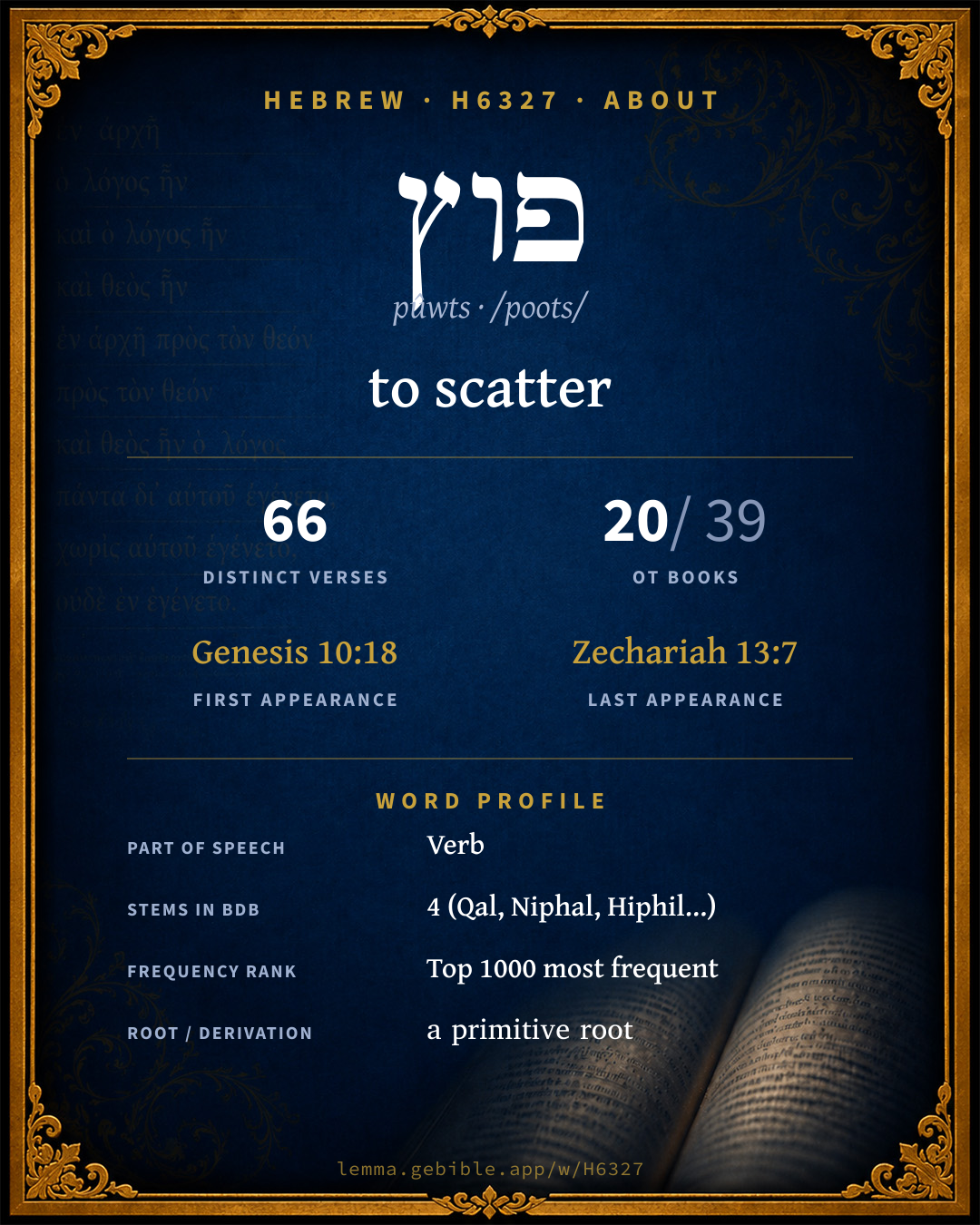
פּוּץ
to scatter
also: be dispersed, be scattered fuller range ↓
Full lexicon entry — Brown-Driver-Briggs (BDB)
From Brown-Driver-Briggs (BDB)
Where this word appears
See every Hiphil verb in the Hebrew Bible →
Grammar key — what these labels mean
Part of speech
- Verb
- An action or state-of-being word.
Stem
- Niphal
- Usually the simple passive or reflexive of the Qal (“he was written”). Here: ‘be scattered’
- Hiphil
- The causative active stem (“he caused / brought about”). Here: ‘trans. scatter’
- Qal
- The basic, simple active stem — the plain form of the verb (“he wrote”).
- Pilpel
- A reduplicated intensive stem of two-letter or hollow roots.
- Hithpolel
- The reflexive counterpart of the Polel.
Form
- Perfect
- A completed action or state — Hebrew marks aspect (completeness) more than strict tense (“he wrote”).
- Sequential Perfect
- A perfect with prefixed waw continuing a preceding imperfect or command (waw-consecutive perfect).
- Sequential Imperfect
- An imperfect with prefixed waw — the standard past-narrative form (waw-consecutive imperfect).
- Imperfect
- An incomplete, ongoing, or future action (“he will / would write”).
- Infinitive Construct
- A bound verbal noun, frequently with prepositions (“to write / in writing”).
- Participle Passive
- A verbal adjective expressing action received (“written”).
- Participle Active
- A verbal adjective expressing ongoing or characteristic action (“writing / one who writes”).
- Imperative
- A direct command (“write!”).
State
- Absolute
- The independent form of a noun, not bound to a following word.
- Construct
- A noun bound to a following noun in a possessive / “of” relationship (the construct chain).
Person
- 3rd Person
- The one spoken about (“he / she / it / they”).
- 1st Person
- The speaker (“I / we”).
- 2nd Person
- The one addressed (“you”).
Gender
- Common
- Either gender — not distinguished for this form.
- Masculine
- Grammatically masculine.
- Feminine
- Grammatically feminine.
Number
- Plural
- More than one (in Hebrew, generally three or more).
- Singular
- One.
6 verses where H6327 appears in the Hiphil stem in the Book of Jeremiah. Filtered view — show all forms. Click any verse to open its interlinear word-by-word view. Verse text shown in the World English Bible for context — . Each verse’s Hebrew form is shown with its reference; the English is not keyword-highlighted, since the data carries no word-level English alignment. Use “Compare translations” on any verse to read it across multiple English versions. This concordance covers the Hebrew Bible; Septuagint (Greek Old Testament) occurrences are not indexed here.
Jeremiah
- Jeremiah 9:16 וַ/הֲפִֽצוֹתִי/ם֙ conj + Hiphil wpf 1cs + sfx pers 3mp I will scatter them also among the nations, whom neither they nor their fathers have known; and I will send the sword after them, until I have consumed them.
- Jeremiah 13:24 וַ/אֲפִיצֵ֖/ם conj + Hiphil impf 1cs + sfx pers 3mp Therefore will I scatter them, as the stubble that passes away, by the wind of the wilderness.
- Jeremiah 18:17 אֲפִיצֵ֖/ם Hiphil impf 1cs + sfx pers 3mp I will scatter them as with an east wind before the enemy; I will show them the back, and not the face, in the day of their calamity.
- Jeremiah 23:1 וּ/מְפִצִ֛ים conj + Hiphil ptcp.act mp Woe to the shepherds who destroy and scatter the sheep of my pasture! says Yahweh.
- Jeremiah 23:2 הֲפִצֹתֶ֤ם Hiphil pf 2mp Therefore thus says Yahweh, the God of Israel, against the shepherds who feed my people: You have scattered my flock, and driven them away, and have not visited them; behold, I will visit on you the evil of your doings, says Yahweh.
- Jeremiah 30:11 הֲפִצוֹתִ֣י/ךָ Hiphil pf 1cs + sfx pers 2ms For I am with you, says Yahweh, to save you: for I will make a full end of all the nations where I have scattered you, but I will not make a full end of you; but I will correct you in measure, and will in no way leave you unpunished.
About this entry
At a glance — auto-summarized from this page’s data, not written by a person. Every figure links to its source below. This summary describes the numbers; it doesn’t interpret them.
“to scatter” is the headline sense of the Hebrew verb פוץ (pûwts). Where the King James Version says “i will scatter,” newer translations reach for “scattered” (Berean Standard Bible); the renderings breakdown has the detail. It appears 66 verses across 20 books of the Hebrew Bible, among its moderately common vocabulary. More than a quarter of its appearances fall in Ezekiel. The verb spans 4 stems, from Qal to Niphal. The sections below give every sense, occurrence, and version rendering.
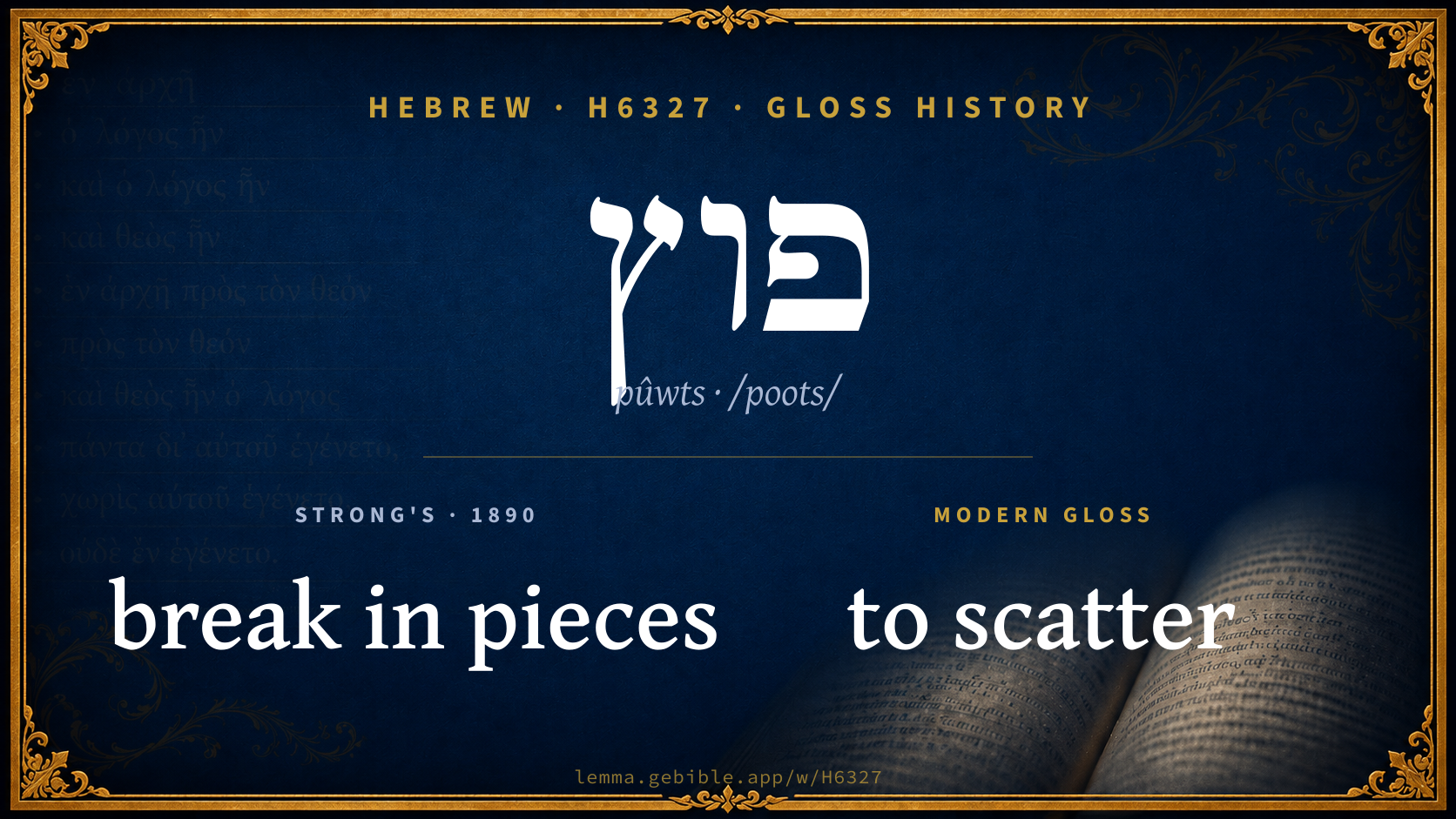
Gloss history
Strong's 1890 vs modern scholarship
About this word
Strong's H6327 catalogs a Hebrew word from the Hebrew Old Testament.
These counts are not copied from any lexicon or concordance. They are computed here, from the morphology-tagged Hebrew Old Testament. What Lemma adds →
- 66
- distinct verses
- The word appears in 66 distinct verses.
- 20 / 39
- OT books
- The word appears in 20 of 39 Old Testament books.
- #582
- by frequency
- Top 1000 most frequent Hebrew words (rank 582 of 8,640 Hebrew words by occurrence).
View all 66 occurrences in the concordance →
By section of the Old Testament
By traditional corpus
Conventional, traditional groupings — biblical authorship is debated, so this is a traditional corpus grouping, not an authorship claim. Each share is this word’s portion of its verses in that division of the Hebrew canon. Each figure is a share of the word’s 66 distinct verses.
- Prophets (Nevi'im) 45 verses · 68%
- Writings (Ketuvim) 11 verses · 17%
- Torah (Pentateuch) 10 verses · 15%
How translations render this word
Counts come from each version’s own published word-to-Strong’s tagging or interlinear alignment — an approximate guide to how each version renders this word, not a word-level alignment the data otherwise carries. Because each total is that version’s own tagged count, the per-version totals vary from one another and need not match the appearance or distinct-verse counts above. These counts may also differ from a printed concordance because Lemma counts each distinctly tagged rendering and does not collapse phrase taggings into a single head-word total. This is a fixed set of word-tagged versions (KJV, ASV, BSB, ULT) and does not change with the reading translation you choose elsewhere. Each version’s license is shown beside its name below (and on Sources).
BDB lists this Strong’s number as 3 distinct words (homographs). Each count above pools all of them and is not split by sense — see the Senses section below. A low-frequency rendering may belong to a different one of those words, not the primary meaning.
- King James Version†: I will scatter 6×, Scatter 4×, Scattered 4×
- American Standard Version†: I will scatter 6×, Scatter 5×, Scattered 5×
- Berean Standard Bible†: Scattered 7×, They were scattered 5×, I will disperse 4×
- unfoldingWord Literal Text†: Scattered 11×, Scatter 5×, And 4×
King James Version Public Domain
Renders H6327 across 69† tagged occurrences — most commonly:
Plus 40 renderings that appear only once — usually multi-word phrases or single function words the recovered tagging swept in, not distinct renderings.
American Standard Version Public Domain
Renders H6327 across 68† tagged occurrences — most commonly:
Plus 44 renderings that appear only once — usually multi-word phrases or single function words the recovered tagging swept in, not distinct renderings.
Berean Standard Bible Public Domain
Renders H6327 across 67† tagged occurrences — most commonly:
Plus 29 renderings that appear only once — usually multi-word phrases or single function words the recovered tagging swept in, not distinct renderings.
unfoldingWord Literal Text CC BY-SA 4.0
Renders H6327 across 80† tagged occurrences — most commonly:
Plus 42 renderings that appear only once — usually multi-word phrases or single function words the recovered tagging swept in, not distinct renderings.
12 senses and sub-senses in the full BDB
Hebrew verbs can shift meaning by stem (binyan): Qal is the basic action, Niphal is often passive or reflexive, Piel often intensifies or makes it factitive, and Hiphil is typically causative. The senses below are grouped under the stem BDB assigns to each. This entry also uses one or more reduplicated stems (the Pōlēl/Pilpēl type), which for hollow or geminate roots behave much like Piel — often intensive or iterative.
What do BDB’s symbols mean?
BDB uses these scholarly abbreviations:
| Symbol | Meaning |
|---|---|
| 𝔊 | the Septuagint (the ancient Greek translation, LXX) |
| 𝔙 | the Vulgate (the Latin translation) |
| 𝔖 | the Syriac version (the Peshitta) |
| 𝔗 | the Targum (the Aramaic translation) |
| ψ | the Psalms |
| √ | root (the underlying root or stem) |
| ‖ | parallel passage (a synonymous or contrasted parallel) |
| † | the dagger: every passage where the word occurs is cited |
The 12 senses and sub-senses the full Brown-Driver-Briggs lexicon distinguishes for this word, in lexicon order (not ranked by frequency), with BDB’s own verbatim wording and sub-sense lettering. Shown in Hebrew script with BDB’s own scholarly abbreviations. The condensed entry is in the Lexicon Entry tab. See also the Forms in the corpus table below.
פוץ I be dispersed, scattered (NH = BH
Qal
- Impf. 3 mpl. יָפוּצוּ ψ 68:2, יָפֻצוּ Ez 48:16 +; 3 fpl. וַתְּפוּצֶינָה Ez 34:5 +, וּתְפוּצֶינָה Zc 13:7, etc.; Imv. mpl. פֻּצוּ 1 S 14:34; Pt. pass. pl. sf. פּוּצַי Zp 3:10 (v. infr.);—be dispersed, disperse, בָּעָם 1 S 14:34; be scattered, of enemies 1 S 11:11; Nu 10:35 ψ 68:2; of Isr. (among nations) under fig. of flock Ez 34:5(×2); Zc 13:7; בַּת־פּוּצַי Zp 3:10 is prob. crpt., and v 9, 10 gloss v. SchwallyZAW x (1890), 203 Now Da; of besieging army 2 S 20:22 (מֵעַל הָעִיר); people from (מִן) possessions Ez 46:18; men (from Babel) Gn 11:4 (עַל loc.). e.g. Psalms 68:2
Niphal
- Pf. 3 fs. נָפ֫וֹצָה Je 10:21, 3 pl. נָ֫פֹצוּ Gn 10:18 +, 2 mpl. נְפֹצֹתֶם Ez 11:17 +, etc.; Pt. f. נָפ֫וֹצֶת 2 S 18:8 Qr (> Kt נפצות) cf. Dr al.; pl. נְפֹצִים 1 K 22:17, נְפוֹצִים 2 Ch 18:16;— e.g. Jeremiah 10:21
- 1. be scattered, of army 2 K 25:5 (מֵעַל pers.) = Je 52:8, 1 K 22:17 (אֶל loc.) = 2 Ch 18:16 (עַל), cf. Je 40:15 (abs.); of dispersed Isr. c. ב loc. Ez 11:17; 20:34, 41; 28:25, as flock Je 10:21; Ez 34:6 (עַל loc.), v 12 (שָׁם); Egyptians 29:13 (שָׁמָּה); of battle scattered over country by defeat 2 S 18:8. e.g. 2 Kings 25:5
- 2. be spread abroad, of peoples Gn 10:18. e.g. Genesis 10:18
Hiphil
- Pf. 3 ms. consec. וְהֵפִיץ Dt 4:27 +, 1 s. consec. וַהֲפִיצוֹתִי Ez 22:15, etc.; Impf. 3 ms. יָפִיץ Jb 37:11, וַיָּ֫פֶץ Gn 11:8 +, etc.; Imv. ms. הָפֵץ Jb 40:11; Inf. cstr. לְהָפִיץ Ez 20:23, etc.;— e.g. Deuteronomy 4:27
- 1. trans. scatter:
- a. c. acc. pers. Gn 11:8, 9 (עַל loc.), Is 41:16; Hb 3:14; c. ב Gn 49:7; Isr. among (ב) nations Dt 4:27; 28:64; Je 9:15; Ez 11:16; 12:15; 20:23; 22:15; 36:19; Ne 1:8; c. שׁם(ה) Dt 30:3; Je 30:11; c. אֶל loc. Ez 34:21; abs. Je 13:24; 18:17, under fig. of flock Je 23:1, 2; Gr reads אֲפִיצֵם also Dt 32:26 (v. [פאה]); Egyptians (c. ב) Ez 29:12; 30:23, 26; inhab. of earth Is 24:1. e.g. Genesis 11:8
- b. c. acc. rei, arrows (fig. for lightnings) 2 S 22:15 = ψ 18:15, ψ 144:6; cloud Jb 37:11; הָפֵץ עַבְרוֹת אַפֶּ֑ךָ 40:11 (i.e. lightnings?); seed Is 28:25. e.g. 2 Samuel 22:15
- c. וֶהֱפִיצֻהוּ Jb 18:11 and drive him (si vera l., vid. conj. in Bu). e.g. Job 18:11
- 2. intrans., scatter, c. ב loc. Ex 5:12, c. מֵעַל pers. 1 S 13:8; of wind Jb 38:24 (עַל loc.). e.g. Exodus 5:12
פוץ II flow, overflow (Arabic فَاضَ flow, cf. BaES 69)
Qal
- Impf. 3 mpl. יָפוּצוּ Pr 5:16 of springs, fig. for sources of pleasure; 3 fpl. תְּפוּצֶנָה עָרַי מִטּוֹב Zc 1:17 my cities shall overflow with good. e.g. Proverbs 5:16
פוץ III break (Arabic فَضَّ break, break asunder
Pilp
- Impf. 3 ms. sf. וַיְפַצְפְּצֵנִי Jb 16:12 he [God] dashed me in pieces (fig.) Hithpōʿ. e.g. Job 16:12
Senses from the full Brown-Driver-Briggs lexicon (Brown, Driver, Briggs; Oxford 1906 — public domain), digitized via Sefaria, supplemented by the OpenScriptures HebrewLexicon (CC BY 4.0). Full attribution on Sources.
Word origin
I. vb. be dispersed, scattered (NH = BH; perhaps akin to Arabic فَضَّ break asunder, scatter);—
II. vb. flow, overflow (Arabic فَاضَ flow, cf. BaES 69);—
I. vb. break (Arabic فَضَّ break, break asunder; Nab. פצץ break asunder; Syriac ܦܰܥ crush);—Pōʿ. Impf. 3 ms. יְפֹצֵץ סָ֑לַע Je 23:29 a hammer which shatters rock.
— Brown-Driver-Briggs (Oxford 1906, public domain), digitized via Sefaria, supplemented by the OpenScriptures HebrewLexicon (CC BY 4.0). See Sources.
Origin: a primitive root
Jastrow Dictionary
A second Hebrew/Aramaic lexicon for comparison, covering Aramaic and post-biblical (Talmudic, Targumic, Midrashic) usage that the biblical-Hebrew BDB does not. Matched by lemma rather than by Strong’s number, so a lemma may carry more than one Jastrow headword (shown separately below), and the entries cover usage well beyond the Bible.
פּוּץ
- (b. h.) to break through.
- to break through, spread. Y. Snh. I, 19ᵇ sq. [read:] חד אמר … וחרנה אין עושין כל עיקר שמא יָפִיצוּ גוים ויבואו לארץ ישראל ואית דבעי מימר שמא יִפְרְצוּ אויבים ויבואו לידי קרחה one says (in the case of border towns condemned for idolatry, v. נָדַח), if there are two of them, we do not condemn them to be destroyed, if only one, we do; and another says, if there are several border towns near one another (of which one is to be condemned), we proceed (against the one, because the protection remains unimpaired), but if they are scattered, we do not; and a third one says, we must not destroy a border town under any circumstances, lest ravaging troops break forth and invade Palestine; but some would say (instead), lest a regular enemy invade and find an open country (v. Bab. Snh. 16ᵇ; Tosef. ib. XIV, 1).
- to shatter, shiver, spread. Part. pass. מְפוֹצָץ; f. מְפוֹצֶצֶת. Lev. R. s. 27 עתידה בת קול להיות מפ׳ … ואומרת וכ׳ (not ואומר) in days to come a divine voice will be scattered in all directions (cmp. נִיצוֹץ) on the top of mountains and proclaim &c.
- to be shattered. Kidd. 30ᵇ אם ברזל הוא מִתְפּוֹצֵץ if he (the tempter in man’s heart) is of iron, he will be shattered (by the study of God’s word, with ref. to Jer. XXIII, 29). e.g. Jeremiah 23:29
פּוּץ ²
- ch., v. פְּצַץ a. נְפַץ.
A Dictionary of the Targumim, the Talmud Babli and Yerushalmi, and the Midrashic Literature (Marcus Jastrow; London, Luzac, 1903) — Public Domain. Digitized via Sefaria. Digitized via Sefaria. Full attribution on Sources.
Forms in the corpus
The 61 distinct written forms H6327 takes in the Hebrew Bible, most frequent first — each parse links to that stem’s occurrences in the concordance. Hebrew forms include their vowel points and cantillation, so a single lemma takes many written forms.
The 60 most common forms are shown; 1 rarer form follow in the full concordance.
Same root — word family
Other BDB entries built from the same root as H6327, grouped by Strong’s listed origin. These share a root / origin per the lexicon — not necessarily a shared meaning. Each links to that word’s own entry.
Derived from this word
Compare all same-root words → They share a root, not necessarily a meaning.
Septuagint verse parallels
This word appears in 64 verses that also exist in the Greek Old Testament (Septuagint), out of the 66 Hebrew verses it occurs in. You can read those verses in Greek by switching the Old Testament edition to the Septuagint.
Read these verses in the Septuagint
- Genesis 10:18
- Exodus 5:12
- Numbers 10:35
- Deuteronomy 4:27
- 1 Samuel 11:11
- 2 Samuel 18:8
- 1 Kings 22:17
- 2 Kings 25:5
- 2 Chronicles 18:16
- Job 16:12
- Psalms 18:14
- Proverbs 5:16
This is a verse-level parallel only — the same verses exist in both the Hebrew and Greek Old Testaments. No word-level Hebrew↔Greek correspondence is claimed: the data carries no such alignment, so no Greek word is shown as this Hebrew word’s translation. Coverage is not total — the Septuagint omits the deuterocanon and renumbers the Psalms, so some Hebrew verses have no direct Greek parallel.