Job 16:12

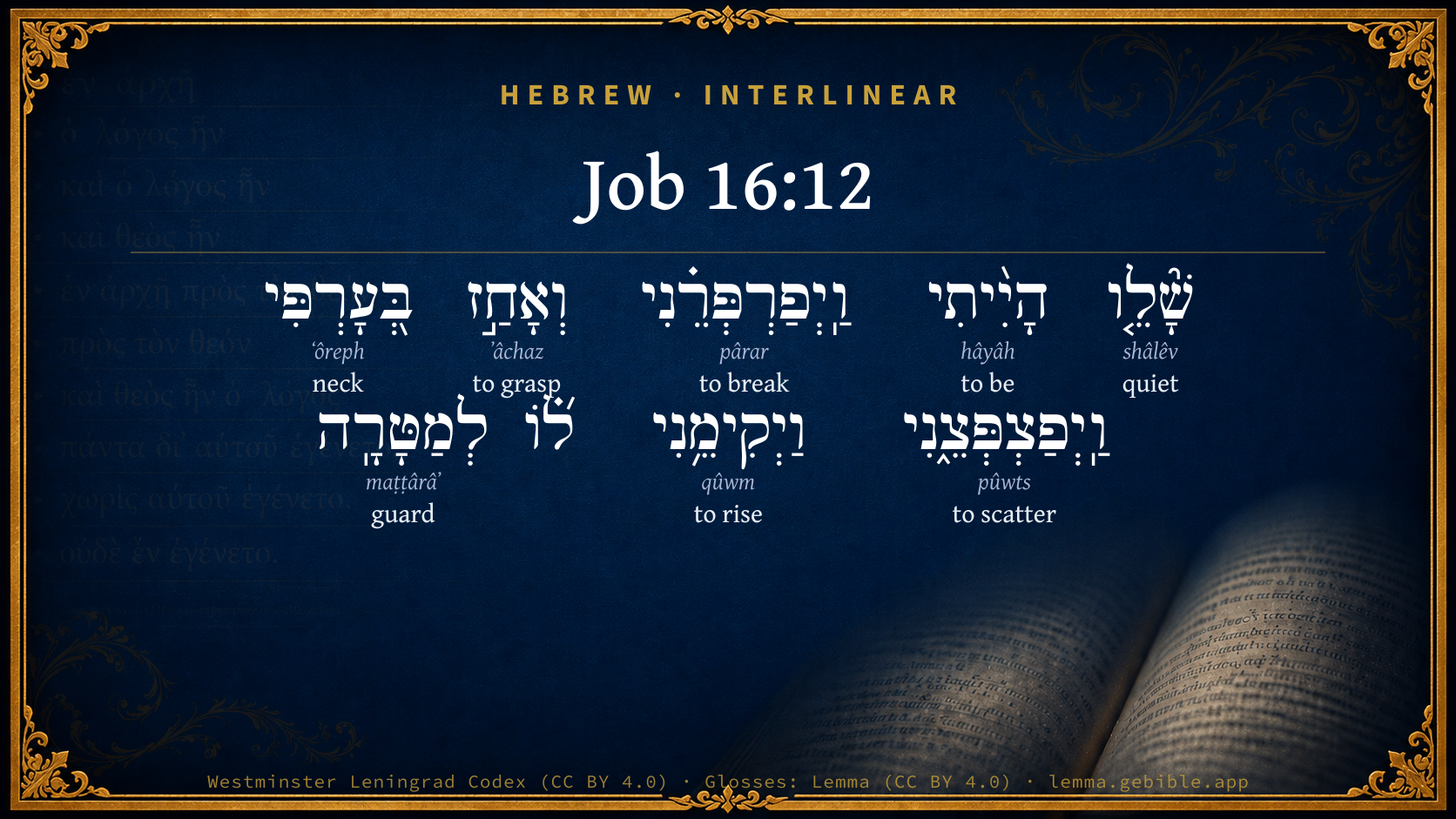
Hebrew (Westminster Leningrad Codex) Job 16:12 appears in the Hebrew Old Testament. The text above is from the Westminster Leningrad Codex. Each word links to its Strong’s number, a concise gloss, and parsing drawn from the Open Scriptures Hebrew Bible morphology. Click any word for its full Brown-Driver-Briggs (BDB) entry.
Download image
Cite this verse

Job 16:12 (World English Bible). Public Domain. Lemma interlinear Bible study tool, https://lemma.gebible.app/v/job/16/12.

Show BibTeX & RIS
BibTeX
RIS
English Translation
I was at ease, and he broke me apart. Yes, he has taken me by the neck, and dashed me to pieces. He has also set me up for his target.
World English Bible · Public Domain
Download a study sheet

One document with this verse’s original text, its word-by-word gloss line, the meaning frame, cross-references with their text, attributed commentary, and full source and license credits — printable, and it pastes into notes with its structure intact.

This verse Autodidact and up

Study sheet (.html) Plain text (.txt)

A passage Seminary Student

Up to 50 verses in one chapter. A passage sheet keeps up to 6 commentary sources and 12 cross-references per verse, in the order this page ranks them, and says so on the sheet whenever that leaves anything out. Ask for a single verse and you get the Autodidact verse sheet above.

Everything on this page stays free to read, with no account — the sheet is a download of what is already on screen, not access to it.

Want to remove ads? Support Godless Engineer
Compare translations 3

The same verse in 3 English versions, stacked beneath the original-language interlinear above. Click any original word for its lexicon entry.

Each is an independent rendering of the whole verse — the interlinear is not word-aligned to these translations.

Highlighted words mark where these versions differ — a whole-verse word diff, not a word-by-word alignment.

  • World English Bible Public Domain
    I was at ease, and he broke me apart. Yes, he has taken me by the neck, and dashed me to pieces. He has also set me up for his target.
  • King James Version Public Domain
    I was at ease, but he hath broken me asunder: he hath also taken me by my neck, and shaken me to pieces, and set me up for his mark.
  • unfoldingWord Literal Text CC BY-SA 4.0
    I was tranquil, but he has shattered me, and he has seized my neck and shaken me to pieces. And he has set me up as a target for him;

unfoldingWord Literal Text — © unfoldingWord, licensed CC BY-SA 4.0. Word-aligned USFM3 via Door43 (git.door43.org/unfoldingWord/en_ult).

Versions to compare (up to 4)

3 of 4 selected

Show all 18 translations

Every available English version of this verse, each an independent rendering of the whole verse.

  • World English Bible Public Domain
    I was at ease, and he broke me apart. Yes, he has taken me by the neck, and dashed me to pieces. He has also set me up for his target.
  • Berean Standard Bible Public Domain
    I was at ease, but He shattered me; He seized me by the neck and crushed me. He has set me up as His target;
  • Majority Standard Bible Public Domain
    I was at ease, but He shattered me; He seized me by the neck and crushed me. He has set me up as His target;
  • King James Version Public Domain
    I was at ease, but he hath broken me asunder: he hath also taken me by my neck, and shaken me to pieces, and set me up for his mark.
  • American Standard Version (1901) Public Domain
    I was at ease, and he brake me asunder; Yea, he hath taken me by the neck, and dashed me to pieces: He hath also set me up for his mark.
  • Revised Version (1885) Public Domain
    I was at ease, and he brake me asunder; yea, he hath taken me by the neck, and dashed me to pieces: he hath also set me up for his mark.
  • Geneva Bible (1599) Public Domain
    I was in welth, but he hath brought me to nought: he hath taken me by the necke, and beaten me, and set me as a marke for himselfe.
  • Douay-Rheims (1899) Public Domain
    God hath shut me up with the unjust man, and hath delivered me into the hands of the wicked.
  • Young's Literal Translation Public Domain
    At ease I have been, and he breaketh me, And he hath laid hold on my neck, And he breaketh me in pieces, And he raiseth me to him for a mark.
  • Literal Standard Version CC BY-SA 4.0
    I have been at ease, and He breaks me, || And He has laid hold on my neck, || And He breaks me in pieces, || And He raises me to Him for a mark.
  • Unlocked Literal Bible CC BY-SA 4.0
    I was at ease, and he broke me apart. Indeed, he has taken me by the neck and dashed me to pieces; he has also set me up as his target.
  • unfoldingWord Literal Text CC BY-SA 4.0
    I was tranquil, but he has shattered me, and he has seized my neck and shaken me to pieces. And he has set me up as a target for him;
  • Darby Bible Public Domain
    I was at rest, but he hath shattered me; he hath taken me by the neck and shaken me to pieces, and set me up for his mark.
  • World Messianic Bible Public Domain
    I was at ease, and he broke me apart. Yes, he has taken me by the neck, and dashed me to pieces. He has also set me up for his target.
  • Webster's Bible Public Domain
    I was at ease, but he hath broken me asunder: he hath also taken me by my neck, and shaken me to pieces, and set me up for his mark.
  • Free Bible Version CC BY-SA 4.0
    I was living in peace and he smashed me to pieces. He grabbed me by the neck and dashed me to pieces. He set me up as his target.
  • Bible in Basic English Public Domain
    I was in comfort, but I have been broken up by his hands; he has taken me by the neck, shaking me to bits; he has put me up as a mark for his arrows.
  • JPS Tanakh (1917) Public Domain
    I was at ease, and He broke me asunder; yea, He hath taken me by the neck, and dashed me to pieces; He hath also set me up for His mark.

Literal Standard Version (2020), Covenant Press — licensed CC BY-SA 4.0. Text via the HelloAO Bible API (eBible.org). Unlocked Literal Bible (unfoldingWord) — licensed CC BY-SA 4.0. Text via the HelloAO Bible API (eBible.org). unfoldingWord Literal Text — © unfoldingWord, licensed CC BY-SA 4.0. Word-aligned USFM3 via Door43 (git.door43.org/unfoldingWord/en_ult). Free Bible Version, Dr. Jonathan Gallagher — licensed CC BY-SA 4.0. Text via the HelloAO Bible API (eBible.org).

Word by word

More ways to search: Search by grammar → Find every occurrence → Compare this word →

Practice this passage: Drill this verse → Learn its vocabulary →

שָׁ֘לֵ֤ו
shâlêv
H7961
“quiet”
Adjective, Adjective, Masculine, Singular, Absolute
Part of Speech
Adjective
Type
Adjective
Gender
Masculine
Number
Singular
State
Absolute
Full BDB Definition

Origin: from H7951

TWOT: 2392c

quiet, at ease, prosperous - at ease (of persons) - quiet (of land) - quiet, ease - ease (substantive)
  1. הָיִ֨יתִי hâyâh H1961 “to be” Verb, Qal, Perfect, 1st Person, Common, Singular
  2. וַֽיְפַרְפְּרֵ֗נִי pârar H6565 “and · to break · me” Conjunction + Verb, Pilpel, Sequential Imperfect, 3rd Person, Masculine, Singular + Suffix, Personal, 1st Person, Common, Singular
  3. וְאָחַ֣ז ʼâchaz H270 “and · to grasp” Conjunction + Verb, Qal, Sequential Perfect, 3rd Person, Masculine, Singular
  4. בְּ֭עָרְפִּי ʻôreph H6203 “in/at · neck · my” Preposition + Noun, Common, Masculine, Singular, Construct + Suffix, Personal, 1st Person, Common, Singular
  5. וַֽיְפַצְפְּצֵ֑נִי pûwts H6327 “and · to scatter · me” Conjunction + Verb, Pilpel, Sequential Imperfect, 3rd Person, Masculine, Singular + Suffix, Personal, 1st Person, Common, Singular
  6. וַיְקִימֵ֥נִי qûwm H6965 “and · to rise · me” Conjunction + Verb, Hiphil, Sequential Imperfect, 3rd Person, Masculine, Singular + Suffix, Personal, 1st Person, Common, Singular
  7. לְמַטָּרָֽה maṭṭârâʼ H4307 “to/for · guard” Preposition + Noun, Common, Feminine, Singular, Absolute

About this verse

These counts appear in no published source. They are computed here, from the morphology-tagged text and Lemma’s own curated glosses. What Lemma adds →

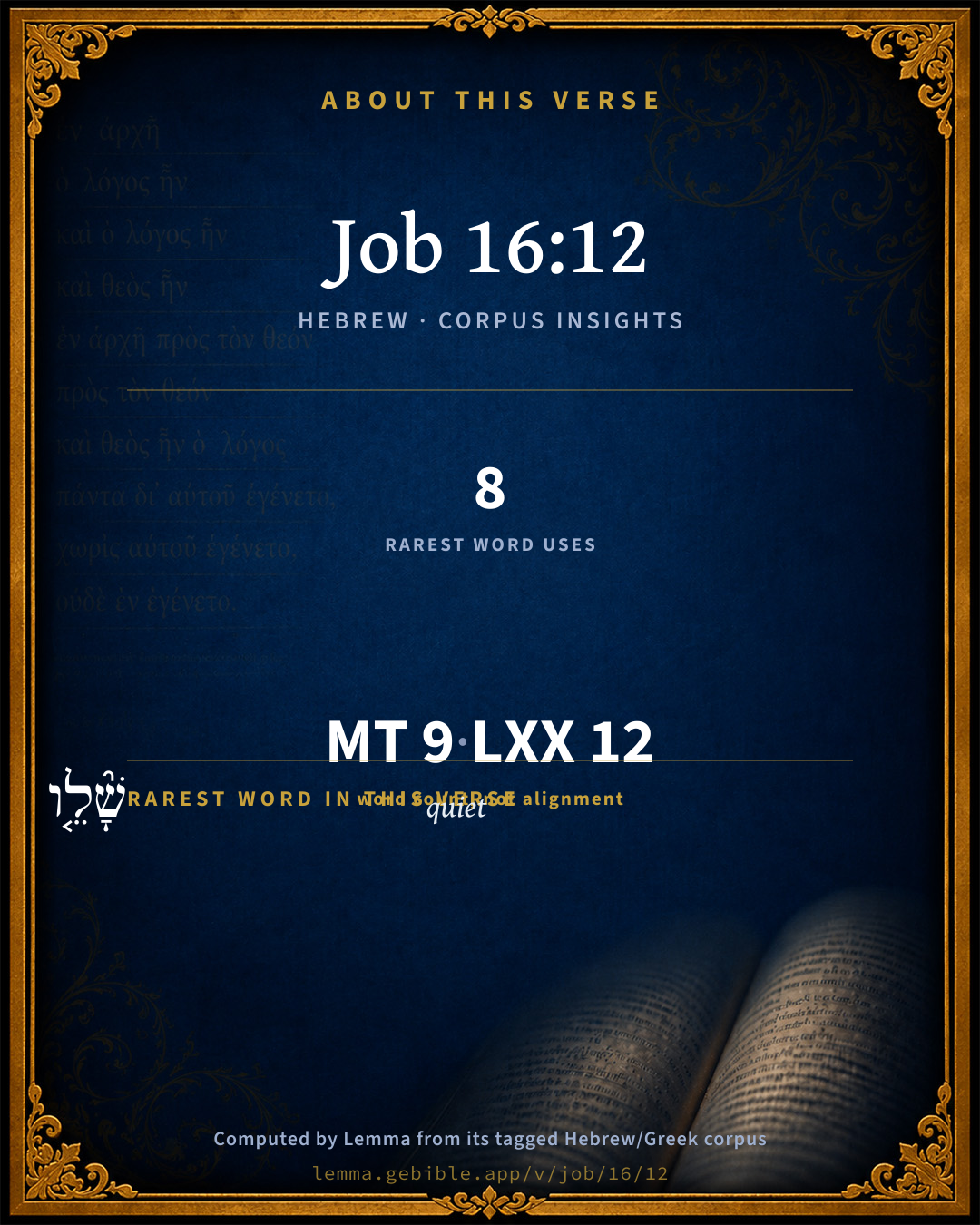
9
words
8
distinct lemmas
Wisdom
section

Notable vocabulary

The rarest word here is שָׁ֘לֵ֤ו quiet H7961 — appearing just 8 times in the whole Hebrew Bible.

Shared distinctive vocabulary

שָׁ֘לֵ֤ו quiet H7961 occurs in 8 verses of the Hebrew Bible. Also found in:

Grammatical profile

  • 5 verbs
  • 2 nouns
  • 1 adjective
  • 1 preposition

Verb forms

  • הָיִ֨יתִי Qal · Perfect
  • וַֽיְפַרְפְּרֵ֗נִי Pilpel · Sequential Imperfect
  • וְאָחַ֣ז Qal · Sequential Perfect
  • וַֽיְפַצְפְּצֵ֑נִי Pilpel · Sequential Imperfect
  • וַיְקִימֵ֥נִי Hiphil · Sequential Imperfect

Hebrew & Septuagint length

In English translation the verse runs 31 words from the Hebrew and 18 from the Septuagint (LXX English) — the Septuagint runs noticeably shorter here. See the side-by-side →

A rough comparison of the two English renderings, which tokenize alike — not a word-level alignment.

Word counts can differ between the Hebrew and the Greek without any difference in meaning — e.g. the Hebrew direct-object marker אֵת has no separate Greek word, and Greek often adds the article ὁ.

In the original languages it is 9 Hebrew tokens and 12 Greek tokens — but the two are counted differently (Hebrew bundles its prefixes and suffixes into one token; the Greek is in lemma form), so that isn’t a like-for-like length.

Cross-references

15

Topical passages linked to Job 16:12 in the Treasury of Scripture Knowledge — connected by theme and wording, ordered by reader-vote popularity; previews shown in the World English Bible.

  • Job 7:20 If I have sinned, what do I do to you, you watcher of men? Why have you set me as a mark for you, So that I am a burden to myself?
  • Lamentations 3:11–12 He has turned aside my ways, and pulled me in pieces; he has made me desolate.
  • Lamentations 3:4 My flesh and my skin has he made old; he has broken my bones.
  • Job 9:17 For he breaks me with a tempest, Multiplies my wounds without cause.
  • Psalms 44:19 Though you have crushed us in the haunt of jackals, And covered us with the shadow of death.
  • Job 4:10 The roaring of the lion, and the voice of the fierce lion, The teeth of the young lions, are broken.
  • Job 7:12 Am I a sea, or a sea-monster, That you put a guard over me?
  • Job 15:26 He runs at him with a stiff neck, With the thick shields of his bucklers;
  • Job 29:3 When his lamp shone on my head, And by his light I walked through darkness;
  • Job 29:18–19 Then I said, 'I shall die in my own house, I shall number my days as the sand.
  • Ezekiel 29:7 When they took hold of you by your hand, you did break, and did tear all their shoulders; and when they leaned on you, you broke, and mad all their loins to be at a stand.
  • Matthew 21:44 He who falls on this stone will be broken to pieces, but on whoever it will fall, it will scatter him as dust."
  • Romans 16:4 who for my life, laid down their own necks; to whom not only I give thanks, but also all the assemblies of the Gentiles.
  • Job 1:2–3 There were born to him seven sons and three daughters.
  • Job 3:26 I am not at ease, neither am I quiet, neither have I rest; But trouble comes."

Cross-references courtesy of OpenBible.info (CC BY 4.0).

Hebrew and Greek witnesses Masoretic Hebrew ↔ Greek Septuagint

The same verse in the two great witnesses to the Old Testament, shown verse-for-verse.

Here the Septuagint runs noticeably shorter than the Hebrew — LXX2012 (modern English Septuagint) 18 words vs World English Bible 31. A rough length comparison of the two English translations, not a word-level alignment — read both below.

These are two independent witnesses, not word-aligned to each other, and the Septuagint is shown in lemma (dictionary) form.

Hebrew Job 16:12 Masoretic · Westminster Leningrad Codex

שָׁ֘לֵ֤ו הָיִ֨יתִי וַֽיְפַרְפְּרֵ֗נִי וְאָחַ֣ז בְּ֭עָרְפִּי וַֽיְפַצְפְּצֵ֑נִי וַיְקִימֵ֥נִי ל֝֗וֹ לְמַטָּרָֽה

I was at ease, and he broke me apart. Yes, he has taken me by the neck, and dashed me to pieces. He has also set me up for his target.

World English Bible · Public Domain

Greek LXX Job 16:12 Septuagint · lemma form

εἰρηνεύω διασκεδάζω ἐγώ λαμβάνω ἐγώ ὁ κόμη διατίλλω καταἵστημι ἐγώ ὥσπερ σκοπός

For the Lord has delivered me into the hands of unrighteous men, and thrown me upon the ungodly.

LXX2012 (modern English Septuagint) · Public Domain

On this verse, Keil & Delitzsch discusses the Septuagint’s reading. Read the note in Commentary ↓

Hebrew: Westminster Leningrad Codex (CC BY 4.0). Greek: Septuagint (public domain); English from LXX2012 (modern English Septuagint) (Public Domain). How the Septuagint differs from the Hebrew →

Commentary

Notes on Job 16:12 from classic Christian and Jewish commentators (each source and its license shown beneath its notes). The classic Christian expositions comment on the surrounding passage and are grouped to its opening verse, so a note may address several verses; the Jewish commentaries on the Tanakh (Rashi and others) are per-verse, so they appear only where the commentator wrote on this verse.

Lemma curates 59 commentaries, every one of them public domain or Creative Commons licensed, each selected and text-cleaned for this edition rather than reprinted as found. About our sources →

Trapp's Complete Commentary

John Trapp

Job 16:12 I was at ease, but he hath broken me asunder: he hath also taken [me] by my neck, and shaken me to pieces, and set me up for his mark.

Ver. 12. I was at ease, but he hath broken me asunder] It is no small misery to have been happy. Fuimus Troes et fortis Milesis. Euripides bringeth in Hecuba as ashamed to look Polymnestor in the face, because having been a queen she was now a captive; her former felicity was no small aggravation compared to her present misery: so was Job’s. Prosper eram, sed disrupit me, saith he. I was wealthy, but he hath undone me; so Broughton rendereth it. The same Hebrew word signifieth both to be rich and to be at ease; for such commonly sing requiems to their souls, as he did Luk 12:19, and say, "I shall never be moved," Psa 30:6; "I shall see no sorrow," Rev 18:7. But God can quickly confute them. Job’s worldly prosperity was quickly dashed and lost. He once hoped to have died in his nest, but God not only unnested him, but broke him to shivers, yea, beat him to dust and atoms, as the word here signifies. Nay, more,

He hath also taken me by my neck] As a strong man doth his enemy, dashing him to the ground, and giving him his passport, as we say.

And hath shaken me to pieces] Heb. He hath scattered and scattered me, as a stone crumbled to crattle, or a pitcher beaten to powder. Sunt illustres figurae et elegantes hyperbolae, saith Mercer. Here is brave rhetoric.

And set me up for his mark] Heb. For a mark to him; that I may feel all the arrows of his judgments. See Job 7:20, with the notes there. God shot showers of shafts at him, and seemed to take pleasure in so doing, as a man doth in his shooting at a mark.

John Trapp, A Commentary or Exposition upon All the Books of the Old and New Testament (1647–1656) — public domain. Text from a community e-Sword module.

Joseph Benson's Commentary

Job 16:12. I was at ease — I lived in great peace and prosperity, and was contented and happy in the comfortable enjoyment of the gifts of God’s bounty, not fretful and uneasy, as some are, in the midst of the blessings of providence, who thereby provoke God to take these blessings from them; but he hath broken me asunder — Hath broken my spirit with the sense of his anger, and my body with loathsome ulcers; and all my hopes and prospects, as to the present life, by the destruction of all my children and property. He hath also taken me by the neck — And thrown me down from an eminent condition into one most despicable; and shaken me to pieces — As a mighty man acts with some young stripling when he wrestles with him; and set me up for his mark — That he may shoot all his arrows into me, and wound me with one calamity after another.

Joseph Benson's Commentary on the Old and New Testaments (1811–1818) — public domain. Text from a community e-Sword module.

Whedon's Commentary on the Bible

Daniel D. Whedon

Second strophe — Notwithstanding Job’s life of purity, God has maltreated and persecuted him even unto death, Job_16:12-17.

12. I was at ease — Our ungrateful nature has only a word, שׁלו, “at ease,” for years of prosperity, but dwells at length upon months of affliction.

By my neck — As a beast does his prey.

Daniel D. Whedon (gen. ed.), Commentary on the Old and New Testaments (1874–1909) — public domain. Text from a community e-Sword module.

Tyndale Open Study Notes

Tyndale Open Resources

16:12 took me by the neck: This might refer to a wild animal with its prey (see 16:9), but it is more likely a military image that signaled defeat (Gen 49:8; Ps 18:40).

Tyndale Open Study Notes — © Tyndale Open Resources, licensed CC BY-SA 4.0. Text via the HelloAO Bible API.

Jamieson, Fausset & Brown

Robert Jamieson, A. R. Fausset & David Brown

I was at ease--in past times (Job 1:1-3).

by my neck--as an animal does its prey (so Job 10:16).

shaken--violently; in contrast to his former "ease" (Psa 102:10). Set me up (again).

mark-- (Job 7:20; Lam 3:12). God lets me always recover strength, so as to torment me ceaselessly.

Jamieson, Fausset & Brown — Commentary Critical and Explanatory on the Whole Bible (1871) — public domain (CC PDM 1.0). Text via the HelloAO Bible API.

Ellicott's Commentary for English Readers

(12) I was at ease.—A highly poetical passage, in which Job becomes, as it were, a St. Sebastian for the arrows of God. It is hardly possible to conceive a more vivid picture of his desolate condition under the persecuting hand of the Almighty.

A Bible Commentary for English Readers, edited by Charles John Ellicott (1878–1897) — public domain. Text from a community e-Sword module.

The Cambridge Bible for Schools and Colleges

gen. ed. J. J. S. Perowne

12. The figure of a man seized by another of overwhelming strength and dashed to pieces. This attack was sudden and unexpected, when Job was at ease and in security cf. ch. Job_29:2 seq. This meets what Eliphaz said of the forebodings of conscience, ch. Job_15:20 seq.

12–14. More particular description of the hostile attack of God, its unexpectedness and destructiveness.

The Cambridge Bible for Schools and Colleges (gen. ed. J. J. S. Perowne; Cambridge University Press, 1878–1918) — public domain. Text from a community e-Sword module.

John Gill's Exposition

His archers compass me round about,.... Satan and his principalities and powers casting their fiery darts at him; or rather, his friends shooting their arrows, even bitter words, reproaches, and calumnies; or the various diseases of his body, his boils and ulcers, which were so many arrows shot into him, in every part of him all around, and gave him exquisite pain and anguish; besides the arrows of the Almighty, or that painful sensation he had of the wrath of God. This also is true of Christ, the antitype of Job and of Joseph; of the latter of which it is said, "the archers sorely grieved him, and shot at him, but his bow abode in strength", Gen 49:23; so Satan and his ministers threw their fiery darts at Christ when on the cross, and the scribes and priests, his emissaries, surrounded him there, and shot out their reproachful and blasphemous words at him, and the justice of God smote him, and the law of God cast its curses on him. Gussetius renders the words, "his great ones" (g); and such Job's friends were, men of great substance, and lived in great credit and honour; some have supposed them to be kings, and such were those that opposed Christ, and distressed him, the rulers of the people, civil and ecclesiastic:

he cleaveth my reins asunder; by causing his arrows to enter into them, Lam 3:13; the consequence of which must be death; a man cannot live, at least long, after this is his case; though some think this is to be understood of the disorder of the stone in his reins or kidneys, which was very distressing to him:

and doth not spare; shows no mercy or pity, though in such sad circumstances and dreadful agonies; thus God spared not his own son, Rom 8:32;

he poureth out my gall upon the ground; which is done by piercing the gall bladder with the sword, or any such instrument, see Job 20:25; which must issue in death; and the design of both these clauses is to show, that Job looked upon his case irretrievable, and he here makes use of hyperbolical expressions to set it forth by.

(g) "Ejus magnates", Comment. Ebr. p. 773. "ejus magni", Montanus.

John Gill's Exposition of the Whole Bible (1746–1763) — public domain (CC PDM 1.0). Text via the HelloAO Bible API.

Albert Barnes' Notes on the Bible

I was at ease - I was in a state of happiness and security. The word used here (שׁלו shâlêv) means sometimes to be “at ease” in an improper sense; that is, to be in a state of “carnal security,” or living unconcerned in sin (Eze 23:42; compare Pro 1:32); but here it is used in the sense of comfort. He had everything desirable around him.

But he hath broken me asunder - He has crushed me.

He hath also taken, me by my neck - Perhaps as an animal does his prey. We have all seen dogs seize upon their prey in this manner.

And set me up for his mark - Changing the figure, and saying that God had directed his arrows against him; so Jeremiah, Lam 3:12 :

He hath bent his bow,

And set me as a mark for the arrow.

Albert Barnes' Notes on the Bible (1834–1885) — public domain. Text from a community e-Sword/MySword module.

Matthew Poole's English Annotations

I lived in great peace and prosperity, which makes my present miseries more grievous to me; and therefore my complaints are excusable, and I deserve pity rather than reproach from my friends.

Broken me asunder; broken my spirit with the sense of his anger, and my body with loathsome ulcers, as also by destroying my children, a part of my own flesh or body.

Taken me by my neck, and shaken me to pieces; as a mighty man doth with some young stripling, when he wrestleth with him. Set me up for his mark; that he may shoot all his arrows into me, and that with delight, which archers have in that exercise.

Matthew Poole's English Annotations on the Holy Bible (1683–1685) — public domain. Text from a community e-Sword/MySword module.

The Pulpit Commentary

I was at ease. (compare the picture drawn in Job_1:1-5) Job had been "at ease," tranquil, prosperous, happy. He had been almost without a care, when suddenly "trouble came." But he hath broken me asunder; rather, he brake me asunder (see the Revised Version). In the midst of his ease and tranquility, God suddenly poured out his chastisements, and "brake Job asunder," i.e. destroyed his life, ruined it and broke it down. He hath also taken me by my neck, and shaken me to pieces; or, dashed me to pieces. And set me up for his mark; i.e. as a target for his arrows. (comp. Deu_32:23Jo Deu_6:4 Psa_7:13 Psa_38:2, etc.; Lam_3:12)

Shattered when at ease.

This was Job"s awful fate. All was calm when the thunderbolt fell and dashed him to the ground.

I GOD GIVES TIMES OF EASE. This should be acknowledged even in the hours of suffering. Take life as a whole, and the intervals of ease are with most people much longer than the periods of trouble. Yet we are tempted to neglect them when giving the story of our life, and, like Jacob, to describe our days as "few and evil". (Gen_47:9) Quiet times come from God quite as much as troublous times. It is an unjust view of providence to suppose that our ease comes from ourselves and the world, and only our trouble from God.

II TIMES OF EASE WILL NOT ENDURE FOR EVER. It is needless to be anticipating future trouble. Christ bids us not be anxious for the morrow. But we should be prepared for trouble. The man who has insured his house against a fire need not be always dreaming that it is in flames. Having made a proper provision, he can set aside all thoughts of danger. We require to have just so much perception of the uncertainty of life as to lead us to make the requisite provision for a reverse of fortune. The storm may come. Where shall we be when it is upon us?

III TIMES OF EASE ARE NOT IN THEMSELVES SECURITIES AGAINST TIMES OF TROUBLE. As they may give place to very different times, they cannot ward off the unacceptable succession. The great temptation of the rich man is to trust in his wealth for what it can never purchase. Seeing that its range is wide, he is in danger of missing its limits. So the prosperous man is tempted to trust to his good fortune, as though the mere occurrence of what is agreeable were a cause of the same in the future. But trouble comes from outside a man"s circumstances, or from his own heart, which may be bankrupt while his estate is perfectly sound.

IV TIMES OF EASE SHOULD HELP US TO PREPARE FOR TIMES OF TROUBLE. Joseph laid up stores during the seven years of plenty in preparation for the coming seven years of famine. The prudent man will always try to put something by for a rainy day. Old age must be provided for by the forethought of earlier years. Thrift is a duty a man owes to his family whom he ought to support, and to his neighbours to whom he ought not to become a burden. Higher considerations require the same method of conduct. These present calm days afford us good opportunities for spiritual preparation. It is rare indeed that a man has power and disposition to enter into the deeper religious experiences on his death-bed if he has not made himself acquainted with them during the days of health and strength. Then death may surprise us at any time, and the only safety is in being always ready. A good use of the long, quiet, prosperous summer-time of life should leave us prepared to meet whatever wintry storms it may please God to send us. If we have the peace of God in our hearts, the most shattering blows will not destroy it, and that peace even in trouble will be far more precious to us than the times of ease of the lotus-eaters, with whom it was "always afternoon," but who knew not the deeper blessedness of peace in sorrow. W.F.A.

The Pulpit Commentary (1880–1919), ed. H.D.M. Spence-Jones & Joseph S. Exell — public domain. Text from a community e-Sword module.

John Wesley's Explanatory Notes

Shaken - As a mighty man doth with some stripling, when he wrestleth with him. Mark - That he may shoot all his arrows in me.

John Wesley, Explanatory Notes Upon the Whole Bible (1754–1765) — public domain. Text via the GEBible commentary corpus.

Keil & Delitzsch

C. F. Keil & F. Delitzsch

12 I was at ease, but He hath broken me in pieces;

And He hath taken me by the neck and shaken me to pieces,

And set me up for a mark for himself.

13 His arrows whistled about me;

He pierced my reins without sparing;

He poured out my gall upon the ground.

14 He brake through me breach upon breach,

He ran upon me like a mighty warrior.

He was prosperous and contented, when all at once God began to be enraged against him; the intensive form פּרפּר (Arab. farfara) signifies to break up entirely, crush, crumble in pieces (Hithpo. to become fragile, Isa 24:19); the corresponding intensive form פּצפּץ (from פּצץ, Arab. fḍḍ, cogn. נפץ), to beat in pieces (Polel of a hammer, Jer 23:29), to dash to pieces: taking him by the neck, God raised him on high in order to dash him to the ground with all His might. מטּרה (from נטר, τηρεῖν, like σκοπός from σκέπτισθαι) is the target, as in the similar passage, Lam 3:12, distinct from מפגּע, Job 7:20, object of attack and point of attack: God has set me up for a target for himself, in order as it were to try what He and His arrows can do. Accordingly רבּיו (from רבב = רבה, רמה, jacere) signifies not: His archers (although this figure would be admissible after Job 10:17; Job 19:12, and the form after the analogy of רב, רע, etc., is naturally taken as a substantival adj.), but, especially since God appears directly as the actor: His arrows (= הצּיו, Job 6:4), from רב, formed after the analogy of בּז, מס, etc., according to which it is translated by lxx, Targ., Jer., while most of the Jewish expositors, referring to Jer 50:29 (where we need not, with Bttch., point רבים, and here רביו), interpret by מורי החצים. On all sides, whichever way he might turn himself, the arrows of God flew about him, mercilessly piercing his reins, so that his gall-bladder became empty (comp. Lam 2:11, and vid., Psychol. S. 268). It is difficult to conceive what is here said;

(Note: The emptying of the gall takes place if the gall-bladder or any of its ducts are torn; but how the gall itself (without assuming some morbid condition) can flow outwardly, even with a severe wound, is a difficult question, with which only those who have no appreciation of the standpoint of imagery and poetry will distress themselves. [On the "spilling of the gall" or "bursting of the gall-bladder" among the Arabs, as the working of violent and painful emotions, vid., Zeitschr. der deutschen morgenlnd. Gesellsch. Bd. xvi. S. 586, Z. 16ff. - Fl.])

it is, moreover, not meant to be understood strictly according to the sense: the divine arrows, which are only an image for divinely decreed sufferings, pressed into his inward parts, and wounded the noblest organs of his nature. In Job 16:14 follows another figure. He was as a wall which was again and again broken through by the missiles or battering-rams of God, and against which He ran after the manner of besiegers when storming. פּרץ is the proper word for such breaches and holes in a wall generally; here it is connected as obj. with its own verb, according to Ges. 138, rem. 1. The second פרץ (פּרץ with Kametz) has Ssade minusculum, for some reason unknown to us.

The next strophe says what change took place in his own conduct in consequence of this incomprehensible wrathful disposition of God which had vented itself on him.

Keil & Delitzsch — Biblical Commentary on the Old Testament (1861–1891) — public domain (CC PDM 1.0). Text via the HelloAO Bible API. (Old Testament only.)

Rashi

Rabbi Shlomo Yitzchaki (Rashi)

but he crumbled me to pieces Heb. ויפרפני. That fool [crumbled me]. [It is] an expression of crumbs (פרורין).

and shattered me Heb. ויפצפצני, an expression of something being broken into many fragments with a hard blow, like (Jer. 13:14), “And I will dash them (ונפצתים), one against the other”; (Ps. 137:90), “and dash (ונפץ) your little ones against the rock. “

Rashi on the Tanakh — English translations: “The Judaica Press complete Tanach with Rashi, translated by A. J. Rosenberg” (CC BY 4.0); “Pentateuch with Rashi's commentary by M. Rosenbaum and A.M. Silbermann, 1929-1934” (public domain); “The Metsudah Tanach series, Lakewood, N.J” (CC BY 4.0); and “The Book of Joshua, Metsudah Publications, 1997” (CC BY 4.0). Text via Sefaria.

Lesson kit

Teaching starters — assembled from the data on this page, not authored interpretation. Every prompt links to the verse data it draws on. Edit before teaching.

Job, in the Wisdom, opens this verse with 9 words (8 distinct Hebrew lemmas). Its most distinctive word is shâlêv (“quiet”). The Greek Septuagint runs shorter here. A historical commentator’s framing appears above. Read the whole chapter for the surrounding context.

Discussion questions

  1. The word shâlêv carries the sense “quiet.” How does it shape the verse?
  2. How does 1 Chronicles 4:40, which shares the word «quiet», read alongside this verse?
  3. The Septuagint runs shorter here than the Hebrew. What might account for the difference?
  4. The translations on this page render this verse differently — a whole-verse word diff, not a word-by-word alignment. What might account for the different wordings?
  5. «הָיִ֨יתִי» is a Qal Perfect verb. How does that grammatical form shape the action described?
  6. Compare how Trapp's Complete Commentary and Joseph Benson's Commentary read this verse. Where do they agree or differ?

Things to notice

Reading settings

Reading text

Shown beneath each verse's original-language words.

Old Testament
Old Testament edition

Read the OT as the Masoretic Hebrew (MT) or the Greek Septuagint (LXX).

English shown for the Greek Septuagint (in the Hebrew ↔ Greek comparison).

Comparing translations? Open the Compare panel on any verse page to stack up to four side by side.