Ezekiel 20:23

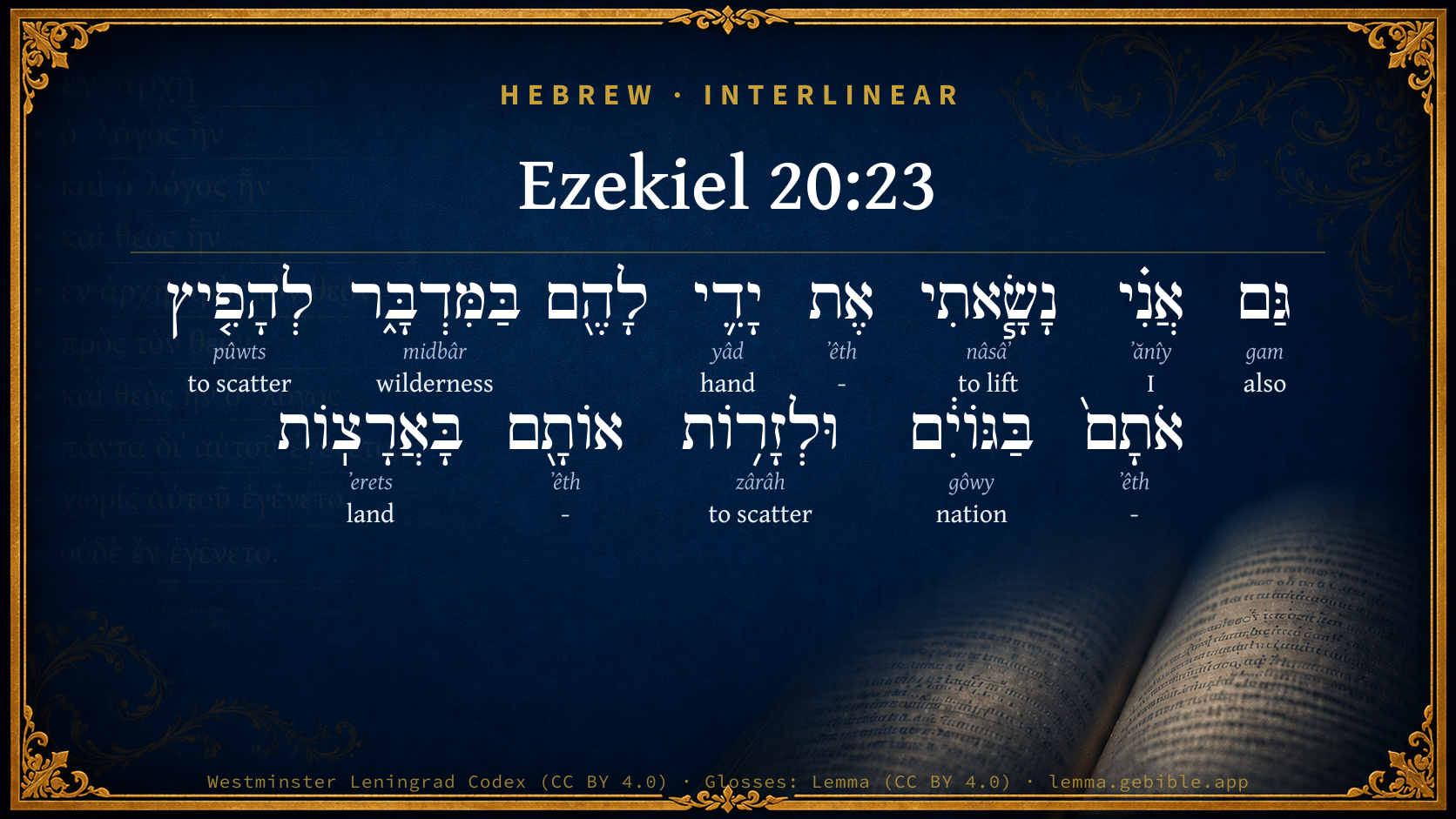
Hebrew (Westminster Leningrad Codex) Ezekiel 20:23 appears in the Hebrew Old Testament. The text above is from the Westminster Leningrad Codex. Each word links to its Strong’s number, a concise gloss, and parsing drawn from the Open Scriptures Hebrew Bible morphology. Click any word for its full Brown-Driver-Briggs (BDB) entry.
Download image
Cite this verse

Ezekiel 20:23 (World English Bible). Public Domain. Lemma interlinear Bible study tool, https://lemma.gebible.app/v/ezekiel/20/23.

Show BibTeX & RIS
BibTeX
RIS
English Translation
Moreover I swore to them in the wilderness, that I would scatter them among the nations, and disperse them through the countries;
World English Bible · Public Domain
Download a study sheet

One document with this verse’s original text, its word-by-word gloss line, the meaning frame, cross-references with their text, attributed commentary, and full source and license credits — printable, and it pastes into notes with its structure intact.

This verse Autodidact and up

Study sheet (.html) Plain text (.txt)

A passage Seminary Student

Up to 50 verses in one chapter. A passage sheet keeps up to 6 commentary sources and 12 cross-references per verse, in the order this page ranks them, and says so on the sheet whenever that leaves anything out. Ask for a single verse and you get the Autodidact verse sheet above.

Everything on this page stays free to read, with no account — the sheet is a download of what is already on screen, not access to it.

Want to remove ads? Support Godless Engineer
Compare translations 3

The same verse in 3 English versions, stacked beneath the original-language interlinear above. Click any original word for its lexicon entry.

Each is an independent rendering of the whole verse — the interlinear is not word-aligned to these translations.

Highlighted words mark where these versions differ — a whole-verse word diff, not a word-by-word alignment.

  • World English Bible Public Domain
    Moreover I swore to them in the wilderness, that I would scatter them among the nations, and disperse them through the countries;
  • King James Version Public Domain
    I lifted up mine hand unto them also in the wilderness, that I would scatter them among the heathen, and disperse them through the countries;
  • unfoldingWord Literal Text CC BY-SA 4.0
    I myself also lifted up my hand to swear to them in the wilderness, that I would scatter them among the nations and disperse them among the lands.

unfoldingWord Literal Text — © unfoldingWord, licensed CC BY-SA 4.0. Word-aligned USFM3 via Door43 (git.door43.org/unfoldingWord/en_ult).

Versions to compare (up to 4)

3 of 4 selected

Show all 18 translations

Every available English version of this verse, each an independent rendering of the whole verse.

  • World English Bible Public Domain
    Moreover I swore to them in the wilderness, that I would scatter them among the nations, and disperse them through the countries;
  • Berean Standard Bible Public Domain
    However, with an uplifted hand I swore to them in the wilderness that I would scatter them among the nations and disperse them throughout the lands.
  • Majority Standard Bible Public Domain
    However, with an uplifted hand I swore to them in the wilderness that I would scatter them among the nations and disperse them throughout the lands.
  • King James Version Public Domain
    I lifted up mine hand unto them also in the wilderness, that I would scatter them among the heathen, and disperse them through the countries;
  • American Standard Version (1901) Public Domain
    Moreover I sware unto them in the wilderness, that I would scatter them among the nations, and disperse them through the countries;
  • Revised Version (1885) Public Domain
    Moreover I lifted up mine hand unto them in the wilderness, that I would scatter them among the nations, and disperse them through the countries,
  • Geneva Bible (1599) Public Domain
    Yet I lift vp mine hande vnto them in the wildernes, that I would scatter them among the heathen, and disperse them through the countreys,
  • Douay-Rheims (1899) Public Domain
    Again I lifted up my hand upon them in the wilderness, to disperse them among the nations, and scatter them through the countries:
  • Young's Literal Translation Public Domain
    I also, I have lifted up My hand to them in the wilderness, To scatter them among nations, And to spread them through lands.
  • Literal Standard Version CC BY-SA 4.0
    I also, I have lifted up My hand to them in the wilderness, || To scatter them among nations, || And to spread them through lands.
  • Unlocked Literal Bible CC BY-SA 4.0
    I myself also lifted up my hand to swear to them in the wilderness, that I would scatter them among the nations and disperse them among the lands.
  • unfoldingWord Literal Text CC BY-SA 4.0
    I myself also lifted up my hand to swear to them in the wilderness, that I would scatter them among the nations and disperse them among the lands.
  • Darby Bible Public Domain
    I lifted up my hand also unto them in the wilderness, that I would scatter them among the nations, and disperse them through the countries;
  • World Messianic Bible Public Domain
    Moreover I swore to them in the wilderness, that I would scatter them among the nations and disperse them through the countries,
  • Webster's Bible Public Domain
    I lifted up my hand to them also in the wilderness, that I would scatter them among the heathen, and disperse them through the countries;
  • Free Bible Version CC BY-SA 4.0
    However, I held up my hand and vowed to them in the desert that I was going to scatter them among the various countries of different nations.
  • Bible in Basic English Public Domain
    Further, I gave my oath to them in the waste land that I would send them wandering among the nations, driving them out among the countries;
  • JPS Tanakh (1917) Public Domain
    I lifted up My hand unto them also in the wilderness, that I would scatter them among the nations, and disperse them through the countries;

Literal Standard Version (2020), Covenant Press — licensed CC BY-SA 4.0. Text via the HelloAO Bible API (eBible.org). Unlocked Literal Bible (unfoldingWord) — licensed CC BY-SA 4.0. Text via the HelloAO Bible API (eBible.org). unfoldingWord Literal Text — © unfoldingWord, licensed CC BY-SA 4.0. Word-aligned USFM3 via Door43 (git.door43.org/unfoldingWord/en_ult). Free Bible Version, Dr. Jonathan Gallagher — licensed CC BY-SA 4.0. Text via the HelloAO Bible API (eBible.org).

Word by word

More ways to search: Search by grammar → Find every occurrence → Compare this word →

Practice this passage: Drill this verse → Learn its vocabulary →

וּלְזָר֥וֹת
zârâh
H2219
“and · to scatter”
Conjunction + Preposition + Verb, Piel, Infinitive Construct
Part of Speech
Conjunction + Preposition + Verb
Stem
Piel
Form
Infinitive Construct
Full BDB Definition

Origin: a primitive root [compare H2114 ]

TWOT: 579

to scatter, fan, cast away, winnow, disperse, compass, spread, be scattered, be dispersed - (Qal) - to scatter - to fan, winnow - (Niphal) to be scattered, be dispersed - (Piel) - to scatter, disperse (intensive of Qal) - to winnow, sift - (Pual) to be scattered, be spread out
  1. גַּם gam H1571 “also” Particle, Accusative
  2. אֲנִ֗י ʼănîy H589 “I” Pronoun, Personal, 1st Person, Common, Singular
  3. נָשָׂ֧אתִי nâsâʼ H5375 “to lift” Verb, Qal, Perfect, 1st Person, Common, Singular
  4. אֶת ʼêth H853 “-” Particle, Direct Object
  5. יָדִ֛י yâd H3027 “hand · my” Noun, Common, Both, Singular, Construct + Suffix, Personal, 1st Person, Common, Singular
  6. בַּמִּדְבָּ֑ר midbâr H4057 “in/at the · wilderness” Preposition, Determined + Noun, Common, Masculine, Singular, Absolute
  7. לְהָפִ֤יץ pûwts H6327 “to scatter” Preposition + Verb, Hiphil, Infinitive Construct
  8. אֹתָם֙ ʼêth H853 “- · them” Particle, Direct Object + Suffix, Personal, 3rd Person, Masculine, Plural
  9. בַּגּוֹיִ֔ם gôwy H1471 “in/at the · nations” Preposition, Determined + Noun, Common, Masculine, Plural, Absolute
  10. אוֹתָ֖ם ʼêth H853 “- · them” Particle, Direct Object + Suffix, Personal, 3rd Person, Masculine, Plural
  11. בָּאֲרָצֽוֹת ʼerets H776 “in/at the · lands” Preposition, Determined + Noun, Common, Both, Plural, Absolute

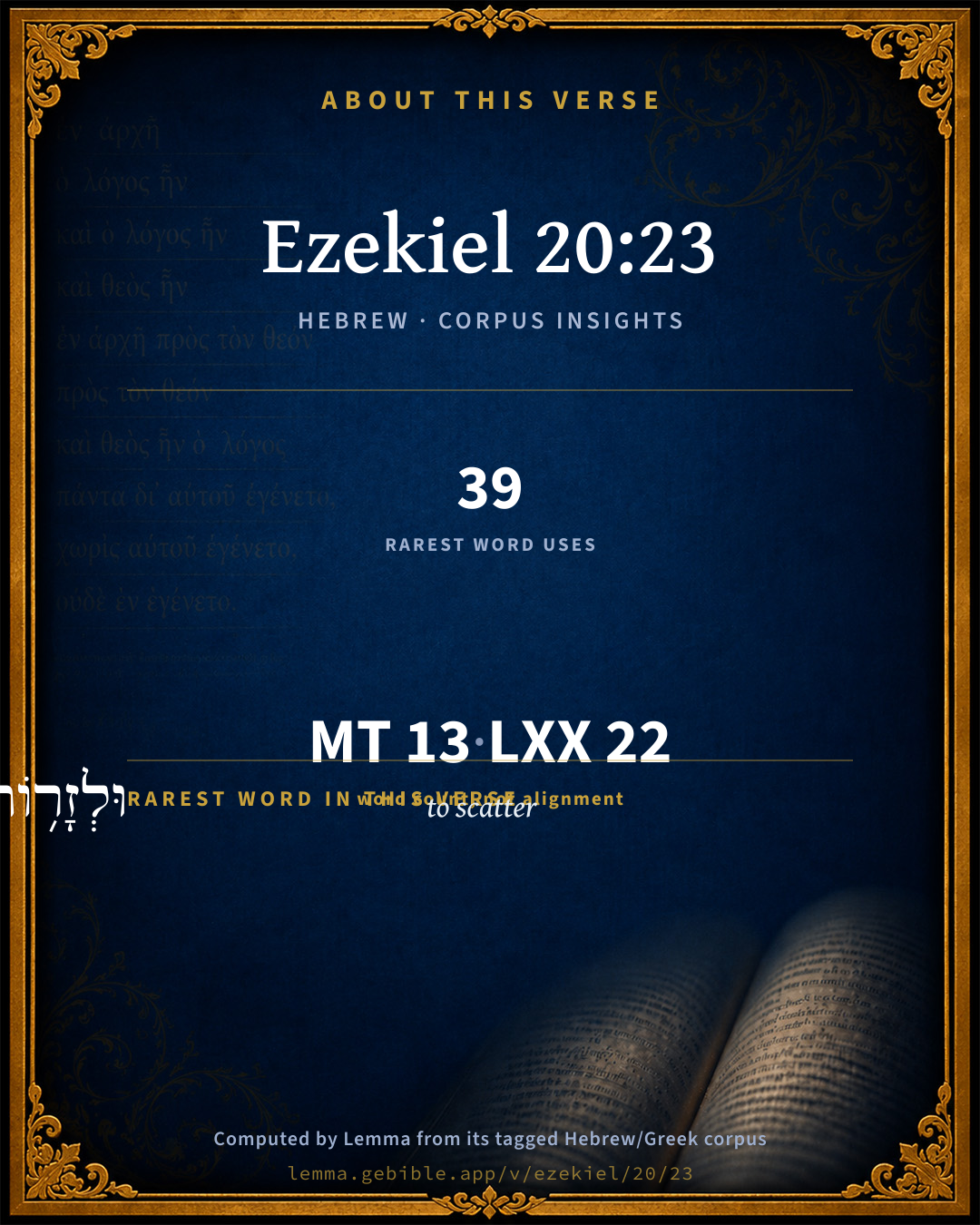
About this verse

These counts appear in no published source. They are computed here, from the morphology-tagged text and Lemma’s own curated glosses. What Lemma adds →

13
words
10
distinct lemmas
Prophets
section

Shared distinctive vocabulary

וּלְזָר֥וֹת to scatter H2219 occurs in 38 verses of the Hebrew Bible. Also found in:

Grammatical profile

  • 3 verbs
  • 4 nouns
  • 1 pronoun
  • 1 preposition
  • 4 particles

Verb forms

  • נָשָׂ֧אתִי Qal · Perfect
  • לְהָפִ֤יץ Hiphil · Infinitive Construct
  • וּלְזָר֥וֹת Piel · Infinitive Construct

Hebrew & Septuagint length

In English translation the verse runs 22 words from the Hebrew and 24 from the Septuagint (LXX English) — closely comparable.

A rough comparison of the two English renderings, which tokenize alike — not a word-level alignment.

Word counts can differ between the Hebrew and the Greek without any difference in meaning — e.g. the Hebrew direct-object marker אֵת has no separate Greek word, and Greek often adds the article ὁ.

In the original languages it is 13 Hebrew tokens and 22 Greek tokens — but the two are counted differently (Hebrew bundles its prefixes and suffixes into one token; the Greek is in lemma form), so that isn’t a like-for-like length.

Cross-references

8

Topical passages linked to Ezekiel 20:23 in the Treasury of Scripture Knowledge — connected by theme and wording, ordered by reader-vote popularity; previews shown in the World English Bible.

  • Leviticus 26:33 I will scatter you among the nations, and I will draw out the sword after you: and your land will be a desolation, and your cities shall be a waste.
  • Deuteronomy 28:64–68 Yahweh will scatter you among all peoples, from the one end of the earth even to the other end of the earth; and there you shall serve other gods, which you have not known, you nor your fathers, even wood and stone.
  • Deuteronomy 32:26–27 I said, I would scatter them afar, I would make the memory of them to cease from among men;
  • Deuteronomy 32:40 For I lift up my hand to heaven, And say, As I live forever,
  • Psalms 106:27 That he would overthrow their seed among the nations, And scatter them in the lands.
  • Jeremiah 15:4 I will cause them to be tossed back and forth among all the kingdoms of the earth, because of Manasseh, the son of Hezekiah, king of Judah, for that which he did in Jerusalem.
  • Ezekiel 20:15 Moreover also I swore to them in the wilderness, that I would not bring them into the land which I had given them, flowing with milk and honey, which is the glory of all lands;
  • Revelation 10:5–6 The angel who I saw standing on the sea and on the land lifted up his right hand to the sky,

Cross-references courtesy of OpenBible.info (CC BY 4.0).

Hebrew and Greek witnesses Masoretic Hebrew ↔ Greek Septuagint

The same verse in the two great witnesses to the Old Testament, shown verse-for-verse.

These are two independent witnesses, not word-aligned to each other, and the Septuagint is shown in lemma (dictionary) form.

Hebrew Ezekiel 20:23 Masoretic · Westminster Leningrad Codex

גַּם אֲנִ֗י נָשָׂ֧אתִי אֶת יָדִ֛י לָהֶ֖ם בַּמִּדְבָּ֑ר לְהָפִ֤יץ אֹתָם֙ בַּגּוֹיִ֔ם וּלְזָר֥וֹת אוֹתָ֖ם בָּאֲרָצֽוֹת

Moreover I swore to them in the wilderness, that I would scatter them among the nations, and disperse them through the countries;

World English Bible · Public Domain

Greek LXX Ezekiel 20:23 Septuagint · lemma form

καί ἐκαἴρω ὁ χείρ ἐγώ ἐπί αὐτός ἐν ὁ ἔρημος ὁ διασκορπίζω αὐτός ἐν ὁ ἔθνος καί διασπείρω αὐτός ἐν ὁ χώρα

I lifted up my hand against them in the wilderness, that I would scatter them among the Gentiles, and disperse them in the countries;

LXX2012 (modern English Septuagint) · Public Domain

Hebrew: Westminster Leningrad Codex (CC BY 4.0). Greek: Septuagint (public domain); English from LXX2012 (modern English Septuagint) (Public Domain). How the Septuagint differs from the Hebrew →

Targum (Aramaic paraphrase)

1

The Targum is the ancient Jewish Aramaic paraphrase of the Hebrew Scriptures — an interpretive translation, not the Hebrew text itself. Onkelos (literal) and Pseudo-Jonathan (expansive) render the Torah, and Jonathan the Prophets. Coverage is partial: where no permissively-licensed English translation exists for a verse, only the Aramaic is shown. This is verse-level text, not a word-by-word alignment to the Hebrew.

  1. Targum Jonathan Prophets (Joshua–Malachi)
    אַף אֲנָא קַיְמֵית בְּמֵימְרִי לְהוֹן בְּמַדְבְּרָא לְאַגְלָאָה יַתְהוֹן לְבֵינֵי עַמְמַיָא וּלְבַדָרָא יַתְהוֹן בִּמְדִינָתָא:

    (no public-domain English translation for this verse)

    Targum Jonathan — Aramaic: “Mikraot Gedolot” (public domain). English: “Sefaria Community Translation” (CC0 1.0 (public-domain dedication)); “London "Chaldee Paraphrase," 1871” (public domain). Text via Sefaria.

Commentary

Notes on Ezekiel 20:23 from classic Christian and Jewish commentators (each source and its license shown beneath its notes). The classic Christian expositions comment on the surrounding passage and are grouped to its opening verse, so a note may address several verses; the Jewish commentaries on the Tanakh (Rashi and others) are per-verse, so they appear only where the commentator wrote on this verse.

Lemma curates 59 commentaries, every one of them public domain or Creative Commons licensed, each selected and text-cleaned for this edition rather than reprinted as found. About our sources →

The Cambridge Bible for Schools and Colleges

gen. ed. J. J. S. Perowne

23. I lifted up … also] Moreover I lifted up, lit. And I on my part, so Eze_20:25.

scatter … among the heathen] The people entered Canaan laden with this heavy threat for their sins in the wilderness. Such threats were always conditional, Jeremiah 18, Jonah. This conditional character is expressed in other passages where a similar idea occurs, Lev_26:33; Deu_28:64. The prophet hardly means that the exile was due to the people’s sins in the wilderness, except in so far as the moral character of the people remained the same throughout down to the generation then living. But cf. Exo_32:34.

23–26. Yet though he wrought for his name’s sake not to destroy them their sins could not be altogether passed by. In two ways they were marked: Jehovah laid a heavy threat upon the people of dispersion among all nations, Eze_20:23-24; and he gave them laws that were not good, that by following them they might be destroyed, Eze_20:25-26.

The Cambridge Bible for Schools and Colleges (gen. ed. J. J. S. Perowne; Cambridge University Press, 1878–1918) — public domain. Text from a community e-Sword module.

Trapp's Complete Commentary

John Trapp

Eze 20:23 I lifted up mine hand unto them also in the wilderness, that I would scatter them among the heathen, and disperse them through the countries;

Ver. 23. See on Eze 20:15.

John Trapp, A Commentary or Exposition upon All the Books of the Old and New Testament (1647–1656) — public domain. Text from a community e-Sword module.

Tyndale Open Study Notes

Tyndale Open Resources

20:23 Because of Israel’s history of refusing to keep the Lord’s decrees or obey his regulations, God determined to scatter them among all the nations.

Tyndale Open Study Notes — © Tyndale Open Resources, licensed CC BY-SA 4.0. Text via the HelloAO Bible API.

Jamieson, Fausset & Brown

Robert Jamieson, A. R. Fausset & David Brown

It was to that generation the threat of dispersion was proclaimed (Deu 28:64; compare Eze 29:4).

Jamieson, Fausset & Brown — Commentary Critical and Explanatory on the Whole Bible (1871) — public domain (CC PDM 1.0). Text via the HelloAO Bible API.

Ellicott's Commentary for English Readers

(23) I would scatter them among the heathen.—This threatening was not designed to be fulfilled in that immediate generation, as abundantly appears from Lev_26:33; Deu_4:27, Deut. 27:64, and the other passages in which it is given, especially Deuteronomy 29, 30. It was given to that generation as representing the nation, but was only to be carried out when, by a long course of obdurate sin, it should be shown to be imperatively required. The threat had now been already realised in part, and was on the eve of being fully accomplished. It was important that the people should be made to understand that this had been the Divine warning from the beginning, and that in its fulfilment they were only receiving that punishment which had always been designed for such sin as they had committed.

A Bible Commentary for English Readers, edited by Charles John Ellicott (1878–1897) — public domain. Text from a community e-Sword module.

John Gill's Exposition

I lifted up mine hand also to them in the wilderness,.... Swore unto them, as in Eze 20:5;

that I would scatter them among the Heathen, and disperse them through the countries; after they came to be settled in the land of Canaan, they sinning against the Lord; which was fulfilled in the times of the Babylonish captivity, and in their destruction by the Romans; but was threatened and foretold while they were in the wilderness, Lev 26:33; with this compare Psa 106:26.

John Gill's Exposition of the Whole Bible (1746–1763) — public domain (CC PDM 1.0). Text via the HelloAO Bible API.

Haydock's Catholic Bible Commentary

Again, or also. (Haydock) --- Four times are specified [in] ver. 13, 15, 21., which may allude to the adoration of the calf, the graves of concupiscence, the murmuring, and commerce with the women and idols of Moab, Exodus xxiii., and Numbers x., and xiv., and xxv. (Calmet)

George Leo Haydock (1774–1849), Haydock's Catholic Family Bible and Commentary, 1859 edition — public domain. Excludes Psalms (Douay-Rheims chapter numbering differs from Protestant) and Deuterocanonical books (Catholic canon only).

Matthew Poole's English Annotations

On this solemn gesture and signification, see Eze 20:5. Here it is an oath added to a threat, to make it more dreadful to them, and to make it successful in keeping them from the sin threatened.

That I would scatter them; foretold them of a captivity which should come upon them for their sins, which it is probable was often inculcated in their hearing before Moses penned it for them, Deu 32:15-42; Le 26:31-33, and it is ingeminated to make it pierce the deeper, and affect them the more.

Matthew Poole's English Annotations on the Holy Bible (1683–1685) — public domain. Text from a community e-Sword/MySword module.

Whedon's Commentary on the Bible

Daniel D. Whedon

23. I would scatter them among the heathen — Jehovah changes the punishment from annihilation to captivity. This decision was announced with solemn warnings, even while they were yet wandering in the wilderness (Lev_26:33; Deu_28:64). This bondage, of which the companions of Ezekiel complain as an inexplicable providence, and which almost drives them to a distrust of Jehovah’s power and goodness, is itself a proof of the fulfillment of prophecy. It has fallen upon the people solely because of their iniquity and their failure to repent.

Daniel D. Whedon (gen. ed.), Commentary on the Old and New Testaments (1874–1909) — public domain. Text from a community e-Sword module.

The Pulpit Commentary

That I would scatter them among the heathen. The words seem to refer to the generation that had grown up in the wilderness, and, so taken, do not correspond with the history of the conquest of Canaan. What Ezekiel contemplates, however, as the resolve of Jehovah, is the commutation of the sentence of destruction for that of the dispersion of the people, leaving the time and manner of that dispersion to be determined by his own will. Possibly even in the time of the judges, with its many conquests and long periods of oppression, there were instances of such dispersion, and these, with others that would naturally accompany an invasion like that of Shishak, (2Ch_12:2-9) not to speak of frequent attacks from Moabites, Ammonites, Philistines, Edomites, and Syrians, may have seemed to the prophet the working out, step by step, of the dispersion which culminated in the deportation of the ten tribes by Shalmaneser, and of Judah and Benjamin by Nebuchadnezzar. Traces of such dispersions before Ezekiel"s time meet us in Psa_78:59-64; Isa_11:11, Isa_11:12; Zep_3:10, Zep_3:20.

The Pulpit Commentary (1880–1919), ed. H.D.M. Spence-Jones & Joseph S. Exell — public domain. Text from a community e-Sword module.

John Wesley's Explanatory Notes

I lifted - I swear.

John Wesley, Explanatory Notes Upon the Whole Bible (1754–1765) — public domain. Text via the GEBible commentary corpus.

unfoldingWord translationNotes

Door43 World Missions Community

General Information:

Yahweh continues giving Ezekiel his message to the elders of Israel.

I myself also lifted up my hand to swear

Here "lifted up my hand" is a symbolic action that shows he will truly do what he has sworn to do. AT: "I myself also solemnly swore" (See: Symbolic Action)

scatter them among the nations and disperse them among the lands

These two phrases mean basically the same thing. See how you translated this in Ezekiel 12:15. AT: "cause them to separate from each other and live in different nations" (See: Parallelism)

Their eyes were longing after their fathers' idols

Here the word "eyes" represents the person who looks to the idols to worship them. AT: "They were longing after their fathers' idols" (See: Synecdoche)

translationWords

desert

oath

nation

disperse

unfoldingWord translationNotes — © Distant Shores Media and the Door43 World Missions Community, licensed CC BY-SA 4.0. Source: git.door43.org/Door43/en_tn.

Rashi

Rabbi Shlomo Yitzchaki (Rashi)

to scatter them Back then, I promised them to scatter them (Deut. 4:25ff.): “When you will beget children and children’s children, etc. [the Lord will scatter you among the nations, etc.].”

Rashi on the Tanakh — English translations: “The Judaica Press complete Tanach with Rashi, translated by A. J. Rosenberg” (CC BY 4.0); “Pentateuch with Rashi's commentary by M. Rosenbaum and A.M. Silbermann, 1929-1934” (public domain); “The Metsudah Tanach series, Lakewood, N.J” (CC BY 4.0); and “The Book of Joshua, Metsudah Publications, 1997” (CC BY 4.0). Text via Sefaria.

Lesson kit

Teaching starters — assembled from the data on this page, not authored interpretation. Every prompt links to the verse data it draws on. Edit before teaching.

Ezekiel, in the Prophets, opens this verse with 13 words (10 distinct Hebrew lemmas). Its most distinctive word is zârâh (“to scatter”). A historical commentator’s framing appears above. Read the whole chapter for the surrounding context.

Discussion questions

  1. What does “to scatter” (zârâh) contribute to the verse as a whole?
  2. Exodus 32:20 shares the word «to scatter» with this verse. How do the two illuminate each other?
  3. These translations render this verse differently. What is at stake in choosing one wording over another?
  4. The verb «נָשָׂ֧אתִי» is Qal Perfect. How does its form color the action?
  5. Reading how The Cambridge Bible for Schools and Colleges and Trapp's Complete Commentary read this verse, where do the two commentators agree and where do they part?

Things to notice

Reading settings

Reading text

Shown beneath each verse's original-language words.

Old Testament
Old Testament edition

Read the OT as the Masoretic Hebrew (MT) or the Greek Septuagint (LXX).

English shown for the Greek Septuagint (in the Hebrew ↔ Greek comparison).

Comparing translations? Open the Compare panel on any verse page to stack up to four side by side.