
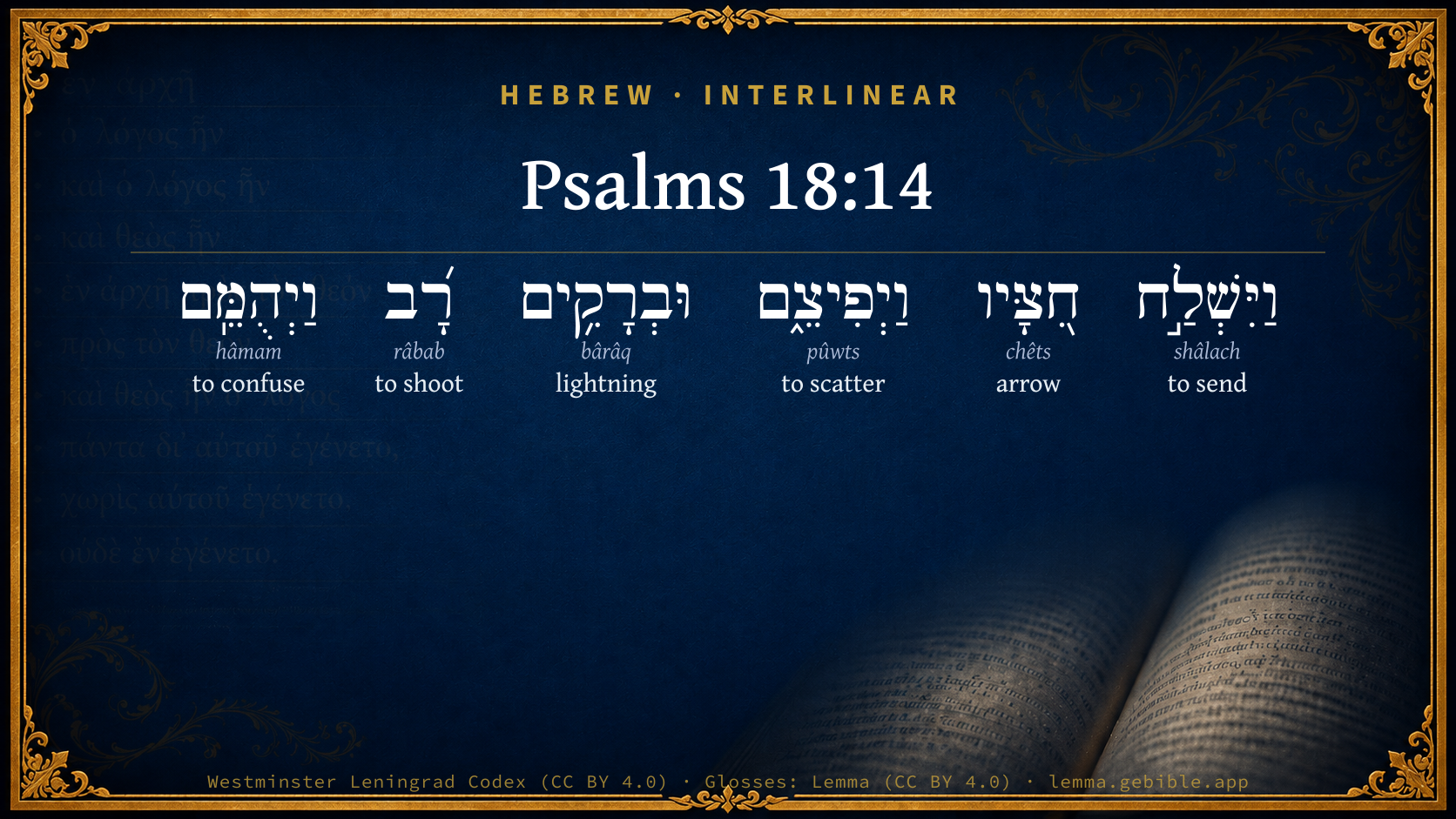
Psalms 18:14

Hebrew (Westminster Leningrad Codex) Psalms 18:14 appears in the Hebrew Old Testament. The text above is from the Westminster Leningrad Codex. Each word links to its Strong’s number, a concise gloss, and parsing drawn from the Open Scriptures Hebrew Bible morphology. Click any word for its full Brown-Driver-Briggs (BDB) entry.
Download image
Cite this verse

Psalms 18:14 (World English Bible). Public Domain. Lemma interlinear Bible study tool, https://lemma.gebible.app/v/psalms/18/14.

Show BibTeX & RIS
BibTeX
RIS
English Translation
He sent out his arrows, and scattered them; Yes, great lightning bolts, and routed them.
World English Bible · Public Domain
Download a study sheet

One document with this verse’s original text, its word-by-word gloss line, the meaning frame, cross-references with their text, attributed commentary, and full source and license credits — printable, and it pastes into notes with its structure intact.

This verse Autodidact and up

Study sheet (.html) Plain text (.txt)

A passage Seminary Student

Up to 50 verses in one chapter. A passage sheet keeps up to 6 commentary sources and 12 cross-references per verse, in the order this page ranks them, and says so on the sheet whenever that leaves anything out. Ask for a single verse and you get the Autodidact verse sheet above.

Everything on this page stays free to read, with no account — the sheet is a download of what is already on screen, not access to it.

Want to remove ads? Support Godless Engineer
Compare translations 3

The same verse in 3 English versions, stacked beneath the original-language interlinear above. Click any original word for its lexicon entry.

Each is an independent rendering of the whole verse — the interlinear is not word-aligned to these translations.

Highlighted words mark where these versions differ — a whole-verse word diff, not a word-by-word alignment.

  • World English Bible Public Domain
    He sent out his arrows, and scattered them; Yes, great lightning bolts, and routed them.
  • King James Version Public Domain
    Yea, he sent out his arrows, and scattered them; and he shot out lightnings, and discomfited them.
  • unfoldingWord Literal Text CC BY-SA 4.0
    And he sent out his arrows and he scattered them and lightnings in abundance and he panicked them.

unfoldingWord Literal Text — © unfoldingWord, licensed CC BY-SA 4.0. Word-aligned USFM3 via Door43 (git.door43.org/unfoldingWord/en_ult).

Versions to compare (up to 4)

3 of 4 selected

Show all 18 translations

Every available English version of this verse, each an independent rendering of the whole verse.

  • World English Bible Public Domain
    He sent out his arrows, and scattered them; Yes, great lightning bolts, and routed them.
  • Berean Standard Bible Public Domain
    He shot His arrows and scattered the foes; He hurled lightning and routed them.
  • Majority Standard Bible Public Domain
    He shot His arrows and scattered the foes; He hurled lightning and routed them.
  • King James Version Public Domain
    Yea, he sent out his arrows, and scattered them; and he shot out lightnings, and discomfited them.
  • American Standard Version (1901) Public Domain
    And he sent out his arrows, and scattered them; Yea, lightnings manifold, and discomfited them.
  • Revised Version (1885) Public Domain
    And he sent out his arrows, and scattered them; yea, lightnings manifold, and discomfited them.
  • Geneva Bible (1599) Public Domain
    Then hee sent out his arrowes and scattred them, and he increased lightnings and destroyed them.
  • Douay-Rheims (1899) Public Domain
    And the Lord thundered from heaven, and the highest gave his voice: hail and coals of fire.
  • Young's Literal Translation Public Domain
    And He sendeth His arrows and scattereth them, And much lightning, and crusheth them.
  • Literal Standard Version CC BY-SA 4.0
    And He sends His arrows and scatters them, || And much lightning, and crushes them.
  • Unlocked Literal Bible CC BY-SA 4.0
    He shot his arrows and scattered his enemies; many lightning bolts dispersed them.
  • unfoldingWord Literal Text CC BY-SA 4.0
    And he sent out his arrows and he scattered them and lightnings in abundance and he panicked them.
  • Darby Bible Public Domain
    And he sent his arrows, and scattered [mine enemies]; and he shot forth lightnings, and discomfited them.
  • World Messianic Bible Public Domain
    He sent out his arrows, and scattered them. He routed them with great lightning bolts.
  • Webster's Bible Public Domain
    \\18:13\\The LORD also thundered in the heavens, and the Highest gave his voice; hail stones and coals of fire.
  • Free Bible Version CC BY-SA 4.0
    He fired his arrows, scattering his enemies; he routed them with his lightning bolts.
  • Bible in Basic English Public Domain
    He sent out his arrows, driving them in all directions; by his flames of fire they were troubled.
  • JPS Tanakh (1917) Public Domain
    (18-15) And He sent out His arrows, and scattered them; and He shot forth lightnings, and discomfited them.

Literal Standard Version (2020), Covenant Press — licensed CC BY-SA 4.0. Text via the HelloAO Bible API (eBible.org). Unlocked Literal Bible (unfoldingWord) — licensed CC BY-SA 4.0. Text via the HelloAO Bible API (eBible.org). unfoldingWord Literal Text — © unfoldingWord, licensed CC BY-SA 4.0. Word-aligned USFM3 via Door43 (git.door43.org/unfoldingWord/en_ult). Free Bible Version, Dr. Jonathan Gallagher — licensed CC BY-SA 4.0. Text via the HelloAO Bible API (eBible.org).

Word by word

More ways to search: Search by grammar → Find every occurrence → Compare this word →

Practice this passage: Drill this verse → Learn its vocabulary →

About this verse

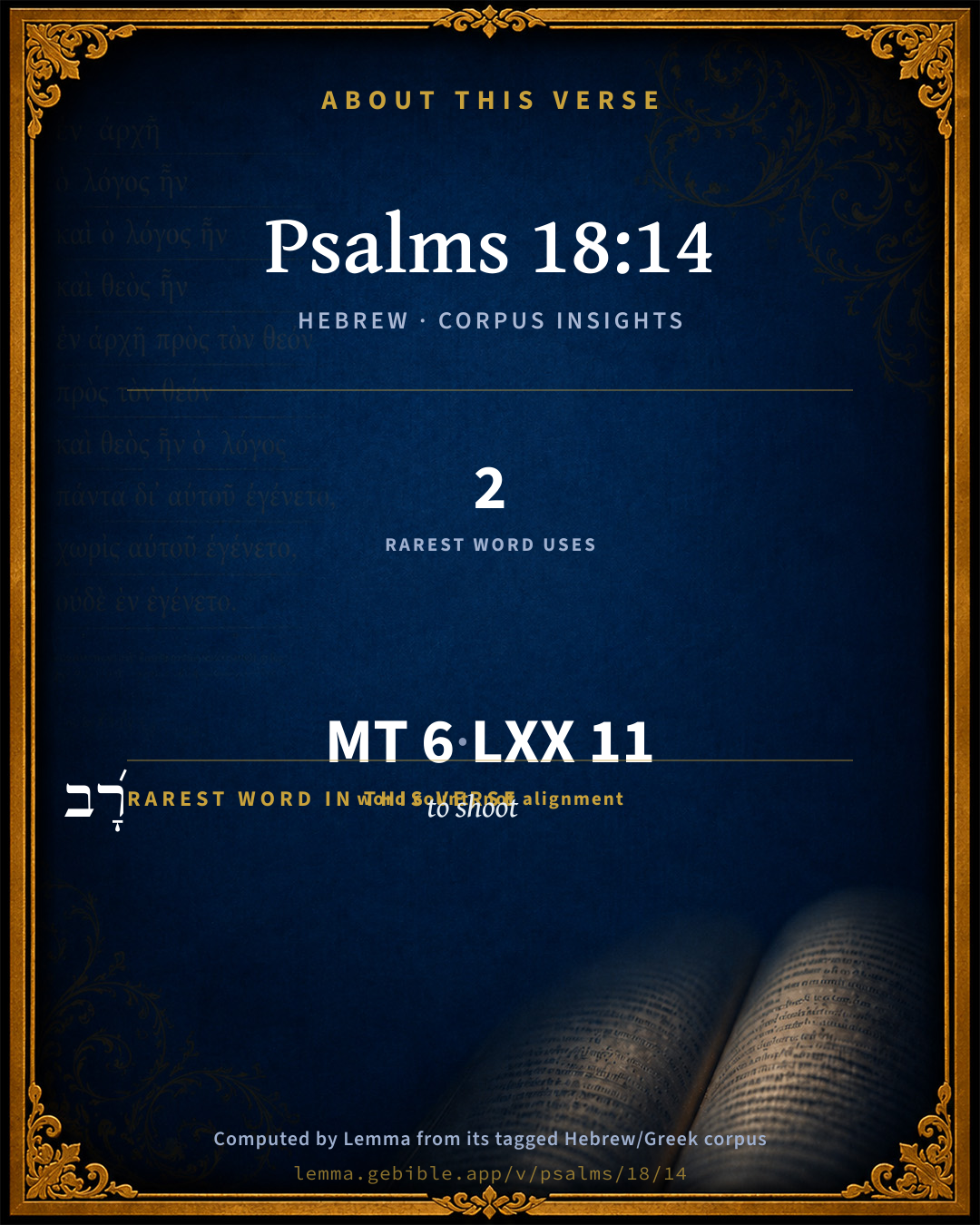
These counts appear in no published source. They are computed here, from the morphology-tagged text and Lemma’s own curated glosses. What Lemma adds →

6
words
6
distinct lemmas
Wisdom
section

Notable vocabulary

The rarest word here is רָ֝ב to shoot H7232 — appearing just 2 times in the whole Hebrew Bible.

Shared distinctive vocabulary

רָ֝ב to shoot H7232 occurs in 2 verses of the Hebrew Bible. Also found in:

Grammatical profile

  • 4 verbs
  • 2 nouns

Verb forms

  • וַיִּשְׁלַ֣ח Qal · Sequential Imperfect
  • וַיְפִיצֵ֑ם Hiphil · Sequential Imperfect
  • רָ֝ב Qal · Perfect
  • וַיְהֻמֵּֽם Qal · Sequential Imperfect

Hebrew & Septuagint length

In English translation the verse runs 15 words from the Hebrew and 15 from the Septuagint (LXX English) — the same length.

A rough comparison of the two English renderings, which tokenize alike — not a word-level alignment.

Word counts can differ between the Hebrew and the Greek without any difference in meaning — e.g. the Hebrew direct-object marker אֵת has no separate Greek word, and Greek often adds the article ὁ.

In the original languages it is 6 Hebrew tokens and 11 Greek tokens — but the two are counted differently (Hebrew bundles its prefixes and suffixes into one token; the Greek is in lemma form), so that isn’t a like-for-like length.

Cross-references

13

Topical passages linked to Psalms 18:14 in the Treasury of Scripture Knowledge — connected by theme and wording, ordered by reader-vote popularity; previews shown in the World English Bible.

  • Psalms 144:6 Throw out lightning, and scatter them. Send out your arrows, and rout them.
  • Habakkuk 3:11 The sun and moon stood still in the sky, At the light of your arrows as they went, At the shining of your glittering spear.
  • Numbers 24:8 God brings him forth out of Egypt; He has as it were the strength of the wild-ox: He shall eat up the nations his adversaries, Shall break their bones in pieces, Smite [them] through with his arrows.
  • Deuteronomy 32:23 I will heap evils on them; I will spend my arrows on them:
  • Deuteronomy 32:42 I will make my arrows drunk with blood, My sword shall devour flesh; With the blood of the slain and the captives, From the head of the leaders of the enemy.
  • Joshua 10:10 Yahweh confused them before Israel, and he killed them with a great slaughter at Gibeon, and chased them by the way of the ascent of Beth Horon, and struck them to Azekah, and to Makkedah.
  • Job 6:4 For the arrows of the Almighty are within me, My spirit drinks up their poison. The terrors of God set themselves in array against me.
  • Psalms 77:17 The clouds poured out water. The skies resounded with thunder. Your arrows also flashed around.
  • Isaiah 30:30 Yahweh will cause his glorious voice to be heard, and will show the lighting down of his arm, with the indignation of [his] anger, and the flame of a devouring fire, with a blast, and tempest, and hailstones.
  • Job 38:35 Can you send forth lightnings, that they may go? Do they report to you, 'Here we are?'
  • Job 40:9–12 Or have you an arm like God? Can you thunder with a voice like him?
  • Psalms 21:12 For you will make them turn their back, When you aim drawn bows at their face.
  • Zechariah 9:14–15 Yahweh will be seen over them; And his arrow will go flash like lightning; And the Lord Yahweh will blow the trumpet, And will go with whirlwinds of the south.

Cross-references courtesy of OpenBible.info (CC BY 4.0).

Hebrew and Greek witnesses Masoretic Hebrew ↔ Greek Septuagint

The same verse in the two great witnesses to the Old Testament, shown verse-for-verse.

You’re reading Greek Psalm 17 (Hebrew Psalm 18). The Septuagint counts the superscription, so verse numbers can differ from the Hebrew — chapter-level alignment, not verse-by-verse. Numbering follows Rahlfs.

These are two independent witnesses, not word-aligned to each other, and the Septuagint is shown in lemma (dictionary) form.

Hebrew Psalms 18:14 Masoretic · Westminster Leningrad Codex

וַיִּשְׁלַ֣ח חִ֭צָּיו וַיְפִיצֵ֑ם וּבְרָקִ֥ים רָ֝ב וַיְהֻמֵּֽם

He sent out his arrows, and scattered them; Yes, great lightning bolts, and routed them.

World English Bible · Public Domain

Greek LXX Greek Psalm 17:14 Septuagint · lemma form

καί βροντάω ἐκ οὐρανός κύριος καί ὁ ὕψιστος δίδωμι φωνή αὐτός

And he sent forth his weapons, and scattered them; and multiplied lightnings, and routed them.

LXX2012 (modern English Septuagint) · Public Domain

On this verse, Ellicott's Commentary for English Readers discusses the Septuagint’s reading. Read the note in Commentary ↓

Hebrew: Westminster Leningrad Codex (CC BY 4.0). Greek: Septuagint (public domain); English from LXX2012 (modern English Septuagint) (Public Domain). How the Septuagint differs from the Hebrew →

Commentary

Notes on Psalms 18:14 from classic Christian and Jewish commentators (each source and its license shown beneath its notes). The classic Christian expositions comment on the surrounding passage and are grouped to its opening verse, so a note may address several verses; the Jewish commentaries on the Tanakh (Rashi and others) are per-verse, so they appear only where the commentator wrote on this verse.

Lemma curates 59 commentaries, every one of them public domain or Creative Commons licensed, each selected and text-cleaned for this edition rather than reprinted as found. About our sources →

The Cambridge Bible for Schools and Colleges

gen. ed. J. J. S. Perowne

14. And he sent out &c. (R.V.) gives the connexion better than Yea. Lightnings are Jehovah’s arrows. Cp. Psa_77:17; Hab_3:11.

Scattered them clearly refers to the enemies whose destruction was the object of this Divine interposition (Psa_18:3).

and he shot out lightnings] Better, yea, lightnings in abundance; or, as R.V., lightnings manifold.

discomfited] A word denoting the confusion of a sudden panic, and used especially of supernatural defeat. Cp. Exo_14:24 (R.V.); Jos_10:10; Jdg_4:15; 1Sa_7:10. Psa_144:6-7 is based on Psa_18:14; Psa_18:16.

The Cambridge Bible for Schools and Colleges (gen. ed. J. J. S. Perowne; Cambridge University Press, 1878–1918) — public domain. Text from a community e-Sword module.

Trapp's Complete Commentary

John Trapp

Psa 18:14 Yea, he sent out his arrows, and scattered them; and he shot out lightnings, and discomfited them.

Ver. 14. Yea, he sent out his arrows, &c.] Tandem permiscentur omnia grandine flammis et fulminibus tanquam telis et sagittis Dei adversus hostes pugnantis. After the advance guard, Psa 18:12, the great ordnance, Psa 18:13, the battle begins, and all is on a hurry.

John Trapp, A Commentary or Exposition upon All the Books of the Old and New Testament (1647–1656) — public domain. Text from a community e-Sword module.

J. A. Alexander on Psalms

Joseph Addison Alexander

15. (Psa 18:14). Then sent he his arrows and scattered them, and shot forth, lightnings and confounded them. The lightnings of the last clause may be understood as explaining the arrows of the first. Instead of shot forth lightnings some translate and lightnings much, i.e. many, in which sense the Hebrew word (brA) occurs sometimes elsewhere (Exo 19:21, 1Sa 14:6, Num 26:54). In several other places it seems to mean enough or too much (Gen 45:28, Exo 9:28, Num 16:3; Num 16:7, Deu 1:6). If either of these constructions is adopted, the verb sent must be repeated from the other clause. The version first given, shot, is justified by the analogy of Gen 49:23. The last verb in the sentence is a military term denoting the confusion of an army produced by a surprise or sudden panic; see Exo 14:24; Exo 23:27, Jos 10:10, and with the whole verse compare Psa 144:6.

Joseph Addison Alexander, The Psalms Translated and Explained (1850) — public domain. Text from a community e-Sword module.

Geneva Bible (1599)

Geneva Bible translators

His lightnings.

Geneva Bible (1599) marginal notes — public domain. Text via Bolls.life.

Jamieson, Fausset & Brown

Robert Jamieson, A. R. Fausset & David Brown

The fiery brightness of lightning, in shape like burning arrows rapidly shot through the air, well represents the most terrible part of an awful storm. Before the terrors of such a scene the enemies are confounded and overthrown in dismay.

Jamieson, Fausset & Brown — Commentary Critical and Explanatory on the Whole Bible (1871) — public domain (CC PDM 1.0). Text via the HelloAO Bible API.

Adam Clarke's Commentary

Verse 14. He sent out his arrows - he shot out lightnings] I believe the latter clause to be an illustration of the former. He sent out his arrows-that is, he shot out lightnings; for lightnings are the arrows of the Lord, and there is something very like the arrowhead apparent in the zigzag lightning. Sense and sound are wonderfully combined in the Hebrew of this last clause: וברכים רב ויהמם uberakim rab vaihummem, "and thunderings he multiplied and confounded them." Who does not hear the bursting, brattling, and pounding of thunder in these words? See Delaney?

Adam Clarke's Commentary on the Bible (1810–1826) — public domain. Text from a community e-Sword/MySword module.

Ellicott's Commentary for English Readers

(14) He sent out.—In the majesty of the storm we have almost forgotten its cause, the Divine wrath against the enemies of the poet. They are abruptly recalled to our remembrance in the suffix (“them”) of the verbs in this verse. So the LXX. and Vulg. Many ancient interpreters, however, understood by them “the lightnings,” while Ewald would carry the pronoun on to the “waters” in the next verse. Instead of “shot” (rab) many render as if it were the adjective “many,” “his numerous lightnings.” But comp. Psa_144:6 and the verse in Samuel.

A Bible Commentary for English Readers, edited by Charles John Ellicott (1878–1897) — public domain. Text from a community e-Sword module.

John Gill's Exposition

Then the channels of water were seen,.... Or, "of the sea"; as in Sa2 22:16. There seems to be an allusion to the drying up of the sea when the Israelites passed through it. Aben Ezra interprets this of the discovery of the secrets of enemies, and of their deep schemes and counsels, which they seek to hide, but are made known by him who sees all things in the dark; and so the following clause;

and the foundations of the world were discovered; but it rather seems to intend the utter extirpation and ruin of the Jewish nation, both in their civil and ecclesiastic state, the foundation of which was rooted up and laid bare; unless with Jerom we understand this of the ministers of the word, in whom the doctrines of grace were channelled, and who were as fountains of water; and of the foundation of the apostles and prophets made known in the Gospel: but the former sense is best; since it follows,

at thy rebuke, O Lord; at the blast of the breath of thy nostrils; for the destruction of the Jews was the effect of divine wrath and vengeance: so ends the account of the wonderful appearance of God in favour of the person the subject of this psalm, and against his enemies; the deliverance wrought for him is next described.

John Gill's Exposition of the Whole Bible (1746–1763) — public domain (CC PDM 1.0). Text via the HelloAO Bible API.

Albert Barnes' Notes on the Bible

Yea, he sent out his arrows - The word arrows here probably refers to the lightnings mentioned in the other clause of the verse. Those lightnings scattered around, and accomplishing such destruction, seemed to be arrows sent forth from the hand of God.

And scattered them - Herder refers this to the lightnings; DeWette, to the enemies of the psalmist. The latter seems to be the more correct interpretation, though the enemies of the psalmist are not here particularly specified. They seem, however, to have been in his eye throughout the psalm, for it was the victory achieved over them by the divine interposition that he was celebrating throughout the poem.

And he shot out lightnings - As arrows; or, as from a bow.

And discomfited them - literally, to impel, to drive; then, to put in commotion or consternation. The allusion is to an army whose order is disturbed, or which is thrown into confusion, and which is, therefore, easily conquered. The idea is that David achieved a victory over all his enemies, as if God had scattered them by a storm and tempest.

Albert Barnes' Notes on the Bible (1834–1885) — public domain. Text from a community e-Sword/MySword module.

Matthew Poole's English Annotations

His arrows, to wit, lightnings, as it is explained in the next clause.

Scattered them, to wit, mine enemies; which is sufficiently understood from Psa 18:3,17, and from the whole context.

Matthew Poole's English Annotations on the Holy Bible (1683–1685) — public domain. Text from a community e-Sword/MySword module.

The Treasury of David

Charles H. Spurgeon

Ver. 14. The lightnings were darted forth as forked arrows upon the hosts of the foe, and speedily

scattered them. Boastful sinners prove to be great cowards when Jehovah enters the lists with them. They despise his words, and are very tongue valiant, but when it comes to blows they fly apace. The glittering flames, and the fierce bolts of fire

discomfited them. God is never at a loss for weapons. Woe be unto him that contendeth with his Maker! God's arrows never miss their aim; they are feathered with lightning, and barbed with everlasting death. Fly, O sinner, to the rock of refuge before these arrows stick fast in thy soul.

Ver. 14. Yea, he sent out his arrows, and scattered them, etc. O that you who are now strangers to God would but consider these things! O that you would but think what this battle may be, where the combatants are so unequal! Stand still, O sun, in the valley of Ajalon, till the Lord have avenged him of his enemies! Muster yourselves, O ye stars, and fight in your courses against those miserable sinners that have waged war against their Maker; plant your mighty cannons, shoot down huge hailstones, arrows of fire, and hot thunderbolts! Oh, how do the wounded fall! How many are the slain of the Lord, multitudes in the Valley of Decision, for the day of the Lord is terrible. Behold God's enemies falling by thousands, behold the garments rolling in blood, hear the prancing of his terrible ones, the mountains are covered with horses and chariots of fire. God's soldiers run from one place to another with their flaming swords in their hands, armed with the justice of God, jealousy, power, and indignation! Oh, the dreadful slaughter that is made! Millions, millions fall; they are not able to stand; not one of them can lift up his hand; their hearts fail them; paleness and trembling hath seized upon the stoutest of them all. The bow of the Lord is strong; from the blood of the slain, from the fat of the mighty, the bow of the Lord turneth not back, the sword of the Almighty returns not empty. How do the mighty ones fall in this battle! A hot battle indeed, in which none escape! Who is he that cometh from Edom, with dyed garments from Bozrah? He that is glorious in his apparel, and thy garments like him that treadeth the wine fat? I have trodden the winepress alone, and of the people there was none with me. For I will tread them in mine anger, and trample them in my fury; and I will bring down their strength to the earth: the hand of the Lord shall be known, the power of the mighty Jehovah shall be felt, and his indignation toward his enemies. For behold he will come with fire and with chariots like a whirlwind, to render his anger with fury, and his rebuke with flames of fire; for by fire and by his sword will he plead with all flesh; and the slain of the Lord shall be many, and the saints shall go forth and look upon the carcases of the men that have transgressed against me. For their worm shall not die, neither shall their fire be quenched, and they shall be an abhorring unto all flesh. Upon the wicked he shall rain snares, fire, and brimstone, and a horrible tempest. This shall be the portion of their cup! This it is to fight against God! This it is to defy the Lord of Hosts! James Janeway.

Ver. 14. He shot out his lightnings. (br Myqrb) 70 astrapus eplhyune. Falgura multiplicavit: Vulgate, and so all the versions. He multiplied his thunderbolts; or, shot them out thick one after another; as the word properly signifies.

Ver. 14. (Mmhyw) And discomfited them, as we render the word; or rather, as I think it should be translated, and melted them; namely, the heavens. Samuel Chandler.

Ver. 14. (last clause). It is written, destroyed them, because the Holy Ghost would not so much as name, by the mouth of his prophet, the evil spirits to whom he refers. Euthymius Zigabenus (1125) quoted by J. M. Neale.

None.

Psalms 18:15*

Charles H. Spurgeon's The Treasury of David (1869–1885) — public domain. Psalms only. Text from a community e-Sword/MySword module.

Whedon's Commentary on the Bible

Daniel D. Whedon

14. And discomfited them—He troubled and defeated them. Here ends the battle, and from this point dates the deliverance.

Daniel D. Whedon (gen. ed.), Commentary on the Old and New Testaments (1874–1909) — public domain. Text from a community e-Sword module.

The Pulpit Commentary

Yea, he sent out his arrows, and scattered them. God"s "arrows" are often spoken of. Job felt them within him. (Job_6:4) David has already said of them, that they are "ordained against the persecutors". (Psa_7:13) We may understand by the expression any sharp pains, mental or bodily, which God sends. And he shot out lightnings, and discomfited them. The effect of the tempest of God"s wrath is to "scatter" and "discomfit" the enemy. (comp. Exo_14:24) Instead of "and he shot out lightnings," our Revisers give, and lightnings manifold, which is perhaps better.

The Pulpit Commentary (1880–1919), ed. H.D.M. Spence-Jones & Joseph S. Exell — public domain. Text from a community e-Sword module.

John Wesley's Explanatory Notes

Arrows - Lightnings. Them - Mine enemies.

John Wesley, Explanatory Notes Upon the Whole Bible (1754–1765) — public domain. Text via the GEBible commentary corpus.

Lesson kit

Teaching starters — assembled from the data on this page, not authored interpretation. Every prompt links to the verse data it draws on. Edit before teaching.

Psalms, in the Wisdom, opens this verse with 6 words (6 distinct Hebrew lemmas). Its most distinctive word is râbab (“to shoot”). A historical commentator’s framing appears above. Read the whole chapter for the surrounding context.

Discussion questions

  1. The word râbab carries the sense “to shoot.” How does it shape the verse?
  2. Genesis 49:23 shares the word «to shoot» with this verse. How do the two illuminate each other?
  3. These translations render this verse differently. What is at stake in choosing one wording over another?
  4. The verb «וַיִּשְׁלַ֣ח» is Qal Sequential Imperfect. How does its form color the action?
  5. Reading how The Cambridge Bible for Schools and Colleges and Trapp's Complete Commentary read this verse, where do the two commentators agree and where do they part?

Things to notice

Reading settings

Reading text

Shown beneath each verse's original-language words.

Old Testament
Old Testament edition

Read the OT as the Masoretic Hebrew (MT) or the Greek Septuagint (LXX).

English shown for the Greek Septuagint (in the Hebrew ↔ Greek comparison).

Comparing translations? Open the Compare panel on any verse page to stack up to four side by side.