
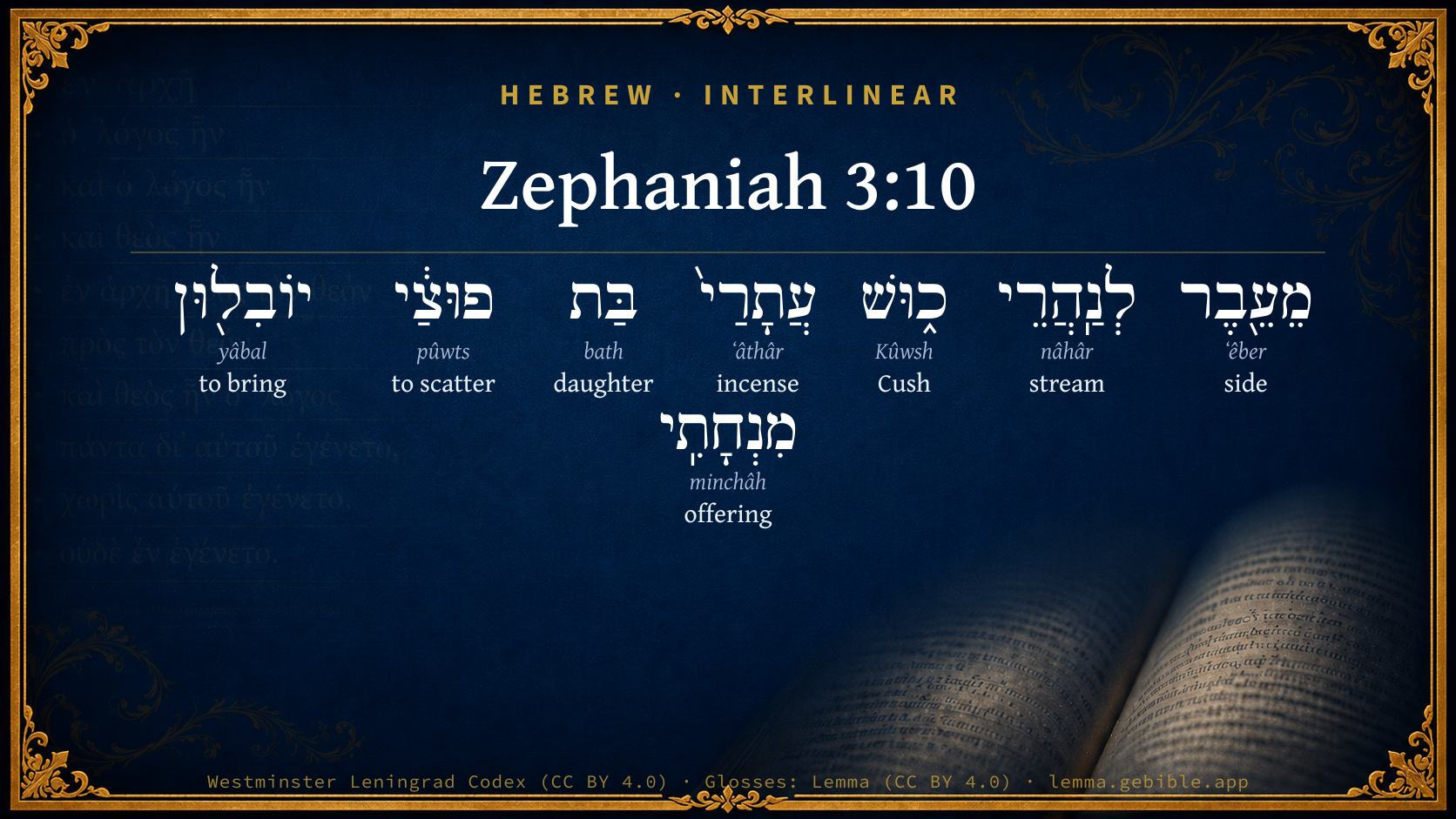
Zephaniah 3:10

Hebrew (Westminster Leningrad Codex) Zephaniah 3:10 appears in the Hebrew Old Testament. The text above is from the Westminster Leningrad Codex. Each word links to its Strong’s number, a concise gloss, and parsing drawn from the Open Scriptures Hebrew Bible morphology. Click any word for its full Brown-Driver-Briggs (BDB) entry.
Download image
Cite this verse

Zephaniah 3:10 (World English Bible). Public Domain. Lemma interlinear Bible study tool, https://lemma.gebible.app/v/zephaniah/3/10.

Show BibTeX & RIS
BibTeX
RIS
English Translation
From beyond the rivers of Cush, my worshipers, even the daughter of my dispersed people, will bring my offering.
World English Bible · Public Domain
Download a study sheet

One document with this verse’s original text, its word-by-word gloss line, the meaning frame, cross-references with their text, attributed commentary, and full source and license credits — printable, and it pastes into notes with its structure intact.

This verse Autodidact and up

Study sheet (.html) Plain text (.txt)

A passage Seminary Student

Up to 50 verses in one chapter. A passage sheet keeps up to 6 commentary sources and 12 cross-references per verse, in the order this page ranks them, and says so on the sheet whenever that leaves anything out. Ask for a single verse and you get the Autodidact verse sheet above.

Everything on this page stays free to read, with no account — the sheet is a download of what is already on screen, not access to it.

Want to remove ads? Support Godless Engineer
Compare translations 3

The same verse in 3 English versions, stacked beneath the original-language interlinear above. Click any original word for its lexicon entry.

Each is an independent rendering of the whole verse — the interlinear is not word-aligned to these translations.

Highlighted words mark where these versions differ — a whole-verse word diff, not a word-by-word alignment.

  • World English Bible Public Domain
    From beyond the rivers of Cush, my worshipers, even the daughter of my dispersed people, will bring my offering.
  • King James Version Public Domain
    From beyond the rivers of Ethiopia my suppliants, even the daughter of my dispersed, shall bring mine offering.
  • unfoldingWord Literal Text CC BY-SA 4.0
    From across the rivers of Cush, my worshipers, the daughter of my scattered one, will bring my offering.

unfoldingWord Literal Text — © unfoldingWord, licensed CC BY-SA 4.0. Word-aligned USFM3 via Door43 (git.door43.org/unfoldingWord/en_ult).

Versions to compare (up to 4)

3 of 4 selected

Show all 18 translations

Every available English version of this verse, each an independent rendering of the whole verse.

  • World English Bible Public Domain
    From beyond the rivers of Cush, my worshipers, even the daughter of my dispersed people, will bring my offering.
  • Berean Standard Bible Public Domain
    From beyond the rivers of Cush My worshipers, My scattered people, will bring Me an offering.
  • Majority Standard Bible Public Domain
    From beyond the rivers of Cush My worshipers, My scattered people, will bring Me an offering.
  • King James Version Public Domain
    From beyond the rivers of Ethiopia my suppliants, even the daughter of my dispersed, shall bring mine offering.
  • American Standard Version (1901) Public Domain
    From beyond the rivers of Ethiopia my suppliants, even the daughter of my dispersed, shall bring mine offering.
  • Revised Version (1885) Public Domain
    From beyond the rivers of Ethiopia my suppliants, even the daughter of my dispersed, shall bring mine offering.
  • Geneva Bible (1599) Public Domain
    From beyonde the riuers of Ethiopia, the daughter of my dispersed, praying vnto me, shall bring me an offering.
  • Douay-Rheims (1899) Public Domain
    From beyond the rivers of Ethiopia, shall my suppliants the children of my dispersed people bring me an offering.
  • Young's Literal Translation Public Domain
    From beyond the rivers of Cush, my supplicants, The daughter of My scattered ones, Do bring My present.
  • Literal Standard Version CC BY-SA 4.0
    From beyond the rivers of Cush, My supplicants, || The daughter of My scattered ones, || Bring My present.
  • Unlocked Literal Bible CC BY-SA 4.0
    From beyond the river of Cush my worshipers—my scattered people—will bring offerings due me.
  • unfoldingWord Literal Text CC BY-SA 4.0
    From across the rivers of Cush, my worshipers, the daughter of my scattered one, will bring my offering.
  • Darby Bible Public Domain
    From beyond the rivers of Cush my suppliants, the daughter of my dispersed, shall bring mine oblation.
  • World Messianic Bible Public Domain
    From beyond the rivers of Cush, my worshipers, even the daughter of my dispersed people, will bring my offering.
  • Webster's Bible Public Domain
    From beyond the rivers of Cush my suppliants, even the daughter of my dispersed, shall bring my offering.
  • Free Bible Version CC BY-SA 4.0
    From beyond the rivers of Ethiopia my scattered people, my worshipers, will come to bring their offerings to me.
  • Bible in Basic English Public Domain
    From over the rivers of Ethiopia, and from the sides of the north, they will come to me with an offering.
  • JPS Tanakh (1917) Public Domain
    From beyond the rivers of Ethiopia shall they bring My suppliants, even the daughter of My dispersed, as Mine offering.

Literal Standard Version (2020), Covenant Press — licensed CC BY-SA 4.0. Text via the HelloAO Bible API (eBible.org). Unlocked Literal Bible (unfoldingWord) — licensed CC BY-SA 4.0. Text via the HelloAO Bible API (eBible.org). unfoldingWord Literal Text — © unfoldingWord, licensed CC BY-SA 4.0. Word-aligned USFM3 via Door43 (git.door43.org/unfoldingWord/en_ult). Free Bible Version, Dr. Jonathan Gallagher — licensed CC BY-SA 4.0. Text via the HelloAO Bible API (eBible.org).

Word by word

More ways to search: Search by grammar → Find every occurrence → Compare this word →

Practice this passage: Drill this verse → Learn its vocabulary →

About this verse

These counts appear in no published source. They are computed here, from the morphology-tagged text and Lemma’s own curated glosses. What Lemma adds →

8
words
8
distinct lemmas
Prophets
section

Notable vocabulary

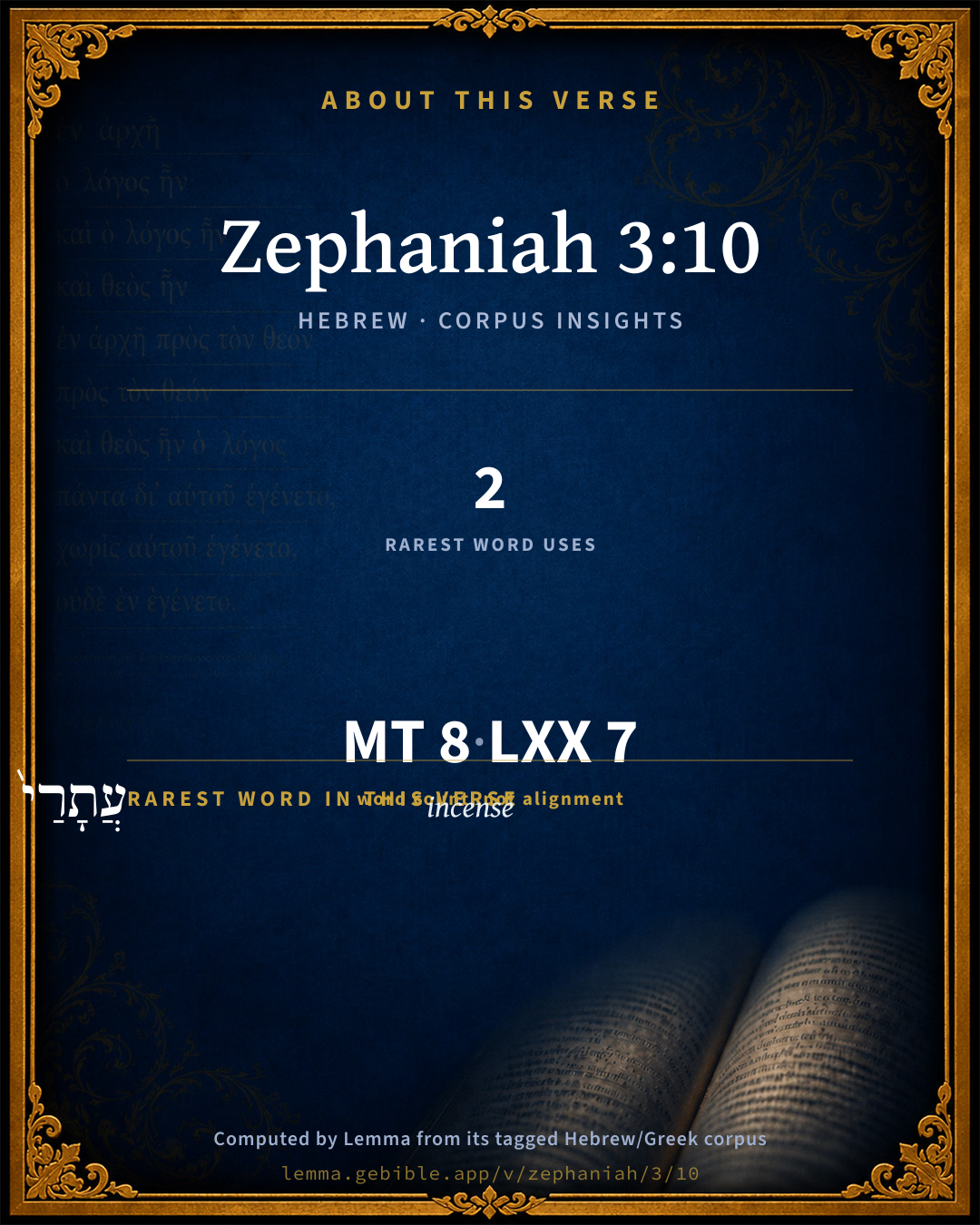
The rarest word here is עֲתָרַי֙ incense H6282 — appearing just 2 times in the whole Hebrew Bible.

Shared distinctive vocabulary

עֲתָרַי֙ incense H6282 occurs in 2 verses of the Hebrew Bible. Also found in:

Grammatical profile

  • 2 verbs
  • 6 nouns

Verb forms

  • פוּצַ֔י Qal · Participle Passive
  • יוֹבִל֖וּן Hiphil · Imperfect

Hebrew & Septuagint length

In English translation the verse runs 19 words from the Hebrew and 20 from the Septuagint (LXX English) — closely comparable.

A rough comparison of the two English renderings, which tokenize alike — not a word-level alignment.

Word counts can differ between the Hebrew and the Greek without any difference in meaning — e.g. the Hebrew direct-object marker אֵת has no separate Greek word, and Greek often adds the article ὁ.

In the original languages it is 8 Hebrew tokens and 7 Greek tokens — but the two are counted differently (Hebrew bundles its prefixes and suffixes into one token; the Greek is in lemma form), so that isn’t a like-for-like length.

Cross-references

15

Topical passages linked to Zephaniah 3:10 in the Treasury of Scripture Knowledge — connected by theme and wording, ordered by reader-vote popularity; previews shown in the World English Bible.

  • Psalms 68:31 Princes shall come out of Egypt. Ethiopia shall hurry to stretch out her hands to God.
  • Isaiah 11:11 It shall happen in that day, that the Lord will set his hand again the second time to recover the remnant of his people, who shall remain, from Assyria, and from Egypt, and from Pathros, and from Cush, and from Elam, and from Shinar, and from Hamath, and from the islands of the sea.
  • Isaiah 18:1 Ah, the land of the rustling of wings, which is beyond the rivers of Ethiopia;
  • Romans 15:16 that I should be a servant of Christ Jesus to the Gentiles, ministering as a priest the Gospel of God, that the offering up of the Gentiles might be made acceptable, sanctified by the Holy Spirit.
  • 1 Peter 1:1 Peter, an apostle of Jesus Christ, to the chosen ones who are living as strangers in the Dispersion in Pontus, Galatia, Cappadocia, Asia, and Bithynia,
  • Psalms 72:8–11 He shall have dominion also from sea to sea, From the River to the ends of the earth.
  • Isaiah 18:7 In that time shall a present be brought to Yahweh of Hosts [from] a people tall and smooth, even from a people awesome from their beginning onward, a nation that measures out and treads down, whose land the rivers divide, to the place of the name of Yahweh of Hosts, Mount Zion.
  • Isaiah 27:12–13 It shall happen in that day, that Yahweh will beat off [his fruit] from the flood of the River to the brook of Egypt; and you shall be gathered one by one, you children of Israel.
  • Isaiah 49:20–23 The children of your bereavement shall yet say in your ears, The place is too small for me; give place to me that I may dwell.
  • Isaiah 60:4–12 Lift up your eyes round about, and see: they all gather themselves together, they come to you; your sons shall come from far, and your daughters shall be carried in the arms.
  • Isaiah 66:18–21 For I [know] their works and their thoughts: [the time] comes, that I will gather all nations and languages; and they shall come, and shall see my glory.
  • Malachi 1:11 For from the rising of the sun even to the going down of the same, my name is great among the nations, and in every place incense will be offered to my name, and a pure offering: for my name is great among the nations," says Yahweh of Hosts.
  • Acts 8:27 He arose and went; and behold, there was a man of Ethiopia, a eunuch of great authority under Candace, queen of the Ethiopians, who was over all her treasure, who had come to Jerusalem to worship.
  • Acts 24:17 Now after some years, I came to bring gifts for the needy to my nation, and offerings;
  • Romans 11:11–12 I ask then, did they stumble that they might fall? May it never be! But by their fall salvation has come to the Gentiles, to provoke them to jealousy.

Cross-references courtesy of OpenBible.info (CC BY 4.0).

Hebrew and Greek witnesses Masoretic Hebrew ↔ Greek Septuagint

The same verse in the two great witnesses to the Old Testament, shown verse-for-verse.

These are two independent witnesses, not word-aligned to each other, and the Septuagint is shown in lemma (dictionary) form.

Hebrew Zephaniah 3:10 Masoretic · Westminster Leningrad Codex

מֵעֵ֖בֶר לְנַֽהֲרֵי כ֑וּשׁ עֲתָרַי֙ בַּת פוּצַ֔י יוֹבִל֖וּן מִנְחָתִֽי

From beyond the rivers of Cush, my worshipers, even the daughter of my dispersed people, will bring my offering.

World English Bible · Public Domain

Greek LXX Zephaniah 3:10 Septuagint · lemma form

ἐκ πέρας ποταμός αἰθίοψ φέρω θυσία ἐγώ

From the boundaries of the rivers of Ethiopia will I receive my dispersed ones; they shall offer sacrifices to me.

LXX2012 (modern English Septuagint) · Public Domain

Hebrew: Westminster Leningrad Codex (CC BY 4.0). Greek: Septuagint (public domain); English from LXX2012 (modern English Septuagint) (Public Domain). How the Septuagint differs from the Hebrew →

Targum (Aramaic paraphrase)

1

The Targum is the ancient Jewish Aramaic paraphrase of the Hebrew Scriptures — an interpretive translation, not the Hebrew text itself. Onkelos (literal) and Pseudo-Jonathan (expansive) render the Torah, and Jonathan the Prophets. Coverage is partial: where no permissively-licensed English translation exists for a verse, only the Aramaic is shown. This is verse-level text, not a word-by-word alignment to the Hebrew.

  1. Targum Jonathan Prophets (Joshua–Malachi)
    מֵעֵבֶר לְנַהֲרֵי הוֹדוּ בְּרַחֲמִין יְתוּבוּן גַלְוַת עַמִי דְאִתְגְלִיאָה וִיהוֹן מַיְתָן לְכוֹן הָא בְּקוּרְבָּנִין:

    (no public-domain English translation for this verse)

    Targum Jonathan — Aramaic: “Mikraot Gedolot” (public domain). English: “Sefaria Community Translation” (CC0 1.0 (public-domain dedication)); “London "Chaldee Paraphrase," 1871” (public domain). Text via Sefaria.

Commentary

Notes on Zephaniah 3:10 from classic Christian and Jewish commentators (each source and its license shown beneath its notes). The classic Christian expositions comment on the surrounding passage and are grouped to its opening verse, so a note may address several verses; the Jewish commentaries on the Tanakh (Rashi and others) are per-verse, so they appear only where the commentator wrote on this verse.

Lemma curates 59 commentaries, every one of them public domain or Creative Commons licensed, each selected and text-cleaned for this edition rather than reprinted as found. About our sources →

Trapp's Complete Commentary

John Trapp

Zep 3:10 From beyond the rivers of Ethiopia my suppliants, [even] the daughter of my dispersed, shall bring mine offering.

Ver. 10. From beyond the rivers of Ethiopia] Heb. Of Chush, that is of Arabia Chusaea, which lay between Judea and Egypt. Confer Isa 18:1; Isa 18:7. Some understand it of Ethiopia, which is beyond the river Nile, and hath two very great rivers. See this in part fulfilled by that Ethiopian eunuch, Act 8:26-40; neither may we think that he was alone in that country. Matthias the apostle is said to have preached the gospel to the Ethiopians (Euseb. i. 1). The large region of Nubia there had from the apostles’ time (as it is thought) professed the Christian faith, till about two hundred years since it forsook the same (Alvarez, Hist. Aethiopic.). The kingdom of Habassia, held by presbyter John, are yet Christians, differing from us in a few ceremonies only. {See Trapp on "Zep 2:12"}

My suppliants] My praying people, that ply the throne of grace, and multiply strong suits, pouring out a flood of words in humble supplication (as the Hebrew signifieth), continuing instant in prayer, as knowing that their safety here and salvation hereafter is of me alone.

Even the daughter of my dispersed] Jews and Gentiles, elect of both sorts, Joh 11:52, scattered here and there, as the salt of the earth upon the face thereof, to keep it from putrefying. Danaeus thinketh that there is mention made of the daughter of the dispersed affectionately; namely, both to describe the earnestness of the saints in serving God (for women, quicquid volunt, valde volunt whatever they wish, they greatly prefer), and that this so goodly and joyful a spectacle or sight of women worshipping and serving God, and of virgins especially, might stir up and move affections. It is easy to observe that the New Testament affordeth more store of good women than the old, who can make masculine prayers, mingled with tears; and as music upon the waters sounds further and more harmoniously than upon the land, so do prayers well watered.

Shall bring mine offering] Heb. My meat offering, or rather my wheat offering (Minchathi), their bodies and souls, Rom 12:1, that best of sacrifices, for a reasonable service, a solemn present; such that the Chaldee paraphrast might express; he translateth it thus: They shall bring as presents unto me the banished of my people, who were carried captive, and shall return by my mercies. Some think that here is foretold the return of the Jews to their own land, toward the end of the world, to set up the spiritual worship of God there; the famous Church that shall be among them, full of sanctity and rid of all wicked ones, Zep 3:11-13, the joy and gladness that shall possess their souls, Zep 3:14, through God’s removing of all cause of fear from them, Zep 3:15, the encouragement they shall receive from others, Zep 3:16, and (which is the cause of all this) the apparent arguments of God’s great love and favour, Zep 3:17, the quality of those that shall be received to be citizens of this New Jerusalem, Zep 3:18, the utter rooting out of all their enemies, the fame and dignity that this Church of the Jews shall be of among all nations, Zep 3:19-20. Thus they: quam recte iudicium sit penes Lectorem.

John Trapp, A Commentary or Exposition upon All the Books of the Old and New Testament (1647–1656) — public domain. Text from a community e-Sword module.

Joseph Benson's Commentary

Zep 3:10. From beyond the rivers of Ethiopia — The expression, מעבר, rendered from beyond, may be translated, from the borders of, as it signifies indifferently the hither or further side of a river. In the war with Pharaoh-necho, king of Egypt, many of the Jews were made captive and carried into Egypt, and from thence were sold into Ethiopia, properly so called. This prophecy, therefore, in its primary sense, seems to signify, that the posterity of these, termed here by God the daughter of his dispersed, should bring him an offering, namely, into his temple. And accordingly Cyrus, entering into an alliance with the Ethiopians, obtained that the Jews, who were captives among them, should have their liberty restored to them, that so they might return with others to their own country. In like manner Ptolemy Philadelphus, as Josephus relates, purchased the liberty of a vast number of the Jews, who were captives, or slaves, in very distant countries. Thus were the prophecies of bringing them from the east and the west, and from the north and the south, and from beyond the sea, very remarkably fulfilled. There can be no doubt, however, that this promise ultimately relates to the time when all Israel shall be saved, Rom 11:26; when “the Jews, who are dispersed in the most distant countries, such as was Ethiopia, which lay beyond Egypt, shall come into the Christian Church, and make their religious acknowledgments there.” — Lowth.

Joseph Benson's Commentary on the Old and New Testaments (1811–1818) — public domain. Text from a community e-Sword module.

Tyndale Open Study Notes

Tyndale Open Resources

3:10 The rivers of Ethiopia are the distant headwaters of the Nile River. The ancient world considered the origin of the Nile a great mystery, so the expression speaks of the farthest reaches of the earth.

Tyndale Open Study Notes — © Tyndale Open Resources, licensed CC BY-SA 4.0. Text via the HelloAO Bible API.

Geneva Bible (1599)

Geneva Bible translators

That is, the Jews shall come as well as the Gentiles: which is to be understood under the time of the Gospel.

Geneva Bible (1599) marginal notes — public domain. Text via Bolls.life.

Jamieson, Fausset & Brown

Robert Jamieson, A. R. Fausset & David Brown

From beyond . . . Ethiopia my suppliants--literally, "burners of incense" (compare Psa 141:2; Rev 5:8; Rev 8:3-4). The Israelites are meant, called "the daughter of My dispersed," a Hebrew idiom for My dispersed people. "The rivers of Ethiopia" are those which enclose it on the north. In the west of Abyssinia there has long existed a people called Falashas, or "emigrants" (akin to the synonym "Philistine"). These trace their origin to Palestine and profess the Jewish religion. In physical traits they resemble the Arabs. When Bruce was there, they had a Jewish king, Gideon, and his queen, Judith. Probably the Abyssinian Christians were originally in part converted Jews. They are here made the representatives of all Israel which is to be restored.

shall bring mine offering--that is, the offering that is My right. I prefer, with DE WETTE and Chaldee Version, making "suppliants" the objective case, not the nominative. The peoples: (Zep 3:8-9), brought to fear Me by My judgments, "shall bring as Mine offering My suppliants (an appropriate term for the Jews, on whom then there shall have been poured the spirit of supplications, Zac 12:10), the daughter of My dispersed." So Isa 66:20, "they shall bring all your brethren for an offering unto the Lord." Compare HORSLEY'S view of Isa 18:1-2, Isa 18:7. England in this view may be the naval power to restore Israel to Palestine (Isa 60:9). The Hebrew for "Ethiopia" is Cush, which may include not only Ethiopia, but also the region of the Tigris and Babylon, where Nimrod, Cush's son (Gen 10:8-12), founded Nineveh and acquired Babylon, and where the ten tribes are mentioned as being scattered (Pe1 1:1; Pe1 5:13; compare Isa 11:11). The restoration under Cyrus of the Jews transported under Pharaoh-necho to Egypt and Ethiopia, was an earnest of the future restoration under Christ.

Jamieson, Fausset & Brown — Commentary Critical and Explanatory on the Whole Bible (1871) — public domain (CC PDM 1.0). Text via the HelloAO Bible API.

Adam Clarke's Commentary

Verse 10. From beyond the rivers of Ethiopia] This may denote both Africa and the southern Arabia. Bochart thinks that Arabia Chusaer is meant; and that the rivers are Besor, which flows into the Mediterranean; Rhinocorura, which flows into the Lake Sirbonis; Trajanus Amnis, which flows into the Red Sea; and the river Corys. Calmet thinks that these rivers mean the Nile, which by seven mouths falls into the Mediterranean. The Nile comes from Ethiopia, properly so called; and runs through all Egypt, and falls into the sea at that part of Arabia which the Scripture calls Cush or Ethiopia.

My dispersed] The Jews, scattered through different parts of the world. Shall bring mine offering. Shall acknowledge my mercy in sending them the Messiah to bless them, by turning every one of them away from their iniquities.

Adam Clarke's Commentary on the Bible (1810–1826) — public domain. Text from a community e-Sword/MySword module.

John Calvin's Commentaries

Interpreters agree not as to the meaning of this verse; for some of the Hebrews connect this with the former, as though the Prophet was still speaking of the calling of the Gentiles. But others, with whom I agree, apply this to the dispersed Jews, so that the Prophet here gives hope of that restoration, of which he had before spoken. They who understand this of the Gentiles, think that Atharai and Phorisai are proper names. But in the first place, we cannot find that any nations were so called; and then, if we receive what they say, these were not separate nations, but portions of the Ethiopians; for the Prophet does not state the fact by itself, that Atharai and Phorisai would be the worshipers of God; but after having spoken of Ethiopia, he adds these words: hence we conclude, that the Prophet means this,—that they would return into Judea from the farthest region of the Ethiopians to offer sacrifices to God. And as he mentions the daughter of the dispersion, we must understand this of the Jews, for it cannot be applied to the Ethiopians. And this promise fits in well with the former verse: for the Prophet spoke, according to what we observed yesterday, of the future calling of the Gentiles; and now he adds, the Jews would come with the Gentiles, that they might unite together, agreeing in the same faith, in the true and pure worship of the only true God. He had said, that the kingdom would be enlarged, for the Church was to be gathered from all nations: he now adds, that the elect people would be restored, after having been driven away into exile.

Hence he says, Beyond the rivers of Ethiopia shall be my suppliants: for עתר, otar, means to supplicate; but it means also sometimes to be pacified, or to be propitious; and therefore some take עתרים, otarim, in a passive sense, they who shall be reconciled to God; as though he had said, God will at length be propitious to the miserable exiles, though they have been cast away beyond the rivers of Ethiopia: they shall yet again be God’s people, for he will be reconciled to them. As David calls Him the God of his mercy, because he had found him merciful and gracious, (Psalm 59:17,) so also in this place they think that the Jews are said to be the עתרי, the reconciled of Jehovah, because he would be reconciled to them. But this exposition is too forced: I therefore retain that which I have stated,—that some suppliants would come to God from the utmost parts of Ethiopia, not the Ethiopians themselves, but the Jews who had been driven there.

To the same purpose is what is added, The daughter of my dispersed; for פוף, puts, means to scatter or to disperse. Hence by the daughter of the dispersed he means the gathered assembly of the miserable exiles, who for a time were considered as having lost their name, so as not to be counted as the people of Israel. These then shall again offer to me a gift, that is, they are to be restored to their country, that they may there worship me after their usual manner. Now though this prophecy extends to the time of the Gospel, it is yet no wonder, that the Prophet describes the worship of God such as it had been, accompanied with the ceremonies of the Law. We now then perceive what Zephaniah means in this verse,—that not only the Gentiles would come into the Church of God, but that the Jews also would return to their country, that they might together make one body. It follows,—

John Calvin's Commentaries (1540-1563) — public domain. Text from the Calvin Translation Society English edition (1840s-50s) via the Christian Classics Ethereal Library (ccel.org). Calvin's coverage is partial (roughly two-thirds of the Bible); uncommented books and verses are honest gaps, never fabricated. The 19th-century editor's footnotes and remarks are omitted so the notes are faithfully Calvin's own voice.

Ellicott's Commentary for English Readers

(10) The daughter of my dispersed.—i.e., dropping the Hebrew idiom, “my dispersed people.” Even from the southern limit of the known world shall the new Church draw adherents. The “dispersed people” are not Jewish exiles, but the Gentile tribes of the dispersion (of Gen_11:8) which have been hitherto alienated from their Creator by ignorance and vice. Similarly, Caiaphas prophesies that Christ should not only die for the Jewish nation, but that “He should gather together in one” the children of God that “were scattered abroad” (Joh_11:51-52).

Bring mine offering.—The minchâh or bloodless oblation. The phrase here merely represents homage rendered to Jehovah as paramount. So in Mal_1:11 it is foretold that “in every place incense shall be offered unto my name, and a pure minchâh.” In Isa_66:20, on the other hand, the Gentiles are represented as bringing the dispersed Jews back to Jerusalem “as a minchâh to Jehovah.” De Wette and others (wrongly, as we believe), give this passage the same force, rendering, “From beyond the rivers of Ethiopia shall men bring my suppliants, even my dispersed people, as my offering.”

A Bible Commentary for English Readers, edited by Charles John Ellicott (1878–1897) — public domain. Text from a community e-Sword module.

The Cambridge Bible for Schools and Colleges

gen. ed. J. J. S. Perowne

10. The verse is obscure on account of the uncertain meaning of several expressions in it. Its general sense is that the heathen nations, even those most distant, shall do homage to Jehovah and present offerings to Him. Jeremiah already predicts the conversion of the nations (Jer_3:17, Jer_16:19).

From beyond the rivers] This meaning is possible, but the usual sense would be: beyond the rivers—in answer to the question where, not, whence (Isa_18:1). On Ethiopia or Cush see on ch. Zep_2:12.

My suppliants] The word does not occur again in this sense, though a verb to supplicate, from which it might be derived, is not uncommon (Gen_25:21). In the sing, the word occurs Eze_8:11 in the sense of vapour or odour (R.V.) of incense, and this sense, being parallel to “mine offering,” might be adopted here.

even the daughter of my dispersed] Phrases like “daughter of Zion” (Zep_3:14), of Babylon (Psa_137:8), of Edom (Lam_4:21), signify the city or country named with its inhabitants. There is always in such phrases the name of a place, and this suggests that under the word “my dispersed” (pûtsai) there lurks some proper name. Ewald suggested Put, which is often named in connexion with Cush (cf. on Nah_3:9). “The daughter of Put” would then be parallel to “beyond the rivers of Cush.” Others have assumed that somewhat after the analogy of “daughter of Zion” in the sense of Zion with those inhabiting it, “the daughter of my dispersed” might mean those composing (comprised in) my dispersed. “My dispersed” must certainly refer to Jews; the view of Hitzig that they are the same as “those that escape” of the Gentiles and carry tidings of the greatness of Jehovah to all nations (Isa_66:18-19), has no probability. The general meaning of the verse would be that the most distant nations would bring back God’s dispersed people the Jews as an offering to Him (Isa_66:20): From beyond the rivers of Cush shall they bring my suppliants, even the daughter of my dispersed as mine offering. The term “suppliants” seems unnatural in the connexion. After all, the other sense appears at least equally probable: Beyond the rivers of Cush they shall offer me incense, the daughter of [Put] shall bring me an offering, the reference being to the service of Jehovah by all the nations. Comp. Isa_18:7; Isa_45:14; Psa_72:10.

The Cambridge Bible for Schools and Colleges (gen. ed. J. J. S. Perowne; Cambridge University Press, 1878–1918) — public domain. Text from a community e-Sword module.

John Gill's Exposition

From beyond the rivers of Ethiopia Either the African Ethiopia, or Arabia Chusea, which lay between Judea and Egypt: here some particular places and people are mentioned, in whom the preceding prophecy would be fulfilled. If these rivers of Ethiopia are such as ran in the midst of the country, and so point at some parts of it, though on the other side of them, then this prophecy might have its accomplishment, at least when the Evangelist Matthew went thither, and preached the Gospel, and very likely the Apostle Paul; as also when the Ethiopian eunuch was converted, who doubtless did what in him lay to promote the interest of Christ in those parts. Ben Melech makes this parallel with and illustrates it by ( Isaiah 18:1 Isaiah 18:7 ) , (See Gill on Isaiah 18:1), (See Gill on Isaiah 18:7); but if these design rivers on the furthermost borders of the country, which divided it from others, then Egypt, which lay beyond it, seems to be intended; and so the prophecy, in connection with the foregoing verse ( Zephaniah 3:9 ) , is the same with ( Isaiah 19:18 ) "in that day shall five cities in the land of Egypt speak the language of Canaan"; of these rivers of Ethiopia, whether in Africa or Arabia Chusea, (See Gill on Isaiah 18:1). The Targum renders it ``beyond the rivers of India:'' my suppliants, [even] the daughter of my dispersed: Aben Ezra, Kimchi, Abarbinel, and Ben Melech, take the words "Atharai Bathpusai" to be the proper name of a nation or family beyond the rivers of Ethiopia F12; whereas they are characters which describe persons there, who should have the pure language turned to them, and call on the name of the Lord; even such, who, being made sensible of sin, and of their danger, would be humble supplicants at the throne of grace, and pray to the Lord for the discovery and application of pardoning grace and mercy to them, agreeably to the prophecy in ( Psalms 68:31 ) "princes shall come out of Egypt; Ethiopia shall soon stretch out her hands unto God"; that is, in prayer: and these are the sons and daughters of the Almighty, who are scattered abroad in the several parts of the world, and among the rest here; but as they are gathered together by Christ in redemption, so they are found out and reached by efficacious grace in calling, whether Jews or Gentiles. Some think the Jews are here meant, even the elect of God among them, who were dispersed in several nations, and particularly in Egypt and Ethiopia; who were met with by the Gospel, and converted in the first times of it; to these Peter and James direct their epistles: and of whom, being called by grace, it is said, they shall bring mine offering; themselves as an offering to the Lord, souls and bodies, with all other spiritual sacrifices of prayer, praise, and well doing; and likewise such persons they may be the instruments of the conversion of, called the offering of the Gentiles, ( Romans 15:16 ) . FOOTNOTES: F12 So Menasseh ben Israel. Spes Israelis, p. 57.

John Gill's Exposition of the Whole Bible (1746–1763) — public domain (CC PDM 1.0). Text via the HelloAO Bible API.

Albert Barnes' Notes on the Bible

From beyond the rivers of Ethiopia - (See Isa 18:1.) The farthest southern people, with whom the Jews had contact, stand as the type of the whole world beyond. The utmost bound of the known inhabited land should not be the bound of the Gospel. The conversion of Abyssinia is one, but the narrowest fulfillment of the prophecy. The whole new world, though not in the mind of the prophet, was in the mind of Him who spake by the prophet.

My suppliants - He names them as what they shall be when they shall come to Him. They shall come, as needy, to the Fountain of all good, asking for mercy of the unfailing Source of all mercy. He describes the very character of all who come to God through Christ. “The daughter of My dispersed.” God is, in the way of Providence, the Father of all, although, by sin, alienated from Him; from where Paul says, “we are the offspring of God” Act 17:28. They were “dispersed,” severed from the oneness in Him and from His house and family; yet still, looking on them as already belonging to Him, He calls them, “My dispersed,” as by Caiaphas, being high priest, He prophesied that “Jesus should die for that nation; and not for that nation only, but that also He should gather together in one the children of God that were scattered abroad” Joh 11:51-52.

Shall bring Mine offering - o The offering is the same as that which Malachi prophesies shall continue under the New Testament, which offering was to be offered to the Name of God, not in Jerusalem, but Mal 1:11 “in every place from the rising of the sun unto the going down of the same.” The dark skin of the Ethiopian is the image of ingrained sin, which man could not efface or change Jer 13:23 : their conversion then declares how those steeped in sin shall be cleansed from all their darkness of mind, and washed white from their sins in Baptism and beautified by the grace of God. Cyril: “The word of prophecy endeth in truth. For not only through the Roman empire is the Gospel preached, but it circles round the barbarous nations. And there are Churches everywhere, shepherds and teachers, guides and instructors in mysteries, and sacred altars, and the Lamb is invisibly sacrificed by holy priests among Indians too and Ethiopians. And this was said plainly by another prophet also, ‘For I am a great King, saith the Lord, and My Name is great among the pagan, and in every place incense is offered to My Name and a pure sacrifice’ Mal 1:11.”

Albert Barnes' Notes on the Bible (1834–1885) — public domain. Text from a community e-Sword/MySword module.

Haydock's Catholic Bible Commentary

Ethiopia. The Nile arises in that country, and runs through Egypt and Arabia, which is often styled Ethiopia or Cush, Isaias xviii. 1. The Jews came from Egypt to adore at Jerusalem, even after the building of Onion. Yet this literally regard’s Christ’s Church. --- Offering. The Jews performed this after the captivity, coming or sending the half sicle to Jerusalem annually, from all quarters of the world, Numbers iii. 46., and Matthew xvii. 23. (Calmet)

George Leo Haydock (1774–1849), Haydock's Catholic Family Bible and Commentary, 1859 edition — public domain. Excludes Psalms (Douay-Rheims chapter numbering differs from Protestant) and Deuterocanonical books (Catholic canon only).

Matthew Poole's English Annotations

From beyond the rivers; the coasts which lie beyond the rivers of India, saith the Chaldee paraphrast, but I doubt whether the captive Jews were carried so far.

Of Ethiopia, in Arabia, bordering on Egypt, whither it is easy to conceive many Jews might betake themselves, who are here called

dispersed, or dispersion, somewhat distinguished from captives.

My suppliants; praying to me, saith one version.

The daughter of my dispersed: this explains who the suppliant is; the praying remnant of the scattered Jews, who had gotten into those parts of Arabia that were coasting along the rivers which divided Ethiopia Cusaea from the rest of Arabia.

Shall bring mine offering; shall return to their land and bring themselves an offering unto the Lord, which was done when Cyrus, in league with these Ethiopians, procured their favour for the dispersed Jews, that they might return to Jerusalem, meet their captive brethren, and offer a gift to God.

Matthew Poole's English Annotations on the Holy Bible (1683–1685) — public domain. Text from a community e-Sword/MySword module.

The Pulpit Commentary

From beyond the rivers of Ethiopia (Cush); i.e. from the distant south, a type of the remotest parts of the world. (Zep_2:12) The rivers of Cush, (Isa_18:1) are the Nile, the Atbara, and their affluents. My suppliants, even the daughter of my dispersed, shall bring mine offering. From the ends of the earth, the Jews who have continued faithful to Jehovah, and have not lost their nationality among the Gentiles, but have considered themselves as belonging to "the dispersion," shall be again received of the Lord, and bring their oblations unto him. This may be the sense intended: but looking to the thought in Isa_66:20 (where it is said that the Gentiles shall bring the Israelites out of all nations as a meat offering unto the Lord), we had better render the passage as the Revised Version margin, "They shall bring my suppliants, even the daughter of my dispersed, for an offering unto me." The remote Gentiles shall show their faith in God by aiding the Hebrews among them to turn to the Lord; this shall be their offering to the true God, whom they have learned to adore. When they themselves are converted, they shall be evangelists to the Hebrews of the Dispersion. For this work of the Gentiles in converting the Hebrews, Wordsworth compares Son_3:4 Son_8:8, 9 Isa_61:5, 6 65:18-21. St. Paul speaks to the same effect in Ro 6. Offering (minehah). The pure meal offering. (Mal_1:10, Mal_1:11, where see notes; comp. Rom_15:16 Php_2:17) Dr. Briggs renders, "From beyond the rivers of Gush will be my incense (athar); the daughter of Phut will bring a minchah." This brings out the parallelism. The universal worship of Messianic times is expressed in the ceremonial terms of the old dispensation, but has a very real applicableness to the Christian religion. (see note on Mal_1:11)

The restoration of the Jews.

These words have been regarded by some biblical expositors as having reference to the conversion of the Gentiles. This utterance of Zephaniah in the Old Testament, and the prophecy of Caiaphas recorded in the New Testament, (Joh_11:51, Joh_11:52) have been associated together in their minds, and they have thought that by the "dispersed" Zephaniah meant the Gentiles, even as Caiaphas described the Gentiles as "the children of God that were scattered abroad," and that when the prophet alluded to the dispersed "beyond the rivers of Ethiopia," he meant to intimate that the Gentiles even from the remotest parts should eventually be brought home to God. Others, including many of the ablest interpreters, take the opposite view. They regard ver. 9 as referring to the Gentiles in their relation to the truth and the kingdom of God, and as intimating the great fact of the calling of the Gentiles, who should be led with one consent to serve the Lord, and then refer to this tenth verse as having special reference to the spiritual restoration of the Jews, who, through the agency of the Gentiles thus converted to God, should at length be brought in. (Rom_11:30, Rom_11:31) Accepting this latter interpretation, we have here declared the spiritual restoration of the Jews (ver. 10). Note

I THEIR PRESENT POSITION.

1. Dispersed. Scattered over the face of the whole earth. "Can you find a country which they can call their own? Can you find a nation in which they are not? In Europe, Asia, Africa, and America, and the furthest islands of the Southern Sea, among bond and tree, copper-coloured and yellows white and black, wherever there are men, there are Jews.

2. Yearning. Crying out to God, longing for the fulfilment of their cherished hopes. In exile they are still his "suppliants," expecting the promised Messiah, and, whilst many of them are embittered against Christianity, there are not wanting numbers who have embraced it, and openly avowed their faith in Christ, whilst many are his disciples "secretly," ready to avow themselves his, only shrinking from the pains and penalties involved, whilst a still larger number are inquiring concerning him, and are easily accessible to the missionary of the cross.

II THEIR ULTIMATE RESTORATION.

1. The fact of their spiritual recovery is here emphatically declared (ver.10). From the remotest parts they shall come and surrender themselves as an offering unto God. "All Israel shall be saved." They shall be brought in with the fulness of the Gentiles, and "there shall be one flock, one Shepherd". (Joh_10:16) Their restoration to their own land is a question of comparative unimportance in view of this spiritual recovery which is so frequently declared in the unerring Word of God. (Rom_9:1-6, Rom_9:8, 9 10:1-4 11:1, 9, 11-15, 23-32 2Co_3:12-16)

2. It is implied here that this spiritual restoration shall be effected through the agency of the Gentiles. The offering here referred to as to be brought unto the Lord was "the meat offering." The idea expressed here is that, just as the children of Israel presented the meat offering unto God, so the Gentiles themselves, converted to him, should labour for the conversion of the Jews, and, crowned with success in this holy service, should bring these Hebrew converts as a meat offering unto the Lord. And the meaning is still more clear if we remember the signification of the meat offering. It was a sacrifice in which the Jew recognized God"s goodness and grace in the bounties of his hand, and acknowledged that these gifts were his by right, and ought to be consecrated unto him. And even so, it is here declared that the Gentiles should recognize God"s mercy in bringing home to himself his chosen race, and should present these converts to him as those who were his in virtue of all he had done for them, and who ought to be entirely consecrated to his service. The Church of Christ should ever prove herself a missionary Church, and in these enterprises a conspicuous place should be assigned to work for the spiritual good of God"s ancient people, whose "falling away" shall result in "the reconciling of the world," and the restoration of whom shall be "as life from the dead". (Rom_11:15)

The Pulpit Commentary (1880–1919), ed. H.D.M. Spence-Jones & Joseph S. Exell — public domain. Text from a community e-Sword module.

John Wesley's Explanatory Notes

My dispersed - The praying remnant of the scattered Jews shall return to their own land, and bring themselves an offering unto the Lord.

John Wesley, Explanatory Notes Upon the Whole Bible (1754–1765) — public domain. Text via the GEBible commentary corpus.

Rashi

Rabbi Shlomo Yitzchaki (Rashi)

From the other side of the rivers of Cush They will bring Me an offering.

My supplicants those who pray to me.

the community of My scattered ones The gatherings of My scattered ones, whom I scattered.

Rashi on the Tanakh — English translations: “The Judaica Press complete Tanach with Rashi, translated by A. J. Rosenberg” (CC BY 4.0); “Pentateuch with Rashi's commentary by M. Rosenbaum and A.M. Silbermann, 1929-1934” (public domain); “The Metsudah Tanach series, Lakewood, N.J” (CC BY 4.0); and “The Book of Joshua, Metsudah Publications, 1997” (CC BY 4.0). Text via Sefaria.

Lesson kit

Teaching starters — assembled from the data on this page, not authored interpretation. Every prompt links to the verse data it draws on. Edit before teaching.

Zephaniah, in the Prophets, opens this verse with 8 words (8 distinct Hebrew lemmas). Its most distinctive word is ʻâthâr (“incense”). A historical commentator’s framing appears above. Read the whole chapter for the surrounding context.

Discussion questions

  1. How does “incense” (ʻâthâr) shape what this verse is saying?
  2. Ezekiel 8:11 shares the word «incense» with this verse. How do the two illuminate each other?
  3. These translations render this verse differently. What is at stake in choosing one wording over another?
  4. The verb «פוּצַ֔י» is Qal Participle Passive. How does its form color the action?
  5. Reading how Trapp's Complete Commentary and Joseph Benson's Commentary read this verse, where do the two commentators agree and where do they part?

Things to notice

Reading settings

Reading text

Shown beneath each verse's original-language words.

Old Testament
Old Testament edition

Read the OT as the Masoretic Hebrew (MT) or the Greek Septuagint (LXX).

English shown for the Greek Septuagint (in the Hebrew ↔ Greek comparison).

Comparing translations? Open the Compare panel on any verse page to stack up to four side by side.