
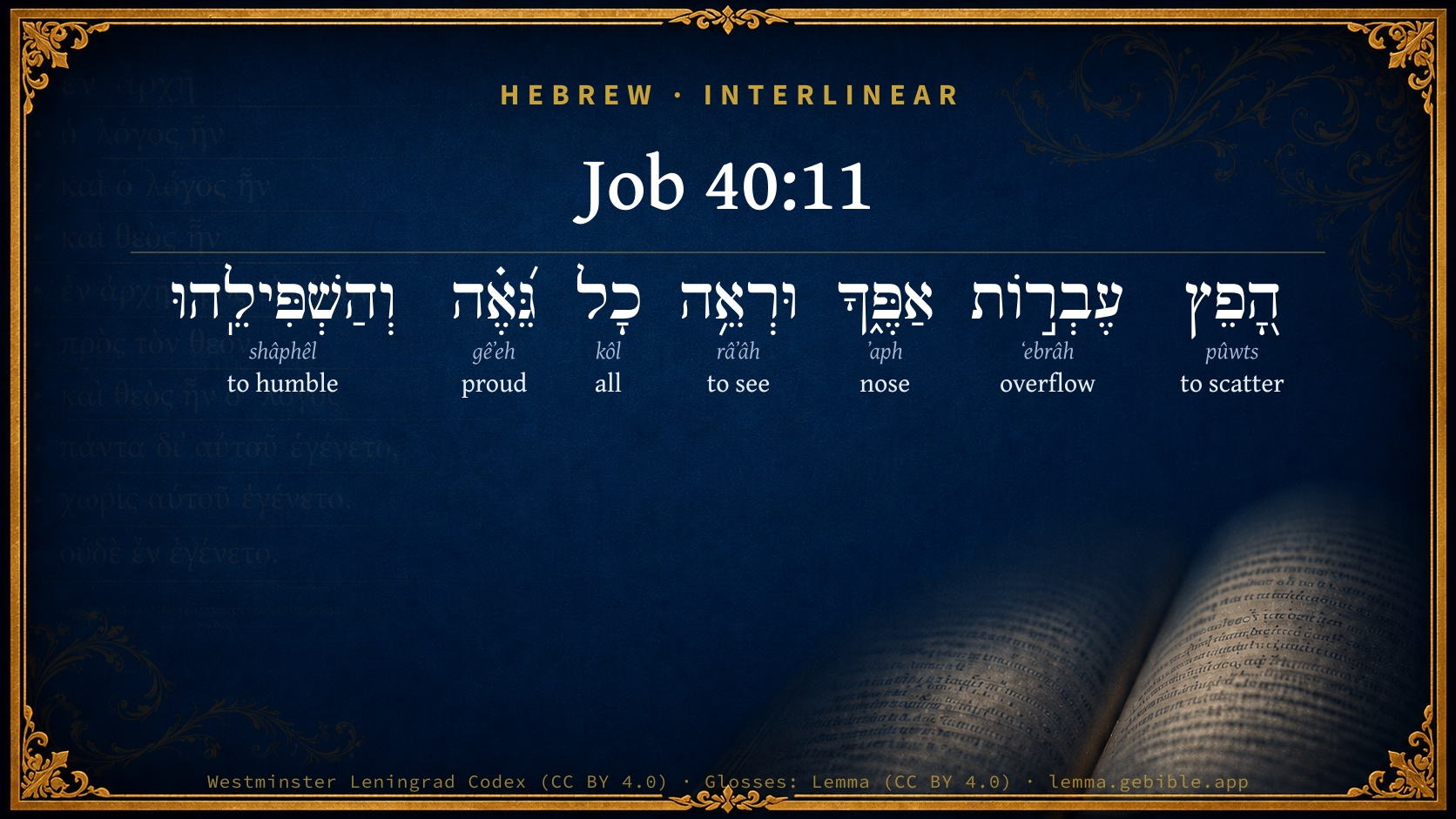
Job 40:11

Hebrew (Westminster Leningrad Codex) Job 40:11 appears in the Hebrew Old Testament. The text above is from the Westminster Leningrad Codex. Each word links to its Strong’s number, a concise gloss, and parsing drawn from the Open Scriptures Hebrew Bible morphology. Click any word for its full Brown-Driver-Briggs (BDB) entry.
Download image
Cite this verse

Job 40:11 (World English Bible). Public Domain. Lemma interlinear Bible study tool, https://lemma.gebible.app/v/job/40/11.

Show BibTeX & RIS
BibTeX
RIS
English Translation
Pour forth the fury of your anger. Look on everyone who is proud, and bring him low.
World English Bible · Public Domain
Highlights
  • 1 first appearance in the Hebrew Bible
Full analysis ↓
Download a study sheet

One document with this verse’s original text, its word-by-word gloss line, the meaning frame, cross-references with their text, attributed commentary, and full source and license credits — printable, and it pastes into notes with its structure intact.

This verse Autodidact and up

Study sheet (.html) Plain text (.txt)

A passage Seminary Student

Up to 50 verses in one chapter. A passage sheet keeps up to 6 commentary sources and 12 cross-references per verse, in the order this page ranks them, and says so on the sheet whenever that leaves anything out. Ask for a single verse and you get the Autodidact verse sheet above.

Everything on this page stays free to read, with no account — the sheet is a download of what is already on screen, not access to it.

Want to remove ads? Support Godless Engineer
Compare translations 3

The same verse in 3 English versions, stacked beneath the original-language interlinear above. Click any original word for its lexicon entry.

Each is an independent rendering of the whole verse — the interlinear is not word-aligned to these translations.

Highlighted words mark where these versions differ — a whole-verse word diff, not a word-by-word alignment.

  • World English Bible Public Domain
    Pour forth the fury of your anger. Look on everyone who is proud, and bring him low.
  • King James Version Public Domain
    Cast abroad the rage of thy wrath: and behold every one that is proud, and abase him.
  • unfoldingWord Literal Text CC BY-SA 4.0
    Scatter the outbursts of your nose, and look at every proud one and bring him down.

unfoldingWord Literal Text — © unfoldingWord, licensed CC BY-SA 4.0. Word-aligned USFM3 via Door43 (git.door43.org/unfoldingWord/en_ult).

Versions to compare (up to 4)

3 of 4 selected

Show all 18 translations

Every available English version of this verse, each an independent rendering of the whole verse.

  • World English Bible Public Domain
    Pour forth the fury of your anger. Look on everyone who is proud, and bring him low.
  • Berean Standard Bible Public Domain
    Unleash the fury of your wrath; look on every proud man and bring him low.
  • Majority Standard Bible Public Domain
    Unleash the fury of your wrath; look on every proud man and bring him low.
  • King James Version Public Domain
    Cast abroad the rage of thy wrath: and behold every one that is proud, and abase him.
  • American Standard Version (1901) Public Domain
    Pour forth the overflowings of thine anger; And look upon every one that is proud, and abase him.
  • Revised Version (1885) Public Domain
    Pour forth the overflowings of thine anger: and look upon every one that is proud, and abase him.
  • Geneva Bible (1599) Public Domain
    Behold now, his strength is in his loynes, and his force is in the nauil of his belly.
  • Douay-Rheims (1899) Public Domain
    His strength is in his loins, and his force in the navel of his belly.
  • Young's Literal Translation Public Domain
    Scatter abroad the wrath of thine anger, And see every proud one, and make him low.
  • Literal Standard Version CC BY-SA 4.0
    Scatter abroad the wrath of your anger, || And see every proud one, and make him low.
  • Unlocked Literal Bible CC BY-SA 4.0
    Scatter around the excess of your anger; look at everyone who is proud and bring him down.
  • unfoldingWord Literal Text CC BY-SA 4.0
    Scatter the outbursts of your nose, and look at every proud one and bring him down.
  • Darby Bible Public Domain
    Cast abroad the ragings of thine anger, and look on every one that is proud, and abase him:
  • World Messianic Bible Public Domain
    Pour out the fury of your anger. Look at everyone who is proud, and bring him low.
  • Webster's Bible Public Domain
    \\40:16\\Lo now, his strength is in his loins, and his force is in the navel of his belly.
  • Free Bible Version CC BY-SA 4.0
    Let loose your fierce anger. Humble the proud with a glance.
  • Bible in Basic English Public Domain
    His strength is in his body, and his force in the muscles of his stomach.
  • JPS Tanakh (1917) Public Domain
    Cast abroad the rage of thy wrath; and look upon every one that is proud, and abase him.

Literal Standard Version (2020), Covenant Press — licensed CC BY-SA 4.0. Text via the HelloAO Bible API (eBible.org). Unlocked Literal Bible (unfoldingWord) — licensed CC BY-SA 4.0. Text via the HelloAO Bible API (eBible.org). unfoldingWord Literal Text — © unfoldingWord, licensed CC BY-SA 4.0. Word-aligned USFM3 via Door43 (git.door43.org/unfoldingWord/en_ult). Free Bible Version, Dr. Jonathan Gallagher — licensed CC BY-SA 4.0. Text via the HelloAO Bible API (eBible.org).

Word by word

More ways to search: Search by grammar → Find every occurrence → Compare this word →

Practice this passage: Drill this verse → Learn its vocabulary →

About this verse

These counts appear in no published source. They are computed here, from the morphology-tagged text and Lemma’s own curated glosses. What Lemma adds →

7
words
7
distinct lemmas
Wisdom
section

Notable vocabulary

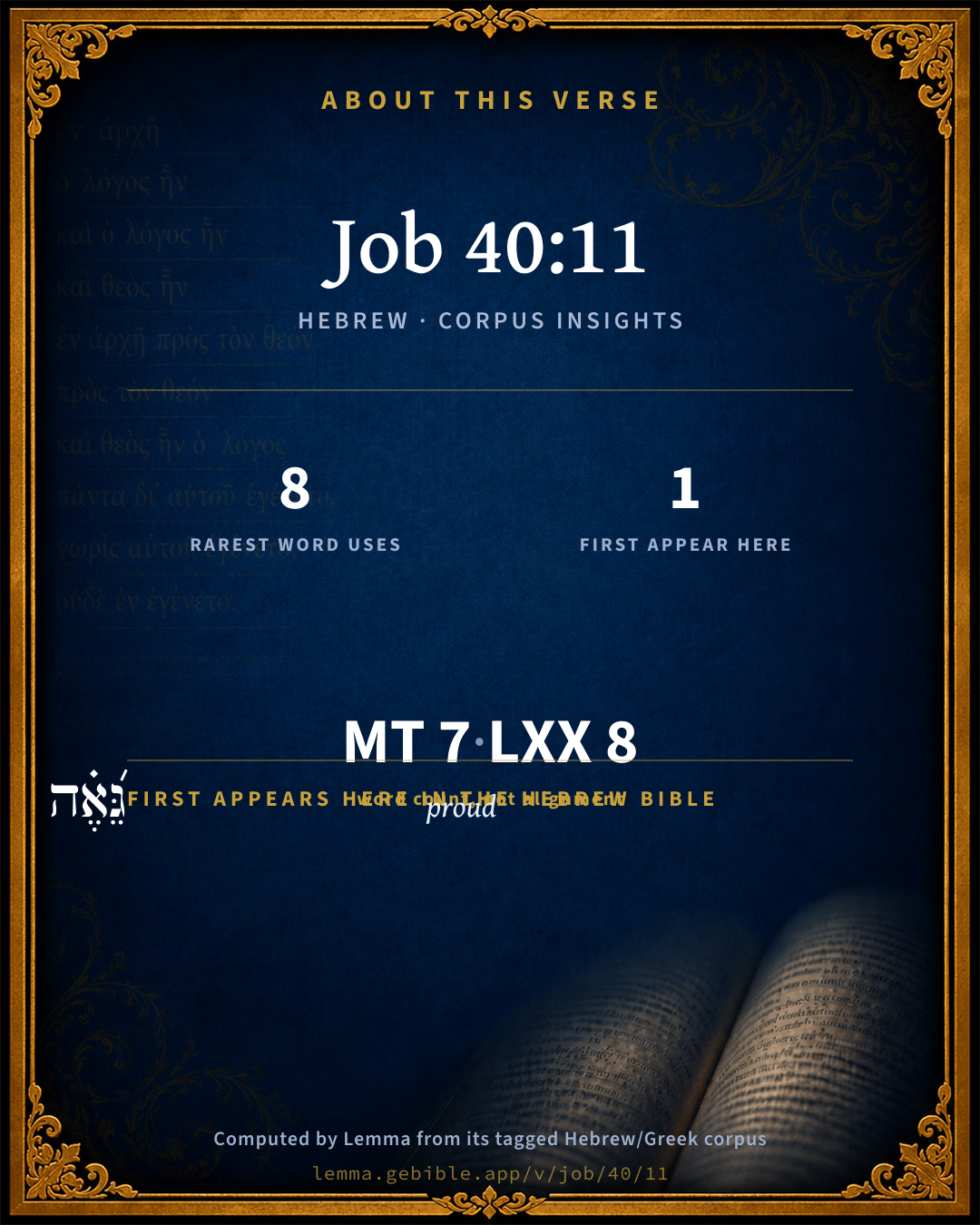
The rarest word here is גֵּ֝אֶ֗ה proud H1343 — appearing just 8 times in the whole Hebrew Bible.

First appearance in Scripture

This word makes its first canonical appearance in the Hebrew Bible here:

  • גֵּ֝אֶ֗ה proud H1343

Shared distinctive vocabulary

גֵּ֝אֶ֗ה proud H1343 occurs in 8 verses of the Hebrew Bible. Also found in:

Grammatical profile

  • 3 verbs
  • 3 nouns
  • 1 adjective

Verb forms

  • הָ֭פֵץ Hiphil · Imperative
  • וּרְאֵ֥ה Qal · Imperative
  • וְהַשְׁפִּילֵֽהוּ Hiphil · Imperative

Hebrew & Septuagint length

In English translation the verse runs 17 words from the Hebrew and 18 from the Septuagint (LXX English) — closely comparable.

A rough comparison of the two English renderings, which tokenize alike — not a word-level alignment.

Word counts can differ between the Hebrew and the Greek without any difference in meaning — e.g. the Hebrew direct-object marker אֵת has no separate Greek word, and Greek often adds the article ὁ.

In the original languages it is 7 Hebrew tokens and 8 Greek tokens — but the two are counted differently (Hebrew bundles its prefixes and suffixes into one token; the Greek is in lemma form), so that isn’t a like-for-like length.

Cross-references

23

Topical passages linked to Job 40:11 in the Treasury of Scripture Knowledge — connected by theme and wording, ordered by reader-vote popularity; previews shown in the World English Bible.

  • Daniel 4:37 Now I, Nebuchadnezzar, praise and extol and honor the King of heaven; for all his works are truth, and his ways justice; and those who walk in pride he is able to abase.
  • Isaiah 2:11–12 The lofty looks of man will be brought low, The haughtiness of men will be bowed down, And Yahweh alone will be exalted in that day.
  • Isaiah 2:17 The loftiness of man shall be bowed down, And the haughtiness of men shall be brought low; And Yahweh alone shall be exalted in that day.
  • Nahum 1:6 Who can stand before his indignation? Who can endure the fierceness of his anger? His wrath is poured out like fire, and the rocks are broken apart by him.
  • Exodus 9:16–17 but indeed for this cause I have made you stand: to show you my power, and that my name may be declared throughout all the earth;
  • Exodus 15:6 Your right hand, Yahweh, is glorious in power, Your right hand, Yahweh, dashes the enemy in pieces.
  • Exodus 18:11 Now I know that Yahweh is greater than all gods because of the thing in which they dealt arrogantly against them."
  • Deuteronomy 32:22 For a fire is kindled in my anger, Burns to the lowest Sheol, Devours the earth with its increase, Sets on fire the foundations of the mountains.
  • Job 20:23 When he is about to fill his belly, God will cast the fierceness of his wrath on him. It will rain on him while he is eating.
  • Job 27:22 For it hurls at him, and does not spare, As he flees away from his hand.
  • Psalms 78:49–50 He threw on them the fierceness of his anger, Wrath, indignation, and trouble, And a band of angels of evil.
  • Psalms 144:6 Throw out lightning, and scatter them. Send out your arrows, and rout them.
  • Isaiah 10:12–19 Therefore it shall happen that, when the Lord has performed his whole work on Mount Zion and on Jerusalem, I will punish the fruit of the stout heart of the king of Assyria, and the glory of his high looks.
  • Isaiah 42:25 Therefore he poured on him the fierceness of his anger, and the strength of battle; and it set him on fire round about, yet he didn't know; and it burned him, yet he didn't lay it to heart.
  • Ezekiel 28:2 Son of man, tell the prince of Tyre, Thus says the Lord Yahweh: Because your heart is lifted up, and you have said, I am a god, I sit in the seat of God, in the midst of the seas; yet you are man, and not God, though you did set your heart as the heart of God;-
  • Daniel 5:20–23 But when his heart was lifted up, and his spirit was hardened so that he dealt proudly, he was deposed from his kingly throne, and they took his glory from him:
  • Obadiah 1:3–4 The pride of your heart has deceived you, you who dwell in the clefts of the rock, whose habitation is high, who says in his heart, 'Who will bring me down to the ground?'
  • Malachi 4:1 "For, behold, the day comes, it burns as a furnace; and all the proud, and all who work wickedness, will be stubble; and the day that comes will burn them up," says Yahweh of Hosts, "that it shall leave them neither root nor branch.
  • Luke 18:14 I tell you, this man went down to his house justified rather than the other; for everyone who exalts himself will be humbled, but he who humbles himself will be exalted."
  • Acts 12:22–23 The people shouted, "The voice of a god, and not of a man!"
  • Romans 2:8–9 but to those who are self-seeking, and don't obey the truth, but obey unrighteousness, will be wrath and indignation,
  • James 4:6 But he gives more grace. Therefore it says, "God resists the proud, but gives grace to the humble."
  • 1 Peter 5:5–6 Likewise, you younger ones, be subject to the elder. Yes, all of you gird yourselves with humility, to subject yourselves to one another; for "God resists the proud, but gives grace to the humble."

Cross-references courtesy of OpenBible.info (CC BY 4.0).

Hebrew and Greek witnesses Masoretic Hebrew ↔ Greek Septuagint

The same verse in the two great witnesses to the Old Testament, shown verse-for-verse.

These are two independent witnesses, not word-aligned to each other, and the Septuagint is shown in lemma (dictionary) form.

Hebrew Job 40:11 Masoretic · Westminster Leningrad Codex

הָ֭פֵץ עֶבְר֣וֹת אַפֶּ֑ךָ וּרְאֵ֥ה כָל גֵּ֝אֶ֗ה וְהַשְׁפִּילֵֽהוּ

Pour forth the fury of your anger. Look on everyone who is proud, and bring him low.

World English Bible · Public Domain

Greek LXX Job 40:11 Septuagint · lemma form

ἀποστέλλω δέ ἄγγελος ὀργή πᾶς δέ ὑβριστής ταπεινόω

Behold now, his strength is in his loins, and his force is in the navel of his belly.

LXX2012 (modern English Septuagint) · Public Domain

Hebrew: Westminster Leningrad Codex (CC BY 4.0). Greek: Septuagint (public domain); English from LXX2012 (modern English Septuagint) (Public Domain). How the Septuagint differs from the Hebrew →

Commentary

Notes on Job 40:11 from classic Christian and Jewish commentators (each source and its license shown beneath its notes). The classic Christian expositions comment on the surrounding passage and are grouped to its opening verse, so a note may address several verses; the Jewish commentaries on the Tanakh (Rashi and others) are per-verse, so they appear only where the commentator wrote on this verse.

Lemma curates 59 commentaries, every one of them public domain or Creative Commons licensed, each selected and text-cleaned for this edition rather than reprinted as found. About our sources →

Trapp's Complete Commentary

John Trapp

Job 40:11 Cast abroad the rage of thy wrath: and behold every one [that is] proud, and abase him.

Ver. 11. Cast abroad the rage of thy wrath] In this glorious equipage; make thy just indignation felt by all the rebels of the world, Nemo te impune lacesset.

And behold every one that is proud] Look upon him oculo minaci, with a flaming eye; look through him, let him see thy displeasure. Upon some God looketh to convert them, as Christ did upon Peter, Luk 22:61. Upon others, to confound them, -- εχει Yεος εκδικον ομμα..

And abase him] Abate his pride, and abase his pomp and greatness; this is God like, Psa 147:6. Aesop, being asked by Chilo (one of the seven wise men of Greece), What God was doing? answered, He abaseth the proud, and exalteth the lowly minded. Tamerlane, to manifest that he knew how to punish the haughty, made Bajazet, the Great Turk, to be shackled, and shut up in an iron cage, and so carried up and down as he passed through Asia, to be scorned and derided by his own people. And when one of his favourites requested him to remit some part of his severity against the person of so great a prince, Tamerlane answered, That he did not use that rigour against him out of hatred to the man, but to manifest the just judgment of God against the arrogant folly of so proud a tyrant (Turk. Hist. f. 220).

John Trapp, A Commentary or Exposition upon All the Books of the Old and New Testament (1647–1656) — public domain. Text from a community e-Sword module.

Tyndale Open Study Notes

Tyndale Open Resources

40:11-12 Job could not do God’s work of humbling the proud (Isa 2:11-12, 17; Jas 4:6; 1 Pet 5:5-6) apart from God’s authority (Mal 4:3; Rom 16:20).

Tyndale Open Study Notes — © Tyndale Open Resources, licensed CC BY-SA 4.0. Text via the HelloAO Bible API.

Jamieson, Fausset & Brown

Robert Jamieson, A. R. Fausset & David Brown

rage--rather, pour out the redundant floods of, &c.

behold--Try, canst thou, as God, by a mere glance abase the proud (Isa 2:12, &c.)?

Jamieson, Fausset & Brown — Commentary Critical and Explanatory on the Whole Bible (1871) — public domain (CC PDM 1.0). Text via the HelloAO Bible API.

The Cambridge Bible for Schools and Colleges

gen. ed. J. J. S. Perowne

11. cast abroad the rage of thy wrath] Or, send forth the floods of thy wrath; the figure is that of a raging, overflowing stream.

The Cambridge Bible for Schools and Colleges (gen. ed. J. J. S. Perowne; Cambridge University Press, 1878–1918) — public domain. Text from a community e-Sword module.

John Gill's Exposition

Cast abroad the rage of thy wrath,.... Work thyself up into a passion, at least seemingly; put on all the airs of a wrathful and enraged king on a throne of state, whose wrath is like the roaring of a lion, and as messengers of death; pour out menaces plentifully, threatening what thou wilt do; and try if by such means thou canst humble the spirit of a proud man, as follows;

and behold everyone that is proud, and abase him; look sternly at him, put on a fierce, furious, and menacing countenance, and see if thou canst dash a proud man out of countenance, and humble him before thee, as I am able; among the many instances of divine power the Lord settles upon this one, and proposes it to Job to try his skill and power upon, the humbling of a proud man.

John Gill's Exposition of the Whole Bible (1746–1763) — public domain (CC PDM 1.0). Text via the HelloAO Bible API.

Albert Barnes' Notes on the Bible

Cast abroad the rage of thy wrath - That is, as God does. Show that the same effects can be produced by “your” indignation which there is in his. God appeals here to the effect of his displeasure in prostrating his foes as one of the evidences of his majesty and glory, and asks Job, if he would compare himself with him, to imitate him in this, and produce similar effects.

And behold every one that is proud, and abase him - That is, “look” upon such an one and bring him low, or humble him by a look. It is implied here that God could do this, and he appeals to it as a proof of his power.

Albert Barnes' Notes on the Bible (1834–1885) — public domain. Text from a community e-Sword/MySword module.

Haydock's Catholic Bible Commentary

Loins. The towers were fastened here by an iron chain. --- Belly. Yet it is nowhere so easily wounded, 1 Machabees vi. 45. (Pliny, viii. 20.) --- Hence some would translate Hebrew, "and its pain in the belly," (Calmet) as it is only subject to an inflammation and flux; profluvium alvi. (Pliny) (Ælian xvii. 44.) --- But the original rather denotes the parts of generation, which lie concealed, (Aristotle, anim. ii. 1., and v. 2.) and are styled the strength, Genesis xlix. 3., and Deuteronomy xxi. 17.

George Leo Haydock (1774–1849), Haydock's Catholic Family Bible and Commentary, 1859 edition — public domain. Excludes Psalms (Douay-Rheims chapter numbering differs from Protestant) and Deuterocanonical books (Catholic canon only).

Matthew Poole's English Annotations

Inflict heavy judgements upon thine enemies, the Chaldeans and Sabeans, and others who have injured or provoked thee. Destroy him with an angry look, as I can do and delight to do with such persons.

Matthew Poole's English Annotations on the Holy Bible (1683–1685) — public domain. Text from a community e-Sword/MySword module.

Whedon's Commentary on the Bible

Daniel D. Whedon

11. Cast abroad… thy wrath — Literally, Let the outbreakings of thy wrath pour forth. A solemnly prominent thought in this personification of Job as deity is this, that wrath belongs to God.

And abase him — A constantly recurring conception in Oriental and classical literature represents the work of Deity to be, the abasement of the proud. The answer of AEsop to Chilon, who asked, “What is God engaged, in doing?” — that “He is abasing the high and lifting up the low,” Bayle calls “the epitome of human history,” and says that a book might be written “concerning the centre of moral oscillation.”

Daniel D. Whedon (gen. ed.), Commentary on the Old and New Testaments (1874–1909) — public domain. Text from a community e-Sword module.

The Pulpit Commentary

Cast abroad the rage of thy wrath. "Give vent," i.e. , "to thy anger against the wicked, and let it be seen what thou canst do in the way of restraining evil and punishing transgressors." Behold every one that is proud, and abase him. If my.moral government does not satisfy thee., Improve upon it. Put down those wicked ones whom thou sayest that I allow to prosper; (Job_24:2-23) "abase" them in the dust; do what thou accusest me of not doing. Then wilt thou have established something of a claim to enter into controversy with me.

The Pulpit Commentary (1880–1919), ed. H.D.M. Spence-Jones & Joseph S. Exell — public domain. Text from a community e-Sword module.

Lesson kit

Teaching starters — assembled from the data on this page, not authored interpretation. Every prompt links to the verse data it draws on. Edit before teaching.

Job, in the Wisdom, opens this verse with 7 words (7 distinct Hebrew lemmas). Its most distinctive word is gêʼeh (“proud”). A historical commentator’s framing appears above. Read the whole chapter for the surrounding context.

Discussion questions

  1. The word gêʼeh carries the sense “proud.” How does it shape the verse?
  2. This is the first place “proud” appears in Scripture (first appears here). What does its debut here establish?
  3. How does Job 40:12, which shares the word «proud», read alongside this verse?
  4. The translations on this page render this verse differently — a whole-verse word diff, not a word-by-word alignment. What might account for the different wordings?
  5. «הָ֭פֵץ» is a Hiphil Imperative verb. How does that grammatical form shape the action described?
  6. Compare how Trapp's Complete Commentary and Tyndale Open Study Notes read this verse. Where do they agree or differ?

Things to notice

Reading settings

Reading text

Shown beneath each verse's original-language words.

Old Testament
Old Testament edition

Read the OT as the Masoretic Hebrew (MT) or the Greek Septuagint (LXX).

English shown for the Greek Septuagint (in the Hebrew ↔ Greek comparison).

Comparing translations? Open the Compare panel on any verse page to stack up to four side by side.