
Psalms 78:56

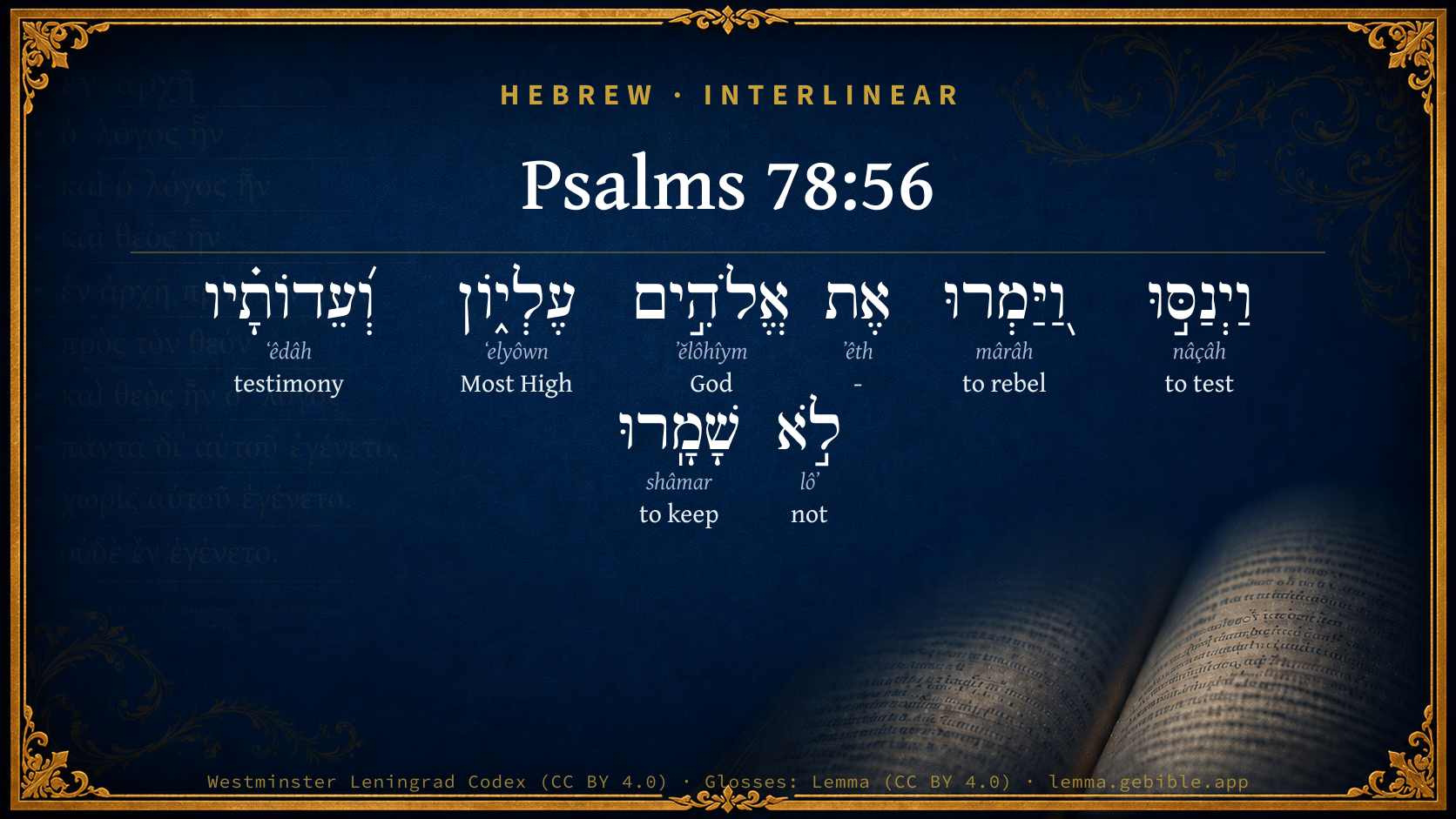
Hebrew (Westminster Leningrad Codex) Psalms 78:56 appears in the Hebrew Old Testament. The text above is from the Westminster Leningrad Codex. Each word links to its Strong’s number, a concise gloss, and parsing drawn from the Open Scriptures Hebrew Bible morphology. Click any word for its full Brown-Driver-Briggs (BDB) entry.
Download image
Cite this verse

Psalms 78:56 (World English Bible). Public Domain. Lemma interlinear Bible study tool, https://lemma.gebible.app/v/psalms/78/56.

Show BibTeX & RIS
BibTeX
RIS
English Translation
Yet they tempted and rebelled against the Most High God, And didn't keep his testimonies;
World English Bible · Public Domain
Download a study sheet

One document with this verse’s original text, its word-by-word gloss line, the meaning frame, cross-references with their text, attributed commentary, and full source and license credits — printable, and it pastes into notes with its structure intact.

This verse Autodidact and up

Study sheet (.html) Plain text (.txt)

A passage Seminary Student

Up to 50 verses in one chapter. A passage sheet keeps up to 6 commentary sources and 12 cross-references per verse, in the order this page ranks them, and says so on the sheet whenever that leaves anything out. Ask for a single verse and you get the Autodidact verse sheet above.

Everything on this page stays free to read, with no account — the sheet is a download of what is already on screen, not access to it.

Want to remove ads? Support Godless Engineer
Compare translations 3

The same verse in 3 English versions, stacked beneath the original-language interlinear above. Click any original word for its lexicon entry.

Each is an independent rendering of the whole verse — the interlinear is not word-aligned to these translations.

Highlighted words mark where these versions differ — a whole-verse word diff, not a word-by-word alignment.

  • World English Bible Public Domain
    Yet they tempted and rebelled against the Most High God, And didn't keep his testimonies;
  • King James Version Public Domain
    Yet they tempted and provoked the most high God, and kept not his testimonies:
  • unfoldingWord Literal Text CC BY-SA 4.0
    But they tested and rebelled against God Most High, and they did not keep his testimonies.

unfoldingWord Literal Text — © unfoldingWord, licensed CC BY-SA 4.0. Word-aligned USFM3 via Door43 (git.door43.org/unfoldingWord/en_ult).

Versions to compare (up to 4)

3 of 4 selected

Show all 18 translations

Every available English version of this verse, each an independent rendering of the whole verse.

  • World English Bible Public Domain
    Yet they tempted and rebelled against the Most High God, And didn't keep his testimonies;
  • Berean Standard Bible Public Domain
    But they tested and disobeyed God Most High, for they did not keep His decrees.
  • Majority Standard Bible Public Domain
    But they tested and disobeyed God Most High, for they did not keep His decrees.
  • King James Version Public Domain
    Yet they tempted and provoked the most high God, and kept not his testimonies:
  • American Standard Version (1901) Public Domain
    Yet they tempted and rebelled against the Most High God, And kept not his testimonies;
  • Revised Version (1885) Public Domain
    Yet they tempted and rebelled against the Most High God, and kept not his testimonies;
  • Geneva Bible (1599) Public Domain
    Yet they tempted, and prouoked the most high God, and kept not his testimonies,
  • Douay-Rheims (1899) Public Domain
    Yet they tempted, and provoked the most high God: and they kept not his testimonies.
  • Young's Literal Translation Public Domain
    And they tempt and provoke God Most High, And His testimonies have not kept.
  • Literal Standard Version CC BY-SA 4.0
    And they tempt and provoke God Most High, || And have not kept His testimonies.
  • Unlocked Literal Bible CC BY-SA 4.0
    Yet they challenged and defied the Most High God and did not keep his solemn commands.
  • unfoldingWord Literal Text CC BY-SA 4.0
    But they tested and rebelled against God Most High, and they did not keep his testimonies.
  • Darby Bible Public Domain
    But they tempted and provoked God, the Most High, and kept not his testimonies,
  • World Messianic Bible Public Domain
    Yet they tempted and rebelled against the Most High God, and didn’t keep his testimonies,
  • Webster's Bible Public Domain
    Yet they tempted and provoked the most high God, and kept not his testimonies:
  • Free Bible Version CC BY-SA 4.0
    But they provoked God Most High, rebelling against him. They did not follow what he had told them.
  • Bible in Basic English Public Domain
    But they were bitter against the Most High God, testing him, and not keeping his laws;
  • JPS Tanakh (1917) Public Domain
    Yet they tried and provoked God, the Most High, and kept not His testimonies;

Literal Standard Version (2020), Covenant Press — licensed CC BY-SA 4.0. Text via the HelloAO Bible API (eBible.org). Unlocked Literal Bible (unfoldingWord) — licensed CC BY-SA 4.0. Text via the HelloAO Bible API (eBible.org). unfoldingWord Literal Text — © unfoldingWord, licensed CC BY-SA 4.0. Word-aligned USFM3 via Door43 (git.door43.org/unfoldingWord/en_ult). Free Bible Version, Dr. Jonathan Gallagher — licensed CC BY-SA 4.0. Text via the HelloAO Bible API (eBible.org).

Word by word

More ways to search: Search by grammar → Find every occurrence → Compare this word →

Practice this passage: Drill this verse → Learn its vocabulary →

וְ֝עֵדוֹתָ֗יו
ʻêdâh
H5713
“and · testimonies · his”
Conjunction + Noun, Common, Feminine, Plural, Construct + Suffix, Personal, 3rd Person, Masculine, Singular
Part of Speech
Conjunction + Noun
Type
Common
Gender
Feminine
Number
Plural
State
Construct
Full BDB Definition

Origin: from H5707 in its technical sense

TWOT: 1576c , 1576e

testimony, witness - always plural and always of laws as divine testimonies
  1. וַיְנַסּ֣וּ nâçâh H5254 “and · to test” Conjunction + Verb, Piel, Sequential Imperfect, 3rd Person, Masculine, Plural
  2. וַ֭יַּמְרוּ mârâh H4784 “and · to rebel” Conjunction + Verb, Hiphil, Sequential Imperfect, 3rd Person, Masculine, Plural
  3. אֶת ʼêth H853 “-” Particle, Direct Object
  4. אֱלֹהִ֣ים ʼĕlôhîym H430 “God(s)” Noun, Common, Masculine, Plural, Absolute
  5. עֶלְי֑וֹן ʻelyôwn H5945 “Most High” Adjective, Adjective, Masculine, Singular, Absolute
  6. לֹ֣א lôʼ H3808 “not” Particle, Negative
  7. שָׁמָֽרוּ shâmar H8104 “to keep” Verb, Qal, Perfect, 3rd Person, Common, Plural

About this verse

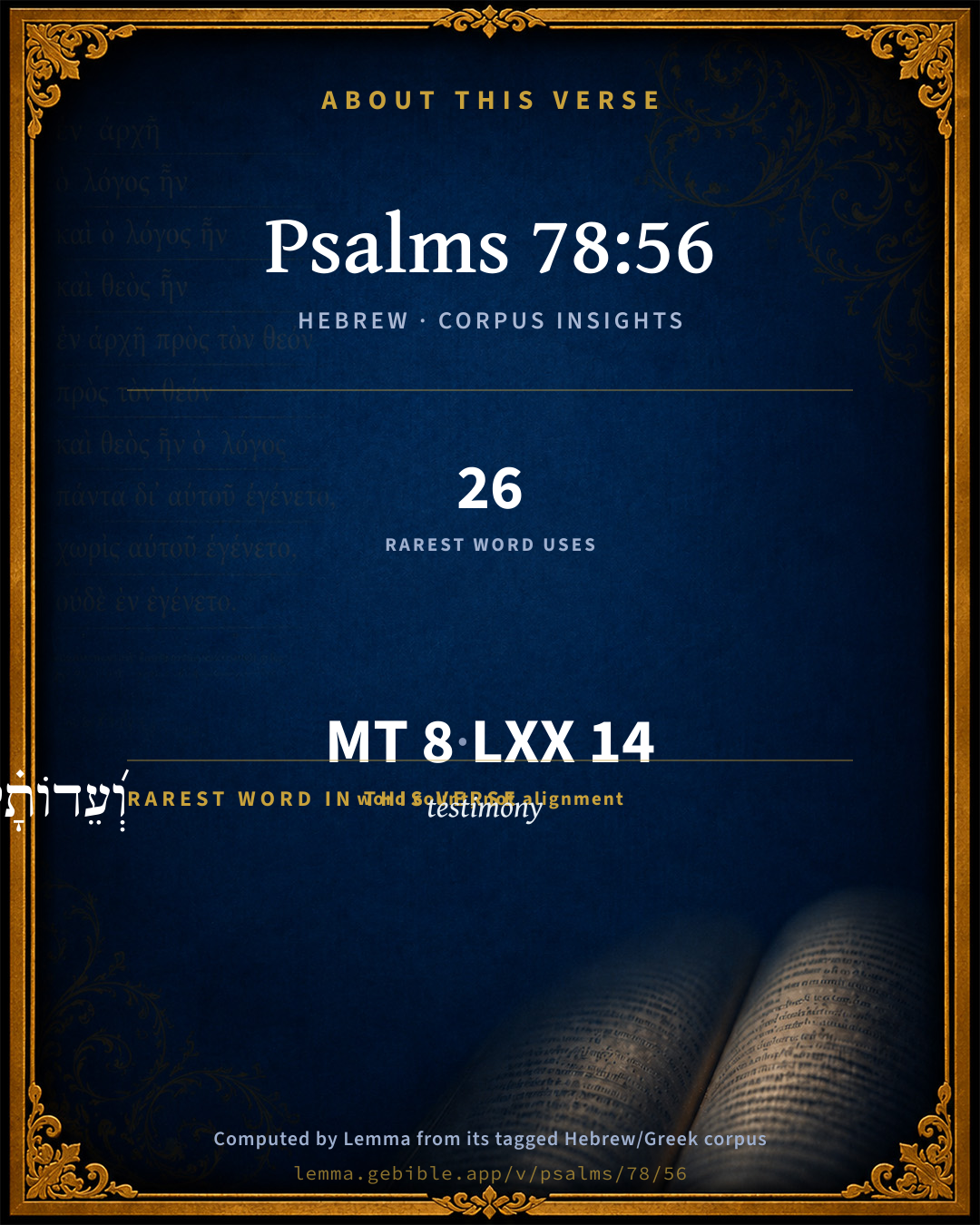
These counts appear in no published source. They are computed here, from the morphology-tagged text and Lemma’s own curated glosses. What Lemma adds →

8
words
8
distinct lemmas
Wisdom
section

Shared distinctive vocabulary

וְ֝עֵדוֹתָ֗יו testimony H5713 occurs in 25 verses of the Hebrew Bible. Also found in:

Grammatical profile

  • 3 verbs
  • 2 nouns
  • 1 adjective
  • 2 particles

Verb forms

  • וַיְנַסּ֣וּ Piel · Sequential Imperfect
  • וַ֭יַּמְרוּ Hiphil · Sequential Imperfect
  • שָׁמָֽרוּ Qal · Perfect

Hebrew & Septuagint length

In English translation the verse runs 15 words from the Hebrew and 14 from the Septuagint (LXX English) — closely comparable.

A rough comparison of the two English renderings, which tokenize alike — not a word-level alignment.

Word counts can differ between the Hebrew and the Greek without any difference in meaning — e.g. the Hebrew direct-object marker אֵת has no separate Greek word, and Greek often adds the article ὁ.

In the original languages it is 8 Hebrew tokens and 14 Greek tokens — but the two are counted differently (Hebrew bundles its prefixes and suffixes into one token; the Greek is in lemma form), so that isn’t a like-for-like length.

Cross-references

7

Topical passages linked to Psalms 78:56 in the Treasury of Scripture Knowledge — connected by theme and wording, ordered by reader-vote popularity; previews shown in the World English Bible.

  • Judges 2:11–12 The children of Israel did that which was evil in the sight of Yahweh, and served the Baals;
  • Deuteronomy 31:16–20 Yahweh said to Moses, Behold, you shall sleep with your fathers; and this people will rise up, and play the prostitute after the strange gods of the land, where they go to be among them, and will forsake me, and break my covenant which I have made with them.
  • Deuteronomy 32:15–21 But Jeshurun grew fat, and kicked: You have grown fat, you are grown thick, you are become sleek; Then he forsook God who made him, Lightly esteemed the Rock of his salvation.
  • 2 Kings 17:7–23 It was so, because the children of Israel had sinned against Yahweh their God, who brought them up out of the land of Egypt from under the hand of Pharaoh king of Egypt, and had feared other gods,
  • Nehemiah 9:25–26 They took fortified cities, and a fat land, and possessed houses full of all good things, cisterns hewn out, vineyards, and olive groves, and fruit trees in abundance: so they ate, and were filled, and became fat, and delighted themselves in your great goodness.
  • Psalms 78:40–41 How often they rebelled against him in the wilderness, And grieved him in the desert!
  • Ezekiel 16:15–26 But you did trust in your beauty, and played the prostitute because of your renown, and poured out your prostitution on everyone who passed by; his it was.

Cross-references courtesy of OpenBible.info (CC BY 4.0).

Hebrew and Greek witnesses Masoretic Hebrew ↔ Greek Septuagint

The same verse in the two great witnesses to the Old Testament, shown verse-for-verse.

You’re reading Greek Psalm 77 (Hebrew Psalm 78). The Septuagint counts the superscription, so verse numbers can differ from the Hebrew — chapter-level alignment, not verse-by-verse. Numbering follows Rahlfs.

These are two independent witnesses, not word-aligned to each other, and the Septuagint is shown in lemma (dictionary) form.

Hebrew Psalms 78:56 Masoretic · Westminster Leningrad Codex

וַיְנַסּ֣וּ וַ֭יַּמְרוּ אֶת אֱלֹהִ֣ים עֶלְי֑וֹן וְ֝עֵדוֹתָ֗יו לֹ֣א שָׁמָֽרוּ

Yet they tempted and rebelled against the Most High God, And didn't keep his testimonies;

World English Bible · Public Domain

Greek LXX Greek Psalm 77:56 Septuagint · lemma form

καί πειράζω καί παραπικραίνω ὁ θεός ὁ ὕψιστος καί ὁ μαρτύριον αὐτός οὐ φυλάσσω

Yet they tempted and provoked the most high God, and kept not his testimonies.

LXX2012 (modern English Septuagint) · Public Domain

Hebrew: Westminster Leningrad Codex (CC BY 4.0). Greek: Septuagint (public domain); English from LXX2012 (modern English Septuagint) (Public Domain). How the Septuagint differs from the Hebrew →

Commentary

Notes on Psalms 78:56 from classic Christian and Jewish commentators (each source and its license shown beneath its notes). The classic Christian expositions comment on the surrounding passage and are grouped to its opening verse, so a note may address several verses; the Jewish commentaries on the Tanakh (Rashi and others) are per-verse, so they appear only where the commentator wrote on this verse.

Lemma curates 59 commentaries, every one of them public domain or Creative Commons licensed, each selected and text-cleaned for this edition rather than reprinted as found. About our sources →

Trapp's Complete Commentary

John Trapp

Psa 78:56 Yet they tempted and provoked the most high God, and kept not his testimonies:

Ver. 56. Yet they tempted and provoked, &c.] Neither God’s judgments on their enemies nor his mercies to themselves could keep them within the bounds of obedience; but in a land of uprightness they would deal unjustly, and not behold the majesty of the Lord, Isa 26:10.

John Trapp, A Commentary or Exposition upon All the Books of the Old and New Testament (1647–1656) — public domain. Text from a community e-Sword module.

The Biblical Illustrator

Joseph S. Exell

Psa_78:56-57

And kept not His testimonies: but turned back, and dealt unfaithfully their fathers.

The deceitfulness of the heart as to duty

I. As to the performance of duty, the heart discovers its power of deceit.

1. By diverting a person from those duties that are most spiritual in their nature. It will plead as to self-examination and meditation on the Word, that these duties are of too difficult a nature; that they require too close an attention; that it is very provoking to God to perform them carelessly; and therefore insist for the neglect of them, and for giving a preference to those of a more general nature.

2. By endeavouring to prevent any real communion with God, and to distract the mind by wandering in duty.

3. By inciting to hypocrisy. The people of God are sometimes disposed to appear to Him more fervent in duty than they really are, to make professions of love to Him which they do not presently feel, to express a hatred of sin and desire of His favour, without the immediate sense of either in their hearts.

4. By prompting the possessor to retain sin in his heart, even when he draws near to God.

5. By exciting a person to rely on his own strength.

6. By pleading uprightness of intention as an apology for a multitude of defects.

7. There are many, on the other hand, who please themselves with the form of duty, without any regard to the intention.

8. By stirring up the believer to spiritual pride after enjoying the Divine presence in duty.

9. By dissuading the Christian from duty, when the observation of it is attended with no comfort.

10. By making the person seek comfort from the mere performance of duty.

11. By inspiring one with greater boldness in duty, because of former comfort in the observation of it.

II. With respect to omission.

1. The heart urges the delay of duty, and thus discovers its deceitfulness, by promising a future opportunity.

2. It persuades us to omit duty by calling in the world to its aid. This is a faithful ally to the corrupt heart, always willing to lend its aid in turning us away from God.

3. It presents evil in opposition to present duty. When God presents an opportunity of serving Him, to which the renewed will consents, the deceitfulness of the heart offers a temptation to evil; and by the artfulness or force of the temptation endeavours to divert the believer from the good that he designs.

4. It dissuades from duty, because of insufficiency for performing it aright. The deceitful heart will often contradict itself, rather than fail of its intention, to baffle all the attempts of the believer in the service of his God. If engaged in duty, it persuades him to depend on his own strength. If he be convinced of the folly of this proposal, it will try to hinder him from duty, because of felt inability.

5. It prompts the Christian to resist the present call to duty, for want of a proper temper. By this is meant a right disposition of heart, liveliness of affections, a present feeling of the comforts of religion. A comfortable warmth of affections is most desirable, indeed, in the service of the Lord. But it is not essential to acceptable worship. A duty may be performed in the exercise of faith, while no sensible comfort is attained. But wilfully to omit any one for want of this is to renounce the true foundation of our access to God, which is only through Christ.

6. It dissuades from duty, by representing that an eminent measure of holiness is not necessary to salvation.

7. It inclines to the neglect of duty, lest others should construe it as presumption or hypocrisy. This is a modesty, for which God may be provoked so to chasten His people as to give them just cause of shame, and to cover their faces with deserved confusion.

We shall conclude with the following directions:--

1. Beware of neglecting the season of duty. Gods time is always the fittest for His own service.

2. Do not plead the world as an excuse for the omission of duty. God hath given you abundance of time to yourselves. To everything there is a season, etc. You may easily accomplish all your worldly business, and yet devote that time to God which He requires.

3. Be extremely suspicious of every excuse that your heart offers for the neglect of duty.

4. Quench not the Spirit, when exciting you to duty. This is grieving to the Holy Ghost, by whom you are sealed to the day of redemption.

5. Carry on, in the strength of promised grace, a constant war against the carnality of your hearts, against that opposition which is in them to duty. (J. Jamieson, M. A.)

The unfaithfulness of Gods people

When the bow is unbent, the rift it has may be undiscerned, but go to use it by drawing the arrow to the head and it flies in pieces; thus doth a false heart when put to the trial. As the ape in the fable, dressed like a man, when nuts are thrown before her, cannot then dissemble her nature any longer, but shows herself an ape indeed; a false heart betrays itself before it is aware, when a fair occasion is presented for its lust; whereas sincerity keeps the soul pure in the face of temptation. (W. Gurnall.)

Disobeying the King

To break the kings laws is punishable, but to pull him out of his throne, and set up a scullion in it and give him the honour and obedience of a king, this is another kind of matter, and much more intolerable. The first commandment is not like the rest, which require only obedience to particular laws in a particular action, but it establisheth the very relations of sovereign and subject, and requires a constant acknowledgment of these relations, and make it high treason against the God of heaven in any that should violate that command. Now, this is the sin of every worldling: he hath taken down God from the throne in his soul and set up the flesh and the world in His stead; these he valueth and delighteth in; these have his very heart, while God that made it and redeemed it is set lightly by. (Richard Baxter.)

The Biblical Illustrator, edited by Joseph S. Exell (c. 1880s–1900s) — public domain. Text from a community e-Sword module.

J. A. Alexander on Psalms

Joseph Addison Alexander

56. (Psa 78:56) And they tempted and resisted God, Most High, and his testimonies did not keep. Having brought down the narrative of God's dealings with the older race to the conquest of Canaan, the Psalmist now resumes his charge (against the following generations) of being no better than their fathers. To tempt God and resist him, or rebel against him, has the same sense as in Psa 78:18; Psa 78:40. The divine title referred to here, suggests that their rebellion was against the highest and the most legitimate of all authority. His testimonies against sin, contained in his commandments; hence the use of the verb keep. The form of expression, in both clauses of this verse, is borrowed from Deu 6:16-17.

Joseph Addison Alexander, The Psalms Translated and Explained (1850) — public domain. Text from a community e-Sword module.

Tyndale Open Study Notes

Tyndale Open Resources

78:56-64 Israel’s rebellion desecrated the Promised Land. The people built shrines to false gods and worshiped idols (78:58) during the period of the judges (e.g., Judg 2:11; 3:7, 17-18).

Tyndale Open Study Notes — © Tyndale Open Resources, licensed CC BY-SA 4.0. Text via the HelloAO Bible API.

John Calvin's Commentaries

56. And they tempted and provoked the Most High God. Here they are upbraided for having, notwithstanding the many tokens of the divine favor by which they were distinguished, persevered in acting perfidiously: yea, even although God from time to time conferred upon them new benefits, to recover them to their allegiance to him, they, notwithstanding, by their rebellion, shook off his yoke. With respect to the word tempt, we have already explained its import. But it is added in general, that they provoked God, because they had not kept his covenant By this last clause, their open and gross rebellion is the more completely demonstrated; for, although they had been plainly taught their duty, they nevertheless refused to submit to the authority of God. The law is called testimonies or agreements, because, as men enter into contracts upon certain conditions, so God, by his covenant, entered into a contract with this people, and bound them to himself. In speaking of them in this manner, there is pronounced upon them no light censure; but when they are charged in the next verse with apostasy and perfidiousness, that fills up the measure of their guilt. God had adopted them to be his people: they, on the other hand, despising his favor, voluntarily renounce it. He had gathered them together under his wings; and they, by their waywardness, scatter themselves in all directions. He had promised to be a father to them; and they refuse to be his children. He had shown them the way of salvation; and they, by going astray, willingly precipitate themselves into destruction. The prophet, therefore, concludes, that in every age they showed themselves to be an impious and wicked people. It is again to be noticed, that the fault which is most severely condemned in them is, that they too much resembled their fathers. This is particularly mentioned, to prevent any man from deceiving himself by supposing, that in indiscriminately imitating his ancestors he is doing right, and that he may not think of making use of their example as an argument for defending his own conduct. The instability of the people is next expressed by a very apposite figure, which Hosea also employs in Hosea 7:16. As archers are deceived when they have a bow which is too weak, or ill bent, or crooked and flexible, so it is stated, that this people turned back, and slipped away by their deceitful and tortuous craftiness, that they might not be governed by the hand of God.

John Calvin's Commentaries (1540-1563) — public domain. Text from the Calvin Translation Society English edition (1840s-50s) via the Christian Classics Ethereal Library (ccel.org). Calvin's coverage is partial (roughly two-thirds of the Bible); uncommented books and verses are honest gaps, never fabricated. The 19th-century editor's footnotes and remarks are omitted so the notes are faithfully Calvin's own voice.

The Cambridge Bible for Schools and Colleges

gen. ed. J. J. S. Perowne

56. Yet &c.] Yet they tempted and rebelled against God the Most High. In spite of all God’s goodness to them, they persisted in their old unfaithfulness. Cp. Psa_78:17-18; Psalms 40, 41. God the Most High is not El Elyôn, as in Psa_78:35; but Elôhîm Elyôn, the equivalent of Jehovah the Most High, Psa_7:17; Psa_47:2.

his testimonies] His commandments, regarded as bearing witness to His will. Cp. Psa_19:7; Psa_25:10.

56–58. The unfaithfulness of Israel in Canaan during the period of the Judges.

The Cambridge Bible for Schools and Colleges (gen. ed. J. J. S. Perowne; Cambridge University Press, 1878–1918) — public domain. Text from a community e-Sword module.

John Gill's Exposition

But turned back,.... From God and his worship, apostatized from the true religion, and turned to idols:

and dealt unfaithfully, like their fathers; in the wilderness; see Psa 78:8,

they were turned aside like a deceitful bow; that promises well to carry the arrow right, but drops it at the feet of the archer; or carries it another way, so that it misses the mark, The Targum is,

"as a bow casting arrows;''

to the ground, and not to the mark; see Hos 7:16, or being too much stretched is suddenly broken, and kills the archer; or returns to its own nature; so Arama.

John Gill's Exposition of the Whole Bible (1746–1763) — public domain (CC PDM 1.0). Text via the HelloAO Bible API.

Albert Barnes' Notes on the Bible

Yet they tempted and provoked ... - They tried the patience of God, and provoked him to anger after they were peaceably settled in the promised land. See Jdg 2:10-13. The object is to show that it was the character of the people that they were prone to depart from God. Compare Psa 78:10-11, note; Psa 78:17, note; Psa 78:40, note.

Albert Barnes' Notes on the Bible (1834–1885) — public domain. Text from a community e-Sword/MySword module.

The Treasury of David

Charles H. Spurgeon

Ver. 56. Yet they tempted and provoked the most high God. Change of condition had not altered their manners. They left their nomadic habits, but not their tendencies to wander from their God. Though every divine promise had been fulfilled to the letter, and the land flowing with milk and honey was actually their own, yet they tried the Lord again with unbelief, and provoked him with other sins. He is not only high and glorious, but most High, yea, the most High, the only being who deserves to be so highly had in honour; yet, instead of honouring him, Israel grieved him with rebellion.

And kept not his testimonies. They were true to nothing but hereditary treachery; steadfast in nothing but in falsehood. They knew his truth and forgot it, his will and disobeyed it, his grace and perverted it to an occasion for greater transgression. Reader, dost thou need a looking glass? See here is one which suits the present expositor well; does it not also reflect thine image?

None.

Ver. 56-57. On the deceitfulness of the heart, with respect to the performance of duty. J. Jamieson. I. 326.

On the deceitfulness of the heart, with respect to the omission of duty. J. Jamieson. I. 353.

Ver. 56-57. On the deceitfulness of the heart, with respect to the performance of duty. J. Jamieson. I. 326.

On the deceitfulness of the heart, with respect to the omission of duty. J. Jamieson. I. 353.

None.

Charles H. Spurgeon's The Treasury of David (1869–1885) — public domain. Psalms only. Text from a community e-Sword/MySword module.

Whedon's Commentary on the Bible

Daniel D. Whedon

56. Yet they tempted… God—Profiting nothing by the nation’s experience in the wilderness, the people now repeat the follies and incur the punishments of their forefathers. The Israel of Canaan and the Israel of the wilderness are alike. The complaint here recorded, is for sins committed after the death of Joshua. Jdg_2:7-13. On “tempted,” see on Psa_78:18, and Psa_95:9-10.

Provoked—Properly, rebelled against. The idea is that of active antagonism. See on Psa_78:8, and Psa_107:11, where the same word occurs.

Daniel D. Whedon (gen. ed.), Commentary on the Old and New Testaments (1874–1909) — public domain. Text from a community e-Sword module.

The Pulpit Commentary

Yet they tempted and provoked the most high God (comp. above, ver. 17). The Israelites continued to "tempt and provoke God" after they had obtained possession of the Holy Land, and divided it among them. (see Jud 2:11-19 3:12 4:1 6:1 10:6-15 13:1, etc.) And kept not his testimonies; or, his ordinances (Cheyne).

The Pulpit Commentary (1880–1919), ed. H.D.M. Spence-Jones & Joseph S. Exell — public domain. Text from a community e-Sword module.

unfoldingWord translationNotes

Door43 World Missions Community

General Information:

The writer continues to describe what God did for the people of Israel.

challenged and defied

These words mean almost the same thing. The writer uses them both to emphasize that the Israelites did not believe that God would either provide for them or punish evil as he had said he would. (See: Doublet)

challenged

They wanted God to prove that he could do what he said he would do before they would believe him. See how you translated this idea in Psalms 78:18.

defied

refused to obey

were unfaithful and acted treacherously

These words mean almost the same thing. The writer uses them both to emphasize that the Israelites did not do for God what they had said they would do. (See: Doublet)

translationWords

Most High

command

faithful

ancestor

bow and arrow

unfoldingWord translationNotes — © Distant Shores Media and the Door43 World Missions Community, licensed CC BY-SA 4.0. Source: git.door43.org/Door43/en_tn.

Rashi

Rabbi Shlomo Yitzchaki (Rashi)

Yet they tried and provoked during the days of the judges.

Rashi on the Tanakh — English translations: “The Judaica Press complete Tanach with Rashi, translated by A. J. Rosenberg” (CC BY 4.0); “Pentateuch with Rashi's commentary by M. Rosenbaum and A.M. Silbermann, 1929-1934” (public domain); “The Metsudah Tanach series, Lakewood, N.J” (CC BY 4.0); and “The Book of Joshua, Metsudah Publications, 1997” (CC BY 4.0). Text via Sefaria.

Lesson kit

Teaching starters — assembled from the data on this page, not authored interpretation. Every prompt links to the verse data it draws on. Edit before teaching.

Psalms, in the Wisdom, opens this verse with 8 words (8 distinct Hebrew lemmas). Its most distinctive word is ʻêdâh (“testimony”). A historical commentator’s framing appears above. Read the whole chapter for the surrounding context.

Discussion questions

  1. The word ʻêdâh carries the sense “testimony.” How does it shape the verse?
  2. Genesis 21:30 shares the word «testimony» with this verse. How do the two illuminate each other?
  3. These translations render this verse differently. What is at stake in choosing one wording over another?
  4. The verb «וַיְנַסּ֣וּ» is Piel Sequential Imperfect. How does its form color the action?
  5. Reading how Trapp's Complete Commentary and The Biblical Illustrator read this verse, where do the two commentators agree and where do they part?

Things to notice

Reading settings

Reading text

Shown beneath each verse's original-language words.

Old Testament
Old Testament edition

Read the OT as the Masoretic Hebrew (MT) or the Greek Septuagint (LXX).

English shown for the Greek Septuagint (in the Hebrew ↔ Greek comparison).

Comparing translations? Open the Compare panel on any verse page to stack up to four side by side.