
Psalms 97:9

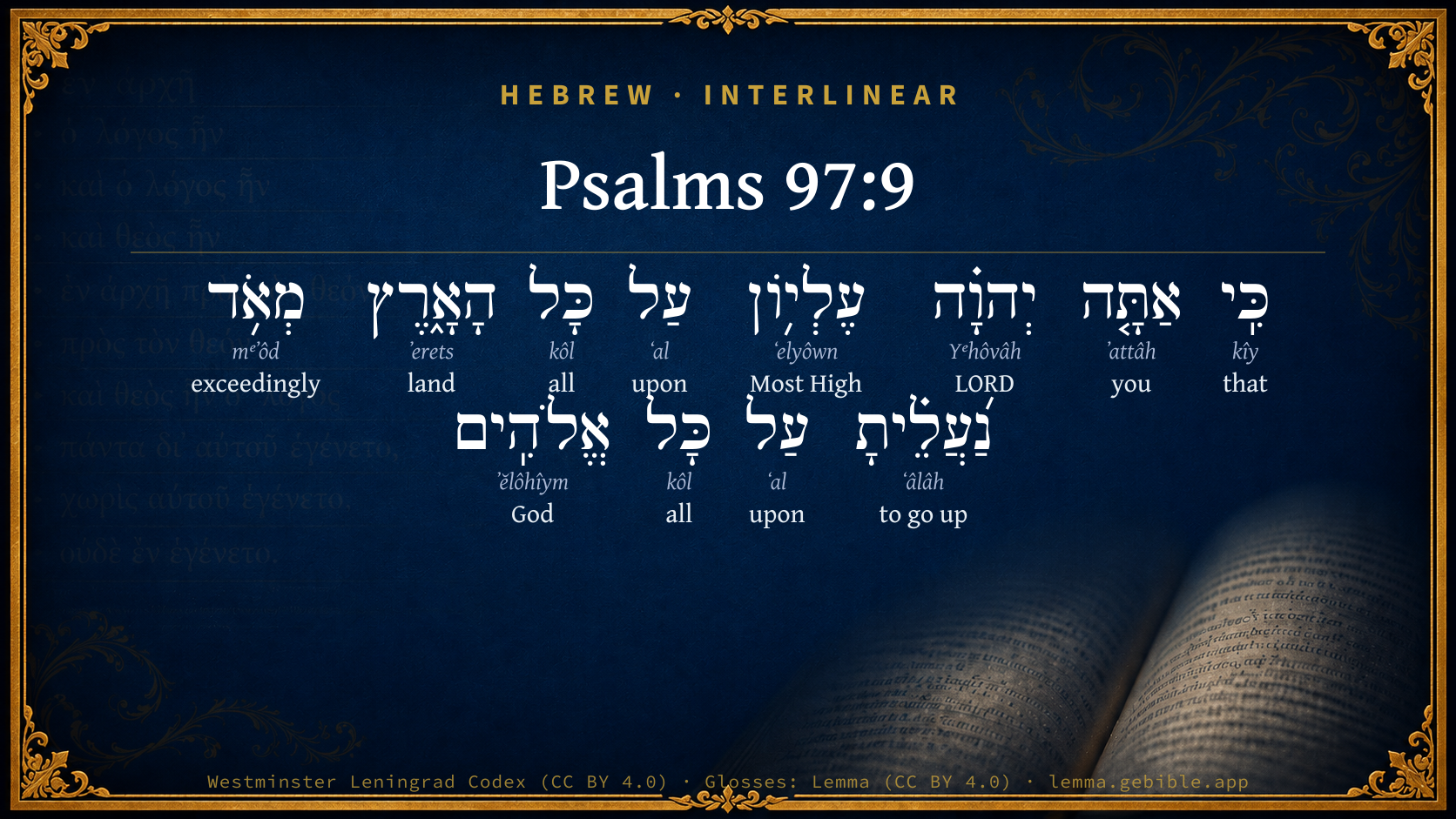
Hebrew (Westminster Leningrad Codex) Psalms 97:9 appears in the Hebrew Old Testament. The text above is from the Westminster Leningrad Codex. Each word links to its Strong’s number, a concise gloss, and parsing drawn from the Open Scriptures Hebrew Bible morphology. Click any word for its full Brown-Driver-Briggs (BDB) entry.
Download image
Cite this verse

Psalms 97:9 (World English Bible). Public Domain. Lemma interlinear Bible study tool, https://lemma.gebible.app/v/psalms/97/9.

Show BibTeX & RIS
BibTeX
RIS
English Translation
For you, Yahweh, are most high above all the earth. You are exalted far above all gods.
World English Bible · Public Domain
Download a study sheet

One document with this verse’s original text, its word-by-word gloss line, the meaning frame, cross-references with their text, attributed commentary, and full source and license credits — printable, and it pastes into notes with its structure intact.

This verse Autodidact and up

Study sheet (.html) Plain text (.txt)

A passage Seminary Student

Up to 50 verses in one chapter. A passage sheet keeps up to 6 commentary sources and 12 cross-references per verse, in the order this page ranks them, and says so on the sheet whenever that leaves anything out. Ask for a single verse and you get the Autodidact verse sheet above.

Everything on this page stays free to read, with no account — the sheet is a download of what is already on screen, not access to it.

Want to remove ads? Support Godless Engineer
Compare translations 3

The same verse in 3 English versions, stacked beneath the original-language interlinear above. Click any original word for its lexicon entry.

Each is an independent rendering of the whole verse — the interlinear is not word-aligned to these translations.

Highlighted words mark where these versions differ — a whole-verse word diff, not a word-by-word alignment.

  • World English Bible Public Domain
    For you, Yahweh, are most high above all the earth. You are exalted far above all gods.
  • King James Version Public Domain
    For thou, LORD, art high above all the earth: thou art exalted far above all gods.
  • unfoldingWord Literal Text CC BY-SA 4.0
    For you, Yahweh, are most high above all the earth. You are exalted far above all gods.

unfoldingWord Literal Text — © unfoldingWord, licensed CC BY-SA 4.0. Word-aligned USFM3 via Door43 (git.door43.org/unfoldingWord/en_ult).

Versions to compare (up to 4)

3 of 4 selected

Show all 18 translations

Every available English version of this verse, each an independent rendering of the whole verse.

  • World English Bible Public Domain
    For you, Yahweh, are most high above all the earth. You are exalted far above all gods.
  • Berean Standard Bible Public Domain
    For You, O LORD, are Most High over all the earth; You are exalted far above all gods.
  • Majority Standard Bible Public Domain
    For You, O LORD, are Most High over all the earth; You are exalted far above all gods.
  • King James Version Public Domain
    For thou, LORD, art high above all the earth: thou art exalted far above all gods.
  • American Standard Version (1901) Public Domain
    For thou, Jehovah, art most high above all the earth: Thou art exalted far above all gods.
  • Revised Version (1885) Public Domain
    For thou, LORD, art most high above all the earth: thou art exalted far above all gods.
  • Geneva Bible (1599) Public Domain
    For thou, Lord, art most High aboue all the earth: thou art much exalted aboue all gods.
  • Douay-Rheims (1899) Public Domain
    For thou art the most high Lord over all the earth: thou art exalted exceedingly above all gods.
  • Young's Literal Translation Public Domain
    For Thou, Jehovah, `art' Most High over all the earth, Greatly Thou hast been exalted over all gods.
  • Literal Standard Version CC BY-SA 4.0
    For You, YHWH, [are] Most High over all the earth, || You have been exalted greatly over all gods.
  • Unlocked Literal Bible CC BY-SA 4.0
    For you, Yahweh, are most high above all the earth. You are exalted far above all gods.
  • unfoldingWord Literal Text CC BY-SA 4.0
    For you, Yahweh, are most high above all the earth. You are exalted far above all gods.
  • Darby Bible Public Domain
    For thou, Jehovah, art the Most High above all the earth; thou art exalted exceedingly above all gods.
  • World Messianic Bible Public Domain
    For you, LORD, are most high above all the earth. You are exalted far above all gods.
  • Webster's Bible Public Domain
    For thou, LORD, art high above all the earth: thou art exalted far above all gods.
  • Free Bible Version CC BY-SA 4.0
    For you, Lord, are the highest of all, ruling over the whole earth; your position is far above any other god.
  • Bible in Basic English Public Domain
    For you, Lord, are most high over the earth; you are lifted up over all other gods.
  • JPS Tanakh (1917) Public Domain
    For Thou, LORD, art most high above all the earth; Thou art exalted far above all gods.

Literal Standard Version (2020), Covenant Press — licensed CC BY-SA 4.0. Text via the HelloAO Bible API (eBible.org). Unlocked Literal Bible (unfoldingWord) — licensed CC BY-SA 4.0. Text via the HelloAO Bible API (eBible.org). unfoldingWord Literal Text — © unfoldingWord, licensed CC BY-SA 4.0. Word-aligned USFM3 via Door43 (git.door43.org/unfoldingWord/en_ult). Free Bible Version, Dr. Jonathan Gallagher — licensed CC BY-SA 4.0. Text via the HelloAO Bible API (eBible.org).

Word by word

More ways to search: Search by grammar → Find every occurrence → Compare this word →

Practice this passage: Drill this verse → Learn its vocabulary →

עֶלְי֥וֹן
ʻelyôwn
H5945
“Most High”
Adjective, Adjective, Masculine, Singular, Absolute
Part of Speech
Adjective
Type
Adjective
Gender
Masculine
Number
Singular
State
Absolute
Full BDB Definition

Origin: from H5927

TWOT: 1624g , 1624h

high, upper (adjective) - of Davidic king exalted above monarchs - Highest, Most High (noun masculine) - name of God - of rulers, either monarchs or angel-princes
  1. כִּֽי kîy H3588 “that” Conjunction
  2. אַתָּ֤ה ʼattâh H859 “you” Pronoun, Personal, 2nd Person, Masculine, Singular
  3. יְהוָ֗ה Yᵉhôvâh H3068 “LORD” Noun, Proper
  4. עַל ʻal H5921 “upon” Preposition
  5. כָּל kôl H3605 “all of” Noun, Common, Masculine, Singular, Construct
  6. הָאָ֑רֶץ ʼerets H776 “the · land” Particle, Definite Article + Noun, Common, Both, Singular, Absolute
  7. מְאֹ֥ד mᵉʼôd H3966 “exceedingly” Adverb
  8. נַ֝עֲלֵ֗יתָ ʻâlâh H5927 “to go up” Verb, Niphal, Perfect, 2nd Person, Masculine, Singular
  9. עַל ʻal H5921 “upon” Preposition
  10. כָּל kôl H3605 “all of” Noun, Common, Masculine, Singular, Construct
  11. אֱלֹהִֽים ʼĕlôhîym H430 “God(s)” Noun, Common, Masculine, Plural, Absolute

About this verse

These counts appear in no published source. They are computed here, from the morphology-tagged text and Lemma’s own curated glosses. What Lemma adds →

12
words
10
distinct lemmas
Wisdom
section

Shared distinctive vocabulary

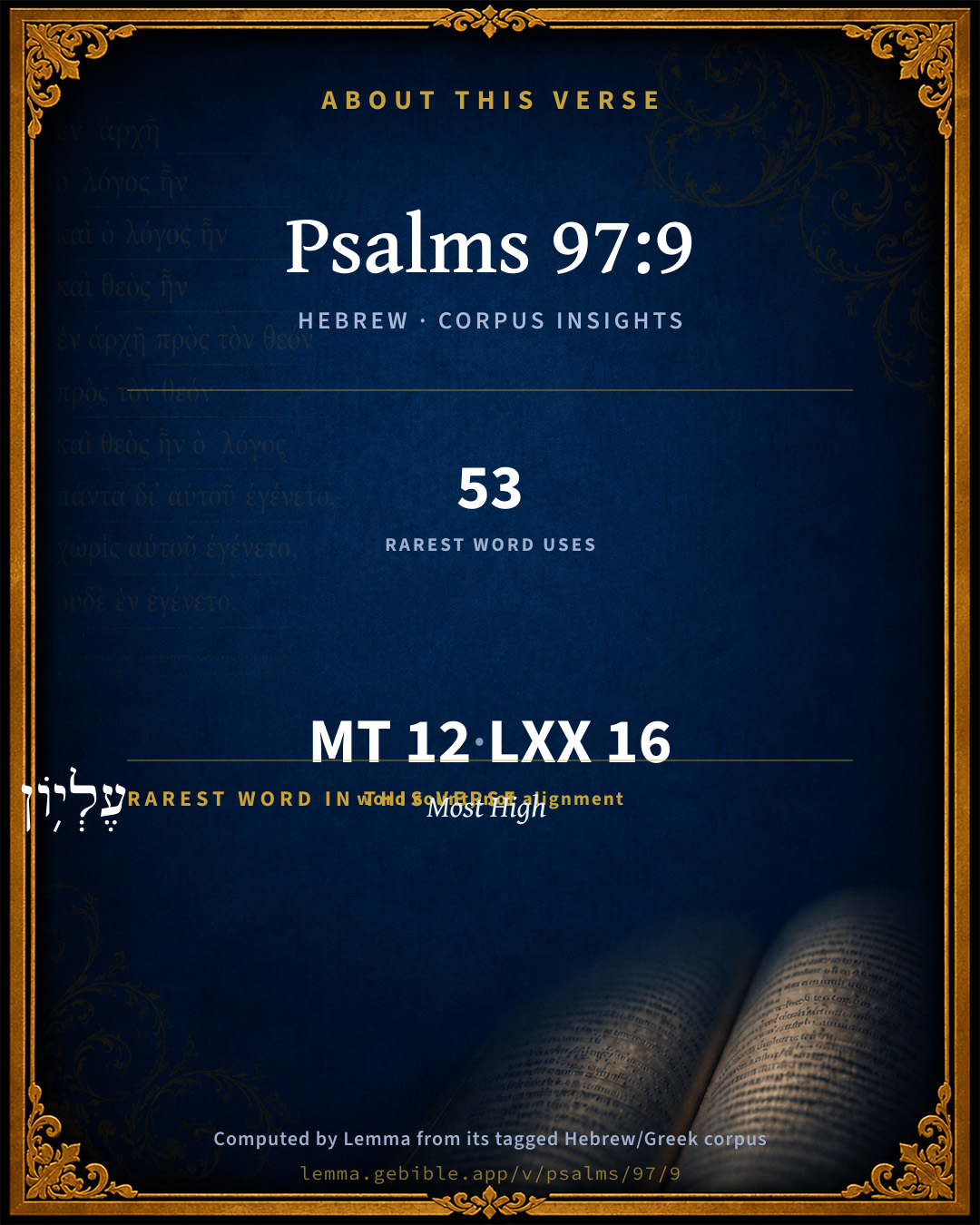
עֶלְי֥וֹן Most High H5945 occurs in 53 verses of the Hebrew Bible. Also found in:

Grammatical profile

  • 1 verb
  • 5 nouns
  • 1 adjective
  • 1 pronoun
  • 2 prepositions
  • 1 conjunction
  • 1 adverb

Verb forms

  • נַ֝עֲלֵ֗יתָ Niphal · Perfect

Repetition

Words recur within this verse — often emphatic in Hebrew:

Hebrew & Septuagint length

In English translation the verse runs 17 words from the Hebrew and 17 from the Septuagint (LXX English) — the same length.

A rough comparison of the two English renderings, which tokenize alike — not a word-level alignment.

Word counts can differ between the Hebrew and the Greek without any difference in meaning — e.g. the Hebrew direct-object marker אֵת has no separate Greek word, and Greek often adds the article ὁ.

In the original languages it is 12 Hebrew tokens and 16 Greek tokens — but the two are counted differently (Hebrew bundles its prefixes and suffixes into one token; the Greek is in lemma form), so that isn’t a like-for-like length.

Cross-references

10

Topical passages linked to Psalms 97:9 in the Treasury of Scripture Knowledge — connected by theme and wording, ordered by reader-vote popularity; previews shown in the World English Bible.

  • Psalms 95:3 For Yahweh is a great God, A great King above all gods.
  • Exodus 18:11 Now I know that Yahweh is greater than all gods because of the thing in which they dealt arrogantly against them."
  • Psalms 83:18 That they may know that you alone, whose name is Yahweh, Are the Most High over all the earth.
  • Jeremiah 10:10 But Yahweh is the true God; he is the living God, and an everlasting King: at his wrath the earth trembles, and the nations are not able to abide his indignation.
  • Philippians 2:9–11 Therefore God also highly exalted him, and gave to him the name which is above every name;
  • Psalms 135:5 For I know that Yahweh is great, That our Lord is above all gods.
  • Psalms 96:4 For great is Yahweh, and greatly to be praised! He is to be feared above all gods.
  • Ephesians 1:21 far above all rule, and authority, and power, and dominion, and every name that is named, not only in this age, but also in that which is to come.
  • Psalms 115:3–8 But our God is in the heavens. He does whatever he pleases.
  • Jeremiah 10:8 But they are together brutish and foolish: the instruction of idols! it is but a stock.

Cross-references courtesy of OpenBible.info (CC BY 4.0).

Hebrew and Greek witnesses Masoretic Hebrew ↔ Greek Septuagint

The same verse in the two great witnesses to the Old Testament, shown verse-for-verse.

You’re reading Greek Psalm 96 (Hebrew Psalm 97). The Septuagint counts the superscription, so verse numbers can differ from the Hebrew — chapter-level alignment, not verse-by-verse. Numbering follows Rahlfs.

These are two independent witnesses, not word-aligned to each other, and the Septuagint is shown in lemma (dictionary) form.

Hebrew Psalms 97:9 Masoretic · Westminster Leningrad Codex

כִּֽי אַתָּ֤ה יְהוָ֗ה עֶלְי֥וֹן עַל כָּל הָאָ֑רֶץ מְאֹ֥ד נַ֝עֲלֵ֗יתָ עַל כָּל אֱלֹהִֽים

For you, Yahweh, are most high above all the earth. You are exalted far above all gods.

World English Bible · Public Domain

Greek LXX Greek Psalm 96:9 Septuagint · lemma form

ὅτι σύ εἰμί κύριος ὁ ὕψιστος ἐπί πᾶς ὁ γῆ σφόδρα ὑπερὑψόω ὑπέρ πᾶς ὁ θεός

For you are Lord most high over all the earth; you are greatly exalted above all gods.

LXX2012 (modern English Septuagint) · Public Domain

Hebrew: Westminster Leningrad Codex (CC BY 4.0). Greek: Septuagint (public domain); English from LXX2012 (modern English Septuagint) (Public Domain). How the Septuagint differs from the Hebrew →

Commentary

Notes on Psalms 97:9 from classic Christian and Jewish commentators (each source and its license shown beneath its notes). The classic Christian expositions comment on the surrounding passage and are grouped to its opening verse, so a note may address several verses; the Jewish commentaries on the Tanakh (Rashi and others) are per-verse, so they appear only where the commentator wrote on this verse.

Lemma curates 59 commentaries, every one of them public domain or Creative Commons licensed, each selected and text-cleaned for this edition rather than reprinted as found. About our sources →

Trapp's Complete Commentary

John Trapp

Psa 97:9 For thou, LORD, [art] high above all the earth: thou art exalted far above all gods.

Ver. 9. For thou, Lord, art high above all the earth] Declared now to be so with power, as Rom 1:4, and the world convinced of singular sottishness in fancying other divinities.

Thou art exalted above all gods] "Far above all principality, and power, and might, and dominion, and every name that is named, not only in this world, but also in that which is to come," Eph 1:21. Here, then, we have the super-exaltation of Christ’s person; and the apostle manifestly alludeth to it, Eph 4:10 Php 2:9.

John Trapp, A Commentary or Exposition upon All the Books of the Old and New Testament (1647–1656) — public domain. Text from a community e-Sword module.

Keil & Delitzsch

C. F. Keil & F. Delitzsch

This distichic epiphonema (Psa 97:9 = Ps 83:19; Psa 97:9, cf. Psa 47:3, 10) might close the Psalm; there follows still, however, a hortatory strophe (which was perhaps not added till later on).

Keil & Delitzsch — Biblical Commentary on the Old Testament (1861–1891) — public domain (CC PDM 1.0). Text via the HelloAO Bible API. (Old Testament only.)

J. A. Alexander on Psalms

Joseph Addison Alexander

9. (Psa 97:9) For thou, Jehovah, (art) Most High above all the eavth; greatly art thou exalted above all gods. Jehovah's infinite superiority to idols and their worshippers is once more solemnly asserted. With the first clause compare Psa 83:18; with the second, Psa 47:9. It is remarkable that two psalms are here put together in quotation, which there is strong internal reason for supposing to have been occasioned by a victory of Jehoshaphat.

Joseph Addison Alexander, The Psalms Translated and Explained (1850) — public domain. Text from a community e-Sword module.

Adam Clarke's Commentary

Verse 9. For thou, Lord, art high] Thou art infinitely exalted above men and angels.

Adam Clarke's Commentary on the Bible (1810–1826) — public domain. Text from a community e-Sword/MySword module.

John Calvin's Commentaries

9 For thou, Jehovah, art high above all the earth Having already, in another place, explained these words, I shall not say more at present upon them. Only it is to be noticed, that there is a comparison drawn between God and the angels, and whatever has any claim to eminence. The Psalmist limits all other excellency in such a manner, as to leave no room for questioning that all majesty is comprehended in God only. This was the case more eminently when God manifested himself in his only-begotten Son, who is the express image of himself. Before that period his greatness was less apparent, because he was less known.

John Calvin's Commentaries (1540-1563) — public domain. Text from the Calvin Translation Society English edition (1840s-50s) via the Christian Classics Ethereal Library (ccel.org). Calvin's coverage is partial (roughly two-thirds of the Bible); uncommented books and verses are honest gaps, never fabricated. The 19th-century editor's footnotes and remarks are omitted so the notes are faithfully Calvin's own voice.

Ellicott's Commentary for English Readers

(9) For the first clause see Psa_83:18; for the second Psa_47:2-9.

A Bible Commentary for English Readers, edited by Charles John Ellicott (1878–1897) — public domain. Text from a community e-Sword module.

The Cambridge Bible for Schools and Colleges

gen. ed. J. J. S. Perowne

9. For thou, Jehovah, art the Most High above all the earth,

Thou art exceedingly exalted above all gods.

From Psa_83:18; Psa_47:2; Psa_47:9 : cp. Psa_95:3.

The Cambridge Bible for Schools and Colleges (gen. ed. J. J. S. Perowne; Cambridge University Press, 1878–1918) — public domain. Text from a community e-Sword module.

John Gill's Exposition

For thou, Lord, art high above all the earth,.... Above all the inhabitants of the earth, as the Targum; he is highly exalted above every name, men of the greatest name that is named in the world; he is made higher than the heavens, and the inhabitants of it; and has all power in heaven and earth, as Mediator; and, as a divine Person, he is the most high God, as the word "Elion", here used, signifies; and all this lays a foundation for joy and gladness in the saints; even the dignity of Christ's person, and the exaltation of him in the human nature:

thou art exalted far above all gods: not only the fictitious deities of the Gentiles, or the greatest potentates upon earth, being made higher than the kings of the earth, who are called gods; but also than the angels in heaven; he is set down at the right hand of God, where they are not, and never were, nor shall be; angels, authorities, and powers, being subject to him, Heb 1:13.

John Gill's Exposition of the Whole Bible (1746–1763) — public domain (CC PDM 1.0). Text via the HelloAO Bible API.

Albert Barnes' Notes on the Bible

For thou, Lord, art high above all the earth - See the notes at Psa 83:18.

Thou art exalted far above all gods - See the notes at Psa 95:3.

Albert Barnes' Notes on the Bible (1834–1885) — public domain. Text from a community e-Sword/MySword module.

Matthew Poole's English Annotations

As thou always wert so in truth, so thou hast now proved and declared thyself to be such in the eyes of the whole world, by subduing them under thy feet.

Matthew Poole's English Annotations on the Holy Bible (1683–1685) — public domain. Text from a community e-Sword/MySword module.

The Treasury of David

Charles H. Spurgeon

Ver. 9. For thou, Lord, art high above all the earth. And therefore do we rejoice to see the idols abolished and to see all mankind bending at thy throne. There is but one God, there cannot be another, and he is and ever must be over all.

Thou art exalted far above all gods. As much as ALL is exalted above nothing, and perfection above folly. Jehovah is not alone high over Judea, but over all the earth, nor is he exalted over men only, but over everything that can be called god: the days are on their way when all men shall discern this truth, and shall render unto the Lord the glory which is due alone to him.

Psalms 97:10*

Charles H. Spurgeon's The Treasury of David (1869–1885) — public domain. Psalms only. Text from a community e-Sword/MySword module.

The Pulpit Commentary

For thou, Lord, art high above all the earth; rather, art the Most High (eliun) above all the earth (see the Revised Version). Thou art exalted far above all gods. (comp. ver. 7, and see also Psa_83:18) No comparison can be made between Jehovah and the heathen gods. He is "exalted" far, far above them.

The Pulpit Commentary (1880–1919), ed. H.D.M. Spence-Jones & Joseph S. Exell — public domain. Text from a community e-Sword module.

unfoldingWord translationNotes

Door43 World Missions Community

are most high above all

The psalmist speaks as if those who were strong enough to rule were the physically higher than others. AT: "rule over all the people who live on" (See: Metaphor and Metonymy)

You are exalted far

The psalmist speaks as if those who were strong enough to rule were the physically higher than others. AT: "You are high, far" (See: Metaphor)

he takes them out of the hand of the wicked

Here the word "hand" represents power. Yahweh rescuing people from the power of wicked people is spoken of as if he took them out of their hands. AT: "he rescues them from the power of the wicked" (See: Metonymy and Metaphor)

Light is sown for ... and gladness for

These two phrases have similar meanings and are used together for emphasis. AT: "Yahweh sows light for those who do right, and he sows gladness for those with honest hearts" (See: Parallelism and Active or Passive and Ellipsis)

Light is sown for the righteous

The word "sown" is a metaphor for actions with future results. "Light" is a metaphor for good things. AT: "Yahweh plans for good things to happen to the righteous in the future" (See: Metaphor)

the righteous

The adjective "righteous" can be translated as a noun phrase. AT: "righteous people" (See: Nominal Adjectives)

gladness for those with honest hearts

The words "is sown" are understood. The word "sown" is a metaphor for actions with future results. The abstract noun "gladness" can be stated as "happy." AT: "gladness is sown for those with honest hearts" or "Yahweh plans for people with honest hearts to be happy in the future" (See: Ellipsis and Metaphor and Abstract Nouns)

those with honest hearts

The heart is a synecdoche for the whole person. AT: "honest people" (See: Synecdoche)

translationWords

Most High

earth

exalt

love

evil

life

saint

hand

light

plant

heart

unfoldingWord translationNotes — © Distant Shores Media and the Door43 World Missions Community, licensed CC BY-SA 4.0. Source: git.door43.org/Door43/en_tn.

Lesson kit

Teaching starters — assembled from the data on this page, not authored interpretation. Every prompt links to the verse data it draws on. Edit before teaching.

Psalms, in the Wisdom, opens this verse with 12 words (10 distinct Hebrew lemmas). Its most distinctive word is ʻelyôwn (“Most High”). A historical commentator’s framing appears above. Read the whole chapter for the surrounding context.

Discussion questions

  1. What does “Most High” (ʻelyôwn) contribute to the verse as a whole?
  2. How does Genesis 14:18, which shares the word «Most High», read alongside this verse?
  3. What does the repetition of “upon” (2× in this one verse) do in this verse?
  4. These translations render this verse differently. What is at stake in choosing one wording over another?
  5. «נַ֝עֲלֵ֗יתָ» is a Niphal Perfect verb. How does that grammatical form shape the action described?
  6. Compare how Trapp's Complete Commentary and Keil & Delitzsch read this verse. Where do they agree or differ?

Things to notice

Reading settings

Reading text

Shown beneath each verse's original-language words.

Old Testament
Old Testament edition

Read the OT as the Masoretic Hebrew (MT) or the Greek Septuagint (LXX).

English shown for the Greek Septuagint (in the Hebrew ↔ Greek comparison).

Comparing translations? Open the Compare panel on any verse page to stack up to four side by side.