

Psalms 57:2

Hebrew (Westminster Leningrad Codex) Psalms 57:2 appears in the Hebrew Old Testament. The text above is from the Westminster Leningrad Codex. Each word links to its Strong’s number, a concise gloss, and parsing drawn from the Open Scriptures Hebrew Bible morphology. Click any word for its full Brown-Driver-Briggs (BDB) entry.
Download image
Cite this verse

Psalms 57:2 (World English Bible). Public Domain. Lemma interlinear Bible study tool, https://lemma.gebible.app/v/psalms/57/2.

Show BibTeX & RIS
BibTeX
RIS
English Translation
I cry out to God Most High, To God who accomplishes my requests for me.
World English Bible · Public Domain
Download a study sheet

One document with this verse’s original text, its word-by-word gloss line, the meaning frame, cross-references with their text, attributed commentary, and full source and license credits — printable, and it pastes into notes with its structure intact.

This verse Autodidact and up

Study sheet (.html) Plain text (.txt)

A passage Seminary Student

Up to 50 verses in one chapter. A passage sheet keeps up to 6 commentary sources and 12 cross-references per verse, in the order this page ranks them, and says so on the sheet whenever that leaves anything out. Ask for a single verse and you get the Autodidact verse sheet above.

Everything on this page stays free to read, with no account — the sheet is a download of what is already on screen, not access to it.

Want to remove ads? Support Godless Engineer
Compare translations 3

The same verse in 3 English versions, stacked beneath the original-language interlinear above. Click any original word for its lexicon entry.

Each is an independent rendering of the whole verse — the interlinear is not word-aligned to these translations.

Highlighted words mark where these versions differ — a whole-verse word diff, not a word-by-word alignment.

  • World English Bible Public Domain
    I cry out to God Most High, To God who accomplishes my requests for me.
  • King James Version Public Domain
    I will cry unto God most high; unto God that performeth all things for me.
  • unfoldingWord Literal Text CC BY-SA 4.0
    I call to God Most High, to God, the one accomplishing for me.

unfoldingWord Literal Text — © unfoldingWord, licensed CC BY-SA 4.0. Word-aligned USFM3 via Door43 (git.door43.org/unfoldingWord/en_ult).

Versions to compare (up to 4)

3 of 4 selected

Show all 18 translations

Every available English version of this verse, each an independent rendering of the whole verse.

  • World English Bible Public Domain
    I cry out to God Most High, To God who accomplishes my requests for me.
  • Berean Standard Bible Public Domain
    I cry out to God Most High, to God who fulfills His purpose for me.
  • Majority Standard Bible Public Domain
    I cry out to God Most High, to God who fulfills His purpose for me.
  • King James Version Public Domain
    I will cry unto God most high; unto God that performeth all things for me.
  • American Standard Version (1901) Public Domain
    I will cry unto God Most High, Unto God that performeth `all things' for me.
  • Revised Version (1885) Public Domain
    I will cry unto God Most High; unto God that performeth all things for me.
  • Geneva Bible (1599) Public Domain
    I will call vnto the most high God, euen to the God, that performeth his promise toward me.
  • Douay-Rheims (1899) Public Domain
    Have mercy on me, O God, have mercy on me: for my soul trusteth in thee. And in the shadow of thy wings will I hope, until iniquity pass away.
  • Young's Literal Translation Public Domain
    I call to God Most High, To God `who' is perfecting for me.
  • Literal Standard Version CC BY-SA 4.0
    I call to God Most High, || To God [who] is perfecting for me.
  • Unlocked Literal Bible CC BY-SA 4.0
    I will cry to God Most High, to God, who does all things for me.
  • unfoldingWord Literal Text CC BY-SA 4.0
    I call to God Most High, to God, the one accomplishing for me.
  • Darby Bible Public Domain
    I will call unto God, the Most High; unto ùGod that performeth [all] for me.
  • World Messianic Bible Public Domain
    I cry out to God Most High, to God who accomplishes my requests for me.
  • Webster's Bible Public Domain
    \\57:1\\To the chief Musician, Al-taschith, Michtam of David, when he fled from Saul in the cave. Be merciful to me, O God, be merciful to me: for my soul trusteth in thee: yes, in the shadow of thy wings will I make my refuge, until these calamities are overpast.
  • Free Bible Version CC BY-SA 4.0
    I cry out for help to God Most High, to God who vindicates me.
  • Bible in Basic English Public Domain
    I will send up my cry to the Most High God; to God who does all things for me.
  • JPS Tanakh (1917) Public Domain
    (57-3) I will cry unto God Most high; unto God that accomplisheth it for me.

Literal Standard Version (2020), Covenant Press — licensed CC BY-SA 4.0. Text via the HelloAO Bible API (eBible.org). Unlocked Literal Bible (unfoldingWord) — licensed CC BY-SA 4.0. Text via the HelloAO Bible API (eBible.org). unfoldingWord Literal Text — © unfoldingWord, licensed CC BY-SA 4.0. Word-aligned USFM3 via Door43 (git.door43.org/unfoldingWord/en_ult). Free Bible Version, Dr. Jonathan Gallagher — licensed CC BY-SA 4.0. Text via the HelloAO Bible API (eBible.org).

Word by word

More ways to search: Search by grammar → Find every occurrence → Compare this word →

Practice this passage: Drill this verse → Learn its vocabulary →

About this verse

These counts appear in no published source. They are computed here, from the morphology-tagged text and Lemma’s own curated glosses. What Lemma adds →

6
words
6
distinct lemmas
Wisdom
section

Notable vocabulary

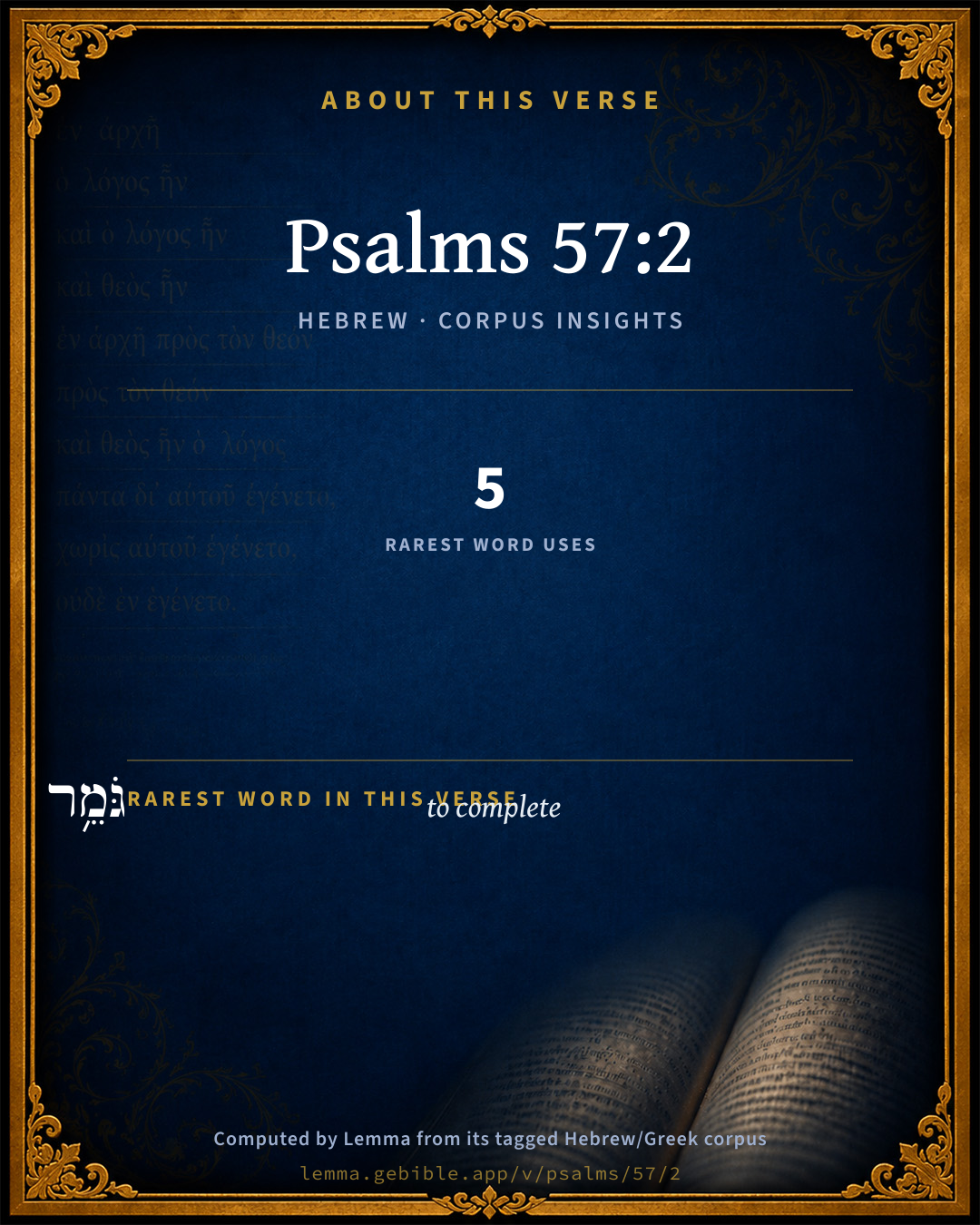
The rarest word here is גֹּמֵ֥ר to complete H1584 — appearing just 5 times in the whole Hebrew Bible.

Shared distinctive vocabulary

גֹּמֵ֥ר to complete H1584 occurs in 5 verses of the Hebrew Bible. Also found in:

Grammatical profile

  • 2 verbs
  • 2 nouns
  • 1 adjective
  • 1 preposition

Verb forms

  • אֶ֭קְרָא Qal · Imperfect
  • גֹּמֵ֥ר Qal · Participle Active

Hebrew & Septuagint length

In English translation the verse runs 15 words from the Hebrew and 14 from the Septuagint (LXX English) — closely comparable.

A rough comparison of the two English renderings, which tokenize alike — not a word-level alignment.

Word counts can differ between the Hebrew and the Greek without any difference in meaning — e.g. the Hebrew direct-object marker אֵת has no separate Greek word, and Greek often adds the article ὁ.

Cross-references

8

Topical passages linked to Psalms 57:2 in the Treasury of Scripture Knowledge — connected by theme and wording, ordered by reader-vote popularity; previews shown in the World English Bible.

  • Psalms 138:8 Yahweh will fulfill that which concerns me; Your loving kindness, Yahweh, endures forever. Don't forsake the works of your own hands.
  • Philippians 1:6 being confident of this very thing, that he who began a good work in you will complete it until the day of Jesus Christ.
  • Hebrews 13:21 make you complete in every good work to do his will, working in you that which is well pleasing in his sight, through Jesus Christ, to whom be the glory forever and ever. Amen.
  • Isaiah 26:12 Yahweh, you will ordain peace for us; for you have also worked all our works for us.
  • Psalms 136:2–3 Give thanks to the God of gods; For his loving kindness endures forever.
  • Philippians 2:12 So then, my beloved, even as you have always obeyed, not only in my presence, but now much more in my absence, work out your own salvation with fear and trembling.
  • Isaiah 57:15 For thus says the high and lofty One who inhabits eternity, whose name is Holy: I dwell in the high and holy place, with him also who is of a contrite and humble spirit, to revive the spirit of the humble, and to revive the heart of the contrite.
  • Psalms 56:2 My enemies want to swallow me up all day long, For they are many who fight proudly against me.

Cross-references courtesy of OpenBible.info (CC BY 4.0).

Hebrew and Greek witnesses Masoretic Hebrew ↔ Greek Septuagint

The same verse in the two great witnesses to the Old Testament, shown verse-for-verse.

You’re reading Greek Psalm 56 (Hebrew Psalm 57). The Septuagint counts the superscription, so verse numbers can differ from the Hebrew — chapter-level alignment, not verse-by-verse. Numbering follows Rahlfs.

These are two independent witnesses, not word-aligned to each other, and the Septuagint is shown in lemma (dictionary) form.

Hebrew Psalms 57:2 Masoretic · Westminster Leningrad Codex

אֶ֭קְרָא לֵֽאלֹהִ֣ים עֶלְי֑וֹן לָ֝אֵ֗ל גֹּמֵ֥ר עָלָֽי

I cry out to God Most High, To God who accomplishes my requests for me.

World English Bible · Public Domain

Greek LXX Greek Psalm 56:2 Septuagint · lemma form

ἐλεέω ἐγώ ὁ θεός ἐλεέω ἐγώ ὅτι ἐπί σύ πείθω ὁ ψυχή ἐγώ καί ἐν ὁ σκιά ὁ πτέρυξ σύ ἐλπίζω ἕως ὅς παραἔρχομαι ὁ ἀνομία

I will cry to God most high; the God who has benefited me. Pause.

LXX2012 (modern English Septuagint) · Public Domain

On this verse, Ellicott's Commentary for English Readers discusses the Septuagint’s reading. Read the note in Commentary ↓

Hebrew: Westminster Leningrad Codex (CC BY 4.0). Greek: Septuagint (public domain); English from LXX2012 (modern English Septuagint) (Public Domain). How the Septuagint differs from the Hebrew →

Commentary

Notes on Psalms 57:2 from classic Christian and Jewish commentators (each source and its license shown beneath its notes). The classic Christian expositions comment on the surrounding passage and are grouped to its opening verse, so a note may address several verses; the Jewish commentaries on the Tanakh (Rashi and others) are per-verse, so they appear only where the commentator wrote on this verse.

Lemma curates 59 commentaries, every one of them public domain or Creative Commons licensed, each selected and text-cleaned for this edition rather than reprinted as found. About our sources →

Trapp's Complete Commentary

John Trapp

Psa 57:2 I will cry unto God most high; unto God that performeth [all things] for me.

Ver. 2. I will cry unto God most high] Who can easily overtop Saul, as high as he is, and all his complices; against whom I have this comfort, that in the thing wherein they deal proudly God is above them, Exo 18:11.

Unto God that performeth all things for me] And in me, Isa 26:12; doth not his work to the halves, but is both author and finisher of my faith, and other affairs, Heb 12:2 Php 1:6 Psa 138:8. Here are the two props of David’s prayer: First, God’s sufficiency, he is the most high. Secondly, His efficiency, he perfectly accomplisheth all things for me.

John Trapp, A Commentary or Exposition upon All the Books of the Old and New Testament (1647–1656) — public domain. Text from a community e-Sword module.

Joseph Benson's Commentary

Psa 57:2. I will cry unto God — For succour and relief; most high — To whom there is none superior or equal; and unto whom, therefore, I will continually commend myself; unto God that performeth all things for me — Hebrew, גמר עלי, gomer gnali, that perfecteth, or finisheth, as this word properly signifies; that is, will certainly perform or finish, for, or, toward, or, concerning me. He does not express what God performed or perfected, (the words all things not being in the Hebrew,) but leaves it to be understood by the reader. He performeth, or perfecteth, all that he hath promised; he engages himself to finish what he hath begun, or what is yet to be completed. His words imply, that God is not like men, who make large promises, but, either through inability, or carelessness, or unfaithfulness, do not perform them; but that he will certainly be as good as his word.

Joseph Benson's Commentary on the Old and New Testaments (1811–1818) — public domain. Text from a community e-Sword module.

J. A. Alexander on Psalms

Joseph Addison Alexander

3. (Psa 57:2). I will cry unto God Most High, unto the Almighty, finishing for me, i.e. perfecting what he has begun. Compare Php 1:6. This verse assigns two reasons for his crying unto God. The first is the supremacy and omnipotence of God himself, the second is the previous experience of his faithfulness in fully performing whatever he has promised. See below, on Psa 138:8.

Joseph Addison Alexander, The Psalms Translated and Explained (1850) — public domain. Text from a community e-Sword module.

Tyndale Open Study Notes

Tyndale Open Resources

57:2 God Most High (Hebrew Elohim-Elyon) is a generic title for God, who is more powerful than all real or imagined supernatural beings (see 91:1; 97:9; Gen 14:18-22). • who will fulfill his purpose: Or who will end my [trouble], or who deals kindly with me.

Tyndale Open Study Notes — © Tyndale Open Resources, licensed CC BY-SA 4.0. Text via the HelloAO Bible API.

Geneva Bible (1599)

Geneva Bible translators

Who leaveth not his works begun imperfect.

Geneva Bible (1599) marginal notes — public domain. Text via Bolls.life.

Jamieson, Fausset & Brown

Robert Jamieson, A. R. Fausset & David Brown

performeth--or, completes what He has begun.

Jamieson, Fausset & Brown — Commentary Critical and Explanatory on the Whole Bible (1871) — public domain (CC PDM 1.0). Text via the HelloAO Bible API.

Adam Clarke's Commentary

Verse 2. I will cry unto God most high] He is the Most High; and therefore far above all my enemies, though the prince of the power of the air be at their head.

Unto God, לאל lael, unto the strong God, one against whom no human or diabolic might can prevail. David felt his own weakness, and he knew the strength of his adversaries; and therefore he views God under those attributes and characters which were suited to his state. This is a great secret in the Christian life; few pray to God wisely; though they may do it fervently.

That performeth all things for me.] Who works for me; גמר gomer, he who completes for me, and will bring all to a happy issue.

Adam Clarke's Commentary on the Bible (1810–1826) — public domain. Text from a community e-Sword/MySword module.

Ellicott's Commentary for English Readers

(2) Peformeth all things for me.—Literally, completes for me, which may be explained from the analogy of Psa_138:8. But as the LXX. and Vulg. have “my benefactor” (reading gomçl for gomçr) we may adopt that emendation.

A Bible Commentary for English Readers, edited by Charles John Ellicott (1878–1897) — public domain. Text from a community e-Sword module.

The Cambridge Bible for Schools and Colleges

gen. ed. J. J. S. Perowne

2. I will cry &c.] I will call unto God Most High. Cp. Psa_55:16; Psa_56:9. The combination Elôhîm Elyon occurs only here and in Psa_78:56; it is the Elohistic equivalent of Jehovah Elyon (Psa_7:17; cp. Psa_47:2; Psa_83:18; Psa_97:9). El Elyon occurs in Psa_78:35 (cp. Psa_73:11); Gen_14:18 ff. The Psalmist appeals to God first as the ‘Most High’ (see Appendix, Note ii), a name which implies God’s power to help him, as the supreme Ruler of the world; and then as God (El) that performeth all things for me, a title which implies His willingness to help His servant now as heretofore. Here as in Psa_138:8, the object of the verb is left to be supplied (cp. Psa_52:9). He will perform all that needs to be performed. Cp. Php_4:19.

The Cambridge Bible for Schools and Colleges (gen. ed. J. J. S. Perowne; Cambridge University Press, 1878–1918) — public domain. Text from a community e-Sword module.

John Gill's Exposition

I will cry unto God most high,.... To remember him in his low estate, and who is higher than the highest, than Saul and his mighty men with him. This epithet David no doubt made use of, to encourage his faith in the Lord, who is above all, and can do all things; as follows;

unto God that performeth all things for me; in a providential way, having made him, upheld him in being, fed and clothed him, preserved him, and followed him with his goodness all his days; and in a way of grace he performed all his purposes concerning him, all his promises unto him, and was performing and would perfect the work of grace in him; see Psa 138:8. The Targum adds a fable by way of paraphrase on the text,

"who commanded, or prepared a spider, to perfect in the mouth of the cave a web for me;''

so it is in the king's Bible; as if, when he was in the cave, God so ordered it in his providence, that a spider should spin a web over the month of it, which prevented his persecutors from searching for him in it; but the Scripture is silent in this matter. Such a story is reported of Felix, bishop of Nola, in ecclesiastical history (m).

(m) Vid. Bochart. Hierozoic. par. 2. l. 4. c. 23. col. 611.

John Gill's Exposition of the Whole Bible (1746–1763) — public domain (CC PDM 1.0). Text via the HelloAO Bible API.

Albert Barnes' Notes on the Bible

I will cry unto God most high - The idea is - God is exalted above all creatures; all events are “under” him, and he can control them. The appeal was not to man, however exalted; not to an angel, however far he may be above man; it was an appeal made at once to the Supreme Being, the God to whom all worlds and all creatures are subject, and under whose protection, therefore, he must be safe.

Unto God that performeth all things for me - The word used here, and rendered “performeth” - גמר gâmar - means properly to bring to an end; to complete; to perfect. The idea here is, that it is the character of God, that he “completes” or “perfects,” or brings to a happy issue all his plans. The psalmist had had experience of that in the past. God had done this in former trials; he felt assured that God would do it in this; and he, therefore, came to God with a confident belief that all would be safe in his hands.

Albert Barnes' Notes on the Bible (1834–1885) — public domain. Text from a community e-Sword/MySword module.

Matthew Poole's English Annotations

Heb. that performeth (or perfecteth, or finisheth, as this word is rendered, Psa 138:8, i.e. will certainly perform or finish) for, or towards, or concerning me. He doth not express what he performeth, or perfecteth, or fulfilleth, but leaveth it to be understood, as being easy to be understood.

He performeth, or perfecteth, to wit, all that he hath promised; engageth himself to perform what he hath begun to do, or what is yet to be performed; it being usual in the Hebrew language to understand a verbal noun after the verb. He implies that God is not like men, who make large promises, but either through inability, or carelessness, or unfaithfulness, do not perform them, but will certainly be as good as his word.

Matthew Poole's English Annotations on the Holy Bible (1683–1685) — public domain. Text from a community e-Sword/MySword module.

The Treasury of David

Charles H. Spurgeon

Ver. 2. I will cry. He is quite safe, but yet he prays, for faith is never dumb. We pray because we believe. We exercise by faith the spirit of adoption whereby we cry. He says not I do cry, or I have cried, but I will cry, and indeed, this resolution may stand with all of us until we pass through the gates of pearl; for while we are here below we shall still have need to cry.

Unto God most high. --Prayers are for God only; the greatness and sublimity of his person and character suggest and encourage prayer; however high our enemies, our heavenly Friend is higher, for he is Most high, and he can readily send from the height of his power the succour which we need.

Unto God that performeth all things for me. He has cogent reason for praying, for he sees God performing. The believer waits and God works. The Lord has undertaken for us, and he will not draw back, he will go through with his covenant engagements. Our translators have very properly inserted the words, "all things, "for there is a blank in the Hebrew, as if it were a carte blanche, and you might write therein that the Lord would finish anything and everything which he has begun. Whatsoever the Lord takes in hand he will accomplish; hence past mercies are guarantees for the future, and admirable reasons for continuing to cry unto him.

Ver. 2. Unto God that performeth all things for me. God's favours already received are a pledge that he will complete his work of love "upon le me." The beginning is the earnest of the completion. His word is a guarantee for the performance of "all things" that I need. (Compare Ps 57:3 56:4 1Sa 2:9 3:12 1Sa 23:17 24:21 Ps 128:8 Job 10:3, 8 14:15 Php 1:6 Isa 26:12). A. R. Fausset.

Ver. 2. God that performeth all things for me. Hebrew, that performeth (or perfecteth, or finisheth, as this word is rendered, Ps 138:8; i.e., will certainly perform or finish), for, or towards, or concerning me. He doth not express what he performeth, or perfecteth, or fulfileth, but leaveth it to be understood, as being easy to be understood. He performeth or perfecteth, to wit, all that he hath promised; engages himself to perform what he hath begun to do, or what is yet to be performed; it being usual in the Hebrew language to understand a verbal noun after the verb. He implies that God is not like men, who make large promises, but either through inability, or carelessness, or unfaithfulness, do not perform them, but will certainly be as good as his word. Matthew Poole, 1624-1679.

Ver. 2. (last clause). The word which we translate performeth comes from a root that signifies both to perfect and to desist or cease. For when a business is performed or perfected, the agent then ceases and desists from working: he puts to the last hand when he finishes the work. To such a happy issue the Lord hath brought all his doubtful and difficult matters before; and this gives him encouragement that he will still be gracious, and perfect that which concerneth him now, as he speaks, Ps 138:8, "The Lord will perfect that which concerneth me." The Septuagint renders it by ton euergetm sonta me, who profits or benefits me. And it is a certain truth, that all the results and issues of providence are profitable and beneficial to the saints. But the supplement in our translation well conveys the importance of the place; "who performeth all things; and it involves the most strict and proper notion of providence, which is nothing else but the performance of God's gracious purposes and promises to his people." And therefore Vatablus and Muis supply and fill up the room with the conciseness of the original leaves, with quae promisit: I will cry unto God most high; unto God that performeth the things which he hath promised. Payment is the performance of promises. Grace makes the promise, and providence the payment. Piscator fills it with benignitatem et misericordiam suam; "unto God that performeth his kindness and mercy." But still it supposes the mercy performed to be contained in the promise, and much more so in the providential performance of it to us. John Flavel.

Ver. 2. (last clause). David even then when he fled from Saul in the cave he looks upon God as having performed all things for him. The word is, he hath perfected all things; and it is observable that David uses the same expression of praising God here when he was in the cave, hiding himself to save his life, as he did when he triumphed over his enemies--Psalm 6 and Psalm 108. Jeremiah Burroughs, 1599-1646.

Ver. 2. (last clause). The Targum curiously paraphrases this clause: "Who ordered the spider that wrought the web, on my account, at the mouth of the cave; "applying a later historical fact, which, however, may have had its prototype in David's history. Andrew A. Bonar, in "Christ and his Church in the Book of Psalms, "1859.

Ver. 2. Prayer to the performing God. He performs all his promises, all my salvation, all my preservation, all needed between here and heaven. Here he reveals his omnipotence, his grace, his faithfulness, his immutability; and we are bound to show our faith, patience, joy, and gratitude.

Ver. 2. Strange reasons.

I. The psalmist in the depth of distress, cries to God,

because he is most high in glory. Surely this thought

might well paralyse him with the fear of divine

inaccessibility, but the soul quickened with

suffering, sees through and beyond the metaphor,

rejoices in the truth, "Though the Lord be high, yet

hath he respect unto the lowly."

II. He cries to God for help, because God is

performing all things for him. Why urge him then?

Prayer is the music to which "the mighty man of war"

goes forth to battle. R. A. G.

Psalms 57:3*

Charles H. Spurgeon's The Treasury of David (1869–1885) — public domain. Psalms only. Text from a community e-Sword/MySword module.

Whedon's Commentary on the Bible

Daniel D. Whedon

2. Unto God that performeth all things for me—The verb for “performeth” signifies to bring to an end, as Psa_7:9; also, to complete; and in the judicial sense, to bring to a righteous determination. David expresses his confidence that God will adjudge and bring to a righteous termination all things concerning him, whether promises to himself or threatenings upon his enemies. See the same word in Psa_138:8, and compare, doctrinally, Php_1:6

Daniel D. Whedon (gen. ed.), Commentary on the Old and New Testaments (1874–1909) — public domain. Text from a community e-Sword module.

The Pulpit Commentary

I will cry unto God most High. In the original, "unto Elohim "elyon an expression which only occurs here and in Psa_78:56. El elyon, however, occurs in Psa_78:45; as in Gen_14:18, Gen_14:19, Gen_14:22, and Jehovah "elyon in Psa_7:1-8. Unto God that performeth all things for me. (comp. Psa_138:8) God "accomplishes" for his saints whatever is good for them.

The Pulpit Commentary (1880–1919), ed. H.D.M. Spence-Jones & Joseph S. Exell — public domain. Text from a community e-Sword module.

John Wesley's Explanatory Notes

That of Engedi, 1 Sam. xxiv, 1.

John Wesley, Explanatory Notes Upon the Whole Bible (1754–1765) — public domain. Text via the GEBible commentary corpus.

unfoldingWord translationNotes

Door43 World Missions Community

who does all things for me

This explains why he will cry out to God. It can be translated with "because." AT: "because he does all things for me"

those who crush me

The enemies' fierce attack is spoken of as if they were crushing his body by marching on it. AT: "those who attack me severely" (See: Metaphor)

God will send me his loving kindness and his faithfulness

God's being kind and faithful is spoken of as if he were sending his kindness and faithful. The abstract nouns "kindness" and "faithfulness" can be stated as "kind" and "trustworthy." AT: "God will be kind to me and trustworthy" (See: Metaphor Abstract Nouns)

translationWords

cry

God

Most High

send

heaven

save

rebuke

selah

covenant faithfulness

faithful

unfoldingWord translationNotes — © Distant Shores Media and the Door43 World Missions Community, licensed CC BY-SA 4.0. Source: git.door43.org/Door43/en_tn.

Rashi

Rabbi Shlomo Yitzchaki (Rashi)

Be gracious to me, etc., be gracious to me that I should neither kill nor be killed.

until the destruction passes Heb. הוות, until the evil passes.

Rashi on the Tanakh — English translations: “The Judaica Press complete Tanach with Rashi, translated by A. J. Rosenberg” (CC BY 4.0); “Pentateuch with Rashi's commentary by M. Rosenbaum and A.M. Silbermann, 1929-1934” (public domain); “The Metsudah Tanach series, Lakewood, N.J” (CC BY 4.0); and “The Book of Joshua, Metsudah Publications, 1997” (CC BY 4.0). Text via Sefaria.

Lesson kit

Teaching starters — assembled from the data on this page, not authored interpretation. Every prompt links to the verse data it draws on. Edit before teaching.

Psalms, in the Wisdom, opens this verse with 6 words (6 distinct Hebrew lemmas). Its most distinctive word is gâmar (“to complete”). A historical commentator’s framing appears above. Read the whole chapter for the surrounding context.

Discussion questions

  1. How does “to complete” (gâmar) shape what this verse is saying?
  2. Psalms 7:9 shares the word «to complete» with this verse. How do the two illuminate each other?
  3. These translations render this verse differently. What is at stake in choosing one wording over another?
  4. The verb «אֶ֭קְרָא» is Qal Imperfect. How does its form color the action?
  5. Reading how Trapp's Complete Commentary and Joseph Benson's Commentary read this verse, where do the two commentators agree and where do they part?

Things to notice

Reading settings

Reading text

Shown beneath each verse's original-language words.

Old Testament
Old Testament edition

Read the OT as the Masoretic Hebrew (MT) or the Greek Septuagint (LXX).

English shown for the Greek Septuagint (in the Hebrew ↔ Greek comparison).

Comparing translations? Open the Compare panel on any verse page to stack up to four side by side.