Ezekiel 42:5

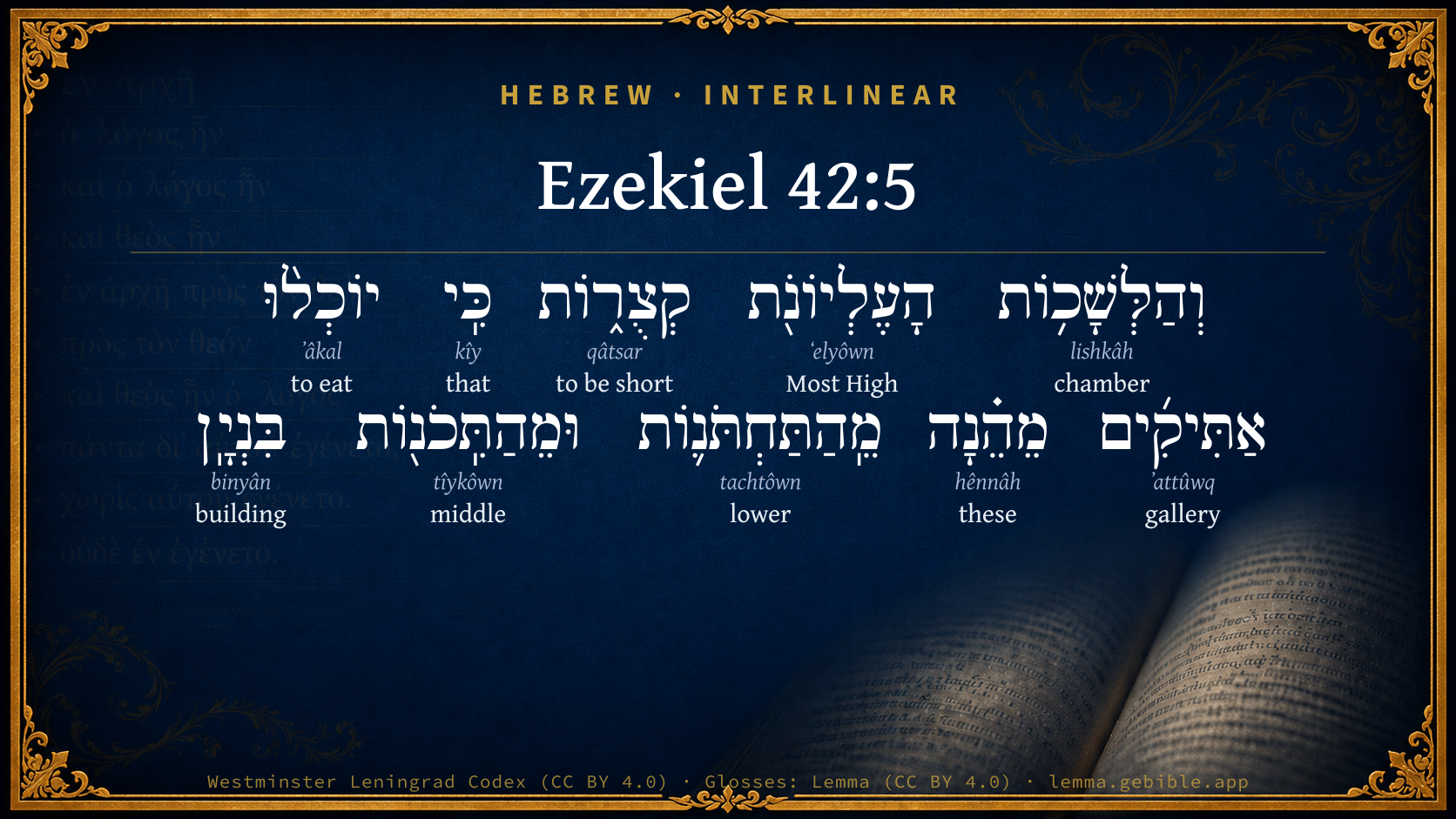
Hebrew (Westminster Leningrad Codex) Ezekiel 42:5 appears in the Hebrew Old Testament. The text above is from the Westminster Leningrad Codex. Each word links to its Strong’s number, a concise gloss, and parsing drawn from the Open Scriptures Hebrew Bible morphology. Click any word for its full Brown-Driver-Briggs (BDB) entry.
Download image
Cite this verse

Ezekiel 42:5 (World English Bible). Public Domain. Lemma interlinear Bible study tool, https://lemma.gebible.app/v/ezekiel/42/5.

Show BibTeX & RIS
BibTeX
RIS
English Translation
Now the upper chambers were shorter; for the galleries took away from these, more than from the lower and the middle, in the building.
World English Bible · Public Domain
Download a study sheet

One document with this verse’s original text, its word-by-word gloss line, the meaning frame, cross-references with their text, attributed commentary, and full source and license credits — printable, and it pastes into notes with its structure intact.

This verse Autodidact and up

Study sheet (.html) Plain text (.txt)

A passage Seminary Student

Up to 50 verses in one chapter. A passage sheet keeps up to 6 commentary sources and 12 cross-references per verse, in the order this page ranks them, and says so on the sheet whenever that leaves anything out. Ask for a single verse and you get the Autodidact verse sheet above.

Everything on this page stays free to read, with no account — the sheet is a download of what is already on screen, not access to it.

Want to remove ads? Support Godless Engineer
Compare translations 3

The same verse in 3 English versions, stacked beneath the original-language interlinear above. Click any original word for its lexicon entry.

Each is an independent rendering of the whole verse — the interlinear is not word-aligned to these translations.

Highlighted words mark where these versions differ — a whole-verse word diff, not a word-by-word alignment.

  • World English Bible Public Domain
    Now the upper chambers were shorter; for the galleries took away from these, more than from the lower and the middle, in the building.
  • King James Version Public Domain
    Now the upper chambers were shorter: for the galleries were higher than these, than the lower, and than the middlemost of the building.
  • unfoldingWord Literal Text CC BY-SA 4.0
    But the upper halls were smaller, for the walkways took away from them more space than they did in the lowest and middle levels of the building.

unfoldingWord Literal Text — © unfoldingWord, licensed CC BY-SA 4.0. Word-aligned USFM3 via Door43 (git.door43.org/unfoldingWord/en_ult).

Versions to compare (up to 4)

3 of 4 selected

Show all 18 translations

Every available English version of this verse, each an independent rendering of the whole verse.

  • World English Bible Public Domain
    Now the upper chambers were shorter; for the galleries took away from these, more than from the lower and the middle, in the building.
  • Berean Standard Bible Public Domain
    Now the upper chambers were smaller because the galleries took more space from the chambers on the lower and middle floors of the building.
  • Majority Standard Bible Public Domain
    Now the upper chambers were smaller because the galleries took more space from the chambers on the lower and middle floors of the building.
  • King James Version Public Domain
    Now the upper chambers were shorter: for the galleries were higher than these, than the lower, and than the middlemost of the building.
  • American Standard Version (1901) Public Domain
    Now the upper chambers were shorter; for the galleries took away from these, more than from the lower and the middlemost, in the building.
  • Revised Version (1885) Public Domain
    Now the upper chambers were shorter: for the galleries took away from these, more than from the lower and the middlemost, in the building.
  • Geneva Bible (1599) Public Domain
    Nowe the chambers aboue were narower: for those chambers seemed to eate vp these, to wit, the lower, and those that were in the middes of the building.
  • Douay-Rheims (1899) Public Domain
    Where were the store chambers lower above: because they bore up the galleries, which appeared above out of them from the lower parts, and from the midst of the building.
  • Young's Literal Translation Public Domain
    And the upper chambers `are' short, for the galleries contain more than these, than the lower, and than the middle one, of the building;
  • Literal Standard Version CC BY-SA 4.0
    And the upper chambers [are] short, for the galleries contain more than these, than the lower, and than the middle one, of the building;
  • Unlocked Literal Bible CC BY-SA 4.0
    But the upper halls were smaller, for the walkways took away from them more space than they did in the lowest and middle levels of the building.
  • unfoldingWord Literal Text CC BY-SA 4.0
    But the upper halls were smaller, for the walkways took away from them more space than they did in the lowest and middle levels of the building.
  • Darby Bible Public Domain
    And the upper cells, because the galleries encroached on them, were shorter than the lower, and than the middle-most of the building.
  • World Messianic Bible Public Domain
    Now the upper rooms were shorter; for the galleries took away from these more than from the lower and the middle in the building.
  • Webster's Bible Public Domain
    Now the upper chambers were shorter: for the galleries were higher than these, than the lower, and than the middlemost of the building.
  • Free Bible Version CC BY-SA 4.0
    The upper rooms were smaller because of the space taken up by the open halls on the lower and middle levels of the building.
  • Bible in Basic English Public Domain
    And the higher rooms were shorter: for the covered ways took up more space from these than from the lower and middle rooms.
  • JPS Tanakh (1917) Public Domain
    Now the upper chambers were shorter; for the galleries took away from these, more than from the lower and the middlemost, in the building.

Literal Standard Version (2020), Covenant Press — licensed CC BY-SA 4.0. Text via the HelloAO Bible API (eBible.org). Unlocked Literal Bible (unfoldingWord) — licensed CC BY-SA 4.0. Text via the HelloAO Bible API (eBible.org). unfoldingWord Literal Text — © unfoldingWord, licensed CC BY-SA 4.0. Word-aligned USFM3 via Door43 (git.door43.org/unfoldingWord/en_ult). Free Bible Version, Dr. Jonathan Gallagher — licensed CC BY-SA 4.0. Text via the HelloAO Bible API (eBible.org).

Word by word

More ways to search: Search by grammar → Find every occurrence → Compare this word →

Practice this passage: Drill this verse → Learn its vocabulary →

אַתִּיקִ֜ים
ʼattûwq
H862
“galleries”
Noun, Common, Masculine, Plural, Absolute
Part of Speech
Noun
Type
Common
Gender
Masculine
Number
Plural
State
Absolute
Full BDB Definition

Origin: from H5423 in the sense of decreasing

TWOT: 191a

gallery, porch
  1. וְהַלְּשָׁכ֥וֹת lishkâh H3957 “and · the · chambers” Conjunction + Particle, Definite Article + Noun, Common, Feminine, Plural, Absolute
  2. הָעֶלְיוֹנֹ֖ת ʻelyôwn H5945 “the · Most High” Particle, Definite Article + Adjective, Adjective, Feminine, Plural, Absolute
  3. קְצֻר֑וֹת qâtsar H7114 “short” Verb, Qal, Participle Passive, Feminine, Plural, Absolute
  4. כִּֽי kîy H3588 “that” Conjunction
  5. יוֹכְל֨וּ ʼâkal H398 “to eat” Verb, Qal, Imperfect, 3rd Person, Masculine, Plural
  6. מֵהֵ֗נָה hênnâh H2007 “from · these” Preposition + Pronoun, Personal, 3rd Person, Feminine, Plural
  7. מֵֽהַתַּחְתֹּנ֛וֹת tachtôwn H8481 “from · the · lower” Preposition + Particle, Definite Article + Adjective, Adjective, Feminine, Plural, Absolute
  8. וּמֵהַתִּֽכֹנ֖וֹת tîykôwn H8484 “and · from · the · middle” Conjunction + Preposition + Particle, Definite Article + Adjective, Adjective, Feminine, Plural, Absolute
  9. בִּנְיָֽן binyân H1146 “building” Noun, Common, Masculine, Singular, Absolute

About this verse

These counts appear in no published source. They are computed here, from the morphology-tagged text and Lemma’s own curated glosses. What Lemma adds →

10
words
10
distinct lemmas
Prophets
section

Notable vocabulary

The rarest word here is אַתִּיקִ֜ים gallery H862 — appearing just 6 times in the whole Hebrew Bible.

Shared distinctive vocabulary

אַתִּיקִ֜ים gallery H862 occurs in 4 verses of the Hebrew Bible. Also found in:

Grammatical profile

  • 2 verbs
  • 3 nouns
  • 3 adjectives
  • 1 pronoun
  • 1 conjunction

Verb forms

  • קְצֻר֑וֹת Qal · Participle Passive
  • יוֹכְל֨וּ Qal · Imperfect

Hebrew & Septuagint length

In English translation the verse runs 24 words from the Hebrew and 42 from the Septuagint (LXX English) — the Septuagint runs noticeably longer here. See the side-by-side →

A rough comparison of the two English renderings, which tokenize alike — not a word-level alignment.

Word counts can differ between the Hebrew and the Greek without any difference in meaning — e.g. the Hebrew direct-object marker אֵת has no separate Greek word, and Greek often adds the article ὁ.

Cross-references

1

Topical passages linked to Ezekiel 42:5 in the Treasury of Scripture Knowledge — connected by theme and wording, ordered by reader-vote popularity; previews shown in the World English Bible.

  • Ezekiel 41:7 The side-chambers were broader as they encompassed [the house] higher and higher; for the encompassing of the house went higher and higher round about the house: therefore the breadth of the house [continued] upward; and so one went up [from] the lowest [chamber] to the highest by the middle [chamber].

Cross-references courtesy of OpenBible.info (CC BY 4.0).

Hebrew and Greek witnesses Masoretic Hebrew ↔ Greek Septuagint

The same verse in the two great witnesses to the Old Testament, shown verse-for-verse.

Here the Septuagint runs noticeably longer than the Hebrew — LXX2012 (modern English Septuagint) 42 words vs World English Bible 24. A rough length comparison of the two English translations, not a word-level alignment — read both below.

These are two independent witnesses, not word-aligned to each other, and the Septuagint is shown in lemma (dictionary) form.

Hebrew Ezekiel 42:5 Masoretic · Westminster Leningrad Codex

וְהַלְּשָׁכ֥וֹת הָעֶלְיוֹנֹ֖ת קְצֻר֑וֹת כִּֽי יוֹכְל֨וּ אַתִּיקִ֜ים מֵהֵ֗נָה מֵֽהַתַּחְתֹּנ֛וֹת וּמֵהַתִּֽכֹנ֖וֹת בִּנְיָֽן

Now the upper chambers were shorter; for the galleries took away from these, more than from the lower and the middle, in the building.

World English Bible · Public Domain

Greek LXX Ezekiel 42:5 Septuagint · lemma form

καί ὁ περίπατος ὁ ὑπερῷον ὡσαύτως ὅτι ἐκἔχω ὁ περίστυλον ἐκ αὐτός ἐκ ὁ ὑποκάτωθεν περίστυλον καί ὁ διάστημα οὕτως περίστυλον καί διάστημα καί οὕτως στοά

And the upper walks were in like manner: for the peristyle projected from it, even from the range of columns below, and there was a space between; so were there a peristyle and a space between, and so were there two porticos.

LXX2012 (modern English Septuagint) · Public Domain

Hebrew: Westminster Leningrad Codex (CC BY 4.0). Greek: Septuagint (public domain); English from LXX2012 (modern English Septuagint) (Public Domain). How the Septuagint differs from the Hebrew →

Targum (Aramaic paraphrase)

1

The Targum is the ancient Jewish Aramaic paraphrase of the Hebrew Scriptures — an interpretive translation, not the Hebrew text itself. Onkelos (literal) and Pseudo-Jonathan (expansive) render the Torah, and Jonathan the Prophets. Coverage is partial: where no permissively-licensed English translation exists for a verse, only the Aramaic is shown. This is verse-level text, not a word-by-word alignment to the Hebrew.

  1. Targum Jonathan Prophets (Joshua–Malachi)
    וְלִשְׁכָּתָא עִלְיָתָא דְחִיקָן אֲרֵי נְסִיבָן זֵיוַיָא מִנְהֵין מֵאַרְעֲיָתָא וּמִמְצִיעָתָא בִּנְיָנָא:

    (no public-domain English translation for this verse)

    Targum Jonathan — Aramaic: “Mikraot Gedolot” (public domain). English: “Sefaria Community Translation” (CC0 1.0 (public-domain dedication)); “London "Chaldee Paraphrase," 1871” (public domain). Text via Sefaria.

Commentary

Notes on Ezekiel 42:5 from classic Christian and Jewish commentators (each source and its license shown beneath its notes). The classic Christian expositions comment on the surrounding passage and are grouped to its opening verse, so a note may address several verses; the Jewish commentaries on the Tanakh (Rashi and others) are per-verse, so they appear only where the commentator wrote on this verse.

Lemma curates 59 commentaries, every one of them public domain or Creative Commons licensed, each selected and text-cleaned for this edition rather than reprinted as found. About our sources →

Trapp's Complete Commentary

John Trapp

Eze 42:5 Now the upper chambers [were] shorter: for the galleries were higher than these, than the lower, and than the middlemost of the building.

Ver. 5. Now the upper chambers were shorter.] As being a kind of cock lofts, and not so fit for habitation.

John Trapp, A Commentary or Exposition upon All the Books of the Old and New Testament (1647–1656) — public domain. Text from a community e-Sword module.

The Biblical Illustrator

Joseph S. Exell

Eze_42:5-6

The glory of the Lord filled the house.

The glory without the cloud

Though God may forsake His people for a small moment, He will return with everlasting loving kindness. Gods glory filled the house, as it had filled the tabernacle which Moses set up and thee temple of Solomon. Now we do not find that ever the Shekinah did in that manner take possession of the second temple, and therefore this was to have its accomplishment in that glory of the Divine grace which shines so brightly in the Gospel Church, and fills it. Here is no mention of a cloud filling the house as formerly, for we now with open face behold the glory of the Lord, in the face of Christ, and not as of old through the cloud of types. (M. Henry.)

In the uplifted life we are brought into closer fellowshi

p with God:--The Spirit took Ezekiel up and brought him into the inner court, I want you to observe that while the prophet was in the inner court he saw the glory of God and heard God speaking to him. That inner court represents to us the innermost fellowship with God.

I. In the inner court he saw the glory of God. You stand outside some great cathedral, looking at the large stained-glass window that is said to be of such immense value and noted for its exquisite loveliness. You have heard of its beautiful design, of its rich colouring and delicate shadings. But you are disappointed. All you can see is a dim, dull easement, blotched here and there. But that is because you have been judging it from the standpoint of the exterior of the building. In that position you can see no glory. Get into the interior,--into the inner court, and your opinion will suddenly change. The scientist, if an unbeliever, cannot see the glory of God in Nature as can the man who has been brought into the inner court of fellowship with God. The man in the outer court may see a great deal of beauty in natural phenomena, and a wonderful design in the operations and effects of natural laws; but there are beauties in Nature to the believer that far surpass those. Jonathan Edwards, speaking of his own experience of having enjoyed a wonderful sense of Gods pardoning mercy, said, The wisdom, purity, and love of God seemed to appear in everything: in the sun, moon, and stars; in the clouds and blue sky; in the grass, flowers, and trees; in the water and all nature, which greatly fixed my mind. I beheld the sweet glory of God in all these things, and in the meantime sang with a low voice my contemplations of the Creator and Redeemer. As with Nature, so with Revelation. The Bible has been called a glorious temple. When He the Spirit of Truth is come, He will guide you into all truth. There our Lord indicates the faculty of spiritual perception and interpretation. How little of the glory of God we have seen! How seldom, as by a mystic hand, are we led beyond the vestibule into the inner sanctuary of the Most High! There was a time when God, maintaining strict reserve, dwelt in a peculiar way in the Holy of Holies of the ancient Temple. On the mercy seat was the Shekinah--the great symbol of His presence and unapproachable glory--which burned and glowed perpetually in bright and vivid splendour. Before this was hung the closely woven veil. There was no admission save for the High Priest, and he might pass within but once a year. But now we have boldness to enter into the holiest by the blood of Jesus, by a new and living way, which He hath consecrated for us, through the veil, that is to say His flesh. The High Priest of old could not look at the glory without seeing the blood that was sprinkled on the mercy seat. The same blood, the same atonement by which we draw near to God, is the same by which we must remain in communion with God. And, says the prophet Ezekiel, the man stood by me. Jesus Christ, the God-Man, is the glory of God. God, Who commanded the light to shine out of darkness, hath shined in our hearts, to give the light of the knowledge of the glory of God in the face of Jesus Christ. The Holy Spirit is the light of God that we may see Him.

II. While Ezekiel was in the inner court, God spake to him. Few live in the higher condition of perpetual fellowship with the Father and the Son; but it is in that higher condition that the noblest faculties of the soul are brought into use, Habakkuk said, I will stand upon my watch, and set me upon the tower, and will watch to see what He will say unto me (2:1). He would get above the crush and clamour of worldly things. As he who stands upon some eminence of cliff is not disturbed by the murmuring wavelets channelling the sands beneath, so the lifted up spirit, liberated from a narrow, mundane view, is unaffected by the carking cares which annoy and the anxieties which absorb the many,--the frettings which disturb serenity and scare away peace. We want to live above the corroding, cloying, flippant, superficial pleasures of time. We must get into a calm atmosphere,--the sphere of silence,--the unbroken solitudes of the heavenlies, if we are to hear His voice. Professor Smythe was engaged for some weeks in making astronomical observations on the Rock of Teneriffe. When he and his party descended from the height, they were surprised to find that a storm had been raging of which they had heard and seen nothing. (A. W. Welch.)

The Biblical Illustrator, edited by Joseph S. Exell (c. 1880s–1900s) — public domain. Text from a community e-Sword module.

Joseph Benson's Commentary

Eze 42:5-7. Now the upper chambers were shorter, &c. — The two upper stories had balconies standing out of them, the breadth of which was taken out of the rooms themselves, and made them so much the narrower, because the weight of the balconies was not supported by pillars, as the rooms over the cloisters were, but only by the wall. The wall that was without, &c., was fifty cubits — The wall that enclosed these buildings was commensurate with the breadth of one of the cloisters of the outer court, which were fifty cubits broad. These three verses are allowed by the Jewish Rabbis Solomon and Kimchi to be very difficult to be understood.

Joseph Benson's Commentary on the Old and New Testaments (1811–1818) — public domain. Text from a community e-Sword module.

Jamieson, Fausset & Brown

Robert Jamieson, A. R. Fausset & David Brown

shorter--that is, the building became narrower as it rose in height. The chambers were many: so "in My Father's house are many mansions" (Joh 14:2); and besides these there was much "room" still left (compare Luk 14:22). The chambers, though private, were near the temple. Prayer in our chambers is to prepare us for public devotions, and to help us in improving them.

Jamieson, Fausset & Brown — Commentary Critical and Explanatory on the Whole Bible (1871) — public domain (CC PDM 1.0). Text via the HelloAO Bible API.

Ellicott's Commentary for English Readers

(5) For the galleries were higher than these.—Translate this verse, And the upper chambers were shortened, because the galleries took off from them (literally, eat of them) in comparison with the lower and the middle [chambers] of the building. The building was in three storeys (Eze_42:6), like the chambers round the Temple, but the gallery is mentioned only in connection with the third (Eze_42:3). As it must have been taken out of the width of the chambers, it made those of the third storey narrower.

A Bible Commentary for English Readers, edited by Charles John Ellicott (1878–1897) — public domain. Text from a community e-Sword module.

The Cambridge Bible for Schools and Colleges

gen. ed. J. J. S. Perowne

5. The uppermost story was contracted by the gallery, so that its area was smaller than that of the other two stories.

The Cambridge Bible for Schools and Colleges (gen. ed. J. J. S. Perowne; Cambridge University Press, 1878–1918) — public domain. Text from a community e-Sword module.

John Gill's Exposition

Now the upper chambers were shorter,.... The chambers were in three stories, as in the following verse, one above another; the middlemost were shorter than the lowermost, and the upper shorter than either; just the reverse of the chambers in Eze 41:7, they were not so high from the floor to the ceiling, nor so broad from side to side. The reason follows:

for the galleries were higher than these; or, "ate out of these" (w), "than the lower, and than the middlemost of the building"; the meaning is, that the galleries or balconies in the middlemost and upper chambers were taken, out of them, and so made them lesser than the lower ones, and the upper ones lesser than either; or the posts or pillars, as the word may be rendered, see Eze 42:3, which supported the chambers, took more out of the uppermost than the others, and so made them shorter. This may signify the diversity of gifts and grace, of light and knowledge, and of liberty and comfort, in the churches; and that, as those that are uppermost have most light, they are usually the least, and fewest members in them; who are the few names in Sardis, Rev 3:4, and are generally more straitened, afflicted, reproached, and persecuted.

(w) Keri, "comedebant ex ipsis", Mariana; "demordebant ab illis", Cocceius, Starckius.

John Gill's Exposition of the Whole Bible (1746–1763) — public domain (CC PDM 1.0). Text via the HelloAO Bible API.

Albert Barnes' Notes on the Bible

Render: “And the upper chambers were” shortened, for galleries took off from them, from “the lower” and from “the middle-most, chambers, of the building.” The building rose in terraces, as was usual in Babylonian architecture, and so each of the two upper stories receded from the one below it.

Albert Barnes' Notes on the Bible (1834–1885) — public domain. Text from a community e-Sword/MySword module.

Haydock's Catholic Bible Commentary

Above. The higher stories are not so lofty.

George Leo Haydock (1774–1849), Haydock's Catholic Family Bible and Commentary, 1859 edition — public domain. Excludes Psalms (Douay-Rheims chapter numbering differs from Protestant) and Deuterocanonical books (Catholic canon only).

Matthew Poole's English Annotations

Were shorter: at first view it should seem to refer to the length, but indeed it refers to the height of the chambers, of which the lowest chamber was highest pitched from the floor to the ceiling; the second lower pitched than the first, yet of greater height than the uppermost between the floor and ceiling.

The galleries were higher than these: possibly, there might be over the uppermost chambers a fiat roof, on which, as on a gallery, they might walk from one end to another, and therefore that floor was much lower than the middle or lowest, according to the rule of architecture, which directs that the upper rooms take not up so much in their height as the lower, that the weight of the timber be not too heavy for the walls..

Matthew Poole's English Annotations on the Holy Bible (1683–1685) — public domain. Text from a community e-Sword/MySword module.

The Pulpit Commentary

The rendering of the Revised Version sufficiently explains this otherwise obscure verse, "Now the upper chambers were shorter," or narrower, "for the galleries took away from these;" literally, did eat of them, more than from the lower and the middlemest in the building." In other words, the chambers rose in terrace form, each of the upper stories receding from that below it, as was customary in Babylonian architecture.

The Pulpit Commentary (1880–1919), ed. H.D.M. Spence-Jones & Joseph S. Exell — public domain. Text from a community e-Sword module.

John Wesley's Explanatory Notes

Shorter - At first view it should seem to refer to the length, but indeed it refers to the height of the chambers, of which the lowest chamber was highest, the second lower pitched than the first, yet of greater height than the uppermost between the floor and ceiling.

John Wesley, Explanatory Notes Upon the Whole Bible (1754–1765) — public domain. Text via the GEBible commentary corpus.

Rashi

Rabbi Shlomo Yitzchaki (Rashi)

And the uppermost chambers, etc. For they were three-storied, etc. I do not understand them at all.

because the pillars consumed [Heb. יוֹכְלוּ,] like יאֹכְלוּ, consumed. Consuming and decreasing the space of the chambers.

Rashi on the Tanakh — English translations: “The Judaica Press complete Tanach with Rashi, translated by A. J. Rosenberg” (CC BY 4.0); “Pentateuch with Rashi's commentary by M. Rosenbaum and A.M. Silbermann, 1929-1934” (public domain); “The Metsudah Tanach series, Lakewood, N.J” (CC BY 4.0); and “The Book of Joshua, Metsudah Publications, 1997” (CC BY 4.0). Text via Sefaria.

Lesson kit

Teaching starters — assembled from the data on this page, not authored interpretation. Every prompt links to the verse data it draws on. Edit before teaching.

Ezekiel, in the Prophets, opens this verse with 10 words (10 distinct Hebrew lemmas). Its most distinctive word is ʼattûwq (“gallery”). The Greek Septuagint runs longer here. A historical commentator’s framing appears above. Read the whole chapter for the surrounding context.

Discussion questions

  1. How does “gallery” (ʼattûwq) shape what this verse is saying?
  2. Ezekiel 41:15 shares the word «gallery» with this verse. How do the two illuminate each other?
  3. Compared with the Hebrew, the Septuagint runs longer here. What questions does that raise?
  4. These translations render this verse differently; the difference is in the English rendering, not the original. What questions does that raise?
  5. The verb «קְצֻר֑וֹת» is Qal Participle Passive. How does its form color the action?
  6. Reading how Trapp's Complete Commentary and The Biblical Illustrator read this verse, where do the two commentators agree and where do they part?

Things to notice

Reading settings

Reading text

Shown beneath each verse's original-language words.

Old Testament
Old Testament edition

Read the OT as the Masoretic Hebrew (MT) or the Greek Septuagint (LXX).

English shown for the Greek Septuagint (in the Hebrew ↔ Greek comparison).

Comparing translations? Open the Compare panel on any verse page to stack up to four side by side.