
Psalms 107:11

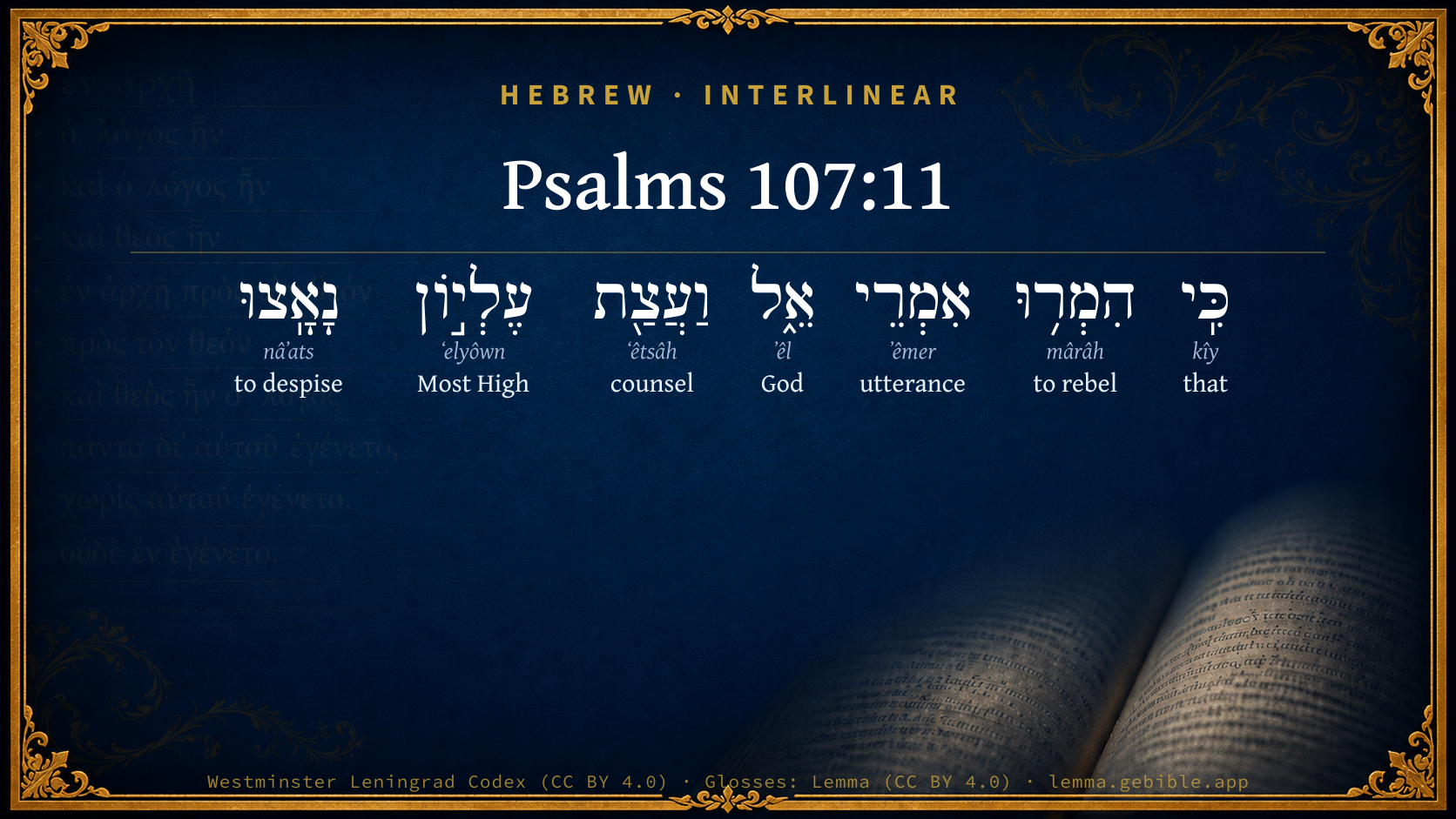
Hebrew (Westminster Leningrad Codex) Psalms 107:11 appears in the Hebrew Old Testament. The text above is from the Westminster Leningrad Codex. Each word links to its Strong’s number, a concise gloss, and parsing drawn from the Open Scriptures Hebrew Bible morphology. Click any word for its full Brown-Driver-Briggs (BDB) entry.
Download image
Cite this verse

Psalms 107:11 (World English Bible). Public Domain. Lemma interlinear Bible study tool, https://lemma.gebible.app/v/psalms/107/11.

Show BibTeX & RIS
BibTeX
RIS
English Translation
Because they rebelled against the words of God, And condemned the counsel of the Most High.
World English Bible · Public Domain
Download a study sheet

One document with this verse’s original text, its word-by-word gloss line, the meaning frame, cross-references with their text, attributed commentary, and full source and license credits — printable, and it pastes into notes with its structure intact.

This verse Autodidact and up

Study sheet (.html) Plain text (.txt)

A passage Seminary Student

Up to 50 verses in one chapter. A passage sheet keeps up to 6 commentary sources and 12 cross-references per verse, in the order this page ranks them, and says so on the sheet whenever that leaves anything out. Ask for a single verse and you get the Autodidact verse sheet above.

Everything on this page stays free to read, with no account — the sheet is a download of what is already on screen, not access to it.

Want to remove ads? Support Godless Engineer
Compare translations 3

The same verse in 3 English versions, stacked beneath the original-language interlinear above. Click any original word for its lexicon entry.

Each is an independent rendering of the whole verse — the interlinear is not word-aligned to these translations.

Highlighted words mark where these versions differ — a whole-verse word diff, not a word-by-word alignment.

  • World English Bible Public Domain
    Because they rebelled against the words of God, And condemned the counsel of the Most High.
  • King James Version Public Domain
    Because they rebelled against the words of God, and contemned the counsel of the most High:
  • unfoldingWord Literal Text CC BY-SA 4.0
    because they had rebelled against the words of God and despised the counsel of the Most High,

unfoldingWord Literal Text — © unfoldingWord, licensed CC BY-SA 4.0. Word-aligned USFM3 via Door43 (git.door43.org/unfoldingWord/en_ult).

Versions to compare (up to 4)

3 of 4 selected

Show all 18 translations

Every available English version of this verse, each an independent rendering of the whole verse.

  • World English Bible Public Domain
    Because they rebelled against the words of God, And condemned the counsel of the Most High.
  • Berean Standard Bible Public Domain
    because they rebelled against the words of God and despised the counsel of the Most High.
  • Majority Standard Bible Public Domain
    because they rebelled against the words of God and despised the counsel of the Most High.
  • King James Version Public Domain
    Because they rebelled against the words of God, and contemned the counsel of the most High:
  • American Standard Version (1901) Public Domain
    Because they rebelled against the words of God, And contemned the counsel of the Most High:
  • Revised Version (1885) Public Domain
    Because they rebelled against the words of God, and contemned the counsel of the Most High:
  • Geneva Bible (1599) Public Domain
    Because they rebelled against the wordes of the Lord, and despised the counsell of the most High,
  • Douay-Rheims (1899) Public Domain
    Because they had exasperated the words of God: and provoked the counsel of the most High:
  • Young's Literal Translation Public Domain
    Because they changed the saying of God, And the counsel of the Most High despised.
  • Literal Standard Version CC BY-SA 4.0
    Because they changed the saying of God, || And despised the counsel of the Most High.
  • Unlocked Literal Bible CC BY-SA 4.0
    This was because they had rebelled against God's word and rejected the instruction of the Most High.
  • unfoldingWord Literal Text CC BY-SA 4.0
    because they had rebelled against the words of God and despised the counsel of the Most High,
  • Darby Bible Public Domain
    Because they had rebelled against the words of ùGod, and had despised the counsel of the Most High;...
  • World Messianic Bible Public Domain
    because they rebelled against the words of God, and condemned the counsel of the Most High.
  • Webster's Bible Public Domain
    Because they rebelled against the words of God, and contemned the counsel of the Most High:
  • Free Bible Version CC BY-SA 4.0
    for they had rebelled against what God had said; they had rejected the guidance of the Most High.
  • Bible in Basic English Public Domain
    Because they went against the words of God, and gave no thought to the laws of the Most High:
  • JPS Tanakh (1917) Public Domain
    Because they rebelled against the words of God, and contemned the counsel of the Most High.

Literal Standard Version (2020), Covenant Press — licensed CC BY-SA 4.0. Text via the HelloAO Bible API (eBible.org). Unlocked Literal Bible (unfoldingWord) — licensed CC BY-SA 4.0. Text via the HelloAO Bible API (eBible.org). unfoldingWord Literal Text — © unfoldingWord, licensed CC BY-SA 4.0. Word-aligned USFM3 via Door43 (git.door43.org/unfoldingWord/en_ult). Free Bible Version, Dr. Jonathan Gallagher — licensed CC BY-SA 4.0. Text via the HelloAO Bible API (eBible.org).

Word by word

More ways to search: Search by grammar → Find every occurrence → Compare this word →

Practice this passage: Drill this verse → Learn its vocabulary →

About this verse

These counts appear in no published source. They are computed here, from the morphology-tagged text and Lemma’s own curated glosses. What Lemma adds →

7
words
7
distinct lemmas
Wisdom
section

Notable vocabulary

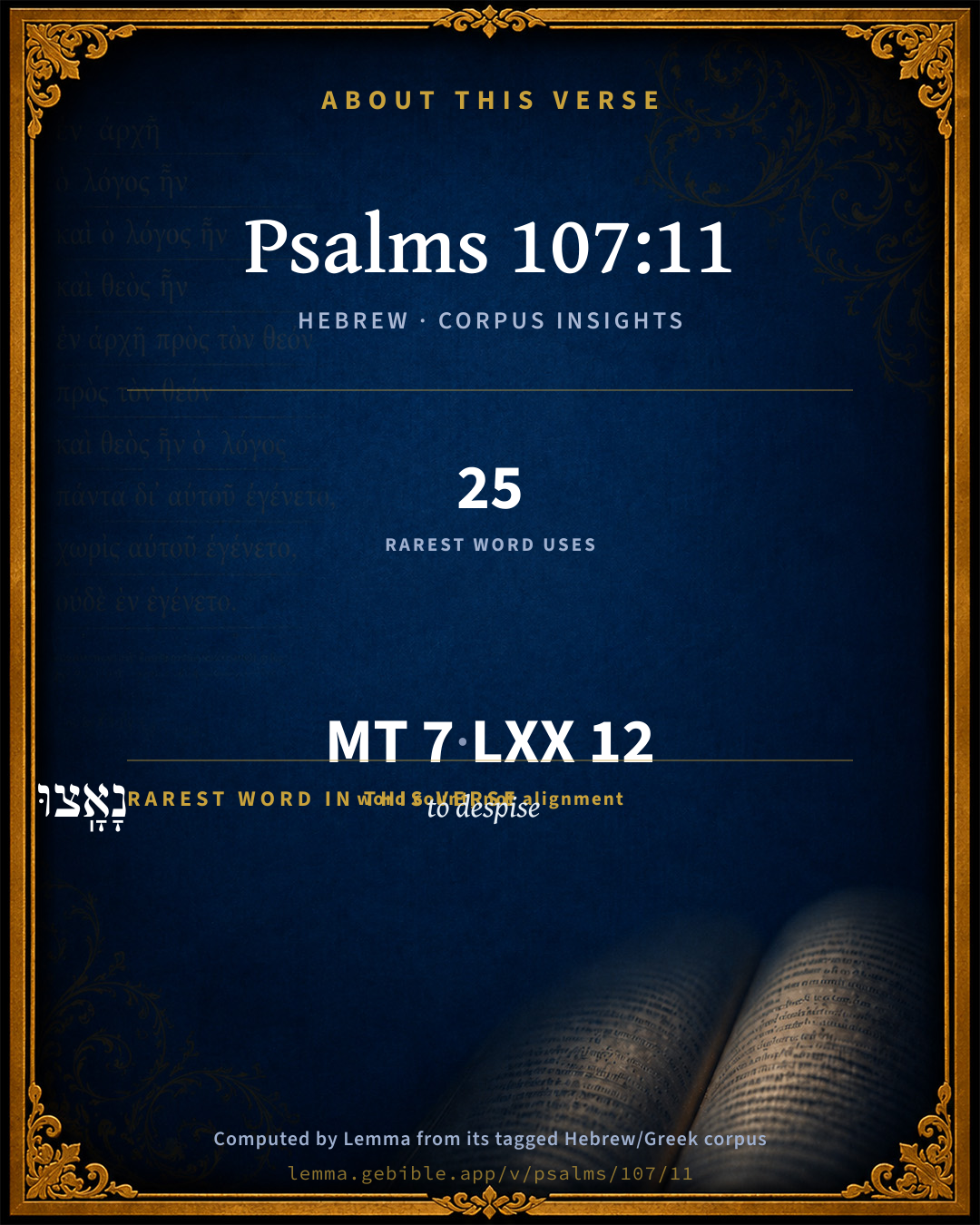
The rarest word here is נָאָֽצוּ to despise H5006 — appearing just 25 times in the whole Hebrew Bible.

Shared distinctive vocabulary

נָאָֽצוּ to despise H5006 occurs in 24 verses of the Hebrew Bible. Also found in:

Grammatical profile

  • 2 verbs
  • 3 nouns
  • 1 adjective
  • 1 conjunction

Verb forms

  • הִמְר֥וּ Hiphil · Perfect
  • נָאָֽצוּ Qal · Perfect

Hebrew & Septuagint length

In English translation the verse runs 16 words from the Hebrew and 16 from the Septuagint (LXX English) — the same length.

A rough comparison of the two English renderings, which tokenize alike — not a word-level alignment.

Word counts can differ between the Hebrew and the Greek without any difference in meaning — e.g. the Hebrew direct-object marker אֵת has no separate Greek word, and Greek often adds the article ὁ.

In the original languages it is 7 Hebrew tokens and 12 Greek tokens — but the two are counted differently (Hebrew bundles its prefixes and suffixes into one token; the Greek is in lemma form), so that isn’t a like-for-like length.

Cross-references

23

Topical passages linked to Psalms 107:11 in the Treasury of Scripture Knowledge — connected by theme and wording, ordered by reader-vote popularity; previews shown in the World English Bible.

  • Psalms 106:43 Many times he delivered them, But they were rebellious in their counsel, And were brought low in their iniquity.
  • Psalms 78:40 How often they rebelled against him in the wilderness, And grieved him in the desert!
  • Proverbs 1:25 But you have ignored all my counsel, And wanted none of my reproof;
  • Romans 1:28 Even as they refused to have God in their knowledge, God gave them up to a reprobate mind, to do those things which are not fitting;
  • 1 Samuel 2:5–8 Those who were full have hired out themselves for bread; Those who were hungry have ceased [to hunger]: Yes, the barren has borne seven; She who has many children languishes.
  • 2 Chronicles 33:10 Yahweh spoke to Manasseh, and to his people; but they gave no heed.
  • 2 Chronicles 36:16 but they mocked the messengers of God, and despised his words, and scoffed at his prophets, until the wrath of Yahweh arose against his people, until there was no remedy.
  • Psalms 73:24 You will guide me with your counsel, And afterward receive me to glory.
  • Proverbs 1:30–31 They wanted none of my counsel. They despised all my reproof.
  • Jeremiah 44:16 As for the word that you have spoken to us in the name of Yahweh, we will not listen to you.
  • Luke 7:30 But the Pharisees and the lawyers rejected the counsel of God, not being baptized by him themselves.
  • Acts 20:27 for I didn't shrink from declaring to you the whole counsel of God.
  • Psalms 68:6 God sets the lonely in families. He brings out the prisoners with singing, But the rebellious dwell in a sun-scorched land.
  • Psalms 113:7–9 He raises up the poor out of the dust. Lifts up the needy from the ash heap;
  • Luke 16:14 The Pharisees, who were lovers of money, also heard all these things, and they scoffed at him.
  • 2 Chronicles 25:15–16 Therefore the anger of Yahweh was kindled against Amaziah, and he sent to him a prophet, who said to him, Why have you sought after the gods of the people, which have not delivered their own people out of your hand?
  • Psalms 68:18 You have ascended on high. You have led away captives. You have received gifts among men, Yes, among the rebellious also, that Yah God might dwell there.
  • Psalms 119:24 Indeed your statutes are my delight, And my counselors.
  • Isaiah 5:19 Who say, "Let him make speed, let him hasten his work, that we may see it; And let the counsel of the Holy One of Israel draw near and come, That we may know it!"
  • Isaiah 63:10–11 But they rebelled, and grieved his holy Spirit: therefore he was turned to be their enemy, [and] himself fought against them.
  • Lamentations 3:39–42 Why does a living man complain, a man for the punishment of his sins?
  • Psalms 106:7 Our fathers didn't understand your wonders in Egypt. They didn't remember the multitude of your loving kindnesses, But were rebellious at the sea, even at the Red Sea.
  • Lamentations 5:15–17 The joy of our heart is ceased; Our dance is turned into mourning.

Cross-references courtesy of OpenBible.info (CC BY 4.0).

Hebrew and Greek witnesses Masoretic Hebrew ↔ Greek Septuagint

The same verse in the two great witnesses to the Old Testament, shown verse-for-verse.

You’re reading Greek Psalm 106 (Hebrew Psalm 107). The Septuagint counts the superscription, so verse numbers can differ from the Hebrew — chapter-level alignment, not verse-by-verse. Numbering follows Rahlfs.

These are two independent witnesses, not word-aligned to each other, and the Septuagint is shown in lemma (dictionary) form.

Hebrew Psalms 107:11 Masoretic · Westminster Leningrad Codex

כִּֽי הִמְר֥וּ אִמְרֵי אֵ֑ל וַעֲצַ֖ת עֶלְי֣וֹן נָאָֽצוּ

Because they rebelled against the words of God, And condemned the counsel of the Most High.

World English Bible · Public Domain

Greek LXX Greek Psalm 106:11 Septuagint · lemma form

ὅτι παραπικραίνω ὁ λόγιον ὁ θεός καί ὁ βουλή ὁ ὕψιστος παραὀξύνω

because they rebelled against the words of God, and provoked the counsel of the Most High.

LXX2012 (modern English Septuagint) · Public Domain

Hebrew: Westminster Leningrad Codex (CC BY 4.0). Greek: Septuagint (public domain); English from LXX2012 (modern English Septuagint) (Public Domain). How the Septuagint differs from the Hebrew →

Commentary

Notes on Psalms 107:11 from classic Christian and Jewish commentators (each source and its license shown beneath its notes). The classic Christian expositions comment on the surrounding passage and are grouped to its opening verse, so a note may address several verses; the Jewish commentaries on the Tanakh (Rashi and others) are per-verse, so they appear only where the commentator wrote on this verse.

Lemma curates 59 commentaries, every one of them public domain or Creative Commons licensed, each selected and text-cleaned for this edition rather than reprinted as found. About our sources →

Trapp's Complete Commentary

John Trapp

Psa 107:11 Because they rebelled against the words of God, and contemned the counsel of the most High:

Ver. 11. Because they rebelled against the words of God] Sin is at the bottom of all men’s miseries, as the procreant cause thereof; for God afflicteth not willingly, nor grieveth the children of men, Lam 3:33, but they rebel against his words written in the Scriptures, or, at least, in their hearts; and so he is concerned in point of honour to subdue them.

And contemned the counsel] A foul fault. See Luk 7:30.

John Trapp, A Commentary or Exposition upon All the Books of the Old and New Testament (1647–1656) — public domain. Text from a community e-Sword module.

J. A. Alexander on Psalms

Joseph Addison Alexander

11. (Psa 107:11) Because they resisted the words of the Mightiest, and the counsel of the Highest condemned. This verse introduces what was wanting in the first scene, the fact that these were not innocent sufferers. However cruel or unjust their sufferings at the hands of men, they were but condign punishments as sent by God. This is a point of contact and resemblance with the preceding psalm, which is not without importance. Resisted, rebelled against, a favourite expression in these psalms. See above, on Psa 105:28; Psa 106:7; Psa 106:33; Psa 106:43. Words or sayings, commonly applied to promises, and even here combining that idea with the sense of command, because the command which they resisted or rebelled against had reference to the plan or counsel of the Lord for the deliverance of his people. The word translated mightiest is one of the divine names, here represented by an English superlative, in order to preserve the antithesis with Most High in the other clause.

Joseph Addison Alexander, The Psalms Translated and Explained (1850) — public domain. Text from a community e-Sword module.

Tyndale Open Study Notes

Tyndale Open Resources

107:11 God’s counsel includes his instruction and will.

Tyndale Open Study Notes — © Tyndale Open Resources, licensed CC BY-SA 4.0. Text via the HelloAO Bible API.

Geneva Bible (1599)

Geneva Bible translators

Then the true way to obey God, is to follow his express commandment: also hereby all are exhorted to descend into themselves, forasmuch as none are punished but for their sins.

Geneva Bible (1599) marginal notes — public domain. Text via Bolls.life.

Adam Clarke's Commentary

Verse 11. Because they rebelled against the words of God]

1. God showed them their duty and their interest, and commanded them to obey his word; but they cast off all subjection to his authority, acted as if they were independent of heaven and earth, and broke out into open rebellion against him.

2. He counselled and exhorted them to return to him: but they contemned his advice, and turned his counsel into ridicule.

3. As lenient means were ineffectual, he visited them in judgment: hence it is added,

Adam Clarke's Commentary on the Bible (1810–1826) — public domain. Text from a community e-Sword/MySword module.

John Calvin's Commentaries

11. Because they rebelled In assigning the cause of their afflictions he corrects the false impressions of those persons who imagine that these happen by chance. Were they to reflect on the judgments of God, they would at once perceive that there was nothing like chance or fortune in the government of the world. Moreover, until men are persuaded that all their troubles come upon them by the appointment of God, it will never come into their minds to supplicate him for deliverance. Farther, when the prophet assigns the reason for their afflictions, he is not to be regarded as speaking of those persons as if they were notoriously wicked, but he is to be considered as calling upon the afflicted carefully to examine some particular parts of their life, and although no one accuse them, to look into their hearts, where they will always discover the true origin of all the miseries which overtake them. Nor does he only charge them with having merely sinned, but with having rebelled against the word of God, thus intimating that the best and only regulation for our lives consists in yielding a prompt obedience to his commandments. When, therefore, sheer necessity compels those who are in this manner convicted to cry unto God, they must be insensate indeed, if they do not acknowledge that the deliverance which, contrary to their expectation, they receive, comes immediately from God. For brazen gates and iron bars are spoken of for the purpose of enhancing the benefit; as if he said, the chains of perpetual slavery have been broken asunder.

John Calvin's Commentaries (1540-1563) — public domain. Text from the Calvin Translation Society English edition (1840s-50s) via the Christian Classics Ethereal Library (ccel.org). Calvin's coverage is partial (roughly two-thirds of the Bible); uncommented books and verses are honest gaps, never fabricated. The 19th-century editor's footnotes and remarks are omitted so the notes are faithfully Calvin's own voice.

Ellicott's Commentary for English Readers

(11) Contemned.—This word is an old Mosaic designation for the provocation offered by the chosen people (Num_14:11; Num_14:23), as well as for the abhorrence shown by Jehovah for their sin (Deu_32:19). Certainly this verse is more closely applicable to violation of the Theocratic relations of Israel to Jehovah than of heathen opposition to God.

A Bible Commentary for English Readers, edited by Charles John Ellicott (1878–1897) — public domain. Text from a community e-Sword module.

The Cambridge Bible for Schools and Colleges

gen. ed. J. J. S. Perowne

11. Their suffering was the punishment of sin. Cp. Psa_107:17; Psa_107:34. They resisted the commands of God (Psa_106:7; Psa_106:33; Psa_106:43); and blasphemously doubted or despised the wisdom and the goodness of His purposes for them. Cp. Pro_1:30; Isa_5:24; and for general illustration, 2Ch_36:16.

The Cambridge Bible for Schools and Colleges (gen. ed. J. J. S. Perowne; Cambridge University Press, 1878–1918) — public domain. Text from a community e-Sword module.

John Gill's Exposition

Then they cried unto the Lord in their trouble,.... Their affliction, their hearts being brought down with labour, and they being and finding themselves in a state of darkness, in the shadow of death, in affliction and iron; or in soul troubles, under a sense of sin, and in a view of wrath and displeasure; under apprehensions of imminent danger, as the disciples in the storm; and therefore cry to the Lord, as they did,

Lord, save us, we perish, Mat 8:2.

And he saved them out of their distresses; from all their sins; from the curse of the law; from wrath to come; from hell and death; being both able and willing. The following verse further explains this.

John Gill's Exposition of the Whole Bible (1746–1763) — public domain (CC PDM 1.0). Text via the HelloAO Bible API.

Albert Barnes' Notes on the Bible

Because they rebelled against the words of God - The commands of God. They did not keep his commandments. Their captivity was produced by national disobedience. See the notes at Dan 9:5-8.

And contemned the counsel - They despised the instructions of God. The law of God, at the same time that it “is” law, is of the nature of “counsel,” since it is indicative of what God regards as wise and good, and since it is the best “advice” that God can give to people. A just and righteous law, while it involves “obligation” to obey it, is also the best counsel that can be given, and implies that the highest “wisdom” would be shown in being obedient to it. God will “command” nothing which he would not “advise,” and which it would not be “wisdom” to obey.

Of the Most High - Of God, who, being supreme, has a right to rule over all, and to require that his laws shall be obeyed.

Albert Barnes' Notes on the Bible (1834–1885) — public domain. Text from a community e-Sword/MySword module.

Matthew Poole's English Annotations

Against the words of God; against God’s commands, made known either,

1. By his written word delivered to the Jews, of which the Gentiles were not ignorant, which therefore they should have diligently inquired after and searched into, as the queen of Sheba came from the ends of the earth to hear the wisdom of Solomon, and as divers of the heathens travelled into very remote parts to gain a more perfect knowledge of the arts and sciences; which will justly be laid to their charge, and condemn them for their neglect of that Divine wisdom which was treasured up in the Holy Scriptures. Or,

2. By the prophets, who sometimes were sent to the Gentiles. Or,

3. By the law and light of nature, and by its interpreters, their wise and learned philosophers, who delivered many excellent rules and precepts of piety and virtue, which were sufficient, though not for their salvation without Christ, yet for the conduct of their lives in a great measure, and to leave them without excuse for their gross disobedience thereunto.

Matthew Poole's English Annotations on the Holy Bible (1683–1685) — public domain. Text from a community e-Sword/MySword module.

The Treasury of David

Charles H. Spurgeon

Ver. 11. Because they rebelled against the words of God. This was the general cause of bondage among the ancient people of God, they were given over to their adversaries because they were not loyal to the Lord. God's words are not to be trifled with, and those who venture on such rebellion will bring themselves into bondage.

And contemned the counsel of the Most High. They thought that they knew better than the Judge of all the earth, and therefore they left his ways and walked in their own. When men do not follow the divine counsel they give the most practical proof of their contempt for it. Those who will not be bound by God's law will, ere long, be bound by the fetters of judgment. There is too much contemning of the divine counsel, even among Christians, and hence so few of them know the liberty wherewith Christ makes us free.

Ver. 11. Because they rebelled against the words of God. There is in the Hebrew a play upon similar soundsHimru Imree. God's words are those spoken in the Law and by the prophets. And contemned the counsel of the Most High another play upon like sounds in the HebrewHatzath Naatzu. A.R. Fausset.

Psalms 107:12*

Charles H. Spurgeon's The Treasury of David (1869–1885) — public domain. Psalms only. Text from a community e-Sword/MySword module.

Whedon's Commentary on the Bible

Daniel D. Whedon

11. Because they rebelled—See the histories of the Kings referred to Psa_107:10, and compare 2Ch_36:14-21.

Contemned the counsel of the Most High—Treated with contempt his declared purpose to punish transgression, of which he had fully forewarned them, as in Deu_28:15-68; Isaiah 1, etc. But the word “counsel,” here, may mean the fixed plan of God respecting Israel, embracing the whole scheme of their national and church life, in its relation to the ultimate redemptive economy of God. This high calling they had overlooked and despised.

Daniel D. Whedon (gen. ed.), Commentary on the Old and New Testaments (1874–1909) — public domain. Text from a community e-Sword module.

The Pulpit Commentary

Because they rebelled against the words of God. Such deep affliction as is here spoken of scarcely ever comes upon any but those who have offended God by resisting his will. And contemned the counsel of the most High. (comp. Pro_1:25) The "counsel of God" is the course of conduct which he has prescribed to man, whether through the reason and conscience that he has implanted in him, or through his revealed Word.

The Pulpit Commentary (1880–1919), ed. H.D.M. Spence-Jones & Joseph S. Exell — public domain. Text from a community e-Sword module.

unfoldingWord translationNotes

Door43 World Missions Community

they had rebelled against God's word ... rejected the instruction of the Most High

These phrases have similar meanings and emphasize how much they had rebelled again God, which is why they had been imprisoned. (See: Parallelism)

He humbled their hearts through hardship

Here the heart represents a person, but specifically his will. AT: "He humbled them by allowing them to suffer hardship" (See: Synecdoche)

hardship

Possible meanings are 1) "trouble" or 2) "hard labor."

they stumbled and there was no one to help them up

The word "stumbled" refers to times when these people got into very difficult situations. AT: "they got into trouble and there was no one to help them out of it" (See: Assumed Knowledge and Implicit Information)

Then they called out to Yahweh in their trouble

It is implied that they are praying to Yahweh so that he will help them. See how you translated this in Psalms 107:6. AT: "Then they prayed to Yahweh to help them in their trouble" (See: Assumed Knowledge and Implicit Information)

their distress

"difficulties" or "afflictions." See how you translated this in Psalms 107:6

he brought

Here David describes Yahweh saving them from their distress as if their distress were a physical place that he was bringing them out of. AT: "he saved" (See: Metaphor)

translationWords

rebel

word of God

reject

Most High

humble

heart

stumble

trouble

unfoldingWord translationNotes — © Distant Shores Media and the Door43 World Missions Community, licensed CC BY-SA 4.0. Source: git.door43.org/Door43/en_tn.

Rashi

Rabbi Shlomo Yitzchaki (Rashi)

For they rebelled against the words of God Trouble does not befall a person except because of his iniquity.

Rashi on the Tanakh — English translations: “The Judaica Press complete Tanach with Rashi, translated by A. J. Rosenberg” (CC BY 4.0); “Pentateuch with Rashi's commentary by M. Rosenbaum and A.M. Silbermann, 1929-1934” (public domain); “The Metsudah Tanach series, Lakewood, N.J” (CC BY 4.0); and “The Book of Joshua, Metsudah Publications, 1997” (CC BY 4.0). Text via Sefaria.

Lesson kit

Teaching starters — assembled from the data on this page, not authored interpretation. Every prompt links to the verse data it draws on. Edit before teaching.

Psalms, in the Wisdom, opens this verse with 7 words (7 distinct Hebrew lemmas). Its most distinctive word is nâʼats (“to despise”). A historical commentator’s framing appears above. Read the whole chapter for the surrounding context.

Discussion questions

  1. How does “to despise” (nâʼats) shape what this verse is saying?
  2. Numbers 14:11 shares the word «to despise» with this verse. How do the two illuminate each other?
  3. These translations render this verse differently; the difference is in the English rendering, not the original. What questions does that raise?
  4. The verb «הִמְר֥וּ» is Hiphil Perfect. How does its form color the action?
  5. Reading how Trapp's Complete Commentary and J. A. Alexander on Psalms read this verse, where do the two commentators agree and where do they part?

Things to notice

Reading settings

Reading text

Shown beneath each verse's original-language words.

Old Testament
Old Testament edition

Read the OT as the Masoretic Hebrew (MT) or the Greek Septuagint (LXX).

English shown for the Greek Septuagint (in the Hebrew ↔ Greek comparison).

Comparing translations? Open the Compare panel on any verse page to stack up to four side by side.