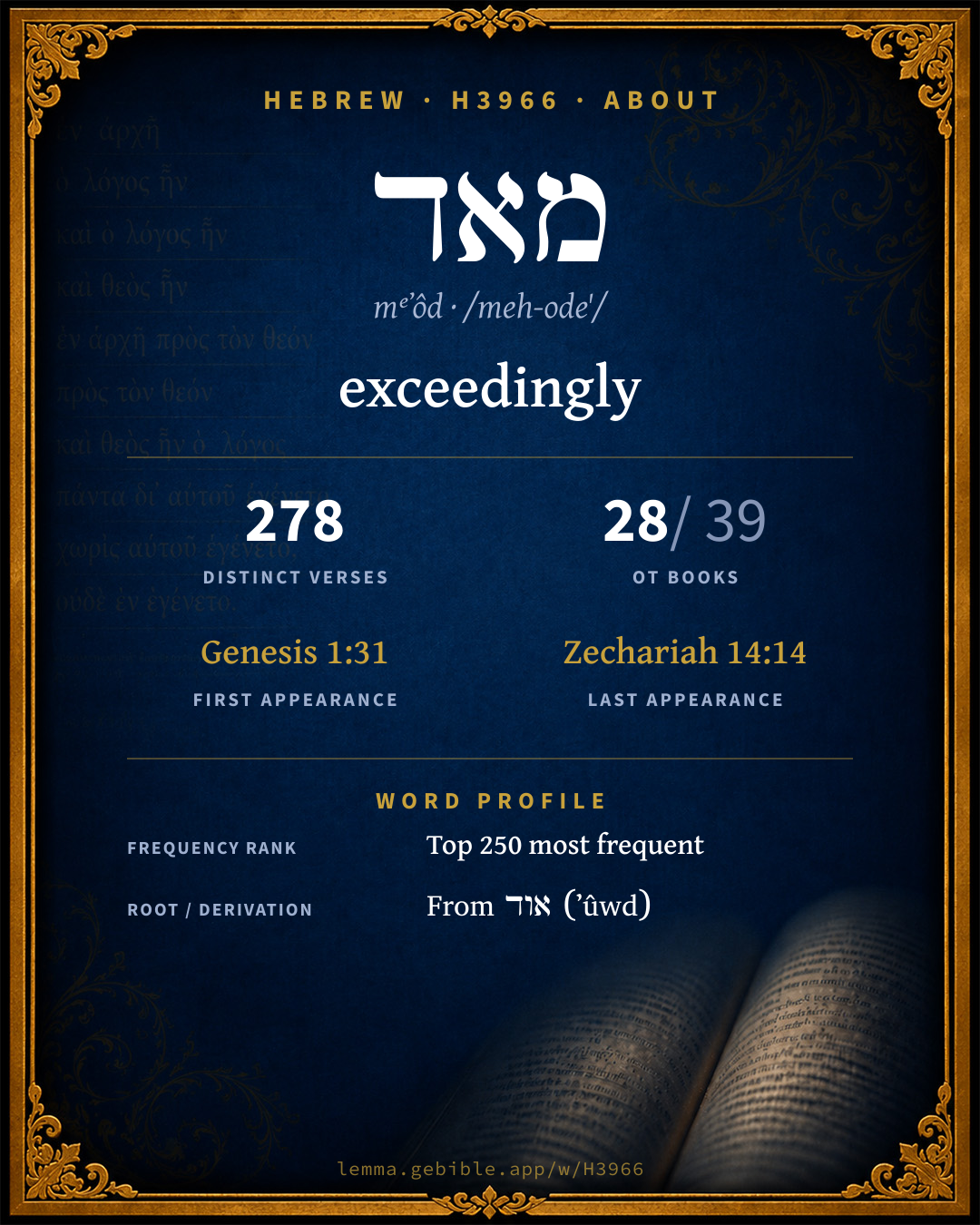
מְאֹד
exceedingly
‘exceedingly’ is one of 3 main senses fuller range ↓
Full lexicon entry — Brown-Driver-Briggs (BDB)
From Brown-Driver-Briggs (BDB)
Where this word appears
Grammar key — what these labels mean
Part of speech
- Adverb
- A word that modifies a verb, adjective, or other adverb.
- Noun
- A naming word — a person, place, thing, or idea.
Noun type
- Common
- A common noun — a general class of person, place, or thing (“king,” “city,” “water”), not a specific name.
State
- Construct
- A noun bound to a following noun in a possessive / “of” relationship (the construct chain).
- Absolute
- The independent form of a noun, not bound to a following word.
Gender
- Masculine
- Grammatically masculine.
Number
- Singular
- One.
Every verse where H3966 appears in the Book of 1 Samuel — 31 distinct verses. Click any verse to open its interlinear word-by-word view. Verse text shown in the World English Bible for context — . Each verse’s Hebrew form is shown with its reference; the English is not keyword-highlighted, since the data carries no word-level English alignment. Use “Compare translations” on any verse to read it across multiple English versions. This concordance covers the Hebrew Bible; Septuagint (Greek Old Testament) occurrences are not indexed here.
1 Samuel
- 1 Samuel 2:17 מְאֹ֖ד adv The sin of the young men was very great before Yahweh; for the men despised the offering of Yahweh.
- 1 Samuel 2:22 מְאֹ֑ד adv Now Eli was very old; and he heard all that his sons did to all Israel, and how that they lay with the women who served at the door of the tent of meeting.
- 1 Samuel 4:10 מְאֹ֑ד adv The Philistines fought, and Israel was struck, and they fled every man to his tent: and there was a very great slaughter; for there fell of Israel thirty thousand footmen.
- 1 Samuel 5:9 מְאֹ֔ד adv It was so, that after they had carried it about, the hand of Yahweh was against the city with a very great confusion: and he struck the men of the city, both small and great; and tumors broke out on them.
- 1 Samuel 5:11 מְאֹ֛ד adv They sent therefore and gathered together all the lords of the Philistines, and they said, Send away the ark of the God of Israel, and let it go again to its own place, that it not kill us and our people. For there was a deadly confusion throughout all the city; the hand of God was very heavy there.
- 1 Samuel 11:6 מְאֹֽד adv The Spirit of God came mightily on Saul when he heard those words, and his anger was kindled greatly.
- 1 Samuel 11:15 מְאֹֽד adv All the people went to Gilgal; and there they made Saul king before Yahweh in Gilgal; and there they offered sacrifices of peace-offerings before Yahweh; and there Saul and all the men of Israel rejoiced greatly.
- 1 Samuel 12:18 מְאֹ֛ד adv So Samuel called to Yahweh; and Yahweh sent thunder and rain that day: and all the people greatly feared Yahweh and Samuel.
- 1 Samuel 14:20 מְאֹֽד adv Saul and all the people who were with him were gathered together, and came to the battle: and, behold, every man's sword was against his fellow, [and there was] a very great confusion.
- 1 Samuel 14:31 מְאֹֽד adv They struck of the Philistines that day from Michmash to Aijalon. The people were very faint;
- 1 Samuel 16:21 מְאֹ֔ד adv David came to Saul, and stood before him: and he loved him greatly; and he became his armor bearer.
- 1 Samuel 17:11 מְאֹֽד adv When Saul and all Israel heard those words of the Philistine, they were dismayed, and greatly afraid.
- 1 Samuel 17:24 מְאֹֽד adv All the men of Israel, when they saw the man, fled from him, and were sore afraid.
- 1 Samuel 18:8 מְאֹ֗ד adv Saul was very angry, and this saying displeased him; and he said, They have ascribed to David ten thousands, and to me they have ascribed but thousands: and what can he have more but the kingdom?
- 1 Samuel 18:15 מְאֹ֑ד adv When Saul saw that he behaved himself very wisely, he stood in awe of him.
- 1 Samuel 18:30 מְאֹֽד adv Then the princes of the Philistines went forth: and it happened, as often as they went forth, that David behaved himself more wisely than all the servants of Saul; so that his name was much set by.
- 1 Samuel 19:1 מְאֹֽד adv Saul spoke to Jonathan his son, and to all his servants, that they should kill David. But Jonathan, Saul's son, delighted much in David.
- 1 Samuel 19:4 מְאֹֽד adv Jonathan spoke good of David to Saul his father, and said to him, Don't let the king sin against his servant, against David; because he has not sinned against you, and because his works have been very good toward you:
- 1 Samuel 20:19 מְאֹ֔ד adv When you have stayed three days, you shall go down quickly, and come to the place where you did hide yourself when the business was in hand, and shall remain by the stone Ezel.
- 1 Samuel 21:12 מְאֹ֔ד adv David laid up these words in his heart, and was very afraid of Achish the king of Gath.
- 1 Samuel 25:2 מְאֹ֔ד adv There was a man in Maon, whose possessions were in Carmel; and the man was very great, and he had three thousand sheep, and a thousand goats: and he was shearing his sheep in Carmel.
- 1 Samuel 25:15 מְאֹ֑ד adv But the men were very good to us, and we were not hurt, neither missed we anything, as long as we went with them, when we were in the fields:
- 1 Samuel 25:36 מְאֹ֑ד adv Abigail came to Nabal; and, behold, he held a feast in his house, like the feast of a king; and Nabal's heart was merry within him, for he was very drunken: therefore she told him nothing, less or more, until the morning light.
- 1 Samuel 26:21 מְאֹֽד adv Then said Saul, I have sinned: return, my son David; for I will no more do you harm, because my life was precious in your eyes this day: behold, I have played the fool, and have erred exceedingly.
- 1 Samuel 28:5 מְאֹֽד adv When Saul saw the host of the Philistines, he was afraid, and his heart trembled greatly.
- 1 Samuel 28:15 מְאֹ֜ד adv Samuel said to Saul, Why have you disquieted me, to bring me up? Saul answered, I am sore distressed; for the Philistines make war against me, and God is departed from me, and answers me no more, neither by prophets, nor by dreams: therefore I have called you, that you may make known to me what I shall do.
- 1 Samuel 28:20 מְאֹ֖ד adv Then Saul fell immediately his full length on the earth, and was sore afraid, because of the words of Samuel: and there was no strength in him; for he had eaten no bread all the day, nor all the night.
- 1 Samuel 28:21 מְאֹ֑ד adv The woman came to Saul, and saw that he was sore troubled, and said to him, Behold, your handmaid has listened to your voice, and I have put my life in my hand, and have listened to your words which you spoke to me.
- 1 Samuel 30:6 מְאֹ֗ד adv David was greatly distressed; for the people spoke of stoning him, because the soul of all the people was grieved, every man for his sons and for his daughters: but David strengthened himself in Yahweh his God.
- 1 Samuel 31:3 מְאֹ֖ד adv The battle went sore against Saul, and the archers overtook him; and he was greatly distressed by reason of the archers.
- 1 Samuel 31:4 מְאֹ֑ד adv Then said Saul to his armor bearer, Draw your sword, and thrust me through therewith, lest these uncircumcised come and thrust me through, and abuse me. But his armor bearer would not; for he was sore afraid. Therefore Saul took his sword, and fell on it.
About this entry
At a glance — auto-summarized from this page’s data, not written by a person. Every figure links to its source below. This summary describes the numbers; it doesn’t interpret them.
The Hebrew word מאד centers on the idea of “exceedingly.” First canonically at Genesis 1:31, it enters the text early. The Hebrew Bible uses it across 278 verses — common. Its meaning spans more than one sense — see its full sense range. Related forms include אוד, אד and אודות. For the data behind this summary, explore the sense tree and the renderings breakdown below.
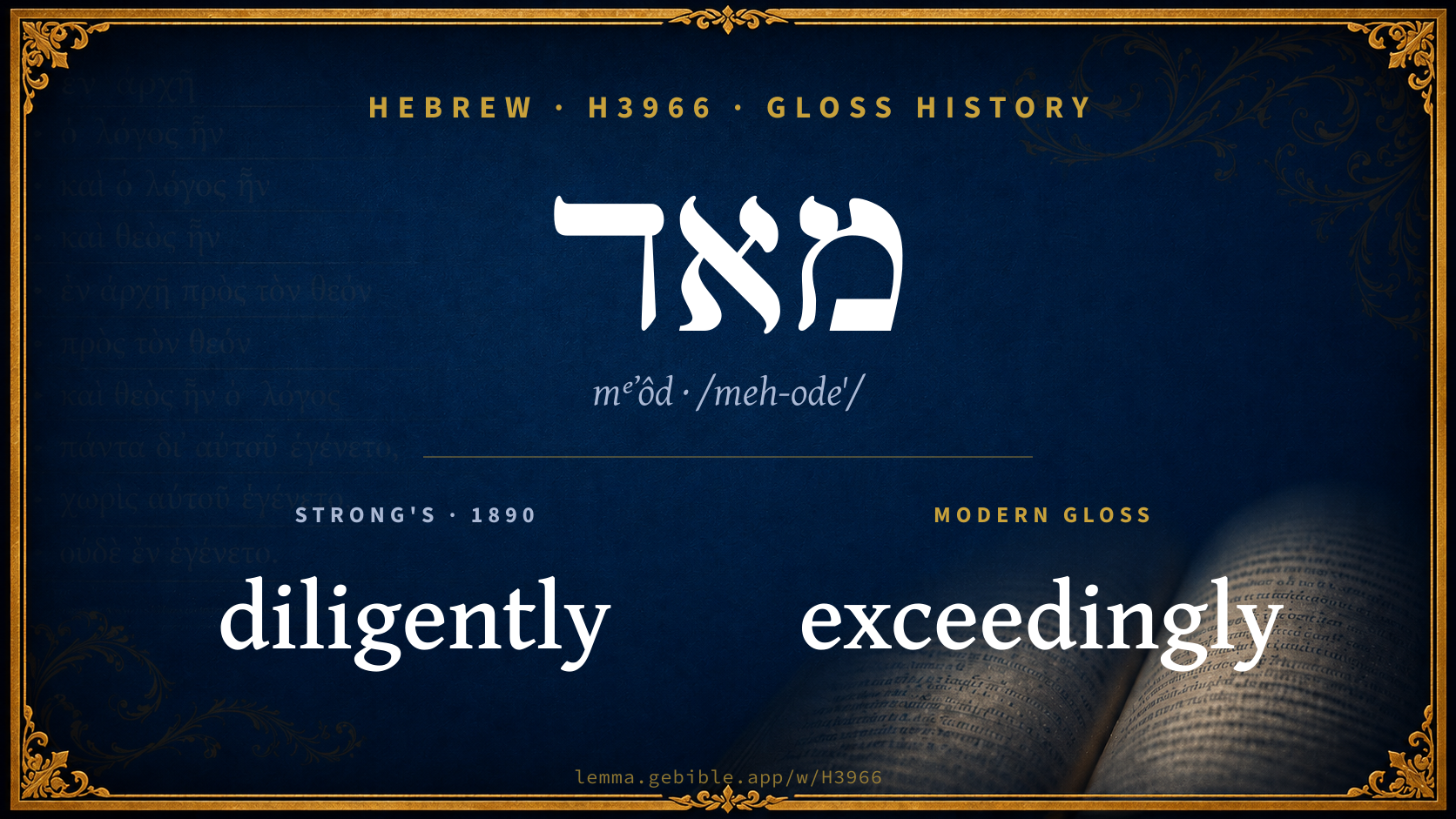
Gloss history
Strong's 1890 vs modern scholarship
About this word
Strong's H3966 catalogs a Hebrew word from the Hebrew Old Testament.
These counts are not copied from any lexicon or concordance. They are computed here, from the morphology-tagged Hebrew Old Testament. What Lemma adds →
- 278
- distinct verses
- The word appears in 278 distinct verses.
- 28 / 39
- OT books
- The word appears in 28 of 39 Old Testament books.
- #164
- by frequency
- Top 250 most frequent Hebrew words (rank 164 of 8,640 Hebrew words by occurrence).
View all 278 occurrences in the concordance →
By section of the Old Testament
By traditional corpus
Conventional, traditional groupings — biblical authorship is debated, so this is a traditional corpus grouping, not an authorship claim. Each share is this word’s portion of its verses in that division of the Hebrew canon. Each figure is a share of the word’s 278 distinct verses.
- Prophets (Nevi'im) 134 verses · 48%
- Writings (Ketuvim) 76 verses · 27%
- Torah (Pentateuch) 68 verses · 24%
How translations render this word
Counts come from each version’s own published word-to-Strong’s tagging or interlinear alignment — an approximate guide to how each version renders this word, not a word-level alignment the data otherwise carries. Because each total is that version’s own tagged count, the per-version totals vary from one another and need not match the appearance or distinct-verse counts above. These counts may also differ from a printed concordance because Lemma counts each distinctly tagged rendering and does not collapse phrase taggings into a single head-word total. This is a fixed set of word-tagged versions (KJV, ASV, BSB, ULT) and does not change with the reading translation you choose elsewhere. Each version’s license is shown beside its name below (and on Sources).
BDB lists this Strong’s number as 2 distinct words (homographs). Each count above pools all of them and is not split by sense — see the Senses section below. A low-frequency rendering may belong to a different one of those words, not the primary meaning.
- King James Version†: Very 55×, Greatly 29×, Was very 21×
- American Standard Version†: Very 47×, Greatly 26×, Was very 22×
- Berean Standard Bible†: Very 27×, Greatly 21×, Was very 8×
- unfoldingWord Literal Text†: Very 135×, Greatly 61×, Exceedingly 23×
King James Version Public Domain
Renders H3966 across 286† tagged occurrences — most commonly:
Plus other, less common renderings. Plus 76 renderings that appear only once — usually multi-word phrases or single function words the recovered tagging swept in, not distinct renderings. Not rendered by a distinct English word in 13 further occurrences.
American Standard Version Public Domain
Renders H3966 across 283† tagged occurrences — most commonly:
Plus other, less common renderings. Plus 80 renderings that appear only once — usually multi-word phrases or single function words the recovered tagging swept in, not distinct renderings.
Berean Standard Bible Public Domain
Renders H3966 across 195† tagged occurrences — most commonly:
Plus other, less common renderings. Plus 76 renderings that appear only once — usually multi-word phrases or single function words the recovered tagging swept in, not distinct renderings. Not rendered by a distinct English word in 104 further occurrences.
unfoldingWord Literal Text CC BY-SA 4.0
Renders H3966 across 296† tagged occurrences — most commonly:
Plus other, less common renderings. Plus 28 renderings that appear only once — usually multi-word phrases or single function words the recovered tagging swept in, not distinct renderings.
7 senses and sub-senses in the full BDB
What do BDB’s symbols mean?
BDB uses these scholarly abbreviations:
| Symbol | Meaning |
|---|---|
| 𝔊 | the Septuagint (the ancient Greek translation, LXX) |
| 𝔙 | the Vulgate (the Latin translation) |
| 𝔖 | the Syriac version (the Peshitta) |
| 𝔗 | the Targum (the Aramaic translation) |
| ψ | the Psalms |
| √ | root (the underlying root or stem) |
| ‖ | parallel passage (a synonymous or contrasted parallel) |
| † | the dagger: every passage where the word occurs is cited |
The 7 senses and sub-senses the full Brown-Driver-Briggs lexicon distinguishes for this word, in lexicon order (not ranked by frequency), with BDB’s own verbatim wording and sub-sense lettering. Shown in Hebrew script with BDB’s own scholarly abbreviations. The condensed entry is in the Lexicon Entry tab. See also the Forms in the corpus table below.
מאד I (√ of following Assyrian ma’âdu, be many, increase
מאד II muchness, force, abundance, exceedingly (cf. Assyrian mu’du, abundance, HomZMG 1878, 711 (‘treasures ana mu’di, in abundance’) DlHWB 399)
- 1. force, might, †Dt 6:5 וּבְכָל־מְאֹדֶ֑ךָ and with all thy might; hence 2 K 23:25. e.g. Deuteronomy 6:5
- 2. in diff. idioms (298 times) to express the idea of exceedingly, greatly, very (whether of magnitude or degree):
- a. (so mostly) as adv. acc., qualifying both adj. and obs., Gn 1:31 טוֹב מְאֹד good exceedingly, 4:5 וַיִּחַר לְקַיִן מְאֹד and Cain was wroth exceedingly, 7:18 וַיִּגְבְּרוּ הַמַּיִם וַיִּרְבּוּ מְאֹד, 12:14; 13:2 וְאַבְרָם כָּבֵד מְאֹד בַּמִּקְנֶה, v 13 חַטָּאִים לי׳ מאד, 18:20; 19:3, 9; 21:11; 24:16, 35, + often, ψ 46:2 עֶזְרָה בְצָרוֹת נִמְצָא מְאֹד as a help in troubles, to be found (= present) exceedingly; with an inf. Is 47:9 בְּעָצְמַת חֲבָרַיִךְ מְאֹד despite of thy spells being very numerous, Jos 9:13 מֵרֹב הַדֶּרֶךְ מְאֹד, 1 K 7:47; הַרְבֵּה מְאֹד Gn 15:1; 41:49; Dt 3:5 +, for which in the later language is found לָרֹב מְאֹד †Zc 14:14; 2 Ch 4:18; 9:9 (in 1 K 10:10 הַרְבֵּה מְאֹד), 24:24; 30:13, and even לְהַרְבֵּה מְאֹד †2 Ch 11:12; 16:8. מְאֹד is not usually separated from the word it qualifies by more than one or two words (as Gn 20:8 וייראו האנשׁים מאד, Nu 11:10 ויחר אף י׳ מאד); see, however, Dt 30:14; Ju 12:2; 2 S 12:5; 1 K 11:19 ψ 31:12. It precedes its verb, †ψ 47:10 מְאֹד נַעֲלָה (hence 97:9), 92:6. e.g. Genesis 1:31
- b. עַד־מְאֹד up to abundance, to a great degree, exceedingly, †Gn 27:33 חֲרָדָה גְּדֹלָה עַד־מ׳, v 34 1 S 11:15 וישׂמח … עד מ׳, 25:36 וְהוּא שִׁכֹּר עַד־מ׳, 2 S 2:17; 1 K 1:4; Is 64:8 (cf. La 5:22), v 11 ψ 38:7, 9; 119:8, 43, 51, 107; Dn 8:8; 11:25. e.g. Genesis 27:33
- c. עַד־לִמְאֹד (v. עַד לְ)† 2 Ch 16:14. e.g. 2 Chronicles 16:14
- d. duplicated (Ges§ 133 k), †Gn 7:19 וְהַמַּיִם גָּֽבְרוּ מ׳ מ׳, 30:43; Nu 14:7; 1 K 7:47; 2 K 10:4; Ez 37:10. e.g. Genesis 7:19
- e. בִּמְאֹד מְאֹד lit. with muchness, muchness, †Gn 17:2, 6, 20; Ex 1:7 (all P), Ez 9:9; 16:13. e.g. Genesis 17:2
Senses from the full Brown-Driver-Briggs lexicon (Brown, Driver, Briggs; Oxford 1906 — public domain), digitized via Sefaria, supplemented by the OpenScriptures HebrewLexicon (CC BY 4.0). Full attribution on Sources.
Word origin
I. (√ of following Assyrian ma’âdu, be many, increase; maʾadu, many; ma’adiš, in abundance, DlHWB, 388 f.; cf. Sab. מאד to add, DHMZMG 1883, 342 f. HomSüd-Ar. Chr. 127; Arabic مَأَدَ begin to grow, of plant).
I. n.m. muchness, force, abundance, exceedingly (cf. Assyrian mu’du, abundance, HomZMG 1878, 711 (‘treasures ana mu’di, in abundance’) DlHWB 399):—
— Brown-Driver-Briggs (Oxford 1906, public domain), digitized via Sefaria, supplemented by the OpenScriptures HebrewLexicon (CC BY 4.0). See Sources.
Derived from אוד (ʼûwd) (H181) — firebrand.
Jastrow Dictionary
A second Hebrew/Aramaic lexicon for comparison, covering Aramaic and post-biblical (Talmudic, Targumic, Midrashic) usage that the biblical-Hebrew BDB does not. Matched by lemma rather than by Strong’s number, so a lemma may carry more than one Jastrow headword (shown separately below), and the entries cover usage well beyond the Bible.
מְאֹד
- v. Schr. KAT2, p. 564) much; (adv.) very. Ber. IX, 5 (ref. to מאדך Deut. VI, 5) בכל מדה ומדה … הוי מודה לו במ׳ מ׳ (Ms. M. a. Y. ed. מ׳ מ׳; Bab. ed. 54ᵃ במ׳ מ׳ omitted) whatever measure he may measure out to thee, give thanks to him very, very much. Ab. IV, 4 מ׳ מ׳ הוי וכ׳ be exceedingly lowly in mind (humble). e.g. Deuteronomy 6:5
A Dictionary of the Targumim, the Talmud Babli and Yerushalmi, and the Midrashic Literature (Marcus Jastrow; London, Luzac, 1903) — Public Domain. Digitized via Sefaria. Digitized via Sefaria. Full attribution on Sources.
Forms in the corpus
The 23 distinct written forms H3966 takes in the Hebrew Bible, most frequent first — each parse links to that state’s occurrences in the concordance. Hebrew forms include their vowel points and cantillation, so a single lemma takes many written forms.
| Form | Parsing | Example | Uses |
|---|---|---|---|
| מְאֹֽד | Adverb | Deuteronomy 2:4 | 89 |
| מְאֹ֑ד | Adverb | Daniel 8:8 | 82 |
| מְאֹ֔ד | Adverb | Esther 1:12 | 47 |
| מְאֹ֖ד | Adverb | Deuteronomy 4:15 | 27 |
| מְאֹד֙ | Adverb | Exodus 11:3 | 11 |
| מְאֹ֗ד | Adverb | Deuteronomy 4:9 | 8 |
| בִּ/מְאֹ֣ד | Adverb | Exodus 1:7 | 5 |
| מְאֹ֜ד | Adverb | 1 Samuel 28:15 | 5 |
| מְאֹ֣ד | Adverb | Genesis 30:43 | 5 |
| מְאֹ֥ד | Adverb | Genesis 7:19 | 4 |
| מְאֹד֒ | Adverb | Genesis 27:33 | 3 |
| מְ֝אֹ֗ד | Adverb | Psalms 78:59 | 2 |
| מְאֹ֛ד | Adverb | 1 Samuel 5:11 | 2 |
| בִּ/מְאֹ֥ד | Adverb | Genesis 17:2 | 1 |
| לִ/מְאֹֽד | Noun, Common, Masculine, Singular, Absolute | 2 Chronicles 16:14 | 1 |
| מְ֭אֹד | Adverb | Psalms 6:10 | 1 |
| מְאֹ֡ד | Adverb | 2 Chronicles 9:1 | 1 |
| מְאֹ֤ד | Adverb | Joshua 9:24 | 1 |
| מְאֹד | Adverb | Ezekiel 37:10 | 1 |
| מְאֹד֔/וֹ | Noun, Common, Masculine, Singular, Construct | 2 Kings 23:25 | 1 |
| מְאֹד֮ | Adverb | Psalms 31:11 | 1 |
| מְאֹדֶֽ/ךָ | Noun, Common, Masculine, Singular, Construct | Deuteronomy 6:5 | 1 |
| מְּאֹ֑ד | Adverb | Psalms 104:1 | 1 |
Same root — word family
Other BDB entries built from the same root as H3966, grouped by Strong’s listed origin. These share a root / origin per the lexicon — not necessarily a shared meaning. Each links to that word’s own entry.
Derives from
Shares the same root
Compare all same-root words → Showing 4 of 5 — not the complete family. They share a root, not necessarily a meaning.
Septuagint verse parallels
This word appears in 252 verses that also exist in the Greek Old Testament (Septuagint), out of the 278 Hebrew verses it occurs in. You can read those verses in Greek by switching the Old Testament edition to the Septuagint.
Read these verses in the Septuagint
- Genesis 1:31
- Exodus 1:7
- Numbers 11:10
- Deuteronomy 2:4
- Joshua 1:7
- Judges 2:15
- Ruth 1:13
- 1 Samuel 2:17
- 2 Samuel 1:26
- 1 Kings 1:4
- 2 Kings 10:4
- 1 Chronicles 10:4
This is a verse-level parallel only — the same verses exist in both the Hebrew and Greek Old Testaments. No word-level Hebrew↔Greek correspondence is claimed: the data carries no such alignment, so no Greek word is shown as this Hebrew word’s translation. Coverage is not total — the Septuagint omits the deuterocanon and renumbers the Psalms, so some Hebrew verses have no direct Greek parallel.