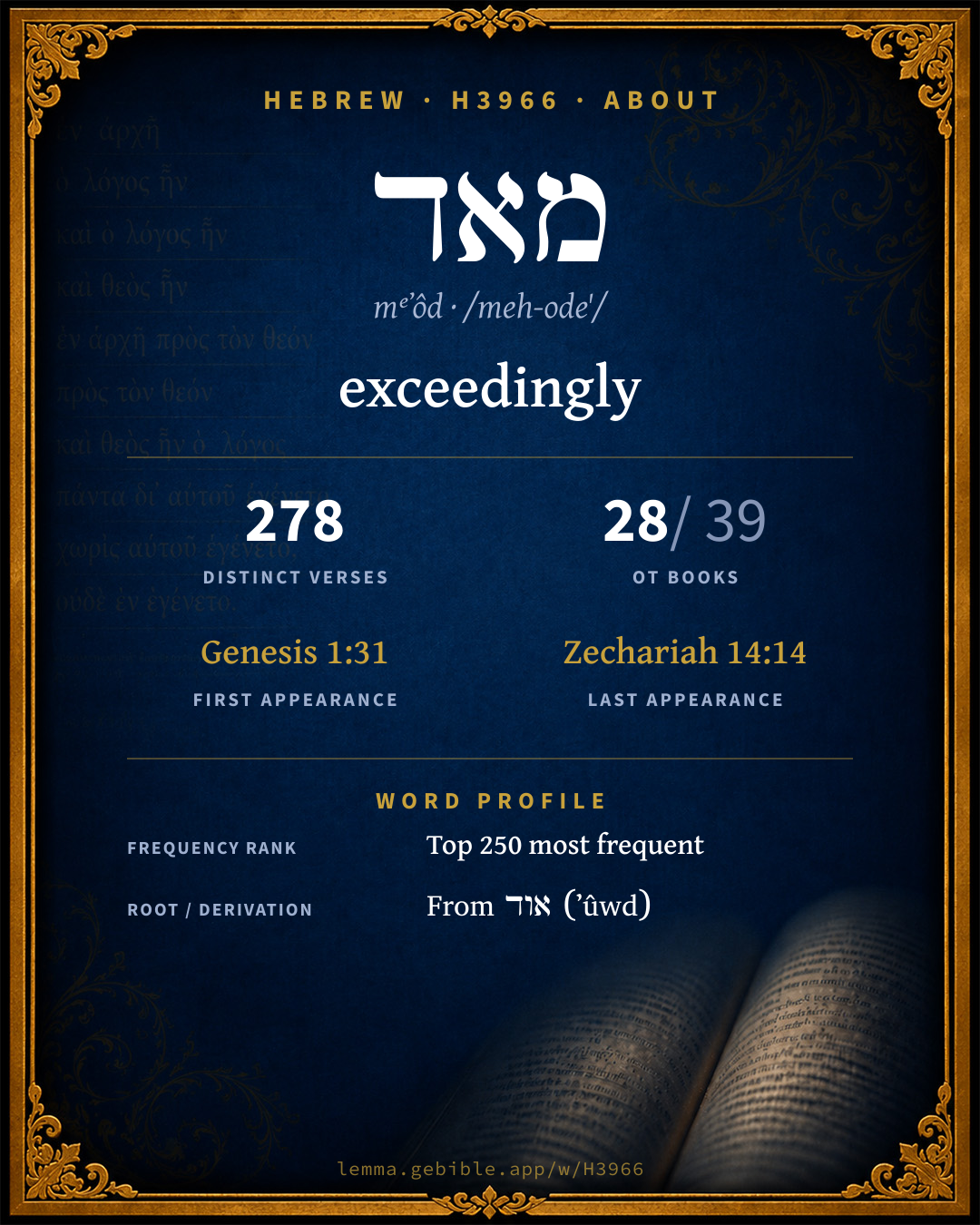
מְאֹד
exceedingly
‘exceedingly’ is one of 3 main senses fuller range ↓
Full lexicon entry — Brown-Driver-Briggs (BDB)
From Brown-Driver-Briggs (BDB)
Where this word appears
Grammar key — what these labels mean
Part of speech
- Adverb
- A word that modifies a verb, adjective, or other adverb.
- Noun
- A naming word — a person, place, thing, or idea.
Noun type
- Common
- A common noun — a general class of person, place, or thing (“king,” “city,” “water”), not a specific name.
State
- Construct
- A noun bound to a following noun in a possessive / “of” relationship (the construct chain).
- Absolute
- The independent form of a noun, not bound to a following word.
Gender
- Masculine
- Grammatically masculine.
Number
- Singular
- One.
Every verse where H3966 appears in the Book of Exodus — 13 distinct verses. Click any verse to open its interlinear word-by-word view. Verse text shown in the World English Bible for context — . Each verse’s Hebrew form is shown with its reference; the English is not keyword-highlighted, since the data carries no word-level English alignment. Use “Compare translations” on any verse to read it across multiple English versions. This concordance covers the Hebrew Bible; Septuagint (Greek Old Testament) occurrences are not indexed here.
Exodus
- Exodus 1:7 בִּ/מְאֹ֣ד מְאֹ֑ד prep + adv adv The children of Israel were fruitful, and increased abundantly, and multiplied, and grew exceedingly mighty; and the land was filled with them.
- Exodus 1:20 מְאֹֽד adv God dealt well with the midwives, and the people multiplied, and grew very mighty.
- Exodus 9:3 מְאֹֽד adv behold, the hand of Yahweh is on your cattle which are in the field, on the horses, on the donkeys, on the camels, on the herds, and on the flocks with a very grievous pestilence.
- Exodus 9:18 מְאֹ֑ד adv Behold, tomorrow about this time I will cause it to rain a very grievous hail, such as has not been in Egypt since the day it was founded even until now.
- Exodus 9:24 מְאֹ֔ד adv So there was very severe hail, and lightning mixed with the hail, such as had not been in all the land of Egypt since it became a nation.
- Exodus 10:14 מְאֹ֔ד adv The locusts went up over all the land of Egypt, and rested in all the borders of Egypt. They were very grievous. Before them there were no such locusts as they, neither after them shall be such.
- Exodus 10:19 מְאֹ֔ד adv Yahweh turned an exceeding strong west wind, which took up the locusts, and drove them into the Red Sea. There remained not one locust in all the borders of Egypt.
- Exodus 11:3 מְאֹד֙ adv Yahweh gave the people favor in the sight of the Egyptians. Moreover the man Moses was very great in the land of Egypt, in the sight of Pharaoh's servants, and in the sight of the people.
- Exodus 12:38 מְאֹֽד adv A mixed multitude went up also with them, with flocks, herds, and even very much cattle.
- Exodus 14:10 מְאֹ֔ד adv When Pharaoh drew near, the children of Israel lifted up their eyes, and behold, the Egyptians were marching after them; and they were very afraid. The children of Israel cried out to Yahweh.
- Exodus 19:16 מְאֹ֑ד adv It happened on the third day, when it was morning, that there were thunders and lightnings, and a thick cloud on the mountain, and the sound of an exceedingly loud trumpet; and all the people who were in the camp trembled.
- Exodus 19:18 מְאֹֽד adv Mount Sinai, the whole of it, smoked, because Yahweh descended on it in fire; and its smoke ascended like the smoke of a furnace, and the whole mountain quaked greatly.
- Exodus 19:19 מְאֹ֑ד adv When the sound of the trumpet grew louder and louder, Moses spoke, and God answered him by a voice.
About this entry
At a glance — auto-summarized from this page’s data, not written by a person. Every figure links to its source below. This summary describes the numbers; it doesn’t interpret them.
The Hebrew word מאד centers on the idea of “exceedingly.” First canonically at Genesis 1:31, it enters the text early. The Hebrew Bible uses it across 278 verses — common. Its meaning spans more than one sense — see its full sense range. Related forms include אוד, אד and אודות. For the data behind this summary, explore the sense tree and the renderings breakdown below.
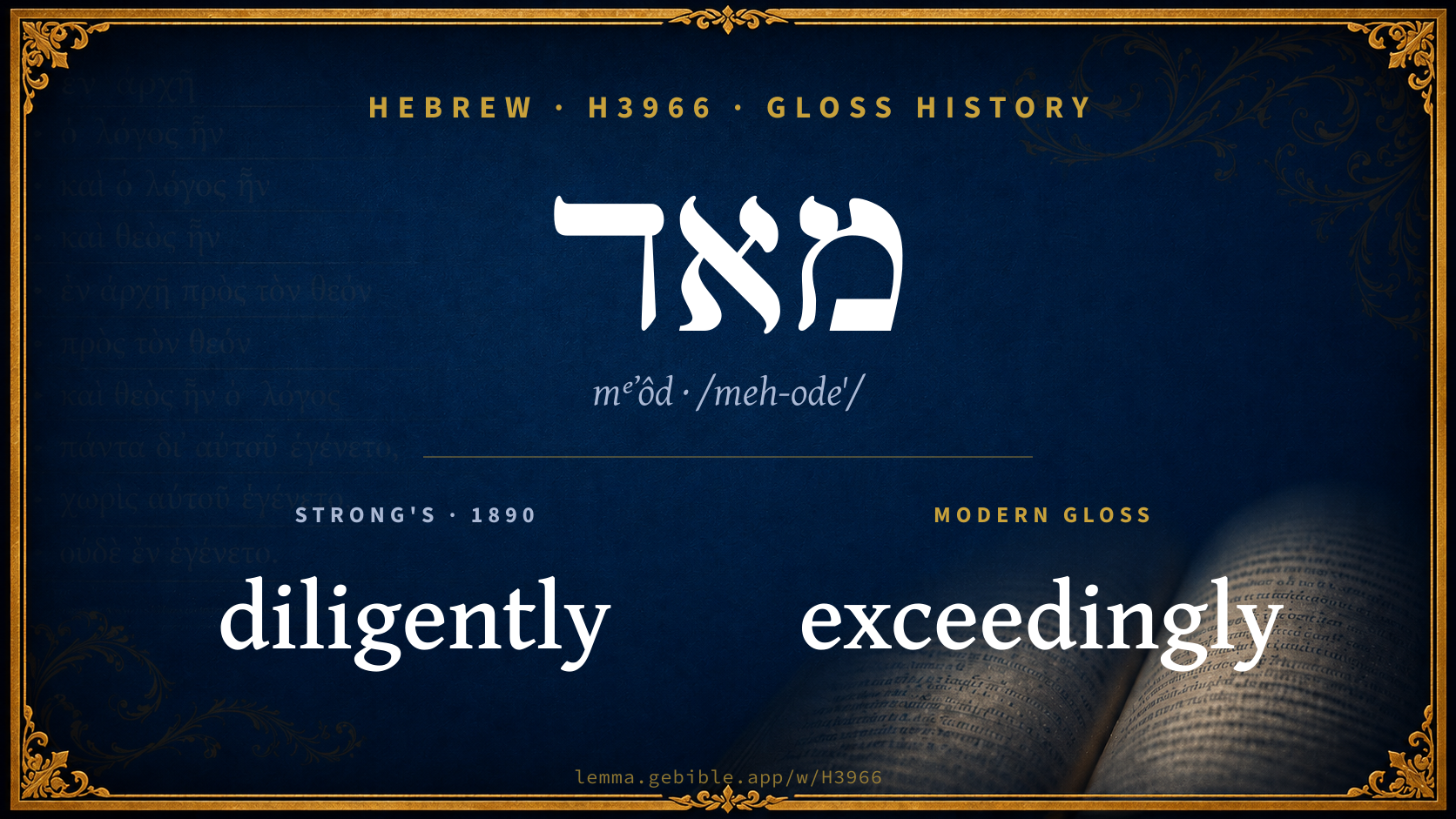
Gloss history
Strong's 1890 vs modern scholarship
About this word
Strong's H3966 catalogs a Hebrew word from the Hebrew Old Testament.
These counts are not copied from any lexicon or concordance. They are computed here, from the morphology-tagged Hebrew Old Testament. What Lemma adds →
- 278
- distinct verses
- The word appears in 278 distinct verses.
- 28 / 39
- OT books
- The word appears in 28 of 39 Old Testament books.
- #164
- by frequency
- Top 250 most frequent Hebrew words (rank 164 of 8,640 Hebrew words by occurrence).
View all 278 occurrences in the concordance →
By section of the Old Testament
By traditional corpus
Conventional, traditional groupings — biblical authorship is debated, so this is a traditional corpus grouping, not an authorship claim. Each share is this word’s portion of its verses in that division of the Hebrew canon. Each figure is a share of the word’s 278 distinct verses.
- Prophets (Nevi'im) 134 verses · 48%
- Writings (Ketuvim) 76 verses · 27%
- Torah (Pentateuch) 68 verses · 24%
How translations render this word
Counts come from each version’s own published word-to-Strong’s tagging or interlinear alignment — an approximate guide to how each version renders this word, not a word-level alignment the data otherwise carries. Because each total is that version’s own tagged count, the per-version totals vary from one another and need not match the appearance or distinct-verse counts above. These counts may also differ from a printed concordance because Lemma counts each distinctly tagged rendering and does not collapse phrase taggings into a single head-word total. This is a fixed set of word-tagged versions (KJV, ASV, BSB, ULT) and does not change with the reading translation you choose elsewhere. Each version’s license is shown beside its name below (and on Sources).
BDB lists this Strong’s number as 2 distinct words (homographs). Each count above pools all of them and is not split by sense — see the Senses section below. A low-frequency rendering may belong to a different one of those words, not the primary meaning.
- King James Version†: Very 55×, Greatly 29×, Was very 21×
- American Standard Version†: Very 47×, Greatly 26×, Was very 22×
- Berean Standard Bible†: Very 27×, Greatly 21×, Was very 8×
- unfoldingWord Literal Text†: Very 135×, Greatly 61×, Exceedingly 23×
King James Version Public Domain
Renders H3966 across 286† tagged occurrences — most commonly:
Plus other, less common renderings. Plus 76 renderings that appear only once — usually multi-word phrases or single function words the recovered tagging swept in, not distinct renderings. Not rendered by a distinct English word in 13 further occurrences.
American Standard Version Public Domain
Renders H3966 across 283† tagged occurrences — most commonly:
Plus other, less common renderings. Plus 80 renderings that appear only once — usually multi-word phrases or single function words the recovered tagging swept in, not distinct renderings.
Berean Standard Bible Public Domain
Renders H3966 across 195† tagged occurrences — most commonly:
Plus other, less common renderings. Plus 76 renderings that appear only once — usually multi-word phrases or single function words the recovered tagging swept in, not distinct renderings. Not rendered by a distinct English word in 104 further occurrences.
unfoldingWord Literal Text CC BY-SA 4.0
Renders H3966 across 296† tagged occurrences — most commonly:
Plus other, less common renderings. Plus 28 renderings that appear only once — usually multi-word phrases or single function words the recovered tagging swept in, not distinct renderings.
7 senses and sub-senses in the full BDB
What do BDB’s symbols mean?
BDB uses these scholarly abbreviations:
| Symbol | Meaning |
|---|---|
| 𝔊 | the Septuagint (the ancient Greek translation, LXX) |
| 𝔙 | the Vulgate (the Latin translation) |
| 𝔖 | the Syriac version (the Peshitta) |
| 𝔗 | the Targum (the Aramaic translation) |
| ψ | the Psalms |
| √ | root (the underlying root or stem) |
| ‖ | parallel passage (a synonymous or contrasted parallel) |
| † | the dagger: every passage where the word occurs is cited |
The 7 senses and sub-senses the full Brown-Driver-Briggs lexicon distinguishes for this word, in lexicon order (not ranked by frequency), with BDB’s own verbatim wording and sub-sense lettering. Shown in Hebrew script with BDB’s own scholarly abbreviations. The condensed entry is in the Lexicon Entry tab. See also the Forms in the corpus table below.
מאד I (√ of following Assyrian ma’âdu, be many, increase
מאד II muchness, force, abundance, exceedingly (cf. Assyrian mu’du, abundance, HomZMG 1878, 711 (‘treasures ana mu’di, in abundance’) DlHWB 399)
- 1. force, might, †Dt 6:5 וּבְכָל־מְאֹדֶ֑ךָ and with all thy might; hence 2 K 23:25. e.g. Deuteronomy 6:5
- 2. in diff. idioms (298 times) to express the idea of exceedingly, greatly, very (whether of magnitude or degree):
- a. (so mostly) as adv. acc., qualifying both adj. and obs., Gn 1:31 טוֹב מְאֹד good exceedingly, 4:5 וַיִּחַר לְקַיִן מְאֹד and Cain was wroth exceedingly, 7:18 וַיִּגְבְּרוּ הַמַּיִם וַיִּרְבּוּ מְאֹד, 12:14; 13:2 וְאַבְרָם כָּבֵד מְאֹד בַּמִּקְנֶה, v 13 חַטָּאִים לי׳ מאד, 18:20; 19:3, 9; 21:11; 24:16, 35, + often, ψ 46:2 עֶזְרָה בְצָרוֹת נִמְצָא מְאֹד as a help in troubles, to be found (= present) exceedingly; with an inf. Is 47:9 בְּעָצְמַת חֲבָרַיִךְ מְאֹד despite of thy spells being very numerous, Jos 9:13 מֵרֹב הַדֶּרֶךְ מְאֹד, 1 K 7:47; הַרְבֵּה מְאֹד Gn 15:1; 41:49; Dt 3:5 +, for which in the later language is found לָרֹב מְאֹד †Zc 14:14; 2 Ch 4:18; 9:9 (in 1 K 10:10 הַרְבֵּה מְאֹד), 24:24; 30:13, and even לְהַרְבֵּה מְאֹד †2 Ch 11:12; 16:8. מְאֹד is not usually separated from the word it qualifies by more than one or two words (as Gn 20:8 וייראו האנשׁים מאד, Nu 11:10 ויחר אף י׳ מאד); see, however, Dt 30:14; Ju 12:2; 2 S 12:5; 1 K 11:19 ψ 31:12. It precedes its verb, †ψ 47:10 מְאֹד נַעֲלָה (hence 97:9), 92:6. e.g. Genesis 1:31
- b. עַד־מְאֹד up to abundance, to a great degree, exceedingly, †Gn 27:33 חֲרָדָה גְּדֹלָה עַד־מ׳, v 34 1 S 11:15 וישׂמח … עד מ׳, 25:36 וְהוּא שִׁכֹּר עַד־מ׳, 2 S 2:17; 1 K 1:4; Is 64:8 (cf. La 5:22), v 11 ψ 38:7, 9; 119:8, 43, 51, 107; Dn 8:8; 11:25. e.g. Genesis 27:33
- c. עַד־לִמְאֹד (v. עַד לְ)† 2 Ch 16:14. e.g. 2 Chronicles 16:14
- d. duplicated (Ges§ 133 k), †Gn 7:19 וְהַמַּיִם גָּֽבְרוּ מ׳ מ׳, 30:43; Nu 14:7; 1 K 7:47; 2 K 10:4; Ez 37:10. e.g. Genesis 7:19
- e. בִּמְאֹד מְאֹד lit. with muchness, muchness, †Gn 17:2, 6, 20; Ex 1:7 (all P), Ez 9:9; 16:13. e.g. Genesis 17:2
Senses from the full Brown-Driver-Briggs lexicon (Brown, Driver, Briggs; Oxford 1906 — public domain), digitized via Sefaria, supplemented by the OpenScriptures HebrewLexicon (CC BY 4.0). Full attribution on Sources.
Word origin
I. (√ of following Assyrian ma’âdu, be many, increase; maʾadu, many; ma’adiš, in abundance, DlHWB, 388 f.; cf. Sab. מאד to add, DHMZMG 1883, 342 f. HomSüd-Ar. Chr. 127; Arabic مَأَدَ begin to grow, of plant).
I. n.m. muchness, force, abundance, exceedingly (cf. Assyrian mu’du, abundance, HomZMG 1878, 711 (‘treasures ana mu’di, in abundance’) DlHWB 399):—
— Brown-Driver-Briggs (Oxford 1906, public domain), digitized via Sefaria, supplemented by the OpenScriptures HebrewLexicon (CC BY 4.0). See Sources.
Derived from אוד (ʼûwd) (H181) — firebrand.
Jastrow Dictionary
A second Hebrew/Aramaic lexicon for comparison, covering Aramaic and post-biblical (Talmudic, Targumic, Midrashic) usage that the biblical-Hebrew BDB does not. Matched by lemma rather than by Strong’s number, so a lemma may carry more than one Jastrow headword (shown separately below), and the entries cover usage well beyond the Bible.
מְאֹד
- v. Schr. KAT2, p. 564) much; (adv.) very. Ber. IX, 5 (ref. to מאדך Deut. VI, 5) בכל מדה ומדה … הוי מודה לו במ׳ מ׳ (Ms. M. a. Y. ed. מ׳ מ׳; Bab. ed. 54ᵃ במ׳ מ׳ omitted) whatever measure he may measure out to thee, give thanks to him very, very much. Ab. IV, 4 מ׳ מ׳ הוי וכ׳ be exceedingly lowly in mind (humble). e.g. Deuteronomy 6:5
A Dictionary of the Targumim, the Talmud Babli and Yerushalmi, and the Midrashic Literature (Marcus Jastrow; London, Luzac, 1903) — Public Domain. Digitized via Sefaria. Digitized via Sefaria. Full attribution on Sources.
Forms in the corpus
The 23 distinct written forms H3966 takes in the Hebrew Bible, most frequent first — each parse links to that state’s occurrences in the concordance. Hebrew forms include their vowel points and cantillation, so a single lemma takes many written forms.
| Form | Parsing | Example | Uses |
|---|---|---|---|
| מְאֹֽד | Adverb | Deuteronomy 2:4 | 89 |
| מְאֹ֑ד | Adverb | Daniel 8:8 | 82 |
| מְאֹ֔ד | Adverb | Esther 1:12 | 47 |
| מְאֹ֖ד | Adverb | Deuteronomy 4:15 | 27 |
| מְאֹד֙ | Adverb | Exodus 11:3 | 11 |
| מְאֹ֗ד | Adverb | Deuteronomy 4:9 | 8 |
| בִּ/מְאֹ֣ד | Adverb | Exodus 1:7 | 5 |
| מְאֹ֜ד | Adverb | 1 Samuel 28:15 | 5 |
| מְאֹ֣ד | Adverb | Genesis 30:43 | 5 |
| מְאֹ֥ד | Adverb | Genesis 7:19 | 4 |
| מְאֹד֒ | Adverb | Genesis 27:33 | 3 |
| מְ֝אֹ֗ד | Adverb | Psalms 78:59 | 2 |
| מְאֹ֛ד | Adverb | 1 Samuel 5:11 | 2 |
| בִּ/מְאֹ֥ד | Adverb | Genesis 17:2 | 1 |
| לִ/מְאֹֽד | Noun, Common, Masculine, Singular, Absolute | 2 Chronicles 16:14 | 1 |
| מְ֭אֹד | Adverb | Psalms 6:10 | 1 |
| מְאֹ֡ד | Adverb | 2 Chronicles 9:1 | 1 |
| מְאֹ֤ד | Adverb | Joshua 9:24 | 1 |
| מְאֹד | Adverb | Ezekiel 37:10 | 1 |
| מְאֹד֔/וֹ | Noun, Common, Masculine, Singular, Construct | 2 Kings 23:25 | 1 |
| מְאֹד֮ | Adverb | Psalms 31:11 | 1 |
| מְאֹדֶֽ/ךָ | Noun, Common, Masculine, Singular, Construct | Deuteronomy 6:5 | 1 |
| מְּאֹ֑ד | Adverb | Psalms 104:1 | 1 |
Same root — word family
Other BDB entries built from the same root as H3966, grouped by Strong’s listed origin. These share a root / origin per the lexicon — not necessarily a shared meaning. Each links to that word’s own entry.
Derives from
Shares the same root
Compare all same-root words → Showing 4 of 5 — not the complete family. They share a root, not necessarily a meaning.
Septuagint verse parallels
This word appears in 252 verses that also exist in the Greek Old Testament (Septuagint), out of the 278 Hebrew verses it occurs in. You can read those verses in Greek by switching the Old Testament edition to the Septuagint.
Read these verses in the Septuagint
- Genesis 1:31
- Exodus 1:7
- Numbers 11:10
- Deuteronomy 2:4
- Joshua 1:7
- Judges 2:15
- Ruth 1:13
- 1 Samuel 2:17
- 2 Samuel 1:26
- 1 Kings 1:4
- 2 Kings 10:4
- 1 Chronicles 10:4
This is a verse-level parallel only — the same verses exist in both the Hebrew and Greek Old Testaments. No word-level Hebrew↔Greek correspondence is claimed: the data carries no such alignment, so no Greek word is shown as this Hebrew word’s translation. Coverage is not total — the Septuagint omits the deuterocanon and renumbers the Psalms, so some Hebrew verses have no direct Greek parallel.