

1 Samuel 18:30

Hebrew (Westminster Leningrad Codex) 1 Samuel 18:30 appears in the Hebrew Old Testament. The text above is from the Westminster Leningrad Codex. Each word links to its Strong’s number, a concise gloss, and parsing drawn from the Open Scriptures Hebrew Bible morphology. Click any word for its full Brown-Driver-Briggs (BDB) entry.
Download image
Cite this verse

1 Samuel 18:30 (World English Bible). Public Domain. Lemma interlinear Bible study tool, https://lemma.gebible.app/v/1-samuel/18/30.

Show BibTeX & RIS
BibTeX
RIS
English Translation
Then the princes of the Philistines went forth: and it happened, as often as they went forth, that David behaved himself more wisely than all the servants of Saul; so that his name was much set by.
World English Bible · Public Domain
Highlights
  • 1 first appearance in the Hebrew Bible
Full analysis ↓
Download a study sheet

One document with this verse’s original text, its word-by-word gloss line, the meaning frame, cross-references with their text, attributed commentary, and full source and license credits — printable, and it pastes into notes with its structure intact.

This verse Autodidact and up

Study sheet (.html) Plain text (.txt)

A passage Seminary Student

Up to 50 verses in one chapter. A passage sheet keeps up to 6 commentary sources and 12 cross-references per verse, in the order this page ranks them, and says so on the sheet whenever that leaves anything out. Ask for a single verse and you get the Autodidact verse sheet above.

Everything on this page stays free to read, with no account — the sheet is a download of what is already on screen, not access to it.

Want to remove ads? Support Godless Engineer
Compare translations 3

The same verse in 3 English versions, stacked beneath the original-language interlinear above. Click any original word for its lexicon entry.

Each is an independent rendering of the whole verse — the interlinear is not word-aligned to these translations.

Highlighted words mark where these versions differ — a whole-verse word diff, not a word-by-word alignment.

  • World English Bible Public Domain
    Then the princes of the Philistines went forth: and it happened, as often as they went forth, that David behaved himself more wisely than all the servants of Saul; so that his name was much set by.
  • King James Version Public Domain
    Then the princes of the Philistines went forth: and it came to pass, after they went forth, that David behaved himself more wisely than all the servants of Saul; so that his name was much set by.
  • unfoldingWord Literal Text CC BY-SA 4.0
    And the commanders of the Philistines came out, and it happened that, whenever they came out, David was more successful than all of the servants of Saul, and his name became greatly precious.

unfoldingWord Literal Text — © unfoldingWord, licensed CC BY-SA 4.0. Word-aligned USFM3 via Door43 (git.door43.org/unfoldingWord/en_ult).

Versions to compare (up to 4)

3 of 4 selected

Show all 18 translations

Every available English version of this verse, each an independent rendering of the whole verse.

  • World English Bible Public Domain
    Then the princes of the Philistines went forth: and it happened, as often as they went forth, that David behaved himself more wisely than all the servants of Saul; so that his name was much set by.
  • Berean Standard Bible Public Domain
    Every time the Philistine commanders came out for battle, David was more successful than all of Saul’s officers, so that his name was highly esteemed.
  • Majority Standard Bible Public Domain
    Every time the Philistine commanders came out for battle, David was more successful than all of Saul’s officers, so that his name was highly esteemed.
  • King James Version Public Domain
    Then the princes of the Philistines went forth: and it came to pass, after they went forth, that David behaved himself more wisely than all the servants of Saul; so that his name was much set by.
  • American Standard Version (1901) Public Domain
    Then the princes of the Philistines went forth: and it came to pass, as often as they went forth, that David behaved himself more wisely than all the servants of Saul; so that his name was much set by.
  • Revised Version (1885) Public Domain
    Then the princes of the Philistines went forth: and it came to pass, as often as they went forth, that David behaved himself more wisely than all the servants of Saul; so that his name was much set by.
  • Geneva Bible (1599) Public Domain
    And when the Princes of the Philistims went forth, at their going forth Dauid behaued himselfe more wisely then all the seruants of Saul, so that his name was much set by.
  • Douay-Rheims (1899) Public Domain
    And the princes of the Philistines went forth: and from the beginning of their going forth, David behaved himself more wisely than all the servants of Saul, and his name became very famous.
  • Young's Literal Translation Public Domain
    And the princes of the Philistines come out, and it cometh to pass from the time of their coming out, David hath acted more wisely than any of the servants of Saul, and his name is very precious.
  • Literal Standard Version CC BY-SA 4.0
    And the princes of the Philistines come out, and it comes to pass from the time of their coming out, David has acted more wisely than any of the servants of Saul, and his name is very precious.
  • Unlocked Literal Bible CC BY-SA 4.0
    Then the princes of the Philistines came out for battle, and as often as they came out, David succeeded more than all the servants of Saul, so that his name was highly regarded.
  • unfoldingWord Literal Text CC BY-SA 4.0
    And the commanders of the Philistines came out, and it happened that, whenever they came out, David was more successful than all of the servants of Saul, and his name became greatly precious.
  • Darby Bible Public Domain
    And the princes of the Philistines went forth; and it came to pass, whenever they went forth, that David succeeded better than all the servants of Saul; and his name was much esteemed.
  • World Messianic Bible Public Domain
    Then the princes of the Philistines went out; and as often as they went out, David behaved himself more wisely than all the servants of Saul, so that his name was highly esteemed.
  • Webster's Bible Public Domain
    Then the princes of the Philistines went forth: and it came to pass after they went forth, that David behaved himself more wisely than all the servants of Saul; so that his name was much esteemed.
  • Free Bible Version CC BY-SA 4.0
    Whenever the Philistine commanders attacked, David was more successful in battle than all of Saul's officers, so that his reputation grew rapidly.
  • Bible in Basic English Public Domain
    Then the rulers of the Philistines went out to war: and whenever they went out, David did more wisely than all the other servants of Saul, so that his name became greatly honoured.
  • JPS Tanakh (1917) Public Domain
    Then the princes of the Philistines went forth; and it came to pass, as often as they went forth, that David prospered more than all the servants of Saul; so that his name was much set by.

Literal Standard Version (2020), Covenant Press — licensed CC BY-SA 4.0. Text via the HelloAO Bible API (eBible.org). Unlocked Literal Bible (unfoldingWord) — licensed CC BY-SA 4.0. Text via the HelloAO Bible API (eBible.org). unfoldingWord Literal Text — © unfoldingWord, licensed CC BY-SA 4.0. Word-aligned USFM3 via Door43 (git.door43.org/unfoldingWord/en_ult). Free Bible Version, Dr. Jonathan Gallagher — licensed CC BY-SA 4.0. Text via the HelloAO Bible API (eBible.org).

Word by word

More ways to search: Search by grammar → Find every occurrence → Compare this word →

Practice this passage: Drill this verse → Learn its vocabulary →

וַיִּיקַ֥ר
yâqar
H3365
“and · to be precious”
Conjunction + Verb, Qal, Sequential Imperfect, 3rd Person, Masculine, Singular
Part of Speech
Conjunction + Verb
Stem
Qal
Form
Sequential Imperfect
Person
3rd Person
Gender
Masculine
Number
Singular
Full BDB Definition

Origin: a primitive root

TWOT: 905

to esteem, be prized, be valuable, be precious, be costly, be appraised - (Qal) - to be precious, be highly valued, be esteemed, be costly - to be appraised - (Hiphil) to make something precious
  1. וַיֵּצְא֖וּ yâtsâʼ H3318 “and · to go out” Conjunction + Verb, Qal, Sequential Imperfect, 3rd Person, Masculine, Plural
  2. שָׂרֵ֣י sar H8269 “princes of” Noun, Common, Masculine, Plural, Construct
  3. פְלִשְׁתִּ֑ים Pᵉlishtîy H6430 “Philistines” Noun, Gentilic, Masculine, Plural, Absolute
  4. וַיְהִ֣י hâyâh H1961 “and · to be” Conjunction + Verb, Qal, Sequential Imperfect, 3rd Person, Masculine, Singular
  5. מִדֵּ֣י day H1767 “from · enough of” Preposition + Noun, Common, Masculine, Singular, Construct
  6. צֵאתָ֗ם yâtsâʼ H3318 “to go out · them” Verb, Qal, Infinitive Construct + Suffix, Personal, 3rd Person, Masculine, Plural
  7. שָׂכַ֤ל sâkal H7919 “to be prudent” Verb, Qal, Perfect, 3rd Person, Masculine, Singular
  8. דָּוִד֙ Dâvid H1732 “David” Noun, Proper
  9. מִכֹּל֙ kôl H3605 “from · all of” Preposition + Noun, Common, Masculine, Singular, Construct
  10. עַבְדֵ֣י ʻebed H5650 “servants of” Noun, Common, Masculine, Plural, Construct
  11. שָׁא֔וּל Shâʼûwl H7586 “Saul” Noun, Proper
  12. שְׁמ֖וֹ shêm H8034 “name · his” Noun, Common, Masculine, Singular, Construct + Suffix, Personal, 3rd Person, Masculine, Singular
  13. מְאֹֽד mᵉʼôd H3966 “exceedingly” Adverb

About this verse

These counts appear in no published source. They are computed here, from the morphology-tagged text and Lemma’s own curated glosses. What Lemma adds →

14
words
13
distinct lemmas
Historical
section

Notable vocabulary

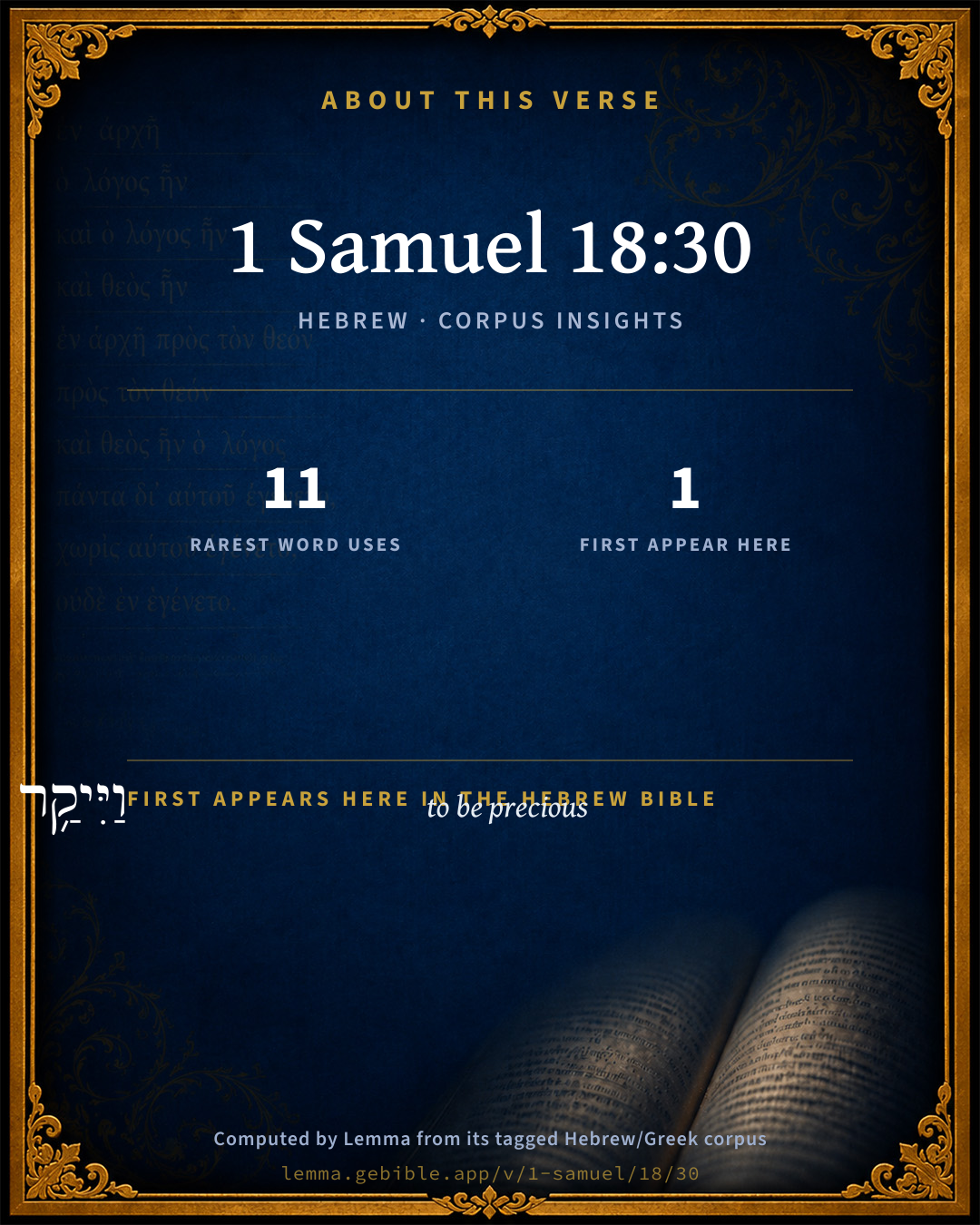
The rarest word here is וַיִּיקַ֥ר to be precious H3365 — appearing just 11 times in the whole Hebrew Bible.

First appearance in Scripture

This word makes its first canonical appearance in the Hebrew Bible here:

  • וַיִּיקַ֥ר to be precious H3365

Shared distinctive vocabulary

וַיִּיקַ֥ר to be precious H3365 occurs in 11 verses of the Hebrew Bible. Also found in:

Grammatical profile

  • 5 verbs
  • 8 nouns
  • 1 adverb

Verb forms

  • וַיֵּצְא֖וּ Qal · Sequential Imperfect
  • וַיְהִ֣י Qal · Sequential Imperfect
  • צֵאתָ֗ם Qal · Infinitive Construct
  • שָׂכַ֤ל Qal · Perfect
  • וַיִּיקַ֥ר Qal · Sequential Imperfect

Repetition

A word recurs within this verse — often emphatic in Hebrew:

  • וַיֵּצְא֖וּ to go out H3318 ×2

Hebrew & Septuagint length

In English translation the verse runs 37 words from the Hebrew and 40 from the Septuagint (LXX English) — closely comparable.

A rough comparison of the two English renderings, which tokenize alike — not a word-level alignment.

Word counts can differ between the Hebrew and the Greek without any difference in meaning — e.g. the Hebrew direct-object marker אֵת has no separate Greek word, and Greek often adds the article ὁ.

Cross-references

12

Topical passages linked to 1 Samuel 18:30 in the Treasury of Scripture Knowledge — connected by theme and wording, ordered by reader-vote popularity; previews shown in the World English Bible.

  • 1 Samuel 18:5 David went out wherever Saul sent him, [and] behaved himself wisely: and Saul set him over the men of war, and it was good in the sight of all the people, and also in the sight of Saul's servants.
  • 2 Samuel 11:1 It happened, at the return of the year, at the time when kings go out [to battle], that David sent Joab, and his servants with him, and all Israel; and they destroyed the children of Ammon, and besieged Rabbah. But David stayed at Jerusalem.
  • 1 Samuel 2:30 Therefore Yahweh, the God of Israel, says, I said indeed that your house, and the house of your father, should walk before me forever: but now Yahweh says, Be it far from me; for those who honor me I will honor, and those who despise me shall be lightly esteemed.
  • Psalms 119:99 I have more understanding than all my teachers, For your testimonies are my meditation.
  • Daniel 1:20 In every matter of wisdom and understanding, concerning which the king inquired of them, he found them ten times better than all the magicians and enchanters who were in all his realm.
  • Luke 21:15 for I will give you a mouth and wisdom which all your adversaries will not be able to withstand or to contradict.
  • Ephesians 5:15 Therefore watch carefully how you walk, not as unwise, but as wise;
  • 1 Peter 2:4 coming to him, a living stone, rejected indeed by men, but chosen by God, precious.
  • 1 Peter 2:7 For you therefore who believe is the honor, but for such as are disobedient, "The stone which the builders rejected, Has become the chief cornerstone,"
  • 1 Samuel 26:21 Then said Saul, I have sinned: return, my son David; for I will no more do you harm, because my life was precious in your eyes this day: behold, I have played the fool, and have erred exceedingly.
  • 2 Kings 1:13 Again he sent the captain of a third fifty with his fifty. The third captain of fifty went up, and came and fell on his knees before Elijah, and begged him, and said to him, man of God, please let my life, and the life of these fifty your servants, be precious in your sight.
  • Psalms 116:15 Precious in the sight of Yahweh is the death of his saints.

Cross-references courtesy of OpenBible.info (CC BY 4.0).

Hebrew and Greek witnesses Masoretic Hebrew ↔ Greek Septuagint

The same verse in the two great witnesses to the Old Testament, shown verse-for-verse.

These are two independent witnesses, not word-aligned to each other, and the Septuagint is shown in lemma (dictionary) form.

Hebrew 1 Samuel 18:30 Masoretic · Westminster Leningrad Codex

וַיֵּצְא֖וּ שָׂרֵ֣י פְלִשְׁתִּ֑ים וַיְהִ֣י מִדֵּ֣י צֵאתָ֗ם שָׂכַ֤ל דָּוִד֙ מִכֹּל֙ עַבְדֵ֣י שָׁא֔וּל וַיִּיקַ֥ר שְׁמ֖וֹ מְאֹֽד

Then the princes of the Philistines went forth: and it happened, as often as they went forth, that David behaved himself more wisely than all the servants of Saul; so that his name was much set by.

World English Bible · Public Domain

Greek LXX 1 Samuel 18:30 Septuagint · lemma form
And the chief of the Philistines went forth; and it came to pass that from 18:30 Gr. their sufficient expedition. the suficiency of their expedition David acted Wisely above all the servants of Saul; and his name was honored exceedingly.

LXX2012 (modern English Septuagint) · Public Domain

Hebrew: Westminster Leningrad Codex (CC BY 4.0). Greek: Septuagint (public domain); English from LXX2012 (modern English Septuagint) (Public Domain). How the Septuagint differs from the Hebrew →

Targum (Aramaic paraphrase)

1

The Targum is the ancient Jewish Aramaic paraphrase of the Hebrew Scriptures — an interpretive translation, not the Hebrew text itself. Onkelos (literal) and Pseudo-Jonathan (expansive) render the Torah, and Jonathan the Prophets. Coverage is partial: where no permissively-licensed English translation exists for a verse, only the Aramaic is shown. This is verse-level text, not a word-by-word alignment to the Hebrew.

  1. Targum Jonathan Prophets (Joshua–Malachi)
    וּנְפָקוּ רַבְרְבֵי פְלִשְׁתָּאֵי וַהֲוָה בִזְמַן מִפַּקְהוֹן אַצְלַח דָוִד מִכָּל עַבְדֵי שָׁאוּל וּסְגֵי שְׁמֵיהּ לַחֲדָא:

    (no public-domain English translation for this verse)

    Targum Jonathan — Aramaic: “Mikraot Gedolot” (public domain). English: “Sefaria Community Translation” (CC0 1.0 (public-domain dedication)); “London "Chaldee Paraphrase," 1871” (public domain). Text via Sefaria.

Commentary

Notes on 1 Samuel 18:30 from classic Christian and Jewish commentators (each source and its license shown beneath its notes). The classic Christian expositions comment on the surrounding passage and are grouped to its opening verse, so a note may address several verses; the Jewish commentaries on the Tanakh (Rashi and others) are per-verse, so they appear only where the commentator wrote on this verse.

Lemma curates 59 commentaries, every one of them public domain or Creative Commons licensed, each selected and text-cleaned for this edition rather than reprinted as found. About our sources →

Trapp's Complete Commentary

John Trapp

1Sa 18:30 Then the princes of the Philistines went forth: and it came to pass, after they went forth, [that] David behaved himself more wisely than all the servants of Saul; so that his name was much set by.

Ver. 30. So that his name was much set by.] Heb., Was precious. Glory fled from Saul who followed it; but followed David who fled from it.

John Trapp, A Commentary or Exposition upon All the Books of the Old and New Testament (1647–1656) — public domain. Text from a community e-Sword module.

Joseph Benson's Commentary

1Sa 18:30. The princes of the Philistines went forth — To fight with the Israelites: who had highly incensed them by David’s late action, as well as by former losses. David behaved himself more wisely than all the servants of Saul, &c. — By discovering, it is likely, the designs of the Philistines, and preventing them. For we do not read that they came to a battle.

Joseph Benson's Commentary on the Old and New Testaments (1811–1818) — public domain. Text from a community e-Sword module.

Geneva Bible (1599)

Geneva Bible translators

That is, David had better success against the Philistines than Saul’s men.

Geneva Bible (1599) marginal notes — public domain. Text via Bolls.life.

Adam Clarke's Commentary

Verse 30. Then the princes of the Philistines went forth] Probably to avenge themselves on David and the Israelites: but of this war we know no more than that David was more skilful and successful in it than any of the other officers of Saul. His military skill was greater, and his success was proportionate to his skill and courage; hence it is said, he behaved himself more wisely than all the servants of Saul.

Adam Clarke's Commentary on the Bible (1810–1826) — public domain. Text from a community e-Sword/MySword module.

Ellicott's Commentary for English Readers

(30) Went forth.—Probably to avenge the last raid of David (recounted in 1Sa_18:27). Wordsworth, quoting from the Rabbis, suggests that they were emboldened to make this attack, supposing that their successful foe would, according to the Hebrew Law, claim exemption from warfare for a year after marriage (Deu_24:5).

A Bible Commentary for English Readers, edited by Charles John Ellicott (1878–1897) — public domain. Text from a community e-Sword module.

The Cambridge Bible for Schools and Colleges

gen. ed. J. J. S. Perowne

30. Then the princes, &c.] “And the princes, &c., and it came to pass as often as they went forth, &c.” This notice of David’s continual success and growing popularity gives the ground of Saul’s increasing enmity, and prepares the way for the narrative of the next chapter.

set by] i.e. esteemed. Cp. Psa_15:4 in the P. B. V. “He that setteth not by himself.”

The Cambridge Bible for Schools and Colleges (gen. ed. J. J. S. Perowne; Cambridge University Press, 1878–1918) — public domain. Text from a community e-Sword module.

John Gill's Exposition

Then the princes of the Philistines went forth,.... Out of their cities in troops, to revenge and spoil the land of Israel, being enraged at their defeat when Goliath their champion was slain, and at the injury and dishonour done them by David very lately in slaying two hundred of them, and taking off their foreskins; and, as the Jews say (b), having heard of the marriage of David, and understanding the Israelites had a law, that a newly married man might not go to the war the first year, took this opportunity of invading and spoiling them; whereas David understood that law better than they, and knew it referred not to a voluntary war, but to that which was the command of God against the seven nations; and even in that case, as some think, it did not oblige such persons to remain at home, but left it to their choice to do as they pleased:

and it came to pass after they went forth; and were met and opposed by the Israelites, by the troops of Saul, under different commanders:

that David behaved himself more wisely than all the servants of Saul; showed himself to be more expert in the art of war, and formed designs with great wisdom and prudence, and which he as wisely executed, as well as with great courage and valour, to the annoyance and defeat of the enemy, and to the advantage, defence, and safety of the people of Israel; or he was more "prosperous" than they, as the Targum, and so others interpret it; he was more successful in his attacks on the Philistines, and in his skirmishes with them:

so that his name was much set by; he was in high esteem with the people; his name was "precious" (c) to them, as the word signifies; they made mention of it, as, Ben Gersom interprets it, with great honour and glory; so that Saul failed much, and was greatly disappointed in the scheme he had formed against him,

(b) Midrash Schemuel apud Abarbinel. in loc. (c) "et in pretio esset vel erat", Junius & Tremellius, Piscator.

John Gill's Exposition of the Whole Bible (1746–1763) — public domain (CC PDM 1.0). Text via the HelloAO Bible API.

Haydock's Catholic Bible Commentary

Forth, probably to revenge the recent insult. (Calmet)

George Leo Haydock (1774–1849), Haydock's Catholic Family Bible and Commentary, 1859 edition — public domain. Excludes Psalms (Douay-Rheims chapter numbering differs from Protestant) and Deuterocanonical books (Catholic canon only).

Matthew Poole's English Annotations

Went forth, to wit, to war against the Israelites, being provoked both by their former losses, and especially by that act of David’s, related above, 1Sa 18:27.

Matthew Poole's English Annotations on the Holy Bible (1683–1685) — public domain. Text from a community e-Sword/MySword module.

Whedon's Commentary on the Bible

Daniel D. Whedon

30. The Philistines went forth — To battle against the armies of Israel.

David behaved himself more wisely than all the servants of Saul — Showed more prudence, skill, and prowess in all the tactics of war.

Much set by — Exceedingly honoured.

Daniel D. Whedon (gen. ed.), Commentary on the Old and New Testaments (1874–1909) — public domain. Text from a community e-Sword module.

The Pulpit Commentary

The princes of the Philistines went forth. See on ver. 5. This new war was the result of David"s raid, but it only led to an increase of his fame and popularity. For he behaved himself more wisely. Ie. was more successful and skilful than any of Saul"s other officers.

The Pulpit Commentary (1880–1919), ed. H.D.M. Spence-Jones & Joseph S. Exell — public domain. Text from a community e-Sword module.

John Wesley's Explanatory Notes

Went forth - To war against the Israelites, being provoked by their former losses, and especially by that act of David's.

John Wesley, Explanatory Notes Upon the Whole Bible (1754–1765) — public domain. Text via the GEBible commentary corpus.

unfoldingWord translationNotes

Door43 World Missions Community

so that his name was highly regarded

Here "name" is a metonym for David. This can be stated in active form. AT: "so that people greatly respected David" (See: Metonymy and Active or Passive)

translationWords

prince

David

servant

Saul (OT)

name

unfoldingWord translationNotes — © Distant Shores Media and the Door43 World Missions Community, licensed CC BY-SA 4.0. Source: git.door43.org/Door43/en_tn.

Rashi

Rabbi Shlomo Yitzchaki (Rashi)

The Philistines officers would venture out. To come in troops to plunder [the Bnei] Yisroel.

Rashi on the Tanakh — English translations: “The Judaica Press complete Tanach with Rashi, translated by A. J. Rosenberg” (CC BY 4.0); “Pentateuch with Rashi's commentary by M. Rosenbaum and A.M. Silbermann, 1929-1934” (public domain); “The Metsudah Tanach series, Lakewood, N.J” (CC BY 4.0); and “The Book of Joshua, Metsudah Publications, 1997” (CC BY 4.0). Text via Sefaria.

Lesson kit

Teaching starters — assembled from the data on this page, not authored interpretation. Every prompt links to the verse data it draws on. Edit before teaching.

1 Samuel, in the Historical, opens this verse with 14 words (13 distinct Hebrew lemmas). Its most distinctive word is yâqar (“to be precious”). A historical commentator’s framing appears above. Read the whole chapter for the surrounding context.

Discussion questions

  1. The word yâqar carries the sense “to be precious.” How does it shape the verse?
  2. The word “to be precious” first appears here in Scripture. What is being introduced at this debut?
  3. 1 Samuel 26:21 shares the word «to be precious» with this verse. How do the two illuminate each other?
  4. “to go out” occurs 2× in this one verse. What is the effect of the repetition?
  5. These translations render this verse differently; the difference is in the English rendering, not the original. What questions does that raise?
  6. The verb «וַיֵּצְא֖וּ» is Qal Sequential Imperfect. How does its form color the action?
  7. Reading how Trapp's Complete Commentary and Joseph Benson's Commentary read this verse, where do the two commentators agree and where do they part?

Things to notice

  • 1 word makes its first canonical appearance in Scripture here.
  • These translations choose different wording for 20 words in this verse.
  • “to go out” occurs 2× in this single verse.
  • 13 distinct Hebrew lemmas span 14 words in this verse.

Reading settings

Reading text

Shown beneath each verse's original-language words.

Old Testament
Old Testament edition

Read the OT as the Masoretic Hebrew (MT) or the Greek Septuagint (LXX).

English shown for the Greek Septuagint (in the Hebrew ↔ Greek comparison).

Comparing translations? Open the Compare panel on any verse page to stack up to four side by side.