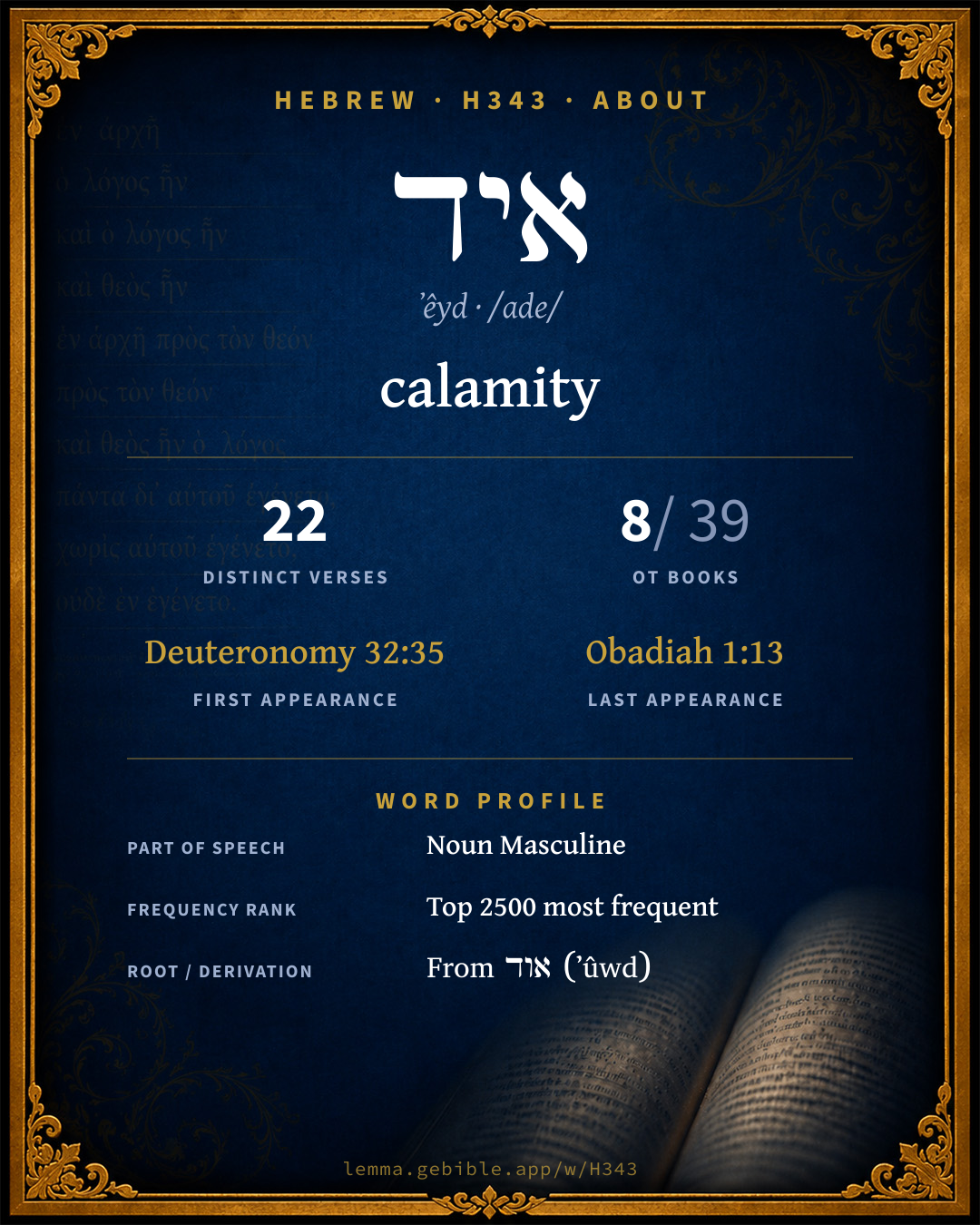
אֵיד
calamity
also: distress, burden fuller range ↓
Full lexicon entry — Brown-Driver-Briggs (BDB)
From Brown-Driver-Briggs (BDB)
Where this word appears
See every Construct-state word in the Hebrew Bible →
Grammar key — what these labels mean
Part of speech
- Noun
- A naming word — a person, place, thing, or idea.
Noun type
- Common
- A common noun — a general class of person, place, or thing (“king,” “city,” “water”), not a specific name.
State
- Construct
- A noun bound to a following noun in a possessive / “of” relationship (the construct chain).
- Absolute
- The independent form of a noun, not bound to a following word.
Gender
- Masculine
- Grammatically masculine.
Number
- Singular
- One.
Grammatical forms
- Noun, Common, Masculine, Singular, Construct 20 times (83%)
- Noun, Common, Masculine, Singular, Absolute 4 times (17%)
Parsed forms decoded from the imported morphology (morphhb / Westminster Leningrad Codex — WLC text public domain, morphhb tagging CC BY 4.0), counted across 24 parsed occurrences — not distinct verses.
Every verse where H343 appears — 22 distinct verses across 8 books. Click any verse to open its interlinear word-by-word view. Verse text shown in the World English Bible for context — . Each verse’s Hebrew form is shown with its reference; the English is not keyword-highlighted, since the data carries no word-level English alignment. Use “Compare translations” on any verse to read it across multiple English versions. This concordance covers the Hebrew Bible; Septuagint (Greek Old Testament) occurrences are not indexed here.
Deuteronomy 1 verse
2 Samuel 1 verse
Job 6 verses
- Job 18:12 וְ֝/אֵ֗יד conj + n c ms His strength shall be famished, Calamity shall be ready at his side.
- Job 21:17 אֵידָ֑/ם n c ms cs + sfx pers 3mp "How often is it that the lamp of the wicked is put out? That their calamity comes on them? That God distributes sorrows in his anger?
- Job 21:30 אֵ֭יד n c ms That the evil man is reserved to the day of calamity? That they are led forth to the day of wrath?
- Job 30:12 אֵידָֽ/ם n c ms cs + sfx pers 3mp On my right hand rise the rabble. They thrust aside my feet, They cast up against me their ways of destruction.
- Job 31:3 אֵ֥יד n c ms Is it not calamity to the unrighteous, And disaster to the workers of iniquity?
- Job 31:23 אֵ֣יד n c ms cs For calamity from God is a terror to me, By reason of his majesty I can do nothing.
Psalms 1 verse
Proverbs 6 verses
- Proverbs 1:26 בְּ/אֵידְ/כֶ֣ם prep + n c ms cs + sfx pers 2mp I also will laugh at your disaster. I will mock when calamity overtakes you;
- Proverbs 1:27 וְֽ֭/אֵידְ/כֶם conj + n c ms cs + sfx pers 2mp When calamity overtakes you like a storm, When your disaster comes on like a whirlwind; When distress and anguish come on you.
- Proverbs 6:15 אֵיד֑/וֹ n c ms cs + sfx pers 3ms Therefore his calamity will come suddenly. He will be broken suddenly, and that without remedy.
- Proverbs 17:5 לְ֝/אֵ֗יד prep + n c ms Whoever mocks the poor reproaches his Maker. He who is glad at calamity shall not be unpunished.
- Proverbs 24:22 אֵידָ֑/ם n c ms cs + sfx pers 3mp For their calamity will rise suddenly; The destruction from them both--who knows?
- Proverbs 27:10 אֵידֶ֑/ךָ n c ms cs + sfx pers 2ms Don't forsake your friend and your father's friend. Don't go to your brother's house in the day of your disaster: Better is a neighbor who is near than a distant brother.
Jeremiah 5 verses
- Jeremiah 18:17 אֵידָֽ/ם n c ms cs + sfx pers 3mp I will scatter them as with an east wind before the enemy; I will show them the back, and not the face, in the day of their calamity.
- Jeremiah 46:21 אֵידָ֛/ם n c ms cs + sfx pers 3mp Also her hired men in the midst of her are like calves of the stall; for they also are turned back, they are fled away together, they didn't stand: for the day of their calamity is come on them, the time of their visitation.
- Jeremiah 48:16 אֵיד n c ms cs The calamity of Moab is near to come, and his affliction hurries fast.
- Jeremiah 49:8 אֵ֥יד n c ms cs Flee you, turn back, dwell in the depths, inhabitants of Dedan; for I will bring the calamity of Esau on him, the time that I shall visit him.
- Jeremiah 49:32 אֵידָ֖/ם n c ms cs + sfx pers 3mp Their camels shall be a booty, and the multitude of their cattle a spoil: and I will scatter to all winds those who have the corners [of their hair] cut off; and I will bring their calamity from every side of them, says Yahweh.
Ezekiel 1 verse
Obadiah 1 verse
About this entry
At a glance — auto-summarized from this page’s data, not written by a person. Every figure links to its source below. This summary describes the numbers; it doesn’t interpret them.
The Hebrew noun איד centers on the idea of “calamity.” Alongside “calamity” the lexicon also lists “distress” and “burden” — part of its full sense range. It turns up in 22 verses across 8 books, an uncommon footprint. The word gravitates to Job (27%), then Proverbs and Jeremiah. Its earliest occurrence is Deuteronomy 32:35. For the data behind this summary, explore the sense tree and the renderings breakdown below.
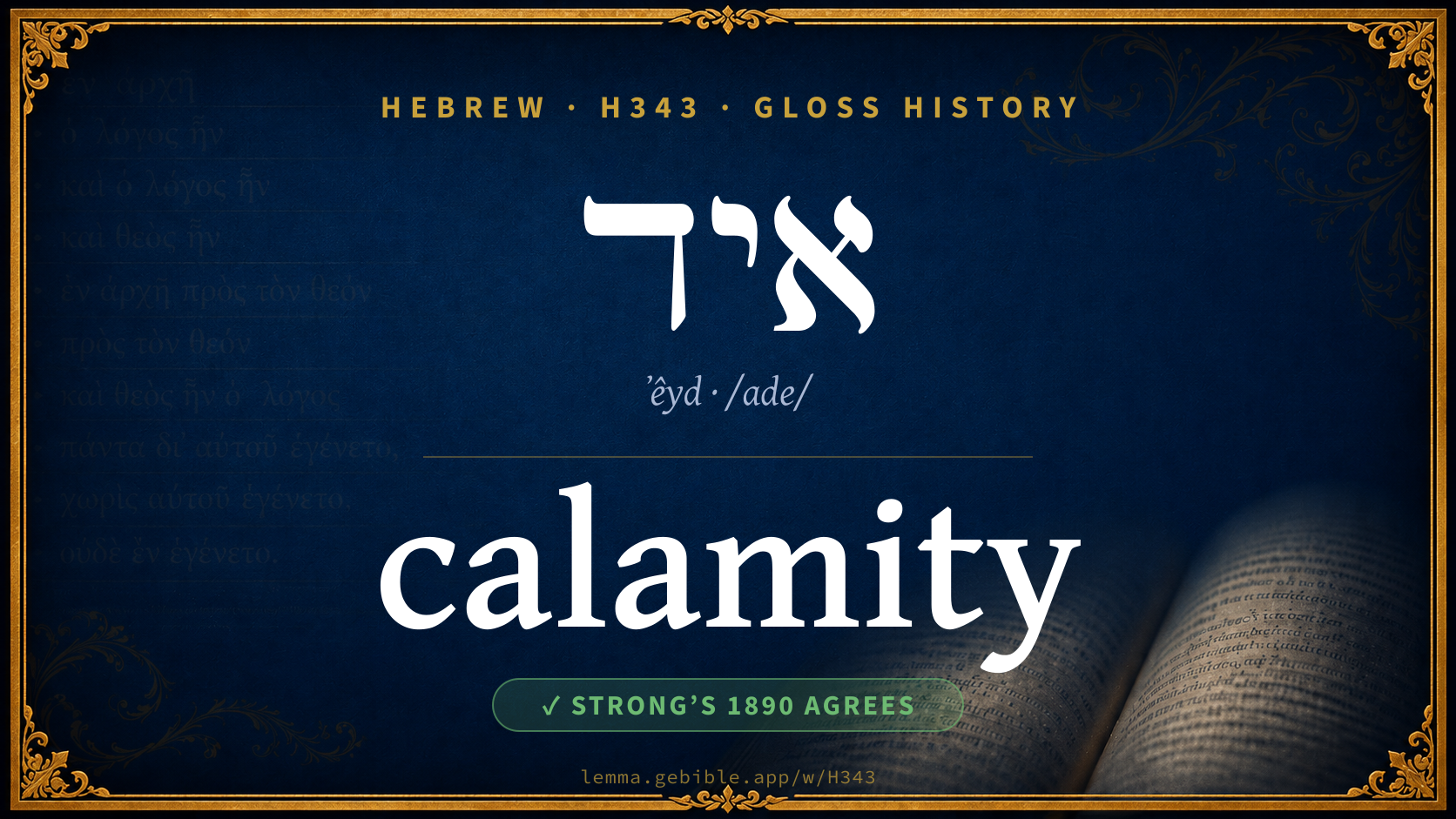
Gloss history
Strong's 1890 vs modern scholarship
About this word
Strong's H343 catalogs a Hebrew word from the Hebrew Old Testament.
These counts are not copied from any lexicon or concordance. They are computed here, from the morphology-tagged Hebrew Old Testament. What Lemma adds →
- 22
- distinct verses
- The word appears in 22 distinct verses.
- 8 / 39
- OT books
- The word appears in 8 of 39 Old Testament books.
- #1,327
- by frequency
- Top 2500 most frequent Hebrew words (rank 1,327 of 8,640 Hebrew words by occurrence).
View all 22 occurrences in the concordance →
By section of the Old Testament
By traditional corpus
Conventional, traditional groupings — biblical authorship is debated, so this is a traditional corpus grouping, not an authorship claim. Each share is this word’s portion of its verses in that division of the Hebrew canon. Each figure is a share of the word’s 22 distinct verses.
- Writings (Ketuvim) 13 verses · 59%
- Prophets (Nevi'im) 8 verses · 36%
- Torah (Pentateuch) 1 verse · 5%
How translations render this word
Counts come from each version’s own published word-to-Strong’s tagging or interlinear alignment — an approximate guide to how each version renders this word, not a word-level alignment the data otherwise carries. Because each total is that version’s own tagged count, the per-version totals vary from one another and need not match the appearance or distinct-verse counts above. These counts may also differ from a printed concordance because Lemma counts each distinctly tagged rendering and does not collapse phrase taggings into a single head-word total. This is a fixed set of word-tagged versions (KJV, ASV, BSB, ULT) and does not change with the reading translation you choose elsewhere. Each version’s license is shown beside its name below (and on Sources).
- King James Version: Calamity 15×, Destruction 6×
- American Standard Version: Calamity 19×
- Berean Standard Bible: Calamity 11×, Disaster 7×, Destruction 2×
- unfoldingWord Literal Text: Calamity 15×, Disaster 2×
King James Version Public Domain
Renders H343 across 24 tagged occurrences — most commonly:
Plus 3 renderings that appear only once — usually multi-word phrases or single function words the recovered tagging swept in, not distinct renderings.
American Standard Version Public Domain
Renders H343 across 24 tagged occurrences — most commonly:
Plus 5 renderings that appear only once — usually multi-word phrases or single function words the recovered tagging swept in, not distinct renderings.
Berean Standard Bible Public Domain
Renders H343 across 23 tagged occurrences — most commonly:
Plus 3 renderings that appear only once — usually multi-word phrases or single function words the recovered tagging swept in, not distinct renderings. Not rendered by a distinct English word in 1 further occurrence.
unfoldingWord Literal Text CC BY-SA 4.0
Renders H343 across 20 tagged occurrences — most commonly:
Plus 3 renderings that appear only once — usually multi-word phrases or single function words the recovered tagging swept in, not distinct renderings.
Senses in the full BDB
What do BDB’s symbols mean?
BDB uses these scholarly abbreviations:
| Symbol | Meaning |
|---|---|
| 𝔊 | the Septuagint (the ancient Greek translation, LXX) |
| 𝔙 | the Vulgate (the Latin translation) |
| 𝔖 | the Syriac version (the Peshitta) |
| 𝔗 | the Targum (the Aramaic translation) |
| ψ | the Psalms |
| √ | root (the underlying root or stem) |
| ‖ | parallel passage (a synonymous or contrasted parallel) |
| † | the dagger: every passage where the word occurs is cited |
The 3 senses and sub-senses the full Brown-Driver-Briggs lexicon distinguishes for this word, in lexicon order (not ranked by frequency), with BDB’s own verbatim wording and sub-sense lettering. Shown in Hebrew script with BDB’s own scholarly abbreviations. The condensed entry is in the Lexicon Entry tab. See also the Forms in the corpus table below.
- 1. national calam. of Isr. (apostate) Je 18:17 Ez 35:5 Ob 13(×3); of Egypt Je 46:21; Moab 48:16; Edom (א׳ עֵשָׂו) 49:8; Hazor v 32. e.g. Jeremiah 18:17
- 2. of righteous sufferer 2 S 22:19 = ψ 18:19 cf. א׳ אֵל i.e. from God Jb 31:23 & אָרְחוֹת אֵידָם 30:12 their calamitous paths (sf. ref. to bereavement, pain, etc.) e.g. 2 Samuel 22:19
- 3. often of wicked Jb 18:12; 21:17; 31:3 Pr 1:26, 27 (wisd. mocks at; ‖ פַּחַד) 6:15; 24:22; also יוֹם א׳ Dt 32:35 Jb 21:30 (cf. supr. 2 S 22:19 = ψ 18:19 Pr 27:10 Je 18:17; 46:21 Ob(×3) where ‖ יוֹם אֹבֶד יוֹם צָרָה v 12, 14, cf. יוֹם יהוה v 15). BevJPhil. xxvi. 302 der. from Arabic آدَ be strong [also oppress, burden], whence إِيَاد (or أَوَى) calamity. e.g. Job 18:12
Senses from the full Brown-Driver-Briggs lexicon (Brown, Driver, Briggs; Oxford 1906 — public domain), digitized via Sefaria, supplemented by the OpenScriptures HebrewLexicon (CC BY 4.0). Full attribution on Sources.
Word origin
n.m. Jb 18:12 distress, calamity (under wh. one bends, cf. Arabic آىِٔدٌ burdening)—א׳ Jb 21:30 +; cstr. id. Jb 31:23 +; אֵידֵי 2 S 22:19 = ψ 18:19 etc.;—distress, calamity (poet. chiefly WisdLt & late); Pr 17:5; 27:10.
— Brown-Driver-Briggs (Oxford 1906, public domain), digitized via Sefaria, supplemented by the OpenScriptures HebrewLexicon (CC BY 4.0). See Sources.
Derived from אוד (ʼûwd) (H181) — firebrand.
Jastrow Dictionary
A second Hebrew/Aramaic lexicon for comparison, covering Aramaic and post-biblical (Talmudic, Targumic, Midrashic) usage that the biblical-Hebrew BDB does not. Matched by lemma rather than by Strong’s number, so a lemma may carry more than one Jastrow headword (shown separately below), and the entries cover usage well beyond the Bible.
אֵיד
- turn, due day, whence
- 1. evil fate, reverses. Gen. R. s. 13, v. אֵד.
- 2. anniversary, idolatrous festival. Ab. Zar. 7ᵇ יום אֵידָם the very day of their festival.—Pl. אֵידִים. Ib. I, 2, a. fr. (של נכרים) אֵידֵיהֶן. Ib. 2ᵃ; Y. Erub. V, beg. 22ᵃ (controversy as to spelling with א׳ or with ע). [As to cacophemistic designation, cmp. אבידן &c.]
A Dictionary of the Targumim, the Talmud Babli and Yerushalmi, and the Midrashic Literature (Marcus Jastrow; London, Luzac, 1903) — Public Domain. Digitized via Sefaria. Digitized via Sefaria. Full attribution on Sources.
Forms in the corpus
The 17 distinct written forms H343 takes in the Hebrew Bible, most frequent first — each parse links to that state’s occurrences in the concordance. Hebrew forms include their vowel points and cantillation, so a single lemma takes many written forms.
Same root — word family
Other BDB entries built from the same root as H343, grouped by Strong’s listed origin. These share a root / origin per the lexicon — not necessarily a shared meaning. Each links to that word’s own entry.
Derives from
Shares the same root
Compare all same-root words → Showing 4 of 5 — not the complete family. They share a root, not necessarily a meaning.
Septuagint verse parallels
This word appears in 19 verses that also exist in the Greek Old Testament (Septuagint), out of the 22 Hebrew verses it occurs in. You can read those verses in Greek by switching the Old Testament edition to the Septuagint.
Read these verses in the Septuagint
This is a verse-level parallel only — the same verses exist in both the Hebrew and Greek Old Testaments. No word-level Hebrew↔Greek correspondence is claimed: the data carries no such alignment, so no Greek word is shown as this Hebrew word’s translation. Coverage is not total — the Septuagint omits the deuterocanon and renumbers the Psalms, so some Hebrew verses have no direct Greek parallel.