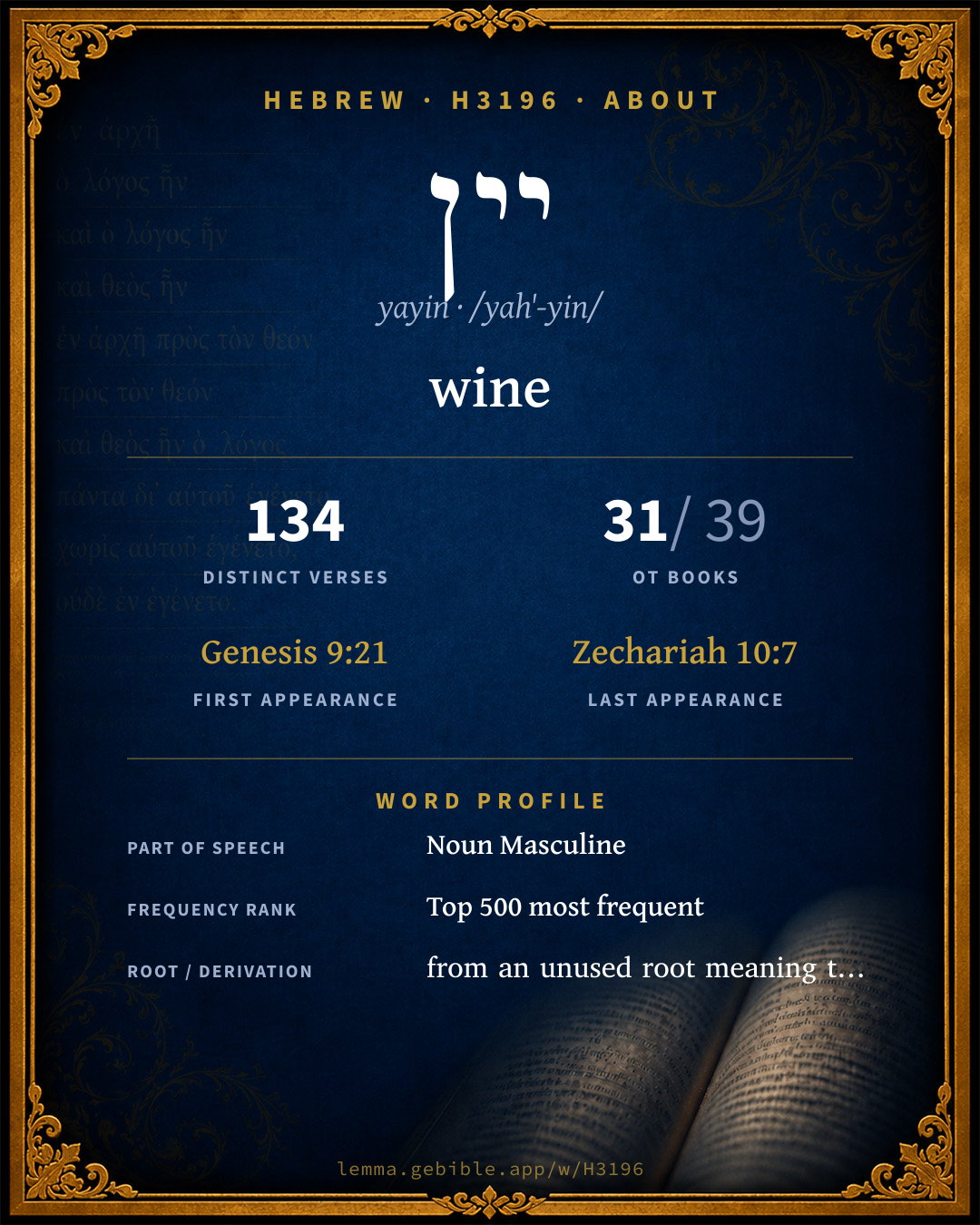
יַ֫יִן
wine
Full lexicon entry — Brown-Driver-Briggs (BDB)
From Brown-Driver-Briggs (BDB)
Where this word appears
See every Absolute-state word in the Hebrew Bible →
Grammar key — what these labels mean
Part of speech
- Noun
- A naming word — a person, place, thing, or idea.
Noun type
- Common
- A common noun — a general class of person, place, or thing (“king,” “city,” “water”), not a specific name.
State
- Absolute
- The independent form of a noun, not bound to a following word.
- Construct
- A noun bound to a following noun in a possessive / “of” relationship (the construct chain).
Gender
- Masculine
- Grammatically masculine.
Number
- Singular
- One.
5 verses where H3196 appears in the Absolute state in the Book of Song of Solomon. Filtered view — show all forms. Click any verse to open its interlinear word-by-word view. Verse text shown in the World English Bible for context — . Each verse’s Hebrew form is shown with its reference; the English is not keyword-highlighted, since the data carries no word-level English alignment. Use “Compare translations” on any verse to read it across multiple English versions. This concordance covers the Hebrew Bible; Septuagint (Greek Old Testament) occurrences are not indexed here.
Song of Solomon
- Song of Solomon 1:2 מִ/יָּֽיִן prep + n c ms Let him kiss me with the kisses of his mouth; For your love is better than wine.
- Song of Solomon 1:4 מִ/יַּ֔יִן prep + n c ms Take me away with you. Let us hurry. The king has brought me into his chambers. Friends We will be glad and rejoice in you. We will praise your love more than wine! Beloved They are right to love you.
- Song of Solomon 2:4 הַ/יָּ֔יִן ptcl def.art + n c ms He brought me to the banquet hall. His banner over me is love.
- Song of Solomon 4:10 מִ/יַּ֔יִן prep + n c ms How beautiful is your love, my sister, my bride! How much better is your love than wine! The fragrance of your perfumes than all manner of spices!
- Song of Solomon 8:2 מִ/יַּ֣יִן prep + n c ms I would lead you, bringing you into my mother's house, Who would instruct me. I would have you drink spiced wine, Of the juice of my pomegranate.
About this entry
At a glance — auto-summarized from this page’s data, not written by a person. Every figure links to its source below. This summary describes the numbers; it doesn’t interpret them.
“wine” is the headline sense of the Hebrew noun יין (yayin). Its earliest occurrence is Genesis 9:21. The Hebrew Bible uses it across 134 verses — common. Related forms include יון, יונה and οινος. The sections below give every sense, occurrence, and version rendering.
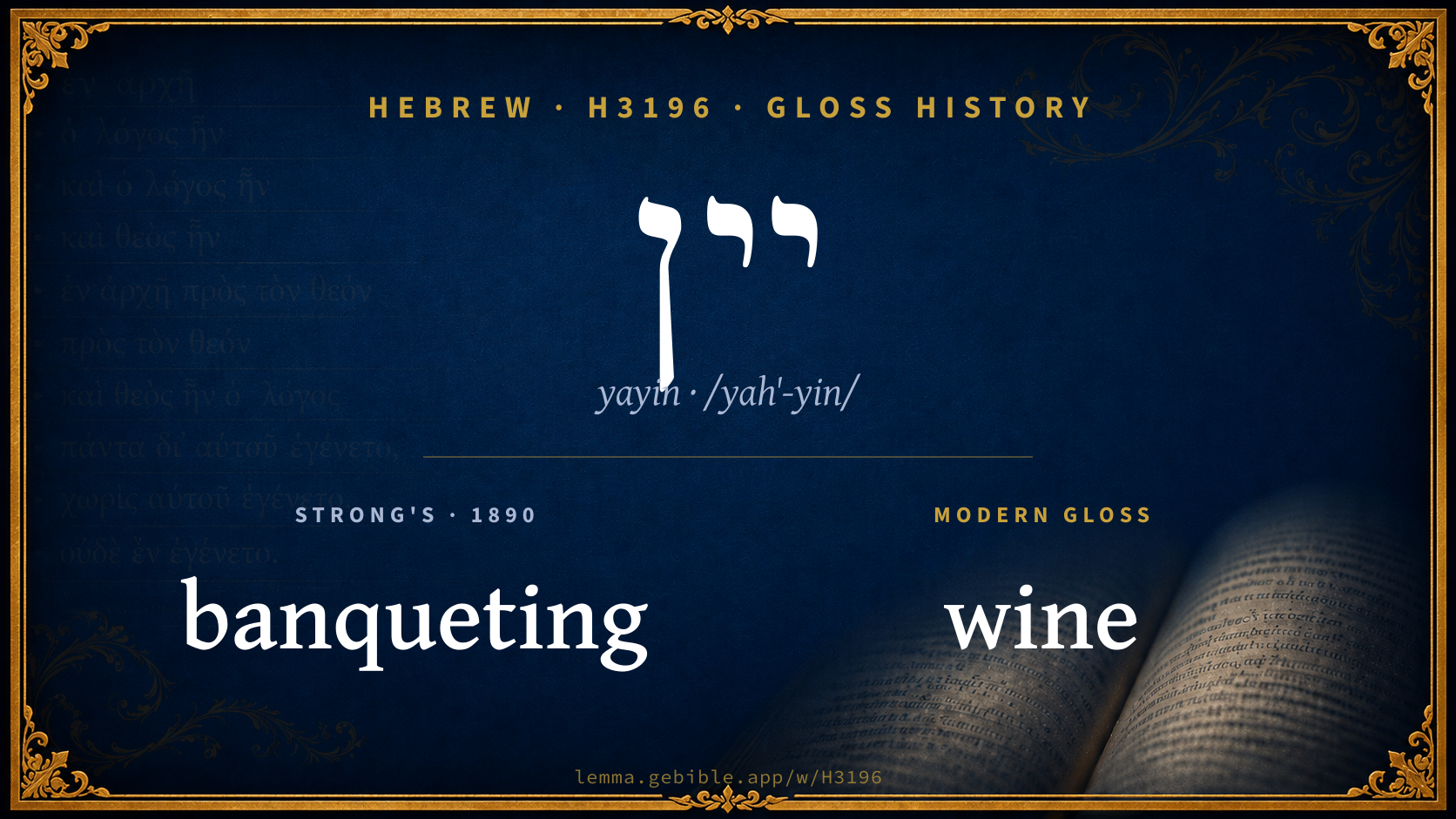
Gloss history
Strong's 1890 vs modern scholarship
About this word
Strong's H3196 catalogs a Hebrew word from the Hebrew Old Testament.
These counts are not copied from any lexicon or concordance. They are computed here, from the morphology-tagged Hebrew Old Testament. What Lemma adds →
- 134
- distinct verses
- The word appears in 134 distinct verses.
- 31 / 39
- OT books
- The word appears in 31 of 39 Old Testament books.
- #318
- by frequency
- Top 500 most frequent Hebrew words (rank 318 of 8,640 Hebrew words by occurrence).
View all 134 occurrences in the concordance →
By section of the Old Testament
By traditional corpus
Conventional, traditional groupings — biblical authorship is debated, so this is a traditional corpus grouping, not an authorship claim. Each share is this word’s portion of its verses in that division of the Hebrew canon. Each figure is a share of the word’s 134 distinct verses.
- Prophets (Nevi'im) 61 verses · 46%
- Writings (Ketuvim) 48 verses · 36%
- Torah (Pentateuch) 25 verses · 19%
How translations render this word
Counts come from each version’s own published word-to-Strong’s tagging or interlinear alignment — an approximate guide to how each version renders this word, not a word-level alignment the data otherwise carries. Because each total is that version’s own tagged count, the per-version totals vary from one another and need not match the appearance or distinct-verse counts above. These counts may also differ from a printed concordance because Lemma counts each distinctly tagged rendering and does not collapse phrase taggings into a single head-word total. This is a fixed set of word-tagged versions (KJV, ASV, BSB, ULT) and does not change with the reading translation you choose elsewhere. Each version’s license is shown beside its name below (and on Sources).
- King James Version: Wine 116×, Through wine 3×, Than wine 2×
- American Standard Version: Wine 102×, Drink no wine 2×, Than wine 2×
- Berean Standard Bible: Wine 119×, Than wine 3×, Any wine 2×
- unfoldingWord Literal Text: Wine 113×, Wine of 7×, And 2×
King James Version Public Domain
Renders H3196 across 140 tagged occurrences — most commonly:
Plus 17 renderings that appear only once — usually multi-word phrases or single function words the recovered tagging swept in, not distinct renderings.
American Standard Version Public Domain
Renders H3196 across 138 tagged occurrences — most commonly:
Plus 28 renderings that appear only once — usually multi-word phrases or single function words the recovered tagging swept in, not distinct renderings.
Berean Standard Bible Public Domain
Renders H3196 across 135 tagged occurrences — most commonly:
Plus 9 renderings that appear only once — usually multi-word phrases or single function words the recovered tagging swept in, not distinct renderings. Not rendered by a distinct English word in 6 further occurrences.
unfoldingWord Literal Text CC BY-SA 4.0
Renders H3196 across 136 tagged occurrences — most commonly:
Plus 12 renderings that appear only once — usually multi-word phrases or single function words the recovered tagging swept in, not distinct renderings.
Senses in the full BDB
What do BDB’s symbols mean?
BDB uses these scholarly abbreviations:
| Symbol | Meaning |
|---|---|
| 𝔊 | the Septuagint (the ancient Greek translation, LXX) |
| 𝔙 | the Vulgate (the Latin translation) |
| 𝔖 | the Syriac version (the Peshitta) |
| 𝔗 | the Targum (the Aramaic translation) |
| ψ | the Psalms |
| √ | root (the underlying root or stem) |
| ‖ | parallel passage (a synonymous or contrasted parallel) |
| † | the dagger: every passage where the word occurs is cited |
The 5 senses and sub-senses the full Brown-Driver-Briggs lexicon distinguishes for this word, in lexicon order (not ranked by frequency), with BDB’s own verbatim wording and sub-sense lettering. Shown in Hebrew script with BDB’s own scholarly abbreviations. The condensed entry is in the Lexicon Entry tab. See also the Forms in the corpus table below.
- a. common drink, for refreshment Gn 14:18 (E?) 27:25 (J), Ju 19:19 2 S 16:2 Am 5:11; 9:14 Ho 14:8 Jb 1:13, 18 Dn 1:5 +, tonic Pr 31:6; art. of commerce Ez 27:18 Ne 13:15; among supplies in strongholds 2 Ch 11:11; as making merry 2 S 13:28 Zc 9:15; 10:7 Est 1:10 Ec 9:7; 10:19 ψ 104:15. e.g. Genesis 14:18
- b. used for rejoicing before י׳ Dt 14:26, cf. Ho 9:4; as drink-offering in prescribed ritual Ex 29:40 Lv 23:13 Nu 15:5, 7, 10; 28:14; among temple stores 1 Ch 9:29; used also in heathen ceremonial, v. Dt 32:33. e.g. Deuteronomy 14:26
- c. intoxicating 1 S 1:14; 25:37 Gn 9:21, 24; 19:32, 33, 34, 35 (all J), Is 5:11, 22 Pr 21:17; 23:30, 31 +; ‖ תִּירוֹשׁ Ho 4:11; ‖ שֵׁכָר 1 S 1:15 Mi 2:11 Is 24:9; 28:7(×2); 56:12 + 12 times; forbidden to Nazirites †Nu 6:3(×2) (חֹמֶץ יַיִן וְחֹמֶץ שֵׁכָר), v 4, 20, cf. Am 2:12; to Rechabites †Je 35:2, 5 f.; to mother of Samson †Ju 13:4, 7, 14; to priests entering sanctuary †Lv 10:9 (P), Ez 44:21; unfitting for kings Pr 31:4. e.g. 1 Samuel 1:14
- d. combinations are: יֵין הַטּוֹב Ct 7:10 = the best wine (read כַּיַּיִן?) Ges§ 133. 3, R. 1; יֵין מַלְכוּת Est 1:7 royal wine; אֹצְרוֹת הַיַּיִן 1 Ch 27:27 stores of wine, wine-supply; יַיִן הָרֶקַח Ct 8:2 spiced wine; מִשְׁתֵּה הַיַּיִן wine-feast Est 5:6; 7:2, 7, 8; סֹבְאֵי יַיִן Pr 23:20 wine-bibbers; נֹאד יין wine-skin; Jos 9:4, 13 1 S 16:20; נֵבֶל יין id. 1 S 1:24; 10:3; 25:18 2 S 16:1 Je 13:12(×2); בֵּית הַיָּ֑יִן Ct 2:4 either winehouse, where wine is drunk, feasting-house (De al.), or place of wine = vineyard (Ew al.; cf. גֶּפֶן יַיִן Nu 6:4). e.g. Song of Solomon 7:10
- e. metaph. of wisdom’s drink Pr 9:2, 5, cf. Is 55:1; of י׳’s wrath Je 25:15 (כּוֹס היין); of confusion sent by י׳, יַיִן תַּרְעֵלָה wine of reeling ψ 60:5, cf. 75:9; of י׳’s awaking for vengeance, like a wine-shouter ψ 78:65; of Babylon’s fierce power Je 51:7; of love Ct 5:1; יֵין חֲמָסִים Pr 4:17; in sim. of one bursting with words Jb 32:19; of disheartened proph. Je 23:9 (כְּגֶבֶר עֲבָרוֹ יַיִן); of lover’s mouth Ct 7:10 (v. supr.); love is better than wine Ct 1:2; 4:10. e.g. Proverbs 9:2
Senses from the full Brown-Driver-Briggs lexicon (Brown, Driver, Briggs; Oxford 1906 — public domain), digitized via Sefaria, supplemented by the OpenScriptures HebrewLexicon (CC BY 4.0). Full attribution on Sources.
Word origin
n.m. ψ 75:9 wine (NH id.; Ethiopic ወይን vitis, vinea, vinum; Arabic وَيْنٌ (black) grapes, v. HomZMG 1889, 654; Sab. וין vineyard, MordtZMG 1887, 364 Homl.c. 659 (both after Glaser); Assyrian înu in vocabularies, but this loan-word from western Semites, according to HomAufsätze 102; JenZA i. 186 f., ZMG 1890, 705 argues to the contrary)—abs. יַ֫יִן Gn 9:21 + 84 times; יָ֑יִן Gn 14:18 + 33 times; cstr. יַ֫יִן ψ 60:5 Ct 8:2; יֵין Dt 32:18 + 9 times; sf. יֵינִי Ct 5:1, etc.;—wine:
— Brown-Driver-Briggs (Oxford 1906, public domain), digitized via Sefaria, supplemented by the OpenScriptures HebrewLexicon (CC BY 4.0). See Sources.
Origin: from an unused root meaning to effervesce
Jastrow Dictionary
A second Hebrew/Aramaic lexicon for comparison, covering Aramaic and post-biblical (Talmudic, Targumic, Midrashic) usage that the biblical-Hebrew BDB does not. Matched by lemma rather than by Strong’s number, so a lemma may carry more than one Jastrow headword (shown separately below), and the entries cover usage well beyond the Bible.
יַיִן
- [thick, fermenting,] wine. Snh. 70ᵃ י׳ חי, v. חַי. Sifré Num. 23 (ref. to Num. VI, 3) י׳ זה מזוג וכ׳ yayin means mixed wine, shekhar unmixed. Ab. Zar. V, 1, a. fr. יֵין נסך, v. נֶסֶךְ.—Ḥull. 4ᵇ, a. e. סתם יֵינָן, v. סְתָם. Ib. יינן של נכרים wine prepared or handled by gentiles; a. v. fr.—Pl. יֵינוֹת. Tosef. Ab. Zar. IV (V), 1 sq. Keth. 65ᵃ, v. פָּסַק; a. e. e.g. Numbers 6:3
A Dictionary of the Targumim, the Talmud Babli and Yerushalmi, and the Midrashic Literature (Marcus Jastrow; London, Luzac, 1903) — Public Domain. Digitized via Sefaria. Digitized via Sefaria. Full attribution on Sources.
Forms in the corpus
The 72 distinct written forms H3196 takes in the Hebrew Bible, most frequent first — each parse links to that state’s occurrences in the concordance. Hebrew forms include their vowel points and cantillation, so a single lemma takes many written forms.
The 60 most common forms are shown; 12 rarer forms follow in the full concordance.
Same root — word family
Other BDB entries built from the same root as H3196, grouped by Strong’s listed origin. These share a root / origin per the lexicon — not necessarily a shared meaning. Each links to that word’s own entry.
Derived from this word
Proper names from this root
People and places named from this root — a name, not an additional meaning of the word.
Compare all same-root words → Showing 4 of 5 — not the complete family. 1 of the same-root words is a proper name (a person or place). They share a root, not necessarily a meaning.
Septuagint verse parallels
This word appears in 127 verses that also exist in the Greek Old Testament (Septuagint), out of the 134 Hebrew verses it occurs in. You can read those verses in Greek by switching the Old Testament edition to the Septuagint.
Read these verses in the Septuagint
- Genesis 9:21
- Exodus 29:40
- Leviticus 10:9
- Numbers 6:3
- Deuteronomy 14:26
- Joshua 9:4
- Judges 13:4
- 1 Samuel 1:14
- 2 Samuel 13:28
- 1 Chronicles 9:29
- 2 Chronicles 2:10
- Esther 1:7
This is a verse-level parallel only — the same verses exist in both the Hebrew and Greek Old Testaments. No word-level Hebrew↔Greek correspondence is claimed: the data carries no such alignment, so no Greek word is shown as this Hebrew word’s translation. Coverage is not total — the Septuagint omits the deuterocanon and renumbers the Psalms, so some Hebrew verses have no direct Greek parallel.