
Isaiah 51:21

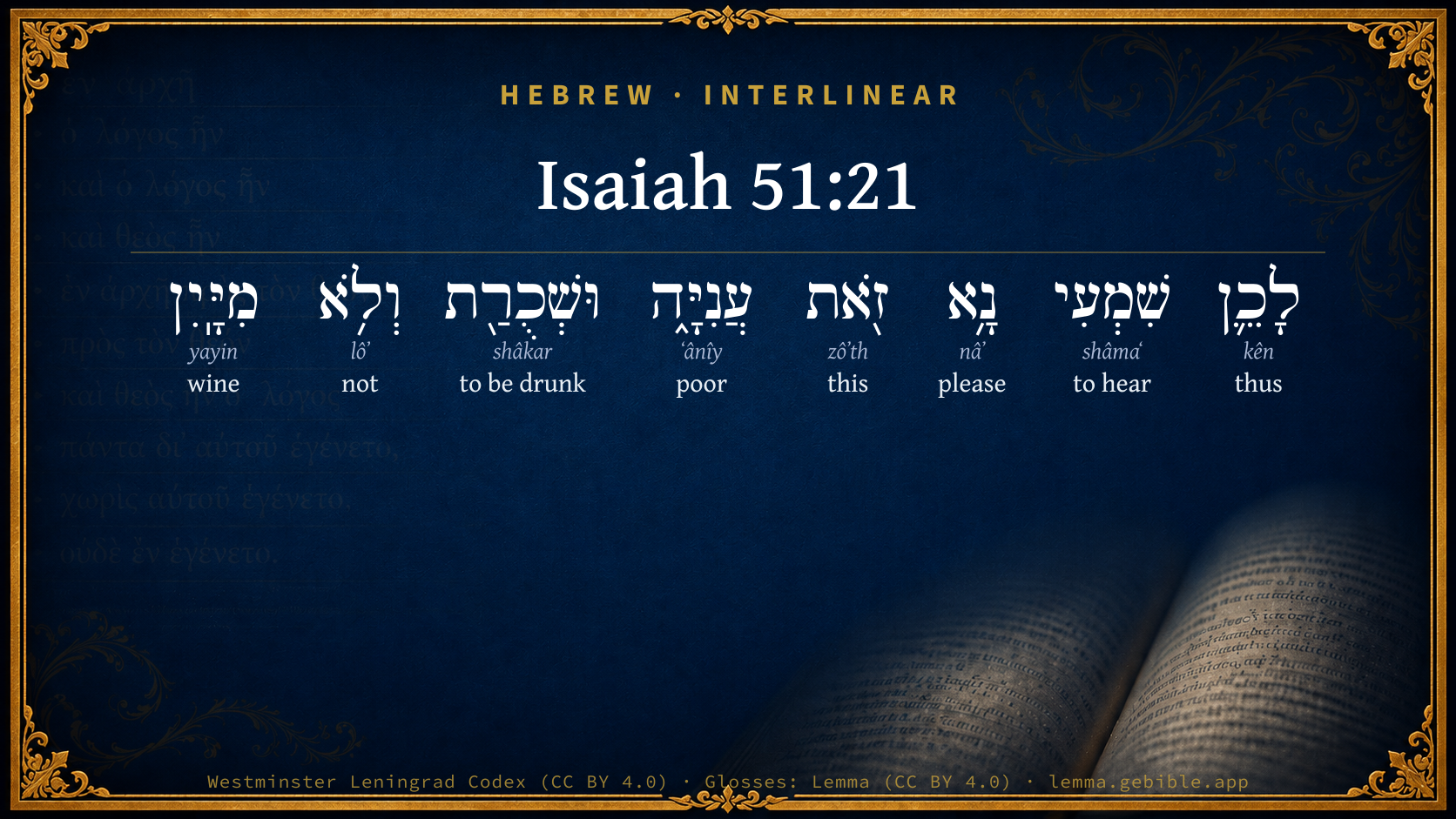
Hebrew (Westminster Leningrad Codex) Isaiah 51:21 appears in the Hebrew Old Testament. The text above is from the Westminster Leningrad Codex. Each word links to its Strong’s number, a concise gloss, and parsing drawn from the Open Scriptures Hebrew Bible morphology. Click any word for its full Brown-Driver-Briggs (BDB) entry.
Download image
Cite this verse

Isaiah 51:21 (World English Bible). Public Domain. Lemma interlinear Bible study tool, https://lemma.gebible.app/v/isaiah/51/21.

Show BibTeX & RIS
BibTeX
RIS
English Translation
Therefore hear now this, you afflicted, and drunken, but now with wine:
World English Bible · Public Domain
Download a study sheet

One document with this verse’s original text, its word-by-word gloss line, the meaning frame, cross-references with their text, attributed commentary, and full source and license credits — printable, and it pastes into notes with its structure intact.

This verse Autodidact and up

Study sheet (.html) Plain text (.txt)

A passage Seminary Student

Up to 50 verses in one chapter. A passage sheet keeps up to 6 commentary sources and 12 cross-references per verse, in the order this page ranks them, and says so on the sheet whenever that leaves anything out. Ask for a single verse and you get the Autodidact verse sheet above.

Everything on this page stays free to read, with no account — the sheet is a download of what is already on screen, not access to it.

Want to remove ads? Support Godless Engineer
Compare translations 3

The same verse in 3 English versions, stacked beneath the original-language interlinear above. Click any original word for its lexicon entry.

Each is an independent rendering of the whole verse — the interlinear is not word-aligned to these translations.

Highlighted words mark where these versions differ — a whole-verse word diff, not a word-by-word alignment.

  • World English Bible Public Domain
    Therefore hear now this, you afflicted, and drunken, but now with wine:
  • King James Version Public Domain
    Therefore hear now this, thou afflicted, and drunken, but not with wine:
  • unfoldingWord Literal Text CC BY-SA 4.0
    Therefore hear this, please, poor and drunken, but not from wine.

unfoldingWord Literal Text — © unfoldingWord, licensed CC BY-SA 4.0. Word-aligned USFM3 via Door43 (git.door43.org/unfoldingWord/en_ult).

Versions to compare (up to 4)

3 of 4 selected

Show all 18 translations

Every available English version of this verse, each an independent rendering of the whole verse.

  • World English Bible Public Domain
    Therefore hear now this, you afflicted, and drunken, but now with wine:
  • Berean Standard Bible Public Domain
    Therefore now hear this, you afflicted one, drunken, but not with wine.
  • Majority Standard Bible Public Domain
    Therefore now hear this, you afflicted one, drunken, but not with wine.
  • King James Version Public Domain
    Therefore hear now this, thou afflicted, and drunken, but not with wine:
  • American Standard Version (1901) Public Domain
    Therefore hear now this, thou afflicted, and drunken, but now with wine:
  • Revised Version (1885) Public Domain
    Therefore hear now this, thou afflicted, and drunken, but not with wine:
  • Geneva Bible (1599) Public Domain
    Therefore heare nowe this, thou miserable and drunken, but not with wine.
  • Douay-Rheims (1899) Public Domain
    Therefore hear this, thou poor little one, and thou that art drunk but no with wine.
  • Young's Literal Translation Public Domain
    Therefore, hear, I pray thee, this, O afflicted and drunken one, and not with wine,
  • Literal Standard Version CC BY-SA 4.0
    Therefore, please hear this, || O afflicted and drunken one, and not with wine,
  • Unlocked Literal Bible CC BY-SA 4.0
    But now hear this, you oppressed one and drunken one, but not drunk with wine:
  • unfoldingWord Literal Text CC BY-SA 4.0
    Therefore hear this, please, poor and drunken, but not from wine.
  • Darby Bible Public Domain
    Therefore hear now this, thou afflicted, and drunken, but not with wine:
  • World Messianic Bible Public Domain
    Therefore now hear this, you afflicted, and drunken, but not with wine:
  • Webster's Bible Public Domain
    Therefore hear now this, thou afflicted, and drunken, but not with wine:
  • Free Bible Version CC BY-SA 4.0
    So please listen to this, you poor people, sitting there in a drunken state, but not from drinking wine.
  • Bible in Basic English Public Domain
    So now give ear to this, you who are troubled and overcome, but not with wine:
  • JPS Tanakh (1917) Public Domain
    Therefore hear now this, thou afflicted, and drunken, but not with wine;

Literal Standard Version (2020), Covenant Press — licensed CC BY-SA 4.0. Text via the HelloAO Bible API (eBible.org). Unlocked Literal Bible (unfoldingWord) — licensed CC BY-SA 4.0. Text via the HelloAO Bible API (eBible.org). unfoldingWord Literal Text — © unfoldingWord, licensed CC BY-SA 4.0. Word-aligned USFM3 via Door43 (git.door43.org/unfoldingWord/en_ult). Free Bible Version, Dr. Jonathan Gallagher — licensed CC BY-SA 4.0. Text via the HelloAO Bible API (eBible.org).

Word by word

More ways to search: Search by grammar → Find every occurrence → Compare this word →

Practice this passage: Drill this verse → Learn its vocabulary →

About this verse

These counts appear in no published source. They are computed here, from the morphology-tagged text and Lemma’s own curated glosses. What Lemma adds →

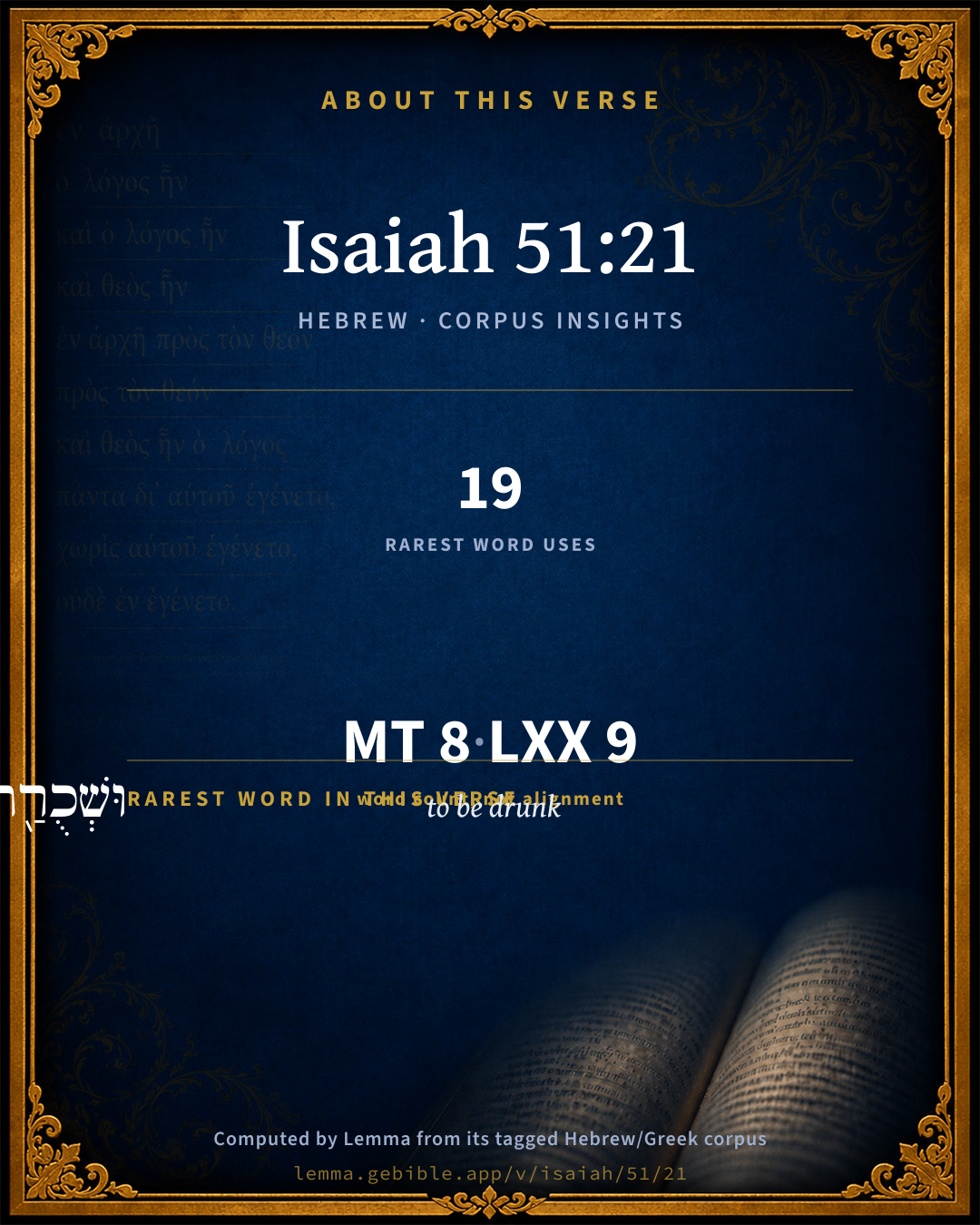
8
words
8
distinct lemmas
Prophets
section

Notable vocabulary

The rarest word here is וּשְׁכֻרַ֖ת to be drunk H7937 — appearing just 19 times in the whole Hebrew Bible.

Shared distinctive vocabulary

וּשְׁכֻרַ֖ת to be drunk H7937 occurs in 19 verses of the Hebrew Bible. Also found in:

Grammatical profile

  • 1 verb
  • 1 noun
  • 2 adjectives
  • 1 pronoun
  • 1 adverb
  • 2 particles

Verb forms

  • שִׁמְעִי Qal · Imperative

Hebrew & Septuagint length

In English translation the verse runs 12 words from the Hebrew and 11 from the Septuagint (LXX English) — closely comparable.

A rough comparison of the two English renderings, which tokenize alike — not a word-level alignment.

Word counts can differ between the Hebrew and the Greek without any difference in meaning — e.g. the Hebrew direct-object marker אֵת has no separate Greek word, and Greek often adds the article ὁ.

In the original languages it is 8 Hebrew tokens and 9 Greek tokens — but the two are counted differently (Hebrew bundles its prefixes and suffixes into one token; the Greek is in lemma form), so that isn’t a like-for-like length.

Cross-references

3

Topical passages linked to Isaiah 51:21 in the Treasury of Scripture Knowledge — connected by theme and wording, ordered by reader-vote popularity; previews shown in the World English Bible.

  • Isaiah 29:9 Stay you and wonder; take your pleasure and be blind: they are drunken, but not with wine; they stagger, but not with strong drink.
  • Isaiah 51:17 Awake, awake, stand up, Jerusalem, that have drunk at the hand of Yahweh the cup of his wrath; you have drunken the bowl of the cup of staggering, and drained it.
  • Isaiah 54:11 you afflicted, tossed with tempest, and not comforted, behold, I will set your stones in beautiful colors, and lay your foundations with sapphires.

Cross-references courtesy of OpenBible.info (CC BY 4.0).

Hebrew and Greek witnesses Masoretic Hebrew ↔ Greek Septuagint

The same verse in the two great witnesses to the Old Testament, shown verse-for-verse.

These are two independent witnesses, not word-aligned to each other, and the Septuagint is shown in lemma (dictionary) form.

Hebrew Isaiah 51:21 Masoretic · Westminster Leningrad Codex

לָכֵ֛ן שִׁמְעִי נָ֥א זֹ֖את עֲנִיָּ֑ה וּשְׁכֻרַ֖ת וְלֹ֥א מִיָּֽיִן

Therefore hear now this, you afflicted, and drunken, but now with wine:

World English Bible · Public Domain

Greek LXX Isaiah 51:21 Septuagint · lemma form

διά οὗτος ἀκούω ταπεινόω καί μεθύω οὐ ἀπό οἶνος

Therefore hear, you afflicted one, and drunken, but not with wine;

LXX2012 (modern English Septuagint) · Public Domain

Hebrew: Westminster Leningrad Codex (CC BY 4.0). Greek: Septuagint (public domain); English from LXX2012 (modern English Septuagint) (Public Domain). How the Septuagint differs from the Hebrew →

Targum (Aramaic paraphrase)

1

The Targum is the ancient Jewish Aramaic paraphrase of the Hebrew Scriptures — an interpretive translation, not the Hebrew text itself. Onkelos (literal) and Pseudo-Jonathan (expansive) render the Torah, and Jonathan the Prophets. Coverage is partial: where no permissively-licensed English translation exists for a verse, only the Aramaic is shown. This is verse-level text, not a word-by-word alignment to the Hebrew.

  1. Targum Jonathan Prophets (Joshua–Malachi)
    בְּכֵן שִׁמְעִי כְעַן דָא מְטַלְטַלְתָּא דְרַוְיָא מִן עָקָא וְלָא מִן חֲמָר:

    Therefore hear now this, thou who art cast out, drunk with tribulation and not with wine:

    Targum Jonathan — Aramaic: “Mikraot Gedolot” (public domain). English: “Sefaria Community Translation” (CC0 1.0 (public-domain dedication)); “London "Chaldee Paraphrase," 1871” (public domain). Text via Sefaria.

Commentary

Notes on Isaiah 51:21 from classic Christian and Jewish commentators (each source and its license shown beneath its notes). The classic Christian expositions comment on the surrounding passage and are grouped to its opening verse, so a note may address several verses; the Jewish commentaries on the Tanakh (Rashi and others) are per-verse, so they appear only where the commentator wrote on this verse.

Lemma curates 59 commentaries, every one of them public domain or Creative Commons licensed, each selected and text-cleaned for this edition rather than reprinted as found. About our sources →

Trapp's Complete Commentary

John Trapp

Isa 51:21 Therefore hear now this, thou afflicted, and drunken, but not with wine:

Ver. 21. Thou afflicted and drunken.] With a dry drunkenness, which thou canst not so easily sleep out. {Isa 51:17}

John Trapp, A Commentary or Exposition upon All the Books of the Old and New Testament (1647–1656) — public domain. Text from a community e-Sword module.

Joseph Benson's Commentary

Isa 51:21-23. Hear, thou drunken, but not with wine — But with the cup of God’s fury, mentioned Isa 51:17. Thus saith the Lord — That is, Jehovah; he that is able to help thee, and hath wherewithal to relieve thee; thy Lord — That hath an incontestable right to thee, and will not alienate it; thy God — In covenant with thee, and that hath undertaken to make thee happy; that pleadeth the cause of his people — As their patron and protector, who, though he hath been angry with, and hath chastised thee, is now reconciled to thee, and will maintain thy cause against all thine enemies. I have taken out of thy hand the cup of trembling — The bitter, intoxicating cup of my wrath; thou shalt no more drink it again — No more lie under such judgments after thy prosperity in the latter days, Isa 52:1. But I will put it into the hand of them that afflict thee — Compare Isa 49:26; Jer 25:29; Rev 18:6. Which have said to thy soul, Bow down, &c. — Lie down upon the ground, that we may trample upon thee. “A very strong and most expressive description of the insolent pride of eastern conquerors, which, though it may seem greatly exaggerated, yet hardly exceeds the strict truth. See Jos 10:24; Jdg 1:7. The Emperor Valerianus, being, through treachery, taken prisoner by Sapor, king of Persia, was treated by him as the basest and most abject slave: for the Persian monarch commanded the unhappy Roman to bow himself down, and offer his back, on which he set his foot, in order to mount his chariot or horse, whenever he had occasion.” — Bishop Lowth.

Joseph Benson's Commentary on the Old and New Testaments (1811–1818) — public domain. Text from a community e-Sword module.

Geneva Bible (1599)

Geneva Bible translators

But with trouble and fear.

Geneva Bible (1599) marginal notes — public domain. Text via Bolls.life.

Jamieson, Fausset & Brown

Robert Jamieson, A. R. Fausset & David Brown

drunken . . . not with wine-- (Isa 29:9; compare Isa 51:17, Isa 51:20, here; Lam 3:15).

Jamieson, Fausset & Brown — Commentary Critical and Explanatory on the Whole Bible (1871) — public domain (CC PDM 1.0). Text via the HelloAO Bible API.

Adam Clarke's Commentary

Verse 21. Drunken, but not with wine] AEschylus has the same expression: -

Αοινοις εμμανεις θυμωμασι· Eumen. 863.

Intoxicated with passion, not with wine.

Schultens thinks that this circumlocution, as he calls it, gradum adfert incomparabiliter majorem; and that it means, not simply without wine, but much more than with wine. Gram. Heb. p. 182.

The bold image of the cup of God's wrath, often employed by the sacred writers, (See Clarke on Isa 1:22,) is nowhere handled with greater force and sublimity than in this passage of Isaiah, Isa 51:17-23. Jerusalem is represented in person as staggering under the effects of it, destitute of that assistance which she might expect from her children; not one of them being able to support or to lead her. They, abject and amazed, lie at the head of every street, overwhelmed with the greatness of their distress; like the oryx entangled in a net, in vain struggling to rend it, and extricate himself. This is poetry of the first order, sublimity of the highest character.

Plato had an idea something like this: "Suppose," says he, "God had given to men a medicating potion inducing fear, so that the more any one should drink of it, so much the more miserable he should find himself at every draught, and become fearful of every thing both present and future; and at last, though the most courageous of men, should be totally possessed by fear: and afterwards, having slept off the effects of it, should become himself again." De Leg. i., near the end. He pursues at large this hypothesis, applying it to his own purpose, which has no relation to the present subject. Homer places two vessels at the disposal of Jupiter, one of good, the other of evil. He gives to some a potion mixed of both; to others from the evil vessel only: these are completely miserable. Iliad xxiv. 527-533.

Δοιοι γαρ τε πιθοι κατακειαται εν Διος ουδει

Δωρων, οἱα διδωσι, κακων, ἑτερος δε εαων,

Ὡ μεν καμμιξας δῳη Ζευς τερπικεραυνος,

Αλλοτε μεν τε κακῳ ὁγε κυρεται, αλλοτε δ' εσθλῳ·

Ὡ δε κε των λυγρων δῳη, λωβητον εθηκε.

Και ἑ κακη βουβρωστις επι χθονα διαν ελαυνει·

Φοιτᾳ δ' ουτε θεοισι τετιμενος, ουτι βροτοισιν.

"Two urns by Jove's high throne have ever stood,

The source of evil one, and one of good;

From thence the cup of mortal man he fills,

Blessings to these, to those distributes ills;

To most he mingles both: the wretch decreed

To taste the bad unmixed, is cursed indeed:

Pursued by wrongs, by meagre famine driven,

He wanders outcast both of earth and heaven."

POPE.

Adam Clarke's Commentary on the Bible (1810–1826) — public domain. Text from a community e-Sword/MySword module.

Ellicott's Commentary for English Readers

(21) Drunken, but not with wine . . .—Same phrase as in Isa_29:9.

A Bible Commentary for English Readers, edited by Charles John Ellicott (1878–1897) — public domain. Text from a community e-Sword module.

The Cambridge Bible for Schools and Colleges

gen. ed. J. J. S. Perowne

21. hear now this] see ch. Isa_47:8.

drunken, but not with wine] Cf. ch. Isa_29:9.

21–23. The message of comfort.

The Cambridge Bible for Schools and Colleges (gen. ed. J. J. S. Perowne; Cambridge University Press, 1878–1918) — public domain. Text from a community e-Sword module.

John Gill's Exposition

Therefore hear now this, thou afflicted,.... By Babylon, by antichrist and his followers; hear, for thy comfort, the following prophecy:

and drunken, but not with wine; not with wine in a literal sense; nor with the wine of the fornication of the whore of Rome; nor with idolatry, as the kings of the earth are said to be, Rev 17:2 but, as the Targum expresses it, with tribulation; with afflictions at the hand of God, and persecutions from men.

John Gill's Exposition of the Whole Bible (1746–1763) — public domain (CC PDM 1.0). Text via the HelloAO Bible API.

Albert Barnes' Notes on the Bible

And drunken, but not with wine - Overcome and prostrate, but not under the influence of intoxicating drink. They were prostrate by the wrath of God.

Albert Barnes' Notes on the Bible (1834–1885) — public domain. Text from a community e-Sword/MySword module.

Matthew Poole's English Annotations

But with the cup of God’s fury, mentioned Isa 51:17

Matthew Poole's English Annotations on the Holy Bible (1683–1685) — public domain. Text from a community e-Sword/MySword module.

Whedon's Commentary on the Bible

Daniel D. Whedon

21-23. Hear now this — It is the same speaker still, but the address turns from the picture of suffering to that of hope and promise.

Drunken, but not with wine — Because she has drunken of the full cup of wrath she is now to hear what Jehovah in mercy purposes to do. God takes from her hand the goblet of reeling, the cup of suffering with which she has been drunken, and of this she is to drink no more. The oppressors of Jerusalem are now to have their turn at the cup. Jerusalem has had her deserts. Her subjects have long been captives under tyranny, both at home as vassals, and abroad in bitter exile. The time now is come for a change; she is to be delivered, and her tormentors to be punished.

Daniel D. Whedon (gen. ed.), Commentary on the Old and New Testaments (1874–1909) — public domain. Text from a community e-Sword module.

The Pulpit Commentary

Drunken, but not with wine. (comp. Isa_29:9; and see above, ver. 17, which shows that the appearance of drunkenness had been produced by Jerusalem drinking the cup of God"s wrath)

The Pulpit Commentary (1880–1919), ed. H.D.M. Spence-Jones & Joseph S. Exell — public domain. Text from a community e-Sword module.

John Wesley's Explanatory Notes

Not with wine - But with the cup of God's fury.

John Wesley, Explanatory Notes Upon the Whole Bible (1754–1765) — public domain. Text via the GEBible commentary corpus.

J. A. Alexander on Isaiah

Joseph Addison Alexander

“Therefore pray hear this, thou suffering one and drunken but not with wine.” The antithesis in the last clause is to be completed from the context. Not with wine, but with the wrath of God, which had already been described as a cup of reeling or intoxication. The same negative expression is employed in Isa 29:9.

Joseph Addison Alexander, The Prophecies of Isaiah (1846–1847; New York: Scribner, 1870–1878) — public domain. Text from a community e-Sword module.

unfoldingWord translationNotes

Door43 World Missions Community

General Information:

Isaiah continues speaking to the people of Israel.

you oppressed one and drunken one

Yahweh uses the word "one" here to refer to all of the oppressed people. AT: "you oppressed people and drunken people" (See: Synecdoche)

drunken one, but not drunk with wine

This speaks of the people acting drunk because they are suffering as if they have become drunk from being forced to drink the bowl of Yahweh's anger. AT: "you who are drunk from drinking the wine of the bowl of Yahweh's anger" or "you who act drunk, because you have suffered greatly" (See: Metaphor and Assumed Knowledge and Implicit Information)

See, I have taken the cup of staggering from your hand—the bowl, which is the cup of my anger—so that

This speaks of Yahweh no longer being angry with his people as if his anger were the contents of a cup that he was taking away from them. AT: "I will no longer be angry with you. See, it is like I have taken away from you the cup that made you stagger, that is, the cup that was full of my anger, so that" (See: Metaphor)

See

This is used to draw the listeners' attention to what is said next. AT: "Listen"

the cup of staggering

The word "cup" refers to what is in the cup. See how you translated a similar phrase in Isaiah 51:17. AT: "the cup of the wine that makes people stagger" (See: Metonymy)

the bowl, which is the cup of my anger

Yahweh speaks of having punished people as if he had forced them to drink from a bowl that was filled with his anger. See how you translated a similar phrase in Isaiah 51:17. AT: "the bowl which is filled with my anger" or "the cup which is filled with my anger" (See: Metaphor)

translationWords

oppress

drunk

wine

Lord Yahweh

people of God

unfoldingWord translationNotes — © Distant Shores Media and the Door43 World Missions Community, licensed CC BY-SA 4.0. Source: git.door43.org/Door43/en_tn.

Rashi

Rabbi Shlomo Yitzchaki (Rashi)

and who is drunk but not from wine Drunk from something else other than wine.

Rashi on the Tanakh — English translations: “The Judaica Press complete Tanach with Rashi, translated by A. J. Rosenberg” (CC BY 4.0); “Pentateuch with Rashi's commentary by M. Rosenbaum and A.M. Silbermann, 1929-1934” (public domain); “The Metsudah Tanach series, Lakewood, N.J” (CC BY 4.0); and “The Book of Joshua, Metsudah Publications, 1997” (CC BY 4.0). Text via Sefaria.

Ibn Ezra

Rabbi Abraham ibn Ezra

Hear now, the prophecy which follows in the next verses.

ושכורת And drunken with. Supply חמה anger, אף wrath, or רעות evils.

Ibn Ezra on the Tanakh — English translations: “Sefaria Community Translation” (CC0 1.0 (public-domain dedication)); “Yalkut, Sifsei Chachomim Chumash, Metsudah Publications, 2009” (CC BY 4.0); and “Commentary of Ibn Ezra on Isaiah - trans. by M. Friedlander, 1873” (public domain). Text via Sefaria.

Lesson kit

Teaching starters — assembled from the data on this page, not authored interpretation. Every prompt links to the verse data it draws on. Edit before teaching.

Isaiah, in the Prophets, opens this verse with 8 words (8 distinct Hebrew lemmas). Its most distinctive word is shâkar (“to be drunk”). A historical commentator’s framing appears above. Read the whole chapter for the surrounding context.

Discussion questions

  1. What does “to be drunk” (shâkar) contribute to the verse as a whole?
  2. Genesis 9:21 shares the word «to be drunk» with this verse. How do the two illuminate each other?
  3. These translations render this verse differently; the difference is in the English rendering, not the original. What questions does that raise?
  4. The verb «שִׁמְעִי» is Qal Imperative. How does its form color the action?
  5. Reading how Trapp's Complete Commentary and Joseph Benson's Commentary read this verse, where do the two commentators agree and where do they part?

Things to notice

Reading settings

Reading text

Shown beneath each verse's original-language words.

Old Testament
Old Testament edition

Read the OT as the Masoretic Hebrew (MT) or the Greek Septuagint (LXX).

English shown for the Greek Septuagint (in the Hebrew ↔ Greek comparison).

Comparing translations? Open the Compare panel on any verse page to stack up to four side by side.