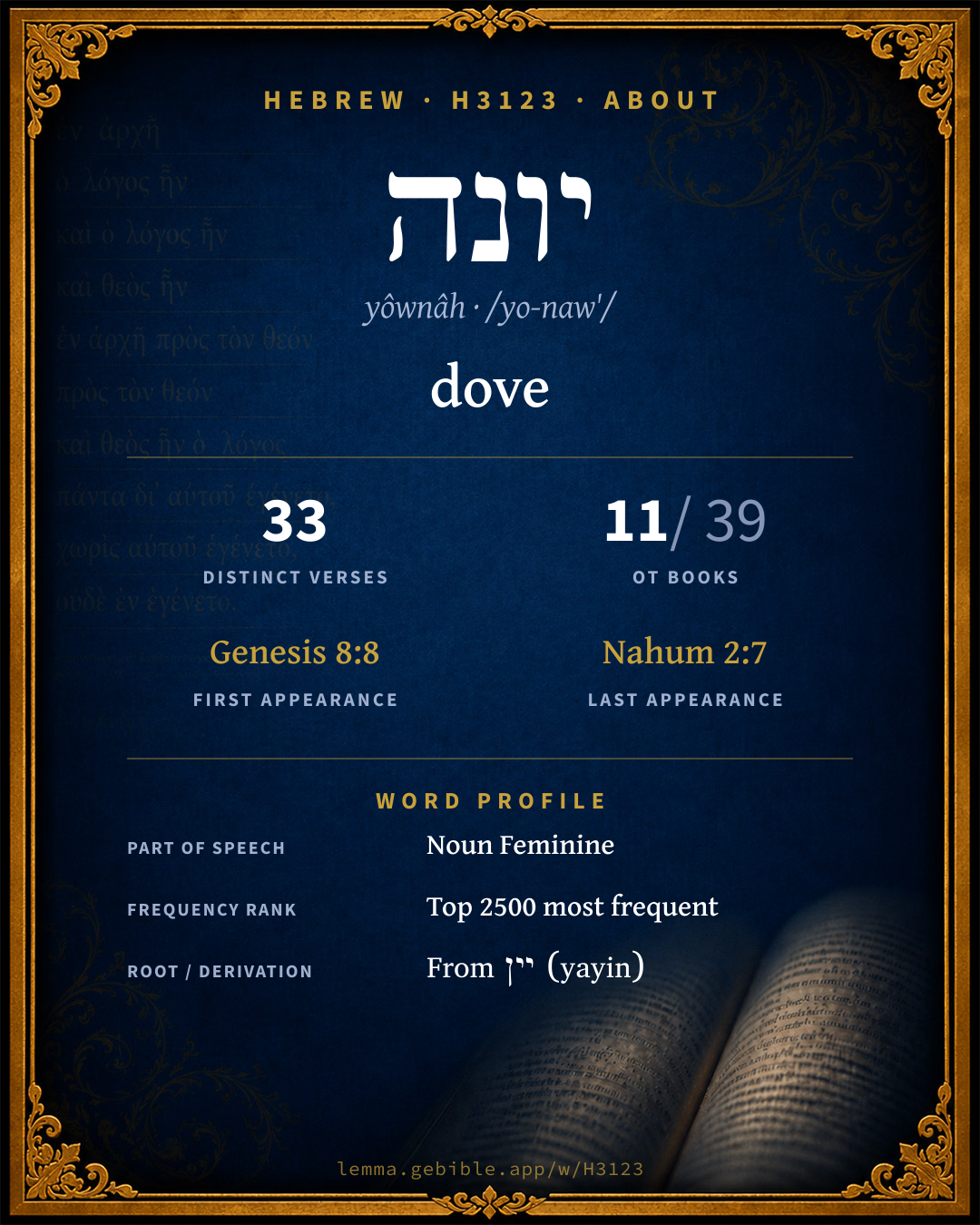
יוֹנָה
dove
Full lexicon entry — Brown-Driver-Briggs (BDB)
From Brown-Driver-Briggs (BDB)
Where this word appears
See every Absolute-state word in the Hebrew Bible →
Grammar key — what these labels mean
Part of speech
- Noun
- A naming word — a person, place, thing, or idea.
Noun type
- Common
- A common noun — a general class of person, place, or thing (“king,” “city,” “water”), not a specific name.
State
- Absolute
- The independent form of a noun, not bound to a following word.
- Construct
- A noun bound to a following noun in a possessive / “of” relationship (the construct chain).
Gender
- Feminine
- Grammatically feminine.
Number
- Singular
- One.
- Plural
- More than one (in Hebrew, generally three or more).
Grammatical forms
- Noun, Common, Feminine, Singular, Absolute 21 times (64%)
- Noun, Common, Feminine, Plural, Absolute 7 times (21%)
- Noun, Common, Feminine, Singular, Construct 4 times (12%)
- Noun, Common, Feminine, Plural, Construct 1 time (3%)
Parsed forms decoded from the imported morphology (morphhb / Westminster Leningrad Codex — WLC text public domain, morphhb tagging CC BY 4.0), counted across 33 parsed occurrences — not distinct verses.
Every verse where H3123 appears — 33 distinct verses across 11 books. Click any verse to open its interlinear word-by-word view. Verse text shown in the World English Bible for context — . Each verse’s Hebrew form is shown with its reference; the English is not keyword-highlighted, since the data carries no word-level English alignment. Use “Compare translations” on any verse to read it across multiple English versions. This concordance covers the Hebrew Bible; Septuagint (Greek Old Testament) occurrences are not indexed here.
Genesis 5 verses
- Genesis 8:8 הַ/יּוֹנָ֖ה ptcl def.art + n c fs He sent forth a dove from him, to see if the waters were abated from off the surface of the ground,
- Genesis 8:9 הַ/יּוֹנָ֨ה ptcl def.art + n c fs but the dove found no place to rest her foot, and she returned to him into the ark; for the waters were on the surface of the whole earth. He put forth his hand, and took her, and brought her to him into the ark.
- Genesis 8:10 הַ/יּוֹנָ֖ה ptcl def.art + n c fs He stayed yet another seven days; and again he sent forth the dove out of the ark.
- Genesis 8:11 הַ/יּוֹנָה֙ ptcl def.art + n c fs The dove came back to him at evening, and, behold, in her mouth was an olive leaf plucked off. So Noah knew that the waters were abated from off the earth.
- Genesis 8:12 הַ/יּוֹנָ֔ה ptcl def.art + n c fs He stayed yet another seven days, and sent forth the dove; and she didn't return to him any more.
Leviticus 9 verses
- Leviticus 1:14 הַ/יּוֹנָ֖ה ptcl def.art + n c fs "'If his offering to Yahweh is a burnt offering of birds, then he shall offer his offering of turtledoves, or of young pigeons.
- Leviticus 5:7 יוֹנָ֖ה n c fs "'If he can't afford a lamb, then he shall bring his trespass offering for that in which he has sinned, two turtledoves, or two young pigeons, to Yahweh; one for a sin offering, and the other for a burnt offering.
- Leviticus 5:11 יוֹנָה֒ n c fs "'But if he can't afford two turtledoves, or two young pigeons, then he shall bring his offering for that in which he has sinned, the tenth part of an ephah of fine flour for a sin offering. He shall put no oil on it, neither shall he put any frankincense on it, for it is a sin offering.
- Leviticus 12:6 יוֹנָ֥ה n c fs "'When the days of her purification are completed, for a son, or for a daughter, she shall bring to the priest at the door of the Tent of Meeting, a year old lamb for a burnt offering, and a young pigeon, or a turtledove, for a sin offering:
- Leviticus 12:8 יוֹנָ֔ה n c fs If she cannot afford a lamb, then she shall take two turtledoves, or two young pigeons; the one for a burnt offering, and the other for a sin offering: and the priest shall make atonement for her, and she shall be clean.'"
- Leviticus 14:22 יוֹנָ֔ה n c fs and two turtledoves, or two young pigeons, such as he is able to afford; and the one shall be a sin offering, and the other a burnt offering.
- Leviticus 14:30 הַ/יּוֹנָ֑ה ptcl def.art + n c fs He shall offer one of the turtledoves, or of the young pigeons, such as he is able to afford,
- Leviticus 15:14 יוֹנָ֑ה n c fs "'On the eighth day he shall take two turtledoves, or two young pigeons, and come before Yahweh to the door of the Tent of Meeting, and give them to the priest:
- Leviticus 15:29 יוֹנָ֑ה n c fs On the eighth day she shall take two turtledoves, or two young pigeons, and bring them to the priest, to the door of the Tent of Meeting.
Numbers 1 verse
2 Kings 1 verse
Psalms 3 verses
- Psalms 55:6 כַּ/יּוֹנָ֗ה prep det + n c fs I said, "Oh that I had wings like a dove! Then I would fly away, and be at rest.
- Psalms 56:1 י֬וֹנַת n c fs cs Be merciful to me, God, for man wants to swallow me up. All day long, he attacks and oppresses me.
- Psalms 68:13 י֭וֹנָה n c fs While you sleep among the campfires, The wings of a dove sheathed with silver, Her feathers with shining gold.
Song of Solomon 6 verses
- Song of Solomon 1:15 יוֹנִֽים n c fp Behold, you are beautiful, my love. Behold, you are beautiful. Your eyes are doves. Beloved
- Song of Solomon 2:14 יוֹנָתִ֞/י n c fs cs + sfx pers 1cs My dove in the clefts of the rock, In the hiding places of the mountainside, Let me see your face. Let me hear your voice; For your voice is sweet, and your face is lovely.
- Song of Solomon 4:1 יוֹנִ֔ים n c fp Behold, you are beautiful, my love. Behold, you are beautiful. Your eyes are doves behind your veil. Your hair is as a flock of goats, That descend from Mount Gilead.
- Song of Solomon 5:2 יוֹנָתִ֣/י n c fs cs + sfx pers 1cs I was asleep, but my heart was awake. It is the voice of my beloved who knocks: Open to me, my sister, my love, my dove, my undefiled; For my head is filled with dew, My hair with the dampness of the night.
- Song of Solomon 5:12 כְּ/יוֹנִ֖ים prep + n c fp His eyes are like doves beside the water brooks, Washed with milk, mounted like jewels.
- Song of Solomon 6:9 יוֹנָתִ֣/י n c fs cs + sfx pers 1cs My dove, my perfect one, is unique. She is her mother's only daughter. She is the favorite one of her who bore her. The daughters saw her, and called her blessed, The queens and the concubines, and they praised her.
Isaiah 3 verses
- Isaiah 38:14 כַּ/יּוֹנָ֑ה prep det + n c fs Like a swallow [or] a crane, so did I chatter; I did moan as a dove; my eyes fail [with looking] upward: Lord, I am oppressed, be my collateral.
- Isaiah 59:11 וְ/כַ/יּוֹנִ֖ים conj + prep det + n c fp We roar all like bears, and moan sore like doves: we look for justice, but there is none; for salvation, but it is far off from us.
- Isaiah 60:8 וְ/כַ/יּוֹנִ֖ים conj + prep det + n c fp Who are these who fly as a cloud, and as the doves to their windows?
Jeremiah 1 verse
Ezekiel 1 verse
Hosea 2 verses
- Hosea 7:11 כְּ/יוֹנָ֥ה prep + n c fs "Ephraim is like an easily deceived dove, without understanding. They call to Egypt. They go to Assyria.
- Hosea 11:11 וּ/כְ/יוֹנָ֖ה conj + prep + n c fs They will come trembling like a bird out of Egypt, And like a dove out of the land of Assyria; And I will settle them in their houses," says Yahweh.
Nahum 1 verse
About this entry
At a glance — auto-summarized from this page’s data, not written by a person. Every figure links to its source below. This summary describes the numbers; it doesn’t interpret them.
The Hebrew noun יונה centers on the idea of “dove.” Debuting at Genesis 8:8, it then recurs through the corpus. Spanning 33 verses in 11 books, it ranks among the moderately common words of the Hebrew Bible. Leviticus dominates its distribution — 9 of 33 verses. Sharing its root, it stands alongside יין, יון and οινος. Dig into 33-verse concordance and the renderings breakdown below.
Gloss history
Strong's 1890 vs modern scholarship
About this word
Strong's H3123 catalogs a Hebrew word from the Hebrew Old Testament.
These counts are not copied from any lexicon or concordance. They are computed here, from the morphology-tagged Hebrew Old Testament. What Lemma adds →
- 33
- distinct verses
- The word appears in 33 distinct verses.
- 11 / 39
- OT books
- The word appears in 11 of 39 Old Testament books.
- #1,064
- by frequency
- Top 2500 most frequent Hebrew words (rank 1,064 of 8,640 Hebrew words by occurrence).
View all 33 occurrences in the concordance →
Most concentrated in
- Leviticus 9 verses 27%
- Song of Solomon 6 verses 18%
- Genesis 5 verses 15%
By section of the Old Testament
By traditional corpus
Conventional, traditional groupings — biblical authorship is debated, so this is a traditional corpus grouping, not an authorship claim. Each share is this word’s portion of its verses in that division of the Hebrew canon. Each figure is a share of the word’s 33 distinct verses.
- Torah (Pentateuch) 15 verses · 45%
- Prophets (Nevi'im) 9 verses · 27%
- Writings (Ketuvim) 9 verses · 27%
How translations render this word
Counts come from each version’s own published word-to-Strong’s tagging or interlinear alignment — an approximate guide to how each version renders this word, not a word-level alignment the data otherwise carries. Because each total is that version’s own tagged count, the per-version totals vary from one another and need not match the appearance or distinct-verse counts above. These counts may also differ from a printed concordance because Lemma counts each distinctly tagged rendering and does not collapse phrase taggings into a single head-word total. This is a fixed set of word-tagged versions (KJV, ASV, BSB, ULT) and does not change with the reading translation you choose elsewhere. Each version’s license is shown beside its name below (and on Sources).
BDB lists this Strong’s number as 3 distinct words (homographs). Each count above pools all of them and is not split by sense — see the Senses section below. A low-frequency rendering may belong to a different one of those words, not the primary meaning.
- King James Version†: Dove 12×, Pigeons 9×, Doves 2×
- American Standard Version†: Dove 13×, Pigeons 9×, Are as doves 2×
- Berean Standard Bible†: Dove 9×, Pigeons 8×, Like doves 4×
- unfoldingWord Literal Text†: Dove 10×, Pigeon 9×, Doves 5×
King James Version Public Domain
Renders H3123 across 31† tagged occurrences — most commonly:
Plus 4 renderings that appear only once — usually multi-word phrases or single function words the recovered tagging swept in, not distinct renderings. Not rendered by a distinct English word in 1 further occurrence.
American Standard Version Public Domain
Renders H3123 across 32† tagged occurrences — most commonly:
Plus 4 renderings that appear only once — usually multi-word phrases or single function words the recovered tagging swept in, not distinct renderings.
Berean Standard Bible Public Domain
Renders H3123 across 31† tagged occurrences — most commonly:
Plus 3 renderings that appear only once — usually multi-word phrases or single function words the recovered tagging swept in, not distinct renderings.
unfoldingWord Literal Text CC BY-SA 4.0
Renders H3123 across 31† tagged occurrences — most commonly:
Plus 1 rendering that appears only once — usually multi-word phrases or single function words the recovered tagging swept in, not distinct renderings.
Senses in the full BDB
What do BDB’s symbols mean?
BDB uses these scholarly abbreviations:
| Symbol | Meaning |
|---|---|
| 𝔊 | the Septuagint (the ancient Greek translation, LXX) |
| 𝔙 | the Vulgate (the Latin translation) |
| 𝔖 | the Syriac version (the Peshitta) |
| 𝔗 | the Targum (the Aramaic translation) |
| ψ | the Psalms |
| √ | root (the underlying root or stem) |
| ‖ | parallel passage (a synonymous or contrasted parallel) |
| † | the dagger: every passage where the word occurs is cited |
The 0 senses and sub-senses the full Brown-Driver-Briggs lexicon distinguishes for this word, in lexicon order (not ranked by frequency), with BDB’s own verbatim wording and sub-sense lettering. Shown in Hebrew script with BDB’s own scholarly abbreviations. The condensed entry is in the Lexicon Entry tab. See also the Forms in the corpus table below.
יונה I dove (NH id.
יונה II m. prophet, according to 2 K 14
Senses from the full Brown-Driver-Briggs lexicon (Brown, Driver, Briggs; Oxford 1906 — public domain), digitized via Sefaria, supplemented by the OpenScriptures HebrewLexicon (CC BY 4.0). Full attribution on Sources.
Word origin
I. n.f. dove (NH id.; Aramaic id., ܝܰܘܢܳܐ )—abs. יוֹנָה Gn 8:8 + 20 times; cstr. יוֹנַת ψ 56:1; sf. יוֹנָתִי Ct 2:14 + 2 times; pl. יוֹנִים Na 2:8 + 6 times; cstr. יוֹנֵי Ez 7:16 (v. infr.);—dove Gn 8:9, 10, 11, 12 (all J); often of offerings, בֶּן־יוֹנָה Lv 12:6 (P; an individual of the species; ‖ תֹּר); בְּנֵי (ה)יונה (‖ תֹּרִים) 1:14; 5:7, 11; 12:3; 14:22, 30; 15:14, 29 Nu 6:10 (all P); חֲרֵי יוֹנִים dove’s dung 2 K 6:25 (Kt, yet v. GeiUrschrift 409); in various similes: Ephr. is כְּיוֹנָה פּוֹתָה like a silly dove Ho 7:11 (allowing itself to be snared); sim. of retun of exiles, like eager flight of doves 11:11, of ships with white outspread sails Is 60:8; אֵבֶר כַּיּוֹנָה ψ 55:7; v. also כַּנְפֵי יוֹנָה 68:14; sim. of fugitive Moab Je 48:28; also כְּיוֹנֵי הַגֵּאָיוֹת Ez 7:16 like the doves of the valleys (but on txt v. Co, who emends כיונים הוֹגִיּוֹת, but regards phr. as gloss); sim. of mourning כְּקוֹל יוֹנִים Na 2:8; without קוֹל, הגה כיונים Is 38:14; 59:11 (from mournful note); fig. of beauty (only Ct): עֵינַיִךְ יוֹנִים thine eyes are (those of) doves Ct 1:15; 4:1, v. also v 12; term of endearment, יוֹנָתִי my dove Ct 2:14; 5:2; 6:9. Elsewhere only ψ 56:1 (title) יוֹנַח אֵלֶם רְחֹקִים (עַל) prob. name of melody: To ‘the dove of distant terebinths’ (read אֵלִים for אֵלֶם; v. אֵלֶם supr. p. 48, and Baeψψ, p. xvii).—On sanctity of dove among Semites, v. RSSem.i. 202, 275.
II. n.pr.m. prophet, according to 2 K 14:25 he was הַנָּבִיא, son of אֲמִתַּי, from גַּת הַחֵפֶר, and predicted the recovery of Isr.’s territory which Jerob. II effected; he is also the principal figure of the Book of Jonah: 1:1 (בֶּן־אֲמִתַּי), v 3, 5, 7, 15 2:1(×2), 2, 11; 3:1, 3, 4; 4:1, 5, 6(×2), 8, 9.
— Brown-Driver-Briggs (Oxford 1906, public domain), digitized via Sefaria, supplemented by the OpenScriptures HebrewLexicon (CC BY 4.0). See Sources.
Derived from יין (yayin) (H3196) — wine.
Jastrow Dictionary
A second Hebrew/Aramaic lexicon for comparison, covering Aramaic and post-biblical (Talmudic, Targumic, Midrashic) usage that the biblical-Hebrew BDB does not. Matched by lemma rather than by Strong’s number, so a lemma may carry more than one Jastrow headword (shown separately below), and the entries cover usage well beyond the Bible.
יוֹנָה I
- (b. h.) pr. n. m. Jonah,
- 1. the prophet. Y. Erub. X, beg. 26ᵃ; Bab. Erub. 96ᵃ. Snh. 89ᵃ, sq Gen. R. s. 21; a. fr.
- 2. name of several Amoraim. a) R. J. father of R. Mana. Taan. 23ᵇ. Y. Shebi. IV, 35ᵃ bot.; a. v. fr.—b) R. J. of Bozra. Y. Kil. IX, beg. 31ᵈ; a. fr.—[Ḥull. 43ᵇ י׳ אמר ר׳ זירא Jonah said in behalf of R. Z.; oth. opin.: as to the gullet of a dove, &c., v. next w.]
יוֹנָה II
- (b. h.) dove. Ḥull. 6ᵃ דמות י׳ וכ׳ the effigy of a dove was found on Mount Gerizim which they (the Samaritans) worshipped. Gen. R. s. 39 הי׳ הזו בשעה שהיא פורחת וכ׳ the dove when flying and tired, flaps one wing and flies with the other. Gen. R. s. 44 (expl. גוזל, Gen. XV, 9) בר י׳ a young dove, (v. infra, a. Targ. Gen. l. c.).—בֶּן י׳, pl. בְּנֵי י׳ pigeons. Ḥull. I, 5 כשר בתורין פסול בבני י׳ what is fit for offering in doves (large size), is a defect in pigeons; a. fr.—[Sabb. 129ᵃ פתורא דיונה, v. יוֹנָס.].—Pl. יוֹנִים, יוֹנִין. Snh. III, 3 מפריחי י׳ those who let doves fly (betting on them), v. יוֹנְתָא. B. Bath. V, 3, v. שׁוֹבָךְ. Ib. 79ᵃ; a. e. e.g. Genesis 15:9
A Dictionary of the Targumim, the Talmud Babli and Yerushalmi, and the Midrashic Literature (Marcus Jastrow; London, Luzac, 1903) — Public Domain. Digitized via Sefaria. Digitized via Sefaria. Full attribution on Sources.
Forms in the corpus
The 25 distinct written forms H3123 takes in the Hebrew Bible, most frequent first — each parse links to that state’s occurrences in the concordance. Hebrew forms include their vowel points and cantillation, so a single lemma takes many written forms.
Same root — word family
Other BDB entries built from the same root as H3123, grouped by Strong’s listed origin. These share a root / origin per the lexicon — not necessarily a shared meaning. Each links to that word’s own entry.
Derives from
Shares the same root
Proper names from this root
People and places named from this root — a name, not an additional meaning of the word.
- יון Yâvân H3120 Javan
- יונה Yôwnâh H3124 Jonah
- יונת אלם רחקים yôwnath ʼêlem rᵉchôqîym H3128 Jonath-elem-rechokim
Compare all same-root words → Showing 4 of 7 — not the complete family. 3 of the same-root words are proper names (people or places). They share a root, not necessarily a meaning.
Septuagint verse parallels
This word appears in 32 verses that also exist in the Greek Old Testament (Septuagint), out of the 33 Hebrew verses it occurs in. You can read those verses in Greek by switching the Old Testament edition to the Septuagint.
Read these verses in the Septuagint
- Genesis 8:8
- Leviticus 1:14
- Numbers 6:10
- 2 Kings 6:25
- Psalms 55:6
- Song of Solomon 1:15
- Isaiah 38:14
- Ezekiel 7:16
- Hosea 7:11
- Nahum 2:7
This is a verse-level parallel only — the same verses exist in both the Hebrew and Greek Old Testaments. No word-level Hebrew↔Greek correspondence is claimed: the data carries no such alignment, so no Greek word is shown as this Hebrew word’s translation. Coverage is not total — the Septuagint omits the deuterocanon and renumbers the Psalms, so some Hebrew verses have no direct Greek parallel.