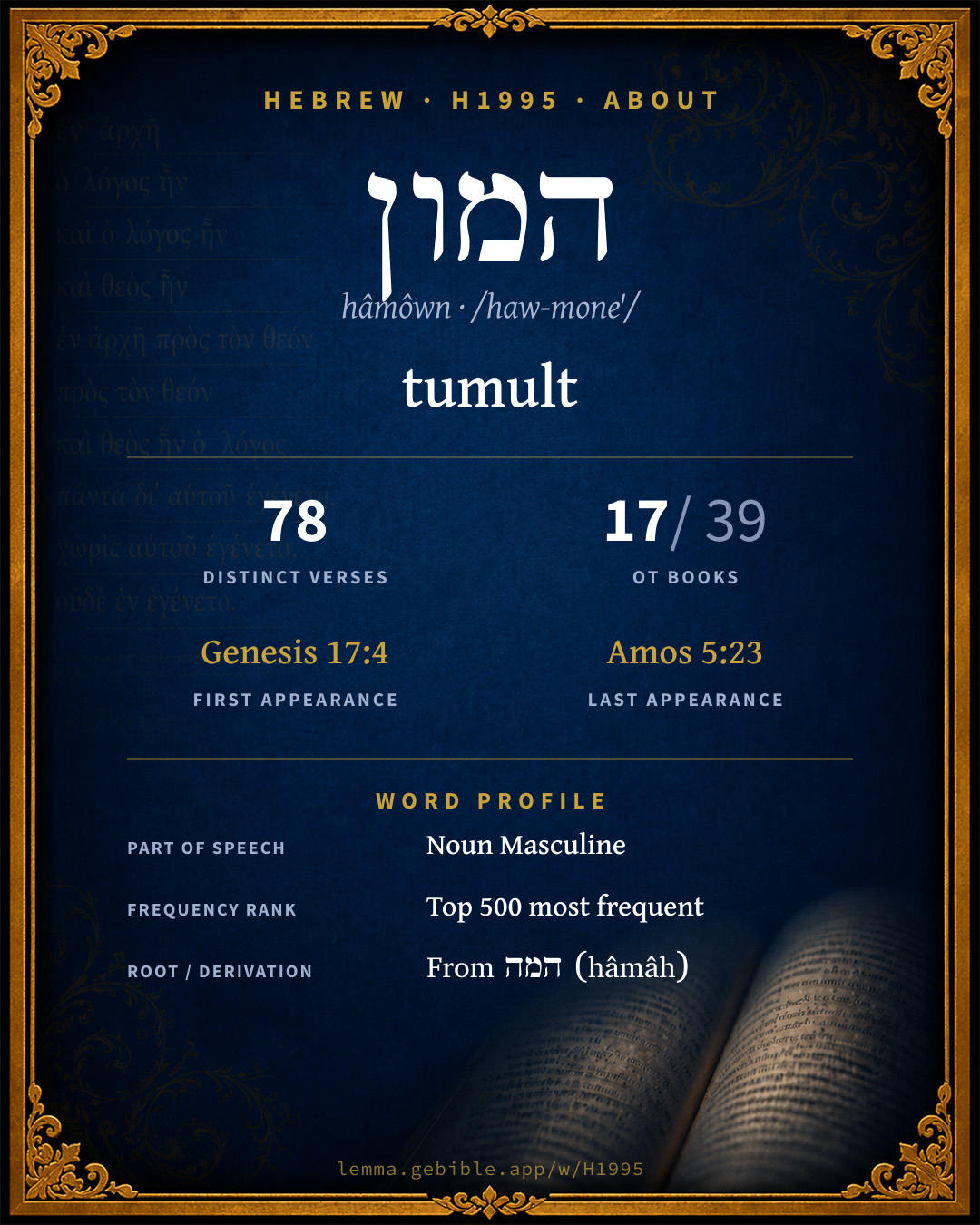
הָמוֹן
tumult
also: murmur, roar, crowd, abundance fuller range ↓
Full lexicon entry — Brown-Driver-Briggs (BDB)
From Brown-Driver-Briggs (BDB)
Where this word appears
See every Construct-state word in the Hebrew Bible →
Grammar key — what these labels mean
Part of speech
- Noun
- A naming word — a person, place, thing, or idea.
Noun type
- Common
- A common noun — a general class of person, place, or thing (“king,” “city,” “water”), not a specific name.
State
- Construct
- A noun bound to a following noun in a possessive / “of” relationship (the construct chain).
- Absolute
- The independent form of a noun, not bound to a following word.
Gender
- Masculine
- Grammatically masculine.
Number
- Singular
- One.
- Plural
- More than one (in Hebrew, generally three or more).
30 distinct verses where H1995 appears in the Absolute state, across 14 books. Filtered view — show all forms. Click any verse to open its interlinear word-by-word view. Verse text shown in the World English Bible for context — . Each verse’s Hebrew form is shown with its reference; the English is not keyword-highlighted, since the data carries no word-level English alignment. Use “Compare translations” on any verse to read it across multiple English versions. This concordance covers the Hebrew Bible; Septuagint (Greek Old Testament) occurrences are not indexed here.
1 Samuel 3 verses
- 1 Samuel 4:14 הֶ/הָמ֖וֹן ptcl def.art + n c ms When Eli heard the noise of the crying, he said, What means the noise of this tumult? The man hurried, and came and told Eli.
- 1 Samuel 14:16 הֶ/הָמ֛וֹן ptcl def.art + n c ms The watchmen of Saul in Gibeah of Benjamin looked; and, behold, the multitude melted away, and they went [here] and there.
- 1 Samuel 14:19 וְ/הֶ/הָמ֗וֹן conj + ptcl def.art + n c ms It happened, while Saul talked to the priest, that the tumult that was in the camp of the Philistines went on and increased: and Saul said to the priest, Withdraw your hand.
2 Samuel 1 verse
1 Kings 2 verses
- 1 Kings 20:13 הֶ/הָמ֥וֹן ptcl def.art + n c ms Behold, a prophet came near to Ahab king of Israel, and said, Thus says Yahweh, Have you seen all this great multitude? behold, I will deliver it into your hand this day; and you shall know that I am Yahweh.
- 1 Kings 20:28 הֶ/הָמ֨וֹן ptcl def.art + n c ms A man of God came near and spoke to the king of Israel, and said, Thus says Yahweh, Because the Syrians have said, Yahweh is a god of the hills, but he is not a god of the valleys; therefore will I deliver all this great multitude into your hand, and you shall know that I am Yahweh.
2 Kings 2 verses
- 2 Kings 7:13 ה/המון הֲמ֤וֹן הֲמ֥וֹן ptcl def.art + n c ms n c ms cs n c ms cs One of his servants answered, Please let some take five of the horses that remain, which are left in the city (behold, they are as all the multitude of Israel who are left in it; behold, they are as all the multitude of Israel who are consumed); and let us send and see.
- 2 Kings 25:11 הֶ/הָמ֑וֹן ptcl def.art + n c ms The residue of the people who were left in the city, and those who fell away, who fell to the king of Babylon, and the residue of the multitude, did Nebuzaradan the captain of the guard carry away captive.
1 Chronicles 1 verse
2 Chronicles 8 verses
- 2 Chronicles 13:8 הָמ֣וֹן n c ms Now you think to withstand the kingdom of Yahweh in the hand of the sons of David; and you are a great multitude, and there are with you the golden calves which Jeroboam made you for gods.
- 2 Chronicles 14:11 הֶ/הָמ֖וֹן ptcl def.art + n c ms Asa cried to Yahweh his God, and said, Yahweh, there is none besides you to help, between the mighty and him who has no strength: help us, Yahweh our God; for we rely on you, and in your name are we come against this multitude. Yahweh, you are our God; don't let man prevail against you.
- 2 Chronicles 20:2 הָמ֥וֹן n c ms Then there came some who told Jehoshaphat, saying, There comes a great multitude against you from beyond the sea from Syria; and, behold, they are in Hazazon Tamar (the same is En Gedi).
- 2 Chronicles 20:12 הֶ/הָמ֥וֹן ptcl def.art + n c ms Our God, will you not judge them? for we have no might against this great company that comes against us; neither know we what to do: but out eyes are on you.
- 2 Chronicles 20:15 הֶ/הָמ֤וֹן ptcl def.art + n c ms and he said, Listen you, all Judah, and you inhabitants of Jerusalem, and you king Jehoshaphat: Thus says Yahweh to you, Don't be afraid you, neither be dismayed by reason of this great multitude; for the battle is not yours, but God's.
- 2 Chronicles 20:24 הֶ֣/הָמ֔וֹן ptcl def.art + n c ms When Judah came to the watch-tower of the wilderness, they looked at the multitude; and, behold, they were dead bodies fallen to the earth, and there were none who escaped.
- 2 Chronicles 31:10 הֶ/הָמ֥וֹן ptcl def.art + n c ms Azariah the chief priest, of the house of Zadok, answered him and said, Since [the people] began to bring the offerings into the house of Yahweh, we have eaten and had enough, and have left plenty: for Yahweh has blessed his people; and that which is left is this great store.
- 2 Chronicles 32:7 הֶ/הָמ֣וֹן ptcl def.art + n c ms Be strong and of good courage, don't be afraid nor dismayed for the king of Assyria, nor for all the multitude who is with him; for there is a greater with us than with him:
Job 1 verse
Psalms 1 verse
Ecclesiastes 1 verse
Isaiah 3 verses
- Isaiah 13:4 הָמ֛וֹן n c ms The noise of a multitude in the mountains, as of a great people! the noise of a tumult of the kingdoms of the nations gathered together! Yahweh of Hosts is mustering the host for the battle.
- Isaiah 16:14 הֶ/הָמ֣וֹן ptcl def.art + n c ms But now Yahweh has spoken, saying, Within three years, as the years of a hireling, the glory of Moab shall be brought into contempt, with all his great multitude; and the remnant shall be very small and of no account.
- Isaiah 33:3 הָמ֔וֹן n c ms At the noise of the thunder the peoples are fled; at the lifting up of yourself the nations are scattered.
Jeremiah 1 verse
Ezekiel 1 verse
Daniel 4 verses
- Daniel 10:6 הָמֽוֹן n c ms his body also was like the beryl, and his face as the appearance of lightning, and his eyes as flaming torches, and his arms and his feet like burnished brass, and the voice of his words like the voice of a multitude.
- Daniel 11:11 הָמ֣וֹן הֶ/הָמ֖וֹן n c ms ptcl def.art + n c ms The king of the south shall be moved with anger, and shall come forth and fight with him, even with the king of the north; and he shall set forth a great multitude, and the multitude shall be given into his hand.
- Daniel 11:12 הֶ/הָמ֖וֹן ptcl def.art + n c ms The multitude shall be lifted up, and his heart shall be exalted; and he shall cast down tens of thousands, but he shall not prevail.
- Daniel 11:13 הָמ֔וֹן n c ms The king of the north shall return, and shall set forth a multitude greater than the former; and he shall come on at the end of the times, [even of] years, with a great army and with much substance.
Joel 1 verse
About this entry
At a glance — auto-summarized from this page’s data, not written by a person. Every figure links to its source below. This summary describes the numbers; it doesn’t interpret them.
המון — transliterated hâmôwn — is a Hebrew noun carrying the sense “tumult.” Alongside “tumult” the lexicon also lists “murmur”, “roar”, and “crowd” — part of its full sense range. Spanning 78 verses in 17 books, it ranks among the moderately common words of the Hebrew Bible. Its uses concentrate in Ezekiel (29% of all occurrences). Its earliest occurrence is Genesis 17:4. Each statement above links to its evidence; the full detail follows below.
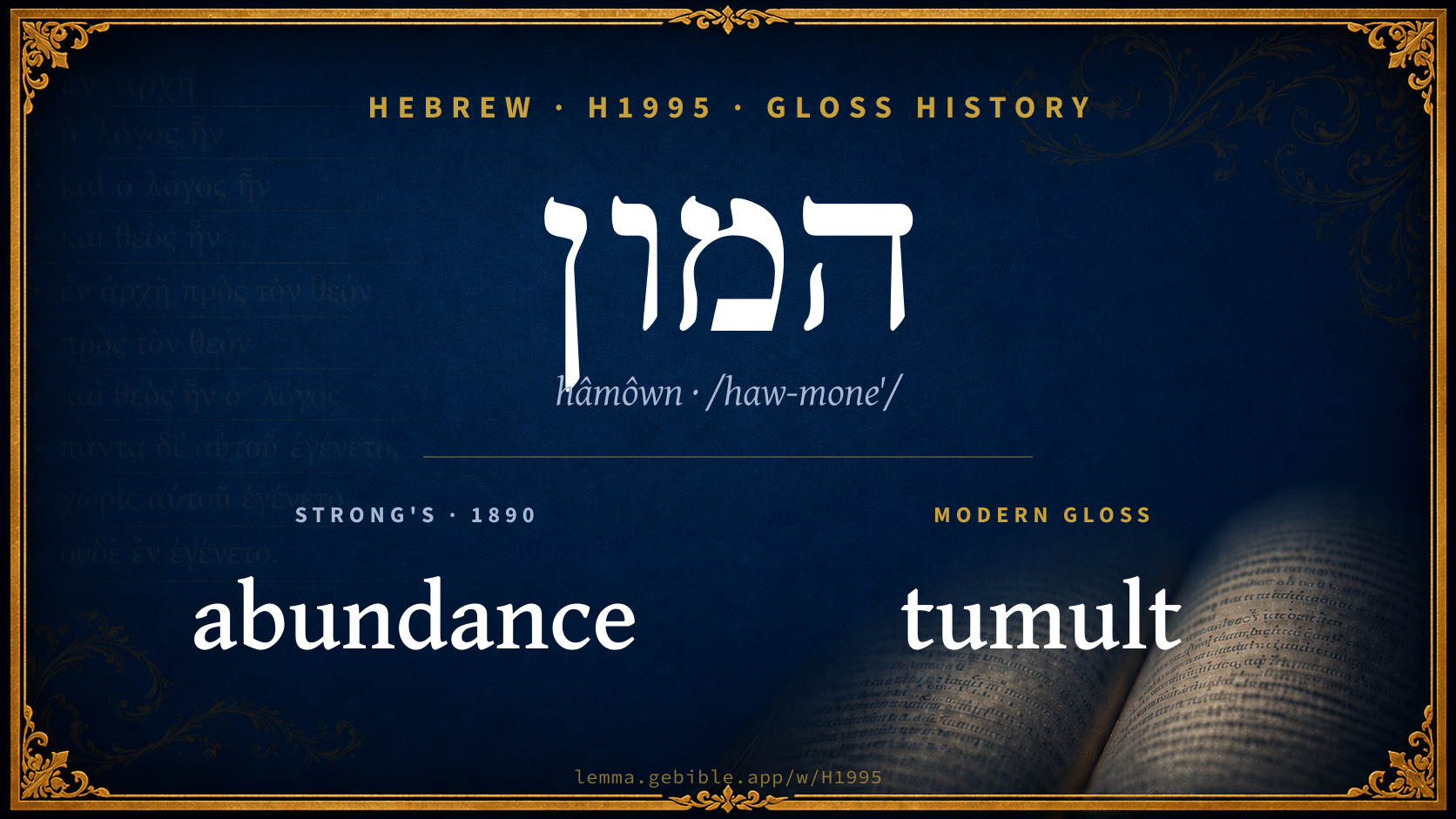
Gloss history
Strong's 1890 vs modern scholarship
About this word
Strong's H1995 catalogs a Hebrew word from the Hebrew Old Testament.
These counts are not copied from any lexicon or concordance. They are computed here, from the morphology-tagged Hebrew Old Testament. What Lemma adds →
- 78
- distinct verses
- The word appears in 78 distinct verses.
- 17 / 39
- OT books
- The word appears in 17 of 39 Old Testament books.
- #481
- by frequency
- Top 500 most frequent Hebrew words (rank 481 of 8,640 Hebrew words by occurrence).
View all 78 occurrences in the concordance →
Most concentrated in
- Ezekiel 23 verses 29%
- Isaiah 13 verses 17%
- 2 Chronicles 9 verses 12%
By section of the Old Testament
By traditional corpus
Conventional, traditional groupings — biblical authorship is debated, so this is a traditional corpus grouping, not an authorship claim. Each share is this word’s portion of its verses in that division of the Hebrew canon. Each figure is a share of the word’s 78 distinct verses.
- Prophets (Nevi'im) 55 verses · 71%
- Writings (Ketuvim) 21 verses · 27%
- Torah (Pentateuch) 2 verses · 3%
How translations render this word
Counts come from each version’s own published word-to-Strong’s tagging or interlinear alignment — an approximate guide to how each version renders this word, not a word-level alignment the data otherwise carries. Because each total is that version’s own tagged count, the per-version totals vary from one another and need not match the appearance or distinct-verse counts above. These counts may also differ from a printed concordance because Lemma counts each distinctly tagged rendering and does not collapse phrase taggings into a single head-word total. This is a fixed set of word-tagged versions (KJV, ASV, BSB, ULT) and does not change with the reading translation you choose elsewhere. Each version’s license is shown beside its name below (and on Sources).
BDB lists this Strong’s number as 2 distinct words (homographs). Each count above pools all of them and is not split by sense — see the Senses section below. A low-frequency rendering may belong to a different one of those words, not the primary meaning.
- King James Version†: Multitude 34×, All her multitude 4×, Tumult 4×
- American Standard Version†: Multitude 31×, Tumult 7×, Abundance 3×
- Berean Standard Bible†: Multitude 12×, Army 10×, Multitudes 8×
- unfoldingWord Literal Text†: Multitude 25×, Multitudes 14×, Multitude of 12×
King James Version Public Domain
Renders H1995 across 83† tagged occurrences — most commonly:
Plus 22 renderings that appear only once — usually multi-word phrases or single function words the recovered tagging swept in, not distinct renderings.
American Standard Version Public Domain
Renders H1995 across 84† tagged occurrences — most commonly:
Plus 28 renderings that appear only once — usually multi-word phrases or single function words the recovered tagging swept in, not distinct renderings.
Berean Standard Bible Public Domain
Renders H1995 across 81† tagged occurrences — most commonly:
Plus other, less common renderings. Plus 21 renderings that appear only once — usually multi-word phrases or single function words the recovered tagging swept in, not distinct renderings.
unfoldingWord Literal Text CC BY-SA 4.0
Renders H1995 across 85† tagged occurrences — most commonly:
Plus 20 renderings that appear only once — usually multi-word phrases or single function words the recovered tagging swept in, not distinct renderings.
9 senses and sub-senses in the full BDB
What do BDB’s symbols mean?
BDB uses these scholarly abbreviations:
| Symbol | Meaning |
|---|---|
| 𝔊 | the Septuagint (the ancient Greek translation, LXX) |
| 𝔙 | the Vulgate (the Latin translation) |
| 𝔖 | the Syriac version (the Peshitta) |
| 𝔗 | the Targum (the Aramaic translation) |
| ψ | the Psalms |
| √ | root (the underlying root or stem) |
| ‖ | parallel passage (a synonymous or contrasted parallel) |
| † | the dagger: every passage where the word occurs is cited |
The 9 senses and sub-senses the full Brown-Driver-Briggs lexicon distinguishes for this word, in lexicon order (not ranked by frequency), with BDB’s own verbatim wording and sub-sense lettering. Shown in Hebrew script with BDB’s own scholarly abbreviations. The condensed entry is in the Lexicon Entry tab. See also the Forms in the corpus table below.
המון I
- 1. sound, murmur, rush, roar, especially sound made by a crowd of people, murmur, roar ψ 65:8 ה׳ לְאֻמִּים (‖ שְׁאוֹן יַמִּים etc.); cf. קוֹל ה׳ Is 13:4 sound of a roaring (‖ קוֹל שְׁאוֹן), 33:3 Dn 10:6; הֲמוֹן עַמִּים Is 17:12 (‖ שְׁאוֹן לְאֻמִּים) where again compared with הֲמוֹת יַמִּים; also 31:4 of throng of shepherds (‖ קוֹל); of a city ה׳ קִרְיָה Jb 39:7 (‖ תְּשֻׁאוֹת נֹגֵשׂ); cf. ה׳ עִיר = noisy city Is 32:14, הֲמוֹנָהּ Is 5:14; of sound of songs ה׳ שִׁירַיִךְ Ez 26:13 (‖ קוֹל כִּנּוֹרַיִךְ), cf. Am 5:23 (‖ זִמְרַת נְבָלֶיךָ); of crying קוֹל ה׳ 1 S 4:14 (‖ קוֹל צְעָקָה); v. further הֲמוֹן מֵעִים fig. of sympathy Is 63:15 (‖ רַחֲמִים), cf. הָמָה 2; of rain קוֹל ה׳ הַגֶּשֶׁם 1 K 18:41, cf. Je 10:13 = 51:16;—of rumbling of chariot-wheels ה׳ גַּלְגִּלָּיו Je 47:3 (‖ קוֹל שַׁעֲטַת פַּרְסוֹת & רַעַשׁ לְרִכְבּוֹ). e.g. Psalms 65:8
- 2. tumult, confusion (as occasioning a roar) 1 S 14:19 2 S 18:29. e.g. 1 Samuel 14:19
- 3. crowd, multitude (especially freq. in Ez Ch):—
- a. frequently of great army Ju 4:7 1 S 14:16 1 K 20:13, 28 Is 29:5(×2) 2 Ch 13:8; 14:10; 20:2, 12, 15, 24; 32:7; cf. Ez 39:11; also 7:12, 13; 30:4 (cf. emend. supr.); on Je 3:23 cf. VB; v. further גֵּיא הֲמוֹן גּוֹג Ez 39:11, 15; Dn 11:10 (ה׳ חֲיָלִים רַבִּים) v 11(×2), 12, 13 (‖ חַיִל גָּדוֹל); also pl. Jo 4:14(×2). e.g. Judges 4:7
- b. of a whole people 2 S 6:19 Is 5:13; 16:14 Ez 7:11, 14; 29:19; 30:10, 15; 31:2, 18; 32:12(×2), 16, 18, 20, 24, 25, 26, 31, 32. e.g. 2 Samuel 6:19
- c. of any great throng 2 K 7:13(×2) (so MT 25:11, but ‖ Je 52:15 הָאָמוֹן) ψ 42:5 Jb 31:34 (ה׳ רַבָּה) Ez 23:42; ה׳ גּוֹיִם Gn 17:4, 5 (P) cf. Is 29:7, 8; so, under fig. of overwhelming mass of waves Je 51:42. e.g. 2 Kings 7:13
- 4. great number, abundance (late) ה׳ נָשִׁים 2 Ch 11:23; for וַיִּשְׁאַל הֲמַוֹן נָשִׁים PerlesAnal. 47 proposes וִיִּשְׂאוּ לָהֶם נ׳ (cf. נשׂא 3 d); of cattle Je 49:32; of things: materials for temple-building 1 Ch 29:16; tithes & gifts 2 Ch 31:10. Hence e.g. 2 Chronicles 11:23
- 5. abundance, wealth, ψ 37:16 cf. Ec 5:9 (‖ כֶּסֶף), Is 60:5 (ה׳ יָם; ‖ חֵיל גּוֹיִם). e.g. Psalms 37:16
המון II rage, be turbulent (?denom. from המון Thes, after Rabb.
Qal
- Inf. sf. יַעַן הֲמָנְכֶם מִן־הַגּוֹיִם Ez 5:7 (Sm queries; Ew, after 𝔖 Aq, הִמָּנֵכֶם from מנה); read rather, with Bö Co Da, המרותכם (from מרה) because ye rebelled. e.g. Ezekiel 5:7
Senses from the full Brown-Driver-Briggs lexicon (Brown, Driver, Briggs; Oxford 1906 — public domain), digitized via Sefaria, supplemented by the OpenScriptures HebrewLexicon (CC BY 4.0). Full attribution on Sources.
Word origin
I. n.m. 1 S 4:14 (f. †Jb 31:34?) sound, murmur, roar, crowd, abundance;—abs. ה׳ 1 S 4:14 + 27 times (+ 2 K 25:11 = אָמוֹן in ‖ Je 52:15, v. ii. אָמוֹן p. 54 supr.); cstr. הֲמוֹן Gn 17:4 + 30 times + Ez 39:11, 15 (גֵּיא הֲמוֹן גּוֹג); sf. הֲמוֹנוֹ Is 5:13 + 2 times + Ez 31:18 Qr + 3 times (Kt המונה); so also Co for n.pr. (?) הֲמוֹנָה (q.v.) 39:16; הַמוֹנָהּ Is 5:14 + 6 times + Ez 7:12, 13; 30:4 (all del. B Co; in 7:13 also Da), הֲמֹנָהּ Ez 29:19; הֲמוֹנָם Is 31:4 Ez 7:11; pl. הֲמֹנִים Jo 4:14(×2); sf. הֲמוֹנֶיהָ Ez 32:30;—הֲמָנְכֶם Ez 5:7 v. sub המן infr.;—
I. vb. rage, be turbulent (?denom. from המון Thes, after Rabb.; cf. Ke RV; AV multiply; but very dub.)—only
— Brown-Driver-Briggs (Oxford 1906, public domain), digitized via Sefaria, supplemented by the OpenScriptures HebrewLexicon (CC BY 4.0). See Sources.
Derived from המה (hâmâh) (H1993) — to roar.
Jastrow Dictionary
A second Hebrew/Aramaic lexicon for comparison, covering Aramaic and post-biblical (Talmudic, Targumic, Midrashic) usage that the biblical-Hebrew BDB does not. Matched by lemma rather than by Strong’s number, so a lemma may carry more than one Jastrow headword (shown separately below), and the entries cover usage well beyond the Bible.
הָמוֹן
- preced.) noise, tumult; multitude. Yoma 20ᵇ קול הֲמוֹנָהּ של רומי Ms. M. (ed. העיר); Lam. R. to V, 18; Macc. 24ᵃ קול ה׳ של רומי Ms. Ms. (ed. בבל); Yalk. Is. 278 המוני של כרך גדול (read: הֲמוֹנוֹ), the din of the city of Rome, v. פּוֹטְיוֹלִין. Macc. 10ᵃ (ref. to Koh. V, 9) ללמד בה׳ to teach before large crowds; (Yalk. Koh. 971 ללמוד בה׳ to study among a crowd of students).—Pl. הֲמוֹנִים. Ex. R. s. 11 אתם עשיתם ה׳ ה׳ וכ׳ you arranged troops against my children &c.—Cant. R. to VIII, 11 (play on המון, ib. באו עליהן המונות (read: המונים) hordes came against them. Ib. שהמו אחריהם הֲמוֹנֵי מלאכים (not מלכים) troops of angels rushed for them (to prevent them from receiving the Law, v. דָּדָה). Ib. שהמו אחר המוני המוניות, read: שהמו אחריהם המוניות, v. הְמוֹנוּת. e.g. Ecclesiastes 5:9
הָמוֹן ²
- , multitude. Targ. Is. XIII, 4. Targ. II Kings XXV, 11; a. e.
A Dictionary of the Targumim, the Talmud Babli and Yerushalmi, and the Midrashic Literature (Marcus Jastrow; London, Luzac, 1903) — Public Domain. Digitized via Sefaria. Digitized via Sefaria. Full attribution on Sources.
Forms in the corpus
The 44 distinct written forms H1995 takes in the Hebrew Bible, most frequent first — each parse links to that state’s occurrences in the concordance. Hebrew forms include their vowel points and cantillation, so a single lemma takes many written forms.
Same root — word family
Other BDB entries built from the same root as H1995, grouped by Strong’s listed origin. These share a root / origin per the lexicon — not necessarily a shared meaning. Each links to that word’s own entry.
Derives from
Shares the same root
Derived from this word
Proper names from this root
People and places named from this root — a name, not an additional meaning of the word.
Compare all same-root words → Showing 4 of 7 — not the complete family. 2 of the same-root words are proper names (people or places). They share a root, not necessarily a meaning.
Septuagint verse parallels
This word appears in 75 verses that also exist in the Greek Old Testament (Septuagint), out of the 78 Hebrew verses it occurs in. You can read those verses in Greek by switching the Old Testament edition to the Septuagint.
Read these verses in the Septuagint
- Genesis 17:4
- Judges 4:7
- 1 Samuel 4:14
- 2 Samuel 6:19
- 1 Kings 18:41
- 2 Kings 7:13
- 1 Chronicles 29:16
- 2 Chronicles 11:23
- Job 31:34
- Psalms 37:16
- Ecclesiastes 5:10
- Isaiah 5:13
This is a verse-level parallel only — the same verses exist in both the Hebrew and Greek Old Testaments. No word-level Hebrew↔Greek correspondence is claimed: the data carries no such alignment, so no Greek word is shown as this Hebrew word’s translation. Coverage is not total — the Septuagint omits the deuterocanon and renumbers the Psalms, so some Hebrew verses have no direct Greek parallel.