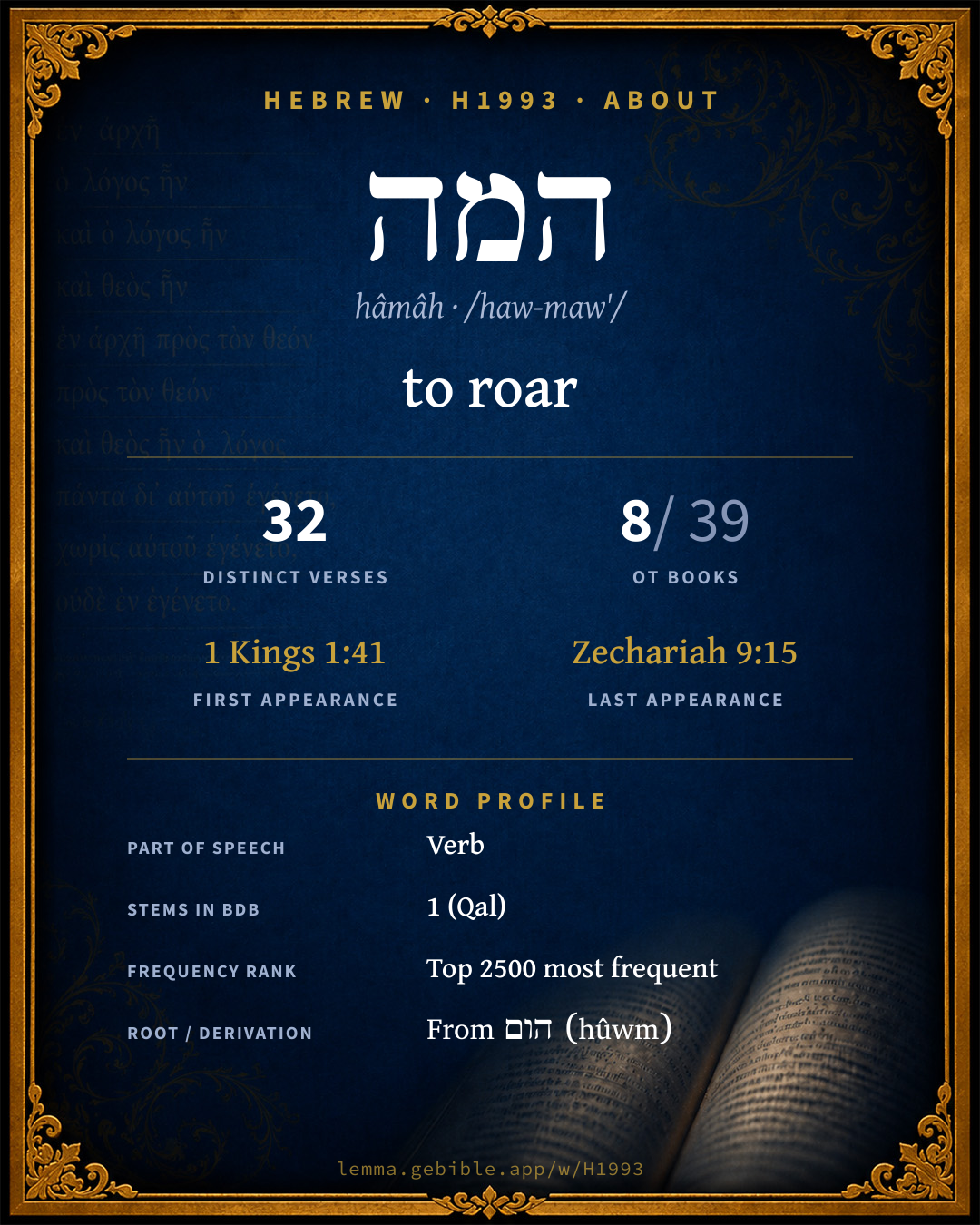
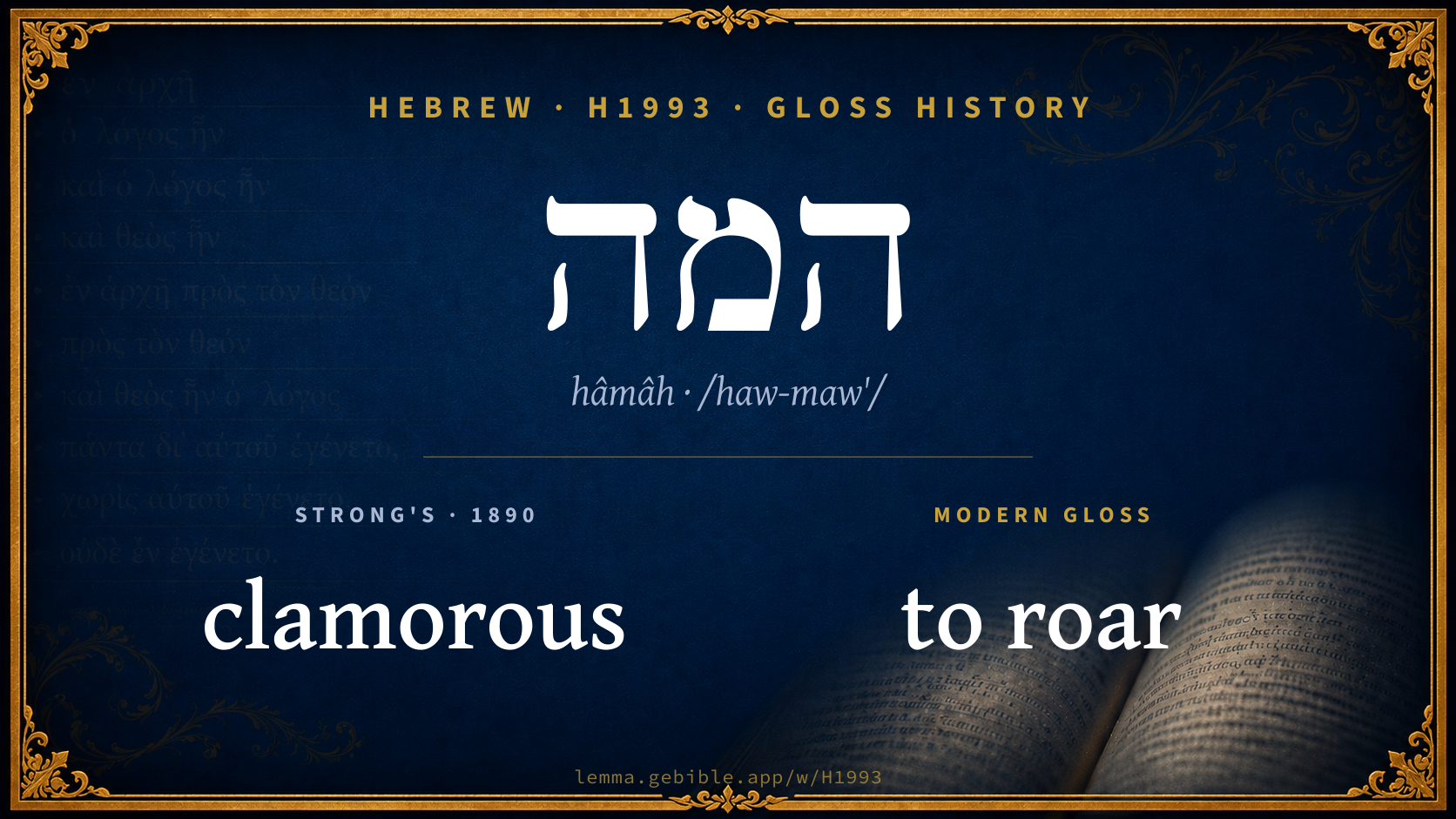
הָמָה
to roar
‘to roar’ is one of 6 main senses fuller range ↓
Full lexicon entry — Brown-Driver-Briggs (BDB)
From Brown-Driver-Briggs (BDB)
Where this word appears
Grammar key — what these labels mean
Part of speech
- Verb
- An action or state-of-being word.
Stem
- Qal
- The basic, simple active stem — the plain form of the verb (“he wrote”). Here: ‘growl like a dog’
Form
- Imperfect
- An incomplete, ongoing, or future action (“he will / would write”).
- Perfect
- A completed action or state — Hebrew marks aspect (completeness) more than strict tense (“he wrote”).
- Participle Active
- A verbal adjective expressing ongoing or characteristic action (“writing / one who writes”).
- Cohortative
- A first-person volitional form expressing wish or resolve (“let me / let us write”).
- Sequential Perfect
- A perfect with prefixed waw continuing a preceding imperfect or command (waw-consecutive perfect).
- Sequential Imperfect
- An imperfect with prefixed waw — the standard past-narrative form (waw-consecutive imperfect).
- Infinitive Construct
- A bound verbal noun, frequently with prepositions (“to write / in writing”).
State
- Absolute
- The independent form of a noun, not bound to a following word.
Person
- 3rd Person
- The one spoken about (“he / she / it / they”).
- 1st Person
- The speaker (“I / we”).
- 2nd Person
- The one addressed (“you”).
Gender
- Masculine
- Grammatically masculine.
- Common
- Either gender — not distinguished for this form.
- Feminine
- Grammatically feminine.
Number
- Plural
- More than one (in Hebrew, generally three or more).
- Singular
- One.
Grammatical forms 13 distinct
- Verb, Qal, Imperfect, 3rd Person, Masculine, Plural 7 times (21%)
- Verb, Qal, Imperfect, 3rd Person, Masculine, Singular 4 times (12%)
- Verb, Qal, Perfect, 3rd Person, Common, Plural 4 times (12%)
- Verb, Qal, Participle Active, Feminine, Singular, Absolute 4 times (12%)
- Verb, Qal, Cohortative, 1st Person, Common, Singular 2 times (6%)
- Verb, Qal, Sequential Perfect, 3rd Person, Common, Plural 2 times (6%)
- Verb, Qal, Sequential Imperfect, 3rd Person, Masculine, Plural 2 times (6%)
- Verb, Qal, Imperfect, 2nd Person, Feminine, Singular 2 times (6%)
+5 more forms (7 occurrences)
Parsed forms decoded from the imported morphology (morphhb / Westminster Leningrad Codex — WLC text public domain, morphhb tagging CC BY 4.0), counted across 34 parsed occurrences — not distinct verses.
Every verse where H1993 appears — 32 distinct verses across 8 books. Click any verse to open its interlinear word-by-word view. Verse text shown in the World English Bible for context — . Each verse’s Hebrew form is shown with its reference; the English is not keyword-highlighted, since the data carries no word-level English alignment. Use “Compare translations” on any verse to read it across multiple English versions. This concordance covers the Hebrew Bible; Septuagint (Greek Old Testament) occurrences are not indexed here.
1 Kings 1 verse
Psalms 11 verses
- Psalms 39:6 יֶהֱמָי֑וּ/ן Qal impf 3mp + sfx n "Surely every man walks like a shadow. Surely they busy themselves in vain. He heaps up, and doesn't know who shall gather.
- Psalms 42:5 וַ/תֶּהֱמִ֪י conj + Qal wimpf 2fs Why are you in despair, my soul? Why are you disturbed within me? Hope in God! For I shall still praise him for the saving help of his presence.
- Psalms 42:11 תֶּהֱמִ֪י Qal impf 2fs Why are you in despair, my soul? Why are you disturbed within me? Hope in God! For I shall still praise him, The saving help of my countenance, and my God.
- Psalms 43:5 תֶּהֱמִ֪י Qal impf 2fs Why are you in despair, my soul? Why are you disturbed within me? Hope in God! For I shall still praise him: My Savior, my helper, and my God.
- Psalms 46:3 יֶהֱמ֣וּ Qal impf 3mp Though the waters of it roar and are troubled, Though the mountains tremble with their swelling. Selah.
- Psalms 46:6 הָמ֣וּ Qal pf 3cp The nations raged. The kingdoms were moved. He lifted his voice, and the earth melted.
- Psalms 55:17 וְ/אֶהֱמֶ֑ה conj + Qal coh 1cs Evening, morning, and at noon, I will cry out in distress. He will hear my voice.
- Psalms 59:6 יֶהֱמ֥וּ Qal impf 3mp They return at evening, howling like dogs, And prowl around the city.
- Psalms 59:14 יֶהֱמ֥וּ Qal impf 3mp At evening let them return. Let them howl like a dog, and go around the city.
- Psalms 77:3 וְ/אֶֽהֱמָיָ֑ה conj + Qal coh 1cs I remember God, and I groan. I complain, and my spirit is overwhelmed. Selah.
- Psalms 83:2 יֶהֱמָי֑וּ/ן Qal impf 3mp + sfx n For, behold, your enemies are stirred up. Those who hate you have lifted up their heads.
Proverbs 4 verses
- Proverbs 1:21 הֹמִיּ֗וֹת Qal ptcp.act fp She calls at the head of noisy places. At the entrance of the city gates, she utters her words:
- Proverbs 7:11 הֹמִיָּ֣ה Qal ptcp.act fs She is loud and defiant. Her feet don't stay in her house.
- Proverbs 9:13 הֹֽמִיָּ֑ה Qal ptcp.act fs The foolish woman is loud, Undisciplined, and knows nothing.
- Proverbs 20:1 הֹמֶ֣ה Qal ptcp.act ms Wine is a mocker, and beer is a brawler; Whoever is led astray by them is not wise.
Song of Solomon 1 verse
Isaiah 5 verses
- Isaiah 16:11 יֶֽהֱמ֑וּ Qal impf 3mp Why my heart sounds like a harp for Moab, and my inward parts for Kir Heres.
- Isaiah 17:12 כַּ/הֲמ֥וֹת יֶהֱמָי֑וּ/ן prep + Qal inf.cs Qal impf 3mp + sfx n Ah, the uproar of many peoples, who roar like the roaring of the seas; and the rushing of nations, that rush like the rushing of mighty waters!
- Isaiah 22:2 הֽוֹמִיָּ֔ה Qal ptcp.act fs You that are full of shouting, a tumultuous city, a joyous town; your slain are not slain with the sword, neither are they dead in battle.
- Isaiah 51:15 וַ/יֶּהֱמ֖וּ conj + Qal wimpf 3mp For I am Yahweh your God, who stirs up the sea, so that the waves of it roar: Yahweh of Hosts is his name.
- Isaiah 59:11 נֶהֱמֶ֤ה Qal impf 1cp We roar all like bears, and moan sore like doves: we look for justice, but there is none; for salvation, but it is far off from us.
Jeremiah 8 verses
- Jeremiah 4:19 הֹֽמֶה Qal ptcp.act ms My anguish, my anguish! I am pained at my very heart; my heart is disquieted in me; I can't hold my peace; because you have heard, O my soul, the sound of the trumpet, the alarm of war.
- Jeremiah 5:22 וְ/הָמ֥וּ conj + Qal wpf 3cp Don't you fear me? says Yahweh: won't you tremble at my presence, who have placed the sand for the bound of the sea, by a perpetual decree, that it can't pass it? and though the waves of it toss themselves, yet they can't prevail; though they roar, yet they can't pass over it.
- Jeremiah 6:23 יֶהֱמֶ֔ה Qal impf 3ms They lay hold on bow and spear; they are cruel, and have no mercy; their voice roars like the sea, and they ride on horses, everyone set in array, as a man to the battle, against you, daughter of Zion.
- Jeremiah 31:20 הָמ֤וּ Qal pf 3cp Is Ephraim my dear son? is he a darling child? for as often as I speak against him, I do earnestly remember him still: therefore my heart yearns for him; I will surely have mercy on him, says Yahweh.
- Jeremiah 31:35 וַ/יֶּהֱמ֣וּ conj + Qal wimpf 3mp Thus says Yahweh, who gives the sun for a light by day, and the ordinances of the moon and of the stars for a light by night, who stirs up the sea, so that the waves of it roar; Yahweh of hosts is his name:
- Jeremiah 48:36 יֶהֱמֶ֔ה יֶהֱמֶ֑ה Qal impf 3ms Qal impf 3ms Therefore my heart sounds for Moab like pipes, and my heart sounds like pipes for the men of Kir Heres: therefore the abundance that he has gotten is perished.
- Jeremiah 50:42 יֶהֱמֶ֔ה Qal impf 3ms They lay hold on bow and spear; they are cruel, and have no mercy; their voice roars like the sea; and they ride on horses, everyone set in array, as a man to the battle, against you, daughter of Babylon.
- Jeremiah 51:55 וְ/הָמ֤וּ conj + Qal wpf 3cp For Yahweh lays Babylon waste, and destroys out of her the great voice; and their waves roar like many waters; the noise of their voice is uttered:
Ezekiel 1 verse
Zechariah 1 verse
About this entry
At a glance — auto-summarized from this page’s data, not written by a person. Every figure links to its source below. This summary describes the numbers; it doesn’t interpret them.
The Hebrew verb המה centers on the idea of “to roar.” The lexicon spreads it across several senses; see its full sense range. It turns up in 32 verses across 8 books, a moderately common footprint. The word gravitates to Psalms (34%), then Jeremiah and Isaiah. Its earliest occurrence is 1 Kings 1:41. For the data behind this summary, explore the sense tree and the renderings breakdown below.
Gloss history
Strong's 1890 vs modern scholarship
About this word
Strong's H1993 catalogs a Hebrew word from the Hebrew Old Testament.
These counts are not copied from any lexicon or concordance. They are computed here, from the morphology-tagged Hebrew Old Testament. What Lemma adds →
- 32
- distinct verses
- The word appears in 32 distinct verses.
- 8 / 39
- OT books
- The word appears in 8 of 39 Old Testament books.
- #1,041
- by frequency
- Top 2500 most frequent Hebrew words (rank 1,041 of 8,640 Hebrew words by occurrence).
View all 32 occurrences in the concordance →
By section of the Old Testament
By traditional corpus
Conventional, traditional groupings — biblical authorship is debated, so this is a traditional corpus grouping, not an authorship claim. Each share is this word’s portion of its verses in that division of the Hebrew canon. Each figure is a share of the word’s 32 distinct verses.
- Prophets (Nevi'im) 16 verses · 50%
- Writings (Ketuvim) 16 verses · 50%
How translations render this word
Counts come from each version’s own published word-to-Strong’s tagging or interlinear alignment — an approximate guide to how each version renders this word, not a word-level alignment the data otherwise carries. Because each total is that version’s own tagged count, the per-version totals vary from one another and need not match the appearance or distinct-verse counts above. These counts may also differ from a printed concordance because Lemma counts each distinctly tagged rendering and does not collapse phrase taggings into a single head-word total. This is a fixed set of word-tagged versions (KJV, ASV, BSB, ULT) and does not change with the reading translation you choose elsewhere. Each version’s license is shown beside its name below (and on Sources).
- King James Version: Shall sound 3×, Why art thou disquieted 3×, Make a noise 2×
- American Standard Version: Soundeth 3×, Thereof roar 3×, Why art thou disquieted 3×
- Berean Standard Bible: Roar 4×, Laments 3×, Is loud 2×
- unfoldingWord Literal Text: Roar 4×, Are you clamoring 2×, Moan 2×
King James Version Public Domain
Renders H1993 across 34 tagged occurrences — most commonly:
Plus 24 renderings that appear only once — usually multi-word phrases or single function words the recovered tagging swept in, not distinct renderings.
American Standard Version Public Domain
Renders H1993 across 34 tagged occurrences — most commonly:
Plus 21 renderings that appear only once — usually multi-word phrases or single function words the recovered tagging swept in, not distinct renderings.
Berean Standard Bible Public Domain
Renders H1993 across 33 tagged occurrences — most commonly:
Plus 16 renderings that appear only once — usually multi-word phrases or single function words the recovered tagging swept in, not distinct renderings.
unfoldingWord Literal Text CC BY-SA 4.0
Renders H1993 across 32 tagged occurrences — most commonly:
Plus 22 renderings that appear only once — usually multi-word phrases or single function words the recovered tagging swept in, not distinct renderings.
Senses in the full BDB
What do BDB’s symbols mean?
BDB uses these scholarly abbreviations:
| Symbol | Meaning |
|---|---|
| 𝔊 | the Septuagint (the ancient Greek translation, LXX) |
| 𝔙 | the Vulgate (the Latin translation) |
| 𝔖 | the Syriac version (the Peshitta) |
| 𝔗 | the Targum (the Aramaic translation) |
| ψ | the Psalms |
| √ | root (the underlying root or stem) |
| ‖ | parallel passage (a synonymous or contrasted parallel) |
| † | the dagger: every passage where the word occurs is cited |
The 6 senses and sub-senses the full Brown-Driver-Briggs lexicon distinguishes for this word, in lexicon order (not ranked by frequency), with BDB’s own verbatim wording and sub-sense lettering. Shown in Hebrew script with BDB’s own scholarly abbreviations. The condensed entry is in the Lexicon Entry tab. See also the Forms in the corpus table below.
Qal
- Pf. 3 mpl. הָמוּ ψ 46:7 + 2 times; וְהָמוּ consec. Je 5:22 + 2 times; Impf. יֶהֱמֶה Jr 6:23 + 3 times; 2 fs. תֶּהֱמִי ψ 42:12; 43:5; וַתֶּהֱמִי 42:6; אֶהֱמֶה 55:18; אֶהֱמָ֑יָה 77:4; יֶהֱמוּ 46:4 + 3 times; וַיֶּהֱמוּ Is 51:15; Je 31:35; יֶהֱמָיוּ֑ן ψ 39:7 + 2 times; 1 pl. נֶהֱמֶה Is 59:11; Inf. הֲמוֹת Is 17:12; Pt. הֹמֶה Pr 20:1 Je 4:19; f. הוֹמָה 1 K 1:41, הֹמִיָּה Pr 7:11; 9:13, הוֹמִיָּה Is 22:2; fpl. הֹמִיּוֹת Pr 1:21, הֹמוֹת Ez 7:16 (Co הַמָּוֶת cf. 𝔊 𝔖);— e.g. Psalms 46:7
- 1. growl like a dog כַּכָּ֑לֶב ψ 59:7, 15, subj. wicked men; groan (in distress, lamentation), like bears כַּדֹּבִים Is 59:11 (‖ הגה כיונה); of doves (also in sim.) Ez 7:16 cf. Da (si vera l., vid. supr.). e.g. Psalms 59:7
- 2. murmur, fig. of soul (נֶפֶשׁ) in discouragement ψ 42:6, 12; 43:5; in prayer 55:18; 77:4 (both ‖ אָשִׂיחָה); also subj. מֵעִים, of the thrill of deep-felt compassion or sympathy, sq. לְ of person pitied, Je 31:20 (‖ רחם ארחמנו), sq. עַל, Ct 5:4; further כַּכִּנּוֹר, like the lyre (zither) Is 16:11; כַּחֲלִילִים, like flutes, subj. לֵב Je 48:36 (sq. לְ) v 36 (sq. אֶל); cf. Je 4:19 לִבִּי הֹמֶה־לִי. e.g. Psalms 42:6
- 3. roar, of waves, subj. גַּלִּים Je 5:22; 31:35 Is 51:15 cf. ψ 46:4; sim. of roar of multitudes Is 17:12 Je 6:23; 50:42; metaph. id., Je 51:55; be tumultuous, of peoples ψ 46:7 (‖ מָטוּ); 83:3 (‖ נָֽשְׂאוּ רֹאשׁ). e.g. Jeremiah 5:22
- 4. be in commotion, stir, of city 1 K 1:41 Is 22:2; so pt. fpl. as subst. רֹאשׁ הֹמִיּוֹת Pr 1:21 head of stirring, bustling streets (‖ פתתי שׁערים); of man, אַךְ־הֶבֶל יֶהֱמָי֑וּן ψ 39:7 surely to no purpose they bustle about (‖ אַךְ־בְּצֶלֶם יִתְהַלֶּךְ־אִישׁ). e.g. 1 Kings 1:41
- 5. be boisterous, turbulent, as with wine Zc 9:15 (but read perhaps דָּמָם, cf. FiHexapl. ii. 3, 1024 KloTh LZ, 1879, 564 StaZAW 1881, 18); also pt. as adj., of שֵׁכָר (by meton.) Pr 20:1; of shameless woman Pr 7:11; 9:13. e.g. Zechariah 9:15
Senses from the full Brown-Driver-Briggs lexicon (Brown, Driver, Briggs; Oxford 1906 — public domain), digitized via Sefaria, supplemented by the OpenScriptures HebrewLexicon (CC BY 4.0). Full attribution on Sources.
Word origin
vb. murmur, growl, roar, be boisterous (𝔗 הֲמָא, but rare, and perhaps not genuine Aramaic; cf. Arabic هَمْهَمَ murmur);—
— Brown-Driver-Briggs (Oxford 1906, public domain), digitized via Sefaria, supplemented by the OpenScriptures HebrewLexicon (CC BY 4.0). See Sources.
Derived from הום (hûwm) (H1949) — to roar.
Jastrow Dictionary
A second Hebrew/Aramaic lexicon for comparison, covering Aramaic and post-biblical (Talmudic, Targumic, Midrashic) usage that the biblical-Hebrew BDB does not. Matched by lemma rather than by Strong’s number, so a lemma may carry more than one Jastrow headword (shown separately below), and the entries cover usage well beyond the Bible.
הָמָה
- , v. המי
המי
- to be noisy, excited, with אחר to rush after, be greedy, envious &c.—Cant. R. to VIII, 11 הָמוּ, v. הָמוֹן a. הֲמוֹנוּת. Part. הוֹמֶה, v. infra; fem. הוֹמִיָּה. Y. M. Kat. III, beg. 81ᶜ (in a riddle) ה׳ בירכתי ביתה she (the soul?) is restless in the corners of her house. Midr. Till. to Ps. LXXVII הוֹמִים are in commotion.
- same, to covet (with אחר). Lev. R. s. 22 (ref. to אוהב בהמון, Koh. V, 9) כל מי שהומה ומְהַמֶּה אחר הממון whosoever is greedy and covetous for money; ib. הומה ומה׳ אחר תורה ambitious to accumulate learning; a. e.—Part. pass. f. מְהוּמָּת anxious. Nidd. 5ᵃ, v. בַּיִת.—Denom. מָמוֹן. e.g. Ecclesiastes 5:9
A Dictionary of the Targumim, the Talmud Babli and Yerushalmi, and the Midrashic Literature (Marcus Jastrow; London, Luzac, 1903) — Public Domain. Digitized via Sefaria. Digitized via Sefaria. Full attribution on Sources.
Forms in the corpus
The 28 distinct written forms H1993 takes in the Hebrew Bible, most frequent first — each parse links to that stem’s occurrences in the concordance. Hebrew forms include their vowel points and cantillation, so a single lemma takes many written forms.
| Form | Parsing | Example | Uses |
|---|---|---|---|
| יֶהֱמֶ֔ה | Verb, Qal, Imperfect, 3rd Person, Masculine, Singular | Jeremiah 6:23 | 3 |
| יֶהֱמָי֑וּ/ן | Verb, Qal, Imperfect, 3rd Person, Masculine, Plural | Isaiah 17:12 | 3 |
| יֶהֱמ֥וּ | Verb, Qal, Imperfect, 3rd Person, Masculine, Plural | Psalms 59:6 | 2 |
| תֶּהֱמִ֪י | Verb, Qal, Imperfect, 2nd Person, Feminine, Singular | Psalms 42:11 | 2 |
| הָמ֖וּ | Verb, Qal, Perfect, 3rd Person, Common, Plural | Zechariah 9:15 | 1 |
| הָמ֣וּ | Verb, Qal, Perfect, 3rd Person, Common, Plural | Psalms 46:6 | 1 |
| הָמ֤וּ | Verb, Qal, Perfect, 3rd Person, Common, Plural | Jeremiah 31:20 | 1 |
| הָמ֥וּ | Verb, Qal, Perfect, 3rd Person, Common, Plural | Song of Solomon 5:4 | 1 |
| הֹֽמִיָּ֑ה | Verb, Qal, Participle Active, Feminine, Singular, Absolute | Proverbs 9:13 | 1 |
| הֹֽמֶה | Verb, Qal, Participle Active, Masculine, Singular, Absolute | Jeremiah 4:19 | 1 |
| הֹמ֑וֹת | Verb, Qal, Participle Active, Feminine, Plural, Absolute | Ezekiel 7:16 | 1 |
| הֹמִיּ֗וֹת | Verb, Qal, Participle Active, Feminine, Plural, Absolute | Proverbs 1:21 | 1 |
| הֹמִיָּ֣ה | Verb, Qal, Participle Active, Feminine, Singular, Absolute | Proverbs 7:11 | 1 |
| הֹמֶ֣ה | Verb, Qal, Participle Active, Masculine, Singular, Absolute | Proverbs 20:1 | 1 |
| הֽוֹמִיָּ֔ה | Verb, Qal, Participle Active, Feminine, Singular, Absolute | Isaiah 22:2 | 1 |
| הוֹמָֽה | Verb, Qal, Participle Active, Feminine, Singular, Absolute | 1 Kings 1:41 | 1 |
| וְ/אֶֽהֱמָיָ֑ה | Verb, Qal, Cohortative, 1st Person, Common, Singular | Psalms 77:3 | 1 |
| וְ/אֶהֱמֶ֑ה | Verb, Qal, Cohortative, 1st Person, Common, Singular | Psalms 55:17 | 1 |
| וְ/הָמ֤וּ | Verb, Qal, Sequential Perfect, 3rd Person, Common, Plural | Jeremiah 51:55 | 1 |
| וְ/הָמ֥וּ | Verb, Qal, Sequential Perfect, 3rd Person, Common, Plural | Jeremiah 5:22 | 1 |
| וַ/יֶּהֱמ֖וּ | Verb, Qal, Sequential Imperfect, 3rd Person, Masculine, Plural | Isaiah 51:15 | 1 |
| וַ/יֶּהֱמ֣וּ | Verb, Qal, Sequential Imperfect, 3rd Person, Masculine, Plural | Jeremiah 31:35 | 1 |
| וַ/תֶּהֱמִ֪י | Verb, Qal, Sequential Imperfect, 2nd Person, Feminine, Singular | Psalms 42:5 | 1 |
| יֶֽהֱמ֑וּ | Verb, Qal, Imperfect, 3rd Person, Masculine, Plural | Isaiah 16:11 | 1 |
| יֶהֱמ֣וּ | Verb, Qal, Imperfect, 3rd Person, Masculine, Plural | Psalms 46:3 | 1 |
| יֶהֱמֶ֑ה | Verb, Qal, Imperfect, 3rd Person, Masculine, Singular | Jeremiah 48:36 | 1 |
| כַּ/הֲמ֥וֹת | Verb, Qal, Infinitive Construct | Isaiah 17:12 | 1 |
| נֶהֱמֶ֤ה | Verb, Qal, Imperfect, 1st Person, Common, Plural | Isaiah 59:11 | 1 |
Same root — word family
Other BDB entries built from the same root as H1993, grouped by Strong’s listed origin. These share a root / origin per the lexicon — not necessarily a shared meaning. Each links to that word’s own entry.
Derives from
Shares the same root
Derived from this word
Compare all same-root words → Showing 4 of 8 — not the complete family. They share a root, not necessarily a meaning.
Septuagint verse parallels
This word appears in 27 verses that also exist in the Greek Old Testament (Septuagint), out of the 32 Hebrew verses it occurs in. You can read those verses in Greek by switching the Old Testament edition to the Septuagint.
Read these verses in the Septuagint
- 1 Kings 1:41
- Psalms 39:6
- Proverbs 1:21
- Song of Solomon 5:4
- Isaiah 16:11
- Jeremiah 4:19
- Ezekiel 7:16
- Zechariah 9:15
This is a verse-level parallel only — the same verses exist in both the Hebrew and Greek Old Testaments. No word-level Hebrew↔Greek correspondence is claimed: the data carries no such alignment, so no Greek word is shown as this Hebrew word’s translation. Coverage is not total — the Septuagint omits the deuterocanon and renumbers the Psalms, so some Hebrew verses have no direct Greek parallel.