1 Samuel 14:16

Hebrew (Westminster Leningrad Codex) 1 Samuel 14:16 appears in the Hebrew Old Testament. The text above is from the Westminster Leningrad Codex. Each word links to its Strong’s number, a concise gloss, and parsing drawn from the Open Scriptures Hebrew Bible morphology. Click any word for its full Brown-Driver-Briggs (BDB) entry.
Download image
Cite this verse

1 Samuel 14:16 (World English Bible). Public Domain. Lemma interlinear Bible study tool, https://lemma.gebible.app/v/1-samuel/14/16.

Show BibTeX & RIS
BibTeX
RIS
English Translation
The watchmen of Saul in Gibeah of Benjamin looked; and, behold, the multitude melted away, and they went [here] and there.
World English Bible · Public Domain
Download a study sheet

One document with this verse’s original text, its word-by-word gloss line, the meaning frame, cross-references with their text, attributed commentary, and full source and license credits — printable, and it pastes into notes with its structure intact.

This verse Autodidact and up

Study sheet (.html) Plain text (.txt)

A passage Seminary Student

Up to 50 verses in one chapter. A passage sheet keeps up to 6 commentary sources and 12 cross-references per verse, in the order this page ranks them, and says so on the sheet whenever that leaves anything out. Ask for a single verse and you get the Autodidact verse sheet above.

Everything on this page stays free to read, with no account — the sheet is a download of what is already on screen, not access to it.

Want to remove ads? Support Godless Engineer
Compare translations 3

The same verse in 3 English versions, stacked beneath the original-language interlinear above. Click any original word for its lexicon entry.

Each is an independent rendering of the whole verse — the interlinear is not word-aligned to these translations.

Highlighted words mark where these versions differ — a whole-verse word diff, not a word-by-word alignment.

  • World English Bible Public Domain
    The watchmen of Saul in Gibeah of Benjamin looked; and, behold, the multitude melted away, and they went [here] and there.
  • King James Version Public Domain
    And the watchmen of Saul in Gibeah of Benjamin looked; and, behold, the multitude melted away, and they went on beating down one another.
  • unfoldingWord Literal Text CC BY-SA 4.0
    And the watchmen to Saul in Gibeah of Benjamin looked, and behold, the multitude was being melted and went, even here.

unfoldingWord Literal Text — © unfoldingWord, licensed CC BY-SA 4.0. Word-aligned USFM3 via Door43 (git.door43.org/unfoldingWord/en_ult).

Versions to compare (up to 4)

3 of 4 selected

Show all 18 translations

Every available English version of this verse, each an independent rendering of the whole verse.

  • World English Bible Public Domain
    The watchmen of Saul in Gibeah of Benjamin looked; and, behold, the multitude melted away, and they went [here] and there.
  • Berean Standard Bible Public Domain
    Now when Saul’s watchmen at Gibeah in Benjamin looked and saw the troops melting away and scattering in every direction,
  • Majority Standard Bible Public Domain
    Now when Saul’s watchmen at Gibeah in Benjamin looked and saw the troops melting away and scattering in every direction,
  • King James Version Public Domain
    And the watchmen of Saul in Gibeah of Benjamin looked; and, behold, the multitude melted away, and they went on beating down one another.
  • American Standard Version (1901) Public Domain
    And the watchmen of Saul in Gibeah of Benjamin looked; and, behold, the multitude melted away, and they went `hither' and thither.
  • Revised Version (1885) Public Domain
    And the watchmen of Saul in Gibeah of Benjamin looked; and, behold, the multitude melted away, and they went hither and thither.
  • Geneva Bible (1599) Public Domain
    Then the watchmen of Saul in Gibeah of Beniamin sawe: and beholde, the multitude was discomfited, and smitten as they went.
  • Douay-Rheims (1899) Public Domain
    And the watchmen of Saul, who were in Gabaa of Benjamin looked, and behold a multitude overthrown, and fleeing this way and that.
  • Young's Literal Translation Public Domain
    And the watchmen of Saul in Gibeah of Benjamin see, and lo, the multitude hath melted away, and it goeth on, and is beaten down.
  • Literal Standard Version CC BY-SA 4.0
    And the watchmen of Saul in Gibeah of Benjamin see, and behold, the multitude has melted away, and it goes on, and is beaten down.
  • Unlocked Literal Bible CC BY-SA 4.0
    Then Saul's watchmen in Gibeah of Benjamin looked; the crowd of Philistine soldiers was dispersing, and they were going here and there.
  • unfoldingWord Literal Text CC BY-SA 4.0
    And the watchmen to Saul in Gibeah of Benjamin looked, and behold, the multitude was being melted and went, even here.
  • Darby Bible Public Domain
    And the watchmen of Saul in Gibeah of Benjamin looked, and behold, the multitude melted away, and they went on slaying one another.
  • World Messianic Bible Public Domain
    The watchmen of Saul in Gibeah of Benjamin looked; and behold, the multitude melted away and scattered.
  • Webster's Bible Public Domain
    And the watchmen of Saul in Gibeah of Benjamin looked; and behold, the multitude melted away, and they went on beating down one another.
  • Free Bible Version CC BY-SA 4.0
    Saul's lookouts at Gibeah in Benjamin saw the Philistine army melting away, scattering in all directions.
  • Bible in Basic English Public Domain
    And the watchmen of Saul, looking out from Geba in the land of Benjamin, saw all the army flowing away and running here and there.
  • JPS Tanakh (1917) Public Domain
    And the watchmen of Saul in Gibeath-benjamin looked; and, behold, the multitude melted away, and they went hither and thither.

Literal Standard Version (2020), Covenant Press — licensed CC BY-SA 4.0. Text via the HelloAO Bible API (eBible.org). Unlocked Literal Bible (unfoldingWord) — licensed CC BY-SA 4.0. Text via the HelloAO Bible API (eBible.org). unfoldingWord Literal Text — © unfoldingWord, licensed CC BY-SA 4.0. Word-aligned USFM3 via Door43 (git.door43.org/unfoldingWord/en_ult). Free Bible Version, Dr. Jonathan Gallagher — licensed CC BY-SA 4.0. Text via the HelloAO Bible API (eBible.org).

Word by word

More ways to search: Search by grammar → Find every occurrence → Compare this word →

Practice this passage: Drill this verse → Learn its vocabulary →

וַהֲלֹֽם
hâlam
H1986
“and · to strike”
Conjunction + Adverb
Part of Speech
Conjunction + Adverb
Full BDB Definition

Origin: a primitive root

TWOT: 502

(Qal) to smite, strike, hammer, strike down
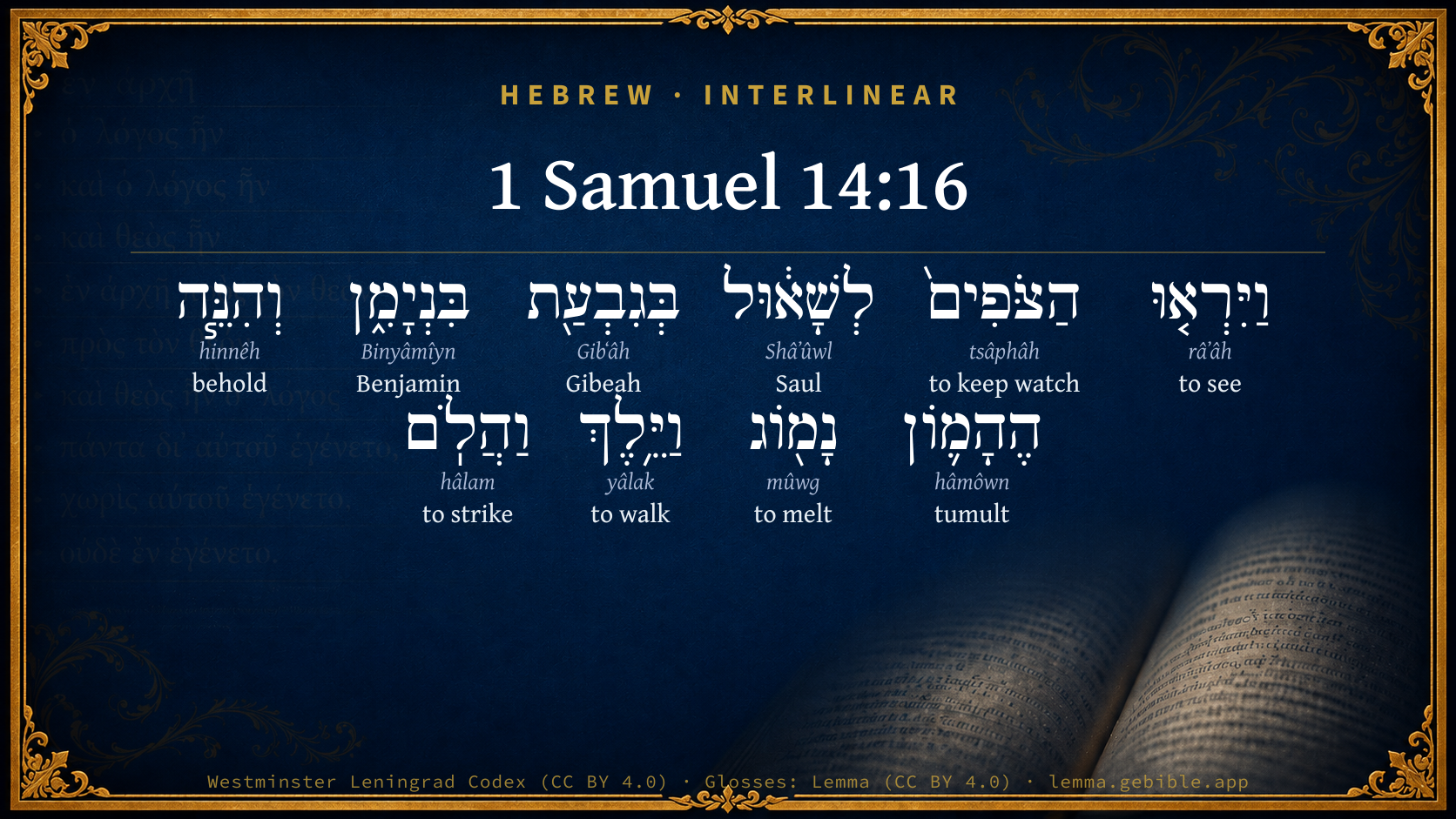
  1. וַיִּרְא֤וּ râʼâh H7200 “and · to see” Conjunction + Verb, Qal, Sequential Imperfect, 3rd Person, Masculine, Plural
  2. הַצֹּפִים֙ tsâphâh H6822 “the · keeping watch” Particle, Definite Article + Verb, Qal, Participle Active, Masculine, Plural, Absolute
  3. לְשָׁא֔וּל Shâʼûwl H7586 “to/for · Saul” Preposition + Noun, Proper
  4. בְּגִבְעַ֖ת Gibʻâh H1390 “in/at · Gibeah” Preposition + Noun, Proper
  5. בִּנְיָמִ֑ן Binyâmîyn H1144 “Benjamin” Noun, Proper
  6. וְהִנֵּ֧ה hinnêh H2009 “and · behold” Conjunction + Particle, Demonstrative
  7. הֶהָמ֛וֹן hâmôwn H1995 “the · tumult” Particle, Definite Article + Noun, Common, Masculine, Singular, Absolute
  8. נָמ֖וֹג mûwg H4127 “to melt” Verb, Niphal, Perfect, 3rd Person, Masculine, Singular
  9. וַיֵּ֥לֶךְ yâlak H3212 “and · to walk” Conjunction + Verb, Qal, Sequential Imperfect, 3rd Person, Masculine, Singular

About this verse

These counts appear in no published source. They are computed here, from the morphology-tagged text and Lemma’s own curated glosses. What Lemma adds →

10
words
10
distinct lemmas
Historical
section

Notable vocabulary

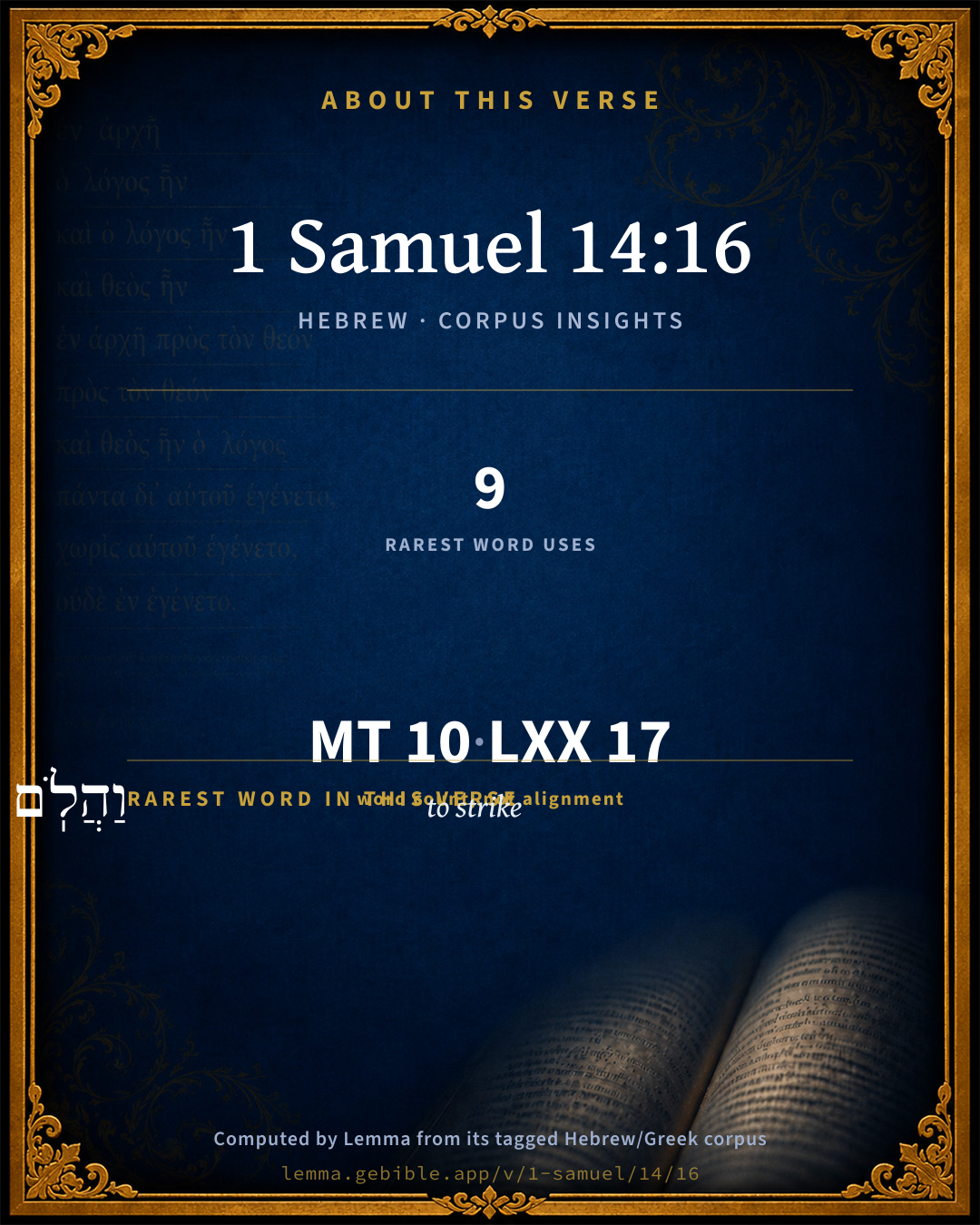
The rarest word here is וַהֲלֹֽם to strike H1986 — appearing just 9 times in the whole Hebrew Bible.

Shared distinctive vocabulary

וַהֲלֹֽם to strike H1986 occurs in 9 verses of the Hebrew Bible. Also found in:

Grammatical profile

  • 4 verbs
  • 4 nouns
  • 1 adverb
  • 1 particle

Verb forms

  • וַיִּרְא֤וּ Qal · Sequential Imperfect
  • הַצֹּפִים֙ Qal · Participle Active
  • נָמ֖וֹג Niphal · Perfect
  • וַיֵּ֥לֶךְ Qal · Sequential Imperfect

Hebrew & Septuagint length

In English translation the verse runs 21 words from the Hebrew and 21 from the Septuagint (LXX English) — the same length.

A rough comparison of the two English renderings, which tokenize alike — not a word-level alignment.

Word counts can differ between the Hebrew and the Greek without any difference in meaning — e.g. the Hebrew direct-object marker אֵת has no separate Greek word, and Greek often adds the article ὁ.

In the original languages it is 10 Hebrew tokens and 17 Greek tokens — but the two are counted differently (Hebrew bundles its prefixes and suffixes into one token; the Greek is in lemma form), so that isn’t a like-for-like length.

Cross-references

6

Topical passages linked to 1 Samuel 14:16 in the Treasury of Scripture Knowledge — connected by theme and wording, ordered by reader-vote popularity; previews shown in the World English Bible.

  • Judges 7:22 They blew the three hundred trumpets, and Yahweh set every man's sword against his fellow, and against all the host; and the host fled as far as Beth-shittah toward Zererah, as far as the border of Abel Meholah, by Tabbath.
  • 1 Samuel 14:20 Saul and all the people who were with him were gathered together, and came to the battle: and, behold, every man's sword was against his fellow, [and there was] a very great confusion.
  • 2 Chronicles 20:22–25 When they began to sing and to praise, Yahweh set liers-in-wait against the children of Ammon, Moab, and Mount Seir, who had come against Judah; and they were struck.
  • Psalms 58:7 Let them vanish as water that flows away. When they draw the bow, let their arrows be made blunt.
  • Psalms 68:2 As smoke is driven away, So drive them away. As wax melts before the fire, So let the wicked perish at the presence of God.
  • Isaiah 19:2 I will stir up the Egyptians against the Egyptians: and they shall fight everyone against his brother, and everyone against his neighbor; city against city, [and] kingdom against kingdom.

Cross-references courtesy of OpenBible.info (CC BY 4.0).

Hebrew and Greek witnesses Masoretic Hebrew ↔ Greek Septuagint

The same verse in the two great witnesses to the Old Testament, shown verse-for-verse.

These are two independent witnesses, not word-aligned to each other, and the Septuagint is shown in lemma (dictionary) form.

Hebrew 1 Samuel 14:16 Masoretic · Westminster Leningrad Codex

וַיִּרְא֤וּ הַצֹּפִים֙ לְשָׁא֔וּל בְּגִבְעַ֖ת בִּנְיָמִ֑ן וְהִנֵּ֧ה הֶהָמ֛וֹן נָמ֖וֹג וַיֵּ֥לֶךְ וַהֲלֹֽם

The watchmen of Saul in Gibeah of Benjamin looked; and, behold, the multitude melted away, and they went [here] and there.

World English Bible · Public Domain

Greek LXX 1 Samuel 14:16 Septuagint · lemma form

καί ὁράω ὁ σκοπός ὁ σαούλ ἐν γαβεε βενιαμίν καί ἰδού ὁ παρεμβολή ταράσσω ἔνθεν καί ἔνθεν

And the watchmen of Saul looked in Gabaa of Benjamin, and, behold, the army was thrown into confusion on every side.

LXX2012 (modern English Septuagint) · Public Domain

On this verse, Keil & Delitzsch discusses the Septuagint’s reading. Read the note in Commentary ↓

Hebrew: Westminster Leningrad Codex (CC BY 4.0). Greek: Septuagint (public domain); English from LXX2012 (modern English Septuagint) (Public Domain). How the Septuagint differs from the Hebrew →

Targum (Aramaic paraphrase)

1

The Targum is the ancient Jewish Aramaic paraphrase of the Hebrew Scriptures — an interpretive translation, not the Hebrew text itself. Onkelos (literal) and Pseudo-Jonathan (expansive) render the Torah, and Jonathan the Prophets. Coverage is partial: where no permissively-licensed English translation exists for a verse, only the Aramaic is shown. This is verse-level text, not a word-by-word alignment to the Hebrew.

  1. Targum Jonathan Prophets (Joshua–Malachi)
    וַחֲזוֹ סִכְוָאַיָא לְשָׁאוּל בְּגִבְעֲתָא דְבֵית בִּנְיָמִין וְהָא הֲמוֹן מַשִׁרְיַת פְּלִשְׁתָּאֵי אִתְּבַר אָזֵיל תַּבְרֵיהּ וְסַגִי:

    (no public-domain English translation for this verse)

    Targum Jonathan — Aramaic: “Mikraot Gedolot” (public domain). English: “Sefaria Community Translation” (CC0 1.0 (public-domain dedication)); “London "Chaldee Paraphrase," 1871” (public domain). Text via Sefaria.

Commentary

Notes on 1 Samuel 14:16 from classic Christian and Jewish commentators (each source and its license shown beneath its notes). The classic Christian expositions comment on the surrounding passage and are grouped to its opening verse, so a note may address several verses; the Jewish commentaries on the Tanakh (Rashi and others) are per-verse, so they appear only where the commentator wrote on this verse.

Lemma curates 59 commentaries, every one of them public domain or Creative Commons licensed, each selected and text-cleaned for this edition rather than reprinted as found. About our sources →

Matthew Henry's Commentary

We have here the prosecution and improvement of the wonderful advantages which Jonathan and his armour-bearer gained against the Philistines.

I. The Philistines were, by the power of God, set against one another. They melted away like snow before the sun, and went on beating down one another (Sa1 14:16), for (Sa1 14:20) every man's sword was against his fellow. When they fled for fear, instead of turning back upon those that chased them, they reckoned those only their enemies that stood in their way, and treated them accordingly. The Philistines were very secure, because all the swords and spears were in their hands. Israel had none except what Saul and Jonathan had. But now God showed them the folly of that confidence, by making their own swords and spears the instruments of their own destruction, and more fatal in their own hands than if they had been in the hands of Israel. See the like done, Jdg 7:22; Ch2 20:23.

II. The Israelites were hereby animated against them.

1. Notice was soon taken of it by the watchmen of Saul, those that stood sentinel at Gibeah, Sa1 14:16. They were aware that the host of the enemy was in great confusion, and that a great slaughter was made among them, and yet, upon search, they found none of their own forces absent, but only Jonathan and his servant (Sa1 14:17), which no doubt greatly animated them, and assured them that it could be no other than the Lord's doing, when there was no more of man's doing than what those two could do against a great host.

2. Saul began to enquire of God, but soon desisted. His spirit had not come down so far as to allow him to consult Samuel, though, it is probable, he was near him; for we read (Sa1 13:15) that he had come to Gibeah of Benjamin; but he called for the ark (Sa1 14:18), desiring to know whether it would be safe for him to attack the Philistines, upon the disorder they perceived them to be in. Many will consult God about their safety that would never consult him about their duty. But, perceiving by his scouts that the noise in the enemy's camp increased, he commanded the priest that officiated to break off abruptly: "Withdraw thy hand (Sa1 14:19), consult no more, wait no longer for an answer." He was very unwise indeed if (as some think) he forbade him to lift up his hands in prayer; for when Joshua was actually engaged with Amalek Moses continued still to lift up his hands. It is rather a prohibition to his enquiring of the Lord, either, (1.) Because now he thought he did not need an answer, the case was plain enough. And yet the more evident it was that God did all the more reason he had to enquire whether he would give him leave to do any thing. Or, (2.) Because now he would not stay for it; he was in such haste to fight a falling enemy that he would not stay to make and end of his devotions, nor hear what answer God would give him. A little thing will divert a vain and carnal mind from religious exercises. He that believeth will not make haste, such haste as this, nor reckon any business so urgent as not to allow time to take God along with him.

3. He, and all the little force he had, made a vigorous attack upon the enemy; and all the people were cried together (so the word is, Sa1 14:20), for want of the silver trumpets wherewith God appointed them to sound an alarm in the day of battle, Num 10:9. They summoned them together by shouting, and their number was not so great but that they might soon be got together. And now they seem bold and brave when the work is done to their hands. Our Lord Jesus had conquered our spiritual enemies, routed and dispersed them, so that we are cowards indeed if we will not stand to our arms when it is only to pursue the victory and to divide the spoil.

4. Every Hebrew, even those from whom one would least have expected it, now turned his hand against the Philistines. (1.) Those that had deserted and gone over to the enemy, and were among them, now fought against them, Sa1 14:21. Some think, they were such as had been taken prisoners by them, and now they were goads in their sides. It rather seems that they went in to them voluntarily, but, now that they saw them falling, recovered the hearts of Israelites, and did valiantly for their country. (2.) Those that had fled their colours, and hid themselves in the mountains, returned to their posts, and joined in with the pursuers (Sa1 14:22), hoping by their great zeal and officiousness, now that the danger was over and the victory sure, to atone for their former cowardice. It was not much to their praise to appear now, but it would have been more their reproach if they had not appeared. Those that are remiss and faint-hearted indeed that will not act in the cause of God when they see it victorious, as well as righteous. Thus all hands were at work against the Philistines, and every Israelite slew as many as he could, without sword or spear; yet it is said (Sa1 14:23), it was the Lord that saved Israel that day. He did it by them, for without him they could do nothing. Salvation is of the Lord.

Matthew Henry's Commentary on the Whole Bible (1708–1710) — public domain (CC PDM 1.0). Text via the HelloAO Bible API.

Trapp's Complete Commentary

John Trapp

1Sa 14:16 And the watchmen of Saul in Gibeah of Benjamin looked; and, behold, the multitude melted away, and they went on beating down [one another].

Ver. 16. And they went on beating down one another.] As any one was in their way, they knocked him down: being smitten with such a scotama or acridis, a giddiness of brain, or blindness of judgment, that they knew not their friends from their foes in that distemper and hurrycomb. Josephus saith, that when Jonathan first showed himself, a cloud suddenly arose, which so darkened the air, that they knew neither him, nor one another. But God, where he pleaseth, can easily trouble the fantasy, and make men to mistake; as we see daily in melancholy persons, who looking through a black cloud, as it were, see all things black, dark, cross and harmful.

John Trapp, A Commentary or Exposition upon All the Books of the Old and New Testament (1647–1656) — public domain. Text from a community e-Sword module.

Joseph Benson's Commentary

1Sa 14:16-17. Behold the multitude melted away — Were discomfited and scattered; so that fewer and fewer were seen in a company together. They went on beating down one another — Not being able in this confusion to distinguish their friends from their enemies. Then said Saul, Number now, &c. — Saul, upon the report of the watchmen concerning the seeming confusion in the army of the Philistines, concluded that some of his people had gone out unknown, and attacked them. He therefore ordered them to be numbered, to see who were missing.

Joseph Benson's Commentary on the Old and New Testaments (1811–1818) — public domain. Text from a community e-Sword module.

Keil & Delitzsch

C. F. Keil & F. Delitzsch

Flight and defeat of the Philistines. - Sa1 14:16. The spies of Saul at Gibeah saw how the multitude (in the camp of the Philistines) melted away and was beaten more and more. The words והלם ויּלך are obscure. The Rabbins are unanimous in adopting the explanation magis magisque frangebatur, and have therefore probably taken הלם as an inf. absol. הלום, and interpreted הלם according to Jdg 5:26. This was also the case with the Chaldee; and Gesenius (Thes. p. 383) has adopted the same rendering, except that he has taken הלם in the sense of dissolutus, dissipatus est. Others take הלום as adverbial ("and thither"), and supply the correlate הלם (hither), so as to bring out the meaning "hither and thither." Thus the lxx render it ἔνθεν καὶ ἔνθεν, but they have not translated ויּלך at all.

Sa1 14:17

Saul conjectured at once that the excitement in the camp of the Philistines was occasioned by an attack made by Israelitish warriors, and therefore commanded the people: פּקדוּ־נא, "Muster (number) now, and see who has gone away from us;" and "Jonathan and his armour-bearer were not there," i.e., they were missing.

Sa1 14:18

Saul therefore resolved to ask God, through the priest Ahiah, what he should do; whether he should go out with his army against the Philistines or no. But whilst he was talking with the priest, the tumult in the camp of the Philistines became greater and greater, so that he saw from that what ought to be done under the circumstances, and stopped the priest's inquiring of God, and set out with his people without delay. We are struck, however, with the expression in Sa1 14:18, "Bring hither the ark of God," and the explanation which follows, "for the ark of God was at that time with the children of Israel," inasmuch as the ark was then deposited at Kirjath-jearim, and it is a very improbable thing that it should have been in the little camp of Saul. Moreover, in other cases where the high priest is spoken of as inquiring the will of God, there is no mention made of the ark, but only of the ephod, the high priest's shoulder-dress, upon which there were fastened the Urim and Thummim, through which inquiry was made of God. And in addition to this, the verb הגּישׁה is not really applicable to the ark, which was not an object that could be carried about at will; whereas this verb is the current expression used to signify the fetching of the ephod (vid., Sa1 23:9; Sa1 30:7). All these circumstances render the correctness of the Masoretic text extremely doubtful, notwithstanding the fact that the Chaldee, the Syriac, and Arabic, and the Vulgate support it, and recommend rather the reading adopted by the lxx, προσάγαγε τὸ Ἐφούδ· ὅτι αὐτὸς ἦρεν τὸ Ἐφοὺδ ἐν τῇ ἡμέρᾳ ἐκείνῃ ἐνώπιον Ἰσραήλ, which would give as the Hebrew text, ישׂראל לפני ההוּא בּיּום האפוד נשׂא הוּא כּי האפוד הגּישׁה. In any case, וב'ני ישׂראל@ at the end of the verse should be read ישׂ לבני or לפני, since וּ gives no sense at all.

Sa1 14:19

"It increased more and more;" lit. increasing and becoming greater. The subject וגו וההמון is placed absolutely at the head, so that the verb ויּלך brev eh is appended in the form of an apodosis. ידך אסף, "draw thy hand in" (back); i.e., leave off now.

Sa1 14:20

"And (i.e., in consequence of the increasing tumult in the enemy's camp) Saul had himself, and all the people with him, called," i.e., called together for battle; and when they came to the war, i.e., to the place of conflict, "behold, there was the sword of the one against the other, a very great confusion," in consequence partly of terror, and partly of the circumstance alluded to in Sa1 14:21.

Sa1 14:21-22

"And the Hebrews were with the Philistines as before (yesterday and the day before yesterday), who had come along with them in the camp round about; they also came over to Israel, which was with Saul and Jonathan." סביב means distributed round about among the Philistines. Those Israelites whom the Philistines had incorporated into their army are called Hebrews, according to the name which was current among foreigners, whilst those who were with Saul are called Israel, according to the sacred name of the nation. The difficulty which many expositors have found in the word להיות has been very correctly solved, so far as the sense is concerned, by the earlier translators, by the interpolation of "they returned:" תבוּ (Chald.), ἐπεστράφησαν (lxx), reversi sunt (Vulg.), and similarly the Syriac and Arabic. We are not at liberty, however, to amend the Hebrew text in this manner, as nothing more is omitted than the finite verb היוּ before the infinitive להיות (for this construction, see Gesenius, Gramm. 132, 3, Anm. 1), and this might easily be left out here, since it stands at the beginning of the verse in the main clause. The literal rendering would be, they were to be with Israel, i.e., they came over to Israel. The fact that the Hebrews who were serving in the army of the Philistines came over to Saul and his host, and turned their weapons against their oppressors, naturally heightened the confusion in the camp of the Philistines, and accelerated their defeat; and this was still further increased by the fact that the Israelites who had concealed themselves on the mountains of Ephraim also joined the Israelitish army, as soon as they heard of the flight of the Philistines (Sa1 14:22).

Sa1 14:23

"Thus the Lord helped Israel that day, and the conflict went out beyond Bethaven." Bethaven was on the east of Michmash, and, according to Sa1 14:31, the Philistines fled westwards from Michmash to Ajalon. But if we bear in mind that the camp of the Philistines was on the eastern side of Michmash before Bethaven, according to Sa1 13:5, and that the Israelites forced their way into it from the south, we shall see that the battle might easily have spread out beyond Bethaven, and that eventually the main body of the enemy might have fled as far as Ajalon, and have been pursued to that point by the victorious Israelites.

Keil & Delitzsch — Biblical Commentary on the Old Testament (1861–1891) — public domain (CC PDM 1.0). Text via the HelloAO Bible API. (Old Testament only.)

Jamieson, Fausset & Brown

Robert Jamieson, A. R. Fausset & David Brown

the watchmen of Saul . . . looked--The wild disorder in the enemies' camp was described and the noise of dismay heard on the heights of Gibeah.

Jamieson, Fausset & Brown — Commentary Critical and Explanatory on the Whole Bible (1871) — public domain (CC PDM 1.0). Text via the HelloAO Bible API.

Adam Clarke's Commentary

Verse 16. The watchmen of Saul] Those who were sent out as scouts to observe the motions of the army.

Melted away] There was no order in the Philistine camp, and the people were dispersing in all directions. The Vulgate has, Et ecce multitudo prostrata, "And behold the multitude were prostrate;" many lay dead upon the field, partly by the sword of Jonathan and his armour-bearer, and partly by the swords of each other, 1Sa 14:20.

Adam Clarke's Commentary on the Bible (1810–1826) — public domain. Text from a community e-Sword/MySword module.

Ellicott's Commentary for English Readers

(16) And the watchmen of Saul in Gibeah of Benjamin looked . . .—The distance between the outposts of the little Israelite army and the vast Philistine host was only about two miles, but a deep ravine or chasm lay between them. The watchmen of Saul were well able to see the scene of dire confusion in the outposts, a confusion which they could discern was rapidly spreading through the more distant camp of the main body.

The Hebrew words, vayçleh vahãlom, in the last clause of the verse, have been variously rendered; the Rabbinical interpretation is the best: “magis magisque pangebatur”—“were more and more broken up.” This takes hãlom as an infinitive absolute. The LXX. considers this word an adverb, and translates enthen hai enthen, hither and thither, and does not attempt to give any rendering for vayçleh.

A Bible Commentary for English Readers, edited by Charles John Ellicott (1878–1897) — public domain. Text from a community e-Sword module.

The Cambridge Bible for Schools and Colleges

gen. ed. J. J. S. Perowne

16–23. The rout of the Philistines

16. in Gibeah of Benjamin] If Tuleil-el-Fûl is the true site of the town of Gibeah, we must either suppose that Gibeah is here used of the surrounding district, or read Geba for Gibeah, since according to Lieut. Conder, Michmash is not visible from Tuleil-el-Fûl. See note on 1Sa_10:5.

they went on beating down one another] It is doubtful if this or any other meaning can be extracted from the present Heb. text The Sept. gives a good sense: “And behold, the camp was in confusion on every side.”

The Cambridge Bible for Schools and Colleges (gen. ed. J. J. S. Perowne; Cambridge University Press, 1878–1918) — public domain. Text from a community e-Sword module.

John Gill's Exposition

And the watchmen of Saul in Gibeah of Benjamin looked,.... The city of Gibeah was built on an hill, from where it had its name; and these watchmen or sentinels of Saul were set by him no doubt in the highest part of it, whereby they could overlook the army of the Philistines as they lay encamped, and could observe their motions, and give notice accordingly; and it being now broad day light, could see the condition they were in:

and, behold, the multitude melted away; like snow gradually, and yet apace; they could discern their numbers lessening more and more, through the slaughter of many made among them by one another, and the flight of others; and they went on beating down one another; they could perceive they fled with great precipitation, throwing one another down in running, tumbling over one another, and trampling on each other which were in their way.

John Gill's Exposition of the Whole Bible (1746–1763) — public domain (CC PDM 1.0). Text via the HelloAO Bible API.

Albert Barnes' Notes on the Bible

Multitude - The word is in 1Sa 14:19 (margin) rendered tumult. It must have the same meaning here. The sentence is obscure and probably corrupt; perhaps it means, “and behold the tumult! and it went on” (increased) “melting away and beating down.”

Albert Barnes' Notes on the Bible (1834–1885) — public domain. Text from a community e-Sword/MySword module.

Haydock's Catholic Bible Commentary

Gabaa, where they were stationed to observe the enemies’ motions, and to give notice of them to Saul, at Remmon, ver. 2. (Calmet) --- Overthrown. Hebrew, "melted down, (without courage) and they went crushing" one another is the narrow passes, (Haydock) and turning their arms against all they met. (Josephus)

George Leo Haydock (1774–1849), Haydock's Catholic Family Bible and Commentary, 1859 edition — public domain. Excludes Psalms (Douay-Rheims chapter numbering differs from Protestant) and Deuterocanonical books (Catholic canon only).

Matthew Poole's English Annotations

In Gibeah, or, in the hill, as the very same word is rendered, 1Sa 13:16, and that was the fittest place for watchmen.

The multitude, to wit, of that numerous host of the Philistines.

Melted away, i.e. were strangely and suddenly dispersed, and put to flight.

Beating down one another; either,

1. Accidentally, through hasty flight; or,

2. With design to destroy one another, as the authors or abettors of the present calamity. Possibly God blinded their eyes or their minds, that they could not distinguish friends from foes. Compare Jdg 7:22; 2Ki 6:18, &c.; 2Ch 20:23.

Matthew Poole's English Annotations on the Holy Bible (1683–1685) — public domain. Text from a community e-Sword/MySword module.

Whedon's Commentary on the Bible

Daniel D. Whedon

16. The watchmen of Saul — Who were stationed where they could observe all the movements of the Philistine army.

In Gibeah — We are not to suppose that all the watchmen here referred to were stationed in one spot, but that they were placed on different heights north and northeast of Gibeah; and, being sent out from Saul’s headquarters, they there made their reports. So we need not alter the reading Gibeah.

The multitude melted away — Dissolved, and perished by killing one another. Their swords were turned against each other, (1Sa_14:20,) for Jehovah interposed as in the days of Gideon, (Jdg_7:22,) and set his seal to the faith of the youthful hero Jonathan.

They went on beating down one another — This, probably, gives the best sense of the Hebrew, וילךְ והלם, and it (that is, the multitude) went and smote. Gesenius renders: “They went on and were scattered, that is, dispersed themselves more and more.” Others, with the Septuagint, take הלם as an adverb, hither, and, supplying its correlate, render, went hither and thither.

Daniel D. Whedon (gen. ed.), Commentary on the Old and New Testaments (1874–1909) — public domain. Text from a community e-Sword module.

The Pulpit Commentary

DEFEAT OF THE PHILISTINES (vers. 16-23).

The watchmen, etc. Condor says ("Tent Work," 2:115), "The watchmen of Saul in Gibeah of Benjamin must have seen dearly across the chasm the extraordinary conflict of two men against a host, as the "multitude melted away, and they went on beating down one another." The noise in the host was also, no doubt, clearly heard at the distance of only two miles, and the army would have crossed the passage with comparatively little difficulty by the narrow path which leads down direct from Geba to Michmash, west of the Philistine comp. Thence the pursuit was towards Bethel, across the watershed, and headlong down the steep descent of Aijalon that same pass where the first great victory of Joshua had been gained, and where the valiant Judas was once more, in later times, to drive back the enemies of Israel to the plains." The multitude. The Hebrew is, "And behold the tumult (the word is so rendered in ver. 19, margin) was reeling and going and thither." Of course hither has dropped out of the text before and thither. (comp. 1Sa_13:8) The Septuagint and Vulgate both read "hither and thither." Tumult means the din made by a confused mass of people, and so the crowd itself. Melted away does not give the exact meaning. The Philistines were not dispersing, but were reeling, moving to and fro purposeless, and in confusion. It may mean, however, to shake or melt with terror, as in Isa_14:31, where it is rendered art dissolved.

Vers. 16-23. (GIBEAH.)

Impatience in seeking Divine counsel.

thine hand" (ver. 19). In order to ascertain the will of God two things are necessary:

1. A special method of communication. In ancient days it was "by Dreams,urim, and prophets". (1Sa_28:6) The Urim (light, illumination) and Thummim (perfection, completeness, truth) were symbols of some kind or other attached to or placed within the folded breastplate connected with the ephod of the high priest (Exo_28:30; Num_27:21) "The question brought was one affecting the well being of the nation, or its army, or its king. The inquirer spoke in a low whisper, asking one question only at a time. The high priest, fixing his gaze on the "gems oracular" that "lay on his heart," fixed his thoughts on the light and perfection which they symbolised, on the holy name inscribed on them. The act was itself a prayer, and, like other prayers, it might be answered. After a time he passed into the new, mysterious, half ecstatic state. All disturbing elements selfishness, prejudice, the fear of man were eliminated. He receivedthe insight he craved. Men trusted in his decisions, as with us men trust the judgment which has been purified by prayer for the help of the eternal Spirit more than that which grows only out of debate and policy and calculation" (Smith"s "Dic."). "When at length a visible king reigned by Divine appointment, the counsel of the Urim and Thummim passed into the public ministry of the prophets, which modified and controlled the political organisations of the kings" ("Bible Educ.," 4:37). We have now the written word and the guidance of the Holy Spirit.

2. A proper spirit of inquiry humility, sincerity, faith, patience, andperseverance. Saul "inquired of the Lord" (Jud_1:1 20:27; 1Sa_10:22) but not in a right manner, impatiently breaking off his inquiry before the answer came, and commanding the priest to desist from pursuing it. In like manner many persons begin to pray, and forthwith cease, instead of "continuing instant in prayer;" ask, and wait not to receive; call upon God under the pressure of trouble, and neglect to do so when it has passed away. Such impatience in seeking to "understand what the will of the Lord is

I ARISES FROM UNDUE CONCERN ABOUT SECONDARY MATTERS.

1. The need of human effort, as if nothing else were necessary to success. (Ps 23 Psa_127:1, Psa_127:2)

1. The gain of earthly honour or other advantages. Saul was eager to obtain, beyond everything else, the glory of a victory over his enemies.

2. The loss of a favorable opportunity. But "there is no time lost while we are waiting God"s time. It is as acceptable a piece of submission to the will of God to sit still contentedly when our Lord requires it as to work for him when we are called to do it" (M. Henry).

II PROVES SINFUL INDIFFERENCE TO THE HIGHEST OBJECT.

1. Inappreciation of its worth. Men often imagine that their own wisdom and strength are sufficient, and that it can be done without.

2. Indisposition to bow to its authority. They love to have their own way.

3. Incredulity as to its communication at the right time and in the right manner. They disbelieve the promises as well as reject the conditions of obtaining them.

III EXHIBITS RECKLESS DISREGARD OF THE LORD HIMSELF. By

1. Seeking him in an insincere, inconsistent, and hypocritical manner, which the cessation of prayer plainly shows. (Job_27:10)

2. Preferring personal and immediate convenience to his honor, and desiring his help only in so far as it may be conducive to self-interest.

3. Disobedience to his will; for to act without the knowledge of that will when it may be obtained is a manifest act of disobedience. (Isa_30:1)

IV INVOLVES DISASTROUS CONSEQUENCES.

1. Destitution of the highest counsel and aid.

2. Unpreparedness for duty and conflict.

3. A course of recklessness, sin, trouble, and humiliation (vers. 24, 37, 39, 44, 45). "Therefore turn thou to thy God: keep mercy and judgment, and wait on thy God continually". (Hos_12:6) "I will hear what God the Lord will speak," etc.. D. (Psa_85:8)

The Pulpit Commentary (1880–1919), ed. H.D.M. Spence-Jones & Joseph S. Exell — public domain. Text from a community e-Sword module.

unfoldingWord translationNotes

Door43 World Missions Community

Gibeah

This was the town where Saul was born. Translated "Gibeah" as in 1 Samuel 10:26. (See: How to Translate Names)

was dispersing ... going here and there

These two phrases share similar meanings and emphasize that the soldiers were running away in every direction. (See: Parallelism)

translationWords

Saul (OT)

watch

Gibeah

Benjamin

Jonathan

unfoldingWord translationNotes — © Distant Shores Media and the Door43 World Missions Community, licensed CC BY-SA 4.0. Source: git.door43.org/Door43/en_tn.

Rashi

Rabbi Shlomo Yitzchaki (Rashi)

Shaul's sentries. The sentries that Shaul had in Givas Binyomin. צוֹפִים is badetes in O.F.

Behold the multitude. Of the Philistines melted away from its position and kept coming nearer to הֲלֹם i.e., Yisroel's side.

Melting away. [It means the same as], "wandering and moving."

Rashi on the Tanakh — English translations: “The Judaica Press complete Tanach with Rashi, translated by A. J. Rosenberg” (CC BY 4.0); “Pentateuch with Rashi's commentary by M. Rosenbaum and A.M. Silbermann, 1929-1934” (public domain); “The Metsudah Tanach series, Lakewood, N.J” (CC BY 4.0); and “The Book of Joshua, Metsudah Publications, 1997” (CC BY 4.0). Text via Sefaria.

Lesson kit

Teaching starters — assembled from the data on this page, not authored interpretation. Every prompt links to the verse data it draws on. Edit before teaching.

1 Samuel, in the Historical, opens this verse with 10 words (10 distinct Hebrew lemmas). Its most distinctive word is hâlam (“to strike”). A historical commentator’s framing appears above. Read the whole chapter for the surrounding context.

Discussion questions

  1. The word hâlam carries the sense “to strike.” How does it shape the verse?
  2. Judges 5:22 shares the word «to strike» with this verse. How do the two illuminate each other?
  3. These translations render this verse differently; the difference is in the English rendering, not the original. What questions does that raise?
  4. The verb «וַיִּרְא֤וּ» is Qal Sequential Imperfect. How does its form color the action?
  5. Reading how Matthew Henry's Commentary and Trapp's Complete Commentary read this verse, where do the two commentators agree and where do they part?

Things to notice

Reading settings

Reading text

Shown beneath each verse's original-language words.

Old Testament
Old Testament edition

Read the OT as the Masoretic Hebrew (MT) or the Greek Septuagint (LXX).

English shown for the Greek Septuagint (in the Hebrew ↔ Greek comparison).

Comparing translations? Open the Compare panel on any verse page to stack up to four side by side.