
Job 39:7

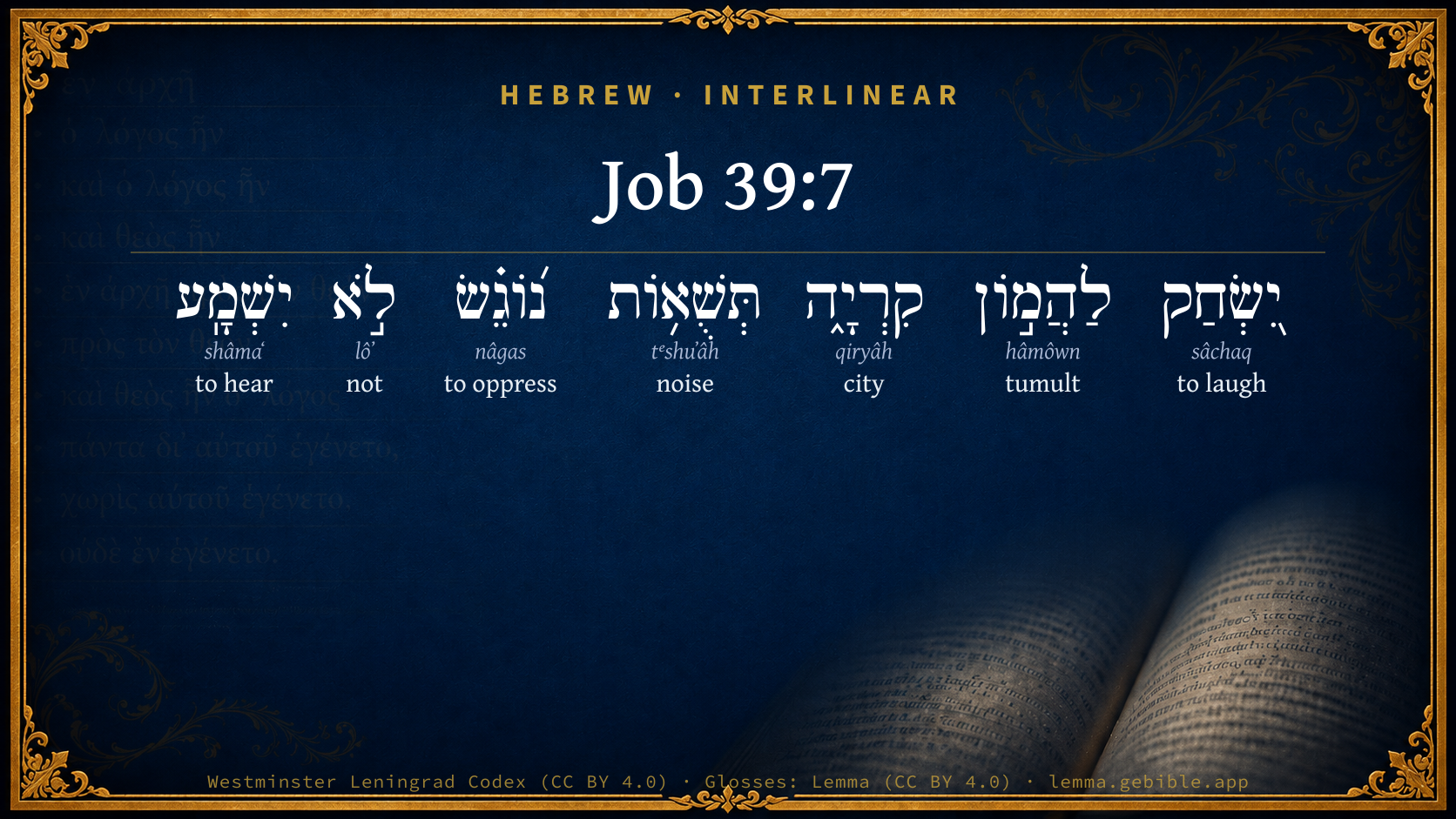
Hebrew (Westminster Leningrad Codex) Job 39:7 appears in the Hebrew Old Testament. The text above is from the Westminster Leningrad Codex. Each word links to its Strong’s number, a concise gloss, and parsing drawn from the Open Scriptures Hebrew Bible morphology. Click any word for its full Brown-Driver-Briggs (BDB) entry.
Download image
Cite this verse

Job 39:7 (World English Bible). Public Domain. Lemma interlinear Bible study tool, https://lemma.gebible.app/v/job/39/7.

Show BibTeX & RIS
BibTeX
RIS
English Translation
He scorns the tumult of the city, Neither hears he the shouting of the driver.
World English Bible · Public Domain
Download a study sheet

One document with this verse’s original text, its word-by-word gloss line, the meaning frame, cross-references with their text, attributed commentary, and full source and license credits — printable, and it pastes into notes with its structure intact.

This verse Autodidact and up

Study sheet (.html) Plain text (.txt)

A passage Seminary Student

Up to 50 verses in one chapter. A passage sheet keeps up to 6 commentary sources and 12 cross-references per verse, in the order this page ranks them, and says so on the sheet whenever that leaves anything out. Ask for a single verse and you get the Autodidact verse sheet above.

Everything on this page stays free to read, with no account — the sheet is a download of what is already on screen, not access to it.

Want to remove ads? Support Godless Engineer
Compare translations 3

The same verse in 3 English versions, stacked beneath the original-language interlinear above. Click any original word for its lexicon entry.

Each is an independent rendering of the whole verse — the interlinear is not word-aligned to these translations.

Highlighted words mark where these versions differ — a whole-verse word diff, not a word-by-word alignment.

  • World English Bible Public Domain
    He scorns the tumult of the city, Neither hears he the shouting of the driver.
  • King James Version Public Domain
    He scorneth the multitude of the city, neither regardeth he the crying of the driver.
  • unfoldingWord Literal Text CC BY-SA 4.0
    It laughs at the commotion of the city; the shouts of the driver it does not hear.

unfoldingWord Literal Text — © unfoldingWord, licensed CC BY-SA 4.0. Word-aligned USFM3 via Door43 (git.door43.org/unfoldingWord/en_ult).

Versions to compare (up to 4)

3 of 4 selected

Show all 18 translations

Every available English version of this verse, each an independent rendering of the whole verse.

  • World English Bible Public Domain
    He scorns the tumult of the city, Neither hears he the shouting of the driver.
  • Berean Standard Bible Public Domain
    He scorns the tumult of the city and never hears the shouts of a driver.
  • Majority Standard Bible Public Domain
    He scorns the tumult of the city and never hears the shouts of a driver.
  • King James Version Public Domain
    He scorneth the multitude of the city, neither regardeth he the crying of the driver.
  • American Standard Version (1901) Public Domain
    He scorneth the tumult of the city, Neither heareth he the shoutings of the driver.
  • Revised Version (1885) Public Domain
    He scorneth the tumult of the city, neither heareth he the shoutings of the driver.
  • Geneva Bible (1599) Public Domain
    Yet their yong waxe fatte, and growe vp with corne: they goe foorth and returne not vnto them.
  • Douay-Rheims (1899) Public Domain
    He scorneth the multitude of the city, he heareth not the cry of the driver.
  • Young's Literal Translation Public Domain
    He doth laugh at the multitude of a city, The cries of an exactor he heareth not.
  • Literal Standard Version CC BY-SA 4.0
    He laughs at the multitude of a city, || He does not hear the cries of an exactor.
  • Unlocked Literal Bible CC BY-SA 4.0
    He laughs in scorn at the noises in the city; he does not hear the driver's shouts.
  • unfoldingWord Literal Text CC BY-SA 4.0
    It laughs at the commotion of the city; the shouts of the driver it does not hear.
  • Darby Bible Public Domain
    He laugheth at the tumult of the city, and heareth not the shouts of the driver;
  • World Messianic Bible Public Domain
    He scorns the tumult of the city, neither does he hear the shouting of the driver.
  • Webster's Bible Public Domain
    \\39:4\\Their young ones are in good liking, they grow up with corn; they go forth, and return not to them.
  • Free Bible Version CC BY-SA 4.0
    It despises the noise of the city; it doesn't need to listen to the shouts of a driver.
  • Bible in Basic English Public Domain
    Their young ones are strong, living in the open country; they go out and do not come back again.
  • JPS Tanakh (1917) Public Domain
    He scorneth the tumult of the city, neither heareth he the shoutings of the driver.

Literal Standard Version (2020), Covenant Press — licensed CC BY-SA 4.0. Text via the HelloAO Bible API (eBible.org). Unlocked Literal Bible (unfoldingWord) — licensed CC BY-SA 4.0. Text via the HelloAO Bible API (eBible.org). unfoldingWord Literal Text — © unfoldingWord, licensed CC BY-SA 4.0. Word-aligned USFM3 via Door43 (git.door43.org/unfoldingWord/en_ult). Free Bible Version, Dr. Jonathan Gallagher — licensed CC BY-SA 4.0. Text via the HelloAO Bible API (eBible.org).

Word by word

More ways to search: Search by grammar → Find every occurrence → Compare this word →

Practice this passage: Drill this verse → Learn its vocabulary →

About this verse

These counts appear in no published source. They are computed here, from the morphology-tagged text and Lemma’s own curated glosses. What Lemma adds →

7
words
7
distinct lemmas
Wisdom
section

Notable vocabulary

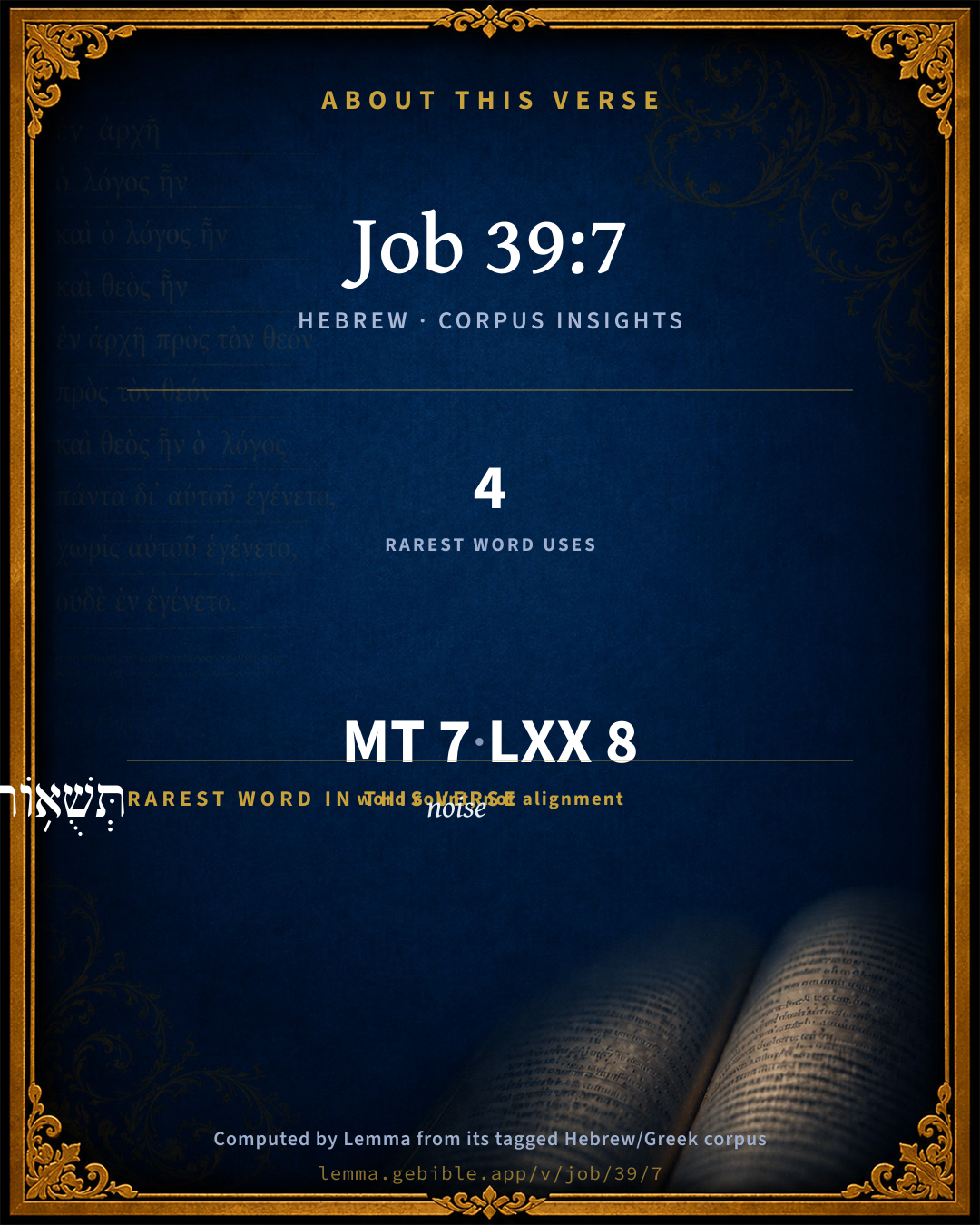
The rarest word here is תְּשֻׁא֥וֹת noise H8663 — appearing just 4 times in the whole Hebrew Bible.

Shared distinctive vocabulary

תְּשֻׁא֥וֹת noise H8663 occurs in 4 verses of the Hebrew Bible. Also found in:

Grammatical profile

  • 3 verbs
  • 3 nouns
  • 1 particle

Verb forms

  • יִ֭שְׂחַק Qal · Imperfect
  • נ֝וֹגֵ֗שׂ Qal · Participle Active
  • יִשְׁמָֽע Qal · Imperfect

Hebrew & Septuagint length

In English translation the verse runs 15 words from the Hebrew and 17 from the Septuagint (LXX English) — closely comparable.

A rough comparison of the two English renderings, which tokenize alike — not a word-level alignment.

Word counts can differ between the Hebrew and the Greek without any difference in meaning — e.g. the Hebrew direct-object marker אֵת has no separate Greek word, and Greek often adds the article ὁ.

In the original languages it is 7 Hebrew tokens and 8 Greek tokens — but the two are counted differently (Hebrew bundles its prefixes and suffixes into one token; the Greek is in lemma form), so that isn’t a like-for-like length.

Cross-references

6

Topical passages linked to Job 39:7 in the Treasury of Scripture Knowledge — connected by theme and wording, ordered by reader-vote popularity; previews shown in the World English Bible.

  • Exodus 5:18 Go therefore now, and work, for no straw shall be given to you, yet shall you deliver the same number of bricks!"
  • Job 3:18 There the prisoners are at ease together. They don't hear the voice of the taskmaster.
  • Exodus 5:13–16 The taskmasters were urgent saying, "Fulfill your work quota daily, as when there was straw!"
  • Job 39:18 When she lifts up herself on high, She scorns the horse and his rider.
  • Isaiah 31:4 For thus says Yahweh to me, As the lion and the young lion growling over his prey, if a multitude of shepherds are called forth against him, will not be dismayed at their voice, nor abase himself for the noise of them: so will Yahweh of Hosts come down to fight on Mount Zion, and on the hill of it.
  • Isaiah 58:3 Why have we fasted, [say they], and you don't see? [why] have we afflicted our soul, and you take no knowledge? Behold, in the day of your fast you find [your own] pleasure, and exact all your labors.

Cross-references courtesy of OpenBible.info (CC BY 4.0).

Hebrew and Greek witnesses Masoretic Hebrew ↔ Greek Septuagint

The same verse in the two great witnesses to the Old Testament, shown verse-for-verse.

These are two independent witnesses, not word-aligned to each other, and the Septuagint is shown in lemma (dictionary) form.

Hebrew Job 39:7 Masoretic · Westminster Leningrad Codex

יִ֭שְׂחַק לַהֲמ֣וֹן קִרְיָ֑ה תְּשֻׁא֥וֹת נ֝וֹגֵ֗שׂ לֹ֣א יִשְׁמָֽע

He scorns the tumult of the city, Neither hears he the shouting of the driver.

World English Bible · Public Domain

Greek LXX Job 39:7 Septuagint · lemma form

καταγελάω πολυοχλία πόλις μέμψις δέ φορολόγος οὐ ἀκούω

He laughs to scorn the multitude of the city, and hears not the chiding of the tax-gatherer.

LXX2012 (modern English Septuagint) · Public Domain

Hebrew: Westminster Leningrad Codex (CC BY 4.0). Greek: Septuagint (public domain); English from LXX2012 (modern English Septuagint) (Public Domain). How the Septuagint differs from the Hebrew →

Commentary

Notes on Job 39:7 from classic Christian and Jewish commentators (each source and its license shown beneath its notes). The classic Christian expositions comment on the surrounding passage and are grouped to its opening verse, so a note may address several verses; the Jewish commentaries on the Tanakh (Rashi and others) are per-verse, so they appear only where the commentator wrote on this verse.

Lemma curates 59 commentaries, every one of them public domain or Creative Commons licensed, each selected and text-cleaned for this edition rather than reprinted as found. About our sources →

Trapp's Complete Commentary

John Trapp

Job 39:7 He scorneth the multitude of the city, neither regardeth he the crying of the driver.

Ver. 7. He scorneth the multitude of the city] Heb. He laugheth. Insignis metaphora. He would scorn to be set to work, as the tame ass is. Asinum oneramus et non curat, quia asinus est, saith Bernard, We load the ass, and he taketh it well for worth, because he is an ass. But the wild ass will not take so; he is not a beast born to bear burdens as the other. He is not tardum et pigrum animal as the other, a dull and slow creature; for which cause also, saith Bellarmine, God would none of him, Exo 13:13; Exo 34:20. Christ so far hateth dulness, that he bade Judas the traitor what he did do quickly. The wild ass is very swift, and fed by God’s providence in the wilderness; scorning the multitude, or the hurrying noises of the city.

Neither regardeth he the crying of the driver] Heb. of the exactor, who rateth and rageth against the tame ass with words and blows, to hasten him to his work, and to bring him this way and that way. Oppressive princes do the like to their poor subjects (the king of France is called, Rex asinorum), which sometimes maketh them turn wild, and shake off subjection; as the Jews did that to the Romans, choosing rather to suffer the most exquisite torments than to be enslaved (Joseph. l. xviii. c. 2). But what a mad conceit was that of Martin Stembach, a Dutch sectary, A. D. 1566, who would needs correct the Lord’s Prayer, Stultam et inefficacem asserens orationem in qua interiectione o uteremur; non secus enim hac exclamandi formula divinam gratiam impediri, quam asinarii, asinorum impetum hoc adverbio? (Lonicer. ex Theatre Vitro).

John Trapp, A Commentary or Exposition upon All the Books of the Old and New Testament (1647–1656) — public domain. Text from a community e-Sword module.

Jamieson, Fausset & Brown

Robert Jamieson, A. R. Fausset & David Brown

multitude--rather, "din"; he sets it at defiance, being far away from it in the freedom of the wilderness.

driver--who urges on the tame ass to work. The wild ass is the symbol of uncontrolled freedom in the East; even kings have, therefore, added its name to them.

Jamieson, Fausset & Brown — Commentary Critical and Explanatory on the Whole Bible (1871) — public domain (CC PDM 1.0). Text via the HelloAO Bible API.

Adam Clarke's Commentary

Verse 7. He scorneth the multitude] He is so swift that he cannot be run or hunted down. See the description in Job 39:5.

Adam Clarke's Commentary on the Bible (1810–1826) — public domain. Text from a community e-Sword/MySword module.

Ellicott's Commentary for English Readers

(7) The crying of the driver.—Or, the shoutings of the taskmaster. The word is the same as is applied to the taskmasters of Egypt, and this suggests the question whether or not there may be a reminiscence of that bondage here.

A Bible Commentary for English Readers, edited by Charles John Ellicott (1878–1897) — public domain. Text from a community e-Sword module.

The Cambridge Bible for Schools and Colleges

gen. ed. J. J. S. Perowne

7. The verse reads,

He scorneth the tumult of the city,

And heareth not the shoutings of the driver.

The wild ass is frequently referred to in the poetry of the Arabs, who were passionately fond of hunting it. Prof. Ahlwardt has collected from his unequalled reading in the Poets a list of statements regarding the creature which is of great interest (Chalef Elaḥmar, pp. 341–360). The colour on the upper part of the body, the neck and higher part of the head is light bay, with a coffee-brown band running down the back to the tuft of the tail; between this band and the bay there is some white. The other parts are of a silver grey, tending to white on the under-side of the body. The animal is described as “thick,” “thick-fleshed,” but also “narrow-built,” that is, behind and in front, and hence it is compared to the point of an arrow. The tail is long. Its pace is exceedingly quick, only the fleetest horses being able to overtake it; and when running it holds its head to the side in frolicsomeness and performs all manner of pranks and capers. A troop of wild asses is usually small, consisting of a male, one or two females, and the young. This is confirmed by Tristram, who says, “I have seen this ass wild in the desert of North Africa, in troops of four or five” (Nat. Hist. of the Bible, p. 43). Wetzstein on the contrary speaks of the herd as consisting of “several hundred” (Del. ii. p. 331). The abode of the wild ass is in deserts, untrodden by man (comp. Job_39:6), hence he is called “the solitary” (comp. Hos_8:9, “A wild ass alone by himself”). In spring he frequents the plains in which there are pools, and later the heights where grass is abundant (comp. Job_39:8). On these heights he passes the summer with the females; and there he stands and keeps watch, spying the approach of foes (comp. Jer_14:6, “The wild asses did stand in the high places &c.”). The poets compare a deep ravine or abyss to the “belly” of the wild ass, which is often lank and empty from want of food (Jer_14:6). He is said to live to a great age, over a hundred years. The flesh is delicious, and for this reason, as well as for the excitement of the chase, the creature was eagerly hunted by the Arabs. His vigour and hardiness are testified to in the proverb, “sounder than a wild ass.”

The Cambridge Bible for Schools and Colleges (gen. ed. J. J. S. Perowne; Cambridge University Press, 1878–1918) — public domain. Text from a community e-Sword module.

John Gill's Exposition

He scorneth the multitude of the city,.... Choosing rather to be alone in the wilderness and free than to be among a multitude of men in a city, and be a slave as the tame ass; or it despises and defies a multitude of men, that may come out of cities to take it, Leo Africanus says (r) it yields to none for swiftness but Barbary horses: according to Xenophon (s), it exceeds the horse in swiftness; and when pursued by horsemen, it will outrun them, and stand still and rest till they come near it, and then start again; so that there is no taking it, unless many are employed. Aristotle (t) says it excels in swiftness; and, according to Bochart (u), it has its name in Hebrew from the Chaldee word "to run". Or it may be rendered, "the noise of the city", so Cocceius; the stir and bustle in it, through a multiplicity of men in business;

neither regardeth he the crying of the driver; or "hears" (w): he neither feels his blows, nor hears his words; urging him to move faster and make quicker dispatch, as the tame ass does; he being neither ridden nor driven, nor drawing in a cart or plough.

(r) Ut supra. (Descriptio Africae, l. 9. p. 752.) (s) Ut supra. (De Expedition. Cyril, l. 1.) (t) Hist. Animal. l. 6. c. 36. (u) Hierozoic. par. 1. l. 1. c. 9. col. 63. (w) "non audiet", Pagninus, Montanus.

John Gill's Exposition of the Whole Bible (1746–1763) — public domain (CC PDM 1.0). Text via the HelloAO Bible API.

Albert Barnes' Notes on the Bible

He scorneth the multitude of the city - That is, he sets all this at defiance; he is not intimidated by it. He finds his home far away from the city in the wild freedom of the wilderness.

Neither regardeth he the crying of the driver - Margin, “exacter.” The Hebrew word properly means a collector of taxes or revenue, and hence, an oppressor, and a driver of cattle. The allusion here is to a driver, and the meaning is, that he is not subject to restraint, but enjoys the most unlimited freedom.

Albert Barnes' Notes on the Bible (1834–1885) — public domain. Text from a community e-Sword/MySword module.

Matthew Poole's English Annotations

He scorneth; either,

1. He feareth them not when they pursue him, because he is swift, and can easily escape them. Or,

2. He values them not, nor any provisions or advantages which he may have from them, but prefers a vagrant and solitary life in the wilderness before them. Or,

3. He disdains to submit himself to them, and resolutely maintains his own freedom.

The multitude of the city: he mentions the city rather than the country, partly because there is the greatest multitude of people to pursue, and overtake, and subject him; and partly because there is the greatest plenty of all things to invite him; the fruits of the country being laid up in cities in greatest abundance.

Neither regardeth, Heb. heareth, i.e. obeyeth. Of the driver, Heb. of the taskmaster, or exactor of labour, i.e. he will not be brought to receive his yoke, nor to do his drudgery, nor to answer to his cries or commands, as tame asses are forced to do.

Matthew Poole's English Annotations on the Holy Bible (1683–1685) — public domain. Text from a community e-Sword/MySword module.

Whedon's Commentary on the Bible

Daniel D. Whedon

7. Multitude — Better, tumult.

Daniel D. Whedon (gen. ed.), Commentary on the Old and New Testaments (1874–1909) — public domain. Text from a community e-Sword module.

The Pulpit Commentary

He scorneth the multitude of the city. Avoids, that is, the haunts of men, and is never seen near them. Neither regardeth he the crying of the driver. Nothing will induce the wild ass to submit to domestication.

The Pulpit Commentary (1880–1919), ed. H.D.M. Spence-Jones & Joseph S. Exell — public domain. Text from a community e-Sword module.

John Wesley's Explanatory Notes

Scorneth - He feareth them not when they pursue him, because he is swift, and can easily escape them. Driver - He will not be brought to receive his yoke, nor to do his drudgery.

John Wesley, Explanatory Notes Upon the Whole Bible (1754–1765) — public domain. Text via the GEBible commentary corpus.

unfoldingWord translationNotes

Door43 World Missions Community

Connecting Statement:

Yahweh continues to challenge Job.

He

The word "He" refers to the wild donkey.

laughs in scorn

Yahweh describes the donkey as though he were a person. The donkey laughs because those in the city have to hear loud noise, but he lives in a quiet place. (See: Personification)

the driver's

someone who forces an animal to work

pastures

places where animals can eat plants growing in the field

unfoldingWord translationNotes — © Distant Shores Media and the Door43 World Missions Community, licensed CC BY-SA 4.0. Source: git.door43.org/Door43/en_tn.

Lesson kit

Teaching starters — assembled from the data on this page, not authored interpretation. Every prompt links to the verse data it draws on. Edit before teaching.

Job, in the Wisdom, opens this verse with 7 words (7 distinct Hebrew lemmas). Its most distinctive word is tᵉshuʼâh (“noise”). A historical commentator’s framing appears above. Read the whole chapter for the surrounding context.

Discussion questions

  1. How does “noise” (tᵉshuʼâh) shape what this verse is saying?
  2. Job 36:29 shares the word «noise» with this verse. How do the two illuminate each other?
  3. The translations on this page render this verse differently — a whole-verse word diff, not a word-by-word alignment. What might account for the different wordings?
  4. The verb «יִ֭שְׂחַק» is Qal Imperfect. How does its form color the action?
  5. Reading how Trapp's Complete Commentary and Jamieson, Fausset & Brown read this verse, where do the two commentators agree and where do they part?

Things to notice

Reading settings

Reading text

Shown beneath each verse's original-language words.

Old Testament
Old Testament edition

Read the OT as the Masoretic Hebrew (MT) or the Greek Septuagint (LXX).

English shown for the Greek Septuagint (in the Hebrew ↔ Greek comparison).

Comparing translations? Open the Compare panel on any verse page to stack up to four side by side.