Joel 3:14

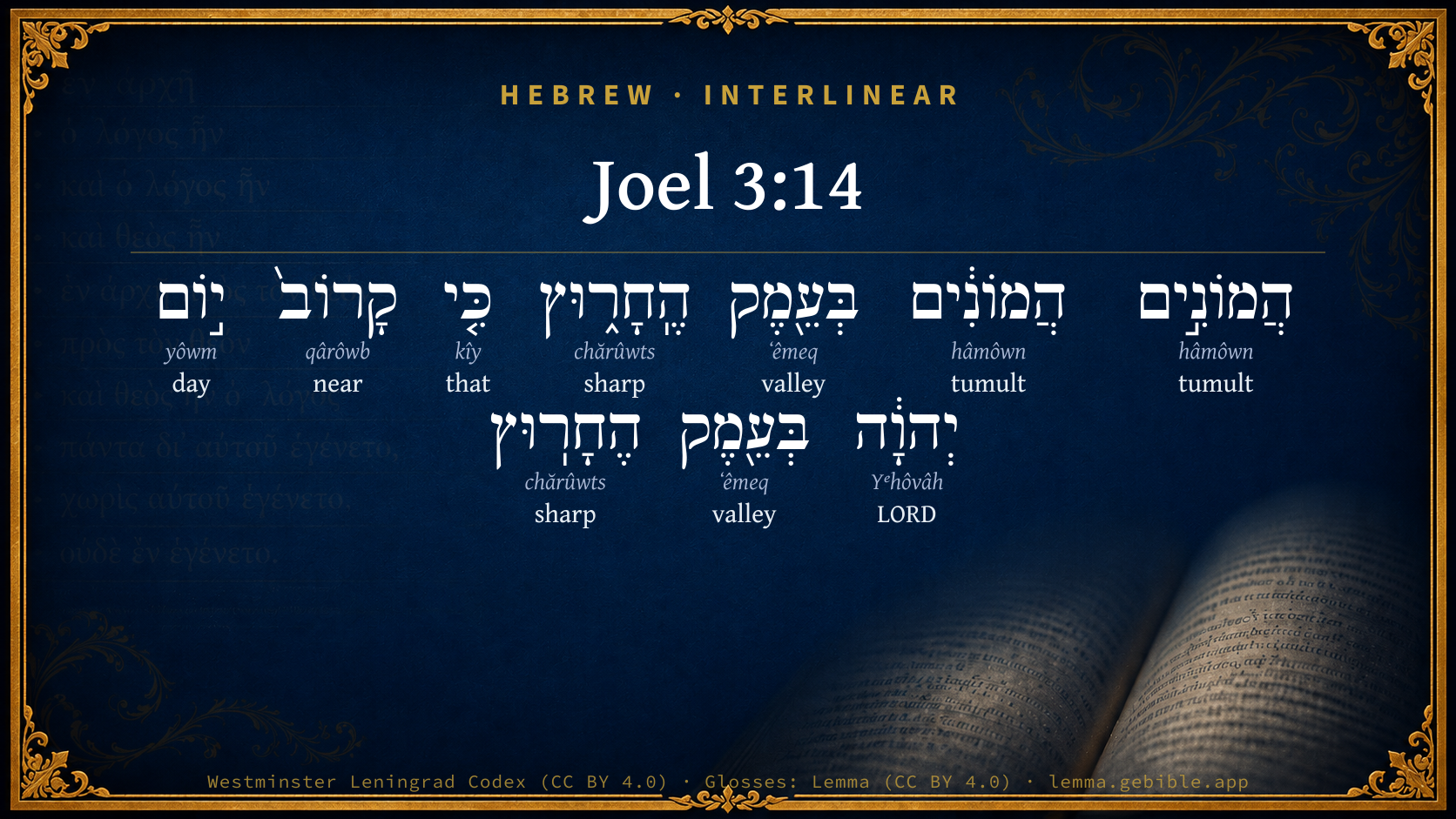
Hebrew (Westminster Leningrad Codex) Joel 3:14 appears in the Hebrew Old Testament. The text above is from the Westminster Leningrad Codex. Each word links to its Strong’s number, a concise gloss, and parsing drawn from the Open Scriptures Hebrew Bible morphology. Click any word for its full Brown-Driver-Briggs (BDB) entry.
Download image
Cite this verse

Joel 3:14 (World English Bible). Public Domain. Lemma interlinear Bible study tool, https://lemma.gebible.app/v/joel/3/14.

Show BibTeX & RIS
BibTeX
RIS
English Translation
Multitudes, multitudes in the valley of decision! For the day of Yahweh is near, in the valley of decision.
World English Bible · Public Domain
Download a study sheet

One document with this verse’s original text, its word-by-word gloss line, the meaning frame, cross-references with their text, attributed commentary, and full source and license credits — printable, and it pastes into notes with its structure intact.

This verse Autodidact and up

Study sheet (.html) Plain text (.txt)

A passage Seminary Student

Up to 50 verses in one chapter. A passage sheet keeps up to 6 commentary sources and 12 cross-references per verse, in the order this page ranks them, and says so on the sheet whenever that leaves anything out. Ask for a single verse and you get the Autodidact verse sheet above.

Everything on this page stays free to read, with no account — the sheet is a download of what is already on screen, not access to it.

Want to remove ads? Support Godless Engineer
Compare translations 3

The same verse in 3 English versions, stacked beneath the original-language interlinear above. Click any original word for its lexicon entry.

Each is an independent rendering of the whole verse — the interlinear is not word-aligned to these translations.

Highlighted words mark where these versions differ — a whole-verse word diff, not a word-by-word alignment.

  • World English Bible Public Domain
    Multitudes, multitudes in the valley of decision! For the day of Yahweh is near, in the valley of decision.
  • King James Version Public Domain
    Multitudes, multitudes in the valley of decision: for the day of the LORD is near in the valley of decision.
  • unfoldingWord Literal Text CC BY-SA 4.0
    Multitudes, multitudes in the valley of decision, for the day of Yahweh near in the valley of decision!

unfoldingWord Literal Text — © unfoldingWord, licensed CC BY-SA 4.0. Word-aligned USFM3 via Door43 (git.door43.org/unfoldingWord/en_ult).

Versions to compare (up to 4)

3 of 4 selected

Show all 18 translations

Every available English version of this verse, each an independent rendering of the whole verse.

  • World English Bible Public Domain
    Multitudes, multitudes in the valley of decision! For the day of Yahweh is near, in the valley of decision.
  • Berean Standard Bible Public Domain
    Multitudes, multitudes in the valley of decision! For the Day of the LORD is near in the valley of decision.
  • Majority Standard Bible Public Domain
    Multitudes, multitudes in the valley of decision! For the Day of the LORD is near in the valley of decision.
  • King James Version Public Domain
    Multitudes, multitudes in the valley of decision: for the day of the LORD is near in the valley of decision.
  • American Standard Version (1901) Public Domain
    Multitudes, multitudes in the valley of decision! for the day of Jehovah is near in the valley of decision.
  • Revised Version (1885) Public Domain
    Multitudes, multitudes in the valley of decision! for the day of the LORD is near in the valley of decision.
  • Geneva Bible (1599) Public Domain
    O multitude, O multitude, come into the valley of threshing: for the day of the Lord is neere in the valley of threshing.
  • Douay-Rheims (1899) Public Domain
    Nations, nations in the valley of destruction: for the day of the Lord is near in the valley of destruction.
  • Young's Literal Translation Public Domain
    Multitudes, multitudes `are' in the valley of decision, For near `is' the day of Jehovah in the valley of decision.
  • Literal Standard Version CC BY-SA 4.0
    Multitudes, multitudes [are] in the Valley of Decision, || For near [is] the Day of YHWH in the Valley of Decision.
  • Unlocked Literal Bible CC BY-SA 4.0
    There is a tumult, a tumult in the Valley of Judgment. For the day of Yahweh is near in the Valley of Judgment.
  • unfoldingWord Literal Text CC BY-SA 4.0
    Multitudes, multitudes in the valley of decision, for the day of Yahweh near in the valley of decision!
  • Darby Bible Public Domain
    Multitudes, multitudes in the valley of decision! For the day of Jehovah is at hand in the valley of decision.
  • World Messianic Bible Public Domain
    Multitudes, multitudes in the valley of decision! For the day of the LORD is near in the valley of decision.
  • Webster's Bible Public Domain
    \\3:9\\Proclaim ye this among the Gentiles; Prepare war, wake up the mighty men, let all the men of war draw near; let them come up:
  • Free Bible Version CC BY-SA 4.0
    Huge mobs are in the valley of the Lord's verdict. For the day of the Lord is near in the valley of his verdict.
  • Bible in Basic English Public Domain
    Give this out among the nations; make ready for war: get the strong men awake; let all the men of war come near, let them come up.
  • JPS Tanakh (1917) Public Domain
    (4-14) Multitudes, multitudes in the valley of decision! For the day of the LORD is near in the valley of decision.

Literal Standard Version (2020), Covenant Press — licensed CC BY-SA 4.0. Text via the HelloAO Bible API (eBible.org). Unlocked Literal Bible (unfoldingWord) — licensed CC BY-SA 4.0. Text via the HelloAO Bible API (eBible.org). unfoldingWord Literal Text — © unfoldingWord, licensed CC BY-SA 4.0. Word-aligned USFM3 via Door43 (git.door43.org/unfoldingWord/en_ult). Free Bible Version, Dr. Jonathan Gallagher — licensed CC BY-SA 4.0. Text via the HelloAO Bible API (eBible.org).

Word by word

More ways to search: Search by grammar → Find every occurrence → Compare this word →

Practice this passage: Drill this verse → Learn its vocabulary →

הֶֽחָר֑וּץ
chărûwts
H2742
“the · sharp”
Particle, Definite Article + Noun, Proper
Part of Speech
Particle + Noun
Type
Proper
Full BDB Definition

Origin: pass. participle of H2782

TWOT: 752a , b, 753a

sharp-pointed, sharp, diligent (adjective) - strict decision, decision (noun masculine) - trench, moat, ditch (noun masculine) - gold (poetical) (noun masculine)
  1. הֲמוֹנִ֣ים hâmôwn H1995 “tumults” Noun, Common, Masculine, Plural, Absolute
  2. הֲמוֹנִ֔ים hâmôwn H1995 “tumults” Noun, Common, Masculine, Plural, Absolute
  3. בְּעֵ֖מֶק ʻêmeq H6010 “in/at · valley of” Preposition + Noun, Common, Masculine, Singular, Construct
  4. כִּ֤י kîy H3588 “that” Conjunction
  5. קָרוֹב֙ qârôwb H7138 “near” Adjective, Adjective, Masculine, Singular, Absolute
  6. י֣וֹם yôwm H3117 “day of” Noun, Common, Masculine, Singular, Construct
  7. יְהוָ֔ה Yᵉhôvâh H3068 “LORD” Noun, Proper
  8. בְּעֵ֖מֶק ʻêmeq H6010 “in/at · valley of” Preposition + Noun, Common, Masculine, Singular, Construct
  9. הֶחָרֽוּץ chărûwts H2742 “the · sharp” Particle, Definite Article + Noun, Proper

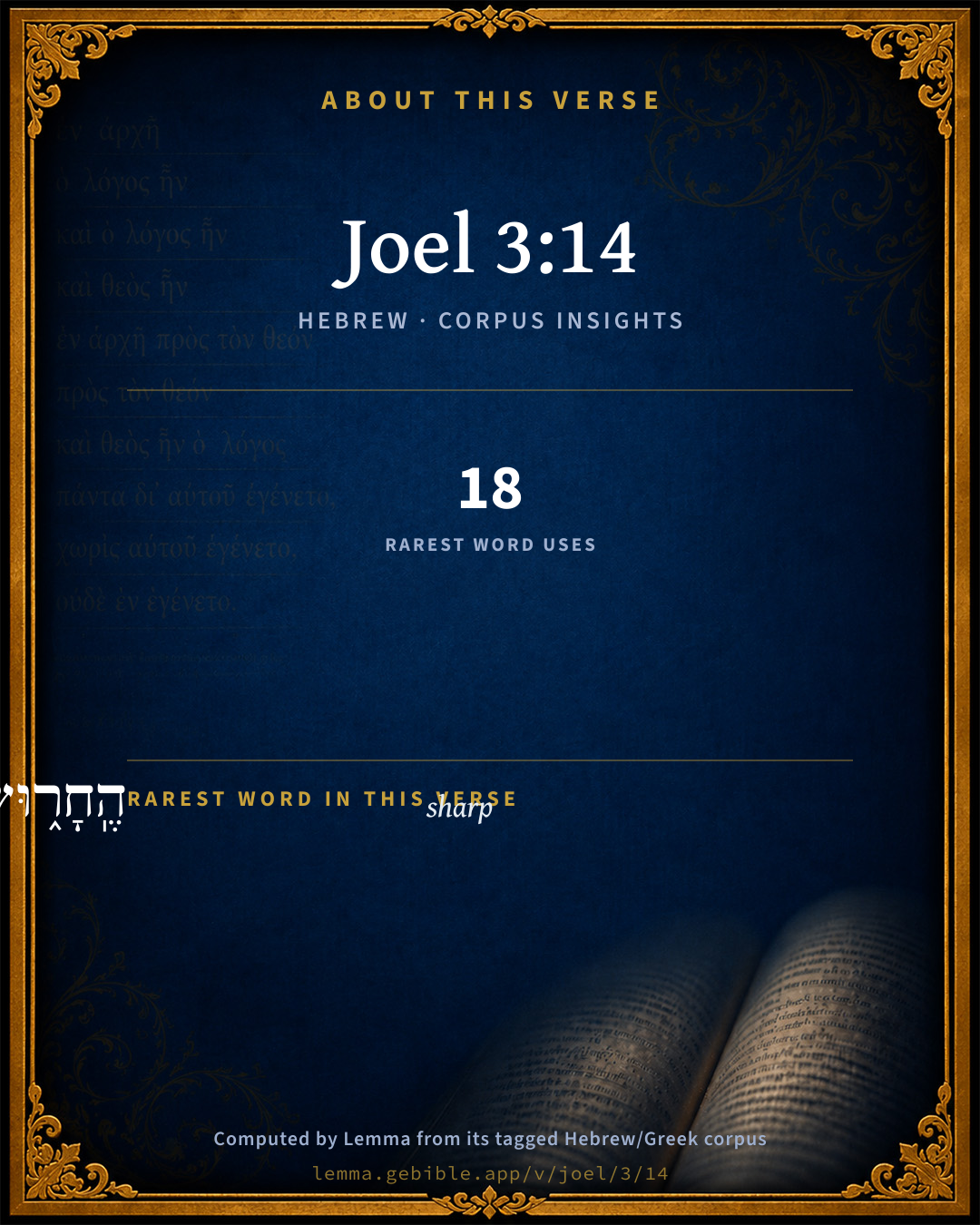
About this verse

These counts appear in no published source. They are computed here, from the morphology-tagged text and Lemma’s own curated glosses. What Lemma adds →

10
words
7
distinct lemmas
Prophets
section

Notable vocabulary

The rarest word here is הֶֽחָר֑וּץ sharp H2742 — appearing just 18 times in the whole Hebrew Bible.

Shared distinctive vocabulary

הֶֽחָר֑וּץ sharp H2742 occurs in 17 verses of the Hebrew Bible. Also found in:

Grammatical profile

  • 8 nouns
  • 1 adjective
  • 1 conjunction

Repetition

Words recur within this verse — often emphatic in Hebrew:

  • הֲמוֹנִ֣ים tumult H1995 ×2
  • בְּעֵ֖מֶק valley H6010 ×2
  • הֶֽחָר֑וּץ sharp H2742 ×2

Hebrew & Septuagint length

In English translation the verse runs 19 words from the Hebrew and 21 from the Septuagint (LXX English) — closely comparable.

A rough comparison of the two English renderings, which tokenize alike — not a word-level alignment.

Word counts can differ between the Hebrew and the Greek without any difference in meaning — e.g. the Hebrew direct-object marker אֵת has no separate Greek word, and Greek often adds the article ὁ.

Cross-references

11

Topical passages linked to Joel 3:14 in the Treasury of Scripture Knowledge — connected by theme and wording, ordered by reader-vote popularity; previews shown in the World English Bible.

  • Isaiah 34:2–8 For Yahweh has indignation against all the nations, and wrath against all their host: he has utterly destroyed them, he has delivered them to the slaughter.
  • Joel 3:2 I will gather all nations, And will bring them down into the valley of Jehoshaphat; And I will execute judgment on them there for my people, And for my heritage, Israel, whom they have scattered among the nations. They have divided my land,
  • Philippians 3:2 Beware of the dogs, beware of the evil workers, beware of the false circumcision.
  • Revelation 16:14–16 for they are spirits of demons, performing signs; which go forth to the kings of the whole inhabited earth, to gather them together for the war of that great day of God, the Almighty.
  • Joel 1:15 Alas for the day! For the day of Yahweh is at hand, And it will come as destruction from the Almighty.
  • Joel 2:1 Blow you the trumpet in Zion, And sound an alarm in my holy mountain! Let all the inhabitants of the land tremble, For the day of Yahweh comes, For it is close at hand:
  • 2 Peter 3:7 But the heavens that now are, and the earth, by the same word have been stored up for fire, being reserved against the day of judgment and destruction of ungodly men.
  • Revelation 19:19–21 I saw the beast, and the kings of the earth, and their armies, gathered together to make war against him who sat on the horse, and against his army.
  • Isaiah 63:1–7 Who is this who comes from Edom, with dyed garments from Bozrah? this who is glorious in his clothing, marching in the greatness of his strength? I who speak in righteousness, mighty to save.
  • Ezekiel 38:8–23 After many days you shall be visited: in the latter years you shall come into the land that is brought back from the sword, that is gathered out of many peoples, on the mountains of Israel, which have been a continual waste; but it is brought forth out of the peoples, and they shall dwell securely, all of them.
  • Ezekiel 39:8–20 Behold, it comes, and it shall be done, says the Lord Yahweh; this is the day about which I have spoken.

Cross-references courtesy of OpenBible.info (CC BY 4.0).

Hebrew and Greek witnesses Masoretic Hebrew ↔ Greek Septuagint

The same verse in the two great witnesses to the Old Testament, shown verse-for-verse.

These are two independent witnesses, not word-aligned to each other, and the Septuagint is shown in lemma (dictionary) form.

Hebrew Joel 3:14 Masoretic · Westminster Leningrad Codex

הֲמוֹנִ֣ים הֲמוֹנִ֔ים בְּעֵ֖מֶק הֶֽחָר֑וּץ כִּ֤י קָרוֹב֙ י֣וֹם יְהוָ֔ה בְּעֵ֖מֶק הֶחָרֽוּץ

Multitudes, multitudes in the valley of decision! For the day of Yahweh is near, in the valley of decision.

World English Bible · Public Domain

Greek LXX Joel 3:14 Septuagint · lemma form
Noises have resounded in the valley of judgment: for the day of the Lord is near in the valley of judgment.

LXX2012 (modern English Septuagint) · Public Domain

On this verse, Haydock's Catholic Bible Commentary discusses the Septuagint’s reading. Read the note in Commentary ↓

Hebrew: Westminster Leningrad Codex (CC BY 4.0). Greek: Septuagint (public domain); English from LXX2012 (modern English Septuagint) (Public Domain). How the Septuagint differs from the Hebrew →

Commentary

Notes on Joel 3:14 from classic Christian and Jewish commentators (each source and its license shown beneath its notes). The classic Christian expositions comment on the surrounding passage and are grouped to its opening verse, so a note may address several verses; the Jewish commentaries on the Tanakh (Rashi and others) are per-verse, so they appear only where the commentator wrote on this verse.

Lemma curates 59 commentaries, every one of them public domain or Creative Commons licensed, each selected and text-cleaned for this edition rather than reprinted as found. About our sources →

Trapp's Complete Commentary

John Trapp

Joe 3:14 Multitudes, multitudes in the valley of decision: for the day of the LORD [is] near in the valley of decision.

Ver. 14. Multitudes, multitudes in the valley of decision] Or concision, as Jerome and Tremellius, or of threshing, as Piscator, in reference to Jehoshaphat, who once threshed the Moabites and Ammonites there. These multitudes are thither summoned ( Turbae, Turbae adeste), or are there laid dead, even heaps upon heaps, with those Philistines, Jdg 15:16. So Aben Ezra senseth it, and thence the name of the valley of concision, or decision: to show that their having passed a definitive sentence upon the Church’s enemies, and a very severe one too, such as was that kind of punishment, to put men under harrows of iron, &c., 2Sa 12:31 Amo 1:3, would now finish the work and cut it short in righteousness, Rom 9:28, idque cito et certo, as sure and as soon as if that day of slaughter were at next door by.

For the day of the Lord is near] Lyra understands it of the last day, which cannot be far off; and Diodati was of the same mind; for upon the next words,

John Trapp, A Commentary or Exposition upon All the Books of the Old and New Testament (1647–1656) — public domain. Text from a community e-Sword module.

The Biblical Illustrator

Joseph S. Exell

Joe_3:14

Multitudes in the valley of decision.

The valley of decision

These words were spoken in a time of deep depression. Joel says the sadness and gloom were mainly due to the indecision of the people, who did not know whether to trust foreign alliances or Jehovah. So they would have to be led into a valley of judgment, from which they would not emerge until they had come to a decision. In our day much of the prevailing darkness is due to indecision. We feel that things are wrong, but we are not exactly sure what is required to set them right.

I. In regard to what we believe. There is peculiar difficulty in this generation, owing to the methods of modern inquiry and discussion. This is an age of specialism. Each branch of theology has its own special students. Each presses his own conclusions to the furthest limit. It is our duty to look for ourselves at the general lines of revealed truth, and to measure our relation to them. We must come to a decision with regard to Jesus Christ. Certainly--

1. Christ was the revealer of God.

2. He was the remover of barriers.

3. The guidance He gave us for our actual conduct was authentic.

These three simple truths can be isolated from all disputed doctrines, and used as a test. The man who sincerely accepts these truths has found his way out of the valley of decision.

II. In regard to what we do. We can test ourselves by our conduct in business, in the family, in general society. There are various plain questions which we ask ourselves too rarely, although we all in the long run shall require to answer them. Do we always do our duty, or only when it suits our plans? Has our life any principle, any plan? We know the road in which we ought to wall are we walking in it? Do we always follow conscience? God often thrusts us into the darkest caves of the valley in order that we may learn our need for giving a plain answer to these questions. In the valley of decision you are bound to fix your faith in God and Christ, and to take the path of goodness. (A. R. MacEwen, M. A. , B. D.)

The valley of decision

There is something very wonderful, and very awe-inspiring in the thought of the multitudinous, the immeasurable multitudinousness, of created things. Infinite space is thronged with multitudes of worlds, and every world with multitudes of things. When we think Of the race of mankind, how vast and inconceivable are the multitudes of men. Each individual that has ever lived exists somewhere. Once born, they can never die. Yet these vast hosts lie easily enough within the reckoning of God. Known unto Him are the history and the character, the temptations and the opportunities, of every single individual of the vast whole of the human race, both quick arid dead. One by one each will personally appear before the personal God in the valley of decision. Where is this valley? Tradition identifies as the valley of Jehoshaphat. But the wady of the Kedron cannot properly be called a valley. Joel invented the name for Jehovahs judgment. Christ never localised the seat of judgment, any more than He announced, the time of judgment. But what is judgment? It is not Christ our judge who decides the bliss of the blessed or the curse of the accursed. The blessed are deciding their own blessedness when they cultivate holiness of character, and the cursed are deciding their own doom when they are forgetting God and living in sin. The valley of decision is the valley which each man treads in the road of life. It is here and now. Divine decision, or final judgment, is no swift, sudden, arbitrary act of Gods; but a long, slow process performed by ourselves. In the valley of decision there is no standing still. (Canon Diggle.)

The valley of decision

A sense of ultimate personal responsibility is inseparable from the mind of man. There is a consciousness within him, which announces the existence of a God who judgeth in the earth, and warns him that the great object of his life must be to prepare to meet Him in a final account. In the text is a striking exhibition of this final judgment of man, the great day of his account with God. The valley of Jehoshaphat means the valley of the judgment of the Lord. The time and manner are His own appointment. In its practical application to man the day of final judgment makes no change in his real character. It simply proclaims that which was before the fact. It declares the sentence which has long been determined. Mans real time of probation is in the present life. Here is the valley of decision.

I. What may be understood as the valley of decision for man. It is the whole life of man upon the earth. There is actually but a single question pro posed from God to man. As a wandering, rebellious creature, he is invited and commanded, to come back in the spirit and act of reconciliation unto God. Will he lay hold of the hope set before him? This is the great question of human life, and it is generally determined by man long before the last hours of his life have come. Many have settled this question for themselves, and so have passed out of the valley of decision. Others have decided, but have chosen death rather than life. These, too, have passed out of the valley of decision. We cannot therefore justly say that all men, now alive, are in the valley of decision. We must narrow down our view to those for whom the great question remains undecided.

II. The greater portion of those to whom the offers of eternal life are made are undecided. The great majority who listen to the Gospel are still in the valley of decision. A blessing and a curse are yet before them.

III. The great decision must speedily be made. The day of the Lord is near. By that day we understand the time of final determination of the destiny of the children of men. Soon for every man, this day must certainly come at the period of death. Then this is the accepted time, and this is the day of your salvation. (S. H. Tyng, D. D.)

Turning-points in life

It has been well said that in every life there is a turning-point, as in a fever, a turning point that brings either life or death. Napoleon said, In every battle there are ten minutes on which hangs the fate of nations. Hundreds of soul battles are fought and won in a few minutes. Unspeakably solemn axe the silence and the quickness with which these spiritual battles are fought. (Old Testament Anecdotes.)

Decision

There is a fascination, even a terror, in the appearance of a great multitude. Where is the valley of decision? First of all, here in this world. The world all unconsciously to its teeming myriads is a valley of decision in which they gather together to certain ends and work out certain definite issues. What is being decided in this valley?

1. Character. That strange stamp which gives to each one of us his own individuality, that personality which spreads itself over our likes and dislikes, that stamp whereby men can label us and catalogue us, and yet feel at the end that we elude classification. Circumstances are the material of life, good or bad. It is we who take up our circumstances, and out of them make habits, and habits decide or form our character in this valley of decision which we call human life.

2. Our own happiness or misery. Life was meant to be happy. But this is placed in our own hands for decision.

3. Eternity. The great decision is not, after all, the sudden thing we suppose it to be, except in very rare cases. Here in this world a decision may be altered, it may not be final. The prophet looks on to a day when the decision will be final; it is the great day of judgment at the end of the world. Is this a belief which is still a living and a practical one to you? Then judge yourselves that you may not be, in that day, judged of the Lord. (Canon Newbolt.)

Armageddon

The matters between two armies are going to be finally decided: therefore the valley is called, the valley of decision. This place is to-night a valley of decision. See some of the things you have to decide.

1. Whether you will adhere to sin or renounce it. Not your pleasures, but your positive sins. You cannot become a child of God and adhere to any one of your transgressions. Will it pay you to keep your sin? Sin never pays.

2. Whether you will have Christ or refuse Him. There is no pardon or heaven without the friendship of Christ. And He is such a precious Jesus.

3. Whether you will have Christian associations or unchristian. Need not apologise for everything that is in the Church. There is some bad and much good in the Church. The fact that there are inconsistent Christians is nothing against Christianity, and nothing against the Church. Come, then, into the ranks of Church members.

4. Whether you will have a Christian deathbed or an unbelievers departure. There is a triumphant and there is an ignominious way of getting out of this life, and we come here to choose which it shall be.

5. Whether yours shall be a future world of sorrow or a future world of joy. (T. De Witt Talmage.)

Reason for decision

What is here called the valley of decision (i.e., of sharp judgment)

, is called in verse 12 the valley of Jehoshaphat (God judgeth). This was locally the valley of Kedron; the later associations of this valley (Gethsemane was there) figuratively present a great spiritual crisis. The prophets show themselves to be taught of God in the breadth and extent of their visions. While speaking to their own nation only, they announce Gods dealings with all the world. They look forward into the distant future--to the end of time. From time to time God specially interferes, either to enlighten and encourage His own when the adversary is too strong for them; or to overthrow those who are opposing His will. The final interference is what is called the day of the Lord. In this chapter is a vision, of the final judgment of mankind, and of that which is to precede it.

1. The wickedness of the earth is full.

2. Drawn by a mighty influence, the enemies of God, to a place whither He has summoned them.

3. The powers of nature sink and fade before the presence of the glory of God.

4. But the Lord is the strength and hope of His own people. Note--

(1) The great issues of good and evil which are working out in the world.

(2) Contemplate the predicted end, the final victory of Christ and His people.

(3) Decide on which side we take part in the conflict. (S. J. Hulme, M. A.)

The valley of decision

There is a day coming when all the uncertainties of life will be at an end, when every mask will drop off, when every hidden thing will be exposed to view, and the secrets of every life will be told. The prophet is here looking forward to an occasion of judgment, and every occasion of judgment must of necessity be an occasion of decision. But the work of judgment is by no means confined to the future. Wherever the Gospel message goes, wherever the truth of God is revealed to the understanding of man, there the work of judgment necessarily commences. Our Lord taught that it was in virtue of the relation in which men stood to the Son of Man that their position before God was to be decided. So it is still. The presence of Christ in His Spirit among us still must needs cause judgment. The first work of the Holy Spirit is to convict the world of sin, of righteousness, and of judgment. The word convict is a judicial term. It may be said of redemption itself, that the Divine mercy is ordained to flow into the human heart through judgment. Unconditioned mercy--mercy that does not come to me through the forms of judgment, and with the sanction of justice--might have a demoralising effect upon me. Ours is a Gospel of merely flowing through judgment. So then, not only does the Holy Ghost judge us when He first brings our sins to remembrance and pronounces us guilty, but in the very act of justifying us He still exhibits, in the most impressive manner, Gods righteous judgment against sin; for it is through the Cross that grace flows forth to us, and the Cross is, above everything else, the place of judgment--the most amazing and impressive vindication that God could give of the majesty of law. We may say that every day of visitation from God to the soul of man is in some sense a lesser judgment day. On the last august occasion, the decision will lie simply and solely with the Judge. There will be no appealing from His judgment. Now, the decision lies with ourselves. It is the work of God the Holy Spirit to bring all with whom He strives, into the valley of decision, the place of judgment. There are two ways out of this valley. Through the gate of life and through the gate of death. (W. Hay Aitken, M. A.)

The valley of judgment

Note the vast appearance that shall be in that great and solemn day.

1. The judgment day, that day of the Lord, has all along been looked upon, and spoken of, as nigh at hand. We ought to be always ready for it.

2. The day of judgment will be a day of decision, when every mans eternal state will be determined, and the controversy that has been long depending between the kingdom of Christ and that of Satan shall he finally decided, and an end put to the struggle. The Chaldee calls it, the valley of the distribution of judgment. Marg. has valley of threshing, carrying on the figure of the harvest.

3. Innumerable multitudes will be gathered together to receive their final doom in that day. O what vast multitudes of sinners will Divine justice be glorified in the ruin of at that day! (Matthew Henry.)

The valley of decision

(Sermon to Children):--The text struck me when I was a lad. Children have a strange way of mixing up things, and I came to think of these words as in some way connected with a place near my native town. Away out on those wild cliffs, with the fierce Atlantic rolling in upon them, there is a valley which came to be in my mind a sort of valley of decision.

I. The valley of decision is a place for sober thought. There is the little stream hurrying on between the banks, always hastening away to the great sea. Is not that just like our life? It is hurrying away to the great sea of eternity.

II. A place of solemn warning. Just under this little valley a merry party had come one day for a picnic. One young man slipped away to bathe. Suddenly, as the others sat singing on the rocks, one sprang up and pointed to their friend as he was being borne away by the current. He was drowning before their eyes. What is death but the sweeping in of the waves of eternity, bearing away one and another T Think of these things deeply and seriously.

III. The place suggested our danger and our deliverance. There was a huge, black, rounded cavern, called Ralphs Cupboard, in a steep, precipitous cliff, never accessible from the land, and scarcely ever to be entered from the sea. A smuggler, hard pressed by the coastguards, turned his boat towards this cave, caught the swelling wave, and was swept into what seemed the jaws of destruction, but to him was harbour of safety. We, too, have broken the law. We want a refuge. And the Bible says, A man shall be as an hiding-place. Our only Safety is in Him, our only hope of escape is there. Yet all this will not make a place the valley of decision. When we have made up our mind, the day of the Lord is near. (Mark Guy Pearse.)

Multitudes

Joel was a prophet in the older sense. He was a seer; he had visions. He had, indeed, a work to do for his own generation; but this was all to be impressed by the solemnity of the visions given to him. One of these visions we follow. In Eastern houses there is often a little upper chamber, available for prayer and meditation, and we may imagine Joel, in such a place, poring over the records of Divine law and Divine leadings, and bending in earnest supplication before his God. As he thinks and prays the daylight fades; gradually he becomes absorbed; other scenes open up before him; he sees more than the bodily eye can see; age after age passes in hurried march; dimly, indistinctly, he traces the progress of events as these ages roll on; and gradually he becomes aware of an extraordinary excitement. As the vision clears it is as though heaven were preparing for some grand event; the angelic warriors are girding on their armour, though evidently rather for a day of glory than a day of battle. The angelic attendants are preparing thrones of judgment, palms of victory, robes of beauty, crowns of glory, songs of triumph; and, strangely enough, also chains of darkness and of woe. Hell is moved. Out of its depths spirit after spirit is appearing to join the procession that is ever forming and passing on. The sea is moved, and casts out the dead that are in her. And even as the prophet watches, he sees the last midnight darkness pass away; gradually the grey of dawn streaks the skies, and at the moment when the sun first looks upon the hills, a mighty angel stands forth and cries--Multitudes, multitudes in the valley of decision, for the day of the Lord is near in the valley of decision. The day of the Lord is yet to come. The day of the Lords glory, when the multitude of the redeemed shall crown Him with many crowns. The day of the Lords vindication, when He shall break down the rebellion of lost souls with the proofs of His forbearance, and the memory of His repeated calls. The day when the wrath of the Lamb must be revealed, and He shall come in flaming fire, taking vengeance on them that know not God, and that obey not the Gospel of His Sort. There must be an end of this dispensation of redemption. There must be a completion of Christs special administration. There must be the day of the Lord. As Joels vision gains distinctness, his attention is arrested by the people assembled on that day. Language fails him in attempting a description. All around, wherever the eye can reach, he sees people, people everywhere; and overwhelmed, he can only cry,--Multitudes, multitudes in the valley of decision! Few things make stronger impressions on us than the sight of a multitude of people. Many of the greatest wrongs the world has known have been committed under the passionate, unreasoning impulses of multitudes. Many of the most impressive Bible narratives concern multitudes. But if a multitude on earth can exert such power on us, what shall be the effect of multitudes to which our present earth-crowds form no comparison; multitudes in the day of the Lord; multitudes in the valley of decision? Numbers altogether fail for recording that multitude. Language altogether fails for describing it. Even imagination, in its highest flights, utterly fails worthily to conceive it. We may venture to contrast in one or two particulars the ordinary crowds of earth, and the multitudes in the valley of decision.

1. In an earthly crowd the individual is lost in the multitude. In that multitude the number is lost in the individual. Each person will stand out distinct to view, as though he alone were placed before the Judge. And each individual will feel as though he were alone. It will be a time of awful self-consciousness.

2. In an earthly crowd there are almost infinite disguises. The people are not in reality what they seem. The dress of the gentleman too often covers the profligate; the lowly look, and humble clothes, often cover the self-righteous hypocrite. The garb of poverty often hides the noble and generous-hearted. In the valley of decision there are no disguises. All disguise drops off at death. Mens shrouds are pretty much alike; and even they soon rot and perish in the dampness of the grave. Men rise to judgment with no disguises upon them. Stern, unflinching truth shall dispel all mists, all doubts, and set our characters forth clear as in the sunlight. And what are the great distinctions which shall mark these multitudes? We notice the utter absence of all merely human distinctions. Riches--nothing. Poverty--nothing. Position--nothing. Fame--nothing. Knowledge--nothing. Character--everything. One test for everybody--righteous or wicked. The Scriptures do not satisfy our questionings concerning the precise terms of the decision at that assize, but they intimate that there will be a more general term, and a more particular one. The general term is thus expressed,--Condemned already, because they,, believed not on the Son of God. The particular term is thus expressed,--We must all appear before the judgment-seat of Christ, that every one may receive the things done in his body, according to that he hath done, whether it be good or bad. How these are to fit into each other, it is beyond any human power to explain. But we can see the two separate facts very clearly. Our life, in its minutest acts, has eternal issues. Everything we do, beyond its bearing on our present character, has its bearing on our eternal destiny, because on our eternal character. Our every-day conduct is, in sober reality, raising our mansion of eternal bliss, or preparing the dungeons of the eternal death. And the general test that is to decide in that great day is very simple. It is this--in Christ or out of Christ? The answer to that question settles all else. And that test may be put now. We shall come out upon that day of the Lord as though from a room where we had rested awhile upon a landing-place, from which steps wind upward into a place of beauty and delights; and from which other steps wind downwards into ever-deepening darkness. If out of Christ when you yield up the ghost, then you must be borne downwards, until it can be said of you, The darkness took them. If in Christ now, and when the spirit parts with its earthly tabernacle, then, loving angel arms shall entwine you; loving angel songs shall cheer you; loving friends, long lost, shall beckon you; the loving Saviour shall Himself be with you, as you journey up the steps of glory everlasting; the gates of the golden palace shall be flung back for you, and with shouts of triumphant welcome, the ransomed of the Lord shall return, and come to Zion with songs and everlasting joy upon their heads, they shall obtain joy and gladness, and sorrow and sighing shall flee away. (Robert Tuck, B. A.)

A time of judgment

Multitudes in the valley of judgment; multitudes come together that they may be examined, criticised in the light of heaven, judged by the standard eternal and unchangeable. Why not accept that as the basis of an appeal to human intelligence and human conscience? There is to be a time of judgment, when the right and the left shall be specifically distinguished; when the bad and the good shall be known one from the other, and separated for ever. Who undertakes this marvellous classification? Blessed be God, not man; thanks be unto heaven, we are to be judged by the Creator, not by the creature. What man could judge his brother? What does man know about his dearest friend? He knows nothing. We live upon appearances. (Joseph Parker, D. D.)

The Biblical Illustrator, edited by Joseph S. Exell (c. 1880s–1900s) — public domain. Text from a community e-Sword module.

Joseph Benson's Commentary

Joe 3:14-15. Multitudes, &c. — These are Joel’s words, exclaiming, with prophetic warmth and agitation, Multitudes, multitudes in the valley of decision! — As though he had said, See what astonishing numbers are brought together for their destruction! The sentence, thus abrupt and broken, is very strong and emphatical. The place is called the valley of decision, because in it the cause would be decided between God and his enemies, and there he would execute judgment upon them. Houbigant reads, the valley of excision, that is, of cutting off: and Chandler, the appointed valley, namely, where God had appointed to execute his judgments. The sun and the moon shall be darkened — States and kingdoms shall be overthrown; and the stars shall withdraw their shining — Kings and princes shall be cast down from their state of dignity and pre- eminence, and shall be deprived of their power and glory. Or the meaning is, This particular judgment shall be a forerunner of the general one, when the whole frame of nature shall be dissolved.

Joseph Benson's Commentary on the Old and New Testaments (1811–1818) — public domain. Text from a community e-Sword module.

Tyndale Open Study Notes

Tyndale Open Resources

3:14 Thousands upon thousands (literally roaring, roaring; or crowds, crowds): The repetition of the Hebrew word captures the chaotic noise made by an immense crowd. • valley of decision: The name of the valley is changed (cp. 3:2-3, 12) because now the Lord’s judgment had been decided.

Tyndale Open Study Notes — © Tyndale Open Resources, licensed CC BY-SA 4.0. Text via the HelloAO Bible API.

Jamieson, Fausset & Brown

Robert Jamieson, A. R. Fausset & David Brown

The prophet in vision seeing the immense array of nations congregating, exclaims, "Multitudes, multitudes!" a Hebraism for immense multitudes.

valley of decision--that is, the valley in which they are to meet their "determined doom." The same as "the valley of Jehoshaphat," that is, "the valley of judgment" (see on Joe 3:2). Compare Joe 3:12, "there will I sit to judge," which confirms English Version rather than Margin, "threshing." The repetition of "valley of decision" heightens the effect and pronounces the awful certainty of their doom.

Jamieson, Fausset & Brown — Commentary Critical and Explanatory on the Whole Bible (1871) — public domain (CC PDM 1.0). Text via the HelloAO Bible API.

Adam Clarke's Commentary

Verse 14. Multitudes, multitudes] המנים המנים hamonim, hamonim, crowds upon crowds, in the valley of decision, or excision: the same as the valley of Jehoshaphat, the place where God is to execute judgment on his enemies.

Adam Clarke's Commentary on the Bible (1810–1826) — public domain. Text from a community e-Sword/MySword module.

John Calvin's Commentaries

The Prophet confirms the same truth; but he multiplies words, because the devastation of the Church might have taken away all hope from God’s servants; for who could have said that the Church could be restored when it was so miserably wasted, yea, almost reduced to nothing? For the people were so scattered that the name of Israel was of no account. The people then had ceased to exist, for they had lost their name; in short, the constitution of the Church was dissolved, and all might have said, that the people were given up to thousand modes of destruction, as all execrated the name of Israel. Since it was so, whatever the Prophets said of the restoration of the people might certainly have seemed incredible. The repetition then is not superfluous, when the Prophet in various forms of words testifies and affirms that God would abide faithful, and that, though Israel should perish according to what men could see, yet God had power enough to vivify the people when dead: hence the Prophet speaks emphatically, Nations! Nations! for he assumes here the character of a herald, as indeed this office had been committed to him, and shows that his predictions would not be fruitless, that he declared not words which would vanish into air, but that whatever he declared in God’s name was full of power and energy. It might indeed have appeared ridiculous in the Prophet to summon all nations since his doctrine was laughed to scorn, even at Jerusalem. How could his voice penetrate to the utmost borders of the world and be there heard? Though hidden then was the power of this prediction, it yet showed itself at last, and it was really made evident that the Prophet spoke not in vain.

Besides, he addresses the nations as though they could hear; but he raises thus his voice, and nobly triumphs over all the wicked for the sake of the godly, though the wicked then proudly ruled and with high disdain: “They shall come,” he says, “at length before God’s tribunal, though they now tread the Church under foot; yea, the nations, the nations.” He does not now mention the valley of Jehoshaphat, but of concision. חרוף cheruts some take for a fixed decree; but the word means a sledge or an instrument for threshing. We know not the mode of threshing used by the Jews, but it is evident from several passages that חרוף cheruts was an instrument with which they were wont to thresh; and I am inclined to adopt this sense; for the Prophet had first called God’s judgment a harvest, then he compared it to presses. But if the word “concision” is more approved, I object not; at the same time, I do not doubt but that the Prophet alludes to threshing, as he ascribes to God his own office, that of scattering nations, who seem now to have conspired for the destruction of the Church. If any one considers it to mean a fixed decree, or a cutting off, as it means in Isaiah, I make no objection; for many give this interpretation. I have, however, explained what I most approve.

As to the drift of the subject, there is no ambiguity; the meaning of the Prophet is, — that God will so punish all the ungodly, that he will cut down and scatter them all, as when the corn is threshed on the floor.

At last he adds, that nigh was the day of Jehovah in the valley of the sledge. He intimates, that though God as yet connived at their wickedness, yet the day was coming on, unknown indeed to men, and that he would come at length to that valley, that is, that he would inflict such punishment as would prove that he was the protector of his people. Of this valley we have spoken already; and no doubt he has throughout a reference to it, otherwise he would not have used a suitable language, when he said, Ascend into the valley. But what is to ascend into the valley? for, on the contrary, he ought to have spoken of descending. But he compares Judea with other parts of the world; and it is, as it is well known elevated in its situation. Then the higher situation of Judea well agrees with the ascent of which the Prophet speaks. But he ever means that God would so punish the nations as to make it evident that he did this in favor of his Church, as we shall soon see more clearly. But he says —

John Calvin's Commentaries (1540-1563) — public domain. Text from the Calvin Translation Society English edition (1840s-50s) via the Christian Classics Ethereal Library (ccel.org). Calvin's coverage is partial (roughly two-thirds of the Bible); uncommented books and verses are honest gaps, never fabricated. The 19th-century editor's footnotes and remarks are omitted so the notes are faithfully Calvin's own voice.

Ellicott's Commentary for English Readers

(14) Multitudes.—The command has gone forth; it is obeyed; and the prophet stands aghast at the vast multitudes assembling in the valley of decision, the place of judgment.

A Bible Commentary for English Readers, edited by Charles John Ellicott (1878–1897) — public domain. Text from a community e-Sword module.

The Cambridge Bible for Schools and Colleges

gen. ed. J. J. S. Perowne

14. The prophet already hears in spirit the distant hum of the multitudes thronging tumultously in the valley of decision.

Multitudes] The Hebrew term is more picturesque than the English one, and suggests the confused noise or hum of a great throng. Cf. Isa_17:12 a (where the word uproar is the same, and roar and roaring are the corresponding verb).

the valley of decision] Another name of the ‘valley of Jah’s judgement’ (Joe_3:2; Joe_3:12), so called on account of the ‘decision’ to be executed in it. The word rendered decision is cognate with those rendered decided in 1Ki_20:40, and determined in Isa_10:23; Isa_28:22, and identical with that rendered determined in Isa_10:22 and Job_14:5 (properly something cut sharply off, de-cision, de-termination). The word ḥârûtz means, however, also a sharp threshing-board (see on Amo_1:3): hence A.V. marg. (following the explanation which David Kimchi seems to prefer) threshing; and so Credner, and a few other moderns, supposing the allusion to be to the cruel method of treating captives mentioned in Amo_1:3 : but there is nothing to suggest that sense here; nor does Joe_3:12 (in which the figure of the wine-press follows that of the harvest) at all lead up to it.

for the day of Jehovah is near, &c.] cf. Joe_1:15, Joe_2:1. The clause states the reason why the “valley of decision” is thus filled with the nations: because, namely, the great ‘day of Jehovah’ is immediately at hand.

The Cambridge Bible for Schools and Colleges (gen. ed. J. J. S. Perowne; Cambridge University Press, 1878–1918) — public domain. Text from a community e-Sword module.

John Gill's Exposition

Multitudes, multitudes in the valley of decision,.... The same with the valley of Jehoshaphat before mentioned; which shows that not any valley of that name is intended, but a certain place so called from the judgments of God in it; and here named "the valley of decision", because here their judgment will be determined, as Kimchi and Jarchi; and at this time the controversy between God, and his people's enemies, will be decided, and at an end: or "the valley of concision", as the Vulgate Latin version; because in this place, and at this time, the nations gathered together in it will be cut to pieces: or, as others, "the valley of threshing" (p); because, as, in Jehoshaphat's time, the Moabites and Ammonites were threshed by the Jews in the valley of Berachah, to which the allusion is; so at this time the antichristian kings and their armies will be threshed and beaten, and destroyed by the men of Judah, God's professing people; see Mic 4:13; these seem to be the words of the prophet, breaking out into this pathetic exclamation, upon a sight of the vast multitudes gathered together in this valley, and slain in it; and the doubling of the word serves to express the prodigious number of them: and this shows that this prophecy refers either to the vast army of the Turks, under the name of Gog, and the great slaughter that will be made of them; and that this valley may be the same with the valley of Hamongog, that is, the valley of the multitude of Gog, where their multitude of slain shall be buried, Eze 39:11; or to that vast carnage of the antichristian kings and their armies at Armageddon, Rev 16:14; the Targum is,

"armies, armies, in the valley of the division of judgment:''

for the day of the Lord is near in the valley of decision; that is, the great and terrible day of the Lord, to take vengeance on all the antichristian powers, both eastern and western, is nigh at hand, which will be done in this valley.

(p) "in valle triturationis", Piscatsr.

John Gill's Exposition of the Whole Bible (1746–1763) — public domain (CC PDM 1.0). Text via the HelloAO Bible API.

Albert Barnes' Notes on the Bible

The prophet continues, as in amazement at the great throng assembling upon one another, “multitudes, multitudes, in the valley of decision,” as though, whichever way he looked, there were yet more of these “tumultuous masses,” so that there was nothing beside them. It was one living, surging, boiling, sea: throngs upon throngs, mere throngs! . The word rendered “multitudes” suggests, besides, the thought of the hum and din of these masses thronging onward, blindly, to their own destruction. They all “tumultuously rage together, and imagine a vain thing, against the Lord and against His Christ” Psa 2:1-2; but the place where they are gathered, (although they know it not,) is the “valley of decision,” i. e., of “sharp, severe judgment.” The valley is the same as that before called “the valley of Jehoshaphat;” but whereas that name only signifies “God judgeth,” this further name denotes the strictness of God’s judgment. The word signifies “cut,” then “decided;” then is used of severe punishment, or destruction decided and decreed , by God.

For the Day of the Lord is near in the valley of decision - Their gathering against God shall be a token of His coming to judge them. They come to fulfill their own ends; but His shall be fulfilled on them. They are left to bring about their own doom; and being abandoned by Him, rush on the more blindly because it is at hand. When their last sin is committed, their last defiance of God spoken or acted against Him, it is come. At all times, indeed, “the Lord is at hand” Phi 4:5. It may be, that we are told, that the whole future revealed to us “must shortly come to pass” Rev 1:1, in order to show that all time is a mere nothing, a moment, a dream, when it is gone. Yet here it is said, relatively, not to us, but to the things foretold, that it “is near” to come.

Albert Barnes' Notes on the Bible (1834–1885) — public domain. Text from a community e-Sword/MySword module.

Haydock's Catholic Bible Commentary

Nations. Hebrew hamonim, "multitudes." (Haydock) --- This alludes to the place Amona, where God was buried, Ezechiel xxx. 15, 18. (Calmet) --- Septuagint, "sounds have been heard in the vale of justice," where sentence has been pronounced and executed. (Haydock) --- The repetition of peoples and destruction, shews the crowds (Haydock) which shall be judged and cut in pieces like fuel for the fire, Psalm cxxviii. 4. (Worthington)

George Leo Haydock (1774–1849), Haydock's Catholic Family Bible and Commentary, 1859 edition — public domain. Excludes Psalms (Douay-Rheims chapter numbering differs from Protestant) and Deuterocanonical books (Catholic canon only).

Matthew Poole's English Annotations

Multitudes, multitudes; whether prediction or exclamation with wonder, it is doubled to intimate the mighty, numerous armies contending one against another, and thrashing each other, overthrowing numberless men between the conquered and conqueror. So each kingdom was overthrown successively. The Assyrian overthrown by Arbaces and Pul-belochus, conspiring against Sardanapalus, where the multitudes were so great that the blood of the slain is by Diodorus Siculus reported to have coloured the water of a river, and the number of the conspirators’ army before Nineveh is said to be four hundred thousand. After this we meet Sennacherib’s mighty hosts against Egypt and the Philistines, to neither of which could he march but either through part of Judea or very near to it, and after this he hath one hundred and eighty-five thousand slain in one night before Jerusalem; beside Necho’s army marching toward Carchemish, and Nebuchadnezzar’s army in pursuit of the routed Egyptian, and the armies of Alexander the Great, and after these the armies of the Seleucid and the Lagidee.

In the valley of decision; where God, having by wise providence gathered them, did by just determination of the victory decide their quarrels, and by the conqueror punished the conquered for their sins against God and his people.

The day of the Lord; the day of vengeance and righteous recompences upon enemies,

is near: if it begin in the punishment of Nineveh and the Assyrian kingdom, by the cutting off Sennacherib’s army, it was in Joel’s time, not above sixty-four years, supposing Joel prophesied in Jeroboam the Second’s time; and probably not quite twenty years to this day of the Lord if Joel prophesied this in Hezekiah’s time, or after the captivating of the ten tribes by Shalmaneser, which was A.M. 3283, and Sennacherib’s overthrow was 3294, eleven years after the deportation, as Archbishop Usher in his Annals.

Matthew Poole's English Annotations on the Holy Bible (1683–1685) — public domain. Text from a community e-Sword/MySword module.

The Pulpit Commentary

This and the following verses, instead of expressly narrating the execution of the Divine command, present a picture of it. In one part the prophet sees in vision and shows us pictorially the multitudes of the nations pouring on in one continuous stream into the fatal valley. In another compartment of the picture, Jehovah is seen in the awfulness of his majesty and in the fearfulness of his judgments on the wicked, while he is a Refuge and Strength for his people. Multitudes, multitudes in the valley of decision. These multitudes are the tumultuous masses. Hamon is from the root hmh, to be noisy, or tumultuous. "It is identical," says Pusey, "with our hum; then noise, and, among others, the hum of a multitude, then a multitude even apart from that noise. It is used of the throng of a large army." The repetition emphasizes the masses as pits, pits, equivalent to "nothing but pits;" or ditches, ditches, equivalent to "full of ditches;" or it expresses diversity, equivalent to "multitudes of the living and multitudes of the dead." Decision is charuts, cut, something decided;

(1) so sharp, severe judgment, from chafers, to cut into, sharpen, dig.

(2) Others understand it in the sense of a threshing-wain, equivalent to charuts morag, a sharpened threshing-instrument. All things being now ready, the immediate proximity of the judgment is announced to be at hand.

"The valley of decision.

A learned and interesting book has been written upon "The Decisive Battles of the World." Often in the long history of mankind, the fate of races, of empires, as well as that of kings and heroes, has been settled upon the battle-field. Decisive conflicts often occur in the region of thought and belief, in the region of personal influence, where there is nothing to attract general attention. But even more overlooked and unnoticed is the perpetual Divine judgment which takes place in human life and human society; and even more forgotten is the day of judgment, which revelation assures us shall surely come. Not denying that there may be in this verse a reference to some special historical incident, we may yet take it as conveying a great and solemn truth applicable to the moral life of humanity.

I LAW AND RETRIBUTION ARE PRESENT AS PERPETUAL FACTORS IN HUMAN HISTORY.

1. Nations are judged by their works. What is stated in this chapter regarding Judah, Tyre, Sidon, and the Gentile nations that surrounded Palestine, is not true of them alone. God is the Ruler of the nations. National error and crime are visited by Divine penalties, and the nations that endure probation are exalted to honour and to sway. History is now better understood than formerly, and it has become growingly evident that deep-seated moral causes underlie and explain the changes, the rise, the decline, the fall, of peoples.

2. Individual life is equally the province of God"s retributive government. "Whatsoever a man soweth, that shall he also reap;" "The wicked shall not go unpunished." His prosperity shall not last for ever; it shall be seen that there is a Judge in the earth. We, indeed, have no right to set ourselves up as infallible interpreters of the ways of God; we have no right to infer from particular sufferings particular sins; but the fact of God"s moral rule we cannot question, and we should never for a moment forget.

II THOUGH RETRIBUTION BE DEFERRED, ITS ACTION WILL NOT BE EVADED; FOR THE DAY OF THE LORD IS NEAR.

1. Men"s conscience assures them that, although for a season they may escape the deserved penalties due to their misdeeds, a time of reckoning shall come, and that soon.

2. The reflections to which events constrain us, and which lead us to consider the course and order of Divine Providence, cannot but induce a belief that the inequalities of this world will be redressed hereafter; that although vice and virtue may not here meet with their recompense, that recompense will be accorded hereafter.

3. Revelation comes in to make the probability a certainty. The Hebrew prophets seem to point on to a day of the Lord, in which the inequalities of this life shall be corrected, in which the truth shall be made manifest, in which every man shall receive according to his works. Indeed, the future judgment occupied a more prominent position in the preaching and teaching of the apostles than it usually holds in Christian teaching at the present time. In that day, for which all days were made, multitudes shall be gathered in the valley of decision; the righteous Judge shall administer his awful functions in the sublimest publicity, and upon principles of unquestionable rectitude. Happy is the Christian who can look forward with equanimity and hope to the day when "every man shall receive his praise from God. T.

The Pulpit Commentary (1880–1919), ed. H.D.M. Spence-Jones & Joseph S. Exell — public domain. Text from a community e-Sword module.

John Wesley's Explanatory Notes

In the valley of decision - Where God having gathered them, decided their quarrels, and by the conqueror punish the conquered for their sins against God and his people. The day - The day of vengeance.

John Wesley, Explanatory Notes Upon the Whole Bible (1754–1765) — public domain. Text via the GEBible commentary corpus.

unfoldingWord translationNotes

Door43 World Missions Community

a tumult, a tumult

A tumult is noise caused by a large crowd. This is repeated to show that it will be very noisy from all the people.

Valley of Judgment ... Valley of Judgment

This phrase is repeated to show that the judgment will certainly happen.

Valley of Judgment

There is no known place with this name. The abstract noun "judgment" can be translated using the verb "judge." AT: "Valley Where Yahweh Judges" (See: Abstract Nouns)

translationWords

judge

day of the Lord

unfoldingWord translationNotes — © Distant Shores Media and the Door43 World Missions Community, licensed CC BY-SA 4.0. Source: git.door43.org/Door43/en_tn.

Lesson kit

Teaching starters — assembled from the data on this page, not authored interpretation. Every prompt links to the verse data it draws on. Edit before teaching.

Joel, in the Prophets, opens this verse with 10 words (7 distinct Hebrew lemmas). Its most distinctive word is chărûwts (“sharp”). A historical commentator’s framing appears above. Read the whole chapter for the surrounding context.

Discussion questions

  1. What does “sharp” (chărûwts) contribute to the verse as a whole?
  2. Job 41:30 shares the word «sharp» with this verse. How do the two illuminate each other?
  3. “tumult” occurs 2× in this one verse. What is the effect of the repetition?
  4. These translations render this verse differently. What is at stake in choosing one wording over another?
  5. Reading how Trapp's Complete Commentary and The Biblical Illustrator read this verse, where do the two commentators agree and where do they part?

Things to notice

  • These translations choose different wording for 2 words in this verse.
  • “tumult” occurs 2× in this single verse.
  • 7 distinct Hebrew lemmas span 10 words in this verse.

Reading settings

Reading text

Shown beneath each verse's original-language words.

Old Testament
Old Testament edition

Read the OT as the Masoretic Hebrew (MT) or the Greek Septuagint (LXX).

English shown for the Greek Septuagint (in the Hebrew ↔ Greek comparison).

Comparing translations? Open the Compare panel on any verse page to stack up to four side by side.