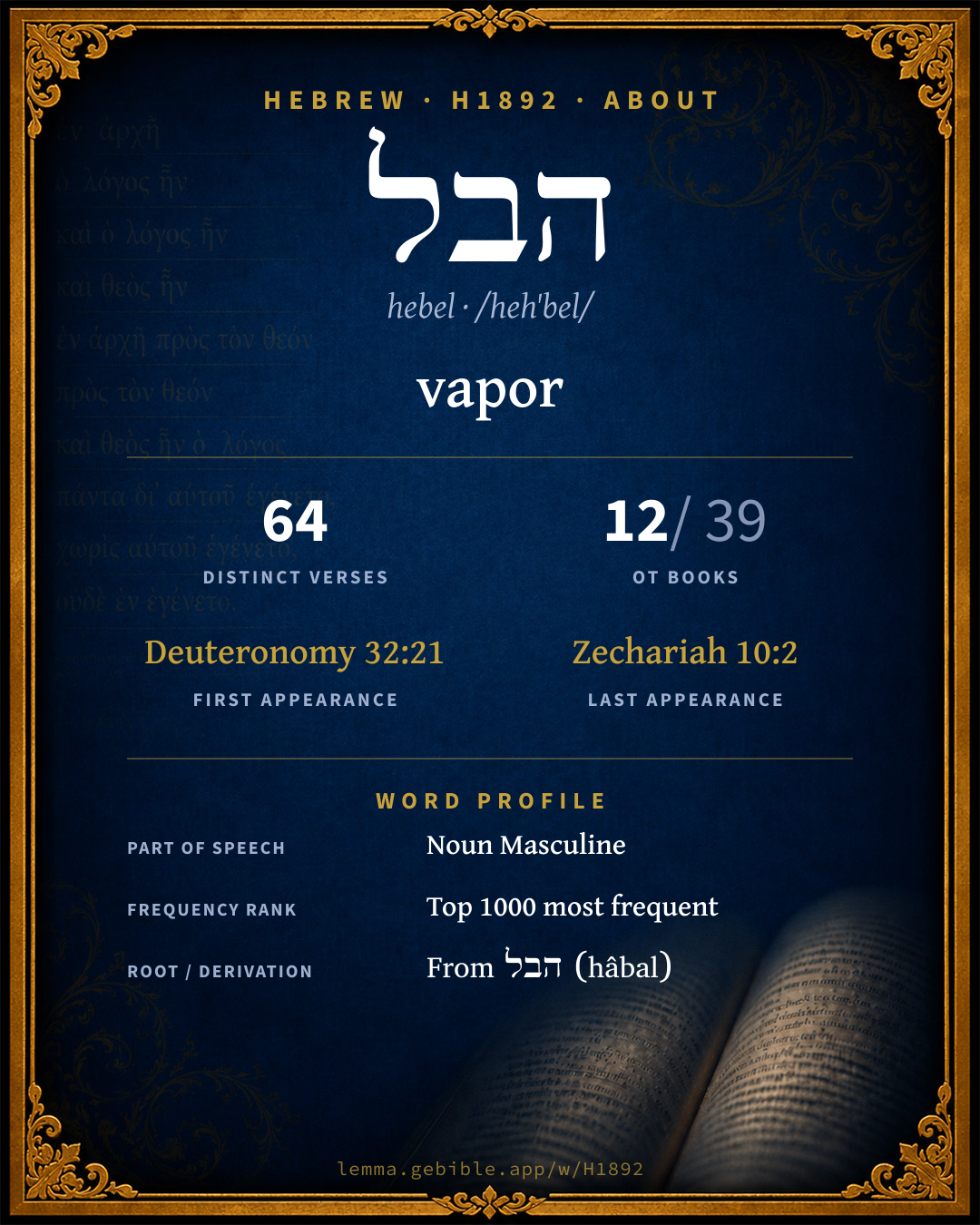
הֶ֫בֶל
vapor
‘vapor’ is one of 2 main senses fuller range ↓
Full lexicon entry — Brown-Driver-Briggs (BDB)
From Brown-Driver-Briggs (BDB)
Where this word appears
See every Absolute-state word in the Hebrew Bible →
Grammar key — what these labels mean
Part of speech
- Noun
- A naming word — a person, place, thing, or idea.
Noun type
- Common
- A common noun — a general class of person, place, or thing (“king,” “city,” “water”), not a specific name.
State
- Absolute
- The independent form of a noun, not bound to a following word.
- Construct
- A noun bound to a following noun in a possessive / “of” relationship (the construct chain).
Gender
- Masculine
- Grammatically masculine.
Number
- Singular
- One.
- Plural
- More than one (in Hebrew, generally three or more).
Grammatical forms
- Noun, Common, Masculine, Singular, Absolute 54 times (74%)
- Noun, Common, Masculine, Singular, Construct 7 times (10%)
- Noun, Common, Masculine, Plural, Construct 7 times (10%)
- Noun, Common, Masculine, Plural, Absolute 5 times (7%)
Parsed forms decoded from the imported morphology (morphhb / Westminster Leningrad Codex — WLC text public domain, morphhb tagging CC BY 4.0), counted across 73 parsed occurrences — not distinct verses.
Every verse where H1892 appears — 64 distinct verses across 12 books. Click any verse to open its interlinear word-by-word view. Verse text shown in the World English Bible for context — . Each verse’s Hebrew form is shown with its reference; the English is not keyword-highlighted, since the data carries no word-level English alignment. Use “Compare translations” on any verse to read it across multiple English versions. This concordance covers the Hebrew Bible; Septuagint (Greek Old Testament) occurrences are not indexed here.
Deuteronomy 1 verse
1 Kings 2 verses
- 1 Kings 16:13 בְּ/הַבְלֵי/הֶֽם prep + n c mp cs + sfx pers 3mp for all the sins of Baasha, and the sins of Elah his son, which they sinned, and with which they made Israel to sin, to provoke Yahweh, the God of Israel, to anger with their vanities.
- 1 Kings 16:26 בְּ/הַבְלֵי/הֶֽם prep + n c mp cs + sfx pers 3mp For he walked in all the way of Jeroboam the son of Nebat, and in his sins with which he made Israel to sin, to provoke Yahweh, the God of Israel, to anger with their vanities.
2 Kings 1 verse
Job 5 verses
- Job 7:16 הֶ֥בֶל n c ms I loathe my life. I don't want to live forever. Leave me alone; for my days are but a breath.
- Job 9:29 הֶ֣בֶל n c ms I shall be condemned; Why then do I labor in vain?
- Job 21:34 הָ֑בֶל n c ms So how can you comfort me with nonsense, Seeing that in your answers there remains only falsehood?"
- Job 27:12 הֶ֣בֶל n c ms Behold, all of you have seen it yourselves; Why then have you become altogether vain?
- Job 35:16 הֶ֣בֶל n c ms Therefore Job opens his mouth with empty talk, And he multiplies words without knowledge."
Psalms 8 verses
- Psalms 31:6 הַבְלֵי n c mp cs I hate those who regard lying vanities, But I trust in Yahweh.
- Psalms 39:5 הֶ֥בֶל n c ms Behold, you have made my days handbreadths. My lifetime is as nothing before you. Surely every man stands as a breath." Selah.
- Psalms 39:6 הֶ֥בֶל n c ms "Surely every man walks like a shadow. Surely they busy themselves in vain. He heaps up, and doesn't know who shall gather.
- Psalms 39:11 הֶ֖בֶל n c ms When you rebuke and correct man for iniquity, You consume his wealth like a moth. Surely every man is but a breath." Selah.
- Psalms 62:9 הֶ֥בֶל מֵ/הֶ֥בֶל n c ms prep + n c ms Surely men of low degree are just a breath, And men of high degree are a lie. In the balances they will go up. They are together lighter than a breath.
- Psalms 78:33 בַּ/הֶ֥בֶל prep det + n c ms Therefore he consumed their days in vanity, And their years in terror.
- Psalms 94:11 הָֽבֶל n c ms Yahweh knows the thoughts of man, That they are futile.
- Psalms 144:4 לַ/הֶ֣בֶל prep det + n c ms Man is like a breath. His days are like a shadow that passes away.
Proverbs 3 verses
- Proverbs 13:11 מֵ/הֶ֣בֶל prep + n c ms Wealth gained dishonestly dwindles away, But he who gathers by hand makes it grow.
- Proverbs 21:6 הֶ֥בֶל n c ms Getting treasures by a lying tongue Is a fleeting vapor for those who seek death.
- Proverbs 31:30 וְ/הֶ֣בֶל conj + n c ms Charm is deceitful, and beauty is vain; But a woman who fears Yahweh, she shall be praised.
Ecclesiastes 30 verses
- Ecclesiastes 1:2 הֲבֵ֤ל הֲבָלִים֙ הֲבֵ֥ל הֲבָלִ֖ים הָֽבֶל n c ms cs n c mp n c ms cs n c mp n c ms "Vanity of vanities," says the Preacher; "Vanity of vanities, all is vanity."
- Ecclesiastes 1:14 הֶ֖בֶל n c ms I have seen all the works that are done under the sun; and, behold, all is vanity and a chasing after wind.
- Ecclesiastes 2:1 הָֽבֶל n c ms I said in my heart, "Come now, I will test you with mirth: therefore enjoy pleasure;" and, behold, this also was vanity.
- Ecclesiastes 2:11 הֶ֨בֶל֙ n c ms Then I looked at all the works that my hands had worked, and at the labor that I had labored to do; and, behold, all was vanity and a chasing after wind, and there was no profit under the sun.
- Ecclesiastes 2:15 הָֽבֶל n c ms Then said I in my heart, "As it happens to the fool, so will it happen even to me; and why was I then more wise?" Then said I in my heart that this also is vanity.
- Ecclesiastes 2:17 הֶ֖בֶל n c ms So I hated life, because the work that is worked under the sun was grievous to me; for all is vanity and a chasing after wind.
- Ecclesiastes 2:19 הָֽבֶל n c ms Who knows whether he will be a wise man or a fool? Yet he will have rule over all of my labor in which I have labored, and in which I have shown myself wise under the sun. This also is vanity.
- Ecclesiastes 2:21 הֶ֖בֶל n c ms For there is a man whose labor is with wisdom, with knowledge, and with skillfulness; yet he shall leave it for his portion to a man who has not labored for it. This also is vanity and a great evil.
- Ecclesiastes 2:23 הֶ֥בֶל n c ms For all his days are sorrows, and his travail is grief; yes, even in the night his heart takes no rest. This also is vanity.
- Ecclesiastes 2:26 הֶ֖בֶל n c ms For to the man who pleases him, God gives wisdom, knowledge, and joy; but to the sinner he gives travail, to gather and to heap up, that he may give to him who pleases God. This also is vanity and a chasing after wind.
- Ecclesiastes 3:19 הָֽבֶל n c ms For that which happens to the sons of men happens to animals. Even one thing happens to them. As the one dies, so the other dies. Yes, they have all one breath; and man has no advantage over the animals: for all is vanity.
- Ecclesiastes 4:4 הֶ֖בֶל n c ms Then I saw all the labor and achievement that is the envy of a man's neighbor. This also is vanity and a striving after wind.
- Ecclesiastes 4:7 הֶ֖בֶל n c ms Then I returned and saw vanity under the sun.
- Ecclesiastes 4:8 הֶ֛בֶל n c ms There is one who is alone, and he has neither son nor brother. There is no end to all of his labor, neither are his eyes satisfied with wealth. For whom then, do I labor, and deprive my soul of enjoyment? This also is vanity, yes, it is a miserable business.
- Ecclesiastes 4:16 הֶ֖בֶל n c ms There was no end of all the people, even of all them over whom he was--yet those who come after shall not rejoice in him. Surely this also is vanity and a chasing after wind.
- Ecclesiastes 5:7 וַ/הֲבָלִ֔ים conj + n c mp For in the multitude of dreams there are vanities, as well as in many words: but you must fear God.
- Ecclesiastes 5:10 הָֽבֶל n c ms He who loves silver shall not be satisfied with silver; nor he who loves abundance, with increase: this also is vanity.
- Ecclesiastes 6:2 הֶ֛בֶל n c ms a man to whom God gives riches, wealth, and honor, so that he lacks nothing for his soul of all that he desires, yet God gives him no power to eat of it, but an alien eats it. This is vanity, and it is an evil disease.
- Ecclesiastes 6:4 בַ/הֶ֥בֶל prep det + n c ms for it comes in vanity, and departs in darkness, and its name is covered with darkness.
- Ecclesiastes 6:9 הֶ֖בֶל n c ms Better is the sight of the eyes than the wandering of the desire. This also is vanity and a chasing after wind.
- Ecclesiastes 6:11 הָ֑בֶל n c ms For there are many words that create vanity. What does that profit man?
- Ecclesiastes 6:12 הֶבְל֖/וֹ n c ms cs + sfx pers 3ms For who knows what is good for man in life, all the days of his vain life which he spends like a shadow? For who can tell a man what will be after him under the sun?
- Ecclesiastes 7:6 הָֽבֶל n c ms For as the crackling of thorns under a pot, so is the laughter of the fool. This also is vanity.
- Ecclesiastes 7:15 הֶבְלִ֑/י n c ms cs + sfx pers 1cs All this have I seen in my days of vanity: there is a righteous man who perishes in his righteousness, and there is a wicked man who lives long in his evil-doing.
- Ecclesiastes 8:10 הָֽבֶל n c ms So I saw the wicked buried. Indeed they came also from holiness. They went and were forgotten in the city where they did this. This also is vanity.
- Ecclesiastes 8:14 הֶבֶל֮ הָֽבֶל n c ms n c ms There is a vanity which is done on the earth, that there are righteous men to whom it happens according to the work of the wicked. Again, there are wicked men to whom it happens according to the work of the righteous. I said that this also is vanity.
- Ecclesiastes 9:9 הֶבְלֶ֔/ךָ הֶבְלֶ֑/ךָ n c ms cs + sfx pers 2ms n c ms cs + sfx pers 2ms Live joyfully with the wife whom you love all the days of your life of vanity, which he has given you under the sun, all your days of vanity: for that is your portion in life, and in your labor in which you labor under the sun.
- Ecclesiastes 11:8 הָֽבֶל n c ms Yes, if a man lives many years, let him rejoice in them all; But let him remember the days of darkness, for they shall be many. All that comes is vanity.
- Ecclesiastes 11:10 הָֽבֶל n c ms Therefore remove sorrow from your heart, And put away evil from your flesh; For youth and the dawn of life are vanity.
- Ecclesiastes 12:8 הֲבֵ֧ל הֲבָלִ֛ים הָֽבֶל n c ms cs n c mp n c ms Vanity of vanities, says the Preacher; All is vanity!
Isaiah 3 verses
- Isaiah 30:7 הֶ֥בֶל n c ms For Egypt helps in vain, and to no purpose: therefore have I called her Rahab who sits still.
- Isaiah 49:4 וְ/הֶ֖בֶל conj + n c ms But I said, I have labored in vain, I have spent my strength for nothing and vanity; yet surely the justice [due] to me is with Yahweh, and my recompense with my God.
- Isaiah 57:13 הָ֑בֶל n c ms When you cry, let those who you have gathered deliver you; but the wind shall take them, a breath shall carry them all away: but he who takes refuge in me shall possess the land, and shall inherit my holy mountain.
Jeremiah 8 verses
- Jeremiah 2:5 הַ/הֶ֖בֶל ptcl def.art + n c ms thus says Yahweh, What unrighteousness have your fathers found in me, that they have gone far from me, and have walked after vanity, and are become vain?
- Jeremiah 8:19 בְּ/הַבְלֵ֥י prep + n c mp cs Behold, the voice of the cry of the daughter of my people from a land that is very far off: isn't Yahweh in Zion? Isn't her King in her? Why have they provoked me to anger with their engraved images, and with foreign vanities?
- Jeremiah 10:3 הֶ֣בֶל n c ms For the customs of the peoples are vanity; for one cuts a tree out of the forest, the work of the hands of the workman with the axe.
- Jeremiah 10:8 הֲבָלִ֖ים n c mp But they are together brutish and foolish: the instruction of idols! it is but a stock.
- Jeremiah 10:15 הֶ֣בֶל n c ms They are vanity, a work of delusion: in the time of their visitation they shall perish.
- Jeremiah 14:22 בְּ/הַבְלֵ֤י prep + n c mp cs Are there any among the vanities of the nations that can cause rain? or can the sky give showers? Aren't you he, Yahweh our God? therefore we will wait for you; for you have made all these things.
- Jeremiah 16:19 הֶ֖בֶל n c ms Yahweh, my strength, and my stronghold, and my refuge in the day of affliction, to you shall the nations come from the ends of the earth, and shall say, Our fathers have inherited nothing but lies, [even] vanity and things in which there is no profit.
- Jeremiah 51:18 הֶ֣בֶל n c ms They are vanity, a work of delusion: in the time of their visitation they shall perish.
Lamentations 1 verse
Jonah 1 verse
Zechariah 1 verse
About this entry
At a glance — auto-summarized from this page’s data, not written by a person. Every figure links to its source below. This summary describes the numbers; it doesn’t interpret them.
At its core, הבל (hebel) means “vapor.” Its English rendering has broadened — “vanity” classically, “is futile” (Berean Standard Bible) and “is vapor” (unfoldingWord Literal Text) in modern versions; see the renderings breakdown. Spanning 64 verses in 12 books, it ranks among the moderately common words of the Hebrew Bible. Its uses concentrate in Ecclesiastes (47% of all occurrences). Not a single-sense word: explore its full sense range. Each statement above links to its evidence; the full detail follows below.
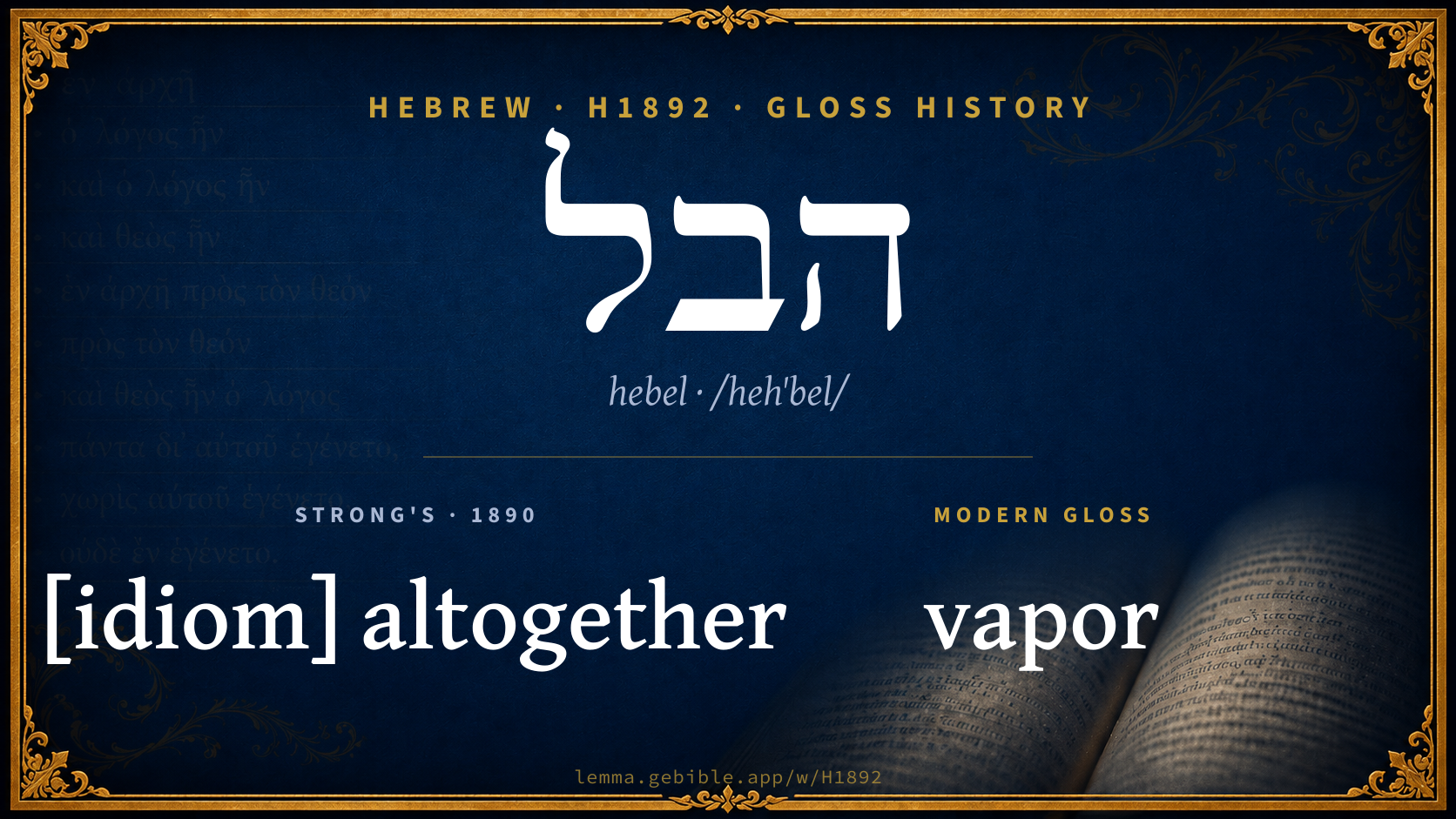
Gloss history
Strong's 1890 vs modern scholarship
About this word
Strong's H1892 catalogs a Hebrew word from the Hebrew Old Testament.
These counts are not copied from any lexicon or concordance. They are computed here, from the morphology-tagged Hebrew Old Testament. What Lemma adds →
- 64
- distinct verses
- The word appears in 64 distinct verses.
- 12 / 39
- OT books
- The word appears in 12 of 39 Old Testament books.
- #542
- by frequency
- Top 1000 most frequent Hebrew words (rank 542 of 8,640 Hebrew words by occurrence).
View all 64 occurrences in the concordance →
Most concentrated in
- Ecclesiastes 30 verses 47%
- Psalms 8 verses 13%
- Jeremiah 8 verses 13%
By section of the Old Testament
By traditional corpus
Conventional, traditional groupings — biblical authorship is debated, so this is a traditional corpus grouping, not an authorship claim. Each share is this word’s portion of its verses in that division of the Hebrew canon. Each figure is a share of the word’s 64 distinct verses.
- Writings (Ketuvim) 47 verses · 73%
- Prophets (Nevi'im) 16 verses · 25%
- Torah (Pentateuch) 1 verse · 2%
How translations render this word
Counts come from each version’s own published word-to-Strong’s tagging or interlinear alignment — an approximate guide to how each version renders this word, not a word-level alignment the data otherwise carries. Because each total is that version’s own tagged count, the per-version totals vary from one another and need not match the appearance or distinct-verse counts above. These counts may also differ from a printed concordance because Lemma counts each distinctly tagged rendering and does not collapse phrase taggings into a single head-word total. This is a fixed set of word-tagged versions (KJV, ASV, BSB, ULT) and does not change with the reading translation you choose elsewhere. Each version’s license is shown beside its name below (and on Sources).
BDB lists this Strong’s number as 2 distinct words (homographs). Each count above pools all of them and is not split by sense — see the Senses section below. A low-frequency rendering may belong to a different one of those words, not the primary meaning.
- King James Version†: Vanity 17×, Vanities 10×, Is vanity 8×
- American Standard Version†: Vanity 17×, Is vanity 14×, Vanities 9×
- Berean Standard Bible†: Is futile 20×, Worthless idols 9×, Futility 8×
- unfoldingWord Literal Text†: Is vapor 19×, Vapor 15×, Vapors 5×
King James Version Public Domain
Renders H1892 across 73† tagged occurrences — most commonly:
Plus 15 renderings that appear only once — usually multi-word phrases or single function words the recovered tagging swept in, not distinct renderings.
American Standard Version Public Domain
Renders H1892 across 72† tagged occurrences — most commonly:
Plus 16 renderings that appear only once — usually multi-word phrases or single function words the recovered tagging swept in, not distinct renderings.
Berean Standard Bible Public Domain
Renders H1892 across 73† tagged occurrences — most commonly:
Plus 14 renderings that appear only once — usually multi-word phrases or single function words the recovered tagging swept in, not distinct renderings.
unfoldingWord Literal Text CC BY-SA 4.0
Renders H1892 across 75† tagged occurrences — most commonly:
Plus 13 renderings that appear only once — usually multi-word phrases or single function words the recovered tagging swept in, not distinct renderings.
Senses in the full BDB
What do BDB’s symbols mean?
BDB uses these scholarly abbreviations:
| Symbol | Meaning |
|---|---|
| 𝔊 | the Septuagint (the ancient Greek translation, LXX) |
| 𝔙 | the Vulgate (the Latin translation) |
| 𝔖 | the Syriac version (the Peshitta) |
| 𝔗 | the Targum (the Aramaic translation) |
| ψ | the Psalms |
| √ | root (the underlying root or stem) |
| ‖ | parallel passage (a synonymous or contrasted parallel) |
| † | the dagger: every passage where the word occurs is cited |
The 2 senses and sub-senses the full Brown-Driver-Briggs lexicon distinguishes for this word, in lexicon order (not ranked by frequency), with BDB’s own verbatim wording and sub-sense lettering. Shown in Hebrew script with BDB’s own scholarly abbreviations. The condensed entry is in the Lexicon Entry tab. See also the Forms in the corpus table below.
הבל I vapour, breath (NH id., Syriac ܗܰܒܳܠܴܐ id.) fig. vanity (so NH, Syriac ܗܶܒܠܴܐ )
- 1. lit. Is 57:13 all of them (the idols) יִשָּׂא־רוּחַ יִקַּח הָ֑בֶל a breath (𝔙 aura) will carry away, Pr 21:6, the getting of treasures by a lying tongue is הֶבֶל נִדָּף, a vapour driven away. Elsewhere always e.g. Isaiah 57:13
- 2. fig. of what is evanescent, unsubstantial, worthless, vanity, as of idols Je 10:15 = 51:18; 16:19 הֶבֶל וְאֵין בָּם מוֹעִיל (‖ שֶׁקֶר), heathen observances 10:3, and in phr. הָלַךְ אַחֲרֵי הַהֶבֶל 2:5 2 K 17:15; Pr 13:11 הוֹן מֵהֶבֶל wealth (gotten) out of vanity (i.e. not by solid toil, opp. קֹבֵץ עַל יָד) is minished (but 𝔊 𝔙 Ew מְבֹהָל, v. 20:21 Qr), 31:30 שֶׁקֶר הַחֵן וְהֶבֶל הַיֹּ֑פִי, La 4:17 אֶל עֶזְרָתֵנוּ הֶבֶל to our vain (Dr§ 193 n.) help; of life Jb 7:16 כִּי הֶבֶל יָמָֽי׃, ψ 78:33 וַיְכַל בַּהֶבֶל יְמֵיהֶם consumed their days as (בְּ I7d) vanity, man ψ 39:6, 12; 62:10 הֶבֶל בְּנֵי אָדָם … הֵמָּה מֵהֶבֶל יָחַֽד׃ they are altogether (made) of vanity, 94:11: 144:4, especially in Ec (31 times + הֲבֵל הֲבָלִים 1:2(×2); 12:8) of the fruitlessness of all human enterprise and endeavour, 1:2 הַכֹּל הֶבֶל, v 14 הַכֹּל הֶבֶל וּרְעוּת רוּחַ all was vanity and the pursuit of wind, 2:1, 14, 15 etc., 6:4 (of an abortion) בַּהֶבֶל בָּא i.e. into a lifeless existence, v 11 יֵשׁ דְּבָרִים הַרְבֵּה מַרְבִּים הָ֑בֶל (of discussions leading to no result), note also the phrases יְמֵי (הֶבְלוֹ, הֶבְלְךָ) הֶבְלִי 7:15; 9:9, יְמֵי חַיֵּי ה׳ 6:12; 9:9; Jb 27:12 (v. הָבַל), Is 49:4 לְתֹהוּ וָהֶבֶל for nought and vanity have I spent my strength; as adv. accus. vainly, to no purpose Is 30:7 הֶבֶל וָרִיק יַעְזֹ֑רוּ, ψ 39:7 אַךְ הֶבֶל יֶהֱמָיוּן they disquiet themselves to no purpose, Jb 9:29 הֶבֶל אִיגָֽע 35:16, with נִחַם to comfort 21:34 Zc 10:2. Pl. †הֲבָלִים of false gods, Dt 32:21 כִּעֲסוּנִי בְהַבְלֵיהֶם (‖ בְּלֹא־אֵל) 1 K 16:13, 26 Je 8:19 הַבְלֵי נֵכָר (‖ בִּפְסִילֵיהֶם), 10:8; 14:22 הַבְלֵי הַגּוֹיִם, ψ 31:7 הַשֹּׁמְרִים הַבְלֵי־שָׁוְא empty vanities Jon 2:9; in more general sense Ec 1:2(×2); 12:8 הֲבֵל הֲבָלִים, 5:6. e.g. Jeremiah 10:15
הבל II m. (perhaps i.q. Assyrian ablu, son, COTGloss. cf. also WeSkizzen iii. 70
Senses from the full Brown-Driver-Briggs lexicon (Brown, Driver, Briggs; Oxford 1906 — public domain), digitized via Sefaria, supplemented by the OpenScriptures HebrewLexicon (CC BY 4.0). Full attribution on Sources.
Word origin
I. n.m. vapour, breath (NH id., Syriac ܗܰܒܳܠܴܐ id.) fig. vanity (so NH, Syriac ܗܶܒܠܴܐ )—הָ֑בֶל Ec 1:2 +; cstr. הֲבֵל †Ec 1:2(×2); 12:8, sf. הֶבְלִי etc. Ec 6:12; 7:15; 9:9(×2); pl. הֲבָלִים Je 10:8 +; cstr. הַבְלֵי Je 8:19 +, sf. הַבְלֵיהֶם Dt 32:21 +;—
II. n.pr.m. (perhaps i.q. Assyrian ablu, son, COTGloss. cf. also WeSkizzen iii. 70: der. from I. הֶבֶל not prob.) second son of Adam Gn 4:2(×2), 4(×2), 8(×2), 9, 25.
— Brown-Driver-Briggs (Oxford 1906, public domain), digitized via Sefaria, supplemented by the OpenScriptures HebrewLexicon (CC BY 4.0). See Sources.
Derived from הבל (hâbal) (H1891) — to become vain.
Jastrow Dictionary
A second Hebrew/Aramaic lexicon for comparison, covering Aramaic and post-biblical (Talmudic, Targumic, Midrashic) usage that the biblical-Hebrew BDB does not. Matched by lemma rather than by Strong’s number, so a lemma may carry more than one Jastrow headword (shown separately below), and the entries cover usage well beyond the Bible.
הָבַל
- , Hif. הֶהֱבִיל (cmp. הבב) to be affected by hot air, begin to steam. Sabb. I, 6 (17ᵇ) long enough before the Sabbath כדי שיַהֲבִילוּ for the flax stalks to begin &c.
הֲבַל
- (= b. h. הָבַל, denom. of הַבְלָא)
- 1. to do vain things. Targ. Job XXVII, 12.
- 2. to be wanton, to sport. Targ. Ps. LXII, 11 תְהַבְלוּן ed. Wil. (Bxt. תִתְהַבְּלוּן Ithpa.; ed. Lag. תקבלון, Ms. תתחבלון).
הֶבֶל
- , constr. הֲבֵל or הֲבַל (b. h.)
- 1. breath, vapor, air, heat. Sabb. 88ᵇ בה׳ שבפיהם with the (fiery) breath of their mouths. Ib. 119ᵇ ה׳ תינוקות וכ׳ the breath of school children. Ib. ה׳ שאין בו חטא a sinless breath (of children). Y. Ab. Zar. III, 42ᵈ bot. ה׳ המרחץ וכ׳ the vapor of the bath room is injurious to the teeth. Yeb. 80ᵇ אין בשרו מעלה ה׳ his body (after bathing) does not steam. Pesik. Baḥod. p. 154ᵃ; Lev. R. s. 29 (ref. to Ps. LXII, 10) עד שהן עשויין ה׳ בתוך וכ׳ while they are yet a gas (in the first embryonic stage) …, they are predestined for marital union. Y. Ter. X, 47ᵃ bot. הה׳ כובש the heat (of the fresh bread placed on top of an open wine casket) keeps the evaporations of the wine down. B. Kam. 50ᵇ להַבְלוֹ for injuries suffered through the bad air of the pit (into which the animal fell), opp. to לחבטו injuries arising from knocking against the ground. Koh. R. to I, 2 ה׳ של תנור the hot air of the stove; ה׳ של עליונה the vapor of the topmost pot; Yalk. ib. 966 ה׳ שביעית; a. e.— e.g. Psalms 62:10
- 2. (b. h.) vanity. B. Bath. 16ᵇ תנחומין של ה׳ vain consolations. Koh. R. l. c.; Yalk. l. c. (ref. to Ps. CXLIV, 4) לאיזו ה׳ to what kind of hebel (breath) man is like; a. fr.—Pl. הֲבָלִים. Ib. שבעה ה׳ וכ׳ the seven times that Solomon used the word hebel. Pesik. Baḥod. l. c.; Lev. R. l. c. כל ה׳ וכזבים וכ׳ all the vain things and falsehoods which the Israelites commit. e.g. Psalms 144:4
A Dictionary of the Targumim, the Talmud Babli and Yerushalmi, and the Midrashic Literature (Marcus Jastrow; London, Luzac, 1903) — Public Domain. Digitized via Sefaria. Digitized via Sefaria. Full attribution on Sources.
Forms in the corpus
The 33 distinct written forms H1892 takes in the Hebrew Bible, most frequent first — each parse links to that state’s occurrences in the concordance. Hebrew forms include their vowel points and cantillation, so a single lemma takes many written forms.
Same root — word family
Other BDB entries built from the same root as H1892, grouped by Strong’s listed origin. These share a root / origin per the lexicon — not necessarily a shared meaning. Each links to that word’s own entry.
Derives from
Proper names from this root
People and places named from this root — a name, not an additional meaning of the word.
Compare all same-root words → 1 of the same-root words is a proper name (a person or place). They share a root, not necessarily a meaning.
Septuagint verse parallels
This word appears in 62 verses that also exist in the Greek Old Testament (Septuagint), out of the 64 Hebrew verses it occurs in. You can read those verses in Greek by switching the Old Testament edition to the Septuagint.
Read these verses in the Septuagint
- Deuteronomy 32:21
- 1 Kings 16:13
- 2 Kings 17:15
- Job 7:16
- Psalms 31:6
- Proverbs 13:11
- Ecclesiastes 1:2
- Isaiah 30:7
- Jeremiah 2:5
- Lamentations 4:17
- Jonah 2:8
- Zechariah 10:2
This is a verse-level parallel only — the same verses exist in both the Hebrew and Greek Old Testaments. No word-level Hebrew↔Greek correspondence is claimed: the data carries no such alignment, so no Greek word is shown as this Hebrew word’s translation. Coverage is not total — the Septuagint omits the deuterocanon and renumbers the Psalms, so some Hebrew verses have no direct Greek parallel.