Ecclesiastes 11:10

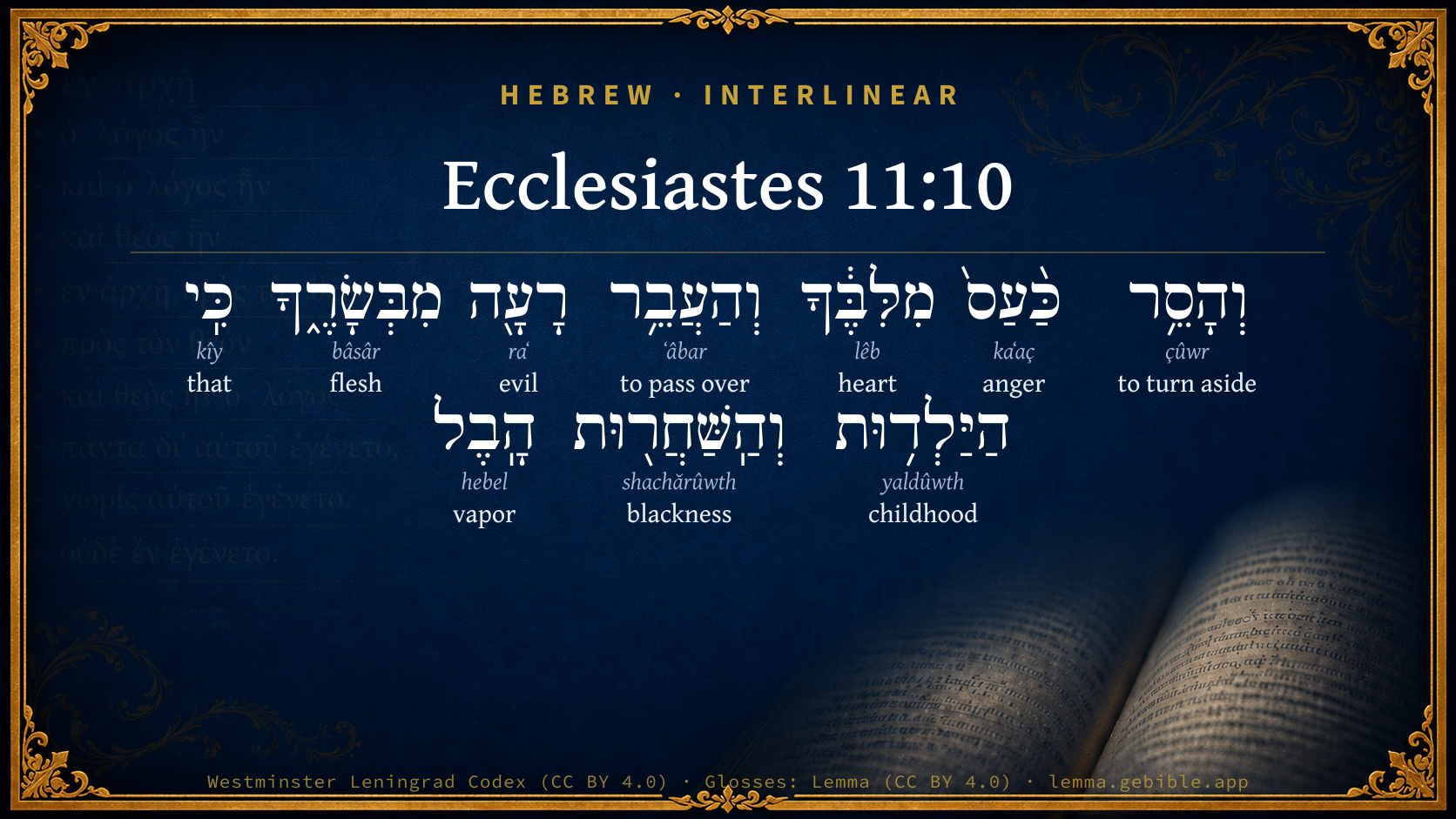
Hebrew (Westminster Leningrad Codex) Ecclesiastes 11:10 appears in the Hebrew Old Testament. The text above is from the Westminster Leningrad Codex. Each word links to its Strong’s number, a concise gloss, and parsing drawn from the Open Scriptures Hebrew Bible morphology. Click any word for its full Brown-Driver-Briggs (BDB) entry.
Download image
Cite this verse

Ecclesiastes 11:10 (World English Bible). Public Domain. Lemma interlinear Bible study tool, https://lemma.gebible.app/v/ecclesiastes/11/10.

Show BibTeX & RIS
BibTeX
RIS
English Translation
Therefore remove sorrow from your heart, And put away evil from your flesh; For youth and the dawn of life are vanity.
World English Bible · Public Domain
Highlights
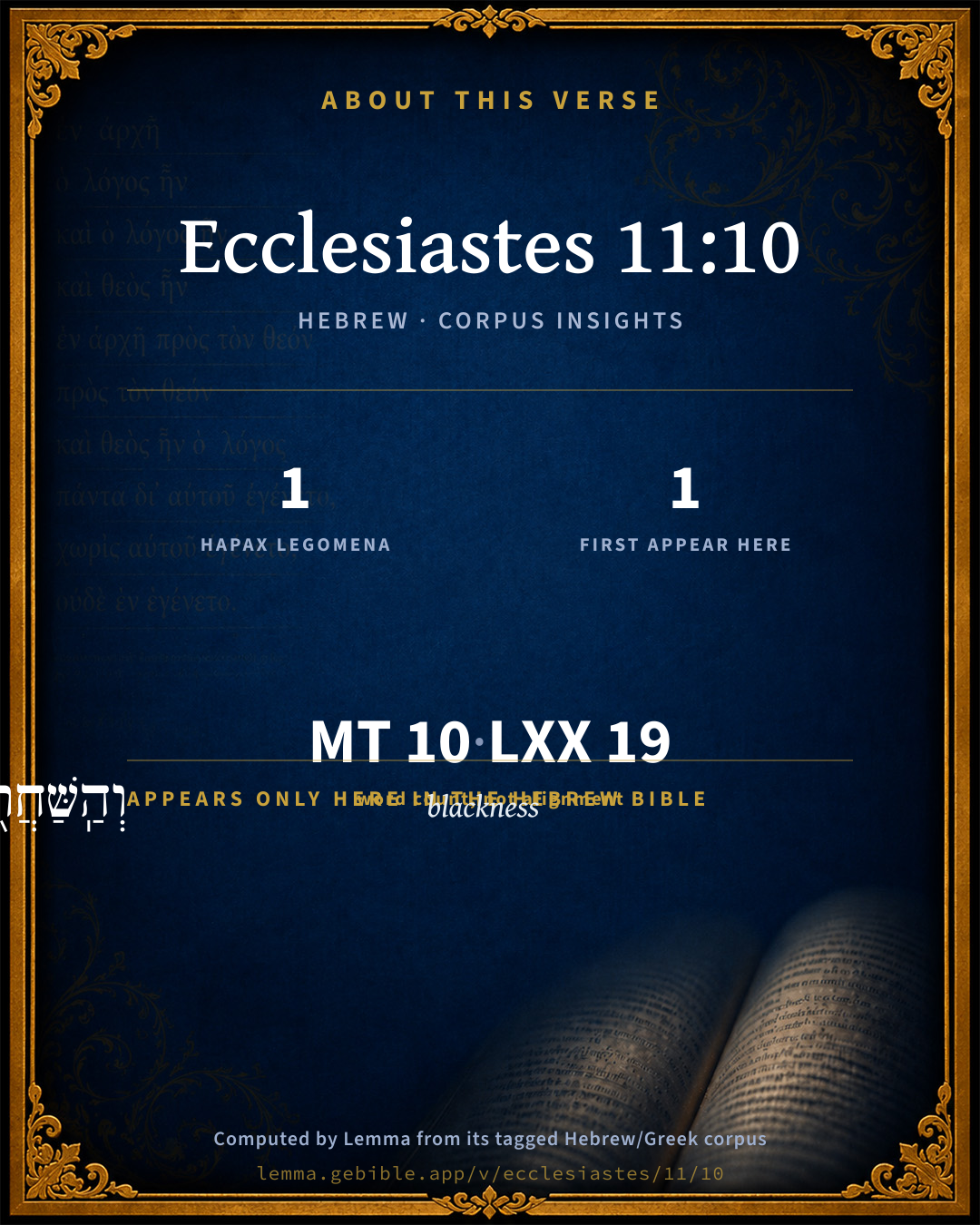
  • 1 hapax legomenon — only here in the Hebrew Bible
  • 1 first appearance in the Hebrew Bible
Full analysis ↓
Download a study sheet

One document with this verse’s original text, its word-by-word gloss line, the meaning frame, cross-references with their text, attributed commentary, and full source and license credits — printable, and it pastes into notes with its structure intact.

This verse Autodidact and up

Study sheet (.html) Plain text (.txt)

A passage Seminary Student

Up to 50 verses in one chapter. A passage sheet keeps up to 6 commentary sources and 12 cross-references per verse, in the order this page ranks them, and says so on the sheet whenever that leaves anything out. Ask for a single verse and you get the Autodidact verse sheet above.

Everything on this page stays free to read, with no account — the sheet is a download of what is already on screen, not access to it.

Want to remove ads? Support Godless Engineer
Compare translations 3

The same verse in 3 English versions, stacked beneath the original-language interlinear above. Click any original word for its lexicon entry.

Each is an independent rendering of the whole verse — the interlinear is not word-aligned to these translations.

Highlighted words mark where these versions differ — a whole-verse word diff, not a word-by-word alignment.

  • World English Bible Public Domain
    Therefore remove sorrow from your heart, And put away evil from your flesh; For youth and the dawn of life are vanity.
  • King James Version Public Domain
    Therefore remove sorrow from thy heart, and put away evil from thy flesh: for childhood and youth are vanity.
  • unfoldingWord Literal Text CC BY-SA 4.0
    And remove anger from your heart, and take misfortune away from your flesh, for youth and dark hair vapor.

unfoldingWord Literal Text — © unfoldingWord, licensed CC BY-SA 4.0. Word-aligned USFM3 via Door43 (git.door43.org/unfoldingWord/en_ult).

Versions to compare (up to 4)

3 of 4 selected

Show all 18 translations

Every available English version of this verse, each an independent rendering of the whole verse.

  • World English Bible Public Domain
    Therefore remove sorrow from your heart, And put away evil from your flesh; For youth and the dawn of life are vanity.
  • Berean Standard Bible Public Domain
    So banish sorrow from your heart, and cast off pain from your body, for youth and vigor are fleeting.
  • Majority Standard Bible Public Domain
    So banish sorrow from your heart, and cast off pain from your body, for youth and vigor are fleeting.
  • King James Version Public Domain
    Therefore remove sorrow from thy heart, and put away evil from thy flesh: for childhood and youth are vanity.
  • American Standard Version (1901) Public Domain
    Therefore remove sorrow from thy heart, and put away evil from thy flesh; for youth and the dawn of life are vanity.
  • Revised Version (1885) Public Domain
    Therefore remove sorrow from thy heart, and put away evil from thy flesh: for youth and the prime of life are vanity.
  • Geneva Bible (1599) Public Domain
    Therefore take away griefe out of thine heart, and cause euil to depart from thy flesh: for childehood and youth are vanitie.
  • Douay-Rheims (1899) Public Domain
    Remove anger from thy heart, and put away evil from thy flesh. For youth and pleasure are vain.
  • Young's Literal Translation Public Domain
    And turn aside anger from thy heart, And cause evil to pass from thy flesh, For the childhood and the age `are' vanity!
  • Literal Standard Version CC BY-SA 4.0
    And turn aside anger from your heart, || And cause evil to pass from your flesh, || For the childhood and the age [are] vanity!
  • Unlocked Literal Bible CC BY-SA 4.0
    Drive anger away from your heart, and ignore any pain in your body, because youth and its strength are vapor.
  • unfoldingWord Literal Text CC BY-SA 4.0
    And remove anger from your heart, and take misfortune away from your flesh, for youth and dark hair vapor.
  • Darby Bible Public Domain
    Then remove discontent from thy heart, and put away evil from thy flesh; for childhood and youth are vanity.
  • World Messianic Bible Public Domain
    Therefore remove sorrow from your heart, and put away evil from your flesh; for youth and the dawn of life are vanity.
  • Webster's Bible Public Domain
    Therefore remove sorrow from thy heart, and put away evil from thy flesh: for childhood and youth are vanity.
  • Free Bible Version CC BY-SA 4.0
    So don't let your mind worry, and avoid things that hurt your body. Even so, despite youth and enthusiasm, life is still so hard to understand!
  • Bible in Basic English Public Domain
    So put away trouble from your heart, and sorrow from your flesh; because the early years and the best years are to no purpose.
  • JPS Tanakh (1917) Public Domain
    Therefore remove vexation from thy heart, and put away evil from thy flesh; for childhood and youth are vanity.

Literal Standard Version (2020), Covenant Press — licensed CC BY-SA 4.0. Text via the HelloAO Bible API (eBible.org). Unlocked Literal Bible (unfoldingWord) — licensed CC BY-SA 4.0. Text via the HelloAO Bible API (eBible.org). unfoldingWord Literal Text — © unfoldingWord, licensed CC BY-SA 4.0. Word-aligned USFM3 via Door43 (git.door43.org/unfoldingWord/en_ult). Free Bible Version, Dr. Jonathan Gallagher — licensed CC BY-SA 4.0. Text via the HelloAO Bible API (eBible.org).

Word by word

More ways to search: Search by grammar → Find every occurrence → Compare this word →

Practice this passage: Drill this verse → Learn its vocabulary →

וְהַֽשַּׁחֲר֖וּת
shachărûwth
H7839
“and · the · blackness”
Conjunction + Particle, Definite Article + Noun, Common, Feminine, Singular, Absolute
Part of Speech
Conjunction + Particle + Noun
Type
Common
Gender
Feminine
Number
Singular
State
Absolute
Full BDB Definition

Origin: from H7836

TWOT: 2368c

blackness - blackness (of hair indicating youth)
  1. וְהָסֵ֥ר çûwr H5493 “and · turn aside” Conjunction + Verb, Hiphil, Imperative, 2nd Person, Masculine, Singular
  2. כַּ֨עַס֙ kaʻaç H3708 “anger” Noun, Common, Masculine, Singular, Absolute
  3. מִלִּבֶּ֔ךָ lêb H3820 “from · heart · your” Preposition + Noun, Common, Masculine, Singular, Construct + Suffix, Personal, 2nd Person, Masculine, Singular
  4. וְהַעֲבֵ֥ר ʻâbar H5674 “and · pass over” Conjunction + Verb, Hiphil, Imperative, 2nd Person, Masculine, Singular
  5. רָעָ֖ה raʻ H7451 “evil” Noun, Common, Feminine, Singular, Absolute
  6. מִבְּשָׂרֶ֑ךָ bâsâr H1320 “from · flesh · your” Preposition + Noun, Common, Masculine, Singular, Construct + Suffix, Personal, 2nd Person, Masculine, Singular
  7. כִּֽי kîy H3588 “that” Conjunction
  8. הַיַּלְד֥וּת yaldûwth H3208 “the · childhood” Particle, Definite Article + Noun, Common, Feminine, Singular, Absolute
  9. הָֽבֶל hebel H1892 “vapor” Noun, Common, Masculine, Singular, Absolute

About this verse

These counts appear in no published source. They are computed here, from the morphology-tagged text and Lemma’s own curated glosses. What Lemma adds →

10
words
10
distinct lemmas
Wisdom
section

Notable vocabulary

1 hapax legomenon — a word that appears only here in the entire Hebrew Bible:

  • וְהַֽשַּׁחֲר֖וּת blackness H7839

First appearance in Scripture

This word makes its first canonical appearance in the Hebrew Bible here:

  • וְהַֽשַּׁחֲר֖וּת blackness H7839

Shared distinctive vocabulary

הַיַּלְד֥וּת childhood H3208 occurs in 3 verses of the Hebrew Bible. Also found in:

Grammatical profile

  • 2 verbs
  • 7 nouns
  • 1 conjunction

Verb forms

  • וְהָסֵ֥ר Hiphil · Imperative
  • וְהַעֲבֵ֥ר Hiphil · Imperative

Hebrew & Septuagint length

In English translation the verse runs 22 words from the Hebrew and 19 from the Septuagint (LXX English) — closely comparable.

A rough comparison of the two English renderings, which tokenize alike — not a word-level alignment.

Word counts can differ between the Hebrew and the Greek without any difference in meaning — e.g. the Hebrew direct-object marker אֵת has no separate Greek word, and Greek often adds the article ὁ.

In the original languages it is 10 Hebrew tokens and 19 Greek tokens — but the two are counted differently (Hebrew bundles its prefixes and suffixes into one token; the Greek is in lemma form), so that isn’t a like-for-like length.

Cross-references

12

Topical passages linked to Ecclesiastes 11:10 in the Treasury of Scripture Knowledge — connected by theme and wording, ordered by reader-vote popularity; previews shown in the World English Bible.

  • 2 Corinthians 7:1 Having therefore these promises, beloved, let us cleanse ourselves from all defilement of flesh and spirit, perfecting holiness in the fear of God.
  • 2 Timothy 2:22 Flee from youthful lusts; but pursue righteousness, faith, love, and peace with those who call on the Lord out of a pure heart.
  • Ecclesiastes 1:2 "Vanity of vanities," says the Preacher; "Vanity of vanities, all is vanity."
  • Ecclesiastes 1:14 I have seen all the works that are done under the sun; and, behold, all is vanity and a chasing after wind.
  • Ecclesiastes 12:1 Remember also your Creator in the days of your youth, Before the evil days come, and the years draw near, When you will say, "I have no pleasure in them;"
  • Job 20:11 His bones are full of his youth, But youth shall lie down with him in the dust.
  • Psalms 39:5 Behold, you have made my days handbreadths. My lifetime is as nothing before you. Surely every man stands as a breath." Selah.
  • Psalms 90:7–11 For we are consumed in your anger. We are troubled in your wrath.
  • 2 Peter 3:11–14 Therefore since all these things are thus to be destroyed, what manner of persons ought you to be in holy living and godliness,
  • Job 13:26 For you write bitter things against me, And make me inherit the iniquities of my youth:
  • Psalms 25:7 Don't remember the sins of my youth, nor my transgressions. Remember me according to your loving kindness, For your goodness' sake, Yahweh.
  • Proverbs 22:15 Folly is bound up in the heart of a child: The rod of discipline drives it far from him.

Cross-references courtesy of OpenBible.info (CC BY 4.0).

Hebrew and Greek witnesses Masoretic Hebrew ↔ Greek Septuagint

The same verse in the two great witnesses to the Old Testament, shown verse-for-verse.

These are two independent witnesses, not word-aligned to each other, and the Septuagint is shown in lemma (dictionary) form.

Hebrew Ecclesiastes 11:10 Masoretic · Westminster Leningrad Codex

וְהָסֵ֥ר כַּ֨עַס֙ מִלִּבֶּ֔ךָ וְהַעֲבֵ֥ר רָעָ֖ה מִבְּשָׂרֶ֑ךָ כִּֽי הַיַּלְד֥וּת וְהַֽשַּׁחֲר֖וּת הָֽבֶל

Therefore remove sorrow from your heart, And put away evil from your flesh; For youth and the dawn of life are vanity.

World English Bible · Public Domain

Greek LXX Ecclesiastes 11:10 Septuagint · lemma form

καί ἀποἵστημι θυμός ἀπό καρδία σύ καί παραἄγω πονηρία ἀπό σάρξ σύ ὅτι ὁ νεότης καί ὁ ἄνοια ματαιότης

Therefore remove sorrow from your heart, and put away evil from your flesh: for youth and folly are vanity.

LXX2012 (modern English Septuagint) · Public Domain

On this verse, Trapp's Complete Commentary discusses the Septuagint’s reading. Read the note in Commentary ↓

Hebrew: Westminster Leningrad Codex (CC BY 4.0). Greek: Septuagint (public domain); English from LXX2012 (modern English Septuagint) (Public Domain). How the Septuagint differs from the Hebrew →

Commentary

Notes on Ecclesiastes 11:10 from classic Christian and Jewish commentators (each source and its license shown beneath its notes). The classic Christian expositions comment on the surrounding passage and are grouped to its opening verse, so a note may address several verses; the Jewish commentaries on the Tanakh (Rashi and others) are per-verse, so they appear only where the commentator wrote on this verse.

Lemma curates 59 commentaries, every one of them public domain or Creative Commons licensed, each selected and text-cleaned for this edition rather than reprinted as found. About our sources →

Trapp's Complete Commentary

John Trapp

Ecc 11:10 Therefore remove sorrow from thy heart, and put away evil from thy flesh: for childhood and youth [are] vanity.

Ver. 10. Therefore remove sorrow from thine heart.] One would have thought that he should have said rather, considering the premises, remove joy from thy heart, "Let thy laughter be turned to mourning, and thy joy into heaviness," {Jas 4:9} turn all the streams into that channel that may drive that mill that may grind the heart. But by sorrow here, or indignation, as Tremellius renders it, the Preacher means sin, the cause of sorrow; and so he interprets himself in the next words, "Put away evil from thy flesh," - i.e., mortify thy lusts.

For childhood and youth are vanity.] The Septuagint and Vulgate render it, Youth and pleasure are vain things. They both will soon be at an end.

John Trapp, A Commentary or Exposition upon All the Books of the Old and New Testament (1647–1656) — public domain. Text from a community e-Sword module.

Joseph Benson's Commentary

Ecc 11:10. Therefore remove sorrow — Sensual and disorderly lusts, which he elegantly calls sorrow, to intimate, that although such practices at present gratify men’s senses, yet they will shortly bring them to intolerable sorrows. And put away evil from thy flesh — All evil desires, though now they seem good to thee. For childhood and youth are vanity — Most vain. The time of youth is vanishing and transitory, and old age and death will speedily come, against which every wise man will take care to lay in solid provisions and comforts.

Joseph Benson's Commentary on the Old and New Testaments (1811–1818) — public domain. Text from a community e-Sword module.

Tyndale Open Study Notes

Tyndale Open Resources

11:10 Youth, like life itself, is beneficial and enjoyable but ultimately meaningless, a fleeting vapor that passes away without apparent significance or lasting purpose.

Tyndale Open Study Notes — © Tyndale Open Resources, licensed CC BY-SA 4.0. Text via the HelloAO Bible API.

Geneva Bible (1599)

Geneva Bible translators

To wit, anger, and envy.

Meaning, carnal lusts, whereunto youth is given.

Geneva Bible (1599) marginal notes — public domain. Text via Bolls.life.

Jamieson, Fausset & Brown

Robert Jamieson, A. R. Fausset & David Brown

sorrow--that is, the lusts that end in "sorrow," opposed to "rejoice," and "heart cheer thee" (Ecc 11:9), Margin, "anger," that is, all "ways of thine heart"; "remove," &c., is thus opposed to "walk in," &c. (Ecc 11:9).

flesh--the bodily organ by which the sensual thoughts of the "heart" are embodied in acts.

childhood--rather, "boyhood"; the same Hebrew word as the first, "youth" in Ecc 11:9. A motive for self-restraint; the time is coming when the vigor of youth on which thou reliest, will seem vain, except in so far as it has been given to God (Ecc 12:1).

youth--literally, the dawn of thy days.

Next: Ecclesiastes Chapter 12

Jamieson, Fausset & Brown — Commentary Critical and Explanatory on the Whole Bible (1871) — public domain (CC PDM 1.0). Text via the HelloAO Bible API.

Adam Clarke's Commentary

Verse 10. Therefore remove sorrow] כעס caas, anger; every kind of violent passion, all filthiness of the flesh and spirit. "Childhood and youth are vanity;" they pass away and come to nothing. Eternity alone is permanent; live for eternity.

Adam Clarke's Commentary on the Bible (1810–1826) — public domain. Text from a community e-Sword/MySword module.

Ellicott's Commentary for English Readers

(10) Sorrow.—See Note on Ecc_7:3.

Youth.—The word occurs not elsewhere in the Old Testament; but nearly the same word is used of black hair in Lev_13:37; Son_5:11.

A Bible Commentary for English Readers, edited by Charles John Ellicott (1878–1897) — public domain. Text from a community e-Sword module.

The Cambridge Bible for Schools and Colleges

gen. ed. J. J. S. Perowne

10. Therefore remove sorrow from thy heart] The two clauses recognise the two conditions of happiness so far as happiness is attainable by man on earth. “Sorrow,” better perhaps, discontent or vexation, is by a deliberate effort to be put away from our “heart,” i.e. from our mind. We are not to look on the dark side of things, but to cultivate cheerfulness, to be “content” (αὐτάρκης) with whatever life brings us (Php_4:11). And the “flesh” too has its claims which may legitimately be recognised. We need not vex it with the self-inflicted tortures of the ascetic, but, in a sense as far as possible different from “the rehabilitation of the flesh” which has been made the plea for an unrivalled sensuality, consider and meet its capacities for pure and innocent enjoyment.

childhood and youth are vanity] The Hebrew word for “youth” is an unusual one and is not found elsewhere in the Old Testament. It has been differently explained: (1) as the dawn or morning of life, the period of its brightness; and (2) as the time when the hair is black as contrasted with the grey hair of age. Of these (1) seems preferable. The prominent idea of “vanity” here is that of transitoriness. The morning will not last. It is wise to use it while we can.

The Cambridge Bible for Schools and Colleges (gen. ed. J. J. S. Perowne; Cambridge University Press, 1878–1918) — public domain. Text from a community e-Sword module.

John Gill's Exposition

Therefore remove sorrow from thy heart,.... Worldly sorrow, as opposed to lawful mirth and cheerfulness, and especially to spiritual joy: or "anger" (z), as the word may be rendered, and often is; either at the providence of God, or at the correction of friends; all perturbations of the mind; all fierceness of spirit, and fiery passions, to which youthful age is subject: or all those things, as Jarchi observes, that provoke God to anger; sinful lusts and pleasures, the end and issue of which also is sorrow to men; and which agrees with our version;

and put away evil from thy flesh; or body; such as intemperance and uncleanness, to which young men are addicted: the advice is much the same, in both clauses, with that of the apostle's, "flee youthful lusts", Ti2 2:22. Jarchi interprets this of the evil concupiscence;

for childhood and youth are vanity; which quickly pass away; come into manhood, and soon slide into old age, and are gone presently, and all things within that compass: all actions done in that age are for the most part vain and foolish; and all the delights, joys, and pleasures thereof, vanishing and transitory. The last word (a), used to express the juvenile age, either is akin to a word which signifies the "morning"; youth being the morning and dawn of man's age, and increases as that; and as soon as it is peep of day with him, or he enters into life, he possesses vanity: or as having the signification of "blackness"; because, as Jarchi observes, the head of a young man is black: and so the Targum,

"childhood, and the days of blackness of hair, are vanity;''

whereas the hair of an aged man is gray.

(z) "iram", Pagninus, Montanus, Mercerus; "indignationem", Junius & Tremellius, Piscator, Gejerus; "God's anger", Broughton. (a) "ortus" Junius & Tremellius; "aurora", Cocceius, Gejerus, so Aben Ezra and Ben Melech; "dies nigredinis pili"; so the Targum, and Abendana.

Next: Ecclesiastes Chapter 12

John Gill's Exposition of the Whole Bible (1746–1763) — public domain (CC PDM 1.0). Text via the HelloAO Bible API.

Haydock's Catholic Bible Commentary

Anger. All turbulent passions, and evil or carnal pleasures. (St. Jerome)

George Leo Haydock (1774–1849), Haydock's Catholic Family Bible and Commentary, 1859 edition — public domain. Excludes Psalms (Douay-Rheims chapter numbering differs from Protestant) and Deuterocanonical books (Catholic canon only).

Matthew Poole's English Annotations

Sorrow, i.e. sensual and disorderly lusts, which he elegantly and emphatically calls sorrow, with respect to the foregoing words, to intimate, that although such practices do at present gratify and delight men’s senses and vain minds, yet they will shortly and certainly bring a man to intolerable and eternal sorrows, which it is thy wisdom to prevent. Sorrow; or, as it is rendered in the margin, and by divers others, anger; a passion to which men are most prone in the heat of youth; whereby he may understand either anger against him for this sharp admonition; or rather against God, who hath laid such severe restraints upon them, and threatens such punishments to them for following their own natural inclinations. So the sense is, Do not quarrel with thy Judge, but submit and make thy peace with him by declaring war against all thy sins.

Evil; all evil concupiscences or lusts, which though now they seem good to thee, will another day appear to be very evil and bitter things.

From thy flesh; from thy bodily members; which he mentions not exclusively, as if he would allow them their spiritual evils; but emphatically, because young men, to whom be is here speaking, are most given to fleshly or bodily lusts.

Childhood and youth are vanity, i.e. most vain, either,

1. In their temper and dispositions. Young men are frothy, and foolish, and inconsiderate, whereby they run into manifold dangers, and therefore they shall do well to hearken to the counsels of those who by their greater wisdom and experience are more capable judges of these matters. Or,

2. In their condition. The time of youth is vanishing and transitory, and old age and death will speedily come, against which every man in his wits will take care to lay in solid provisions and comforts.

Matthew Poole's English Annotations on the Holy Bible (1683–1685) — public domain. Text from a community e-Sword/MySword module.

Whedon's Commentary on the Bible

Daniel D. Whedon

10. Remove sorrow, etc. — In this verse the precept so often given is exactly reversed. The way has been, to reckon the present as every thing, and grasp all it has to give, because the future is vain and uncertain. Now Koheleth fixes his vision on the calm and crystal ages beyond the judgment, and urges the enjoyment of the present because it is “vanity,” and the future is every thing.

Youth — Hebrew, the time of black hair, meaning the early prime — the juventus or military age — until forty-five years. Even this best and choicest part of human life is vanity compared with the hereafter.

Daniel D. Whedon (gen. ed.), Commentary on the Old and New Testaments (1874–1909) — public domain. Text from a community e-Sword module.

The Pulpit Commentary

Ecc_12:7. Section Ecc 12:18. The third remedy is piety, and this ought to be practiced from one"s earliest days; life should be so guided as not to offend the laws of the Creator and Judge, and virtue should not be postponed till the failure of faculties makes pleasure unattainable, and death closes the scene. The last days of the old man are beautifully described under certain images, metaphors, and analogies.

Therefore remove sorrow from thy heart. The writer reiterates his advice concerning cheerfulness, and then proceeds to inculcate early piety. Kaas, rendered "sorrow," has been variously understood. The Septuagint has qumon, the Vulgate gram; so the margin of the Authorized Version gives "anger," and that of the Revised Version "vexation," or "provocation." Wordsworth adopts this last meaning (relating to 1Ki_15:30 1Ki_21:22; 2Ki_23:26, etc., where, however, the signification is modified by the connection in which the word stands) and paraphrases, "Take heed lest you provoke God by the thoughts of your heart." Jerome affirms that in the term "anger" all perturbations of the mind are included which seems rather forced. The word is better rendered, low spirits, moroseness, discontent. These feelings are to be put away from the mind by a deliberate act. Put away evil from thy flesh. Many commentators consider that the evil here named is physical, not moral, the author enjoining his young disciple to take proper care of his body, not to weaken it on the one hand by asceticism, nor on the other by indulgence in youthful lusts. In this ease the two clauses would urge the removal of what respectively affects the mind and body, the inner and outer man. But the ancient versions are unanimous in regarding the "evil" spoken of as moral. Thus the Septuagint gives ponhrian, "wickedness;" the Vulgate, malitiam. Similarly the Syriac and Targum. And according to our interpretation of the passage, such is the meaning here. It is a call to early piety and virtue, like that of St. Paul, (2Co_7:1) "Having these promises, let us cleanse ourselves from all filthiness of the flesh and spirit, perfecting holiness in the fear of God." Do not, says Koheleth, defile thy body by carnal sins, (1Co_6:18) which bring decay and sickness, and arouse the wrath of God against thee. For childhood and youth are vanity. This time of youth soon passes away; the capacity for enjoyment is soon circumscribed; therefore use thy opportunities aright, remembering the end. The word for "youth" (shacharuth) occurs nowhere else in the Old Testament, and is probably connected with shachon, "black," used of hair in Lev_13:31. Hence it means the time of black hair, in contradistinction to the time when the hair has become grey. The explanation which refers it to the time of dawn (Ps 110) seems to be erroneous, as it would then be identical with" childhood." The Septuagint renders it anoia, "folly;" the Vulgate, voluptas, "pleasure;" the Syriac, "and not knowledge, but the word cannot be rightly thus translated. The two terms are childhood and manhood, the period during which the capacity for pleasure is fresh and strong. Its vanity is soon brought home; it is evanescent; it brings punishment. Thus Bailey, "Festus

I cast mine eyes around, and feel There is a blessing wanting; Too soon our hearts the truth reveal, That joy is disenchanting.

And again

When amid the world"s delights, How warm soe"er we feel a moment among them We find ourselves, when the hot blast hath blown, Prostrate, and weak, and wretched.

The vanity and glory of youth.

See homily on Ecc_12:1 C.

The Pulpit Commentary (1880–1919), ed. H.D.M. Spence-Jones & Joseph S. Exell — public domain. Text from a community e-Sword module.

John Wesley's Explanatory Notes

Sorrow - Sensual and disorderly lusts, which he elegantly calls sorrow, to intimate, that although such practices at present gratify mens senses, yet they will shortly bring them to intolerable sorrows. Evil - All evil desires, tho' now they seem good to thee. Vanity - Most vain. The time of youth is vanishing and transitory, and old age and death will speedily come, against which every wise man will take care to lay in solid provisions and comforts.

John Wesley, Explanatory Notes Upon the Whole Bible (1754–1765) — public domain. Text via the GEBible commentary corpus.

Keil & Delitzsch

C. F. Keil & F. Delitzsch

"And remove sorrow from thy heart, and banish evil from thy flesh: for youth and age, not yet grown to grey hairs, are vain." Jerome translates: aufer iram a corde tuo, and remarks in his Comm.: in ira omnes perturbationes animi comprehendit; but כּעס (R. כס, contundere, confringere) does not signify anger, but includes both anger and sorrow, and thus corresponds to the specific ideas, "sadness, moroseness, fretfulness." The clause following, Jerome translates: et amove malitiam a carne tua, with the remark: in carnis malitia universas significat corporis voluptates; but רעה is not taken in an ethical, but in a physical sense: כעס is that which brings sorrow to the heart; and רעה, that which brings evil to the flesh (בשׂר, opp. לב, Ecc 2:3; Pro 14:30). More correctly than the Vulgate, Luther renders: "banish sorrow from thy heart, and put evil from thy body." He ought to free himself from that which is injurious to the inner and the outer man, and hurtfully affects it; for youth, destined for and disposed to joy, is hevel, i.e., transitory, and only too soon passes away. Almost all modern interpreters (excepting the Jewish), in view of Psa 110:3, gives to שׁחרוּת the meaning of "the dawn of the morning;" but the connection with ילדוּת would then be tautological; the Mishn.-Midrash usus loq., in conformity with which the Targ. translates, "days of black hair," proves that the word does not go back to שׁחר, morning dawn, morning-red, but immediately to שׁחור, black, and as the contrast of שׂיבה (non-bibl. שׂיבוּת, סיב, סב), canities, denotes the time of black hair, and thus, in the compass of its conception, goes beyond ילדות, since it comprehends both the period of youth and of manhood, and thus the whole period during which the strength of life remains unbroken.

(Note: The Mishna, Nedarim iii. 8, jurist. determines that שׁחורי הראשׁ denotes men, with the exclusion of women (whose hair is covered) and children. It is disputed (vid., Baer's Abodath Jisrael, p. 279) whether תּשׁחרת, Aboth iii. 16, Derech erez c. II., Midrash under Lam 2:11, is = שׁחרוּת, but without right; ben-tishhorěth is used for a grown-up son in full manly strength.)

Keil & Delitzsch — Biblical Commentary on the Old Testament (1861–1891) — public domain (CC PDM 1.0). Text via the HelloAO Bible API. (Old Testament only.)

Rashi

Rabbi Shlomo Yitzchaki (Rashi)

And remove anger things that anger the Omnipresent.

and take evil away the evil inclination.

from your flesh that you should have a heart of flesh.

and youth Heb. וְהַשַׁחֲרוּת, lit. blackness, youth, called thus because [the hair on] a person’s head is black in his youth.

Rashi on the Tanakh — English translations: “The Judaica Press complete Tanach with Rashi, translated by A. J. Rosenberg” (CC BY 4.0); “Pentateuch with Rashi's commentary by M. Rosenbaum and A.M. Silbermann, 1929-1934” (public domain); “The Metsudah Tanach series, Lakewood, N.J” (CC BY 4.0); and “The Book of Joshua, Metsudah Publications, 1997” (CC BY 4.0). Text via Sefaria.

Lesson kit

Teaching starters — assembled from the data on this page, not authored interpretation. Every prompt links to the verse data it draws on. Edit before teaching.

Ecclesiastes, in the Wisdom, opens this verse with 10 words (10 distinct Hebrew lemmas). Its most distinctive word is shachărûwth (“blackness”). A historical commentator’s framing appears above. Read the whole chapter for the surrounding context.

Discussion questions

  1. What does “blackness” (shachărûwth) contribute to the verse as a whole?
  2. 1 word here appears nowhere else in the Hebrew Bible. Why might the author reach for such rare wording?
  3. This is the first place “blackness” appears in Scripture (first appears here). What does its debut here establish?
  4. How does Psalms 110:3, which shares the word «childhood», read alongside this verse?
  5. These translations render this verse differently. What is at stake in choosing one wording over another?
  6. «וְהָסֵ֥ר» is a Hiphil Imperative verb. How does that grammatical form shape the action described?
  7. Compare how Trapp's Complete Commentary and Joseph Benson's Commentary read this verse. Where do they agree or differ?

Things to notice

Reading settings

Reading text

Shown beneath each verse's original-language words.

Old Testament
Old Testament edition

Read the OT as the Masoretic Hebrew (MT) or the Greek Septuagint (LXX).

English shown for the Greek Septuagint (in the Hebrew ↔ Greek comparison).

Comparing translations? Open the Compare panel on any verse page to stack up to four side by side.