
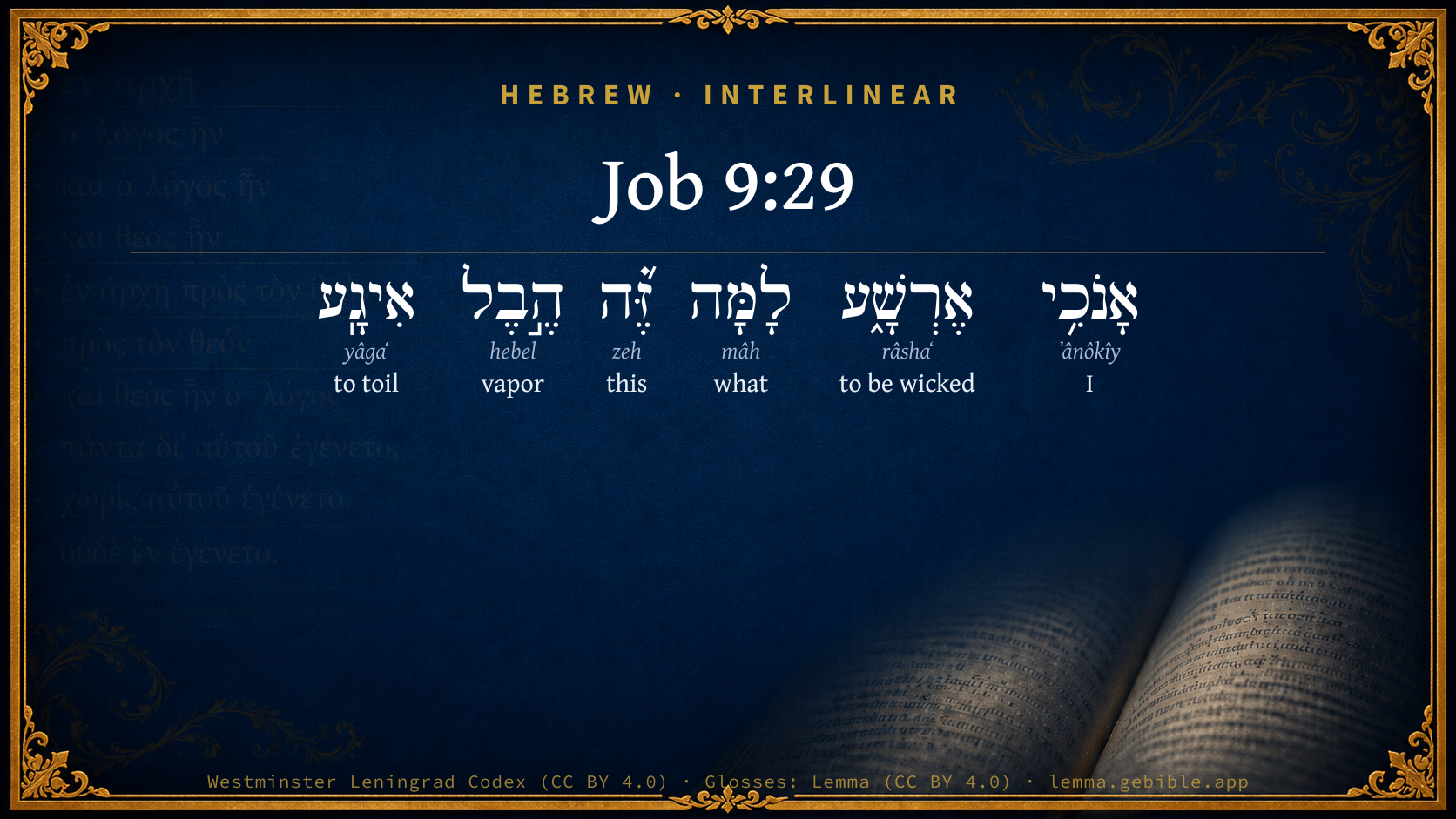
Job 9:29

Hebrew (Westminster Leningrad Codex) Job 9:29 appears in the Hebrew Old Testament. The text above is from the Westminster Leningrad Codex. Each word links to its Strong’s number, a concise gloss, and parsing drawn from the Open Scriptures Hebrew Bible morphology. Click any word for its full Brown-Driver-Briggs (BDB) entry.
Download image
Cite this verse

Job 9:29 (World English Bible). Public Domain. Lemma interlinear Bible study tool, https://lemma.gebible.app/v/job/9/29.

Show BibTeX & RIS
BibTeX
RIS
English Translation
I shall be condemned; Why then do I labor in vain?
World English Bible · Public Domain
Download a study sheet

One document with this verse’s original text, its word-by-word gloss line, the meaning frame, cross-references with their text, attributed commentary, and full source and license credits — printable, and it pastes into notes with its structure intact.

This verse Autodidact and up

Study sheet (.html) Plain text (.txt)

A passage Seminary Student

Up to 50 verses in one chapter. A passage sheet keeps up to 6 commentary sources and 12 cross-references per verse, in the order this page ranks them, and says so on the sheet whenever that leaves anything out. Ask for a single verse and you get the Autodidact verse sheet above.

Everything on this page stays free to read, with no account — the sheet is a download of what is already on screen, not access to it.

Want to remove ads? Support Godless Engineer
Compare translations 3

The same verse in 3 English versions, stacked beneath the original-language interlinear above. Click any original word for its lexicon entry.

Each is an independent rendering of the whole verse — the interlinear is not word-aligned to these translations.

Highlighted words mark where these versions differ — a whole-verse word diff, not a word-by-word alignment.

  • World English Bible Public Domain
    I shall be condemned; Why then do I labor in vain?
  • King James Version Public Domain
    If I be wicked, why then labour I in vain?
  • unfoldingWord Literal Text CC BY-SA 4.0
    I am wicked; why, then, would I toil in vain?

unfoldingWord Literal Text — © unfoldingWord, licensed CC BY-SA 4.0. Word-aligned USFM3 via Door43 (git.door43.org/unfoldingWord/en_ult).

Versions to compare (up to 4)

3 of 4 selected

Show all 18 translations

Every available English version of this verse, each an independent rendering of the whole verse.

  • World English Bible Public Domain
    I shall be condemned; Why then do I labor in vain?
  • Berean Standard Bible Public Domain
    Since I am already found guilty, why should I labor in vain?
  • Majority Standard Bible Public Domain
    Since I am already found guilty, why should I labor in vain?
  • King James Version Public Domain
    If I be wicked, why then labour I in vain?
  • American Standard Version (1901) Public Domain
    I shall be condemned; Why then do I labor in vain?
  • Revised Version (1885) Public Domain
    I shall be condemned; why then do I labour in vain?
  • Geneva Bible (1599) Public Domain
    If I be wicked, why labour I thus in vaine?
  • Douay-Rheims (1899) Public Domain
    But if so also I am wicked, why have I laboured in vain?
  • Young's Literal Translation Public Domain
    I -- I am become wicked; why `is' this? `In' vain I labour.
  • Literal Standard Version CC BY-SA 4.0
    I become wicked; why [is] this? I labor [in] vain.
  • Unlocked Literal Bible CC BY-SA 4.0
    I will be condemned; why, then, should I try in vain?
  • unfoldingWord Literal Text CC BY-SA 4.0
    I am wicked; why, then, would I toil in vain?
  • Darby Bible Public Domain
    Be it that I am wicked, why then do I labour in vain?
  • World Messianic Bible Public Domain
    I will be condemned. Why then do I labor in vain?
  • Webster's Bible Public Domain
    If I am wicked, why then do I labor in vain?
  • Free Bible Version CC BY-SA 4.0
    Since I'm condemned, what's the point in arguing?
  • Bible in Basic English Public Domain
    You will not let me be clear of sin! why then do I take trouble for nothing?
  • JPS Tanakh (1917) Public Domain
    I shall be condemned; why then do I labour in vain?

Literal Standard Version (2020), Covenant Press — licensed CC BY-SA 4.0. Text via the HelloAO Bible API (eBible.org). Unlocked Literal Bible (unfoldingWord) — licensed CC BY-SA 4.0. Text via the HelloAO Bible API (eBible.org). unfoldingWord Literal Text — © unfoldingWord, licensed CC BY-SA 4.0. Word-aligned USFM3 via Door43 (git.door43.org/unfoldingWord/en_ult). Free Bible Version, Dr. Jonathan Gallagher — licensed CC BY-SA 4.0. Text via the HelloAO Bible API (eBible.org).

Word by word

More ways to search: Search by grammar → Find every occurrence → Compare this word →

Practice this passage: Drill this verse → Learn its vocabulary →

About this verse

These counts appear in no published source. They are computed here, from the morphology-tagged text and Lemma’s own curated glosses. What Lemma adds →

6
words
6
distinct lemmas
Wisdom
section

Shared distinctive vocabulary

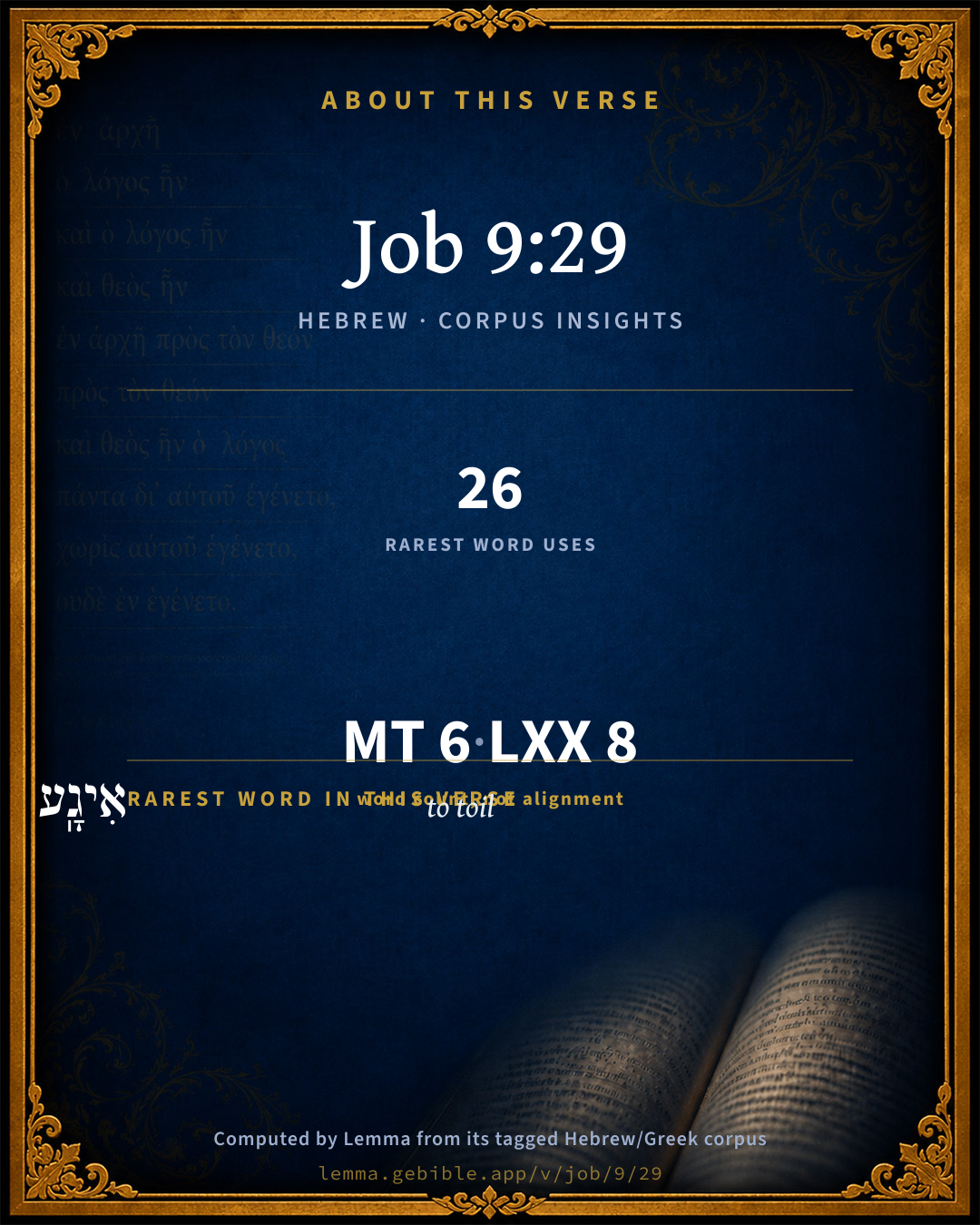
אִיגָֽע to toil H3021 occurs in 25 verses of the Hebrew Bible. Also found in:

Grammatical profile

  • 2 verbs
  • 1 noun
  • 2 pronouns
  • 1 particle

Verb forms

  • אֶרְשָׁ֑ע Qal · Imperfect
  • אִיגָֽע Qal · Imperfect

Hebrew & Septuagint length

In English translation the verse runs 11 words from the Hebrew and 10 from the Septuagint (LXX English) — closely comparable.

A rough comparison of the two English renderings, which tokenize alike — not a word-level alignment.

Word counts can differ between the Hebrew and the Greek without any difference in meaning — e.g. the Hebrew direct-object marker אֵת has no separate Greek word, and Greek often adds the article ὁ.

In the original languages it is 6 Hebrew tokens and 8 Greek tokens — but the two are counted differently (Hebrew bundles its prefixes and suffixes into one token; the Greek is in lemma form), so that isn’t a like-for-like length.

Cross-references

10

Topical passages linked to Job 9:29 in the Treasury of Scripture Knowledge — connected by theme and wording, ordered by reader-vote popularity; previews shown in the World English Bible.

  • Job 10:7 Although you know that I am not wicked, There is no one who can deliver out of your hand.
  • Job 9:22 "It is all the same. Therefore I say, He destroys the blameless and the wicked.
  • Job 10:2 I will tell God, 'Do not condemn me, Show me why you contend with me.
  • Job 10:14–17 If I sin, then you mark me. You will not acquit me from my iniquity.
  • Job 21:16–17 Behold, their prosperity is not in their hand: The counsel of the wicked is far from me.
  • Job 21:27 "Behold, I know your thoughts, The devices with which you would wrong me.
  • Job 22:5–30 Isn't your wickedness great? Neither is there any end to your iniquities.
  • Psalms 37:33 Yahweh will not leave him in his hand, Nor condemn him when he is judged.
  • Psalms 73:13 Surely in vain I have cleansed my heart, And washed my hands in innocence,
  • Jeremiah 2:35 Yet you said, I am innocent; surely his anger is turned away from me. Behold, I will enter into judgment with you, because you say, I have not sinned.

Cross-references courtesy of OpenBible.info (CC BY 4.0).

Hebrew and Greek witnesses Masoretic Hebrew ↔ Greek Septuagint

The same verse in the two great witnesses to the Old Testament, shown verse-for-verse.

These are two independent witnesses, not word-aligned to each other, and the Septuagint is shown in lemma (dictionary) form.

Hebrew Job 9:29 Masoretic · Westminster Leningrad Codex

אָנֹכִ֥י אֶרְשָׁ֑ע לָמָּה זֶּ֝֗ה הֶ֣בֶל אִיגָֽע

I shall be condemned; Why then do I labor in vain?

World English Bible · Public Domain

Greek LXX Job 9:29 Septuagint · lemma form

ἐπειδή δέ εἰμί ἀσεβής διά τίς οὐ ἀποθνήσκω

But since I am ungodly, why have I not died?

LXX2012 (modern English Septuagint) · Public Domain

On this verse, Haydock's Catholic Bible Commentary discusses the Septuagint’s reading. Read the note in Commentary ↓

Hebrew: Westminster Leningrad Codex (CC BY 4.0). Greek: Septuagint (public domain); English from LXX2012 (modern English Septuagint) (Public Domain). How the Septuagint differs from the Hebrew →

Commentary

Notes on Job 9:29 from classic Christian and Jewish commentators (each source and its license shown beneath its notes). The classic Christian expositions comment on the surrounding passage and are grouped to its opening verse, so a note may address several verses; the Jewish commentaries on the Tanakh (Rashi and others) are per-verse, so they appear only where the commentator wrote on this verse.

Lemma curates 59 commentaries, every one of them public domain or Creative Commons licensed, each selected and text-cleaned for this edition rather than reprinted as found. About our sources →

Trapp's Complete Commentary

John Trapp

Job 9:29 [If] I be wicked, why then labour I in vain?

Ver. 29. If I be wicked] Heb. I am wicked, sc. in your thoughts, and you have so earnestly and effectually affirmed it, and confirmed it, that I am almost ready to say as you say, I am wicked. Plato brings in Socrates in his apology to the judges, thus bespeaking them, My lords, I know not how you have been affected with mine accusers’ eloquence while you heard them speak; for mine own part, I assure you that I, whom it toucheth most, was almost drawn to believe that all they said, though against myself, was true, when they scarcely uttered one word of truth. The Chaldee paraphrase reads it, I shall be culpable, or, I shall be condemned.

Why then labour I in vain?] Or, for nothing, as the Chaldee hath it. See the like Psa 73:13-14. Why put I myself to so much fruitless pains, either in praying to God, or apologizing to you, my friends, since by God I am still afflicted, and by you reputed a wicked person? Job’s hope was low, his endeavour was therefore little. Si nihil sperarem, nihil orarem, saith one. Let us pray on. God sometimes defers to come till men have even left looking for him, till he scarce findeth faith upon earth, Luk 18:8.

John Trapp, A Commentary or Exposition upon All the Books of the Old and New Testament (1647–1656) — public domain. Text from a community e-Sword module.

Joseph Benson's Commentary

Job 9:29. If I be wicked, &c. — The Hebrew, אנכי ארשׁעanochi ershang, is, I am, or, I shall be wicked, or guilty, without any supposition. That is, Whether I be holy or wicked, if I dispute with thee I shall be found guilty; or, I shall be treated as guilty; I shall not be acquitted, or exempted from punishment. Why then labour I in vain? — Since my friends will still continue to think and treat me as wicked, and thou wilt still continue to afflict me with the calamities and miseries which gave them occasion to think so, why should I use any efforts to clear myself, and vindicate my innocence? Why should I speak in a cause that is already prejudged? Or, why should I comfort myself with vain hopes of deliverance? With men it is often labour in vain for the most innocent to go about to clear themselves: they will be adjudged guilty, though the evidence be ever so plain for them. But it is not so in our dealings with God, who is the patron of oppressed innocence, and to whom it was never in vain to commit a righteous cause.

Joseph Benson's Commentary on the Old and New Testaments (1811–1818) — public domain. Text from a community e-Sword module.

Whedon's Commentary on the Bible

Daniel D. Whedon

Strophe b — Job is divinely judged to be guilty; all efforts to free himself from guilt will therefore be futile, Job_9:29-31.

29. If I be wicked — I, I am to be held guilty. Literally, I shall be guilty.

Omit if. There is no escape from the divine determination.

Daniel D. Whedon (gen. ed.), Commentary on the Old and New Testaments (1874–1909) — public domain. Text from a community e-Sword module.

Geneva Bible (1599)

Geneva Bible translators

Why doth not God destroy me at once? thus he speaketh according to the infirmity of the flesh.

Geneva Bible (1599) marginal notes — public domain. Text via Bolls.life.

Jamieson, Fausset & Brown

Robert Jamieson, A. R. Fausset & David Brown

The "if" is better omitted; I (am treated by God as) wicked; why then labor I in vain (to disprove His charge)? Job submits, not so much because he is convinced that God is right, as because God is powerful and he weak [BARNES].

Jamieson, Fausset & Brown — Commentary Critical and Explanatory on the Whole Bible (1871) — public domain (CC PDM 1.0). Text via the HelloAO Bible API.

Adam Clarke's Commentary

Verse 29. If I be wicked] If I am the sinner you suppose me to be, in vain should I labour to counterfeit joy, and cease to complain of my sufferings.

Adam Clarke's Commentary on the Bible (1810–1826) — public domain. Text from a community e-Sword/MySword module.

The Cambridge Bible for Schools and Colleges

gen. ed. J. J. S. Perowne

29. if I be wicked] Rather, I shall be guilty, that is, I have to be, shall be held, guilty; God has resolved so to consider me. Everywhere in these verses guilt and afflictions mean the same thing, the one being the sign of the other.

The Cambridge Bible for Schools and Colleges (gen. ed. J. J. S. Perowne; Cambridge University Press, 1878–1918) — public domain. Text from a community e-Sword module.

John Gill's Exposition

If I wash myself with snow water,.... As it came from heaven, or flowed from the mountains covered with snow, as Lebanon, see Jer 18:14; or was kept in vessels for such use, as being judged the best for such a purpose; so it was used by the ancients (n), as being what whitens the skin, and strengthens the parts by contracting the pores, and hindering perspiration; it signifies, in a figurative sense, that let him take what methods he would to cleanse himself from sin, they were all in vain, his iniquity would be seen, and remain marked before God; and indeed there is nothing that a man can do that will make him pure and clean in the sight of an holy God; this is not to be done by ceremonial ablutions, such as might be in use in Job's time, before the law of Moses was given, and to which he may have some reference; these only sanctified to the purifying of the flesh, or only externally, but could not purify the heart, so as to have no more conscience of sin; nor by moral duties, not by repentance, as Sephorno; a fountain, a flood, an ocean of tears of humiliation and repentance, would not wash away sin; if, instead of ten thousand rivers of oil, so many rivers of brinish tears could be produced, they would be of no avail to cleanse the sinner; nor any works of righteousness done by man, for these themselves need washing in the blood of the Lamb; for nothing short of the blood of Christ, and the grace of God, can do it:

and make my hands never so clean; the hands are what men work with, Ecc 9:10; and so may design good works, which are sometimes called clean hands; see Psa 24:4; compared with Psa 15:1; and may be said to be so when they are done well, from a pare heart, and faith unfeigned, without selfish and sordid views, with a single eye to the glory of God; which is doing them as well, and making the hands as clean, as well can be; yet these are of no avail with respect to justification before God, and acceptance with him, or with regard to salvation, which is all of grace, and not of works, be they what they will; some render the words, "and cleanse my hands with soap" (o), which cleanses them best of anything, see Jer 2:22.

(n) "Discubuimus, pueris aquam nivalem in manus infundentibus", Petronius in Satyr. (o) Smegmate, Codurcus, Junius & Tremellius, Piscator, Schmidt; so the Targum, and Mr. Broughton.

John Gill's Exposition of the Whole Bible (1746–1763) — public domain (CC PDM 1.0). Text via the HelloAO Bible API.

Albert Barnes' Notes on the Bible

If I be wicked, why then labour I in vain? - The word “if,” here introduced by our translators, greatly obscures the sense. The meaning evidently is, “I am held to be guilty, and cannot answer to that charge. God regards me as such, and if I should attempt to meet him on the charge, it would be a vain attempt; and I must admit its truth. It would be labor in vain to deny it against one so mighty as he is.” This interpretation accords with the argument in the whole chapter. Job maintains that it would be in vain to contend with God, and he gives up the argument in despair. It is quite evident, however, that he does not do it so much because he is convinced himself, as because he knows that God is great, and that it would be useless to contend with him. There is evidently implied all along the feeling that if he was able to cope with God in the argument, the result would be different. As it is, he submits - not because he is convinced, but because he is weak; not because he sees that God is right, but because he sees that he is powerful. How much submission of this kind is there in the world - submision, not to right, but to power; submission to God, not because he is seen to be wise and good, but because he is seen to be almighty, and it is vain to attempt to oppose him! It is needless to say that such feelings evince no true submission.

Albert Barnes' Notes on the Bible (1834–1885) — public domain. Text from a community e-Sword/MySword module.

Haydock's Catholic Bible Commentary

Vain. Why have I endeavoured to repress my grief in silence? God does not forbid us to complain, but only to murmur. (Calmet) --- Septuagint, "Since I am wicked, why did I not die?" (Haydock) --- Should a wretch be even suffered to live" (St. Chrysostom)

George Leo Haydock (1774–1849), Haydock's Catholic Family Bible and Commentary, 1859 edition — public domain. Excludes Psalms (Douay-Rheims chapter numbering differs from Protestant) and Deuterocanonical books (Catholic canon only).

Matthew Poole's English Annotations

Heb. I shall be wicked, or guilty, to wit, before thee. Whether I be holy or wicked, if I dispute with thee, I shall be found guilty. Or thus, I shall be used like a wicked man, and punished as such. So this is opposed to his not being held innocent, Job 9:28, i.e. not being acquitted or exempt from punishment. Why then should I not indulge my griefs, but restrain them? Why should I comfort myself with vain hopes of deliverance, as thou advisest me, Job 8:6; or seek to God, as I was directed, Job 5:8, for that ease which I see he is resolved not to give me? Why should I trouble myself with clearing mine innocency, seeing God will still hold me guilty?

Matthew Poole's English Annotations on the Holy Bible (1683–1685) — public domain. Text from a community e-Sword/MySword module.

The Pulpit Commentary

If I be wicked; rather, I am wicked; i.e. I am accounted so I am already condemned. The extreme afflictions raider which I suffer indicate that God has passed sentence upon me, and awarded me my punishment. Why then labour I in vain? i.e. Why argue? Why seek to justify myself, since no result is likely to follow? Nothing that I can say will alter God"s foregone conclusion.

The Pulpit Commentary (1880–1919), ed. H.D.M. Spence-Jones & Joseph S. Exell — public domain. Text from a community e-Sword module.

John Wesley's Explanatory Notes

I shall - I shall be used like a wicked man still. Why - Why then should I comfort myself with vain hopes of deliverance, as thou advisest me.

John Wesley, Explanatory Notes Upon the Whole Bible (1754–1765) — public domain. Text via the GEBible commentary corpus.

Keil & Delitzsch

C. F. Keil & F. Delitzsch

29 If I am wicked, why do I exert myself in vain?

30 If I should wash myself with snow water,

And make my hands clean with lye,

31 Then thou wouldst plunge me into the pit,

And my clothes would abhor me.

32 For He is not a man as I, that I should answer Him,

That we should go together to judgment.

33 There is not an arbitrator between us

Who should lay his hand upon us both.

The clause with strongly accented "I" affirms that in relation to God is from the first, and unchangeably, a wicked, i.e., guilty, man (Psa 109:7) (רשׁע, to be a wicked man, means either to act as such Job 10:15, or to appear as such, be accounted as such, as here and Job 10:7; Hiph., Job 9:20, to condemn). Why, therefore, should he vainly (הבל, acc. adv., like breath, useless) exert himself by crying for help, and basing his plaint on his innocence? In Job 9:30 the Chethib is במו, the Keri במי, as the reverse in Isa 25:10; mo itself appears in the signification water (Egyptian muau), in the proper names Moab and Moshe (according to Jablonsky, ex aqua servatus); in במו, however, the mo may be understood according to Ges. 103, 2. This is the meaning - no cleansing, even though he should use snow and בּר (a vegetable alkali), i.e., not even the best-grounded self-justification can avail him, for God would still bring it to pass, that his clearly proved innocence should change to the most horrible impurity. Ewald, Rdiger, and others translate incorrectly: my clothes would make me disgusting. The idea is tame. The Piel תּעב signifies elsewhere in the book (Job 19:19; Job 30:10) to abhor, not to make abhorrent; and the causative meaning is indeed questionable, for מתעב (Isa 49:7) signifies loathing, as מכסּה (Job 23:17) covering, and Eze 16:25 certainly borders on the signification "to make detestable," but תעב may also be in the primary meaning, abominari, the strongest expression for that contempt of the beauty bestowed by God which manifests itself by prostitution. Translate: My clothes would abhor me; which does not mean: I should be disgusted with myself (Hirzel); Job is rather represented as naked; him, the naked one, God would - says he - so plunge into the pit that his clothes would conceive a horror of him, i.e., start back in terror at the idea of being put on and defiled by such a horrible creature (Schlottm., Oehler). For God is not his equal, standing on the same level with him: He, the Absolute Being, is accuser and judge in one person; there is between them no arbitrator who (or that he) should lay, etc. Mercier correctly explains: impositio manus est potestatis signum; the meaning therefore is: qui utrumque nostrum velut manu imposita coerceat.

Keil & Delitzsch — Biblical Commentary on the Old Testament (1861–1891) — public domain (CC PDM 1.0). Text via the HelloAO Bible API. (Old Testament only.)

Rashi

Rabbi Shlomo Yitzchaki (Rashi)

why should I toil in vain to come to judgment?

Rashi on the Tanakh — English translations: “The Judaica Press complete Tanach with Rashi, translated by A. J. Rosenberg” (CC BY 4.0); “Pentateuch with Rashi's commentary by M. Rosenbaum and A.M. Silbermann, 1929-1934” (public domain); “The Metsudah Tanach series, Lakewood, N.J” (CC BY 4.0); and “The Book of Joshua, Metsudah Publications, 1997” (CC BY 4.0). Text via Sefaria.

Lesson kit

Teaching starters — assembled from the data on this page, not authored interpretation. Every prompt links to the verse data it draws on. Edit before teaching.

Job, in the Wisdom, opens this verse with 6 words (6 distinct Hebrew lemmas). Its most distinctive word is yâgaʻ (“to toil”). A historical commentator’s framing appears above. Read the whole chapter for the surrounding context.

Discussion questions

  1. The word yâgaʻ carries the sense “to toil.” How does it shape the verse?
  2. How does Joshua 7:3, which shares the word «to toil», read alongside this verse?
  3. These translations render this verse differently. What is at stake in choosing one wording over another?
  4. «אֶרְשָׁ֑ע» is a Qal Imperfect verb. How does that grammatical form shape the action described?
  5. Compare how Trapp's Complete Commentary and Joseph Benson's Commentary read this verse. Where do they agree or differ?

Things to notice

Reading settings

Reading text

Shown beneath each verse's original-language words.

Old Testament
Old Testament edition

Read the OT as the Masoretic Hebrew (MT) or the Greek Septuagint (LXX).

English shown for the Greek Septuagint (in the Hebrew ↔ Greek comparison).

Comparing translations? Open the Compare panel on any verse page to stack up to four side by side.