
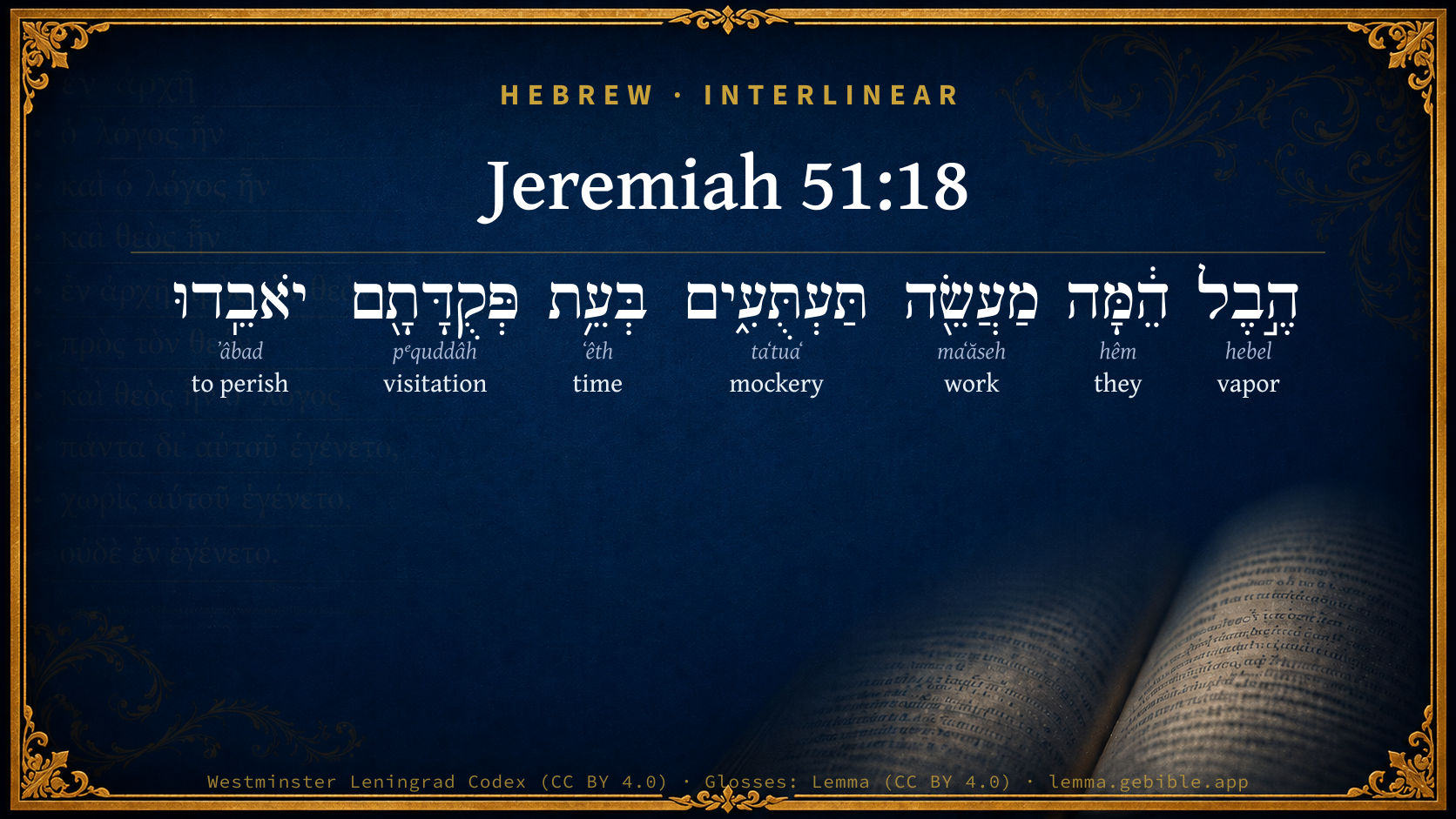
Jeremiah 51:18

Hebrew (Westminster Leningrad Codex) Jeremiah 51:18 appears in the Hebrew Old Testament. The text above is from the Westminster Leningrad Codex. Each word links to its Strong’s number, a concise gloss, and parsing drawn from the Open Scriptures Hebrew Bible morphology. Click any word for its full Brown-Driver-Briggs (BDB) entry.
Download image
Cite this verse

Jeremiah 51:18 (World English Bible). Public Domain. Lemma interlinear Bible study tool, https://lemma.gebible.app/v/jeremiah/51/18.

Show BibTeX & RIS
BibTeX
RIS
English Translation
They are vanity, a work of delusion: in the time of their visitation they shall perish.
World English Bible · Public Domain
Download a study sheet

One document with this verse’s original text, its word-by-word gloss line, the meaning frame, cross-references with their text, attributed commentary, and full source and license credits — printable, and it pastes into notes with its structure intact.

This verse Autodidact and up

Study sheet (.html) Plain text (.txt)

A passage Seminary Student

Up to 50 verses in one chapter. A passage sheet keeps up to 6 commentary sources and 12 cross-references per verse, in the order this page ranks them, and says so on the sheet whenever that leaves anything out. Ask for a single verse and you get the Autodidact verse sheet above.

Everything on this page stays free to read, with no account — the sheet is a download of what is already on screen, not access to it.

Want to remove ads? Support Godless Engineer
Compare translations 3

The same verse in 3 English versions, stacked beneath the original-language interlinear above. Click any original word for its lexicon entry.

Each is an independent rendering of the whole verse — the interlinear is not word-aligned to these translations.

Highlighted words mark where these versions differ — a whole-verse word diff, not a word-by-word alignment.

  • World English Bible Public Domain
    They are vanity, a work of delusion: in the time of their visitation they shall perish.
  • King James Version Public Domain
    They are vanity, the work of errors: in the time of their visitation they shall perish.
  • unfoldingWord Literal Text CC BY-SA 4.0
    They are useless, the work of mockers; they will perish at the time of their punishment.

unfoldingWord Literal Text — © unfoldingWord, licensed CC BY-SA 4.0. Word-aligned USFM3 via Door43 (git.door43.org/unfoldingWord/en_ult).

Versions to compare (up to 4)

3 of 4 selected

Show all 18 translations

Every available English version of this verse, each an independent rendering of the whole verse.

  • World English Bible Public Domain
    They are vanity, a work of delusion: in the time of their visitation they shall perish.
  • Berean Standard Bible Public Domain
    They are worthless, a work to be mocked. In the time of their punishment they will perish.
  • Majority Standard Bible Public Domain
    They are worthless, a work to be mocked. In the time of their punishment they will perish.
  • King James Version Public Domain
    They are vanity, the work of errors: in the time of their visitation they shall perish.
  • American Standard Version (1901) Public Domain
    They are vanity, a work of delusion: in the time of their visitation they shall perish.
  • Revised Version (1885) Public Domain
    They are vanity, a work of delusion: in the time of their visitation they shall perish.
  • Geneva Bible (1599) Public Domain
    They are vanitie, and the worke of errours: in the time of their visitation they shall perish.
  • Douay-Rheims (1899) Public Domain
    They are vain works, and worthy to be laughed at, in the time of their visitation they shall perish.
  • Young's Literal Translation Public Domain
    Vanity `are' they -- work of errors, In the time of their inspection they perish.
  • Literal Standard Version CC BY-SA 4.0
    They [are] vanity—a work of errors, || They perish in the time of their inspection.
  • Unlocked Literal Bible CC BY-SA 4.0
    They are useless, the work of mockers; they will perish at the time of their punishment.
  • unfoldingWord Literal Text CC BY-SA 4.0
    They are useless, the work of mockers; they will perish at the time of their punishment.
  • Darby Bible Public Domain
    They are vanity, a work of delusion: in the time of their visitation they shall perish.
  • World Messianic Bible Public Domain
    They are vanity, a work of delusion. In the time of their visitation, they will perish.
  • Webster's Bible Public Domain
    They are vanity, the work of errors: in the time of their visitation they shall perish.
  • Free Bible Version CC BY-SA 4.0
    They are useless, an object to be laughed at. They will be destroyed at the time of their punishment.
  • Bible in Basic English Public Domain
    They are nothing, a work of error: in the time of their punishment, destruction will overtake them.
  • JPS Tanakh (1917) Public Domain
    They are vanity, a work of delusion; in the time of their visitation they shall perish,

Literal Standard Version (2020), Covenant Press — licensed CC BY-SA 4.0. Text via the HelloAO Bible API (eBible.org). Unlocked Literal Bible (unfoldingWord) — licensed CC BY-SA 4.0. Text via the HelloAO Bible API (eBible.org). unfoldingWord Literal Text — © unfoldingWord, licensed CC BY-SA 4.0. Word-aligned USFM3 via Door43 (git.door43.org/unfoldingWord/en_ult). Free Bible Version, Dr. Jonathan Gallagher — licensed CC BY-SA 4.0. Text via the HelloAO Bible API (eBible.org).

Word by word

More ways to search: Search by grammar → Find every occurrence → Compare this word →

Practice this passage: Drill this verse → Learn its vocabulary →

About this verse

These counts appear in no published source. They are computed here, from the morphology-tagged text and Lemma’s own curated glosses. What Lemma adds →

7
words
7
distinct lemmas
Prophets
section

Notable vocabulary

The rarest word here is תַּעְתֻּעִ֑ים mockery H8595 — appearing just 2 times in the whole Hebrew Bible.

Shared distinctive vocabulary

תַּעְתֻּעִ֑ים mockery H8595 occurs in 2 verses of the Hebrew Bible. Also found in:

Grammatical profile

  • 1 verb
  • 5 nouns
  • 1 pronoun

Verb forms

  • יֹאבֵֽדוּ Qal · Imperfect

Cross-references

13

Topical passages linked to Jeremiah 51:18 in the Treasury of Scripture Knowledge — connected by theme and wording, ordered by reader-vote popularity; previews shown in the World English Bible.

  • Exodus 12:12 For I will go through the land of Egypt in that night, and will strike all the firstborn in the land of Egypt, both man and animal. Against all the gods of Egypt I will execute judgments: I am Yahweh.
  • Isaiah 19:1 The burden of Egypt. Behold, Yahweh rides on a swift cloud, and comes to Egypt: and the idols of Egypt shall tremble at his presence; and the heart of Egypt shall melt in the midst of it.
  • Isaiah 46:1 Bel bows down, Nebo stoops; their idols are on the animals, and on the cattle: the things that you carried about are made a load, a burden to the weary [animal].
  • Jeremiah 10:8 But they are together brutish and foolish: the instruction of idols! it is but a stock.
  • Jeremiah 10:15 They are vanity, a work of delusion: in the time of their visitation they shall perish.
  • Jeremiah 18:15 For my people have forgotten me, they have burned incense to false [gods]; and they have been made to stumble in their ways, in the ancient paths, to walk in byways, in a way not built up;
  • Jeremiah 43:12–13 I will kindle a fire in the houses of the gods of Egypt; and he shall burn them, and carry them away captive: and he shall array himself with the land of Egypt, as a shepherd puts on his garment; and he shall go forth from there in peace.
  • Jeremiah 46:25 Yahweh of Hosts, the God of Israel, says: Behold, I will punish Amon of No, and Pharaoh, and Egypt, with her gods, and her kings; even Pharaoh, and those who trust in him:
  • Jeremiah 48:7 For, because you have trusted in your works and in your treasures, you also shall be taken: and Chemosh shall go forth into captivity, his priests and his princes together.
  • Jeremiah 50:2 Declare you among the nations and publish, and set up a standard; publish, and don't conceal: say, Babylon is taken, Bel is disappointed, Merodach is dismayed; her images are disappointed, her idols are dismayed.
  • Jonah 2:8 Those who regard lying vanities forsake their own mercy.
  • Zephaniah 2:11 Yahweh will be awesome to them, for he will famish all the gods of the land. Men will worship him, everyone from his place, even all the shores of the nations.
  • Acts 14:15 "Men, why are you doing these things? We also are men of like passions with you, and bring you good news, that you should turn from these vain things to the living God, who made the sky and the earth and the sea, and all that is in them;

Cross-references courtesy of OpenBible.info (CC BY 4.0).

Hebrew and Greek witnesses Masoretic Hebrew ↔ Greek Septuagint

The same verse in the two great witnesses to the Old Testament, shown verse-for-verse.

These are two independent witnesses, not word-aligned to each other, and the Septuagint is shown in lemma (dictionary) form.

Hebrew Jeremiah 51:18 Masoretic · Westminster Leningrad Codex

הֶ֣בֶל הֵ֔מָּה מַעֲשֵׂ֖ה תַּעְתֻּעִ֑ים בְּעֵ֥ת פְּקֻדָּתָ֖ם יֹאבֵֽדוּ

They are vanity, a work of delusion: in the time of their visitation they shall perish.

World English Bible · Public Domain

Greek LXX Structure differs

In the Septuagint, Jeremiah is about an eighth shorter than the Hebrew and arranges its material differently — the Oracles Against the Nations (Hebrew chapters 46–51) appear in the middle of the Greek book, after 25:13. Because the chapter and verse boundaries do not line up, a verse-for-verse comparison with the Hebrew is not shown.

A verse-for-verse comparison isn’t shown here because the chapters and verses don’t line up. Switch to the LXX edition with the MT / LXX toggle above to read the Greek directly.

Hebrew: Westminster Leningrad Codex (CC BY 4.0). Greek: Septuagint (public domain); English from a public-domain English Septuagint. How the Septuagint differs from the Hebrew →

Targum (Aramaic paraphrase)

1

The Targum is the ancient Jewish Aramaic paraphrase of the Hebrew Scriptures — an interpretive translation, not the Hebrew text itself. Onkelos (literal) and Pseudo-Jonathan (expansive) render the Torah, and Jonathan the Prophets. Coverage is partial: where no permissively-licensed English translation exists for a verse, only the Aramaic is shown. This is verse-level text, not a word-by-word alignment to the Hebrew.

  1. Targum Jonathan Prophets (Joshua–Malachi)
    לְמָא אִינוּן עוֹבַד תּוּלְעֲבָא בְּעִדַן דְאַסְעַר עֲלֵיהוֹן חוֹבֵיהוֹן יֵיבְדוּן:

    (no public-domain English translation for this verse)

    Targum Jonathan — Aramaic: “Mikraot Gedolot” (public domain). English: “Sefaria Community Translation” (CC0 1.0 (public-domain dedication)); “London "Chaldee Paraphrase," 1871” (public domain). Text via Sefaria.

Commentary

Notes on Jeremiah 51:18 from classic Christian and Jewish commentators (each source and its license shown beneath its notes). The classic Christian expositions comment on the surrounding passage and are grouped to its opening verse, so a note may address several verses; the Jewish commentaries on the Tanakh (Rashi and others) are per-verse, so they appear only where the commentator wrote on this verse.

Lemma curates 59 commentaries, every one of them public domain or Creative Commons licensed, each selected and text-cleaned for this edition rather than reprinted as found. About our sources →

Trapp's Complete Commentary

John Trapp

Jer 51:18 They [are] vanity, the work of errors: in the time of their visitation they shall perish.

Ver. 18. They are vanity.] See Jer 10:15.

John Trapp, A Commentary or Exposition upon All the Books of the Old and New Testament (1647–1656) — public domain. Text from a community e-Sword module.

Geneva Bible (1599)

Geneva Bible translators

When God shall execute his vengeance.

Geneva Bible (1599) marginal notes — public domain. Text via Bolls.life.

John Calvin's Commentaries

As he had called idols a lie, so now in the same sense he declares that they were vanity, even because they were nothing real, but vain pomps, or phantoms, or masks; and he afterwards expresses himself more clearly by saying that they were the work of illusions But he does not seem to take the word תעתעים, toroim, in a passive but in an active sense. He then means that it was a deceptive work, which was a snare to men; as though he had said, that they were the work of imposture, or impostures.

This passage, and such as are like it, ought to be carefully noticed; because the Papists seem to themselves to find a way to escape when they confess their images are not to be worshipped, but that they are books for the unlearned. They who are moderate in their views have recourse to this evasion. This was once suggested by Gregory, but very foolishly; and they who wish to appear more enlightened than others under the papacy repeat the same saying, that images ought to be tolerated, because they are the books of the ignorant. But what does the Holy Spirit, on the other hand, declare here, and also by the Prophet Habakkuk? that they are the work of impostures, even mere snares or traps. (Habakkuk 2:18.) All, then, who seek instruction from statues or pictures gain nothing, but become entangled in the snares of Satan, and find nothing but impostures. And doubtless, whatever draws us away from the contemplation of the only true God, ought justly to be deemed an imposture or a deception; for who by the sight of a picture or a statue can form a right idea of the true God? Is not the truth respecting him thus turned into falsehood? and is not his glory thus debased? For we have then only the true knowledge of God, when we regard him to be God alone, when we ascribe to him an infinite essence which fills heaven and earth, when we acknowledge him to be a spirit, when, in short, we know that he alone, properly speaking, exists, and that heaven and earth, and everything they contain, exist through his power. Can a stone or wood teach us these things? No; but on the contrary, I am led by the stone to imagine that God is fixed and confined to a certain place. And then the life of God, does it appear in the stone or in the wood? Besides, what likeness has a body, and that lifeless, to an infinite spirit? It. is, then, not without reason that he complains, as it is recorded by Isaiah, that he is thus wholly degraded:

“To whom have ye made me like? for I contain the earth in my fist, and ye confine me to wood or stone.” (Isaiah 40:12, 18)

If, in a word, the minds of men received no other error from idols than the thought that God is corporeal, what can be more preposterous?

We hence see that the Prophet does not here say without cause, that all idols are vanity, and the work of imposture or deception.

He lastly adds, that all fictitious gods would perish at the time of visitation In this clause he exhorts the faithful to patience, and in a manner sustains their minds, that they might not despond; for it was not a small trial to see the monarchy of Babylon flourishing, when yet it had no other protection than that of idols. As, then, the Babylonians thought flint fictitious gods were the guardians and defenders of their safety, and that through them they had subdued all their neighbors, they became thus more and more addicted to their superstitions, the reward of which they regarded all their wealth and power. Inasmuch as the minds of the godly could not have been otherwise than shaken by such a trial, the Prophet here supports them, and reminds them to wait for the time of visitation when the idols were to perish. However, a reference may be intended to the Babylonians as well as to the idols, when he says, They shall perish at the time of their visitation, that is, when the Chaldeans shall be visited. But it is probable that the time of visitation refers here especially to idols, because the Prophet had spoken before of all the wicked and reprobate. However this may be, we understand that his object was to show that however prosperous idolaters might be for a time, yet the hand of God was to be patiently borne until the suitable time came, which is here called the time of visitation. And the metaphor refers to the notions of men, for we think that God dwells idly in heaven and turns away his eyes from us, while he spares the ungodly. Hence the Prophet calls the judgment of God a visitation, because he then shows really, by evident proofs, that he does not disregard the affairs of men. It now follows, —

John Calvin's Commentaries (1540-1563) — public domain. Text from the Calvin Translation Society English edition (1840s-50s) via the Christian Classics Ethereal Library (ccel.org). Calvin's coverage is partial (roughly two-thirds of the Bible); uncommented books and verses are honest gaps, never fabricated. The 19th-century editor's footnotes and remarks are omitted so the notes are faithfully Calvin's own voice.

John Gill's Exposition

Thou art my battle axe and weapons of war,.... This is said by the Lord, either to Cyrus, as some, to which our version inclines, whom God made use of as an instrument to subdue nations and kingdoms, and destroy them; see Isa 45:1; or rather Babylon, and the king of it, who had been the hammer of the earth, Jer 50:23; as it may be rendered here, "thou art my hammer" (s); or, "hast been"; an instrument in his hands, of beating the nations to pieces, as stones by a hammer, and of destroying them, as by weapons of war: this, and what follows, are observed to show, that though Babylon had been used by the Lord for the destruction of others, it should not be secure from it itself, but should share the same fate; unless this is to be understood of the church of God, and kingdom of Christ, which in the latter day will break in pieces all the kingdoms of the earth, Dan 2:44; which sense seems to have some countenance and confirmation from Jer 51:24 "in your sight". The Targum is,

"thou art a scatterer before me, a city in which are warlike arms;''

which seems to refer to Babylon:

for with thee will I break in pieces the nations, and with thee will I destroy kingdoms; or, "with thee I have broke in pieces, and have destroyed"; the future instead of the past (t); as the nations and kingdoms of Judea, Egypt, Edom, Moab, Ammon, and others: or, "that I may break in pieces" (u), &c. and so it expresses the end for which he was a hammer, as well as the use he had been or would be of.

(s) "malleus es, vel fuisti mihi", Pagninus, Piscator, Cocceius, Schmidt. (t) "Dispersi, perdidi", Lutherus; "conquassavi", Munster; "dissipavi", Piscator. (u) "ut dissiparem", Junius & Tremellius; "ut dispergam", Schmidt.

John Gill's Exposition of the Whole Bible (1746–1763) — public domain (CC PDM 1.0). Text via the HelloAO Bible API.

Rashi

Rabbi Shlomo Yitzchaki (Rashi)

at the time of their visitation When the Holy One, blessed be He, visits retribution upon them and upon their worshippers.

Rashi on the Tanakh — English translations: “The Judaica Press complete Tanach with Rashi, translated by A. J. Rosenberg” (CC BY 4.0); “Pentateuch with Rashi's commentary by M. Rosenbaum and A.M. Silbermann, 1929-1934” (public domain); “The Metsudah Tanach series, Lakewood, N.J” (CC BY 4.0); and “The Book of Joshua, Metsudah Publications, 1997” (CC BY 4.0). Text via Sefaria.

Lesson kit

Teaching starters — assembled from the data on this page, not authored interpretation. Every prompt links to the verse data it draws on. Edit before teaching.

Jeremiah, in the Prophets, opens this verse with 7 words (7 distinct Hebrew lemmas). Its most distinctive word is taʻtuaʻ (“mockery”). A historical commentator’s framing appears above. Read the whole chapter for the surrounding context.

Discussion questions

  1. What does “mockery” (taʻtuaʻ) contribute to the verse as a whole?
  2. Jeremiah 10:15 shares the word «mockery» with this verse. How do the two illuminate each other?
  3. The translations on this page render this verse differently — a whole-verse word diff, not a word-by-word alignment. What might account for the different wordings?
  4. The verb «יֹאבֵֽדוּ» is Qal Imperfect. How does its form color the action?
  5. Reading how Trapp's Complete Commentary and Geneva Bible (1599) read this verse, where do the two commentators agree and where do they part?

Things to notice

Reading settings

Reading text

Shown beneath each verse's original-language words.

Old Testament
Old Testament edition

Read the OT as the Masoretic Hebrew (MT) or the Greek Septuagint (LXX).

English shown for the Greek Septuagint (in the Hebrew ↔ Greek comparison).

Comparing translations? Open the Compare panel on any verse page to stack up to four side by side.