
Jeremiah 14:22

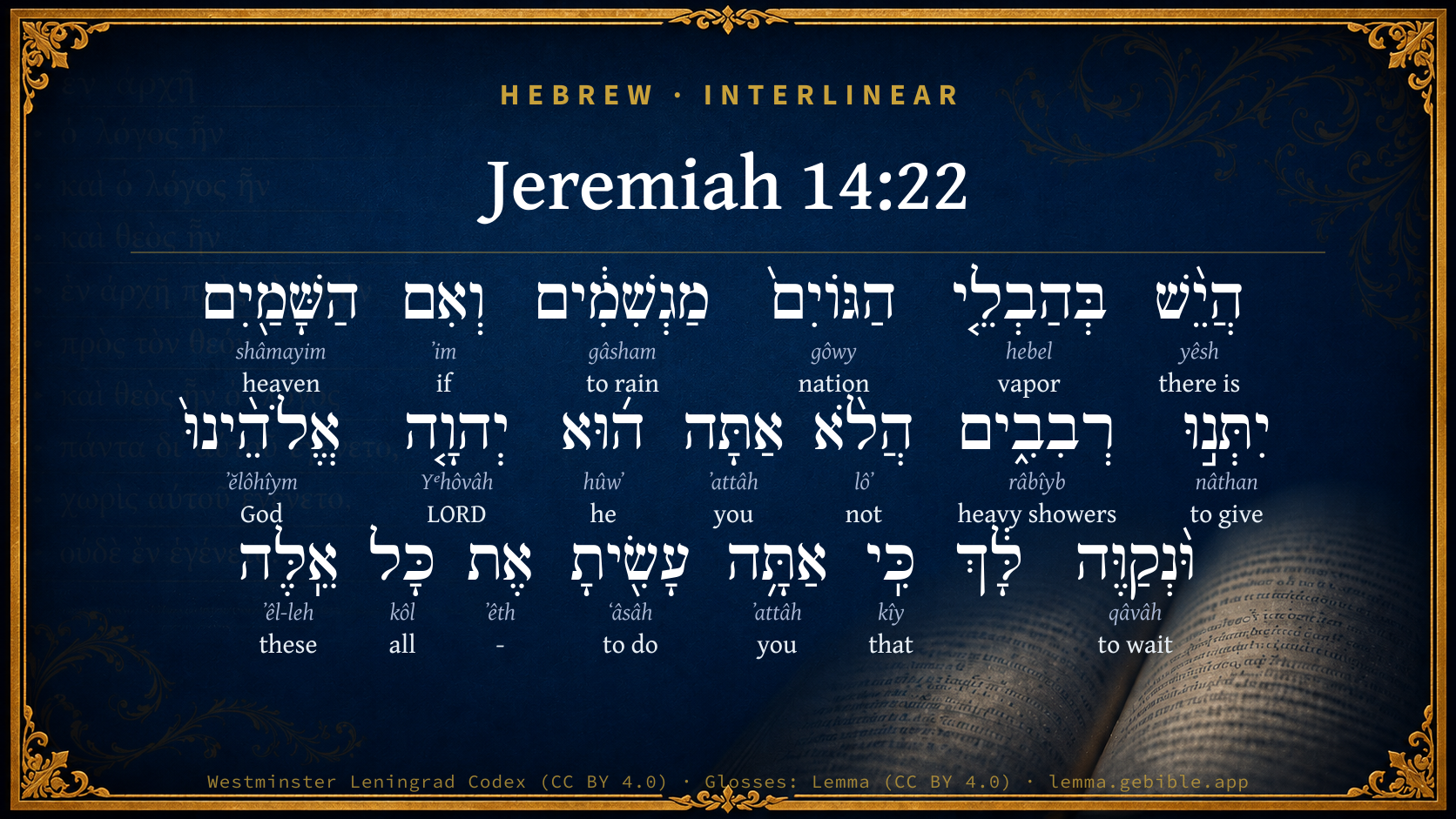
Hebrew (Westminster Leningrad Codex) Jeremiah 14:22 appears in the Hebrew Old Testament. The text above is from the Westminster Leningrad Codex. Each word links to its Strong’s number, a concise gloss, and parsing drawn from the Open Scriptures Hebrew Bible morphology. Click any word for its full Brown-Driver-Briggs (BDB) entry.
Download image
Cite this verse

Jeremiah 14:22 (World English Bible). Public Domain. Lemma interlinear Bible study tool, https://lemma.gebible.app/v/jeremiah/14/22.

Show BibTeX & RIS
BibTeX
RIS
English Translation
Are there any among the vanities of the nations that can cause rain? or can the sky give showers? Aren't you he, Yahweh our God? therefore we will wait for you; for you have made all these things.
World English Bible · Public Domain
Highlights
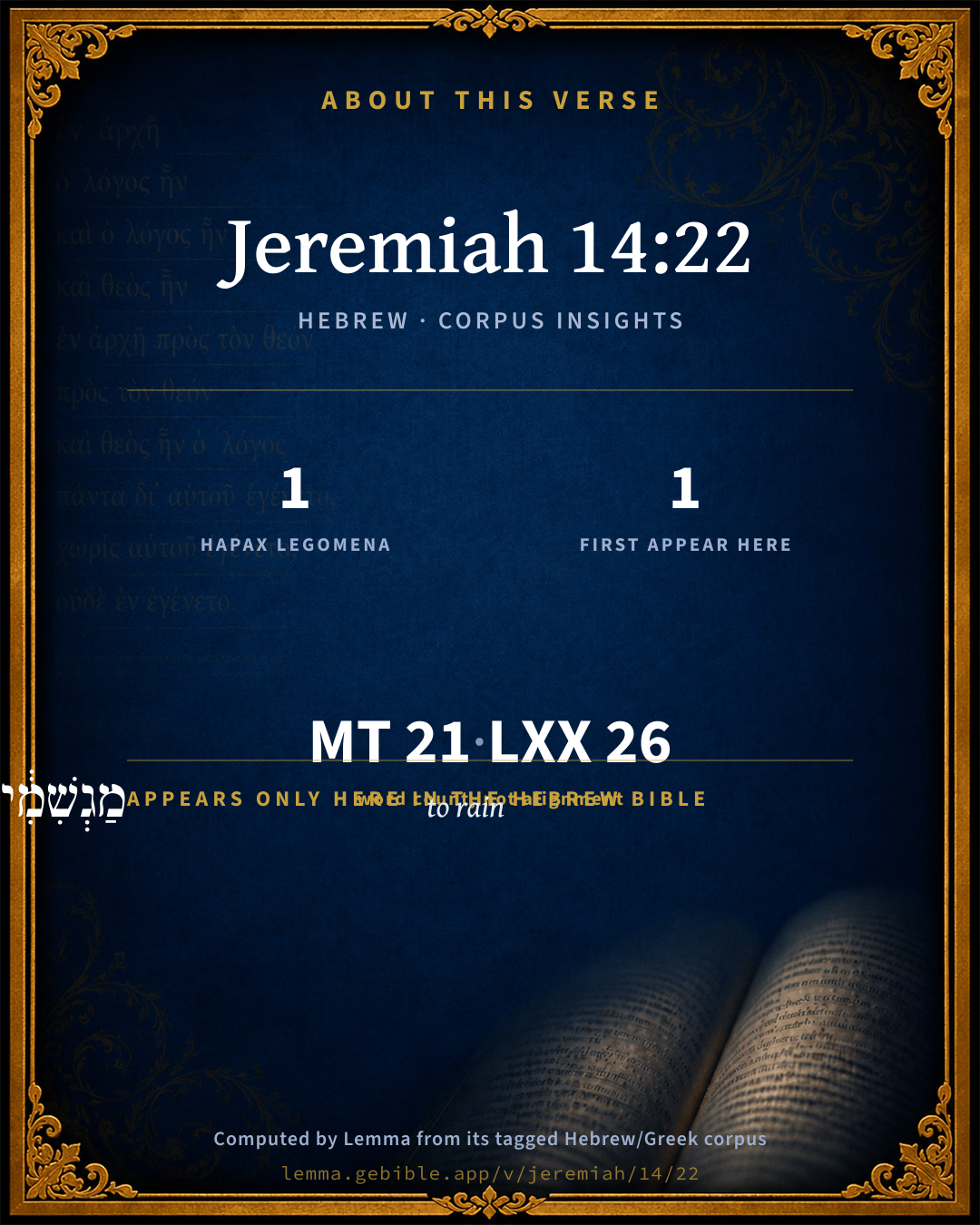
  • 1 hapax legomenon — only here in the Hebrew Bible
  • 1 first appearance in the Hebrew Bible
Full analysis ↓
Download a study sheet

One document with this verse’s original text, its word-by-word gloss line, the meaning frame, cross-references with their text, attributed commentary, and full source and license credits — printable, and it pastes into notes with its structure intact.

This verse Autodidact and up

Study sheet (.html) Plain text (.txt)

A passage Seminary Student

Up to 50 verses in one chapter. A passage sheet keeps up to 6 commentary sources and 12 cross-references per verse, in the order this page ranks them, and says so on the sheet whenever that leaves anything out. Ask for a single verse and you get the Autodidact verse sheet above.

Everything on this page stays free to read, with no account — the sheet is a download of what is already on screen, not access to it.

Want to remove ads? Support Godless Engineer
Compare translations 3

The same verse in 3 English versions, stacked beneath the original-language interlinear above. Click any original word for its lexicon entry.

Each is an independent rendering of the whole verse — the interlinear is not word-aligned to these translations.

Highlighted words mark where these versions differ — a whole-verse word diff, not a word-by-word alignment.

  • World English Bible Public Domain
    Are there any among the vanities of the nations that can cause rain? or can the sky give showers? Aren't you he, Yahweh our God? therefore we will wait for you; for you have made all these things.
  • King James Version Public Domain
    Are there any among the vanities of the Gentiles that can cause rain? or can the heavens give showers? art not thou he, O LORD our God? therefore we will wait upon thee: for thou hast made all these things.
  • unfoldingWord Literal Text CC BY-SA 4.0
    Are there any among the idols of the nations who can bring rain or can the heavens give showers? you not he, Yahweh our God? Therefore we will wait for you, since you have done all these.

unfoldingWord Literal Text — © unfoldingWord, licensed CC BY-SA 4.0. Word-aligned USFM3 via Door43 (git.door43.org/unfoldingWord/en_ult).

Versions to compare (up to 4)

3 of 4 selected

Show all 18 translations

Every available English version of this verse, each an independent rendering of the whole verse.

  • World English Bible Public Domain
    Are there any among the vanities of the nations that can cause rain? or can the sky give showers? Aren't you he, Yahweh our God? therefore we will wait for you; for you have made all these things.
  • Berean Standard Bible Public Domain
    Can the worthless idols of the nations bring rain? Do the skies alone send showers? Is this not by You, O LORD our God? So we put our hope in You, for You have done all these things.
  • Majority Standard Bible Public Domain
    Can the worthless idols of the nations bring rain? Do the skies alone send showers? Is this not by You, O LORD our God? So we put our hope in You, for You have done all these things.
  • King James Version Public Domain
    Are there any among the vanities of the Gentiles that can cause rain? or can the heavens give showers? art not thou he, O LORD our God? therefore we will wait upon thee: for thou hast made all these things.
  • American Standard Version (1901) Public Domain
    Are there any among the vanities of the nations that can cause rain? or can the heavens give showers? art not thou he, O Jehovah our God? therefore we will wait for thee; for thou hast made all these things.
  • Revised Version (1885) Public Domain
    Are there any among the vanities of the heathen that can cause rain? or can the heavens give showers? art not thou he, O LORD our God? therefore we will wait upon thee; for thou hast made all these things.
  • Geneva Bible (1599) Public Domain
    Are there any among the vanities of the Gentiles, that can giue raine? or can the heauens giue showres? is it not thou, O Lord our God? therefore we will waite vpon thee: for thou hast made all these things.
  • Douay-Rheims (1899) Public Domain
    Are there any among the graven things of the Gentiles that can send rain? or can the heavens give showers? art not thou the Lord our God, whom we have looked for? for thou hast made all these things.
  • Young's Literal Translation Public Domain
    Are there among the vanities of the nations any causing rain? And do the heavens give showers? Art not Thou He, O Jehovah our God? And we wait for thee, for Thou -- Thou hast done all these!
  • Literal Standard Version CC BY-SA 4.0
    Are there any among the vanities of the nations causing rain? And do the heavens give showers? Are You not He, O our God YHWH? And we wait for you, for You have done all these!
  • Unlocked Literal Bible CC BY-SA 4.0
    Do any of the worthless idols of the nations bring rain? Or can the skies themselves send down showers? Are you not the one, Yahweh our God? We wait for you, for you are the one who does all these things.
  • unfoldingWord Literal Text CC BY-SA 4.0
    Are there any among the idols of the nations who can bring rain or can the heavens give showers? you not he, Yahweh our God? Therefore we will wait for you, since you have done all these.
  • Darby Bible Public Domain
    Are there any among the vanities of the nations that can cause rain? or can the heavens give showers? Art not thou HE, Jehovah, our God? And we wait upon thee; for thou hast made all these things.
  • World Messianic Bible Public Domain
    Are there any among the vanities of the nations that can cause rain? Or can the sky give showers? Aren’t you he, the LORD our God? Therefore we will wait for you; for you have made all these things.
  • Webster's Bible Public Domain
    Are there any among the vanities of the Gentiles that can cause rain? or can the heavens give showers? art not thou he, O LORD our God? therefore we will wait upon thee: for thou hast made all these things.
  • Free Bible Version CC BY-SA 4.0
    Can the false gods of the other nations bring rain? Can the skies themselves send showers? No, it's you, Lord our God. So we put our hope in you, because only you can do all this.
  • Bible in Basic English Public Domain
    Are any of the false gods of the nations able to make rain come? are the heavens able to give showers? are you not he, O Lord our God? so we will go on waiting for you, for you have done all these things.
  • JPS Tanakh (1917) Public Domain
    Are there any among the vanities of the nations that can cause rain? or can the heavens give showers? Art not Thou He, O LORD our God, and do we not wait for Thee? For Thou hast made all these things.

Literal Standard Version (2020), Covenant Press — licensed CC BY-SA 4.0. Text via the HelloAO Bible API (eBible.org). Unlocked Literal Bible (unfoldingWord) — licensed CC BY-SA 4.0. Text via the HelloAO Bible API (eBible.org). unfoldingWord Literal Text — © unfoldingWord, licensed CC BY-SA 4.0. Word-aligned USFM3 via Door43 (git.door43.org/unfoldingWord/en_ult). Free Bible Version, Dr. Jonathan Gallagher — licensed CC BY-SA 4.0. Text via the HelloAO Bible API (eBible.org).

Word by word

More ways to search: Search by grammar → Find every occurrence → Compare this word →

Practice this passage: Drill this verse → Learn its vocabulary →

מַגְשִׁמִ֔ים
gâsham
H1652
“raining”
Verb, Hiphil, Participle Active, Masculine, Plural, Absolute
Part of Speech
Verb
Stem
Hiphil
Form
Participle Active
Gender
Masculine
Number
Plural
State
Absolute
Full BDB Definition

Origin: a primitive root

TWOT: 389

to rain - (Pual) to be rained on - (Hiphil) to cause rain, send rain
  1. הֲיֵ֨שׁ yêsh H3426 “there is” Particle, Interrogative + Particle, Demonstrative
  2. בְּהַבְלֵ֤י hebel H1892 “in/at · vanities of” Preposition + Noun, Common, Masculine, Plural, Construct
  3. הַגּוֹיִם֙ gôwy H1471 “the · nations” Particle, Definite Article + Noun, Common, Masculine, Plural, Absolute
  4. וְאִם ʼim H518 “and · if” Conjunction + Conjunction
  5. הַשָּׁמַ֖יִם shâmayim H8064 “the · heaven(s)” Particle, Definite Article + Noun, Common, Masculine, Plural, Absolute
  6. יִתְּנ֣וּ nâthan H5414 “to give” Verb, Qal, Imperfect, 3rd Person, Masculine, Plural
  7. רְבִבִ֑ים râbîyb H7241 “heavy showers” Noun, Common, Masculine, Plural, Absolute
  8. הֲלֹ֨א lôʼ H3808 “not” Particle, Interrogative + Particle, Negative
  9. אַתָּה ʼattâh H859 “you” Pronoun, Personal, 2nd Person, Masculine, Singular
  10. ה֜וּא hûwʼ H1931 “he” Pronoun, Personal, 3rd Person, Masculine, Singular
  11. יְהוָ֤ה Yᵉhôvâh H3068 “LORD” Noun, Proper
  12. אֱלֹהֵ֨ינוּ֙ ʼĕlôhîym H430 “God(s) · our” Noun, Common, Masculine, Plural, Construct + Suffix, Personal, 1st Person, Common, Plural
  13. וּ֨נְקַוֶּה qâvâh H6960 “and · to wait” Conjunction + Verb, Piel, Imperfect, 1st Person, Common, Plural
  14. כִּֽי kîy H3588 “that” Conjunction
  15. אַתָּ֥ה ʼattâh H859 “you” Pronoun, Personal, 2nd Person, Masculine, Singular
  16. עָשִׂ֖יתָ ʻâsâh H6213 “to do” Verb, Qal, Perfect, 2nd Person, Masculine, Singular
  17. אֶת ʼêth H853 “-” Particle, Direct Object
  18. כָּל kôl H3605 “all of” Noun, Common, Masculine, Singular, Construct
  19. אֵֽלֶּה ʼêl-leh H428 “these” Pronoun, Demonstrative, Common, Plural

About this verse

These counts appear in no published source. They are computed here, from the morphology-tagged text and Lemma’s own curated glosses. What Lemma adds →

21
words
19
distinct lemmas
Prophets
section

Notable vocabulary

1 hapax legomenon — a word that appears only here in the entire Hebrew Bible:

  • מַגְשִׁמִ֔ים to rain H1652

First appearance in Scripture

This word makes its first canonical appearance in the Hebrew Bible here:

  • מַגְשִׁמִ֔ים to rain H1652

Shared distinctive vocabulary

רְבִבִ֑ים heavy showers H7241 occurs in 6 verses of the Hebrew Bible. Also found in:

Grammatical profile

  • 4 verbs
  • 7 nouns
  • 4 pronouns
  • 1 preposition
  • 2 conjunctions
  • 3 particles

Verb forms

  • מַגְשִׁמִ֔ים Hiphil · Participle Active
  • יִתְּנ֣וּ Qal · Imperfect
  • וּ֨נְקַוֶּה Piel · Imperfect
  • עָשִׂ֖יתָ Qal · Perfect

Repetition

A word recurs within this verse — often emphatic in Hebrew:

  • אַתָּה you H859 ×2

Hebrew & Septuagint length

In the original languages it is 21 Hebrew tokens and 26 Greek tokens — but the two are counted differently (Hebrew bundles its prefixes and suffixes into one token; the Greek is in lemma form), so that isn’t a like-for-like length.

Cross-references

33

Topical passages linked to Jeremiah 14:22 in the Treasury of Scripture Knowledge — connected by theme and wording, ordered by reader-vote popularity; previews shown in the World English Bible.

  • Joel 2:23 "Be glad then, you children of Zion, And rejoice in Yahweh, your God; For he gives you the former rain in just measure, And he causes the rain to come down for you, The former rain and the latter rain, As before.
  • Jeremiah 5:24 Neither say they in their heart, Let us now fear Yahweh our God, who gives rain, both the former and the latter, in its season; who preserves to us the appointed weeks of the harvest.
  • Psalms 135:7 Who causes the clouds to rise from the ends of the earth; Who makes lightnings with the rain; Who brings forth the wind out of his treasuries;
  • Isaiah 30:23 He will give the rain for your seed, with which you shall sow the ground; and bread of the increase of the ground, and it shall be fat and plenteous. In that day shall your cattle feed in large pastures;
  • Deuteronomy 32:21 They have moved me to jealousy with that which is not God; They have provoked me to anger with their vanities: I will move them to jealousy with those who are not a people; I will provoke them to anger with a foolish nation.
  • Deuteronomy 28:12 Yahweh will open to you his good treasure in the sky, to give the rain of your land in its season, and to bless all the work of your hand: and you shall lend to many nations, and you shall not borrow.
  • 1 Kings 17:1 Elijah the Tishbite, who was of the foreigners of Gilead, said to Ahab, As Yahweh, the God of Israel, lives, before whom I stand, there shall not be dew nor rain these years, but according to my word.
  • 1 Kings 17:14 For thus says Yahweh, the God of Israel, The jar of meal shall not empty, neither shall the jar of oil fail, until the day that Yahweh sends rain on the earth.
  • Job 38:26–28 To cause it to rain on a land where no man is; On the wilderness, in which there is no man;
  • Psalms 25:21 Let integrity and uprightness preserve me, For I wait for you.
  • Psalms 130:5 I wait for Yahweh. My soul waits. I hope in his word.
  • Isaiah 41:29 Behold, all of them, their works are vanity [and] nothing; their molten images are wind and confusion.
  • Jeremiah 10:15 They are vanity, a work of delusion: in the time of their visitation they shall perish.
  • Jeremiah 16:19 Yahweh, my strength, and my stronghold, and my refuge in the day of affliction, to you shall the nations come from the ends of the earth, and shall say, Our fathers have inherited nothing but lies, [even] vanity and things in which there is no profit.
  • Jeremiah 51:16 when he utters his voice, there is a tumult of waters in the heavens, and he causes the vapors to ascend from the ends of the earth; he makes lightnings for the rain, and brings forth the wind out of his treasuries.
  • Zechariah 10:1–2 Ask of Yahweh rain in the spring time, Yahweh who makes storm clouds, And he gives rain showers to everyone for the plants in the field.
  • Lamentations 3:25–26 Yahweh is good to those who wait for him, to the soul that seeks him.
  • 1 Kings 8:36 then hear in heaven, and forgive the sin of your servants, and of your people Israel, when you teach them the good way in which they should walk; and send rain on your land, which you have given to your people for an inheritance.
  • 1 Kings 18:1 It happened after many days, that the word of Yahweh came to Elijah, in the third year, saying, Go, show yourself to Ahab; and I will send rain on the earth.
  • 1 Kings 18:39–45 When all the people saw it, they fell on their faces: and they said, Yahweh, he is God; Yahweh, he is God.
  • Job 5:10 Who gives rain on the earth, And sends waters on the fields;
  • Psalms 25:3 Yes, no one who waits for you shall be shamed. They shall be shamed who deal treacherously without cause.
  • Psalms 27:14 Wait for Yahweh. Be strong, and let your heart take courage. Yes, wait for Yahweh.
  • Psalms 74:1–2 God, why have you rejected us forever? Why does your anger smolder against the sheep of your pasture?
  • Psalms 147:8 Who covers the sky with clouds, Who prepares rain for the earth, Who makes grass grow on the mountains.
  • Isaiah 30:18 Therefore will Yahweh wait, that he may be gracious to you; and therefore will he be exalted, that he may have mercy on you: for Yahweh is a God of justice; blessed are all those who wait for him.
  • Isaiah 44:12–20 The smith [makes] an axe, and works in the coals, and fashions it with hammers, and works it with his strong arm: yes, he is hungry, and his strength fails; he drinks no water, and is faint.
  • Jeremiah 10:13 when he utters his voice, there is a tumult of waters in the heavens, and he causes the vapors to ascend from the ends of the earth; he makes lightnings for the rain, and brings forth the wind out of his treasuries.
  • Amos 4:7 "I also have withheld the rain from you, When there were yet three months to the harvest; And I caused it to rain on one city, And caused it not to rain on another city. One place was rained on, And the piece where it didn't rain withered.
  • Micah 7:7 But as for me, I will look to Yahweh. I will wait for the God of my salvation. My God will hear me.
  • Habakkuk 3:17–19 For though the fig tree doesn't flourish, Nor fruit be in the vines; The labor of the olive fails, The fields yield no food; The flocks are cut off from the fold, And there is no herd in the stalls:
  • Acts 14:15–17 "Men, why are you doing these things? We also are men of like passions with you, and bring you good news, that you should turn from these vain things to the living God, who made the sky and the earth and the sea, and all that is in them;
  • Matthew 5:45 that you may be children of your Father who is in heaven. For he makes his sun to rise on the evil and the good, and sends rain on the just and the unjust.

Cross-references courtesy of OpenBible.info (CC BY 4.0).

Hebrew and Greek witnesses Masoretic Hebrew ↔ Greek Septuagint

The same verse in the two great witnesses to the Old Testament, shown verse-for-verse.

These are two independent witnesses, not word-aligned to each other, and the Septuagint is shown in lemma (dictionary) form.

Hebrew Jeremiah 14:22 Masoretic · Westminster Leningrad Codex

הֲיֵ֨שׁ בְּהַבְלֵ֤י הַגּוֹיִם֙ מַגְשִׁמִ֔ים וְאִם הַשָּׁמַ֖יִם יִתְּנ֣וּ רְבִבִ֑ים הֲלֹ֨א אַתָּה ה֜וּא יְהוָ֤ה אֱלֹהֵ֨ינוּ֙ וּ֨נְקַוֶּה לָּ֔ךְ כִּֽי אַתָּ֥ה עָשִׂ֖יתָ אֶת כָּל אֵֽלֶּה

Are there any among the vanities of the nations that can cause rain? or can the sky give showers? Aren't you he, Yahweh our God? therefore we will wait for you; for you have made all these things.

World English Bible · Public Domain

Greek LXX Structure differs

In the Septuagint, Jeremiah is about an eighth shorter than the Hebrew and arranges its material differently — the Oracles Against the Nations (Hebrew chapters 46–51) appear in the middle of the Greek book, after 25:13. Because the chapter and verse boundaries do not line up, a verse-for-verse comparison with the Hebrew is not shown.

A verse-for-verse comparison isn’t shown here because the chapters and verses don’t line up. Switch to the LXX edition with the MT / LXX toggle above to read the Greek directly.

Hebrew: Westminster Leningrad Codex (CC BY 4.0). Greek: Septuagint (public domain); English from a public-domain English Septuagint. How the Septuagint differs from the Hebrew →

Targum (Aramaic paraphrase)

1

The Targum is the ancient Jewish Aramaic paraphrase of the Hebrew Scriptures — an interpretive translation, not the Hebrew text itself. Onkelos (literal) and Pseudo-Jonathan (expansive) render the Torah, and Jonathan the Prophets. Coverage is partial: where no permissively-licensed English translation exists for a verse, only the Aramaic is shown. This is verse-level text, not a word-by-word alignment to the Hebrew.

  1. Targum Jonathan Prophets (Joshua–Malachi)
    הָא לֵית צְרוֹךְ בְּטַעֲוַת פַּלְחֵי כּוֹכְבַיָא לַאֲחָתָא מִטְרָא וְאִם שְׁמַיָא לָא יִתְּנוּן רְסִיסִין אֱלָהֵין עַל מֵימְרָךְ הֲלָא אַתְּ הוּא יְיָ אֱלָהָנָא וְנִסְבַּר קָדָמָךְ אֲרֵי אַתְּ עֲבַדְתְּ יַת כָּל אִילֵין:

    (no public-domain English translation for this verse)

    Targum Jonathan — Aramaic: “Mikraot Gedolot” (public domain). English: “Sefaria Community Translation” (CC0 1.0 (public-domain dedication)); “London "Chaldee Paraphrase," 1871” (public domain). Text via Sefaria.

Commentary

Notes on Jeremiah 14:22 from classic Christian and Jewish commentators (each source and its license shown beneath its notes). The classic Christian expositions comment on the surrounding passage and are grouped to its opening verse, so a note may address several verses; the Jewish commentaries on the Tanakh (Rashi and others) are per-verse, so they appear only where the commentator wrote on this verse.

Lemma curates 59 commentaries, every one of them public domain or Creative Commons licensed, each selected and text-cleaned for this edition rather than reprinted as found. About our sources →

Trapp's Complete Commentary

John Trapp

Jer 14:22 Are there [any] among the vanities of the Gentiles that can cause rain? or can the heavens give showers? [art] not thou he, O LORD our God? therefore we will wait upon thee: for thou hast made all these [things].

Ver. 22. Are there among the vanities of the Gentiles,] i.e., The heathen idols wickedly worshipped by the Jews.

That can cause rain?] Pluit, ningit: supple Deus. These impersonals imply that the ancient Romans looked upon rain, snow, &c., as God’s work. Sure it is that they come by a divine decree. {Job 28:26} Not Jupiter, ομβριος - whatever the poets fable - nor the heavens themselves, without the divine concurrence, can give rain; but it is God Almighty who both prepareth it {Psa 147:8} and withholdeth it at his pleasure. {Amo 4:7} The second causes do but serve the divine providence in these common occurrences.

Therefore we will wait upon thee.] For seasonable showers in this our great necessity. We will wait, or, if thou see fit, want of our will, so that thy will may be done; for that is best.

For thou hast made all these things.] Both the constellations, and rain or drought caused thereby.

John Trapp, A Commentary or Exposition upon All the Books of the Old and New Testament (1647–1656) — public domain. Text from a community e-Sword module.

The Biblical Illustrator

Joseph S. Exell

Jer_14:22

Are there any among the vanities of the Gentiles that can cause rain?

Impotence of idols

Remember it was a time of dearth. The question turned upon the presence of grass; there was no grass, and therefore the hind calved in the field and forsook its own offspring, that it might abate its own hunger, seeking grass in some far-away place. Natural instincts were subdued and overcome, and the helpless offspring was left in helplessness, that the poor dying mother, hunger smitten, might find a mouthful of green herbage somewhere. And the ground was dust; the ploughmen were ashamed, they resorted to that last sign of Oriental desperation and grief, to cover their heads, because there was no rain, no grass; and now the prophet asks, Are there any among the vanities of the Gentiles than can cause rain? What can the idols do? If they can give rain, let them give it now. Can the heavens themselves give showers--the blue heavens that look so kind--can they of themselves, and as it were by their own motion, pour a baptism of water upon the earth? No. This is the act of the living God, the providence of the redeeming Father, the miracle of love. Thus we are driven in various ways to pray. You never know what a man is religiously, until he has been well tried, hungry a long time, and had no water to drink, until his tongue is as a burning sting in his mouth, until it hardens like metal, and if he can then move his lips you may find the coward trying to pray. (J. Parker, D. D.)

Rainmakers among the heathen

In Burmah the inhabitants have a novel form of the sport that elsewhere is commonly called a tug-of-war. In the Burmese game there is a rain party and a drought party, who pull one against the other, the victory of either party being considered to have immediate results as regards the weather. The drought party, however, obtain few victories, for the kind of weather they represent is commonly not so much desired as rain. In the face, therefore, of a strong public opinion the rain party are nearly always allowed to win, the palpable roping, in the popular notion, being generally followed by a fertilising downpour.

Prayer is the most potent means of obtaining rain, as shown in the case of Elijah..

The Biblical Illustrator, edited by Joseph S. Exell (c. 1880s–1900s) — public domain. Text from a community e-Sword module.

Tyndale Open Study Notes

Tyndale Open Resources

14:22 Worship of other gods is useless. Only the Creator of the universe has the power to make nature do his bidding.

Tyndale Open Study Notes — © Tyndale Open Resources, licensed CC BY-SA 4.0. Text via the HelloAO Bible API.

Geneva Bible (1599)

Geneva Bible translators

Meaning, their idols, read Jer. 10:15.

Geneva Bible (1599) marginal notes — public domain. Text via Bolls.life.

Jamieson, Fausset & Brown

Robert Jamieson, A. R. Fausset & David Brown

vanities--idols (Deu 32:21).

rain-- (Zac 10:1-2).

heavens--namely, of themselves without God (Mat 5:45; Act 14:17); they are not the First Cause, and ought not to be deified, as they were by the heathen. The disjunctive "or" favors CALVIN'S explanation: "Not even the heavens themselves can give rain, much less can the idol vanities."

art not thou he--namely, who canst give rain?

Next: Jeremiah Chapter 15

Jamieson, Fausset & Brown — Commentary Critical and Explanatory on the Whole Bible (1871) — public domain (CC PDM 1.0). Text via the HelloAO Bible API.

Adam Clarke's Commentary

Verse 22. Are there any among the vanities of the Gentiles] Probably the dearth was now coming, as there had been a long want of rain. It was the prerogative of the true God to give rain and send showers at the prayers of his people.

Therefore we will wait upon thee] If thou do not undertake for us, we must be utterly ruined.

Adam Clarke's Commentary on the Bible (1810–1826) — public domain. Text from a community e-Sword/MySword module.

John Calvin's Commentaries

In order to conciliate the favor of God, Jeremiah says here, that with him is the only remedy in extremities; and it is the same as though by avowing despair he wished to turn God to mercy; as if he had said, “What will become of us, except thou shewest thyself propitious? for if thou remainest implacable, the Gentiles have their gods from whom they seek safety; but with us it is a fixed principle to hope for and to seek salvation from thee alone.” Now this argument must have been of great weight; not that God had need of being reminded, but he allows a familiar dealing with himself. For if we wish stoically to dispute, even our prayers are superfluous; for why do we pray God to help us? Does he not himself see what we want? Is he not ready enough to bring us help? But these are delirious things, wholly contrary to the true and genuine feeling of piety. As then we flee to God, whenever necessity urges us, so also we remind him, like a son who unburdens all his feelings in the bosom of his father. Thus in prayer the faithful reason and expostulate with God, and bring forward all those things by which he may be pacified towards them; in short, they deal with him after the manner of men, as though they would persuade him concerning that which yet has been decreed before the creation of the world: but as the eternal counsel of God is hid from us, we ought in this respect to act wisely and according to the measure of our faith.

However this may be, the Prophet, according to the common practice of the godly, seeks to conciliate the favor of God by this argument, — that unless God dealt mercifully with his people and in his paternal kindness forgave them, it was all over with them, as though he had said, “O Lord, thou alone art he, from whom we can hope for salvation; if now we are repudiated by thee, there remains for us no refuge: wilt thou send thy people to the idols and the inventions of the heathens? but we have looked for thee alone; thou then seest that there remains for us no hope of salvation but from thy mercy.”

But the Prophet here testifies in the name of the faithful, that when extremities oppress the miserable, they cannot obtain any help from the idols of the heathens. Can they give rain, he says? He states here a part for the whole; for he means that the idols of the heathens have no power whatever. Hence to give rain is to be taken for everything necessary to sustain mankind, either to bring help, or to supply the necessaries of life, or to bestow abundance of blessings. Paul also, in speaking of God’s power, refers to rain, (Acts 14:17) and Isaiah often uses this kind of speaking, (Isaiah 5:6)

He then says, Are there any among the vanities of the heathens? etc. He here condemns and reproaches all superstitions; for he does not call them the gods of the heathens, though this word is often used by the prophets, but the vanities of the heathens. Are there any, he says, who can cause it to rain? and can the heavens give rain? I may give a more free rendering, “Can they from heaven give rain?” for it seems not to me so suitable to apply this to the heavens. If, however, the common rendering is more approved, let every one have his own judgment; but if the heavens are spoken of, the argument is from the less to the greater; “Not even the heavens give rain; how then can vanities? how can the devices of men do this, which only proceed from their foolish brains? Can they give rain? For doubtless there is some implanted power in the heavens? but man, were he to devise for himself a thousand gods, cannot yet form one drop of rain, and cause it to come down from heaven. Since, then, the heavens do not of themselves give rain, but at the command of God, how can the idols of the heathens and their vain inventions send rain for us from heaven?” The object of the Prophet is now sufficiently evident, which was to shew, that, if God rejected the people, and resolved to punish their sins with the utmost rigor, and in an implacable manner, their salvation was hopeless; for it was not their purpose to flee to idols.

Art not thou, he says, Jehovah himself, or alone? Art not thou Jehovah himself, and our God? He first mentions the name Jehovah, by which is meant the eternal majesty and power of God; and then he joins another sentence, — that he was their God, to remind him of his covenant. Then it is added, We have looked to thee, for thou hast made all these things

Here many, in my judgment, are mistaken, for they apply “these things” to the heavens and the earth, and to all the elements, as though the Prophet declared that God was the creator of the world, and that therefore all things are under his control. But I have no doubt but that he speaks of those punishments which God had already inflicted on the people, and had resolved soon to inflict; for he does not speak here of God’s power, whiich shines forth in the workmanship of the world; but he says, “We have looked to thee, for thou hast made all these things;” that is, from thee alone salvation will come to us: for thou who hast inflicted the wound canst alone heal, according to what is said in another place,

“God kills and brings to life, he leads to the grave and restores.” (1 Samuel 2:6)

It is then the same as though the Prophet had said, “We, O Lord, do now flee to thy mercy, for no one but thou alone can help us, as thou art he who has punished our sins. Since then thou hast been our Judge, thou also canst alone deliver us now from our calamities; and no one can resist thee, since the highest power is thine alone. Let all the gods of the heathens unite, yea, all the elements and all creatures, for the purpose of serving us, yet what will all that they can do avail us? As then thou hast made all these things, that is, as these things have not happened to us by chance, but are the effects of thy just vengeance — as thou hast been judge in inflicting these punishments, be now our Physician and Father; as thou hast heavily afflicted us, so now bring comfort and heal those evils which we justly suffer, and indeed through thy judgment.” We now understand the real meaning of the Prophet.

And hence may be learned a useful doctrine, — that there is no reason why punishments, which are signs of God’s wrath, should discourage us so as to prevent us from venturing to seek pardon from him; but, on the contrary, a form of prayer is here prescribed for us; for if we are convinced that we have been chastised by God’s hand, we are on this very account encouraged to hope for salvation; for it belongs to him who wounds to heal, and to him who kins to restore to life. Now follows —

John Calvin's Commentaries (1540-1563) — public domain. Text from the Calvin Translation Society English edition (1840s-50s) via the Christian Classics Ethereal Library (ccel.org). Calvin's coverage is partial (roughly two-thirds of the Bible); uncommented books and verses are honest gaps, never fabricated. The 19th-century editor's footnotes and remarks are omitted so the notes are faithfully Calvin's own voice.

Ellicott's Commentary for English Readers

(22) Vanities.—sc., as in Jer_10:8, the idols of the heathen, powerless and perishable.

Are there any . . . that can cause rain?—The question is asked with a special reference to the drought which had called forth the prophet’s utterance (Jer_14:1). Israel remembers at last that it is Jehovah alone who gives the rain from heaven and the fruitful seasons, and turns to Him in patient waiting for His gifts. The words contain an implied appeal to the history of Elijah (1Ki_18:41) and that of Joe_2:23).

A Bible Commentary for English Readers, edited by Charles John Ellicott (1878–1897) — public domain. Text from a community e-Sword module.

The Cambridge Bible for Schools and Colleges

gen. ed. J. J. S. Perowne

22. A fragment, as shewn by its subject, of the former of the two utterances combined in the section.

art not thou he, O Lord our God] rather, art not thou the LORD our God?

The Cambridge Bible for Schools and Colleges (gen. ed. J. J. S. Perowne; Cambridge University Press, 1878–1918) — public domain. Text from a community e-Sword module.

John Gill's Exposition

Are there any among the vanities of the Gentiles that can cause rain?.... The blessing wanted; none of the idols of the Gentiles, called vanities, because it was a vain thing to apply to them, or hope for anything from them, none of these could give a shower of rain; though the name of one of their idols was Jupiter Imbrius (u), or Pluvius, the god of rain, yet he could not make nor give a single drop; as Baal, in the times of Ahab, when there was a drought, could not.

Or can the heavens give showers? from whence they descend, and which are the second causes of rain; even these could not of themselves, and much less Heathen deities.

Art not thou he, O Lord our God? the everlasting and unchangeable He, or I AM, our covenant God and Father, thou, and thou only, canst give rain; this is the peculiar of the great God himself; see Act 14:17.

Therefore we will wait upon thee; for rain, by prayer and supplication, and hope for it, and wait the Lord's own time to give it:

for thou hast made all these things; the rain and its showers, who have no other father than the Lord, Job 38:28, also the heavens from whence it descends, and the earth on which it falls, are made by him, who restrains and gives it at pleasure.

(u) Pausanias makes mention of an image of Jupiter Pluvius, and of altars erected to him in various places; Attica, sive l. 1. p. 60. Corinthiaca, sive l. 2. p. 119. Boeotica, sive l. 9. p. 602. and in India, as Apollonius Tyanaeus relates, in Vit. Philostrat. l. 3. c. 2. in fine, was a tub, which in time of drought they opened; from whence, as they pretended, clouds came forth and watered all the country. Near Rome was a stone called Lapis Manalis, which being brought into the city, was said to cause rain. A like fable is told of water being in the forehead of Jupiter Lycaeus, which being shook by an oaken branch in the hand of a priest, gathered clouds, and produced plentiful showers of rain when wanted; but these, with others, are all fables and lies. See Alex. ab Alex Genial. Dier. l. 4. c. 16.

Next: Jeremiah Chapter 15

John Gill's Exposition of the Whole Bible (1746–1763) — public domain (CC PDM 1.0). Text via the HelloAO Bible API.

Haydock's Catholic Bible Commentary

Rain. Let not the people have recourse to idols, (Calmet) in despair. (Haydock)

George Leo Haydock (1774–1849), Haydock's Catholic Family Bible and Commentary, 1859 edition — public domain. Excludes Psalms (Douay-Rheims chapter numbering differs from Protestant) and Deuterocanonical books (Catholic canon only).

Matthew Poole's English Annotations

The present judgment under which they groaned was a drought, which he had described in the six first verses; the prophet imploring God for the removal of it, argues from the impossibility of help in this case from any other way; none of the idols of the heathens, which he calls vain things, nothing in themselves, and of no use or profit to those that ran after them, could give rain. The heavens indeed give it, but in the order of second causes; if God stoppeth those bottles, they cannot run.

Art not thou he, O Lord our God? Lord, art not thou able to do it? (saith the prophet;) nay, art not thou he who alone is able to do it? (for so much the phrase doth import). The Scripture constantly giveth God the honour of giving rain, Gen 2:5; Deu 28:12; 1Ki 8:36; 2Ch 6:27; Job 5:10; 38:26,28; Psa 147:8; Jer 5:24; 51:16; Joe 2:23; Zec 10:1; Mat 5:45; Act 14:17.

Therefore, saith the prophet,

we thy people

will wait upon thee by prayer, and the payment of those homages thou requirest;

for thou hast made all these things; that is, (say some,) thou hast caused all these judgments, or afflictive dispensations; or rather, thou hast made the rain, last mentioned.

Matthew Poole's English Annotations on the Holy Bible (1683–1685) — public domain. Text from a community e-Sword/MySword module.

Whedon's Commentary on the Bible

Daniel D. Whedon

22. Vanities of the Gentiles — Most pathetically does the prayer culminate in this — that God would not leave his people to the powerless and worthless, but still most debasing, deities of the Gentiles.

Daniel D. Whedon (gen. ed.), Commentary on the Old and New Testaments (1874–1909) — public domain. Text from a community e-Sword module.

The Pulpit Commentary

None of the vanities, or false gods, (Jer_3:17) of the heathen can deliver us in this our strait (want of rain). "Rainmakers" is still a common name of soothsayers among savage nations. Thou alone art God, and our God; or, in Jeremiah"s phrase (not, Art not thou he, etc.? but) Art thou not Jehovah our God? and the ground of the appeal follows, Jehovah is the Maker of all these things; i.e. all the heavenly phenomena, especially the clouds and the rain.

Prayer for rain.

I OBJECTIONS TO PRAYER FOR RAIN.

1. The universality of law. It seems to have been vaguely imagined till recently that the weather was not subject to laws of nature in the same strict form in which most material things are thus bound. But this surmise was simply based on ignorance. Recently more indications of law have been discovered, and we see the dawn of a meteorological science. How, then, can we expect God to change the weather in response to our prayers?

2. The limitations of knowledge. We really do not know what weather is best. What is good for one place is bad for another. The effects of rain and of drought are so far-reaching that it seems vain for us to judge what is best regarding them. But God knows all and is infinitely wise. Why should we not trust to his unerring discretion?

3. The goodness of God. If God is well disposed to his creatures, will he not give them what is for their good? Why, then, even if it were possible for the weather to be affected by our prayer, and if we were wise enough to know what was best for the world, should it be necessary for us to pray about the weather, as if God needed to be urged to govern the world for our benefit?

II REASONS IN FAVOR OF PRAYER FOR RAIN.

1. The control of God over the laws of nature. God is not the slave of his own legislation. Without changing his laws, he can act through them, as men who cannot alter the laws of nature can still alter the facts of nature by their use of those laws. Moreover, are there no spiritual laws? Yet, without violating the principles of the constitution of the spiritual universe, we believe that God can answer prayer for spiritual blessings.

2. The conditional character of prayer. The limitation to our knowledge makes it necessary for us to pray on the condition that God will only answer our requests so far as they agree with his wise and righteous will. Prayer for rain, of all prayers, must not be an absolute demand, but a submissive and humble request, accompanied by the desire that not our will but God"s be done. We have no right to dictate to God in prayer, and wisdom would not desire such a right. But there need be no limit to the greatness of the objects of prayer when the right condition of trust in God"s higher will is observed.

3. The fact that prayer alters our condition before God. It may be wise and right for God to do after our prayer what it would not be well for him to do without it. The very prayer may be a link in a chain of causation. Drought may be sent to us, as it was to Judah, with a Divine purpose concerning our conduct. A change in our conduct will then modify the action of that purpose. Prayer may be the best indication of such a change. We have distinct promises that we may receive, when we seek them in prayer, blessings which are withheld so long as we abstain from asking for. (Mat_7:7, Mat_7:8)

The Pulpit Commentary (1880–1919), ed. H.D.M. Spence-Jones & Joseph S. Exell — public domain. Text from a community e-Sword module.

John Wesley's Explanatory Notes

Rain - The present judgment under which they groan, was a drought, which he had described in the six first verses; the prophet imploring God for the removal of it, argues, from the impossibility of help in this case from any other way, none of the idols of the Heathens, which he calls vain things, nothing in themselves, and of no use, or profit to those that ran after them. Give showers - Without thy will? Art not - Lord, art not thou he alone who is able to do it? The scripture constantly gives God the honour of giving rain.

John Wesley, Explanatory Notes Upon the Whole Bible (1754–1765) — public domain. Text via the GEBible commentary corpus.

Rashi

Rabbi Shlomo Yitzchaki (Rashi)

Does the heaven give raindrops? by itself, except by Your command? This is the interrogative form. In every double question, the first question is preceded by a ‘heh’ and the second one with אִם, like (Num. 13:19) “Are they in open cities (הַבְּמַחֲנִים) or in fortresses (אִם בְּמִבְצָרִים)?”(Ibid. 13:19) “It is good (הֲטוֹבָה) or bad (אִם רָעָה)?” (verse 19) “Have You indeed rejected (הֲמָאֹס) Judah, or has Your soul despised (אִם...גָּעֲלָה) Zion?” Here, too, “are there among the vanities of the nations those who give rain? Does the heaven...?”

Rashi on the Tanakh — English translations: “The Judaica Press complete Tanach with Rashi, translated by A. J. Rosenberg” (CC BY 4.0); “Pentateuch with Rashi's commentary by M. Rosenbaum and A.M. Silbermann, 1929-1934” (public domain); “The Metsudah Tanach series, Lakewood, N.J” (CC BY 4.0); and “The Book of Joshua, Metsudah Publications, 1997” (CC BY 4.0). Text via Sefaria.

Lesson kit

Teaching starters — assembled from the data on this page, not authored interpretation. Every prompt links to the verse data it draws on. Edit before teaching.

Jeremiah, in the Prophets, opens this verse with 21 words (19 distinct Hebrew lemmas). Its most distinctive word is gâsham (“to rain”). A historical commentator’s framing appears above. Read the whole chapter for the surrounding context.

Discussion questions

  1. How does “to rain” (gâsham) shape what this verse is saying?
  2. This verse holds 1 word here found nowhere else in the Hebrew Bible. What might the rare word draw attention to?
  3. The word “to rain” first appears here in Scripture. What is being introduced at this debut?
  4. Deuteronomy 32:2 shares the word «heavy showers» with this verse. How do the two illuminate each other?
  5. “you” occurs 2× in this one verse. What is the effect of the repetition?
  6. The translations on this page render this verse differently — a whole-verse word diff, not a word-by-word alignment. What might account for the different wordings?
  7. The verb «מַגְשִׁמִ֔ים» is Hiphil Participle Active. How does its form color the action?
  8. Reading how Trapp's Complete Commentary and The Biblical Illustrator read this verse, where do the two commentators agree and where do they part?

Things to notice

  • 1 word in this verse appears nowhere else in the Hebrew Bible.
  • 1 word makes its first canonical appearance in Scripture here.
  • This verse counts 21 Hebrew ↔ 26 Greek words.
  • These translations choose different wording for 20 words in this verse.
  • “you” occurs 2× in this single verse.

Reading settings

Reading text

Shown beneath each verse's original-language words.

Old Testament
Old Testament edition

Read the OT as the Masoretic Hebrew (MT) or the Greek Septuagint (LXX).

English shown for the Greek Septuagint (in the Hebrew ↔ Greek comparison).

Comparing translations? Open the Compare panel on any verse page to stack up to four side by side.