
Psalms 94:11

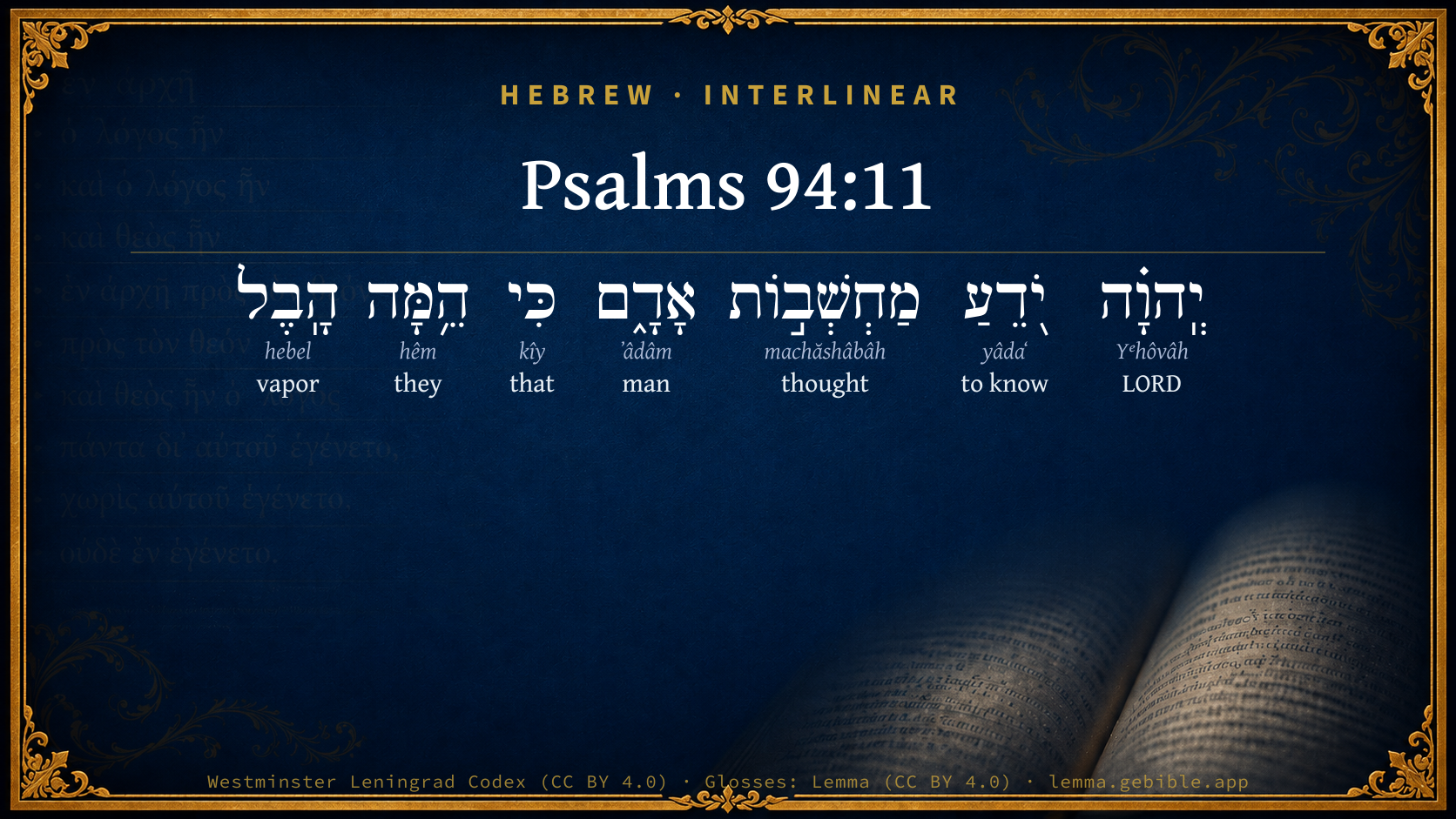
Hebrew (Westminster Leningrad Codex) Psalms 94:11 appears in the Hebrew Old Testament. The text above is from the Westminster Leningrad Codex. Each word links to its Strong’s number, a concise gloss, and parsing drawn from the Open Scriptures Hebrew Bible morphology. Click any word for its full Brown-Driver-Briggs (BDB) entry.
Download image
Cite this verse

Psalms 94:11 (World English Bible). Public Domain. Lemma interlinear Bible study tool, https://lemma.gebible.app/v/psalms/94/11.

Show BibTeX & RIS
BibTeX
RIS
English Translation
Yahweh knows the thoughts of man, That they are futile.
World English Bible · Public Domain
Download a study sheet

One document with this verse’s original text, its word-by-word gloss line, the meaning frame, cross-references with their text, attributed commentary, and full source and license credits — printable, and it pastes into notes with its structure intact.

This verse Autodidact and up

Study sheet (.html) Plain text (.txt)

A passage Seminary Student

Up to 50 verses in one chapter. A passage sheet keeps up to 6 commentary sources and 12 cross-references per verse, in the order this page ranks them, and says so on the sheet whenever that leaves anything out. Ask for a single verse and you get the Autodidact verse sheet above.

Everything on this page stays free to read, with no account — the sheet is a download of what is already on screen, not access to it.

Want to remove ads? Support Godless Engineer
Compare translations 3

The same verse in 3 English versions, stacked beneath the original-language interlinear above. Click any original word for its lexicon entry.

Each is an independent rendering of the whole verse — the interlinear is not word-aligned to these translations.

Highlighted words mark where these versions differ — a whole-verse word diff, not a word-by-word alignment.

  • World English Bible Public Domain
    Yahweh knows the thoughts of man, That they are futile.
  • King James Version Public Domain
    The LORD knoweth the thoughts of man, that they are vanity.
  • unfoldingWord Literal Text CC BY-SA 4.0
    Yahweh knows the thoughts of mankind, that they are vapor.

unfoldingWord Literal Text — © unfoldingWord, licensed CC BY-SA 4.0. Word-aligned USFM3 via Door43 (git.door43.org/unfoldingWord/en_ult).

Versions to compare (up to 4)

3 of 4 selected

Show all 18 translations

Every available English version of this verse, each an independent rendering of the whole verse.

  • World English Bible Public Domain
    Yahweh knows the thoughts of man, That they are futile.
  • Berean Standard Bible Public Domain
    The LORD knows the thoughts of man, that they are futile.
  • Majority Standard Bible Public Domain
    The LORD knows the thoughts of man, that they are futile.
  • King James Version Public Domain
    The LORD knoweth the thoughts of man, that they are vanity.
  • American Standard Version (1901) Public Domain
    Jehovah knoweth the thoughts of man, That they are vanity.
  • Revised Version (1885) Public Domain
    The LORD knoweth the thoughts of man, that they are vanity.
  • Geneva Bible (1599) Public Domain
    The Lord knoweth the thoughtes of man, that they are vanitie.
  • Douay-Rheims (1899) Public Domain
    The Lord knoweth the thoughts of men, that they are vain.
  • Young's Literal Translation Public Domain
    He knoweth the thoughts of man, that they `are' vanity.
  • Literal Standard Version CC BY-SA 4.0
    He knows the thoughts of man, that they [are] vanity.
  • Unlocked Literal Bible CC BY-SA 4.0
    Yahweh knows the thoughts of men, that they are vapor.
  • unfoldingWord Literal Text CC BY-SA 4.0
    Yahweh knows the thoughts of mankind, that they are vapor.
  • Darby Bible Public Domain
    Jehovah knoweth the thoughts of man, that they are vanity.
  • World Messianic Bible Public Domain
    The LORD knows the thoughts of man, that they are futile.
  • Webster's Bible Public Domain
    The LORD knoweth the thoughts of man, that they are vanity.
  • Free Bible Version CC BY-SA 4.0
    The Lord knows the thoughts of human beings—he knows they are pointless.
  • Bible in Basic English Public Domain
    The Lord has knowledge of the thoughts of man, for they are only a breath.
  • JPS Tanakh (1917) Public Domain
    The LORD knoweth the thoughts of man, that they are vanity.

Literal Standard Version (2020), Covenant Press — licensed CC BY-SA 4.0. Text via the HelloAO Bible API (eBible.org). Unlocked Literal Bible (unfoldingWord) — licensed CC BY-SA 4.0. Text via the HelloAO Bible API (eBible.org). unfoldingWord Literal Text — © unfoldingWord, licensed CC BY-SA 4.0. Word-aligned USFM3 via Door43 (git.door43.org/unfoldingWord/en_ult). Free Bible Version, Dr. Jonathan Gallagher — licensed CC BY-SA 4.0. Text via the HelloAO Bible API (eBible.org).

Word by word

More ways to search: Search by grammar → Find every occurrence → Compare this word →

Practice this passage: Drill this verse → Learn its vocabulary →

About this verse

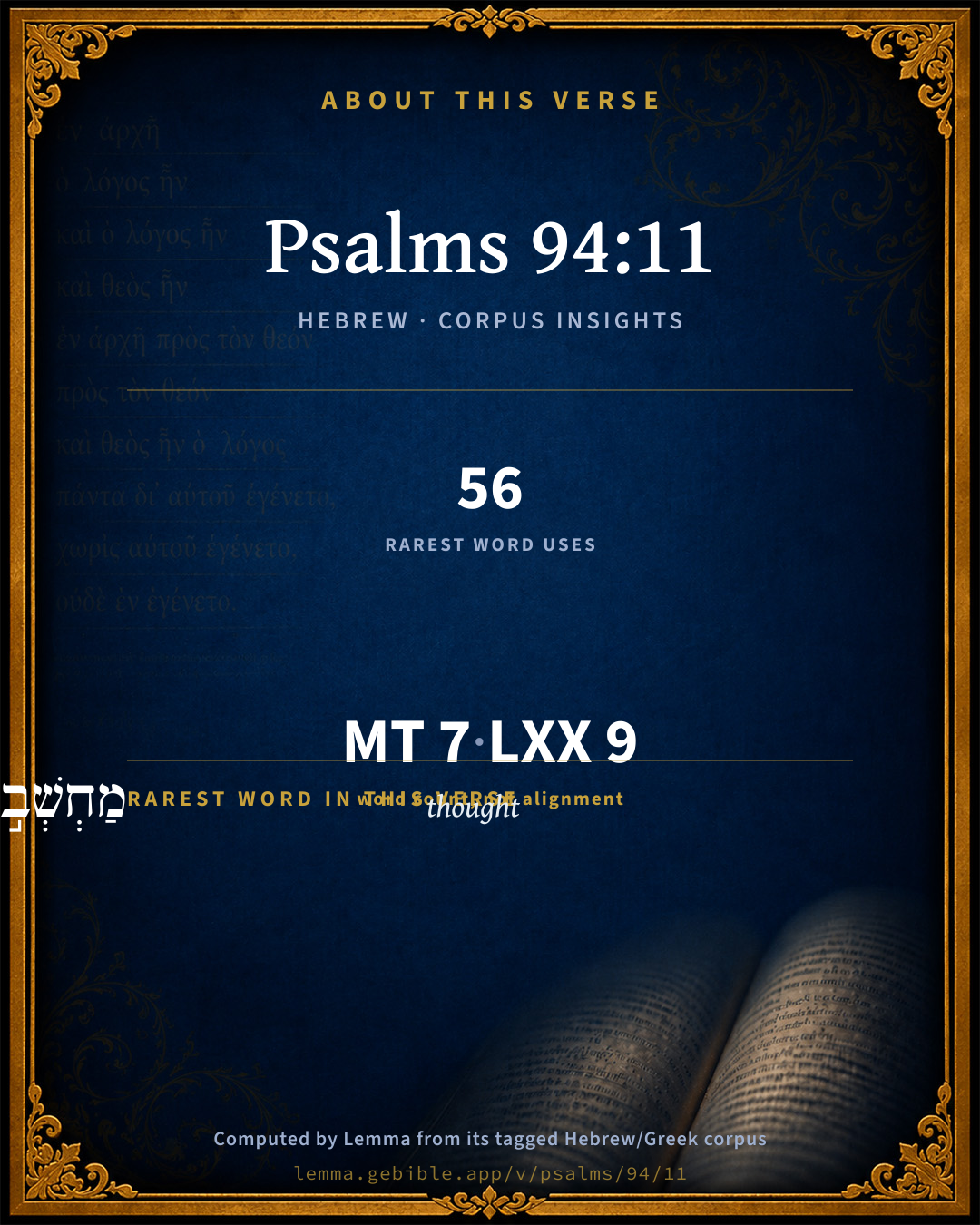
These counts appear in no published source. They are computed here, from the morphology-tagged text and Lemma’s own curated glosses. What Lemma adds →

7
words
7
distinct lemmas
Wisdom
section

Shared distinctive vocabulary

מַחְשְׁב֣וֹת thought H4284 occurs in 52 verses of the Hebrew Bible. Also found in:

Grammatical profile

  • 1 verb
  • 4 nouns
  • 1 pronoun
  • 1 conjunction

Verb forms

  • יֹ֭דֵעַ Qal · Participle Active

Hebrew & Septuagint length

In English translation the verse runs 10 words from the Hebrew and 11 from the Septuagint (LXX English) — closely comparable.

A rough comparison of the two English renderings, which tokenize alike — not a word-level alignment.

Word counts can differ between the Hebrew and the Greek without any difference in meaning — e.g. the Hebrew direct-object marker אֵת has no separate Greek word, and Greek often adds the article ὁ.

In the original languages it is 7 Hebrew tokens and 9 Greek tokens — but the two are counted differently (Hebrew bundles its prefixes and suffixes into one token; the Greek is in lemma form), so that isn’t a like-for-like length.

Cross-references

7

Topical passages linked to Psalms 94:11 in the Treasury of Scripture Knowledge — connected by theme and wording, ordered by reader-vote popularity; previews shown in the World English Bible.

  • 1 Corinthians 3:20 And again, "The Lord knows the reasoning of the wise, that it is worthless."
  • 1 Corinthians 1:19 For it is written, "I will destroy the wisdom of the wise, I will bring the discernment of the discerning to nothing."
  • Job 11:11–12 For he knows false men. He sees iniquity also, even though he doesn't consider it.
  • Romans 1:21–22 Because, knowing God, they didn't glorify him as God, neither gave thanks, but became vain in their reasoning, and their senseless heart was darkened.
  • 1 Corinthians 1:21 For seeing that in the wisdom of God, the world through its wisdom didn't know God, it was God's good pleasure through the foolishness of the preaching to save those who believe.
  • 1 Corinthians 1:25 Because the foolishness of God is wiser than men, and the weakness of God is stronger than men.
  • Psalms 49:10–13 For he sees that wise men die; Likewise the fool and the senseless perish, And leave their wealth to others.

Cross-references courtesy of OpenBible.info (CC BY 4.0).

Hebrew and Greek witnesses Masoretic Hebrew ↔ Greek Septuagint

The same verse in the two great witnesses to the Old Testament, shown verse-for-verse.

You’re reading Greek Psalm 93 (Hebrew Psalm 94). The Septuagint counts the superscription, so verse numbers can differ from the Hebrew — chapter-level alignment, not verse-by-verse. Numbering follows Rahlfs.

These are two independent witnesses, not word-aligned to each other, and the Septuagint is shown in lemma (dictionary) form.

Hebrew Psalms 94:11 Masoretic · Westminster Leningrad Codex

יְֽהוָ֗ה יֹ֭דֵעַ מַחְשְׁב֣וֹת אָדָ֑ם כִּי הֵ֥מָּה הָֽבֶל

Yahweh knows the thoughts of man, That they are futile.

World English Bible · Public Domain

Greek LXX Greek Psalm 93:11 Septuagint · lemma form

κύριος γιγνώσκω ὁ διαλογισμός ὁ ἄνθρωπος ὅτι εἰμί μάταιος

The Lord knows the thoughts of men, that they are vain.

LXX2012 (modern English Septuagint) · Public Domain

On this verse, Ellicott's Commentary for English Readers discusses the Septuagint’s reading. Read the note in Commentary ↓

Hebrew: Westminster Leningrad Codex (CC BY 4.0). Greek: Septuagint (public domain); English from LXX2012 (modern English Septuagint) (Public Domain). How the Septuagint differs from the Hebrew →

Commentary

Notes on Psalms 94:11 from classic Christian and Jewish commentators (each source and its license shown beneath its notes). The classic Christian expositions comment on the surrounding passage and are grouped to its opening verse, so a note may address several verses; the Jewish commentaries on the Tanakh (Rashi and others) are per-verse, so they appear only where the commentator wrote on this verse.

Lemma curates 59 commentaries, every one of them public domain or Creative Commons licensed, each selected and text-cleaned for this edition rather than reprinted as found. About our sources →

Trapp's Complete Commentary

John Trapp

Psa 94:11 The LORD knoweth the thoughts of man, that they [are] vanity.

Ver. 11. The Lord knoweth the thoughts of man, that they are vanity] Or worse; that they are ever weaving spiders’ webs, or else hatching cockatrices’ eggs, Isa 59:5. This sentence St Paul allegeth against the world’s wizards, 1Co 3:20, who, the wiser they were the vainer they were, Rom 1:21. As Austin, writing to a man of great parts, saith, Ornari abs te Diabolus quaerit, The devil would fain be tricked up by thee.

John Trapp, A Commentary or Exposition upon All the Books of the Old and New Testament (1647–1656) — public domain. Text from a community e-Sword module.

The Biblical Illustrator

Joseph S. Exell

Psa_94:11

The Lord knoweth the thoughts of man, that they are vanity.

Gods indictment of our thoughts

In treatises on morals and in manuals of religion, much has been said about controlling ones thoughts. This is a difficult task to perform.

I. God in the text brings a severe charge against our thoughts. We are taught that only the blood of the Lord Jesus can cleanse them.

1. Consider what thought is, and how far and swiftly it can go. It allies us to the spirits above. It can go so far that the bounds of the infinite alone can check it; so swiftly, that it can distance an archangel in his most rapid flight. Think of its achievements!

2. This thought, so marvellous in its capacity, God charges with vanity. It is a heavy indictment.

II. There are many proofs of the correctness of the charge.

1. This vanity appears in mans persistent seeking to pry into the mysteries of God.

2. It is seen in this, that when man cannot see, he proceeds to conjecture; when he cannot know then he guesses.

3. It is seen in the many ways the thoughts of men lead them into arrant, nonsense.

Self-importance. Pleasures of sense, and appetite, etc.

4. It appears by a review of our past. In manhood, how foolish the thoughts of our childhood appears! We have then put away childish things. So the past period of our lives appears to us at every succeeding stage.

III. Two things are needed,

1. Purification of our thoughts.

2. Regulation of our thoughts, by--

(1) Watchfulness;

(2) Discipline;

(3) Self-examination. (M. Dix, D.D.)

The true character of mans thoughts

Suppose a man should find a great basket by the wayside carefully packed, and, on opening it, he should find it filled with human thoughts, all the thoughts which had passed through one single brain in one year, or five years, what a medley they would make! How many would be wild and foolish, how many weak and contemptible, how many mean and vile, how many so contradictory and crooked, that they could hardly lie still in the basket! And suppose he should be told that these were all his own thoughts, children of his own brain, how amazed would he be, how little prepared to see himself as revealed in these thoughts! And how would he want to run away and hide, if all the world were to see the basket, opened and see his thoughts! (J. Todd, D.D.)

The Biblical Illustrator, edited by Joseph S. Exell (c. 1880s–1900s) — public domain. Text from a community e-Sword module.

Joseph Benson's Commentary

Psa 94:11. The Lord knoweth the thoughts of man — This is an answer to the foregoing question, Shall not he know? Yes, he knoweth all things, yea, even the most secret things, as the thoughts of men; and in particular your thoughts, and much more your practices, which you supposed he did not see, Psa 94:6-7. And he knows that they are generally vain and foolish; and that, while you applaud yourselves in such thoughts, you do not benefit, but only delude yourselves with them.

Joseph Benson's Commentary on the Old and New Testaments (1811–1818) — public domain. Text from a community e-Sword module.

J. A. Alexander on Psalms

Joseph Addison Alexander

11. (Psa 94:11) Jehovah knows the thoughts of mankind, that they (are) vanity. The verbal form is still that of a participle, knowing, habitually knowing, what they are and what they deserve. Such knowledge carries with it, as a necessary consequence, condemnation and punishment. See above, on Psa 1:6. Thoughts, purposes, designs. See above, on Psa 40:4. Instead of that, some give the particle its usual sense of for, because, without a material change of meaning. The pronoun they seems in English to relate necessarily to thoughts; but in Hebrew the more natural antecedent is man as a generic or collective term, because the pronoun is masculine and thoughts feminine; because the same thing is predicated, in the same form, of men themselves, Psa 39:5; Psa 39:11; and because this idea is better suited to the context here.

Joseph Addison Alexander, The Psalms Translated and Explained (1850) — public domain. Text from a community e-Sword module.

Tyndale Open Study Notes

Tyndale Open Resources

94:11 While the Lord’s thoughts are deep, people’s thoughts are worthless (cp. 92:5; 1 Cor 3:20).

Tyndale Open Study Notes — © Tyndale Open Resources, licensed CC BY-SA 4.0. Text via the HelloAO Bible API.

John Calvin's Commentaries

11. Jehovah knoweth the thoughts of men, etc. He again insists upon the folly of men in seeking to wrap themselves up in darkness, and hide themselves from the view of God. To prevent them from flattering themselves with vain pretexts, he reminds them that the mists of delusion will be scattered at once when they come to stand in God’s presence. Nothing can avail them, so long as God from heaven stamps vanity upon their deepest counsels. The Psalmist’s design in citing them before the Judge of all, is to make them thoroughly search and try their own hearts; for the great cause of their self-security lay in failing to realize God, burying all distinction between right and wrong, and, so far as that was possible, hardening themselves against all feeling. They might contrive to soothe their minds by means like these, but he tells them that God ridiculed all such trifling. The truth may be a plain one, and well known; but the Psalmist states a fact which many overlook, and which we would do well to remember, That the wicked, when they attempt to hide themselves under subtile refuges, cannot deceive God, and necessarily deceive themselves. Some read — They (that is, men themselves) are vanity; but this is a forced rendering, and the form of expression is one which both in the Greek and Hebrew may be translated, God knows that the thoughts of men are vain.

John Calvin's Commentaries (1540-1563) — public domain. Text from the Calvin Translation Society English edition (1840s-50s) via the Christian Classics Ethereal Library (ccel.org). Calvin's coverage is partial (roughly two-thirds of the Bible); uncommented books and verses are honest gaps, never fabricated. The 19th-century editor's footnotes and remarks are omitted so the notes are faithfully Calvin's own voice.

Ellicott's Commentary for English Readers

(11) That they are vanity—The literal rendering, “for they are breath,” referring not to thoughts, but to man collectively, gives equally good sense, and would, notwithstanding the order of the words, be natural, since the masculine pronoun is used. But the LXX. stands as the Authorised Version, and is so quoted by St. Paul (1Co_3:20), with the substitution of wise men for men.

A Bible Commentary for English Readers, edited by Charles John Ellicott (1878–1897) — public domain. Text from a community e-Sword module.

The Cambridge Bible for Schools and Colleges

gen. ed. J. J. S. Perowne

11. The positive answer to the self-delusion of the wicked and the doubts of the faithless. Jehovah not only sees their works, but knows their very thoughts.

that they are vanity] So the LXX, quoted by St Paul in 1Co_3:20, with the substitution of the wise for men to suit his argument. This rendering gives a good sense, and suggests an emphatic contrast between the designs of men and the designs of God (Psa_92:5). But the masculine pronoun they is more naturally referred to man than to the feminine word for thoughts, and its emphatic position further points to the rendering, For they, in contrast to Jehovah, are (but) a breath (Psa_39:5). How can man, the feeble creature of a day, escape the knowledge of the Omniscient and Eternal, or entertain designs which He cannot fathom?

The Cambridge Bible for Schools and Colleges (gen. ed. J. J. S. Perowne; Cambridge University Press, 1878–1918) — public domain. Text from a community e-Sword module.

John Gill's Exposition

The Lord knoweth the thoughts of man,.... He not only hears their words, and sees their actions; but he knows their thoughts, the secret thoughts of their hearts, though he is afar off from them, and, they from him; he is the searcher of the hearts and trier of the reins of the children of men; see Psa 139:2, and so is Christ, who is the omniscient God, and is the Jehovah all along spoken to and of in this psalm; he knows the thoughts of men, and is a critical discerner of them, Mat 9:3.

that they are vanity; either that their thoughts are vanity; the object of them is vanity, the riches and honours of this world, which are all vanity and vexation of spirit; and sinful lusts and pleasures, which are vain and useless, yea, pernicious and hurtful: and so they are in their issue and event; they come to nothing, they are without effect; the Lord disappoints men's devices, and frustrates their designs; they think of this and the other, form schemes, but cannot execute them: or else the sense is, that they themselves are vanity, as man in his best estate is; even every man, whether of high or low degree; see Psa 39:5. The Syriac version is, "for they are a vapour"; with which compare Jam 4:14. Thales, an Heathen philosopher (e), being asked whether men's deeds could be hid from God, answered, no, nor their thoughts.

(e) Apud Laert. Vit. ejus, Valer. Maxim. l. 7. c. 2. extern. 8.

John Gill's Exposition of the Whole Bible (1746–1763) — public domain (CC PDM 1.0). Text via the HelloAO Bible API.

Albert Barnes' Notes on the Bible

The Lord knoweth the thoughts of man - That is, He who teaches people all that they know Psa 94:10, must understand all that there is in the mind. See the notes at 1Co 3:20.

That they are vanity - That is, that they are foolish, vain, unwise, wicked. The knowledge of the thoughts themselves carries with it also the knowledge that they are vain and foolish - for that is their character, and to know them truly is to know this of them. They do not appear to him as they do to people themselves. They are to his view stripped of all that is flattering and illusive, and are seen to be vain and foolish.

Albert Barnes' Notes on the Bible (1834–1885) — public domain. Text from a community e-Sword/MySword module.

Matthew Poole's English Annotations

This is an answer to the foregoing question, shall not he know? Yes, he knoweth all things, yea, even the most secret things, as the thoughts of men; and in particular your atheistical thoughts, and much more doth he know your wicked practices, which you said he did not see, Psa 94:6,7. And he knows that they are generally vain and foolish, and that whilst you mock God and applaud yourselves in such thoughts, you do not relieve, but only delude yourselves with them.

Matthew Poole's English Annotations on the Holy Bible (1683–1685) — public domain. Text from a community e-Sword/MySword module.

The Treasury of David

Charles H. Spurgeon

Ver. 11. Whether men admit or deny that God knows, one thing is here declared, namely, that

The Lord knoweth the thoughts of man, that they are vanity. Not their words alone are heard, and their works seen, but he reads the secret motions of their minds, for men themselves are not hard to be discerned of him, before his glance they themselves are but vanity. It is in the Lord's esteem no great matter to know the thoughts of such transparent pieces of vanity as mankind are, he sums them up in a moment as poor vain things. This is the sense of the original, but that given in the authorised version is also truethe thoughts, the best part, the most spiritual portion of man's nature, even these are vanity itself, and nothing better. Poor man! And yet such a creature as this boasts, plays at monarch, tyrannises over his fellow worms, and defies his God! Madness is mingled with human vanity, like smoke with the fog, to make it fouler but not more substantial than it would have been alone.

How foolish are those who think that God does not know their actions, when the truth is that their vain thoughts are all perceived by him! How absurd to make nothing of God when in fact we ourselves are as nothing in his sight.

Ver. 11. The LORD knoweth the thoughts. The thoughts of man's heartwhat millions are there of them in a day! The twinkling of the eye is not so sudden a thing as the twinkling of a thought; yet those thousands and thousands of thoughts which pass from thee, that thou canst not reckon, they are all known to God. Anthony Burgess.

Ver. 11. The Lord knoweth the thoughts of man, that they are vanity. What a humbling thought is here suggested to us! Let us examine it.

1. If vanity had been ascribed to the meaner parts of the creation if all inanimate and irrational beings, whose days are as a shadow, and who know not whence they came nor whither they go, had thus been characterizedit had little more than accorded with our own ideas. But the humiliating truth belongs to man, the lord of the lower creationto man, that distinguished link in the chain of being which unites in his person mortality and immortality, heaven and earth. "The LORD knoweth the thoughts of man, that they are vanity."

2. Had vanity been ascribed only to the exercise of our sensual or mortal part, or of that which we possess in common with other animals, it had been less humiliating. But the charge is pointed at that which is the peculiar glory of man the intellectual part, his thoughts. It is here, if anywhere, that we excel the creatures which are placed around us. We can contemplate our own existence, dive into the past and the future, and understand whence we came and whither we go. Yet in this tender part; we are touched. Even the "thoughts" of man are vanity.

3. If vanity had been ascribed merely to those loose and trifling excursions of the imagination which fall not under the influence of choice, a kind of comers and goers, which are ever floating in the mind, like insects in the air on a summer's evening, it had been less affecting. The soul of man seems to be necessarily active. Everything we see, hear, taste, feel, or perceive, has some influence upon thought, which is moved by it as leaves on the trees are moved by every breeze of wind. But "thoughts" here include those exercises of the mind in which it is voluntarily or intensely engaged, and in which we are in earnest; even all our schemes, contrivances, and purposes. One would think, if there were anything in man to be accounted of, it should be those exercises in which his intellectual faculty is seriously and intensely employed. Yet the Lord knoweth that even these are vanity.

4. If during our state of childhood and youth only vanity had been ascribed to our thoughts, it would have been less surprising. This is a truth of which numberless parents have painful proof; yea, and of which children themselves, as they grow up to maturity, are generally conscious. Vanity at this period, however, admits of some apology. The obstinacy and folly of some young people, while they provoke disgust, often excite a tear of pity. But the charge is exhibited against man. "Man at his best estate is altogether vanity."

5. The decision proceeds from a quarter from which there can be no appeal. "The LORD knoweth" it. Opinions dishonourable to our species may sometimes arise from ignorance, sometimes from spleen and disappointment, and sometimes from a gloomy turn of mind, which views mankind through a distorted medium. But the judgment given in this passage is the decision of Him who cannot err; a decision therefore to which, if we had no other proof, it becomes us to accede. Andrew Fuller.

Ver. 11. They are vanity. The Syriac version is, For they are a vapour. Compare Jas 4:14. John Gill.

Ver. 11.

1. With respect to the present world, consider what multitudes of thoughts are employed in vain.

(a) In seeking satisfaction where it is not to be found.

(b) In poring on events which cannot be recalled.

(c) In anticipating evils which never befall us.

(d) To these may be added the valuing ourselves on things

of little or no account.

(e) In laying plans which must be disconcerted.

2. Let us see what are man's thoughts with regard to religion, and the concerns of a future life. (a) What are the thoughts of the heathen world about religion? (b) What are all the thoughts of the Christian world, where God's thoughts are neglected? (c) What is all that practical atheism which induces multitudes to act as if there were no God? (d) What are all the unbelieving, self flattering imaginations of wicked men, as though God were not in earnest in his declarations and threatenings? (e) What are the conceits of the self righteous, by which they buoy up their minds with vain hopes, and refuse to submit to the righteousness of God? Andrew Fuller.

Ver. 11. God's intimate knowledge of man. A startling truth. A humiliating truth.

Psalms 94:12*

Charles H. Spurgeon's The Treasury of David (1869–1885) — public domain. Psalms only. Text from a community e-Sword/MySword module.

Whedon's Commentary on the Bible

Daniel D. Whedon

11. The Lord knoweth—A direct affirmation of what had been put interrogatively in Psa_94:9-10. He knoweth the thoughts, devices, of men, not only as an intellectual conception, but by way of judicial cognizance, with the intent to punish then.

Vanity—Literally, a breath. The idea is, not only that of emptiness, but of wickedness also, as the word often denotes. Deu_32:21; Pro_13:11. God is not an indifferent spectator. He fathoms all the devices of the wicked oppressors, and will requite them.

Daniel D. Whedon (gen. ed.), Commentary on the Old and New Testaments (1874–1909) — public domain. Text from a community e-Sword module.

The Pulpit Commentary

The Lord knoweth the thoughts of man. Not only does the Almighty see and know all the actions of men (ver. 9), but he is even acquainted with their thoughts. (comp. Psa_7:9 Psa_26:2 Psa_139:17 Isa_66:18 1Co_3:20) That they are vanity. (comp. Ecc_2:14, Ecc_2:15)

The vanity of men"s idea of the Divine indifference.

"The Lord knoweth the thoughts of man, that they are vanity." Clearly the reference is not a general one, to the common and usual thoughts of men, but a special one to the particular thoughts about the delay of God"s vindication of the oppressed, which was at the time distressing the psalmist (see ver. 7). The idea that God does not regard the suffering of his people, and will not intervene in their behalf, is characterized as "vanity," a foolish, baseless, and altogether unsound notion. This idea concerning God is sometimes the doubt of the pious soul, as in Isa_40:27; here it is the reproach of the ungodly. The doubt of the pious soul is properly met by Divine comfortings and assurances; the reproach of the ungodly is properly met by scornful and withering reproof. "So far from "not seeing," "not regarding," as these brutish persons fondly imagine, Jehovah reads their inmost thoughts and devices, as he reads the hearts of all men, even though for a time they are unpunished". (see 1Co_3:20)

I SUCH THOUGHTS ARE VANITY BECAUSE THEY ARE UNTRUE. They do not answer to the facts. If God be God, he must know what is going on; he must be controlling everything; he must be working toward the blessing of the good. Such thoughts are untrue if tested

(1) by right knowledge of God;

(2) by the assurances and promises of God;

(3) by the history of his dealings with men;

(4) by the personal experiences of believers.

II SUCH THOUGHTS ARE VANITY BECAUSE THEY ARE UNWORTHY. The men who encourage them are not in a right state of mind. Men ought to trust God, not doubt him. Men ought to be quick to observe everything that can nourish confidence. If God"s ways ever seem perplexing, our assumption should always be in favour of their wisdom and loving kindness. It is unworthy of men to doubt God in one thing, seeing he gives them such abundant reason for trusting him in a thousand things. He is "too good to be unkind.

III SUCH THOUGHTS ARE VANITY BECAUSE THEY ARE UNSTABLE. They are but the feelings of the hour; they are based on no careful considerations. Men take them up when they are vexed at not getting what they wish, or not having things according to their minds. The moods of the hour may well be called "vanity. R.T.

The Pulpit Commentary (1880–1919), ed. H.D.M. Spence-Jones & Joseph S. Exell — public domain. Text from a community e-Sword module.

John Wesley's Explanatory Notes

Thoughts - Yes, he knoweth all things, even the most secret things, as the thoughts of men; and in particular your thoughts; much more your practices.

John Wesley, Explanatory Notes Upon the Whole Bible (1754–1765) — public domain. Text via the GEBible commentary corpus.

Rashi

Rabbi Shlomo Yitzchaki (Rashi)

The Lord knows your thoughts, that you are thinking to be haughty with the crown of the kingdom, and you should know that they [your thoughts] are vanity.

Rashi on the Tanakh — English translations: “The Judaica Press complete Tanach with Rashi, translated by A. J. Rosenberg” (CC BY 4.0); “Pentateuch with Rashi's commentary by M. Rosenbaum and A.M. Silbermann, 1929-1934” (public domain); “The Metsudah Tanach series, Lakewood, N.J” (CC BY 4.0); and “The Book of Joshua, Metsudah Publications, 1997” (CC BY 4.0). Text via Sefaria.

Lesson kit

Teaching starters — assembled from the data on this page, not authored interpretation. Every prompt links to the verse data it draws on. Edit before teaching.

Psalms, in the Wisdom, opens this verse with 7 words (7 distinct Hebrew lemmas). Its most distinctive word is machăshâbâh (“thought”). A historical commentator’s framing appears above. Read the whole chapter for the surrounding context.

Discussion questions

  1. What does “thought” (machăshâbâh) contribute to the verse as a whole?
  2. How does Genesis 6:5, which shares the word «thought», read alongside this verse?
  3. These translations render this verse differently. What is at stake in choosing one wording over another?
  4. «יֹ֭דֵעַ» is a Qal Participle Active verb. How does that grammatical form shape the action described?
  5. Compare how Trapp's Complete Commentary and The Biblical Illustrator read this verse. Where do they agree or differ?

Things to notice

Reading settings

Reading text

Shown beneath each verse's original-language words.

Old Testament
Old Testament edition

Read the OT as the Masoretic Hebrew (MT) or the Greek Septuagint (LXX).

English shown for the Greek Septuagint (in the Hebrew ↔ Greek comparison).

Comparing translations? Open the Compare panel on any verse page to stack up to four side by side.