Psalms 62:9

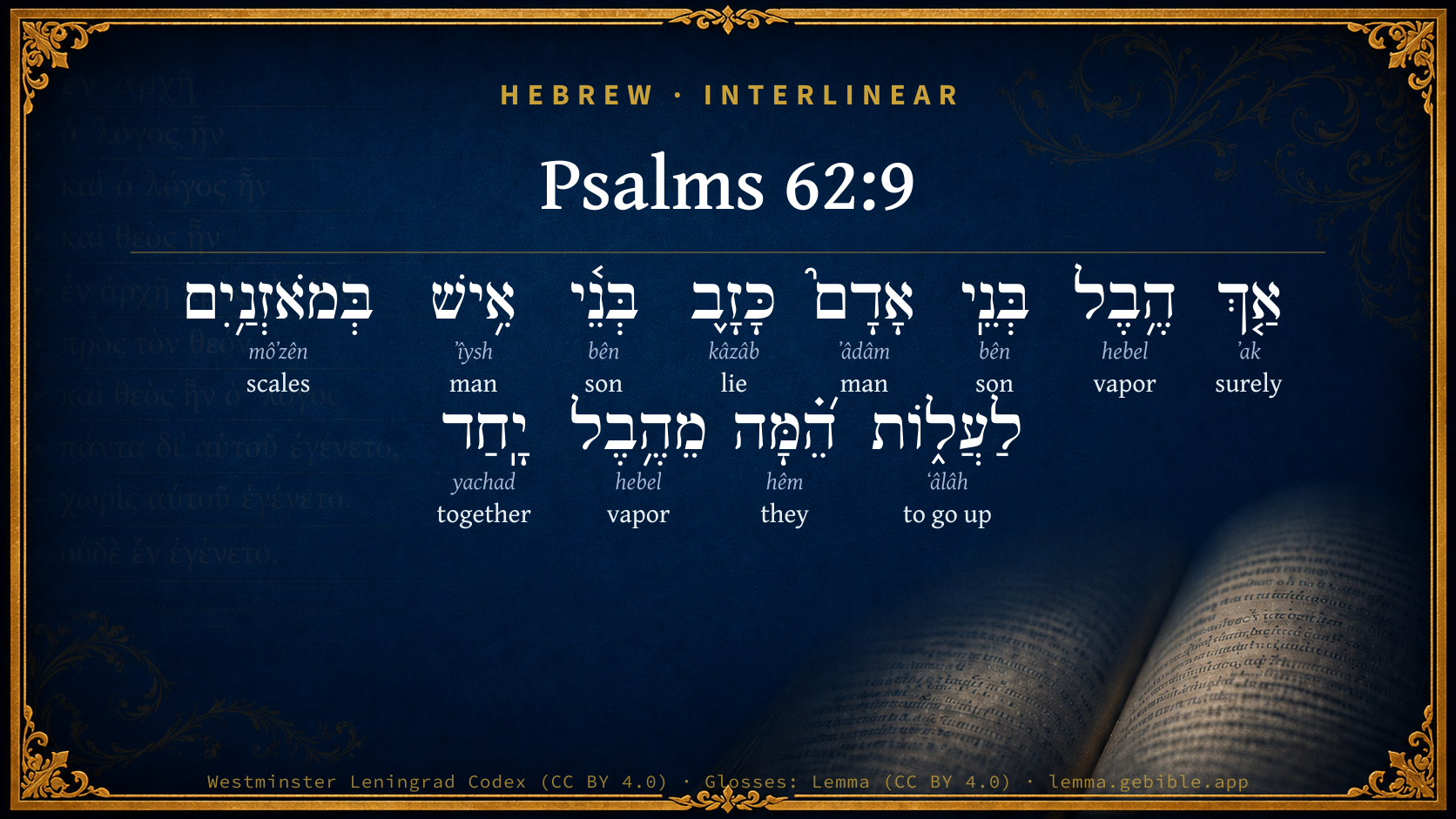
Hebrew (Westminster Leningrad Codex) Psalms 62:9 appears in the Hebrew Old Testament. The text above is from the Westminster Leningrad Codex. Each word links to its Strong’s number, a concise gloss, and parsing drawn from the Open Scriptures Hebrew Bible morphology. Click any word for its full Brown-Driver-Briggs (BDB) entry.
Download image
Cite this verse

Psalms 62:9 (World English Bible). Public Domain. Lemma interlinear Bible study tool, https://lemma.gebible.app/v/psalms/62/9.

Show BibTeX & RIS
BibTeX
RIS
English Translation
Surely men of low degree are just a breath, And men of high degree are a lie. In the balances they will go up. They are together lighter than a breath.
World English Bible · Public Domain
Download a study sheet

One document with this verse’s original text, its word-by-word gloss line, the meaning frame, cross-references with their text, attributed commentary, and full source and license credits — printable, and it pastes into notes with its structure intact.

This verse Autodidact and up

Study sheet (.html) Plain text (.txt)

A passage Seminary Student

Up to 50 verses in one chapter. A passage sheet keeps up to 6 commentary sources and 12 cross-references per verse, in the order this page ranks them, and says so on the sheet whenever that leaves anything out. Ask for a single verse and you get the Autodidact verse sheet above.

Everything on this page stays free to read, with no account — the sheet is a download of what is already on screen, not access to it.

Want to remove ads? Support Godless Engineer
Compare translations 3

The same verse in 3 English versions, stacked beneath the original-language interlinear above. Click any original word for its lexicon entry.

Each is an independent rendering of the whole verse — the interlinear is not word-aligned to these translations.

Highlighted words mark where these versions differ — a whole-verse word diff, not a word-by-word alignment.

  • World English Bible Public Domain
    Surely men of low degree are just a breath, And men of high degree are a lie. In the balances they will go up. They are together lighter than a breath.
  • King James Version Public Domain
    Surely men of low degree are vanity, and men of high degree are a lie: to be laid in the balance, they are altogether lighter than vanity.
  • unfoldingWord Literal Text CC BY-SA 4.0
    Surely sons of a human vapor, sons of a man a lie. To go up on the scales, they together than vapor.

unfoldingWord Literal Text — © unfoldingWord, licensed CC BY-SA 4.0. Word-aligned USFM3 via Door43 (git.door43.org/unfoldingWord/en_ult).

Versions to compare (up to 4)

3 of 4 selected

Show all 18 translations

Every available English version of this verse, each an independent rendering of the whole verse.

  • World English Bible Public Domain
    Surely men of low degree are just a breath, And men of high degree are a lie. In the balances they will go up. They are together lighter than a breath.
  • Berean Standard Bible Public Domain
    Lowborn men are but a vapor, the exalted but a lie. Weighed on the scale, they go up; together they are but a vapor.
  • Majority Standard Bible Public Domain
    Lowborn men are but a vapor; the exalted are but a lie. Weighed on the scale, they go up; together they are but a vapor.
  • King James Version Public Domain
    Surely men of low degree are vanity, and men of high degree are a lie: to be laid in the balance, they are altogether lighter than vanity.
  • American Standard Version (1901) Public Domain
    Surely men of low degree are vanity, and men of high degree are a lie: In the balances they will go up; They are together lighter than vanity.
  • Revised Version (1885) Public Domain
    Surely men of low degree are vanity, and men of high degree are a lie: in the balances they will go up; they are together lighter than vanity.
  • Geneva Bible (1599) Public Domain
    Yet the children of men are vanitie, the chiefe men are lies: to lay them vpon a balance they are altogether lighter then vanitie.
  • Douay-Rheims (1899) Public Domain
    Trust in him, all ye congregation of people: pour out your hearts before him. God is our helper for ever.
  • Young's Literal Translation Public Domain
    Only -- vanity `are' the low, a lie the high. In balances to go up they than vanity `are' lighter.
  • Literal Standard Version CC BY-SA 4.0
    Surely vanity the low, a lie the high. In balances to go up || They [are] lighter than a breath.
  • Unlocked Literal Bible CC BY-SA 4.0
    Surely men of low standing are vanity, and men of high standing are a lie; they will weigh lightly in the scales; weighed together, they are lighter than nothing.
  • unfoldingWord Literal Text CC BY-SA 4.0
    Surely sons of a human vapor, sons of a man a lie. To go up on the scales, they together than vapor.
  • Darby Bible Public Domain
    Men of low degree are only vanity; men of high degree, a lie: laid in the balance, they go up together [lighter] than vanity.
  • World Messianic Bible Public Domain
    Surely men of low degree are just a breath, and men of high degree are a lie. In the balances they will go up. They are together lighter than a breath.
  • Webster's Bible Public Domain
    \\62:8\\Trust in him at all times; ye people, pour out your heart before him: God is a refuge for us. Selah.
  • Free Bible Version CC BY-SA 4.0
    Ordinary people are mere breaths, while leaders are just fakes. Put them all together and weigh them on scales and they wouldn't weigh more than air!
  • Bible in Basic English Public Domain
    Truly men of low birth are nothing, and men of high position are not what they seem; if they are put in the scales together they are less than a breath.
  • JPS Tanakh (1917) Public Domain
    (62-10) Men of low degree are vanity, and men of high degree are a lie; if they be laid in the balances, they are together lighter than vanity.

Literal Standard Version (2020), Covenant Press — licensed CC BY-SA 4.0. Text via the HelloAO Bible API (eBible.org). Unlocked Literal Bible (unfoldingWord) — licensed CC BY-SA 4.0. Text via the HelloAO Bible API (eBible.org). unfoldingWord Literal Text — © unfoldingWord, licensed CC BY-SA 4.0. Word-aligned USFM3 via Door43 (git.door43.org/unfoldingWord/en_ult). Free Bible Version, Dr. Jonathan Gallagher — licensed CC BY-SA 4.0. Text via the HelloAO Bible API (eBible.org).

Word by word

More ways to search: Search by grammar → Find every occurrence → Compare this word →

Practice this passage: Drill this verse → Learn its vocabulary →

בְּמֹאזְנַ֥יִם
môʼzên
H3976
“in/at · scales”
Preposition + Noun, Common, Masculine, Dual, Absolute
Part of Speech
Preposition + Noun
Type
Common
Gender
Masculine
Number
Dual
State
Absolute
Full BDB Definition

Origin: from H239

TWOT: 58a

scales, balances
  1. אַ֤ךְ ʼak H389 “surely” Particle, Accusative
  2. הֶ֥בֶל hebel H1892 “vapor” Noun, Common, Masculine, Singular, Absolute
  3. בְּנֵֽי bên H1121 “sons of” Noun, Common, Masculine, Plural, Construct
  4. אָדָם֮ ʼâdâm H120 “man” Noun, Common, Masculine, Singular, Absolute
  5. כָּזָ֪ב kâzâb H3577 “lie” Noun, Common, Masculine, Singular, Absolute
  6. בְּנֵ֫י bên H1121 “sons of” Noun, Common, Masculine, Plural, Construct
  7. אִ֥ישׁ ʼîysh H376 “man” Noun, Common, Masculine, Singular, Absolute
  8. לַעֲל֑וֹת ʻâlâh H5927 “to go up” Preposition + Verb, Qal, Infinitive Construct
  9. הֵ֝֗מָּה hêm H1992 “they” Pronoun, Personal, 3rd Person, Masculine, Plural
  10. מֵהֶ֥בֶל hebel H1892 “from · vapor” Preposition + Noun, Common, Masculine, Singular, Absolute
  11. יָֽחַד yachad H3162 “together” Noun, Common, Masculine, Singular, Absolute

About this verse

These counts appear in no published source. They are computed here, from the morphology-tagged text and Lemma’s own curated glosses. What Lemma adds →

12
words
10
distinct lemmas
Wisdom
section

Notable vocabulary

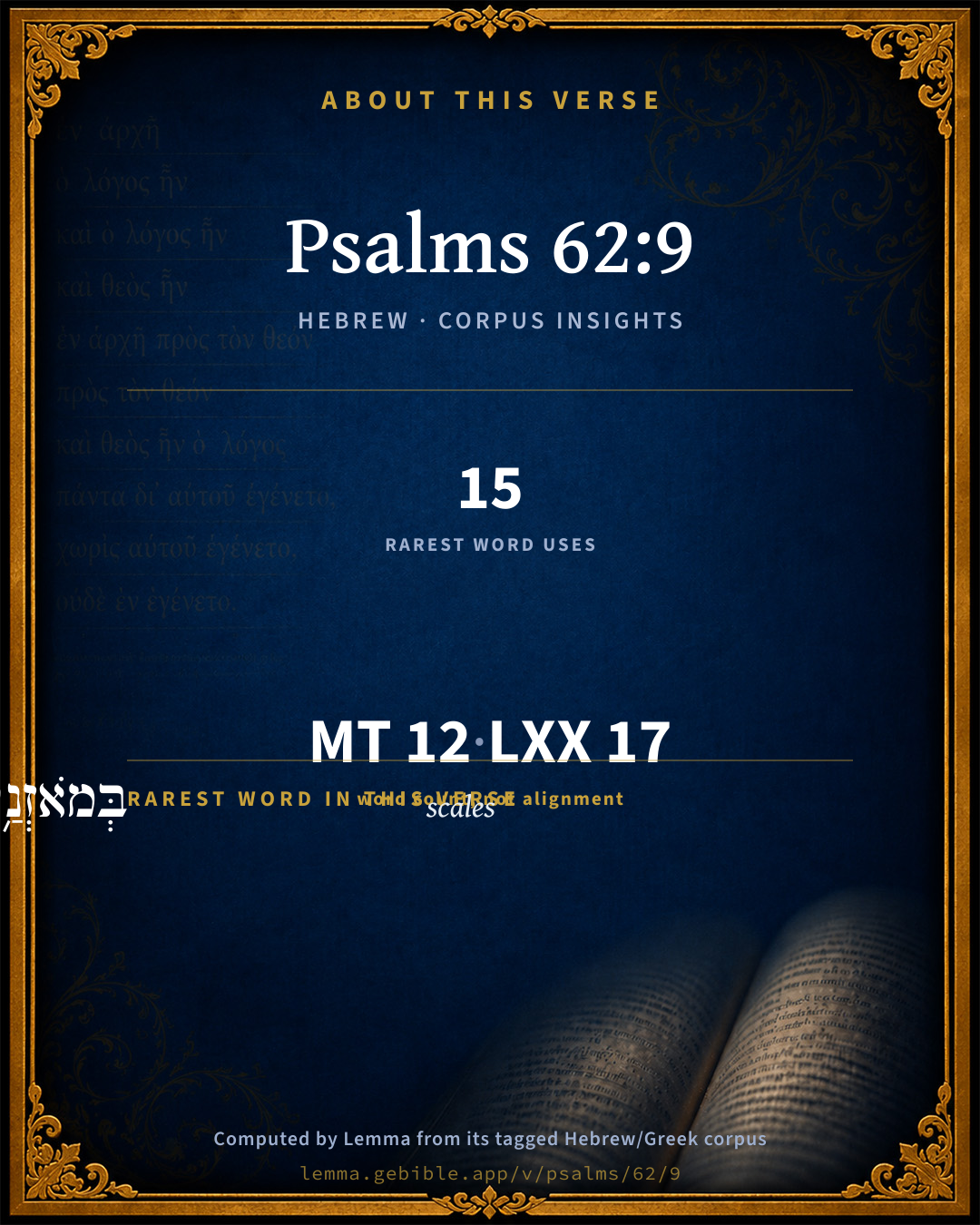
The rarest word here is בְּמֹאזְנַ֥יִם scales H3976 — appearing just 15 times in the whole Hebrew Bible.

Shared distinctive vocabulary

בְּמֹאזְנַ֥יִם scales H3976 occurs in 15 verses of the Hebrew Bible. Also found in:

Grammatical profile

  • 1 verb
  • 9 nouns
  • 1 pronoun
  • 1 particle

Verb forms

  • לַעֲל֑וֹת Qal · Infinitive Construct

Repetition

Words recur within this verse — often emphatic in Hebrew:

  • הֶ֥בֶל vapor H1892 ×2
  • בְּנֵֽי son H1121 ×2

Hebrew & Septuagint length

In English translation the verse runs 31 words from the Hebrew and 29 from the Septuagint (LXX English) — closely comparable.

A rough comparison of the two English renderings, which tokenize alike — not a word-level alignment.

Word counts can differ between the Hebrew and the Greek without any difference in meaning — e.g. the Hebrew direct-object marker אֵת has no separate Greek word, and Greek often adds the article ὁ.

In the original languages it is 12 Hebrew tokens and 17 Greek tokens — but the two are counted differently (Hebrew bundles its prefixes and suffixes into one token; the Greek is in lemma form), so that isn’t a like-for-like length.

Cross-references

19

Topical passages linked to Psalms 62:9 in the Treasury of Scripture Knowledge — connected by theme and wording, ordered by reader-vote popularity; previews shown in the World English Bible.

  • Psalms 39:5 Behold, you have made my days handbreadths. My lifetime is as nothing before you. Surely every man stands as a breath." Selah.
  • Isaiah 40:15 Behold, the nations are as a drop of a bucket, and are accounted as the small dust of the balance: Behold, he takes up the isles as a very little thing.
  • Isaiah 40:17 All the nations are as nothing before him; they are accounted by him as less than nothing, and vanity.
  • Psalms 118:9 It is better to take refuge in Yahweh, Than to put confidence in princes.
  • Psalms 39:11 When you rebuke and correct man for iniquity, You consume his wealth like a moth. Surely every man is but a breath." Selah.
  • 1 Samuel 18:5 David went out wherever Saul sent him, [and] behaved himself wisely: and Saul set him over the men of war, and it was good in the sight of all the people, and also in the sight of Saul's servants.
  • 1 Samuel 18:21–26 Saul said, I will give her to him, that she may be a snare to him, and that the hand of the Philistines may be against him. Therefore Saul said to David, You shall this day be my son-in-law a second time.
  • 1 Samuel 23:12 Then said David, Will the men of Keilah deliver up to me and my men into the hand of Saul? Yahweh said, They will deliver you up.
  • 1 Samuel 23:19–20 Then came up the Ziphites to Saul to Gibeah, saying, Doesn't David hide himself with us in the strongholds in the wood, in the hill of Hachilah, which is on the south of the desert?
  • 2 Samuel 15:6 In this manner Absalom did to all Israel who came to the king for judgment: so Absalom stole the hearts of the men of Israel.
  • 2 Samuel 15:31 One told David, saying, Ahithophel is among the conspirators with Absalom. David said, Yahweh, please turn the counsel of Ahithophel into foolishness.
  • Psalms 116:11 I said in my haste, "All men are liars."
  • Romans 3:4 May it never be! Yes, let God be found true, but every man a liar. As it is written, "That you might be justified in your words, And might prevail when you come into judgment."
  • 1 Samuel 18:7 The women sang one to another as they played, and said, Saul has slain his thousands, David his ten thousands.
  • 1 Samuel 26:21–25 Then said Saul, I have sinned: return, my son David; for I will no more do you harm, because my life was precious in your eyes this day: behold, I have played the fool, and have erred exceedingly.
  • Daniel 5:27 TEKEL; you are weighed in the balances, and are found wanting.
  • Matthew 21:9 The multitudes who went before him, and who followed kept shouting, "Hosanna to the son of David! Blessed is he who comes in the name of the Lord! Hosanna in the highest!"
  • John 19:15 They cried out, "Away with him! Away with him! Crucify him!" Pilate said to them, "Shall I crucify your King?" The chief priests answered, "We have no king but Caesar!"
  • Psalms 55:13–14 But it was you, a man like me, My companion, and my familiar friend.

Cross-references courtesy of OpenBible.info (CC BY 4.0).

Hebrew and Greek witnesses Masoretic Hebrew ↔ Greek Septuagint

The same verse in the two great witnesses to the Old Testament, shown verse-for-verse.

You’re reading Greek Psalm 61 (Hebrew Psalm 62). The Septuagint counts the superscription, so verse numbers can differ from the Hebrew — chapter-level alignment, not verse-by-verse. Numbering follows Rahlfs.

These are two independent witnesses, not word-aligned to each other, and the Septuagint is shown in lemma (dictionary) form.

Hebrew Psalms 62:9 Masoretic · Westminster Leningrad Codex

אַ֤ךְ הֶ֥בֶל בְּנֵֽי אָדָם֮ כָּזָ֪ב בְּנֵ֫י אִ֥ישׁ בְּמֹאזְנַ֥יִם לַעֲל֑וֹת הֵ֝֗מָּה מֵהֶ֥בֶל יָֽחַד

Surely men of low degree are just a breath, And men of high degree are a lie. In the balances they will go up. They are together lighter than a breath.

World English Bible · Public Domain

Greek LXX Greek Psalm 61:9 Septuagint · lemma form

ἐλπίζω ἐπί αὐτός πᾶς συναγωγή λαός ἐκχέω ἐνώπιον αὐτός ὁ καρδία σύ ὁ θεός βοηθός ἐγώ διάψαλμα

But the sons of men are vain; the sons of men are false, so as to be deceitful in the balances; they are all alike formed out of vanity.

LXX2012 (modern English Septuagint) · Public Domain

On this verse, Keil & Delitzsch discusses the Septuagint’s reading. Read the note in Commentary ↓

Hebrew: Westminster Leningrad Codex (CC BY 4.0). Greek: Septuagint (public domain); English from LXX2012 (modern English Septuagint) (Public Domain). How the Septuagint differs from the Hebrew →

Commentary

Notes on Psalms 62:9 from classic Christian and Jewish commentators (each source and its license shown beneath its notes). The classic Christian expositions comment on the surrounding passage and are grouped to its opening verse, so a note may address several verses; the Jewish commentaries on the Tanakh (Rashi and others) are per-verse, so they appear only where the commentator wrote on this verse.

Lemma curates 59 commentaries, every one of them public domain or Creative Commons licensed, each selected and text-cleaned for this edition rather than reprinted as found. About our sources →

Trapp's Complete Commentary

John Trapp

Psa 62:9 Surely men of low degree [are] vanity, [and] men of high degree [are] a lie: to be laid in the balance, they [are] altogether [lighter] than vanity.

Ver. 9. Surely men of low degree are vanity] Man is a depending creature, and, like the vine, must have somewhat to lean upon; apt he is to leave God, and cleave to the creature, to make either men or means his refuge; David therefore dehorteth from both, in this and the next verse showing that men of what degree soever are in nowise to be confided in. The word rendered vanity denoteth a vain light thing, such as is the breath of one’s mouth or a bubble on the water

Men of high degree are a lie] There is no more truth nor assurance in them than in a false tale; also they frustrate men’s hopes, as a barren fruit tree, Heb 3:17.

They are altogether, lighter,. &c.] Put all mankind into one bundle, into one balance, and vanity into the ether, and it will weigh them down, Ut ascendant ipsi prae vanitate simul.

John Trapp, A Commentary or Exposition upon All the Books of the Old and New Testament (1647–1656) — public domain. Text from a community e-Sword module.

Joseph Benson's Commentary

Psa 62:9. Surely men of low degree are vanity — Are most vain, impotent, and helpless creatures in themselves. This he delivers as a reason, or argument, to enforce his foregoing exhortation to trust in God, because there was no other person or thing to which they could safely trust. Men of high degree are a lie — That is, deceitful; because unable to perform what by their power and dignity they seem to promise. They raise men’s expectations, and afterward disappoint them, and so deceive those that trust in them. In which sense lying is ascribed to a fountain, Jer 15:18; to wine, Hos 9:2; and to the olive, Heb 3:17, (see the Hebrew,) when they do not give what they promise. Or, a lie may signify, a mere nothing; for a lie has no reality in it.

Joseph Benson's Commentary on the Old and New Testaments (1811–1818) — public domain. Text from a community e-Sword module.

J. A. Alexander on Psalms

Joseph Addison Alexander

10. (Psa 62:9). Only vanity (are) sons of Adam, a falsehood sons of man; in the scales (they are sure) to go up; they are of vanity (or less than vanity) together. As to the supposed antithesis between men of high and low degree in the first clause, see above, on Psa 4:2; Psa 49:2. Only vanity, see above, on Psa 39:5. A falsehood, something that deceives expectation, a false confidence. See above, on Psa 4:2. Of vanity, composed of it, containing nothing else; or giving the particle its frequent comparative sense, (less) than vanity, or (vainer) than vanity (itself). The same doubt exists as to the meaning of the similar expressions in Isa 40:17; Isa 41:24.

Joseph Addison Alexander, The Psalms Translated and Explained (1850) — public domain. Text from a community e-Sword module.

Tyndale Open Study Notes

Tyndale Open Resources

62:9-12 Unlike God, humans are transient beings. Even when they thrive, their prosperity is fleeting.

62:9 not what they appear to be: People often try to look stronger and better than they are.

Tyndale Open Study Notes — © Tyndale Open Resources, licensed CC BY-SA 4.0. Text via the HelloAO Bible API.

Jamieson, Fausset & Brown

Robert Jamieson, A. R. Fausset & David Brown

No kind of men are reliable, compared with God (Isa 2:22; Jer 17:5).

altogether--alike, one as the other (Psa 34:3).

Jamieson, Fausset & Brown — Commentary Critical and Explanatory on the Whole Bible (1871) — public domain (CC PDM 1.0). Text via the HelloAO Bible API.

Adam Clarke's Commentary

Verse 9. Men of low degree are vanity] בני אדם beney Adam, which we here translate men of low degree, literally, sons of Adam, are put in opposition to בני איש beney ish, men of high degree, literally, the sons of substance, or children of substantial men. Adam was the name of the first man when formed out of the earth; Ish was his name when united to his wife, and they became one flesh. Before, he was the incomplete man; after, he was the complete man; for it seems, in the sight of God, it requires the male and female to make one complete human being. אנוש enosh is another name given to man, but this concerns him in his low, fallen, wretched estate: it properly signifies weak, poor, addicted, wretched man.

Common men can give no help. They are vanity, and it is folly to trust in them; for although they may be willing, yet they have no ability to help you: "Rich men are a lie." They promise much, but perform nothing; they cause you to hope, but mock your expectation.

To be laid to the balance] במאזנים לעלות bemozenayim laaloth, In the balances they ascend: exactly answerable to our phrase, they kick the beam.

They are altogether lighter than vanity.] Literally, Both of them united are vanity, המה מהבל יחד hemmah mehebel yachad. Put both together in one scale, and truth in the opposite, and both will kick the beam. They weigh nothing, they avail nothing.

Adam Clarke's Commentary on the Bible (1810–1826) — public domain. Text from a community e-Sword/MySword module.

John Calvin's Commentaries

9. Nevertheless, the sons of Adam are vanity. If we take the particle אך, ach, affirmatively, as meaning surely or certainly, then this verse contains a confirmation of the truth expressed in the preceding verse; and David argues by contrast, that as men are lighter than vanity, we are shut up to the necessity of placing all our expectation upon God. It would agree well, however, with the contrast to suppose, that, under an impression of the little effect which the truth he had announced was calculated to have upon the people, (ever disposed to build upon fallacious hopes,) he exclaims, with a degree of holy fervor, Nevertheless, etc. According to this view, he is here administering a reproof to the blind infidelity so prevalent amongst men, and which leads them to deceive themselves with lying vanities rather than trust in the infallible promises of Jehovah. Having had occasion to discover such a large amount of vanity in the chosen seed of Abraham, he does not scruple to speak of the whole human family in general as being abandoned to lying delusions. The adverb יחד, yachad, together, intimates that all, without exception, are ready to find an occasion of turning aside. Such is the sweeping condemnation passed, not upon a few individuals, but upon human nature, declaring men to be lighter than vanity; and may we not ask what in this case becomes of boasted reason, wisdom, and free-will? It is of no avail to object, that believers are delivered from the deceit which is here condemned. If they owe their exemption from lying and vanity to the regeneration of the Spirit, this is to grant that they were subject to these in their natural state. The first man was created by God upright, but drew us by his fall into such a depth of corruption, that any light which was originally bestowed has been totally obscured. Is it alleged that there still remain in man such gifts of God as are not to be despised, and as distinguish him from all the other creatures, this is easily answered, by remembering, that however great these may be, he is tainted by sin, and therefore nothing to be accounted of. It is only when allied with the knowledge of God that any of the endowments conferred upon us from above can be said to have a real excellency; — apart from this, they are vitiated by that contagion of sin which has not left a vestige in man of his original integrity. With too much justice, then, might David say that all men are vanity and nothingness.

John Calvin's Commentaries (1540-1563) — public domain. Text from the Calvin Translation Society English edition (1840s-50s) via the Christian Classics Ethereal Library (ccel.org). Calvin's coverage is partial (roughly two-thirds of the Bible); uncommented books and verses are honest gaps, never fabricated. The 19th-century editor's footnotes and remarks are omitted so the notes are faithfully Calvin's own voice.

Ellicott's Commentary for English Readers

(9) Are vanity.—Or, mere breath.

To be laid in the balance.—Literally, in the balances to go up, which may mean in the scales they must go up, i.e., kick the beam. But a slight change in one letter gives the more probable, when weighed in the scales.

A Bible Commentary for English Readers, edited by Charles John Ellicott (1878–1897) — public domain. Text from a community e-Sword module.

The Cambridge Bible for Schools and Colleges

gen. ed. J. J. S. Perowne

9. Surely] Lit., as before, only. Nought but vanity are men, (nought but) a lie are great men. Only a mere breath which vanishes, an imposture which deludes those who trust them, are all men, whatever may be their rank. For the phrases bnç âdâm, bnç îsh, ‘low’ and ‘high,’ see Psa_49:2. In Psa_4:2 Absalom’s followers are termed bnç îsh: waverers would be influenced by seeing the number of leading men on his side. The same phrase nought but vanity is used in Psa_39:5; Psa_39:11, to describe the transitoriness and unsubstantiality of man, but the point is wholly different.

to be laid in the balance &c.] In the balances they will go up, they are altogether of vanity. They spring from and consist of mere breath (Isa_41:24): put them in the scale, it flies up, for they have no weight or substance. The rendering ‘lighter than vanity’ is possible but less probable.

9–12. Trust in God, I say, and not in man or in material force. God’s strength and love are the guarantee for the punishment of the wicked and the reward of the righteous.

The Cambridge Bible for Schools and Colleges (gen. ed. J. J. S. Perowne; Cambridge University Press, 1878–1918) — public domain. Text from a community e-Sword module.

John Gill's Exposition

Surely men of low degree are vanity,.... Or "sons of Adam" (i); of the earthly man; of fallen Adam; one of his immediate sons was called Hebel, "vanity"; and it is true of all his sons; but here it designs only one sort of them; such as are poor and low in the world; mean men, as the phrase is rendered in Isa 2:9; See Gill on Psa 49:2; these are subject to sinful vanity; their thoughts are vain, their affections vain, their minds vain, their conversation vain, sinful, foolish, fallacious, and inconstant. The wicked poor are, generally speaking, of all persons, the most wicked; and therefore, though they are the multitude, they are not to be trusted in. The Arabic version is, they are as a "shadow", fleeting and unstable, no solidity in them; the Syriac version, "as a vapour", that soon passeth away, like the breath of the mouth, and so not to be accounted of;

and men of high degree are a lie; or "sons of men"; of "the great man" (k), as it is rendered in Isa 2:9, noblemen, men of high birth, fortune, rank, and quality; these are a "lie", fallacious and deceitful: they talk of their blood, as if it was different from the rest of mankind; but, trace them up to their original, Adam, and it is a lie. All men are made of one blood, Act 17:26; their riches promise them peace and pleasure, and long life, but do not give those things, Luk 12:16; their honour is fickle and inconstant; they are act in high places, and those are slippery ones; they are brought to desolation in a moment; and if they continue in them till death, their glory does not descend after them, Psa 49:17; they make promises of great things to those who apply to them, but rarely perform, and are by no means to be confided in. This distinction of high and low degree is observed in Jam 1:9;

to be laid in the balance, they are altogether lighter than vanity; take a pair of balances, and put men both of high and low degree together in one scale, and vanity in the other, vanity will weigh heaviest; the scale in which men are will go up, as the word (l) here used signifies: they are "in the balances to ascend"; or being put in the balances, they will ascend, and the scale in which vanity is will go down; for, take them altogether, they are "lighter" than that: the word "lighter" is not in the text, but is rightly supplied, as it is by Aben Ezra, Kimchi, and Ben Melech. This last clause, according to the accents, may be best rendered thus; being put "in the balance, they must ascend; they are lighter than vanity together". The Targum is,

"if they should take the sons of men in a balance, and weigh their fates, they themselves would be "lighter" than nothing, as one;''

or than vanity together.

(i) "filii Adam", Musculus, Michaelis; "nati plebeio homine", Junius & Tremellius; "plebeii", Gejerus; "sons of base men", Ainsworth. (k) "nati praestante viro", Junius & Tremellius; "sons of noble men", Ainsworth. Vid. Schindler. col. 214. (l) "ascendant", Pagninus, Cocceius; so Musculus, Junius & Tremellius, &c.

John Gill's Exposition of the Whole Bible (1746–1763) — public domain (CC PDM 1.0). Text via the HelloAO Bible API.

Albert Barnes' Notes on the Bible

Surely men of low degree are vanity - literally, “vanity are the sons of Adam,” but the word Adam here is used evidently to represent men, or the race. The same word is also employed particularly to represent common men, or men of the humbler rank, in contradistinction to the word אישׁ 'ı̂ysh - which is the other word used here, and rendered “men of high degree.” Compare, for this use of the word, Hos 6:7. The same antithesis between the two words is found in Isa 2:9; Isa 5:15. The idea here is, that in the great matters which pertain to us, we cannot depend on men, and that our hope - our trust - must be in God. Of men of the humbler or lower classes, it is said that they are “vanity;” that is, they are like a vain, empty, unsubstantial thing. They cannot help us. It is useless to rely on them when we most need aid.

Men of high degree are a lie - Men of exalted rank, kings, princes, nobles. This does not refer to their personal character, as if they were always false, deceitful, treacherous; but the idea is, that any prospect of protection or aid from men of rank and station - front any power which they wield - is unworthy to be relied on. It is not that which we need; it is not that on which we can depend.

To be laid in the balance - literally, “In the scales to go up;” that is, they are seen to go up, or to show how light they are. They have no real weight; no real value. On the scales or balance, see the notes at Dan 5:27.

They are altogether lighter than vanity - They are all vain; single or combined, they have no power to save us. The meaning is not that if these two ranks of persons were weighed against each other they would both be found to be vanity; but that it is true of each and every rank of men - high and low - whether single or combined - that, as weighed against our interests and needs, they are nothing. All the kings of the earth with all their hosts of war, all princes and nobles with all that they can summon from the lower ranks of their people, cannot save one soul from death - cannot deliver us from the consequences of our transgressions. God, and God alone, can do this.

Albert Barnes' Notes on the Bible (1834–1885) — public domain. Text from a community e-Sword/MySword module.

Matthew Poole's English Annotations

Vanity, i.e. most vain, impotent, and helpless creatures in themselves. This he delivers as a reason or argument to enforce his foregoing exhortation; trust in God, because there is no other person or thing to which you can safely trust.

A lie, because they promise much, and raise men’s expectations upon consideration of their great power and dignity, but are not able to perform, and generally deceive those who trust in them; in which respect lying is ascribed to a fountain, Jer 15:18, to wine, Hos 9:2, to the olive, Hab 3:17, when they do not give what they promise.

Matthew Poole's English Annotations on the Holy Bible (1683–1685) — public domain. Text from a community e-Sword/MySword module.

The Treasury of David

Charles H. Spurgeon

Ver. 9. Surely men of low degree are vanity. Here the word is only again; men of low degree are only vanity, nothing more. They are many and enthusiastic, but they are not to be depended on; they are mobile as the waves of the sea, ready to be driven to and fro by any and every wind; they cry "Hosanna" today, and "Crucify him" tomorrow. The instability of popular applause is a proverb; as well build a house with smoke as find comfort in the adulation of the multitude. As the first son of Adam was called Abel or vanity, so here we are taught that all the sons of Adam are Abels: it were well if they were all so in character as well as in name; but alas! in this respect, too many of them are Cains.

And men of high degree are a lie. That is worse. We gain little by putting our trust in the aristocracy, they are not one whit better than the democracy: nay, they are even worse, for we expect something from them, but get nothing. May we not trust the elite? Surely reliance may be placed in the educated, the chivalrous, the intelligent? For this reason are they a lie; because they promise so much, and in the end, when relied upon, yield nothing but disappointment. How wretched is that poor man who puts his trust in princes. The more we rely upon God, the more shall we perceive the utter hollowness of every other confidence.

To be laid in the balance, they are altogether lighter than vanity. Take a true estimate of them; judge them neither by quantity nor by appearance, but by weight, and they will no longer deceive you. Calmly deliberate, quietly ponder, and your verdict will be that which inspiration here records. Vainer than vanity itself are all human confidences: the great and the mean, alike, are unworthy of our trust. A feather has some weight in the scale, vanity has none, and creature confidence has less than that: yet such is the universal infatuation, that mankind prefer an arm of flesh to the power of the invisible but almighty Creator; and even God's own children are too apt to be bitten with this madness.

Ver. 9. Other doctrines, moral or civil instructions, may be delivered to us possibly, and probably, and likely, and credibly, and under the like terms and modifications, but this in our text, is assuredly, undoubtedly, undeniably, irrefragably, Surely men of low degree, etc. For howsoever when they two are compared together with one another, it may admit discourse and disputation, whether men of high degree, or of low degree, do most violate the laws of God; that is, whether prosperity or adversity make men most obnoxious to sin; yet, when they come to be compared, not with one another, but both with God, this asseveration, this surely reaches to both: "Surely men of low degree are vanity, and, as surely, men of high degree are a lie." And though this may seem to leave room for men of middle ranks, and fortunes, and places, that there is a mediocrity that might give an assurance, and an establishment, yet there is no such thing in this case; (as surely still) to be laid in the balance, they are all (not of low, and all of high degree, all rich, and all poor), but all, of all conditions, altogether lighter than vanity. Now, all this doth destroy, not extinguish, not annihilate, that affection in man, of hope and trust, and confidence in anything; but it rectifies that hope, and trust, and confidence, and directs it upon the right object. Trust not in flesh, but in spiritual things, that we neither bend our hope downward, to infernal spirits, to seek help in witches; nor miscarry it upward, to seek it in saints or angels, but fix it in him who is nearer to us than our own souls--our blessed, and gracious, and powerful God, who in this one Psalm is presented unto us by so many names of assurance and confidence: "my expectation, my salvation, my rock, my defence, my glory, my strength, my refuge, "and the rest... Men of high degree are a lie. The Holy Ghost hath been pleased to vary the phrase here, and to call men of high degree not "vanity, " but a lie; because the poor, men of low degree, in their condition promise no assistance, feed not men with hope, and therefore cannot be said to lie; but in the condition of men of high degree, who are of power, there is a tacit promise, a natural and inherent assurance of protection and assistance flowing from them. For the magistrate cannot say that he never promised me justice, never promised me protection; for in his assuming that place, he made me that promise. I cannot say that I never promised my parish my service; for in my induction I made them that promise, and if I perform it not I am a lie: for so this word chasab (which we translate a lie) is frequently used in the Scriptures, for that which is defective in the duty it should perform: "Thou shalt be a spring of water" (says God in Isaiah), cujus aquae non mentiuntur, "whose waters never lie; "that is, never dry, never fail. So, then, when men of high degree do not perform the duties of their places, then they are a lie of their own making; and when I over magnify them in their place, flatter them, humour them, ascribe more to them, expect more from them, rely more upon them than I should, then they are a lie of my making... To be laid in the balance, they are altogether lighter than vanity. Vanity is nothing, but there is a condition worse than nothing. Confidence in the things or persons of this world, but most of all a confidence in ourselves, will bring us at last to that state wherein we would fain be nothing, and cannot. But yet we have a balance in our text; and all these are but put together in one balance. In the other scale there is something put too, in comparison whereof all this world is so light. God does not leave our great and noble faculty and affection of hope, and trust, and confidence without something to direct itself upon, and rectify itself in. He does not: for, for that he proposes himself. The words immediately before the text are, God is a refuge; and, in comparison of him, To be laid in the balance, they are altogether lighter than vanity. John Donne.

Ver. 9. Surely men of low degree are vanity.

"Who over the herd would wish to reign,

Fantastic, fickle, fierce, and vain!

Vain as the leaf upon the stream,

And fickle as a changeful dream;

Fantastic as a woman's mood,

And fierce as Frenzy's fevered blood,

Thou many headed monster thing,

O, who would wish to be thy king!" Walter Scott (1771-1832).

Ver. 9. Surely men of low degree are vanity, etc. Or, sons of Adam; of the earthly man; of fallen Adam; one of his immediate sons was called Hebel, vanity; and it is true of all his sons, but here it designs only one sort of them; such as are poor and low in the world; mean men, as the phrase is rendered in Isa 2:9; these are subject to sinful vanity; their thoughts are vain, their affections vain, their minds vain, their conversation vain, sinful, foolish, fallacious, and inconstant. John Gill.

Ver. 9. Men... are a lie. An active lie--they deceive others; and a passive lie--they are deceived by others; and they who are most actively a lie, are most usually and most deservedly a passive lie, or fed with lies. Joseph Caryl.

Ver. 9. Lighter than vanity. If there were any one among men immortal, not liable to sin, or change, whom it were impossible for any one to overcome, but who was strong as an angel, such a one might be something; but inasmuch as every one is a man, a sinner, mortal, weak, liable to sickness and death, exposed to pain and terror, like Pharaoh, even from the most insignificant animals, and liable to so many miseries that it is impossible to count them, the conclusion must be a valid one: "Man is nothing." Arndt.

None.

Psalms 62:10*

Charles H. Spurgeon's The Treasury of David (1869–1885) — public domain. Psalms only. Text from a community e-Sword/MySword module.

Whedon's Commentary on the Bible

Daniel D. Whedon

9. Men of low degree… high degree—Men of all degrees, as Psa_49:2. The first designation denotes in the Hebrew the masses of our race as descendants of Adam; the second, those classes which have attained distinction on account of rank, wealth, or other circumstances. These all, apart from God, and of themselves considered as sources of help or objects of trust, are, the first class, vanity, the second, a lie.

To be laid in the balance—Literally, going up, or ascending in the balance, as being the lighter scale.

Altogether lighter than vanity—The meaning is: Put every one of them together in one scale of the balance, and vanity, or a breath, in the other, and they would mount up, as less than a breath. This estimate is not of man as God made him, but of man as sin and selfishness have corrupted him. It is man apart from God, and fighting against God, and fitly applies to Absalom with his accomplices, and the thoughtless multitude that follow them.

Daniel D. Whedon (gen. ed.), Commentary on the Old and New Testaments (1874–1909) — public domain. Text from a community e-Sword module.

The Pulpit Commentary

Vers. 9-12. the psalmist becomes didactic" (Professor Cheyne). He encourages the faithful, and warns the wicked, by the declaration that men of every sort "are but vanity have no strength, no permanence while power belongs only to God. Those who "oppress" and "rob" are, consequently, not to be feared there is no strength in riches God alone determines the issues of things. Unto him belongs mercy, or loving kindness a quality which leads him not only to forgive men their transgressions, but to "reward" them, when, by his assisting grace, they have done good works.

Surely men of low degree are vanity, and men of high degree are a lie; rather, only vanity or, nought but vanity are men of low degree; common men, as we call them mere sons of Adam. This is too evident for dispute; but, in the view of the psalmist, this is not the worst. "Men of high degree" (beney ish) are no better they are "a lie an unreality a fading, false illusion. To be laid in the balance; rather, in the balance, they go up (Hupfeld, Ewald Hitzig, Revised Version). They are altogether lighter than vanity; or, altogether made out of vanity (Kay); i.e. there is no substance, no solidity, in them.

"Laid in the balance.

I RANK. Precedence among men does not depend on moral worth. It is a matter of etiquette. The man of "low degree" before men may be of "high degree" before God. The man who gets the "lowest place" in the great houses of this world may sit in the highest place in the kingdom of God. "Knighthoods and honours borne without desert are titles but of scorn" (Shakespeare). The true honour is that which cometh from God only.

II RICHES. Most people would like to be rich. In this, as in other matters, there is a right way and a wrong way. It is hinted (ver. 10) that if riches increase, it may be by "oppression" and "robbery." But though they should be obtained lawfully, they bring great responsibilities and risks, and often prove a delusion and a mockery. (1Ti_6:9) The true riches are not in the hand, but in the heart; not in the abundance of things outward, but in faith and love and good works in being "rich toward God". (Luk_12:21)

III REFUTATION. What others think of us is of importance. It so far settles our place and our influence in society. But the judgment of men is not the judgment of God. In the world, in society, in the Church, our reputation may stand high, but if our reputation and our character which is what we are really and in the sight of God do not agree, we are but hypocrites and liars. "Except your righteousness shall exceed the righteousness of the scribes and Pharisees, ye shall in no case enter into the kingdom of God". W.F. (Mat_5:20)

The Pulpit Commentary (1880–1919), ed. H.D.M. Spence-Jones & Joseph S. Exell — public domain. Text from a community e-Sword module.

John Wesley's Explanatory Notes

Vanity - Vain, and helpless creatures. A lie - They promise much, but generally deceive those who trust in them.

John Wesley, Explanatory Notes Upon the Whole Bible (1754–1765) — public domain. Text via the GEBible commentary corpus.

Keil & Delitzsch

C. F. Keil & F. Delitzsch

Just as all men with everything earthly upon which they rely are perishable, so also the purely earthly form which the new kingship has assumed carries within itself the germ of ruin; and God will decide as Judge, between the dethroned and the usurpers, in accordance with the relationship in which they stand to Him. This is the internal connection of the third group with the two preceding ones. By means of the strophe vv. 10-13, our Psalm is brought into the closest reciprocal relationship with Psa 39:1-13. Concerning בּני־אדם and בּני־אישׁ vid., on Psa 49:3; Psa 4:3. The accentuation divides Psa 62:10 quite correctly. The Athnach does not mark בּמאזנים לעלות as an independent clause: they are upon the balance לעלות, for a going up; they must rise, so light are they (Hengstenberg). Certainly this expression of the periphrastic future is possible (vid., on Psa 25:14; Psa 1:1-6 :17), still we feel the want here of the subject, which cannot be dispensed within the clause as an independent one. Since, however, the combining of the words with what follows is forbidden by the fact that the infinitive with ל in the sense of the ablat. gerund. always comes after the principal clause, not before it (Ew. 280, d), we interpret: upon the balances ad ascendendum = certo ascensuri, and in fact so that this is an attributive that is co-ordinate with כּזב. Is the clause following now meant to affirm that men, one and all, belong to nothingness or vanity (מן partitivum), or that they are less than nothing (מן comparat.)? Umbreit, Stier, and others explain Isa 40:17 also in the latter way; but parallels like Isa 41:24 do not favour this rendering, and such as Isa 44:11 are opposed to it. So also here the meaning is not that men stand under the category of that which is worthless or vain, but that they belong to the domain of the worthless or vain.

The warning in Psa 62:11 does not refer to the Absalomites, but, pointing to these as furnishing a salutary example, to those who, at the sight of the prosperous condition and joyous life on that side, might perhaps be seized with envy and covetousness. Beside בּטח בּ the meaning of הבל בּ is nevertheless not: to set in vain hope upon anything (for the idea of hoping does not exist in this verb in itself, Job 27:12; Jer 2:5, nor in this construction of the verb), but: to be befooled, blinded by something vain (Hitzig). Just as they are not to suffer their heart to be befooled by their own unjust acquisition, so also are they not, when the property of others increases (נוּב, root נב, to raise one's self, to mount up; cf. Arabic nabata, to sprout up, grow; nabara, to raise; intransitive, to increase, and many other verbal stems), to turn their heart towards it, as though it were something great and fortunate, that merited special attention and commanded respect. Two great truths are divinely attested to the poet. It is not to be rendered: once hath God spoken, now twice (Job 40:5; Kg2 6:10) have I heard this; but after Psa 89:36 : One thing hath God spoken, two things (it is) that I have heard; or in accordance with the interpunction, which here, as in Psa 12:8 (cf. on Psa 9:16), is not to be called in question: these two things have I heard. Two divine utterances actually do follow. The two great truths are: (1) that God has the power over everything earthly, that consequently nothing takes place without Him, and that whatever is opposed to Him must sooner or later succumb; (2) that of this very God, the sovereign Lord (אדני), is mercy also, the energy of which is measured by His omnipotence, and which does not suffer him to succumb upon whom it is bestowed. With כּי the poet establishes these two revealed maxims which God has impressed upon his mind, from His righteous government as displayed in the history of men. He recompenses each one in accordance with his doing, κατὰ τὰ ἔργα αὐτοῦ, as Paul confesses (Rom 2:6) no less than David, and even (vid., lxx) in the words of David. It shall be recompensed unto every man according to his conduct, which is the issue of his relationship to God. He who rises in opposition to the will and order of God, shall feel God's power (עז) as a power for punishment that dashes in pieces; and he who, anxious for salvation, resigns his own will to the will of God, receives from God's mercy or loving-kindness (חסד), as from an overflowing fulness, the promised reward of faithfulness: his resignation becomes experience, and his hoping attainment.

Keil & Delitzsch — Biblical Commentary on the Old Testament (1861–1891) — public domain (CC PDM 1.0). Text via the HelloAO Bible API. (Old Testament only.)

unfoldingWord translationNotes

Door43 World Missions Community

men of low standing ... men of high standing are a lie

This refers to men of all levels of wealth and importance. The phrases "are vanity" and "are a lie" have the same meaning. One cannot confidently trust in anyone. AT: "you cannot place your trust in men, no matter how important they are" (See: Merism and Parallelism)

weighed together, they are lighter than nothing

If you put all of these kinds of men together on a scale, they would have no weight. This means that they have no real value to you.

oppression or robbery

These two words have basically the same meaning. You cannot trust in money that you get by taking it from other people. (See: Doublet)

for they will bear no fruit

The writer speaks of riches as if they were trees or vines that could bear fruit. AT: "for they will provide nothing good for you" (See: Metaphor)

do not fix your heart on them

Here "fix your heart" is an idiom that means to desire something greatly. AT: "do not desire them" (See: Idiom)

translationWords

vain

oppress

hope

fruit

unfoldingWord translationNotes — © Distant Shores Media and the Door43 World Missions Community, licensed CC BY-SA 4.0. Source: git.door43.org/Door43/en_tn.

Lesson kit

Teaching starters — assembled from the data on this page, not authored interpretation. Every prompt links to the verse data it draws on. Edit before teaching.

Psalms, in the Wisdom, opens this verse with 12 words (10 distinct Hebrew lemmas). Its most distinctive word is môʼzên (“scales”). A historical commentator’s framing appears above. Read the whole chapter for the surrounding context.

Discussion questions

  1. The word môʼzên carries the sense “scales.” How does it shape the verse?
  2. How does Leviticus 19:36, which shares the word «scales», read alongside this verse?
  3. What does the repetition of “vapor” (2× in this one verse) do in this verse?
  4. The translations on this page render this verse differently — a whole-verse word diff, not a word-by-word alignment. What might account for the different wordings?
  5. «לַעֲל֑וֹת» is a Qal Infinitive Construct verb. How does that grammatical form shape the action described?
  6. Compare how Trapp's Complete Commentary and Joseph Benson's Commentary read this verse. Where do they agree or differ?

Things to notice

Reading settings

Reading text

Shown beneath each verse's original-language words.

Old Testament
Old Testament edition

Read the OT as the Masoretic Hebrew (MT) or the Greek Septuagint (LXX).

English shown for the Greek Septuagint (in the Hebrew ↔ Greek comparison).

Comparing translations? Open the Compare panel on any verse page to stack up to four side by side.