
Psalms 144:4

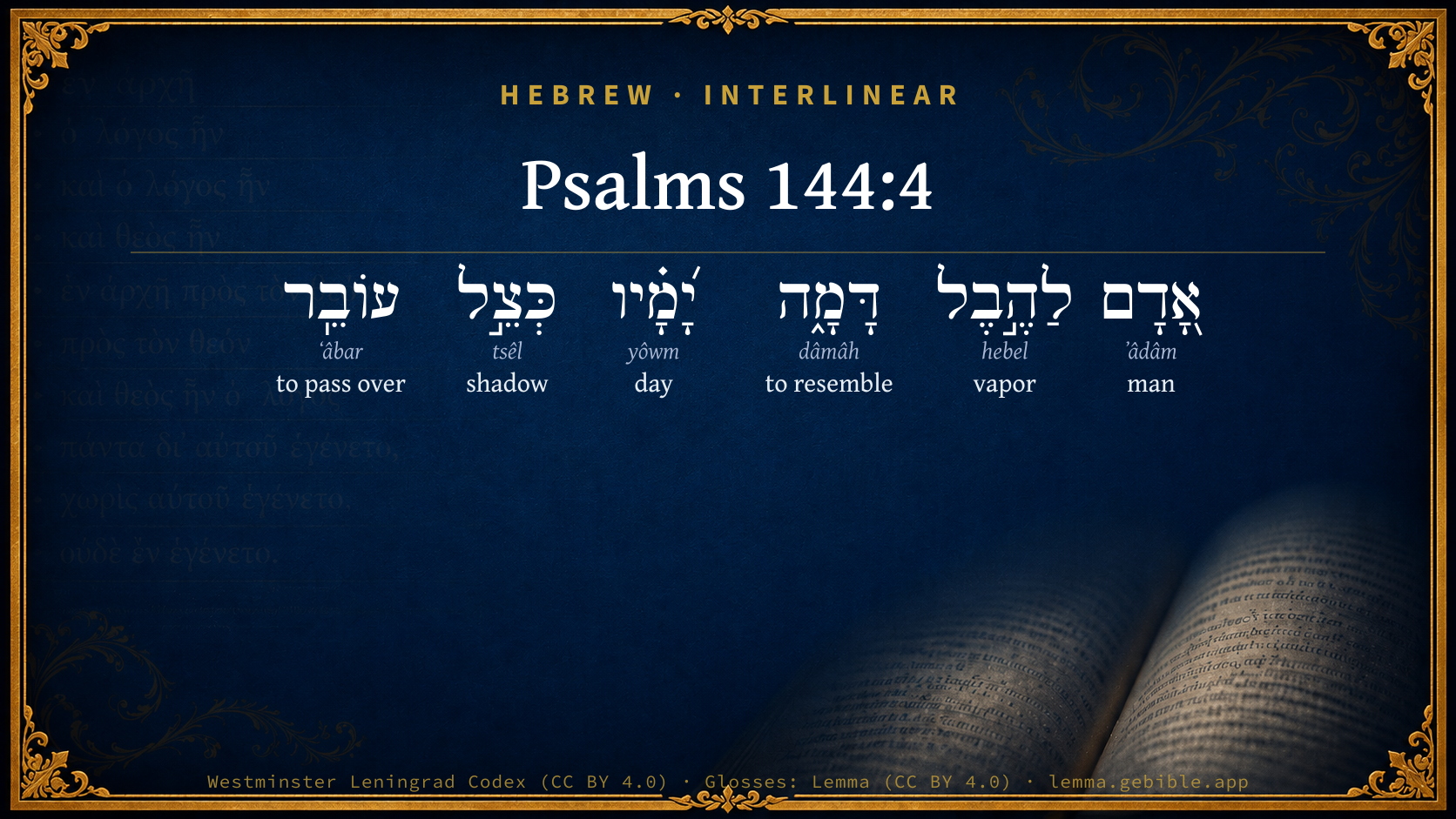
Hebrew (Westminster Leningrad Codex) Psalms 144:4 appears in the Hebrew Old Testament. The text above is from the Westminster Leningrad Codex. Each word links to its Strong’s number, a concise gloss, and parsing drawn from the Open Scriptures Hebrew Bible morphology. Click any word for its full Brown-Driver-Briggs (BDB) entry.
Download image
Cite this verse

Psalms 144:4 (World English Bible). Public Domain. Lemma interlinear Bible study tool, https://lemma.gebible.app/v/psalms/144/4.

Show BibTeX & RIS
BibTeX
RIS
English Translation
Man is like a breath. His days are like a shadow that passes away.
World English Bible · Public Domain
Download a study sheet

One document with this verse’s original text, its word-by-word gloss line, the meaning frame, cross-references with their text, attributed commentary, and full source and license credits — printable, and it pastes into notes with its structure intact.

This verse Autodidact and up

Study sheet (.html) Plain text (.txt)

A passage Seminary Student

Up to 50 verses in one chapter. A passage sheet keeps up to 6 commentary sources and 12 cross-references per verse, in the order this page ranks them, and says so on the sheet whenever that leaves anything out. Ask for a single verse and you get the Autodidact verse sheet above.

Everything on this page stays free to read, with no account — the sheet is a download of what is already on screen, not access to it.

Want to remove ads? Support Godless Engineer
Compare translations 3

The same verse in 3 English versions, stacked beneath the original-language interlinear above. Click any original word for its lexicon entry.

Each is an independent rendering of the whole verse — the interlinear is not word-aligned to these translations.

Highlighted words mark where these versions differ — a whole-verse word diff, not a word-by-word alignment.

  • World English Bible Public Domain
    Man is like a breath. His days are like a shadow that passes away.
  • King James Version Public Domain
    Man is like to vanity: his days are as a shadow that passeth away.
  • unfoldingWord Literal Text CC BY-SA 4.0
    Man compares to vapor; his days like a passing shadow.

unfoldingWord Literal Text — © unfoldingWord, licensed CC BY-SA 4.0. Word-aligned USFM3 via Door43 (git.door43.org/unfoldingWord/en_ult).

Versions to compare (up to 4)

3 of 4 selected

Show all 18 translations

Every available English version of this verse, each an independent rendering of the whole verse.

  • World English Bible Public Domain
    Man is like a breath. His days are like a shadow that passes away.
  • Berean Standard Bible Public Domain
    Man is like a breath; his days are like a passing shadow.
  • Majority Standard Bible Public Domain
    Man is like a breath; his days are like a passing shadow.
  • King James Version Public Domain
    Man is like to vanity: his days are as a shadow that passeth away.
  • American Standard Version (1901) Public Domain
    Man is like to vanity: His days are as a shadow that passeth away.
  • Revised Version (1885) Public Domain
    Man is like to vanity: his days are as a shadow that passeth away.
  • Geneva Bible (1599) Public Domain
    Man is like to vanitie: his dayes are like a shadow, that vanisheth.
  • Douay-Rheims (1899) Public Domain
    and my spirit is in anguish within me: my heart within me is troubled.
  • Young's Literal Translation Public Domain
    Man to vanity hath been like, His days `are' as a shadow passing by.
  • Literal Standard Version CC BY-SA 4.0
    Man has been like a breath, || His days [are] as a shadow passing by.
  • Unlocked Literal Bible CC BY-SA 4.0
    Man is like a breath; his days are like a passing shadow.
  • unfoldingWord Literal Text CC BY-SA 4.0
    Man compares to vapor; his days like a passing shadow.
  • Darby Bible Public Domain
    Man is like to vanity; his days are as a shadow that passeth away.
  • World Messianic Bible Public Domain
    Man is like a breath. His days are like a shadow that passes away.
  • Webster's Bible Public Domain
    Man is like to vanity: his days are as a shadow that passeth away.
  • Free Bible Version CC BY-SA 4.0
    Humanity is like a breath; their lives are like a passing shadow.
  • Bible in Basic English Public Domain
    Man is like a breath: his life is like a shade which is quickly gone.
  • JPS Tanakh (1917) Public Domain
    Man is like unto a breath; his days are as a shadow that passeth away.

Literal Standard Version (2020), Covenant Press — licensed CC BY-SA 4.0. Text via the HelloAO Bible API (eBible.org). Unlocked Literal Bible (unfoldingWord) — licensed CC BY-SA 4.0. Text via the HelloAO Bible API (eBible.org). unfoldingWord Literal Text — © unfoldingWord, licensed CC BY-SA 4.0. Word-aligned USFM3 via Door43 (git.door43.org/unfoldingWord/en_ult). Free Bible Version, Dr. Jonathan Gallagher — licensed CC BY-SA 4.0. Text via the HelloAO Bible API (eBible.org).

Word by word

More ways to search: Search by grammar → Find every occurrence → Compare this word →

Practice this passage: Drill this verse → Learn its vocabulary →

About this verse

These counts appear in no published source. They are computed here, from the morphology-tagged text and Lemma’s own curated glosses. What Lemma adds →

6
words
6
distinct lemmas
Wisdom
section

Shared distinctive vocabulary

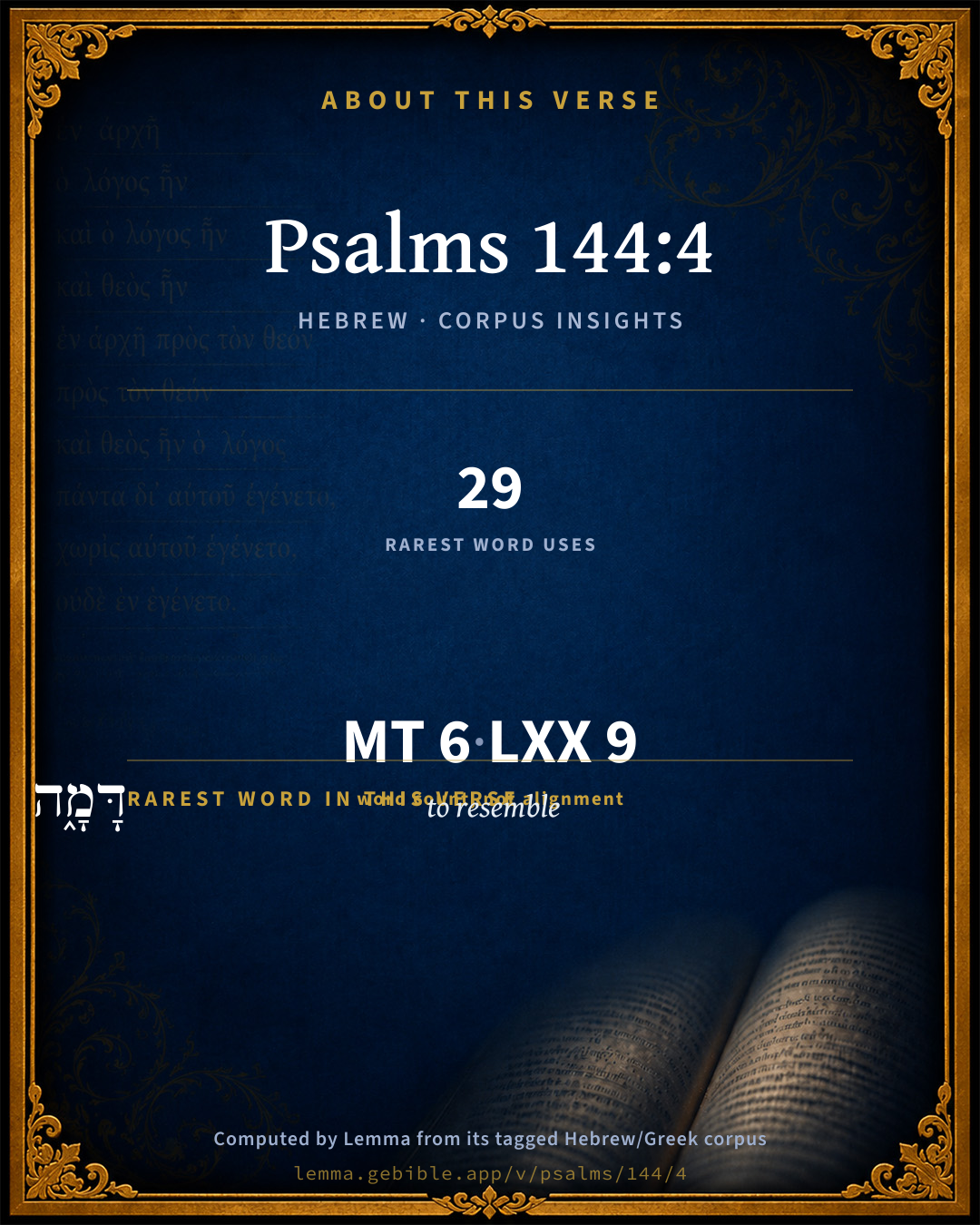
דָּמָ֑ה to resemble H1819 occurs in 27 verses of the Hebrew Bible. Also found in:

Grammatical profile

  • 2 verbs
  • 4 nouns

Verb forms

  • דָּמָ֑ה Qal · Perfect
  • עוֹבֵֽר Qal · Participle Active

Hebrew & Septuagint length

In English translation the verse runs 14 words from the Hebrew and 11 from the Septuagint (LXX English) — closely comparable.

A rough comparison of the two English renderings, which tokenize alike — not a word-level alignment.

Word counts can differ between the Hebrew and the Greek without any difference in meaning — e.g. the Hebrew direct-object marker אֵת has no separate Greek word, and Greek often adds the article ὁ.

In the original languages it is 6 Hebrew tokens and 9 Greek tokens — but the two are counted differently (Hebrew bundles its prefixes and suffixes into one token; the Greek is in lemma form), so that isn’t a like-for-like length.

Cross-references

16

Topical passages linked to Psalms 144:4 in the Treasury of Scripture Knowledge — connected by theme and wording, ordered by reader-vote popularity; previews shown in the World English Bible.

  • Psalms 102:11 My days are like a long shadow. I have withered like grass.
  • Job 8:9 (For we are but of yesterday, and know nothing, Because our days on earth are a shadow.)
  • Psalms 39:5–6 Behold, you have made my days handbreadths. My lifetime is as nothing before you. Surely every man stands as a breath." Selah.
  • Psalms 109:23 I fade away like an evening shadow. I am shaken off like a locust.
  • 2 Samuel 14:14 For we must needs die, and are as water split on the ground, which can't be gathered up again; neither does God take away life, but devises means, that he who is banished not be an outcast from him.
  • Ecclesiastes 12:8 Vanity of vanities, says the Preacher; All is vanity!
  • 1 Chronicles 29:15 For we are strangers before you, and foreigners, as all our fathers were: our days on the earth are as a shadow, and there is no abiding.
  • Job 14:1–3 "Man, who is born of a woman, Is of few days, and full of trouble.
  • Psalms 39:11 When you rebuke and correct man for iniquity, You consume his wealth like a moth. Surely every man is but a breath." Selah.
  • Psalms 62:9 Surely men of low degree are just a breath, And men of high degree are a lie. In the balances they will go up. They are together lighter than a breath.
  • Psalms 89:47 Remember how short my time is! For what vanity have you created all the children of men!
  • Psalms 103:15–16 As for man, his days are like grass. As a flower of the field, so he flourishes.
  • Ecclesiastes 1:2 "Vanity of vanities," says the Preacher; "Vanity of vanities, all is vanity."
  • Ecclesiastes 1:14 I have seen all the works that are done under the sun; and, behold, all is vanity and a chasing after wind.
  • Ecclesiastes 8:13 But it shall not be well with the wicked, neither shall he lengthen days like a shadow; because he doesn't fear God.
  • Job 4:19 How much more, those who dwell in houses of clay, Whose foundation is in the dust, Who are crushed before the moth!

Cross-references courtesy of OpenBible.info (CC BY 4.0).

Hebrew and Greek witnesses Masoretic Hebrew ↔ Greek Septuagint

The same verse in the two great witnesses to the Old Testament, shown verse-for-verse.

You’re reading Greek Psalm 143 (Hebrew Psalm 144). The Septuagint counts the superscription, so verse numbers can differ from the Hebrew — chapter-level alignment, not verse-by-verse. Numbering follows Rahlfs.

These are two independent witnesses, not word-aligned to each other, and the Septuagint is shown in lemma (dictionary) form.

Hebrew Psalms 144:4 Masoretic · Westminster Leningrad Codex

אָ֭דָם לַהֶ֣בֶל דָּמָ֑ה יָ֝מָ֗יו כְּצֵ֣ל עוֹבֵֽר

Man is like a breath. His days are like a shadow that passes away.

World English Bible · Public Domain

Greek LXX Greek Psalm 143:4 Septuagint · lemma form

ἄνθρωπος ματαιότης ὁμοιόω ὁ ἡμέρα αὐτός ὡσεὶ σκιά παραἄγω

Man is like to vanity: his days pass as a shadow.

LXX2012 (modern English Septuagint) · Public Domain

Hebrew: Westminster Leningrad Codex (CC BY 4.0). Greek: Septuagint (public domain); English from LXX2012 (modern English Septuagint) (Public Domain). How the Septuagint differs from the Hebrew →

Commentary

Notes on Psalms 144:4 from classic Christian and Jewish commentators (each source and its license shown beneath its notes). The classic Christian expositions comment on the surrounding passage and are grouped to its opening verse, so a note may address several verses; the Jewish commentaries on the Tanakh (Rashi and others) are per-verse, so they appear only where the commentator wrote on this verse.

Lemma curates 59 commentaries, every one of them public domain or Creative Commons licensed, each selected and text-cleaned for this edition rather than reprinted as found. About our sources →

Trapp's Complete Commentary

John Trapp

Psa 144:4 Man is like to vanity: his days [are] as a shadow that passeth away.

Ver. 4. Man is like to vanity] See Psa 39:6; Psa 62:9. Adam Abelo compar est, Adam is Abel’s mate.

His days are as a shadow] Which is a mere privation, and hath no subsistence at all.

John Trapp, A Commentary or Exposition upon All the Books of the Old and New Testament (1647–1656) — public domain. Text from a community e-Sword module.

The Biblical Illustrator

Joseph S. Exell

Psa_144:4

His days are as a shadow.

Human life a shadow

I. A shadow is compounded of light and darkness; for when no object intercepts the light of the sun, or when the light of the sun is withdrawn, no shadow is produced. In like manner, the state of man in the present world is made up of joy and sorrow; while, as in the emblem, the latter greatly preponderates.

II. A shadow seems to be something, when in reality it is nothing. If you grasp it, you prove its emptiness. The pleasures, riches, and honours of the present world seem important to the eye of the carnal mind when viewed at a little distance; they attract attention, excite desire, and are eagerly pursued. But when, the object being attained, they are closely examined, how empty and unsatisfactory do they prove!

III. A shadow is the subject of continual changes, till at length it finally and suddenly ceases. In the morning, when the sun first rises above the horizon, it is weak and extended to a great length. Towards noon it gains strength, and is contracted in its dimensions. From thence to sunset it gradually becomes less distinct, and at last suddenly and wholly disappears. Man, survey in this emblem thy life l How lively and affecting the description! (Cf. Job_14:1-2; Jam_4:14).

IV. A. Shadow cannot exist longer than the suns continuance above the horizon, and is every moment liable to annihilation by the intervention of a cloud. In like manner, human life generally lasts but threescore years and ten, or four-score years; and may, by a sudden accident or the power of disease, be much curtailed.

V. A shadow, when gone, leaves no track of its existence behind. This also is the case with the riches, pleasures, and honours of the world. This world is no further substantial, or of importance, than as it stands connected with the next. (The Christian Guardian.)

The Biblical Illustrator, edited by Joseph S. Exell (c. 1880s–1900s) — public domain. Text from a community e-Sword module.

The Treasury of David

Charles H. Spurgeon

Ver. 4. Man is like to vanity. Adam is like to Abel. He is like that which is nothing at all. He is actually vain, and he resembles that unsubstantial empty thing which is nothing but a blown up nothing, a puff, a bubble. Yet he is not vanity, but only like it. He is not so substantial as that unreal thing; he is only the likeness of it. Lord, what is a man? It is wonderful that God should think of such a pretentious insignificance.

His days are as a shadow that passeth away. He is so short lived that he scarcely attains to years, but exists by the day, like the ephemera, whose birth and death are both seen by the self same sun. His life is only like to a shadow, which is in itself a vague resemblance, an absence of something rather than in itself an existence. Observe that human life is not only as a shade, but as a shade which is about to depart. It is a mere mirage, the image of a thing which is not, a phantasm which melts back into nothing. How is it that the Eternal should make so much of mortal man, who begins to die as soon as he begins to live?

The connection of the two verses before us with the rest of the psalm is not far to seek: David trusts in God and finds him everything; he looks to man and sees him to be nothing; and then he wonders how it is that the great Lord can condescend to take notice of such a piece of folly and deceit as man.

Ver. 4. Man is like to vanity As he that goeth to a fair, with a purse full of money, is devising and debating with himself how to lay it outpossibly thinking that such and such commodities will be most profitable, and bring him in the greatest gainwhen on a sudden a cut purse comes and eases him both of his money and care how to dispose of it. Surely you might have taken notice how some of thy neighbours or countrymen, when they have been busy in their contrivances, and big with many plots and projects how to raise their estate and names and families, were arrested by death in a moment, returned to their earth, and in that day all their gay, their great thoughts perished, and came to nothing. The heathen historian could not but observe how Alexander the Great, when he had to carry on his great designs, summoned a parliament before him of the whole world, he was himself summoned by death to appear in the other world. The Dutch, therefore, very wittily to express the world's vanity, picture at Amsterdam a man with a full blown bladder on his shoulders, and another standing by pricking the bladder with a pin, with this motto, quam subito, How soon is all blown down! George Swinnock.

Ver. 4. Man is like to vanity. When Cain was born, there was much ado about his birth; "I have gotten a man child from God", saith his mother: she looked upon him as a great possession, and therefore called his name Cain, which signifies "a possession." But the second man that was born unto the world bare the title of the world, "vanity"; his name was Abel, that is, "vanity." A premonition was given in the name of the second man what would or should be the condition of all men. In Ps 144:4 there is an allusion unto those two names. We translate it, "Man is like to vanity"; the Hebrew is, "Adam is as Abel"; Adam, you know, was the name of the first man, the name of Abel's father; but as Adam was the proper name of the first, so it is an appellative, or common to all men: now Adam, that is, man of all men, are Abel, vain, and walking in a vain show. Joseph Caryl.

Ver. 4. Man is like to vanity, etc. The occasion of the introduction of these sentiments here is not quite clear. It may be the humility of the warrior who ascribes all success to God instead of to human prowess, or it may be a reflection uttered over the corpses of comrades, or, perhaps a blending of the two. A.S. Aglen.

Ver. 4. Man is like to vanity, etc. With what idle dreams, what foolish plans, what vain pursuits, are men for the most part occupied! They undertake dangerous expeditions and difficult enterprises in foreign countries, and they acquire fame; but what is it? Vanity! They pursue deep and abstruse speculations, and give themselves to that "much study which is a weariness to the flesh", and they attain to literary renown, and survive in their writings; but what is it? Vanity! They rise up early, and sit up late, and eat the bread of anxiety and care, and thus they amass wealth; but what is it? Vanity! They frame and execute plans and schemes of ambitionthey are loaded with honours and adorned with titles they afford employment for the herald, and form a subject for the historian; but what is it? Vanity! In fact, all occupations and pursuits are worthy of no other epithet, if they are not preceded by, and connected with, a deep and paramount regard to the salvation of the soul, the honour of God, and the interests of eternity...Oh, then, what phantoms, what airy nothings are those things that wholly absorb the powers and occupy the days of the great mass of mankind around us! Their most substantial good perishes in the using, and their most enduring realities are but "the fashion of this world that passeth away." Thomas Raffles, 1788-1863.

Ver. 4. A shadow that passeth away. The shadows of the mountains are constantly shifting their position during the day, and ultimately disappear altogether on the approach of night: so is it with man who is every day advancing to the moment of his final departure from this world. Bellarmine.

Ver. 4. He is nothing, he pretends to be something, he is soon gone, he ends in nothing as to this life; yet there is a light somewhere.

Ver. 4. The Shadow World.

1. Our lives are like shadows.

2. But God's light casts these shadows. Our being is of God. The brevity and mystery of life are a part of providence.

3. The destiny of the shadows; eternal night; or eternal light. W.B.H.

Ver. 4. The brevity of our earthly life.

1. A profitable subject for meditation.

2. A rebuke to those who provide for this life alone.

3. A trumpet call to prepare for eternity.

4. An incentive to the Christian to make the best of this life for the glory of God. J.F.

Psalms 144:5*

Charles H. Spurgeon's The Treasury of David (1869–1885) — public domain. Psalms only. Text from a community e-Sword/MySword module.

J. A. Alexander on Psalms

Joseph Addison Alexander

4. (Psa 144:4) Man to vanity is like; his days (are) as a passing shadow. He cannot therefore be a worthy object, in himself, of the divine regard and favour. With the first clause compare Psa 39:5-6; Psa 62:9; with the second, Psa 102:11; Psa 103:15.

Joseph Addison Alexander, The Psalms Translated and Explained (1850) — public domain. Text from a community e-Sword module.

Adam Clarke's Commentary

Verse 4. Man is like to vanity] אדם להבל דמה Adam lahebel damah, literally, Adam is like to Abel, exposed to the same miseries, accidents, and murderers; for in millions of cases the hands of brothers are lifted up to shed the blood of brothers. What are wars but fratricide in the great human family?

His days are as a shadow] The life of Abel was promissory of much blessedness; but it afforded merely the shadow of happiness. He was pure and holy, beloved of his parents, and beloved of God; but, becoming the object of his brother's envy, his life became a sacrifice to his piety.

Adam Clarke's Commentary on the Bible (1810–1826) — public domain. Text from a community e-Sword/MySword module.

Ellicott's Commentary for English Readers

(4) Vanity . . . shadow.—See Psa_39:5-6; Psa_102:11. The occasion of the introduction of these sentiments here is not quite clear. It may be the humility of the warrior who ascribes all success to God instead of to human prowess, or it may be a reflection uttered over the corpses of comrades, or, perhaps, a blending of the two.

A Bible Commentary for English Readers, edited by Charles John Ellicott (1878–1897) — public domain. Text from a community e-Sword module.

The Cambridge Bible for Schools and Colleges

gen. ed. J. J. S. Perowne

4. vanity] Or, a breath, unsubstantial and evanescent (a different word from that in Psa_144:8; Psa_144:11). Cp. Psa_39:5; Psa_39:11; Psa_62:9.

his days &c.] Cp. Psa_102:11; Psa_109:23; Job_8:9; Ecc_6:12.

The Cambridge Bible for Schools and Colleges (gen. ed. J. J. S. Perowne; Cambridge University Press, 1878–1918) — public domain. Text from a community e-Sword module.

John Gill's Exposition

Man is like to vanity,.... Is vanity itself, in every age, state, and condition; yea, in his best estate, Psa 39:5; or, "to the breath" (h) of the mouth, as Kimchi; which is gone as soon as seen almost: or, to a vapour (i); to which the life of man is compared, Jam 4:14;

his days are as a shadow that passeth away; as the former denotes the frailty and mortality of man, this the shortness of his duration; his days fleeing away, and of no more continuance than the shadow cast by the sun, which presently declines and is gone.

(h) "halitui", Muis; so Kimchi. (i) "Vapori", Cocceius; so the Syriac and Arabic versions.

John Gill's Exposition of the Whole Bible (1746–1763) — public domain (CC PDM 1.0). Text via the HelloAO Bible API.

Albert Barnes' Notes on the Bible

Man is like to vanity - See the notes at Psa 39:5-6; Psa 62:9. The idea here is, that man can be compared only with that which is utterly vain - which is emptiness - which is nothing.

His days are as a shadow that passeth away - See the notes at Psa 102:11 : “My days are like a shadow that declineth.” The idea is essentially the same. It is, that as a shadow has no substance, and that as it moves along constantly as the sun declines, until it vanishes altogether, so man has nothing substantial or permanent, and so he is constantly moving off and will soon wholly disappear.

Albert Barnes' Notes on the Bible (1834–1885) — public domain. Text from a community e-Sword/MySword module.

Matthew Poole's English Annotations

Man is like, in his nature and continuance in the world,

to vanity, or to a vapour or a breath, as Isa 57:13, which is gone in an instant.

That passeth away; or, that declineth, as Psa 102:11; 109:23; that groweth less and less, till it be quite out of sight, and lost.

Matthew Poole's English Annotations on the Holy Bible (1683–1685) — public domain. Text from a community e-Sword/MySword module.

The Pulpit Commentary

Man is like to vanity; or, "to a breath". (comp. Psa_39:5 Psa_62:9) His days are as a shadow that passeth away. (see Psa_102:11 Psa_119:23) And yet God has regard to this weak creature of an hour.

The Pulpit Commentary (1880–1919), ed. H.D.M. Spence-Jones & Joseph S. Exell — public domain. Text from a community e-Sword module.

Rashi

Rabbi Shlomo Yitzchaki (Rashi)

his days are as a fleeting shadow Solomon said (Ecc. 6:12): “that he do them like a shadow,” but he did not explain whether [this refers to] the shadow of a palm or the shadow of a wall, which are permanent. His father already explained, “as a fleeting shadow,” the shadow of a flying bird.

Rashi on the Tanakh — English translations: “The Judaica Press complete Tanach with Rashi, translated by A. J. Rosenberg” (CC BY 4.0); “Pentateuch with Rashi's commentary by M. Rosenbaum and A.M. Silbermann, 1929-1934” (public domain); “The Metsudah Tanach series, Lakewood, N.J” (CC BY 4.0); and “The Book of Joshua, Metsudah Publications, 1997” (CC BY 4.0). Text via Sefaria.

Lesson kit

Teaching starters — assembled from the data on this page, not authored interpretation. Every prompt links to the verse data it draws on. Edit before teaching.

Psalms, in the Wisdom, opens this verse with 6 words (6 distinct Hebrew lemmas). Its most distinctive word is dâmâh (“to resemble”). A historical commentator’s framing appears above. Read the whole chapter for the surrounding context.

Discussion questions

  1. What does “to resemble” (dâmâh) contribute to the verse as a whole?
  2. How does Numbers 33:56, which shares the word «to resemble», read alongside this verse?
  3. These translations render this verse differently; the difference is in the English rendering, not the original. What questions does that raise?
  4. «דָּמָ֑ה» is a Qal Perfect verb. How does that grammatical form shape the action described?
  5. Compare how Trapp's Complete Commentary and The Biblical Illustrator read this verse. Where do they agree or differ?

Things to notice

Reading settings

Reading text

Shown beneath each verse's original-language words.

Old Testament
Old Testament edition

Read the OT as the Masoretic Hebrew (MT) or the Greek Septuagint (LXX).

English shown for the Greek Septuagint (in the Hebrew ↔ Greek comparison).

Comparing translations? Open the Compare panel on any verse page to stack up to four side by side.