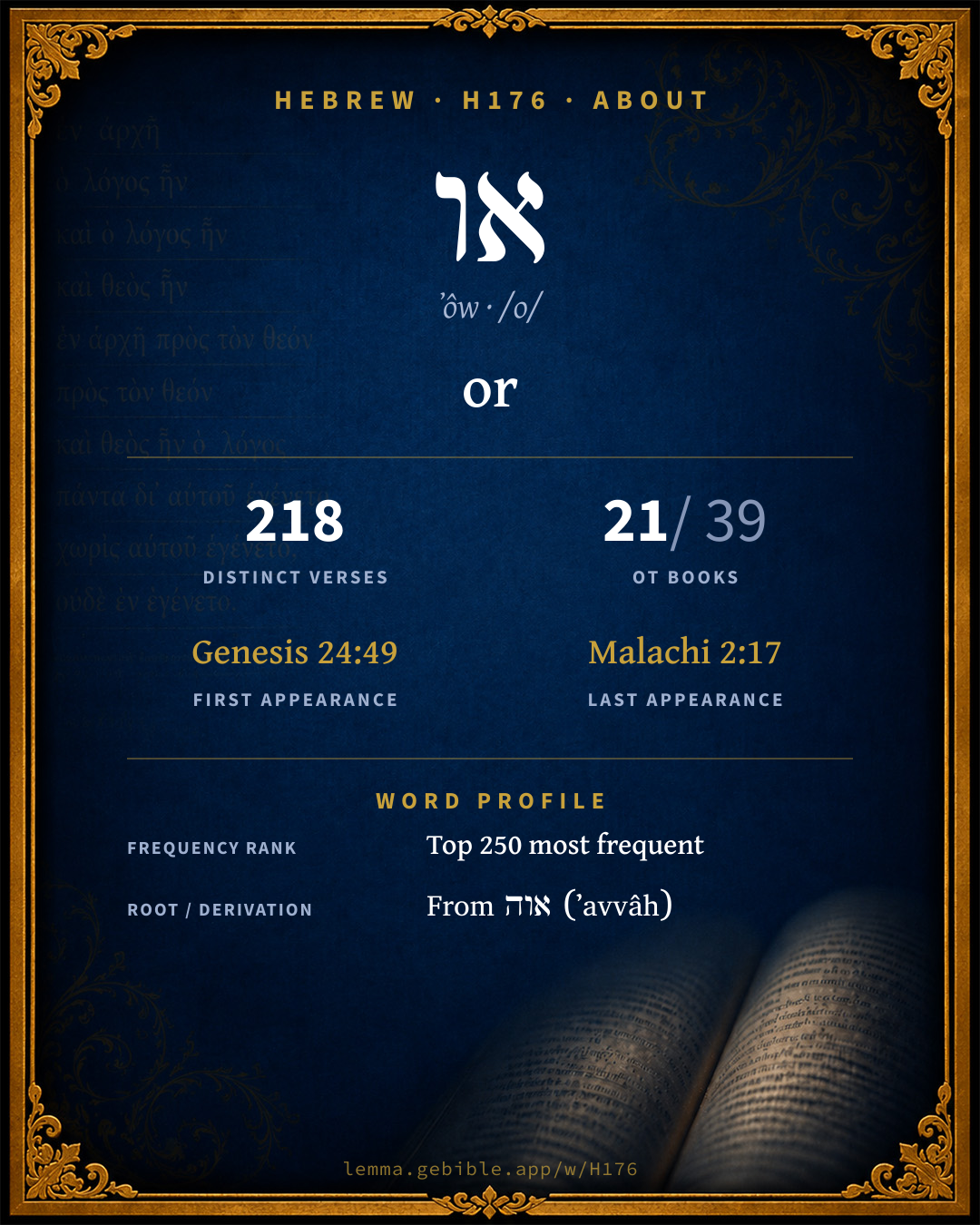
אוֹ
or
‘or’ is one of 2 main senses fuller range ↓
Full lexicon entry — Brown-Driver-Briggs (BDB)
From Brown-Driver-Briggs (BDB)
Where this word appears
Grammar key — what these labels mean
Part of speech
- Conjunction
- A joining word (e.g. “and,” “but”) linking words or clauses.
Every verse where H176 appears in the Book of Exodus — 25 distinct verses. Click any verse to open its interlinear word-by-word view. Verse text shown in the World English Bible for context — . Each verse’s Hebrew form is shown with its reference; the English is not keyword-highlighted, since the data carries no word-level English alignment. Use “Compare translations” on any verse to read it across multiple English versions. This concordance covers the Hebrew Bible; Septuagint (Greek Old Testament) occurrences are not indexed here.
Exodus
- Exodus 4:11 א֚וֹ א֣וֹ א֥וֹ א֣וֹ conj conj conj conj Yahweh said to him, "Who made man's mouth? Or who makes one mute, or deaf, or seeing, or blind? Isn't it I, Yahweh?
- Exodus 5:3 א֥וֹ conj They said, "The God of the Hebrews has met with us. Please let us go three days' journey into the wilderness, and sacrifice to Yahweh, our God, lest he fall on us with pestilence, or with the sword."
- Exodus 19:13 אוֹ conj No hand shall touch him, but he shall surely be stoned or shot through; whether it is animal or man, he shall not live.' When the trumpet sounds long, they shall come up to the mountain."
- Exodus 21:4 א֣וֹ conj If his master gives him a wife and she bears him sons or daughters, the wife and her children shall be her master's, and he shall go out by himself.
- Exodus 21:6 א֖וֹ conj then his master shall bring him to God, and shall bring him to the door or to the door-post, and his master shall bore his ear through with an awl, and he shall serve him for ever.
- Exodus 21:18 א֣וֹ conj "If men quarrel and one strikes the other with a stone, or with his fist, and he doesn't die, but is confined to bed;
- Exodus 21:20 א֤וֹ conj "If a man strikes his servant or his maid with a rod, and he dies under his hand, he shall surely be punished.
- Exodus 21:21 א֥וֹ conj Notwithstanding, if he gets up after a day or two, he shall not be punished, for he is his property.
- Exodus 21:26 אֽוֹ conj "If a man strikes his servant's eye, or his maid's eye, and destroys it, he shall let him go free for his eye's sake.
- Exodus 21:27 אֽוֹ conj If he strikes out his man-servant's tooth, or his maid-servant's tooth, he shall let him go free for his tooth's sake.
- Exodus 21:28 א֥וֹ conj "If a bull gores a man or a woman to death, the bull shall surely be stoned, and its flesh shall not be eaten; but the owner of the bull shall not be held responsible.
- Exodus 21:29 א֣וֹ conj But if the bull had a habit of goring in the past, and it has been testified to its owner, and he has not kept it in, but it has killed a man or a woman, the bull shall be stoned, and its owner shall also be put to death.
- Exodus 21:31 אוֹ אוֹ conj conj Whether it has gored a son or has gored a daughter, according to this judgment it shall be done to him.
- Exodus 21:32 א֣וֹ conj If the bull gores a man-servant or a maid-servant, thirty shekels of silver shall be given to their master, and the ox shall be stoned.
- Exodus 21:33 א֠וֹ א֥וֹ conj conj "If a man opens a pit, or if a man digs a pit and doesn't cover it, and a bull or a donkey falls into it,
- Exodus 21:36 א֣וֹ conj Or if it is known that the bull was in the habit of goring in the past, and its owner has not kept it in, he shall surely pay bull for bull, and the dead animal shall be his own.
- Exodus 22:1 אוֹ א֣וֹ conj conj "If a man steals an ox or a sheep, and kills it, or sells it; he shall pay five oxen for an ox, and four sheep for a sheep.
- Exodus 22:5 אוֹ conj "If a man causes a field or vineyard to be eaten, and lets his animal loose, and it grazes in another man's field, he shall make restitution from the best of his own field, and from the best of his own vineyard.
- Exodus 22:6 א֥וֹ א֣וֹ conj conj "If fire breaks out, and catches in thorns so that the shocks of grain, or the standing grain, or the field are consumed; he who kindled the fire shall surely make restitution.
- Exodus 22:7 אֽוֹ conj "If a man delivers to his neighbor money or stuff to keep, and it is stolen out of the man's house; if the thief is found, he shall pay double.
- Exodus 22:10 אוֹ אוֹ אוֹ אוֹ conj conj conj conj "If a man delivers to his neighbor a donkey, an ox, a sheep, or any animal to keep, and it dies or is injured, or driven away, no man seeing it;
- Exodus 22:14 אוֹ conj "If a man borrows anything of his neighbor's, and it is injured, or dies, the owner of it not being with it, he shall surely make restitution.
- Exodus 23:4 א֥וֹ conj "If you meet your enemy's ox or his donkey going astray, you shall surely bring it back to him again.
- Exodus 28:43 א֣וֹ conj They shall be on Aaron, and on his sons, when they go in to the tent of meeting, or when they come near to the altar to minister in the holy place; that they don't bear iniquity, and die: it shall be a statute forever to him and to his descendants after him.
- Exodus 30:20 א֣וֹ conj When they go into the tent of meeting, they shall wash with water, that they not die; or when they come near to the altar to minister, to burn an offering made by fire to Yahweh.
About this entry
At a glance — auto-summarized from this page’s data, not written by a person. Every figure links to its source below. This summary describes the numbers; it doesn’t interpret them.
“or” is the headline sense of the Hebrew word או (ʼôw). First canonically at Genesis 24:49, it enters the text early. It appears 218 verses across 21 books of the Hebrew Bible, among its common vocabulary. More than a third of its appearances fall in Leviticus. Its meaning spans more than one sense — see its full sense range. See the sense tree, 218-verse concordance, and the renderings breakdown below.
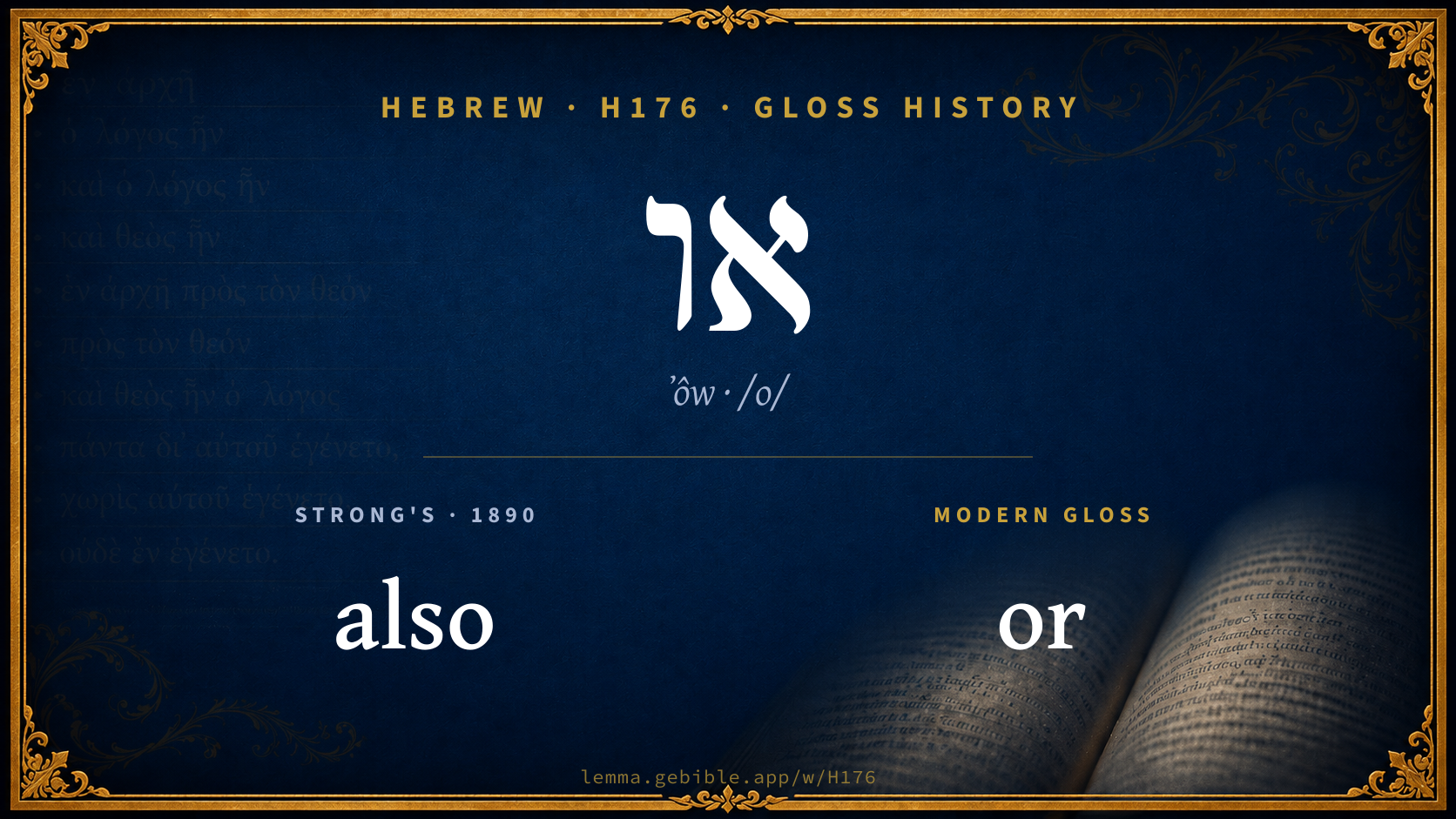
Gloss history
Strong's 1890 vs modern scholarship
About this word
Strong's H176 catalogs a Hebrew word from the Hebrew Old Testament.
These counts are not copied from any lexicon or concordance. They are computed here, from the morphology-tagged Hebrew Old Testament. What Lemma adds →
- 218
- distinct verses
- The word appears in 218 distinct verses.
- 21 / 39
- OT books
- The word appears in 21 of 39 Old Testament books.
- #154
- by frequency
- Top 250 most frequent Hebrew words (rank 154 of 8,640 Hebrew words by occurrence).
View all 218 occurrences in the concordance →
By section of the Old Testament
By traditional corpus
Conventional, traditional groupings — biblical authorship is debated, so this is a traditional corpus grouping, not an authorship claim. Each share is this word’s portion of its verses in that division of the Hebrew canon. Each figure is a share of the word’s 218 distinct verses.
- Torah (Pentateuch) 157 verses · 72%
- Prophets (Nevi'im) 39 verses · 18%
- Writings (Ketuvim) 22 verses · 10%
How translations render this word
Counts come from each version’s own published word-to-Strong’s tagging or interlinear alignment — an approximate guide to how each version renders this word, not a word-level alignment the data otherwise carries. Because each total is that version’s own tagged count, the per-version totals vary from one another and need not match the appearance or distinct-verse counts above. These counts may also differ from a printed concordance because Lemma counts each distinctly tagged rendering and does not collapse phrase taggings into a single head-word total. This is a fixed set of word-tagged versions (KJV, ASV, BSB, ULT) and does not change with the reading translation you choose elsewhere. Each version’s license is shown beside its name below (and on Sources).
BDB lists this Strong’s number as 2 distinct words (homographs). Each count above pools all of them and is not split by sense — see the Senses section below. A low-frequency rendering may belong to a different one of those words, not the primary meaning.
- King James Version†: Or 9×, And 2×, Either 2×
- American Standard Version†: Or 13×
- Berean Standard Bible†: Or 240×, If 5×, Whether 5×
- unfoldingWord Literal Text†: Or 306×, Whether 4×, If 3×
King James Version Public Domain
Renders H176 across 20† tagged occurrences — most commonly:
Plus 7 renderings that appear only once — usually multi-word phrases or single function words the recovered tagging swept in, not distinct renderings. Not rendered by a distinct English word in 1 further occurrence.
American Standard Version Public Domain
Renders H176 across 21† tagged occurrences — most commonly:
Plus 8 renderings that appear only once — usually multi-word phrases or single function words the recovered tagging swept in, not distinct renderings.
Berean Standard Bible Public Domain
Renders H176 across 265† tagged occurrences — most commonly:
Plus 6 renderings that appear only once — usually multi-word phrases or single function words the recovered tagging swept in, not distinct renderings. Not rendered by a distinct English word in 56 further occurrences.
unfoldingWord Literal Text CC BY-SA 4.0
Renders H176 across 321† tagged occurrences — most commonly:
Plus 5 renderings that appear only once — usually multi-word phrases or single function words the recovered tagging swept in, not distinct renderings.
Senses in the full BDB
What do BDB’s symbols mean?
BDB uses these scholarly abbreviations:
| Symbol | Meaning |
|---|---|
| 𝔊 | the Septuagint (the ancient Greek translation, LXX) |
| 𝔙 | the Vulgate (the Latin translation) |
| 𝔖 | the Syriac version (the Peshitta) |
| 𝔗 | the Targum (the Aramaic translation) |
| ψ | the Psalms |
| √ | root (the underlying root or stem) |
| ‖ | parallel passage (a synonymous or contrasted parallel) |
| † | the dagger: every passage where the word occurs is cited |
The 4 senses and sub-senses the full Brown-Driver-Briggs lexicon distinguishes for this word, in lexicon order (not ranked by frequency), with BDB’s own verbatim wording and sub-sense lettering. Shown in Hebrew script with BDB’s own scholarly abbreviations. The condensed entry is in the Lexicon Entry tab. See also the Forms in the corpus table below.
או I (أَوْ, ܐܰܘ, አው ), conj. or (whether aut or vel).
- 1. Gn 24:49; 31:43 Ex 4:11 Ct 2:9 Lv 13:24 Nu 5:30 + often (especially in laws); sometimes implying a preference, nearly = or rather Gn 24:55 יָמִים אוֹ עָשׂוֹר a few days or ten Ju 18:19 1 S 29:3. Prefixed to the first as well as to the second alternative (rare) either (whether) … or Lv 5:1; 13:48, 51; = or, if not Ez 21:15 (si vera l.) Ke Mal 2:17 Jb 16:3; 22:11. e.g. Genesis 24:49
- 2. introducing a sentence, especially a particular case under a general principle, or = or if Ex 21:31 אוֹ־בֵן יִגַּח וג׳ or if he gore a son, etc. v 36 Lv 4:23, 28 (v. Di) 5:21, 22; 25:49b; Nu 5:14 2 S 18:13 or if I had dealt falsely against his life, then, etc., Ez 14:17, 19 or if I send, etc. e.g. Exodus 21:31
- 3. if perchance, 1 S 20:10 if perchance thy father answer thee with something hard, Lv 26:41. e.g. 1 Samuel 20:10
- 4. once, with the juss. (as in Arabic with the subjunct. v. Dr§ 175 = except: Is 27:5 I would burn them together, אוֹ יַחֲזֵק בְּמָעֻזִּי or else let him take hold (= except he take hold) of my strong-hold, etc.—אַו Pr 31:4 v. sub [אָוָה] on p. 16. e.g. Isaiah 27:5
או II cstr. אוֹ, Kt Pr 31
Senses from the full Brown-Driver-Briggs lexicon (Brown, Driver, Briggs; Oxford 1906 — public domain), digitized via Sefaria, supplemented by the OpenScriptures HebrewLexicon (CC BY 4.0). Full attribution on Sources.
Word origin
I. (أَوْ, ܐܰܘ, አው ), conj. or (whether aut or vel).
I. n.m. cstr. אוֹ, Kt Pr 31:4 desire, so Thes MV; but אֵי q.v.
— Brown-Driver-Briggs (Oxford 1906, public domain), digitized via Sefaria, supplemented by the OpenScriptures HebrewLexicon (CC BY 4.0). See Sources.
Derived from אוה (ʼavvâh) (H185) — desire.
Jastrow Dictionary
A second Hebrew/Aramaic lexicon for comparison, covering Aramaic and post-biblical (Talmudic, Targumic, Midrashic) usage that the biblical-Hebrew BDB does not. Matched by lemma rather than by Strong’s number, so a lemma may carry more than one Jastrow headword (shown separately below), and the entries cover usage well beyond the Bible.
או־
- 1. prefix, esp. for verbal nouns, e.g. 1) prefix, esp. for verbal nouns, e.g. אודיצותא fr. דיץ.
- 2. או, אוו = εὐ-αὐ, v. אב
אוֹ I
- , v. Ges. H. Dict. s. v.) or; או … או either … or. Shebu. 27ᵃ או … לחלק the word אוֹ in the Bible text is necessary as a disjunctif, (one or the other), contrad. from ו־ which is conjunctive (one and the other). Men. 91ᵃ; או לדרשא the word אוֹ intimates something not explicitly stated in the text; a. fr.—Pl. אוֹאִין Shebu. 33ᵇ.—אוֹיִין, אוֹיִים, const. אוֹיֵי the word אוֹ in the biblical passages. Y. ibid. IV, 35ᶜᵈ
אוֹ
- Targ. Ex. XXI, 20; a. e. Targ. Prov. VI, 28 Ms. (ed. אי).—Ber. 2ᵇ, v. דילמא; a. v. fr.
אוֹ II
- (ὁ) the. Y. R. Hash. I, 57ᵃ bot. (in a Greek sentence), v. אגרפוס.
אוּ
- (contr. of אֲהוּ, אֲהִי v. הוּ, הִי)he, that, this (only in Y. Dial). [Y. Ber. II, 5ᵇ top או מקשי, read הוה מ׳; ed. Amst. בעי.] Y. B. Bath. III, 14ᵇ I was jesting באו גברא with that man. Y. Snh. XI, beg. 30ᵃ באו ד(א)מר with him who says—Fem. אִי.—Y. Erub. III, 21ᵇ bot. אי אידא אי אידא it is all the same; v. אִידָא II.
A Dictionary of the Targumim, the Talmud Babli and Yerushalmi, and the Midrashic Literature (Marcus Jastrow; London, Luzac, 1903) — Public Domain. Digitized via Sefaria. Digitized via Sefaria. Full attribution on Sources.
Forms in the corpus
The 16 distinct written forms H176 takes in the Hebrew Bible, most frequent first — each parse links to that state’s occurrences in the concordance. Hebrew forms include their vowel points and cantillation, so a single lemma takes many written forms.
| Form | Parsing | Example | Uses |
|---|---|---|---|
| א֣וֹ | Conjunction | Amos 3:12 | 77 |
| א֥וֹ | Conjunction | Deuteronomy 4:16 | 59 |
| אוֹ | Conjunction | Deuteronomy 17:2 | 45 |
| אֽוֹ | Conjunction | Deuteronomy 13:6 | 43 |
| א֖וֹ | Conjunction | Deuteronomy 4:32 | 28 |
| א֤וֹ | Conjunction | Deuteronomy 14:21 | 22 |
| א֚וֹ | Conjunction | Deuteronomy 15:12 | 18 |
| א֛וֹ | Conjunction | Deuteronomy 13:3 | 11 |
| א֧וֹ | Conjunction | Deuteronomy 13:6 | 5 |
| א֠וֹ | Conjunction | Exodus 21:33 | 3 |
| א֨וֹ | Conjunction | Judges 21:22 | 3 |
| אוֹ֩ | Conjunction | Deuteronomy 17:5 | 3 |
| א֕וֹ | Conjunction | Leviticus 5:2 | 1 |
| א֡וֹ | Conjunction | Numbers 35:18 | 1 |
| או | Conjunction | Proverbs 31:4 | 1 |
| אוֹ֮ | Conjunction | Leviticus 5:11 | 1 |
Same root — word family
Other BDB entries built from the same root as H176, grouped by Strong’s listed origin. These share a root / origin per the lexicon — not necessarily a shared meaning. Each links to that word’s own entry.
Derives from
Derived from this word
Proper names from this root
People and places named from this root — a name, not an additional meaning of the word.
Compare all same-root words → 1 of the same-root words is a proper name (a person or place). They share a root, not necessarily a meaning.
Septuagint verse parallels
This word appears in 217 verses that also exist in the Greek Old Testament (Septuagint), out of the 218 Hebrew verses it occurs in. You can read those verses in Greek by switching the Old Testament edition to the Septuagint.
Read these verses in the Septuagint
- Genesis 24:49
- Exodus 4:11
- Leviticus 1:10
- Numbers 5:6
- Deuteronomy 4:16
- Joshua 7:3
- Judges 11:34
- 1 Samuel 2:14
- 2 Samuel 2:21
- 1 Kings 8:46
- 2 Kings 2:16
- 2 Chronicles 6:36
This is a verse-level parallel only — the same verses exist in both the Hebrew and Greek Old Testaments. No word-level Hebrew↔Greek correspondence is claimed: the data carries no such alignment, so no Greek word is shown as this Hebrew word’s translation. Coverage is not total — the Septuagint omits the deuterocanon and renumbers the Psalms, so some Hebrew verses have no direct Greek parallel.