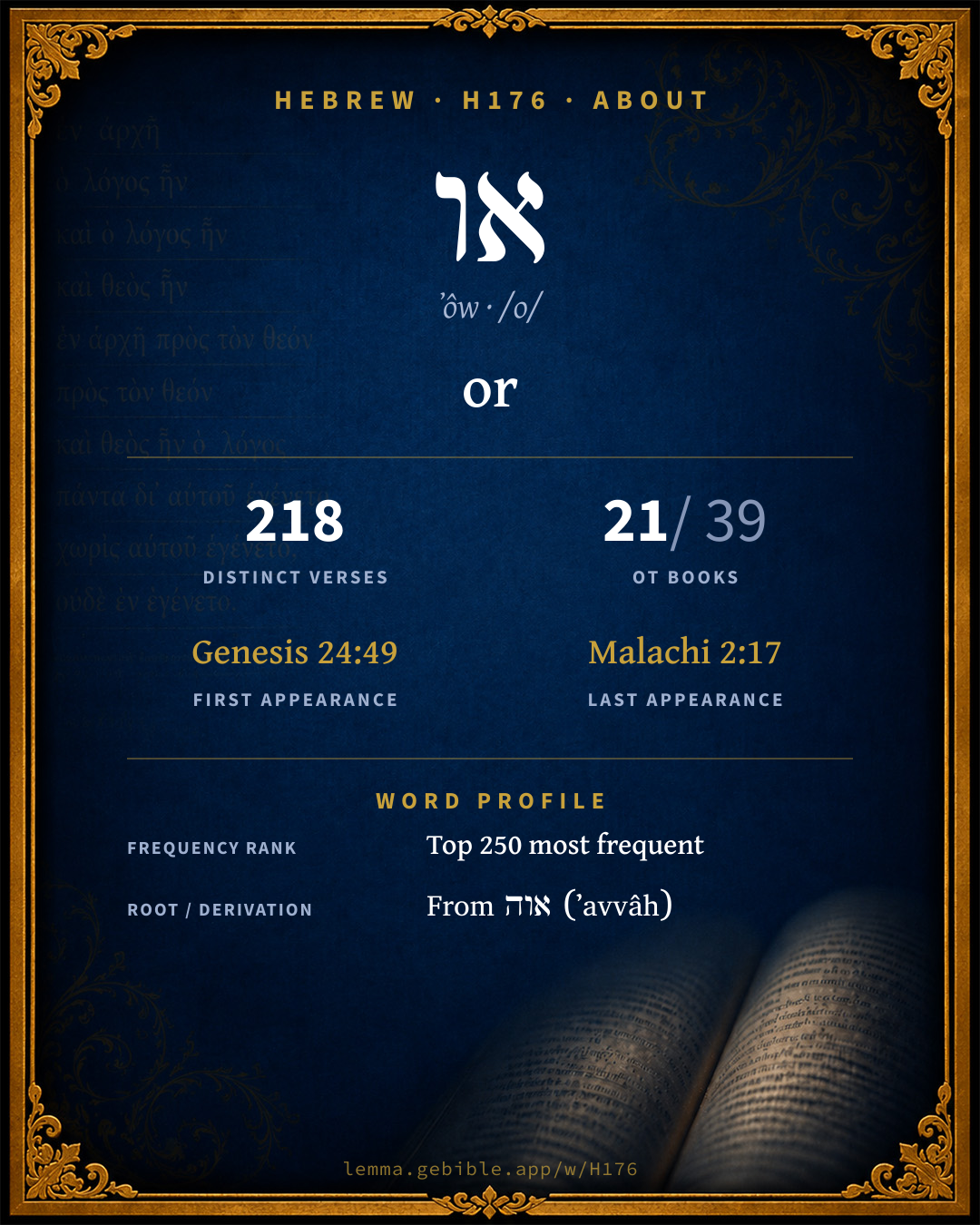
אוֹ
or
‘or’ is one of 2 main senses fuller range ↓
Full lexicon entry — Brown-Driver-Briggs (BDB)
From Brown-Driver-Briggs (BDB)
Where this word appears
Grammar key — what these labels mean
Part of speech
- Conjunction
- A joining word (e.g. “and,” “but”) linking words or clauses.
Every verse where H176 appears in the Book of Deuteronomy — 24 distinct verses. Click any verse to open its interlinear word-by-word view. Verse text shown in the World English Bible for context — . Each verse’s Hebrew form is shown with its reference; the English is not keyword-highlighted, since the data carries no word-level English alignment. Use “Compare translations” on any verse to read it across multiple English versions. This concordance covers the Hebrew Bible; Septuagint (Greek Old Testament) occurrences are not indexed here.
Deuteronomy
- Deuteronomy 4:16 א֥וֹ conj Lest you corrupt yourselves, and make yourself an engraved image in the form of any figure, the likeness of male or female,
- Deuteronomy 4:32 א֖וֹ conj For ask now of the days that are past, which were before you, since the day that God created man on the earth, and from the one end of the sky to the other, whether there has been [any such thing] as this great thing is, or has been heard like it?
- Deuteronomy 4:34 א֣וֹ conj Or has God tried to go and take him a nation from the midst of [another] nation, by trials, by signs, and by wonders, and by war, and by a mighty hand, and by an outstretched arm, and by great terrors, according to all that Yahweh your God did for you in Egypt before your eyes?
- Deuteronomy 13:1 א֖וֹ א֥וֹ conj conj If there arise in the midst of you a prophet, or a dreamer of dreams, and he give you a sign or a wonder,
- Deuteronomy 13:3 א֛וֹ conj you shall not listen to the words of that prophet, or to that dreamer of dreams: for Yahweh your God proves you, to know whether you love Yahweh your God with all your heart and with all your soul.
- Deuteronomy 13:5 א֣וֹ conj That prophet, or that dreamer of dreams, shall be put to death, because he has spoken rebellion against Yahweh your God, who brought you out of the land of Egypt, and redeemed you out of the house of bondage, to draw you aside out of the way which Yahweh your God commanded you to walk in. So shall you put away the evil from the midst of you.
- Deuteronomy 13:6 אֽוֹ אֽוֹ א֣וֹ א֧וֹ conj conj conj conj If your brother, the son of your mother, or your son, or your daughter, or the wife of your bosom, or your friend, who is as your own soul, entice you secretly, saying, Let us go and serve other gods, which you have not known, you, nor your fathers;
- Deuteronomy 13:7 א֖וֹ conj of the gods of the peoples who are round about you, near to you, or far off from you, from the one end of the earth even to the other end of the earth;
- Deuteronomy 14:21 א֤וֹ conj You shall not eat of anything that dies of itself: you may give it to the foreigner living among you who is within your gates, that he may eat it; or you may sell it to a foreigner: for you are a holy people to Yahweh your God. You shall not boil a kid in its mother's milk.
- Deuteronomy 15:12 א֚וֹ conj If your brother, a Hebrew man, or a Hebrew woman, be sold to you, and serve you six years; then in the seventh year you shall let him go free from you.
- Deuteronomy 15:21 א֣וֹ conj If it have any blemish, [as if it be] lame or blind, any ill blemish whatever, you shall not sacrifice it to Yahweh your God.
- Deuteronomy 17:2 אוֹ conj If there be found in the midst of you, within any of your gates which Yahweh your God gives you, man or woman, who does that which is evil in the sight of Yahweh your God, in transgressing his covenant,
- Deuteronomy 17:3 א֣וֹ א֛וֹ conj conj and has gone and served other gods, and worshiped them, or the sun, or the moon, or any of the host of the sky, which I have not commanded;
- Deuteronomy 17:5 אוֹ֩ א֖וֹ conj conj then shall you bring forth that man or that woman, who has done this evil thing, to your gates, even the man or the woman; and you shall stone them to death with stones.
- Deuteronomy 17:6 א֛וֹ conj At the mouth of two witnesses, or three witnesses, shall he who is to die be put to death; at the mouth of one witness he shall not be put to death.
- Deuteronomy 17:12 א֖וֹ conj The man who does presumptuously, in not listening to the priest who stands to minister there before Yahweh your God, or to the judge, even that man shall die: and you shall put away the evil from Israel.
- Deuteronomy 19:15 א֛וֹ conj One witness shall not rise up against a man for any iniquity, or for any sin, in any sin that he sins: at the mouth of two witnesses, or at the mouth of three witnesses, shall a matter be established.
- Deuteronomy 22:1 א֤וֹ conj You shall not see your brother's ox or his sheep go astray, and hide yourself from them: you shall surely bring them again to your brother.
- Deuteronomy 22:4 א֤וֹ conj You shall not see your brother's donkey or his ox fallen down by the way, and hide yourself from them: you shall surely help him to lift them up again.
- Deuteronomy 22:6 א֣וֹ א֣וֹ א֖וֹ conj conj conj If a bird's nest chance to be before you in the way, in any tree or on the ground, with young ones or eggs, and the hen sitting on the young, or on the eggs, you shall not take the hen with the young:
- Deuteronomy 24:3 א֣וֹ conj If the latter husband hate her, and write her a bill of divorce, and give it in her hand, and send her out of his house; or if the latter husband die, who took her to be his wife;
- Deuteronomy 24:14 א֧וֹ conj You shall not oppress a hired servant who is poor and needy, whether he be of your brothers, or of your foreigners who are in your land within your gates:
- Deuteronomy 27:22 א֣וֹ conj Cursed be he who lies with his sister, the daughter of his father, or the daughter of his mother. All the people shall say, Amen.
- Deuteronomy 29:18 אוֹ א֧וֹ אוֹ conj conj conj lest there should be among you man, or woman, or family, or tribe, whose heart turns away this day from Yahweh our God, to go to serve the gods of those nations; lest there should be among you a root that bears gall and wormwood;
About this entry
At a glance — auto-summarized from this page’s data, not written by a person. Every figure links to its source below. This summary describes the numbers; it doesn’t interpret them.
“or” is the headline sense of the Hebrew word או (ʼôw). First canonically at Genesis 24:49, it enters the text early. It appears 218 verses across 21 books of the Hebrew Bible, among its common vocabulary. More than a third of its appearances fall in Leviticus. Its meaning spans more than one sense — see its full sense range. See the sense tree, 218-verse concordance, and the renderings breakdown below.
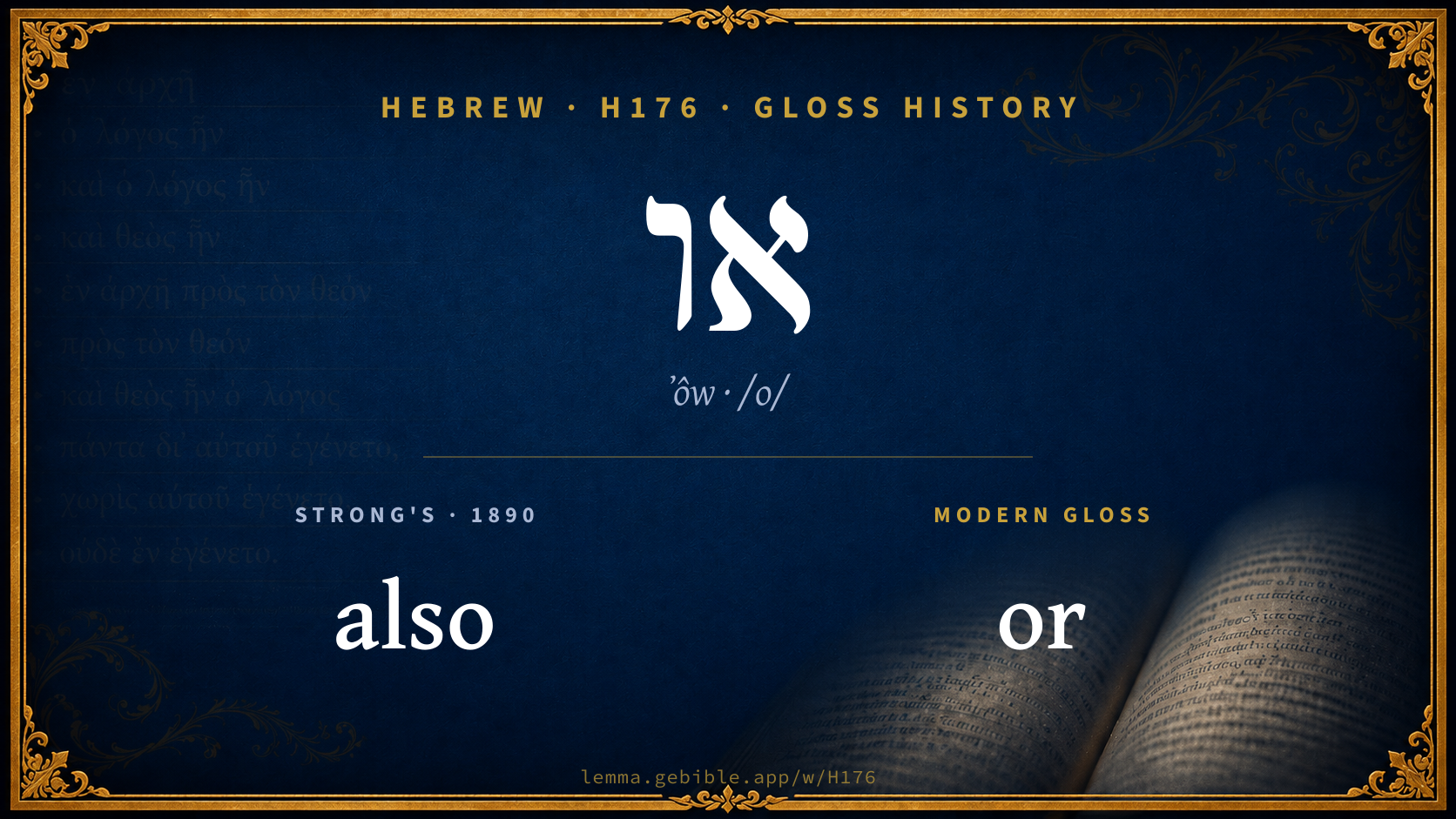
Gloss history
Strong's 1890 vs modern scholarship
About this word
Strong's H176 catalogs a Hebrew word from the Hebrew Old Testament.
These counts are not copied from any lexicon or concordance. They are computed here, from the morphology-tagged Hebrew Old Testament. What Lemma adds →
- 218
- distinct verses
- The word appears in 218 distinct verses.
- 21 / 39
- OT books
- The word appears in 21 of 39 Old Testament books.
- #154
- by frequency
- Top 250 most frequent Hebrew words (rank 154 of 8,640 Hebrew words by occurrence).
View all 218 occurrences in the concordance →
By section of the Old Testament
By traditional corpus
Conventional, traditional groupings — biblical authorship is debated, so this is a traditional corpus grouping, not an authorship claim. Each share is this word’s portion of its verses in that division of the Hebrew canon. Each figure is a share of the word’s 218 distinct verses.
- Torah (Pentateuch) 157 verses · 72%
- Prophets (Nevi'im) 39 verses · 18%
- Writings (Ketuvim) 22 verses · 10%
How translations render this word
Counts come from each version’s own published word-to-Strong’s tagging or interlinear alignment — an approximate guide to how each version renders this word, not a word-level alignment the data otherwise carries. Because each total is that version’s own tagged count, the per-version totals vary from one another and need not match the appearance or distinct-verse counts above. These counts may also differ from a printed concordance because Lemma counts each distinctly tagged rendering and does not collapse phrase taggings into a single head-word total. This is a fixed set of word-tagged versions (KJV, ASV, BSB, ULT) and does not change with the reading translation you choose elsewhere. Each version’s license is shown beside its name below (and on Sources).
BDB lists this Strong’s number as 2 distinct words (homographs). Each count above pools all of them and is not split by sense — see the Senses section below. A low-frequency rendering may belong to a different one of those words, not the primary meaning.
- King James Version†: Or 9×, And 2×, Either 2×
- American Standard Version†: Or 13×
- Berean Standard Bible†: Or 240×, If 5×, Whether 5×
- unfoldingWord Literal Text†: Or 306×, Whether 4×, If 3×
King James Version Public Domain
Renders H176 across 20† tagged occurrences — most commonly:
Plus 7 renderings that appear only once — usually multi-word phrases or single function words the recovered tagging swept in, not distinct renderings. Not rendered by a distinct English word in 1 further occurrence.
American Standard Version Public Domain
Renders H176 across 21† tagged occurrences — most commonly:
Plus 8 renderings that appear only once — usually multi-word phrases or single function words the recovered tagging swept in, not distinct renderings.
Berean Standard Bible Public Domain
Renders H176 across 265† tagged occurrences — most commonly:
Plus 6 renderings that appear only once — usually multi-word phrases or single function words the recovered tagging swept in, not distinct renderings. Not rendered by a distinct English word in 56 further occurrences.
unfoldingWord Literal Text CC BY-SA 4.0
Renders H176 across 321† tagged occurrences — most commonly:
Plus 5 renderings that appear only once — usually multi-word phrases or single function words the recovered tagging swept in, not distinct renderings.
Senses in the full BDB
What do BDB’s symbols mean?
BDB uses these scholarly abbreviations:
| Symbol | Meaning |
|---|---|
| 𝔊 | the Septuagint (the ancient Greek translation, LXX) |
| 𝔙 | the Vulgate (the Latin translation) |
| 𝔖 | the Syriac version (the Peshitta) |
| 𝔗 | the Targum (the Aramaic translation) |
| ψ | the Psalms |
| √ | root (the underlying root or stem) |
| ‖ | parallel passage (a synonymous or contrasted parallel) |
| † | the dagger: every passage where the word occurs is cited |
The 4 senses and sub-senses the full Brown-Driver-Briggs lexicon distinguishes for this word, in lexicon order (not ranked by frequency), with BDB’s own verbatim wording and sub-sense lettering. Shown in Hebrew script with BDB’s own scholarly abbreviations. The condensed entry is in the Lexicon Entry tab. See also the Forms in the corpus table below.
או I (أَوْ, ܐܰܘ, አው ), conj. or (whether aut or vel).
- 1. Gn 24:49; 31:43 Ex 4:11 Ct 2:9 Lv 13:24 Nu 5:30 + often (especially in laws); sometimes implying a preference, nearly = or rather Gn 24:55 יָמִים אוֹ עָשׂוֹר a few days or ten Ju 18:19 1 S 29:3. Prefixed to the first as well as to the second alternative (rare) either (whether) … or Lv 5:1; 13:48, 51; = or, if not Ez 21:15 (si vera l.) Ke Mal 2:17 Jb 16:3; 22:11. e.g. Genesis 24:49
- 2. introducing a sentence, especially a particular case under a general principle, or = or if Ex 21:31 אוֹ־בֵן יִגַּח וג׳ or if he gore a son, etc. v 36 Lv 4:23, 28 (v. Di) 5:21, 22; 25:49b; Nu 5:14 2 S 18:13 or if I had dealt falsely against his life, then, etc., Ez 14:17, 19 or if I send, etc. e.g. Exodus 21:31
- 3. if perchance, 1 S 20:10 if perchance thy father answer thee with something hard, Lv 26:41. e.g. 1 Samuel 20:10
- 4. once, with the juss. (as in Arabic with the subjunct. v. Dr§ 175 = except: Is 27:5 I would burn them together, אוֹ יַחֲזֵק בְּמָעֻזִּי or else let him take hold (= except he take hold) of my strong-hold, etc.—אַו Pr 31:4 v. sub [אָוָה] on p. 16. e.g. Isaiah 27:5
או II cstr. אוֹ, Kt Pr 31
Senses from the full Brown-Driver-Briggs lexicon (Brown, Driver, Briggs; Oxford 1906 — public domain), digitized via Sefaria, supplemented by the OpenScriptures HebrewLexicon (CC BY 4.0). Full attribution on Sources.
Word origin
I. (أَوْ, ܐܰܘ, አው ), conj. or (whether aut or vel).
I. n.m. cstr. אוֹ, Kt Pr 31:4 desire, so Thes MV; but אֵי q.v.
— Brown-Driver-Briggs (Oxford 1906, public domain), digitized via Sefaria, supplemented by the OpenScriptures HebrewLexicon (CC BY 4.0). See Sources.
Derived from אוה (ʼavvâh) (H185) — desire.
Jastrow Dictionary
A second Hebrew/Aramaic lexicon for comparison, covering Aramaic and post-biblical (Talmudic, Targumic, Midrashic) usage that the biblical-Hebrew BDB does not. Matched by lemma rather than by Strong’s number, so a lemma may carry more than one Jastrow headword (shown separately below), and the entries cover usage well beyond the Bible.
או־
- 1. prefix, esp. for verbal nouns, e.g. 1) prefix, esp. for verbal nouns, e.g. אודיצותא fr. דיץ.
- 2. או, אוו = εὐ-αὐ, v. אב
אוֹ I
- , v. Ges. H. Dict. s. v.) or; או … או either … or. Shebu. 27ᵃ או … לחלק the word אוֹ in the Bible text is necessary as a disjunctif, (one or the other), contrad. from ו־ which is conjunctive (one and the other). Men. 91ᵃ; או לדרשא the word אוֹ intimates something not explicitly stated in the text; a. fr.—Pl. אוֹאִין Shebu. 33ᵇ.—אוֹיִין, אוֹיִים, const. אוֹיֵי the word אוֹ in the biblical passages. Y. ibid. IV, 35ᶜᵈ
אוֹ
- Targ. Ex. XXI, 20; a. e. Targ. Prov. VI, 28 Ms. (ed. אי).—Ber. 2ᵇ, v. דילמא; a. v. fr.
אוֹ II
- (ὁ) the. Y. R. Hash. I, 57ᵃ bot. (in a Greek sentence), v. אגרפוס.
אוּ
- (contr. of אֲהוּ, אֲהִי v. הוּ, הִי)he, that, this (only in Y. Dial). [Y. Ber. II, 5ᵇ top או מקשי, read הוה מ׳; ed. Amst. בעי.] Y. B. Bath. III, 14ᵇ I was jesting באו גברא with that man. Y. Snh. XI, beg. 30ᵃ באו ד(א)מר with him who says—Fem. אִי.—Y. Erub. III, 21ᵇ bot. אי אידא אי אידא it is all the same; v. אִידָא II.
A Dictionary of the Targumim, the Talmud Babli and Yerushalmi, and the Midrashic Literature (Marcus Jastrow; London, Luzac, 1903) — Public Domain. Digitized via Sefaria. Digitized via Sefaria. Full attribution on Sources.
Forms in the corpus
The 16 distinct written forms H176 takes in the Hebrew Bible, most frequent first — each parse links to that state’s occurrences in the concordance. Hebrew forms include their vowel points and cantillation, so a single lemma takes many written forms.
| Form | Parsing | Example | Uses |
|---|---|---|---|
| א֣וֹ | Conjunction | Amos 3:12 | 77 |
| א֥וֹ | Conjunction | Deuteronomy 4:16 | 59 |
| אוֹ | Conjunction | Deuteronomy 17:2 | 45 |
| אֽוֹ | Conjunction | Deuteronomy 13:6 | 43 |
| א֖וֹ | Conjunction | Deuteronomy 4:32 | 28 |
| א֤וֹ | Conjunction | Deuteronomy 14:21 | 22 |
| א֚וֹ | Conjunction | Deuteronomy 15:12 | 18 |
| א֛וֹ | Conjunction | Deuteronomy 13:3 | 11 |
| א֧וֹ | Conjunction | Deuteronomy 13:6 | 5 |
| א֠וֹ | Conjunction | Exodus 21:33 | 3 |
| א֨וֹ | Conjunction | Judges 21:22 | 3 |
| אוֹ֩ | Conjunction | Deuteronomy 17:5 | 3 |
| א֕וֹ | Conjunction | Leviticus 5:2 | 1 |
| א֡וֹ | Conjunction | Numbers 35:18 | 1 |
| או | Conjunction | Proverbs 31:4 | 1 |
| אוֹ֮ | Conjunction | Leviticus 5:11 | 1 |
Same root — word family
Other BDB entries built from the same root as H176, grouped by Strong’s listed origin. These share a root / origin per the lexicon — not necessarily a shared meaning. Each links to that word’s own entry.
Derives from
Derived from this word
Proper names from this root
People and places named from this root — a name, not an additional meaning of the word.
Compare all same-root words → 1 of the same-root words is a proper name (a person or place). They share a root, not necessarily a meaning.
Septuagint verse parallels
This word appears in 217 verses that also exist in the Greek Old Testament (Septuagint), out of the 218 Hebrew verses it occurs in. You can read those verses in Greek by switching the Old Testament edition to the Septuagint.
Read these verses in the Septuagint
- Genesis 24:49
- Exodus 4:11
- Leviticus 1:10
- Numbers 5:6
- Deuteronomy 4:16
- Joshua 7:3
- Judges 11:34
- 1 Samuel 2:14
- 2 Samuel 2:21
- 1 Kings 8:46
- 2 Kings 2:16
- 2 Chronicles 6:36
This is a verse-level parallel only — the same verses exist in both the Hebrew and Greek Old Testaments. No word-level Hebrew↔Greek correspondence is claimed: the data carries no such alignment, so no Greek word is shown as this Hebrew word’s translation. Coverage is not total — the Septuagint omits the deuterocanon and renumbers the Psalms, so some Hebrew verses have no direct Greek parallel.